Daily Digest
UPSC · Civil Services Examination
Current Affairs · Thursday, 17 September 2026
Current affairs curated and edited by Anantam IAS faculty — pulled from The Hindu, PIB, IDSA, Foreign Affairs and the ministries. Read, annotate, revise.
Old Rajinder Nagar · Delhi 110005 · anantamias.com
EPFO Wage Ceiling: Expanding Mandatory Social Security
Why in News?
On 16 September 2026, the Union Cabinet approved a higher EPFO wage ceiling for mandatory coverage, with the Labour Ministry announcing effect from 17 September.
- The monthly wage ceiling rises from ₹15,000 to ₹25,000, bringing more employees within mandatory coverage subject to applicable provisions.
- The Cabinet expects over 5.1 million additional employees to enter mandatory coverage; this is a projection, not verified enrolment.
- The announcement covers access to provident fund, pension and insurance through applicable EPFO schemes.
- Both official releases say statutory and administrative steps will be undertaken for implementation.
- A fixed eligibility threshold can lose reach as wages rise, even when the underlying need for retirement protection remains.
- A wider legal boundary matters only when employers enrol eligible workers and contributions reach the social-security system.
UPSC Relevance
Prelims Relevance
- EPFO: organisation administering the principal provident-fund, pension and linked-insurance components discussed in the announcement.
- EPF: provident fund savings.
- EPS: Employees’ Pension Scheme.
- EDLI: Employees’ Deposit Linked Insurance Scheme.
- Wage ceiling: a coverage threshold; not a government-set maximum salary.
Mains Relevance
GS Paper 2
- Social justice: eligibility design, exclusion and delivery of social protection.
GS Paper 3
- Employment: formalisation, worker retention and employer compliance.
Essay
- Economic progress should strengthen protection against insecurity across a worker’s life.
Background and Context
How a wage ceiling changes coverage
A wage ceiling determines the boundary of mandatory entry; it does not describe every worker’s benefits or replace other conditions.
- The policy mechanism is an eligibility change: increasing the threshold brings a wider wage band into mandatory protection. It does not raise salaries or guarantee every worker a pension of equal value.
- The official explanation focuses on employees joining establishments whose wages exceeded the earlier ceiling. Their position must be assessed under the applicable framework, rather than inferred from salary alone or an informal job description.
- Rising nominal wages can move workers beyond an unchanged entry threshold without making retirement protection unnecessary. Revising that threshold helps the framework keep pace with wage growth and changing living costs over time.
- Employment coverage still matters: the announcement repeatedly qualifies access by statutory and scheme provisions. It does not establish that every self-employed person, informal worker or employee automatically enters all the schemes from today.
- The coverage estimate measures the government’s expected additional reach, not jobs created by the decision. In an answer, distinguish newly eligible workers from newly enrolled members and from previously informal jobs becoming formal.
EPF, EPS and EDLI protect against different risks
The three components belong to the same administrative system but serve different purposes and retain their own applicable rules.
- EPF provides provident fund savings linked to employment. Its central purpose in this announcement is building financial resources for workers; it should not be described as the same benefit as a recurring pension payment.
- EPS provides pension protection under its scheme provisions. Access to the EPFO system does not justify assuming identical pension entitlement for every person: eligibility and the applicable benefit framework remain necessary parts of assessment.
- EDLI provides insurance protection linked to EPF membership. Insurance addresses a different contingency from accumulated savings, so treating it as an additional savings account would misrepresent the role assigned to it in the release.
- The administrative umbrella is shared, but the benefit functions differ. Compare this distinction with ESIC’s public social-insurance debate: social security is a family of protections, rather than a single interchangeable entitlement.
- Coverage expansion concerns who comes within mandatory protection; delivery support concerns whether people can access it. Pension Sakhis’ rural outreach illustrates the latter problem, which a higher wage threshold alone cannot resolve.
From announced eligibility to effective protection
The test is whether the wider legal boundary becomes dependable protection through enrolment, contributions and access to benefits.
- The Labour Ministry announced effect from 17 September, while both releases also mention necessary statutory and administrative steps. Read these together; a press announcement should not be presented as a reproduced implementation notification.
- Employer compliance connects eligibility to protection: workers must be correctly identified and brought into the applicable arrangements. Clear implementation guidance can reduce inconsistent interpretations of wage coverage across employers and prevent avoidable disputes.
- Formalisation involves more than a registration count. A stronger assessment would examine continuing participation and functioning protection, because an eligible worker gains little from an account that fails to receive the required contributions.
- Worker retention is a benefit the government expects, not an outcome already established by this decision. Retirement security may support workforce stability, but evaluating that claim requires subsequent evidence rather than repeating the announcement.
- Universal social security remains a broader objective than this threshold revision. Workers outside covered employment need appropriate routes of their own; expanding an existing contributory framework cannot by itself eliminate every gap in protection.
Way Forward
Make the coverage change usable
- Publish clear implementation guidance explaining applicability, treatment of affected employees and the responsibilities of employers.
- Track actual enrolment and continuing contributions separately from projected beneficiaries to measure effective coverage.
- Provide accessible grievance correction when workers face exclusion or inconsistent application of the revised framework.
Conclusion
- The higher EPFO wage ceiling updates the boundary of mandatory protection as wages rise. Its significance lies in widening access within the applicable framework, not in announcing universal coverage.
- For a balanced answer, connect eligibility, compliance and benefit access. The reform succeeds when the broader statutory promise becomes dependable provident-fund, pension and insurance protection for eligible workers.
UPSC Practice Questions
Prelims MCQ 1
With reference to the EPFO wage-ceiling announcement, consider the following statements:
- EPF, EPS and EDLI serve identical benefit functions.
- The additional-coverage figure is an estimate rather than a verified enrolment total.
- The announcement automatically covers every self-employed worker.
How many of the above statements are correct?
(a) Only one (b) Only two (c) All three (d) None
Answer: (a) Only one
Explanation:
Only statement 2 is correct. EPF, EPS and EDLI have distinct functions. Coverage remains subject to applicable statutory and scheme provisions.
Prelims MCQ 2
Which description best explains the purpose of the EPFO wage-ceiling revision?
(a) Establishing a maximum salary employers may pay (b) Widening the wage band eligible for mandatory coverage under applicable provisions (c) Replacing provident fund savings with health insurance (d) Guaranteeing identical pension payments to all workers
Answer: (b) Widening the wage band eligible for mandatory coverage under applicable provisions
Explanation:
The revision changes the mandatory-coverage threshold. It neither caps salaries nor establishes identical benefits for all workers.
UPSC Mains Questions
- How can revising the EPFO wage ceiling advance social protection? Explain why eligibility expansion and effective coverage should be assessed separately.
- Distinguish provident fund, pension and linked insurance protection. Discuss the implementation challenges involved in extending contributory social security.
Sources: PIB, Cabinet and PIB, Ministry of Labour & Employment.
Frequently Asked Questions
What is the new EPFO wage ceiling?
The Cabinet approved raising the monthly mandatory-coverage ceiling from ₹15,000 to ₹25,000. Coverage remains subject to applicable statutory and scheme provisions; the revision is not a maximum salary limit.
When does the change take effect?
The Labour Ministry announced effect from 17 September 2026. Both official releases also mention necessary statutory and administrative implementation steps, so detailed applicability should follow the operative provisions.
Does the change cover every worker in India?
No. It widens the wage threshold within the relevant mandatory-coverage framework. The announcement does not automatically bring every informal worker or self-employed person into all EPFO schemes.
How are EPF, EPS and EDLI different?
EPF provides provident fund savings, EPS provides pension protection, and EDLI provides linked insurance protection. They address different risks and operate according to their respective applicable scheme provisions.
Has the estimated additional coverage already been achieved?
No verified enrolment outcome is established by these releases. The Cabinet’s figure describes expected additional coverage; actual enrolment and continuing contributions must be measured after implementation to assess effective protection.
Source: https://anantamias.com/current-affairs/epfo-wage-ceiling-mandatory-social-security/
Stem Cell Advisory: Approved Care and Clinical Trials
Why in News?
On 17 September 2026, the Union Health Ministry announced a stem cell advisory reiterating approved-care limits and restricting therapeutic use for autism to duly approved clinical trials.
- The advisory, dated 16 September, addresses States and Union Territories that have adopted the Clinical Establishments Act.
- Routine standard care is permitted only for conditions or indications included in the ministry-approved list.
- Stem cell interventions for autism spectrum disorder cannot be offered as routine, standard or commercial clinical services.
- The ministry seeks compliance by relevant public and private establishments and dissemination to State and district regulatory authorities.
- The policy problem is the gap between scientific promise and what a clinic can responsibly offer as established treatment.
- Patient protection requires scrutiny of advertising and professional conduct alongside oversight of research.
UPSC Relevance
Prelims Relevance
- Standard care: approved clinical use for a specified indication.
- Clinical trial: an investigation that does not itself establish therapeutic benefit.
- ICMR and DBT: joint issuers of the National Guidelines for Stem Cell Research, 2017.
- CEA scope: this advisory addresses adopting States and Union Territories.
- State Medical Councils: examine alleged professional misconduct through due process.
Mains Relevance
GS Paper 2
- Health regulation, patient rights and accountability of clinical establishments.
- Coordination between establishment regulators and professional disciplinary bodies.
GS Paper 3
- Translating biomedical research into evidence-supported clinical practice.
Essay
- Scientific hope requires institutions that can distinguish evidence from promises.
Background and Context
Why approval attaches to an indication
The central distinction concerns the proposed clinical use, rather than the appeal of the technology itself.
- Stem cells can self-renew and develop into specialised cells. That biological capacity provides a research rationale; it does not demonstrate that a particular intervention safely benefits patients with a particular condition.
- An indication is the disease or clinical situation for which an intervention is used. Permission for one indication cannot be presented as permission to treat every condition using the same broad technology.
- The current advisory makes the ministry-approved list the reference for routine standard care. Read the permitted indication before judging a clinic’s claim; the phrase “stem cell therapy” alone supplies insufficient information.
- The ICMR–DBT guidelines distinguish established blood-forming stem cell transplantation for approved indications from investigational uses. This explains the regulatory distinction without assuming the older document reproduces every current approval.
- The same evidence principle underlies traditional medicine regulation: scientific plausibility must be assessed separately from clinical evidence. A promising mechanism is a reason to investigate, not a substitute for demonstrating benefit.
Why an approved trial is not an approved treatment
Research permission creates a controlled route for answering a question; it does not settle the answer in advance.
- For autism spectrum disorder, the advisory restricts therapeutic use of any type of stem cell to duly approved clinical trials. It provides no basis for advertising these interventions as established autism treatment.
- A clinical trial investigates outcomes under a defined protocol. Approval allows the investigation to proceed under applicable safeguards; the possibility of an unfavourable or inconclusive result remains part of the research question.
- The research–care distinction should shape communication with families. Calling an intervention innovative does not explain whether it is standard care or experimental, what remains uncertain, or whether the necessary approvals exist.
- Informed consent and regulatory authorisation answer different questions. A participant’s willingness matters ethically, but it cannot be treated as a replacement for the approvals required to conduct a stem cell clinical trial.
- Laboratory quality is another distinct question. As biological reference standards illustrate, reliable measurement supports scientific assessment; it does not independently establish that a proposed intervention improves outcomes for a particular condition.

Who must enforce the distinction
The advisory links clinical-establishment oversight with professional accountability, while retaining the need for due process.
- Territorial scope matters: the recipients are States and Union Territories adopting the Clinical Establishments Act. Do not describe this communication as creating identical establishment-level enforcement arrangements across every jurisdiction in India.
- State and district authorities are asked to circulate the directions to relevant establishments. The compliance chain includes facilities involved in research, treatment, promotion or administration, rather than focusing solely on the prescribing doctor.
- According to the ministry, the National Medical Commission has reiterated limits on unauthorised administration, prescription, promotion and advertising beyond approved indications. Misleading promotion belongs within the regulatory problem, even before an intervention is administered.
- State Medical Councils are advised to examine alleged violations and act where professional misconduct is established after due process. A complaint initiates scrutiny; it should not be confused with an automatic finding of guilt.
- For implementation, ask whether the specific indication is approved, whether experimental use has necessary trial approvals, and whether promotional claims match that status. These questions make inspection more meaningful than checking scientific terminology alone.
Way Forward
Make the approval boundary checkable
- Require clear disclosure of the specific indication and regulatory status in patient-facing explanations, separating routine care from participation in research.
- Regulators should coordinate establishment inspections and professional complaints, recording the evidence and giving affected parties the applicable opportunity to respond.
- Research institutions should explain uncertainty and trial safeguards in accessible language without suggesting that enrolment guarantees improvement.
Conclusion
- The stem cell advisory reinforces an indication-specific boundary: approved routine care remains available, while investigational interventions require the applicable research route. It is not a blanket prohibition on stem cell science.
- A strong governance answer connects evidence, truthful communication and accountable enforcement. Protecting patients and enabling responsible research depend on preserving the distinction between permission to investigate and permission to offer established treatment.
UPSC Practice Questions
Prelims MCQ 1
With reference to the Union Health Ministry’s stem cell advisory, consider the following statements:
- Routine standard care is restricted to conditions or indications on the ministry-approved list.
- Therapeutic stem cell use for autism is restricted to duly approved clinical trials.
- The advisory prohibits all stem cell research.
How many of the above statements are correct?
(a) Only one (b) Only two (c) All three (d) None
Answer: (b) Only two
Explanation:
Statements 1 and 2 reflect the advisory. Statement 3 is incorrect: approved research remains possible under the applicable framework.
Prelims MCQ 2
What is the most accurate interpretation of approval to conduct a clinical trial?
(a) It guarantees that participants will benefit. (b) It permits unrestricted commercial treatment. (c) It permits investigation under the applicable approved framework. (d) It removes the need for informed consent.
Answer: (c) It permits investigation under the applicable approved framework.
Explanation:
Trial approval permits research under specified safeguards. It does not establish efficacy or authorise unrestricted routine clinical use.
UPSC Mains Questions
- How can India protect patients from unproven biomedical interventions while enabling responsible clinical research? Discuss using stem cell regulation.
- Explain the roles of clinical-establishment regulation, professional accountability and truthful communication in enforcing indication-specific treatment standards.
Sources: PIB, Ministry of Health and Family Welfare and ICMR and Department of Biotechnology.
Frequently Asked Questions
Does the advisory ban all stem cell therapy?
No. The advisory retains standard clinical care for ministry-approved conditions or indications and restricts unproven interventions. It preserves a route for duly approved research under the applicable regulatory framework.
Can stem cells be offered as routine autism treatment?
The advisory restricts therapeutic stem cell use for autism spectrum disorder to duly approved clinical trials. It says these interventions cannot be offered as routine, standard or commercial clinical services.
Which jurisdictions received the advisory?
It was addressed to States and Union Territories that have adopted the Clinical Establishments Act. That stated scope should be preserved when explaining establishment-level implementation and the role of State and district authorities.
Does trial approval prove a treatment works?
No. Trial approval permits a proposed investigation under the applicable framework. Whether an intervention delivers benefit is a research question; permission to study it does not guarantee benefit or establish routine-care status.
Who examines alleged professional misconduct?
The ministry says State Medical Councils should examine alleged violations and take appropriate disciplinary action where professional misconduct is established after due process. A complaint and a confirmed finding are distinct stages.
Source: https://anantamias.com/current-affairs/stem-cell-advisory-approved-care-clinical-trials/
Russia Sanctions Bill: Secondary Tariffs and Presidential Discretion
Why in News?
The US House passed the Russia sanctions bill on 16 September 2026, creating potential tariff exposure for Russian-energy buyers, subject to presidential signature and implementation.
- The Hindu reported that the bill would proceed to the President; House passage does not establish that new tariffs are already in force.
- The engrossed text sets a mandatory duty framework if enacted, with rates up to 100% for qualifying countries, subject to exceptions and waiver provisions.
- The House Rules Committee recorded rejection of an amendment naming particular countries; that proposed list must not be presented as the adopted eligibility rule.
- Secondary pressure can affect a country because of its dealings with a sanctioned economy, even when that country is not the primary target.
- For India, the issue connects energy procurement, export-market access and diplomatic room for manoeuvre; the eventual effect depends on implementation.
UPSC Relevance
Prelims Relevance
- Primary sanctions and secondary economic pressure
- Ad valorem customs duties
- Eligibility, exceptions and waiver provisions
- Legislative passage versus entry into force
Mains Relevance
GS Paper 2
- Strategic autonomy and economic statecraft
- Third-country effects of unilateral sanctions
GS Paper 3
- Energy-security and export-exposure trade-offs
- Tariff incidence and supply-chain uncertainty
Essay
- Interdependence can create both cooperation and coercive power.
Background and Context
How pressure travels beyond Russia
The bill connects Russian energy revenues with the market access of other countries, giving an external purchasing decision possible consequences for unrelated exports.
- Primary sanctions target specified Russian actors, assets or activities. The secondary tariff mechanism reaches qualifying third countries, using access to the US market to influence their energy-purchasing choices and commercial relationships.
- A tariff is a charge on imports, not a direct deduction from Russia’s oil revenue. Its intended pressure works indirectly, by changing the costs and incentives facing Russia’s trading partners.
- The bill links eligibility to Russian-origin energy or facilitation of sanctions evasion, while potential duties cover goods imported from qualifying countries. The exposed products need not themselves be oil or gas.
- An ad valorem duty is calculated against a product’s value. A statutory ceiling identifies the permitted upper limit; it does not prove that the maximum rate has been selected or collected.
- This differs from dumping and subsidy investigations, which examine particular trade practices and injury. Here, the central criterion is an energy or sanctions-evasion relationship, making the policy logic geopolitical.

Who qualifies, and what limits apply
The operative text matters more than political headlines: country eligibility, exceptions and presidential discretion each affect whether a potential duty becomes an actual obligation.
- The initial purchaser category combines being among the five largest importers in the preceding annual period with knowing new purchases from 30 days after enactment. Historical purchases alone do not establish eligibility.
- A separate evasion category addresses the leading countries facilitating Russian oil sanctions evasion. This distinction matters because buying energy and facilitating prohibited transactions are different routes into the proposed tariff framework.
- The natural-gas exception requires both imports below 15% of Russia’s annual gas exports in the relevant period and significant steps to reduce imports. Satisfying only one condition does not meet this test.
- The proposed duty is additional to other applicable duties. A headline tariff ceiling should not be mistaken for a guaranteed ceiling on every combined border charge an importer may ultimately face.
- The bill directs duties through a mandatory framework, while allowing the President to waive them subject to reporting. Rate and waiver discretion must not be confused with an entirely optional statutory starting point.
What this means for India
India’s response must consider both energy supply and export exposure, while separating a possible future cost from a legal obligation that already exists.
- Energy security includes affordability, reliable supply and available alternatives. Changing crude suppliers can involve freight, refinery compatibility and contractual costs, so diversification is a practical adjustment problem rather than an instantaneous switch.
- Export exposure depends on which firms sell to the affected market, their margins and customers’ alternatives. A duty paid at import can distribute costs among buyers, importers and foreign suppliers through price adjustments.
- Uncertainty itself can affect business decisions before duties begin. Exporters may review contracts and shipping commitments, while energy buyers compare alternatives; those responses remain separate from evidence of actual sanctions enforcement.
- Strategic autonomy requires assessing competing dependencies rather than assuming unlimited choice. India’s engagement in multilateral reform debates provides context, but collective declarations do not automatically remove exposure to unilateral measures.
- For an exam answer, distinguish legislation, implementation and economic effect. Passage establishes a political and legal step; operative notifications determine obligations, while trade patterns and business adjustments determine who ultimately bears the cost.
Way Forward
Track operative decisions and actual exposure
- Verify presidential action, implementing measures and any waiver before describing tariffs as active.
- Map sector-specific export exposure and alternative energy supplies instead of assuming identical costs across the economy.
- Use diplomatic engagement to seek clarity on eligibility and exceptions while preserving room for procurement decisions.
Conclusion
- The durable lesson is that secondary economic pressure can connect one country’s energy choices with its wider trade relationships. The proposed authority matters, but its eventual use cannot be inferred from its maximum rate.
- A balanced answer should assess legal scope, implementation discretion and economic incidence together. Treat parliamentary passage, a presidential signature and the collection of duties as separate stages requiring separate evidence.
UPSC Practice Questions
Prelims MCQ 1
With reference to the Russia sanctions bill passed by the US House, consider the following statements:
- The maximum tariff mentioned in the bill proves that this rate is already being collected.
- The proposed natural-gas exception combines a low-share condition with steps to reduce imports.
- A proposed amendment naming countries is automatically part of the adopted text.
How many of the above statements are correct?
(a) Only one (b) Only two (c) All three (d) None
Answer: (a) Only one
Explanation:
Only the second statement is correct. House passage alone does not enact a bill, and the country-list amendment was rejected.
Prelims MCQ 2
Which best describes secondary economic pressure in this context?
(a) A levy imposed only on Russian domestic consumers (b) Pressure on third countries because of specified dealings with Russia (c) An automatic ban on all international energy trade (d) A subsidy to firms importing Russian energy
Answer: (b) Pressure on third countries because of specified dealings with Russia
Explanation:
The tariff mechanism links qualifying third countries’ dealings with Russia to their access to the US import market.
UPSC Mains Questions
- Explain how secondary sanctions can affect a third country’s strategic autonomy. Discuss with reference to energy procurement and market access.
- Why must the analysis of a tariff measure distinguish statutory authority, implementation and economic incidence?
Sources: US Congress, engrossed Senate text of H.R. 5334 and The Hindu.
Frequently Asked Questions
Has the bill already imposed new tariffs on India?
The verified reporting describes House passage and transmission for presidential signature. It does not establish that the new tariffs are being collected. Any later signature, implementing decision or waiver needs separate confirmation.
What does an ad valorem tariff mean?
It is a customs duty calculated as a proportion of an imported product’s value. A maximum rate written into legislation describes permitted authority, while the operative rate depends on the applicable implementation decision.
Why can exporters be affected by energy purchases?
The proposed mechanism links country eligibility to specified Russian-energy purchases or sanctions-evasion facilitation, but applies duties to imported goods from qualifying countries. Exposure can consequently extend beyond the energy products themselves.
Does the natural-gas exception require either condition or both?
Both conditions must be satisfied: the country’s relevant gas imports must fall below the specified share of Russian gas exports, and it must have taken significant steps to reduce those imports.
Does the bill provide presidential discretion?
It includes a waiver provision subject to reporting requirements. That makes implementation partly discretionary, but a possible waiver is not an actual exemption, just as potential tariff authority is not proof of current collection.
Source: https://anantamias.com/current-affairs/russia-sanctions-bill-secondary-tariff-authority/
Federal Reserve Rate Hike: Spillovers and RBI Autonomy
Why in News?
On 16 September 2026, the US Federal Reserve announced a rate hike as elevated inflation persisted, renewing attention to monetary-policy spillovers for India.
- The Federal Open Market Committee raised its federal funds target range by 25 basis points to 3.75–4%.
- The statement describes economic activity as expanding and inflation as elevated; the increase responds to US conditions.
- The Fed also maintained its policy of ample banking-system reserves, showing that a rate change and reserve conditions are distinct.
- A change in US financial returns can affect cross-border investment choices, exchange rates and financing conditions elsewhere.
- India faces these external spillovers, but the Fed’s decision does not determine the Reserve Bank of India’s next policy move.
UPSC Relevance
Prelims Relevance
- FOMC: the Federal Reserve’s monetary-policy decision-making committee.
- Basis point: one-hundredth of a percentage point.
- Interest differential: the gap between interest rates on compared assets or markets.
- Exchange-rate depreciation: a currency losing value against another currency.
- Imported inflation: domestic price pressure transmitted through imported goods and inputs.
Mains Relevance
GS Paper 3
- Macroeconomics: external shocks, capital flows and monetary-policy transmission.
- Policy judgment: inflation risks, financing conditions and domestic growth.
GS Paper 2
- International relations: economic interdependence and national policy space.
Essay
- Interdependence changes the constraints on national policy without removing the need for independent judgment.
Background and Context
Why higher US rates can affect Indian markets
The first transmission channel runs through investors’ comparisons of returns and risk across currencies and financial markets.
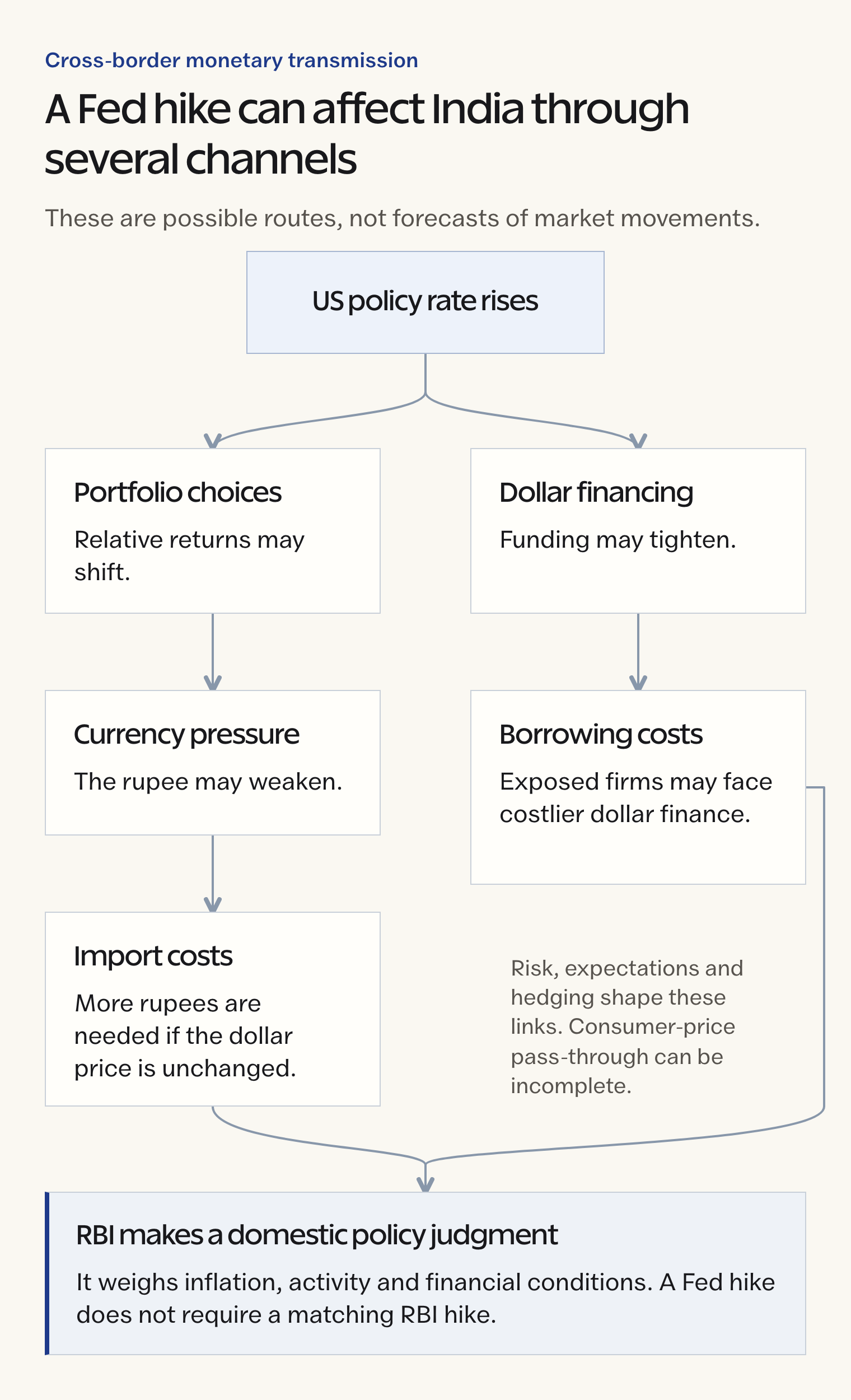
- Interest differentials can narrow when US rates rise while Indian rates remain unchanged. That may reduce the relative attraction of some Indian debt investments, but investors also consider currency risk and hedging costs.
- Portfolio decisions compare risk-adjusted returns, not policy rates alone. Growth prospects, market liquidity and expected exchange-rate movements can alter the comparison, which is why a Fed increase does not guarantee capital flight from India.
- Market expectations matter before an announcement arrives. If investors already anticipated the decision, prices may have adjusted earlier; a surprise about the future rate path can matter more than the announced increase itself.
- Dollar funding is another channel: tighter global financing conditions can raise borrowing costs for exposed firms. The effect depends on refinancing needs and contract terms, rather than applying equally to every Indian borrower.
- Domestic market rates need not move exactly with the RBI’s policy rate. Global risk premiums can change financial conditions independently, a distinction that complements domestic liquidity and monetary transmission within India’s banking system.
How currency pressure can reach import costs
The second channel links foreign-exchange demand to domestic costs, with several conditions between a financial shock and consumer inflation.
- If investors shift funds toward dollar assets, increased dollar demand can put pressure on the rupee. This is a possible transmission route, not evidence that depreciation has already followed this particular Federal Reserve announcement.
- A weaker rupee raises the rupee cost of a dollar-priced import if its dollar price stays unchanged. The exchange rate and the international commodity price are separate influences that can reinforce or offset each other.
- Imported inputs can transmit currency pressure into production and distribution costs. Consumer prices do not necessarily rise immediately or equally: firms’ margins, existing contracts and demand conditions influence how much cost is passed through.
- Dollar liabilities can also become more expensive in rupee terms when the currency weakens. A borrower with dollar earnings or effective hedging faces a different exposure from an otherwise similar borrower without those protections.
- Inflation analysis must separate exchange-rate effects from domestic supply changes. Read the household price basket and food-inflation discussion alongside this channel; a rise in consumer prices cannot automatically be attributed to a foreign rate decision.
Why the RBI does not mechanically follow the Fed
External conditions enter India’s policy assessment through their domestic effects; they do not replace that assessment with a matching rule.
- Domestic judgment begins with the inflation outlook, economic activity and financial conditions in India. A foreign rate increase is relevant when it changes those conditions; copying its size is not a substitute for analysis.
- Policy trade-offs depend on the shock: persistent inflation pressure may call for a different response from temporary currency volatility. A rate increase can restrain demand, making the domestic growth implications part of the decision.
- Resilience varies across emerging markets because economic fundamentals, financing structures and policy credibility differ. The IMF’s assessment of earlier tightening shows why blanket predictions of outflows or crisis are unreliable guides to a new episode.
- Policy instruments address different problems. Interest-rate decisions, banking liquidity management and measures addressing disorderly currency markets should be judged against their purposes, rather than treated as identical ways of responding to the Federal Reserve.
- Forecasts and decisions belong in separate categories. Market expectations about an upcoming RBI meeting do not establish its outcome; an exam answer should distinguish the confirmed US action from any possible Indian policy response.
Way Forward
Judge the transmission before choosing the response
- Monitor capital flows, funding costs and currency exposure together to identify where the external shock is actually being transmitted.
- Assess inflation persistence and domestic demand before drawing conclusions about the appropriate interest-rate response.
- Explain the domestic basis of policy decisions clearly so a foreign announcement does not become a misleading guide to India’s next move.
Conclusion
- The Federal Reserve rate hike can influence India through returns, financing conditions and exchange rates. Each channel depends on expectations, exposures and domestic conditions; none establishes an automatic market outcome.
- A strong answer separates external pressure from policy choice. The RBI must assess how the shock affects India’s economy rather than reproduce the Federal Reserve’s decision mechanically.
UPSC Practice Questions
Prelims MCQ 1
Consider the following statements about monetary-policy spillovers:
- A Fed rate hike guarantees depreciation of the Indian rupee.
- Expected exchange-rate movements can influence investors’ comparisons of asset returns.
- Domestic borrowing conditions can change even without a change in the RBI policy rate.
How many of the above statements are correct?
(a) Only one (b) Only two (c) All three (d) None
Answer: (b) Only two
Explanation:
Statements 2 and 3 are correct. Currency risk and global financing conditions affect transmission. A rate increase does not guarantee a particular exchange-rate outcome.
Prelims MCQ 2
With a dollar-priced import’s dollar price unchanged, what is the direct effect of rupee depreciation?
(a) Its rupee cost falls (b) Its rupee cost is necessarily unchanged (c) Its rupee cost rises (d) Its dollar price must rise
Answer: (c) Its rupee cost rises
Explanation:
More rupees are required to purchase the same dollars. The effect on final consumer prices can differ because pass-through is not necessarily immediate or complete.
UPSC Mains Questions
- Explain how US monetary tightening can affect capital flows, exchange rates and imported inflation in India. Why are these effects conditional?
- Does a Federal Reserve rate hike require the RBI to raise its policy rate? Discuss with reference to domestic economic conditions and monetary-policy transmission.
Sources: Federal Reserve, FOMC statement and IMF, monetary policy transmission in emerging markets.
Frequently Asked Questions
What did the Federal Reserve decide?
On 16 September 2026, the FOMC raised the federal funds target range by 25 basis points to 3.75–4%. Its statement cited elevated inflation alongside expanding economic activity.
Does a Fed hike guarantee a weaker rupee?
No. Higher US returns can influence dollar demand, but currency outcomes also depend on expectations, capital flows, economic prospects and risk perceptions. A transmission channel is not a guaranteed forecast.
How can a weaker rupee affect inflation?
It can raise the rupee cost of dollar-priced imports when their dollar price is unchanged. Pass-through to consumer prices depends on contracts, margins, demand and other domestic conditions.
Must the RBI match the Fed’s rate increase?
No. The RBI must judge the consequences for Indian inflation, activity and financial conditions. A US policy decision can influence that assessment without determining the size or direction of India’s response.
Is an expected RBI move a confirmed decision?
No. Analysts’ forecasts and market expectations describe possible outcomes. Only the actual policy announcement confirms the decision; the US rate hike alone cannot establish what an upcoming RBI meeting will do.
Source: https://anantamias.com/current-affairs/fed-rate-hike-india-monetary-policy-spillovers/
RCMC Exemption: Lower Compliance Costs for Small Exports
Why in News?
On 16 September 2026, the government announced an RCMC exemption for export consignments with Free-on-Board value up to ₹3 lakh, easing one entry requirement for small exporters.
- The change concerns Registration-cum-Membership Certificates or Certificates of Registration wherever otherwise required under the Foreign Trade Policy.
- The threshold applies to each export consignment, including one valued exactly at the stated ceiling.
- Above the threshold, the certificate requirement continues where otherwise applicable.
- The ministry identifies postal, courier and emerging channels as potential routes benefiting from the change.
- A paperwork step can impose a substantial fixed entry cost on a business testing a small overseas order.
- The reform concerns trade participation; it does not guarantee larger export earnings or remove every cross-border obligation.
UPSC Relevance
Prelims Relevance
- RCMC: Registration-cum-Membership Certificate.
- DGFT: Directorate General of Foreign Trade.
- FOB: Free-on-Board, the stated valuation basis for this exemption.
- De minimis: a specified threshold below which a particular requirement is relaxed.
- Per consignment: distinct from a business’s annual turnover.
Mains Relevance
GS Paper 3
- Compliance costs, MSME internationalisation and participation in merchandise exports.
- Distinguishing wider exporter participation from growth in aggregate export value.
GS Paper 2
- Proportionate regulation and clear administrative implementation.
Essay
- Economic opportunity depends partly on the cost of taking the first step.
Background and Context
Read the exemption at the transaction level
The useful first question is which obligation changes for which shipment.
- RCMC connects an exporter with the relevant Export Promotion Council or Commodity Board where the policy requires registration. The new exemption removes that upfront certificate requirement for eligible small consignments.
- The ₹3 lakh ceiling refers to the consignment’s FOB value. It is not an annual turnover limit or a definition of an MSME, and uses the specified FOB valuation basis rather than the exporter’s overall sales.
- The phrase “wherever otherwise required” limits the rule’s scope. It would be incorrect to infer that every larger shipment requires the same certificate irrespective of the underlying Foreign Trade Policy provisions.
- Other compliance questions remain separate: what goods may be exported, what declarations are needed and what destination rules apply. Relaxing a named certificate cannot by itself answer all those questions for a shipment.
- A practical reading separates threshold, document and applicability. First establish the consignment value, then identify the certificate being discussed, and finally check whether the underlying requirement applies before drawing a compliance conclusion.
Why a small paperwork saving can change entry decisions
A fixed compliance task absorbs a larger share of effort when an exporter is testing a small order.
- Fixed costs do not necessarily shrink with order size. Identifying an authority, preparing documents and completing a process can demand attention before a business knows whether an overseas customer will place repeat orders.
- Market testing involves uncertainty about demand, packaging, delivery and customer satisfaction. Reducing an initial administrative step can leave more time for these tasks, although it cannot make the product attractive or logistics reliable.
- Consider an illustrative first-time artisan exporter with one eligible small order. Removing an upfront certificate step may make that trial easier; it does not reveal the artisan’s profit margin or guarantee future sales.
- The potential gain is broader participation: more businesses may find it worthwhile to attempt exports. Whether participation becomes sustained growth depends on repeat demand, product quality and the ability to fulfil orders consistently.
- Digital facilitation addresses a related but different friction. The DGFT certificate-of-origin API concerns verifiable origin data; this exemption instead changes whether a particular registration certificate is required for an eligible transaction.

Judge the reform by durable participation
A successful threshold reform should simplify entry without obscuring the obligations that remain.
- Participation and export value measure different outcomes. A rise in small transactions can widen the exporter base without immediately producing a comparable rise in total earnings; evaluation should keep both measures visible.
- Retention is a useful follow-up measure: do first-time exporters continue selling overseas? A single successful shipment reveals less about durable integration than repeated orders, dependable fulfilment and the ability to resolve customer problems.
- Scaling creates a transition problem. A business approaching larger consignments needs timely information about applicable registration and available institutional support, so that simplified entry does not become confusion at the next stage.
- Document-specific reform requires document-specific communication. Compare automated Free Sale and Commerce Certificates: changing a procedure for one certificate should not be mistaken for removing distinct certificates or requirements elsewhere in the export process.
- Proportionate administration means matching a requirement to its purpose and burden. Its success should be judged by reduced avoidable effort, accurate declarations and sustained legitimate trade, rather than treating fewer forms as the only objective.
Way Forward
Support the first shipment and the next one
- Publish a concise document-by-document explanation of what the exemption changes and what exporters must still check.
- Provide transition guidance for businesses moving into higher-value consignments, including relevant registering bodies and support services.
- Track repeat exporting and processing effort alongside transaction counts, using evidence before attributing export growth to the exemption.
Conclusion
- The RCMC exemption illustrates targeted deregulation: one specified entry requirement is relaxed for eligible consignments while the larger framework continues. Its value lies in making a first export attempt easier to organise.
- For a Mains answer, connect fixed compliance costs, market testing and exporter retention. Keep the distinction between a narrow registration exemption and a general waiver of export obligations explicit throughout the analysis.
UPSC Practice Questions
Prelims MCQ 1
With reference to the RCMC exemption announced in September 2026, consider the following statements:
- The threshold is based on a consignment’s FOB value.
- The threshold is an annual turnover limit for the exporter.
- The exemption removes every customs and export-policy requirement.
How many of the above statements are correct?
(a) Only one (b) Only two (c) All three (d) None
Answer: (a) Only one
Explanation:
Only statement 1 is correct. The rule concerns a specific registration certificate for eligible consignments; it is neither an annual turnover threshold nor a blanket compliance waiver.
Prelims MCQ 2
Why can removing a fixed compliance task particularly help an occasional small exporter?
(a) It guarantees demand in the importing country. (b) The task can represent a larger burden relative to a small order. (c) It removes all delivery and quality risks. (d) It guarantees eligibility for every export incentive.
Answer: (b) The task can represent a larger burden relative to a small order.
Explanation:
A fixed administrative task can be disproportionately burdensome for a small trial shipment. Removing it does not determine demand, remove commercial risks or establish incentive eligibility.
UPSC Mains Questions
- Explain how fixed compliance costs can limit MSME participation in exports. Assess the logic and limits of a consignment-level registration exemption.
- How should the government evaluate whether simpler export procedures lead to sustained international-market participation rather than only more first-time shipments?
Source: PIB, Ministry of Commerce and Industry.
Frequently Asked Questions
What does RCMC stand for?
RCMC stands for Registration-cum-Membership Certificate. The announced reform relaxes the requirement for this certificate or Certificate of Registration for eligible consignments where the Foreign Trade Policy would otherwise require it.
Does the ₹3 lakh threshold refer to annual turnover?
No. It refers to the FOB value of the export consignment. It is a transaction-level threshold, not the exporter’s annual turnover or a new classification rule for MSME status.
Is a consignment worth exactly ₹3 lakh covered?
Yes. The announcement uses “up to ₹3 lakh,” which includes the boundary value on the stated FOB basis. The exemption concerns the specified certificate requirement, rather than every obligation associated with exporting.
Does the exemption remove customs or tax requirements?
No blanket customs or tax waiver is announced. The measure concerns RCMC or Certificate of Registration where otherwise required; exporters must assess other applicable obligations separately for their goods and destination.
Will the exemption automatically increase export earnings?
No. It can lower an initial administrative barrier, but export earnings also depend on demand, quality, pricing and fulfilment. More small export transactions and higher aggregate export value are distinct outcomes.
Source: https://anantamias.com/current-affairs/rcmc-exemption-small-export-consignments/
UAPA Network Designation: Listing, Liability and Due Process
Why in News?
On 16 September 2026, the Ministry of Home Affairs announced the Shahzad Bhatti Network’s designation as a terrorist organisation under the Unlawful Activities (Prevention) Act.
- The ministry attributed cross-border arms, explosives and narcotics smuggling to the network; these are official allegations, not findings independently established by this announcement.
- The release also alleged recruitment into terrorism and circulation of hateful digital content. It did not provide a criminal court’s determination of individual liability.
- The exam-relevant issue is the distinction between organisational designation, criminal prosecution and the statutory opportunity to seek removal from the list.
- A crime-terror nexus can connect illicit commerce, recruitment and violent activity; the designation concerns the alleged network rather than merely one reported incident.
- Effective enforcement needs both disruption and legal accountability; an official label does not eliminate the need to prove the elements of an offence.
UPSC Relevance
Prelims Relevance
- Organisational designation under UAPA
- Central Government and Official Gazette notification
- Application for removal and Review Committee
- Distinction between listing and criminal conviction
Mains Relevance
GS Paper 3
- Organised crime and terrorism linkages
- Disruption of support networks through lawful enforcement
GS Paper 2
- Administrative decisions, review and procedural safeguards
- Evidence-based criminal accountability
Essay
- Security institutions earn legitimacy through both effectiveness and fairness.
Background and Context
What organisational designation does
Designation is a statutory decision about an organisation’s involvement in terrorism; it is not a substitute for adjudicating every allegation against every person linked to it.
- The Central Government may add an organisation to the First Schedule through an Official Gazette notification when it believes the organisation is involved in terrorism. The statutory power concerns the organisation’s legal classification.
- The law’s organisational involvement test extends beyond carrying out an attack. It includes preparation, promotion or encouragement of terrorism, showing why a support network can matter even without direct participation in violence.
- A designation announcement communicates the government’s action; the statutory notification supplies its formal legal particulars. A news release should not be used to invent a notification number, additional restrictions or a court finding.
- The alleged crime-terror nexus explains the current security concern: smuggling can sustain an organisation while recruitment expands its capacity. In this case, those connections remain attributed to the ministry’s account of the network.
- For context, network-focused narcotics control examines connected actors rather than isolated seizures. The distinct issue here is legal designation, including the basis for listing and the safeguards available to challenge its continuation.
Why listing does not decide individual guilt
A prosecution concerns a person’s legally defined conduct and the evidence supporting it; organisational status is one part of that analysis rather than its complete answer.
- Listing and conviction answer different questions. Listing classifies an organisation under the statute; a criminal case determines whether the prosecution has established an accused person’s offence through the applicable judicial process and evidence.
- For the organisation-membership offence discussed in the statute, intention to further its activities matters. A broad assertion that every social connection or mention of a listed organisation automatically proves this offence would be misleading.
- The law separately addresses support and fundraising connected with terrorist organisations. These provisions contain their own conduct and mental-element requirements; their existence does not establish that every transaction or public statement meets those requirements.
- Digital material can be relevant evidence, but investigators must establish what it shows, who produced or controlled it and how it relates to the allegation. An alarming screenshot is not automatically complete proof.
- Official attribution preserves the distinction between an allegation and an adjudicated finding. Describing the ministry’s account accurately allows serious security concerns to be explained without pronouncing untried individuals guilty through association or reputation.
How removal and review protect accountability
The statutory framework provides a route to seek removal of an organisation, followed by review of a rejected application; this operates separately from a criminal trial.
- An application for removal can be made to the Central Government by the organisation or a person affected by its inclusion. This makes the challenge mechanism relevant beyond the organisation’s own formal representatives.
- If that application is rejected, the applicant may approach a Review Committee within the statutory time limit. The review examines the refusal to remove the organisation; it is not an appeal against a criminal conviction.
- The committee considers whether the refusal was flawed on judicial-review principles. This provides scrutiny of the administrative decision rather than a declaration that the committee performs every function of a court conducting a criminal trial.
- A committee chair must be a current or former High Court judge. Judicial experience in the review structure is a safeguard, while the statutory process still requires a properly presented application and a decision.
- Like the broader lessons from preventive-detention safeguards, strong security powers require procedural discipline. The statutes and remedies differ; the shared principle is that public safety does not make reasoned, lawful decision-making unnecessary.
Way Forward
Link disruption to defensible evidence
- Communicate the notification’s exact scope so institutions do not substitute assumptions for legal requirements.
- Preserve reliable financial, communications and transaction evidence, linking alleged conduct to the relevant statutory elements.
- Keep removal and review procedures accessible, with reasoned decisions that can be examined through the applicable legal process.
Conclusion
- The durable distinction is between designation, prosecution and review. A listed organisation presents a statutory security concern, but each person’s criminal liability still requires its own legal and evidentiary assessment through the appropriate process.
- A strong answer should explain how network disruption and procedural safeguards work together. Avoid treating official allegations as convictions or presenting access to review as a guarantee that an organisation will be removed.
UPSC Practice Questions
Prelims MCQ 1
With reference to designation of a terrorist organisation under UAPA, consider the following statements:
- The organisation or a person affected by its inclusion may apply for its removal.
- Designation itself constitutes a criminal conviction of every person associated with the organisation.
- Rejection of a removal application may be taken to the statutory Review Committee.
How many of the above statements are correct?
(a) Only one (b) Only two (c) All three (d) None
Answer: (b) Only two
Explanation:
The first and third statements describe the removal and review route. Organisational designation does not itself convict every associated person.
Prelims MCQ 2
Which distinction is most important when reporting a new organisational designation?
(a) A ministry’s allegation is identical to a criminal court’s finding (b) Review of listing automatically terminates every criminal investigation (c) Organisational listing and individual criminal liability require distinct legal analysis (d) Designation eliminates the need for evidence
Answer: (c) Organisational listing and individual criminal liability require distinct legal analysis
Explanation:
Listing concerns the organisation’s statutory status. Individual offences require examination of their applicable legal elements and supporting evidence.
UPSC Mains Questions
- Distinguish organisational designation from individual criminal liability under counter-terrorism law. Why does this distinction matter for effective and fair enforcement?
- Discuss how removal and review mechanisms can strengthen accountability in the exercise of national-security powers.
Sources: PIB, Ministry of Home Affairs and Ministry of Home Affairs, UAPA statutory text.
Frequently Asked Questions
What was announced about the Shahzad Bhatti Network?
The Home Ministry announced its designation as a terrorist organisation under UAPA. The ministry attributed smuggling, recruitment and hateful digital content to the network; its announcement should not be confused with individual criminal convictions.
Does listing automatically convict every associated person?
No. Organisational designation and individual criminal liability are different legal questions. A criminal case must address the relevant offence, its required elements and the supporting evidence through the applicable judicial process.
Who can seek removal of an organisation?
The statutory route allows the organisation or a person affected by its inclusion to apply to the Central Government for removal. Rejection can be challenged before the Review Committee within the prescribed statutory period.
What does the Review Committee examine?
It examines a refusal to remove the organisation, applying the statutory review standard. This is distinct from deciding an accused person’s guilt at a criminal trial or automatically cancelling every related investigation.
Why must the alleged conduct be attributed?
Attribution identifies what the ministry has stated without presenting its account as a court’s finding. That distinction supports accurate reporting of security concerns while preserving the separate role of investigation and adjudication.
Source: https://anantamias.com/current-affairs/shahzad-bhatti-network-uapa-designation/
Chrome Shavings to Syntans: Recovering Protein for Leather Retanning
Why in News?
On 16 September 2026, CSIR presented a CLRI technology that converts chrome shavings into protein-based syntans for leather retanning at a technology-transfer event.
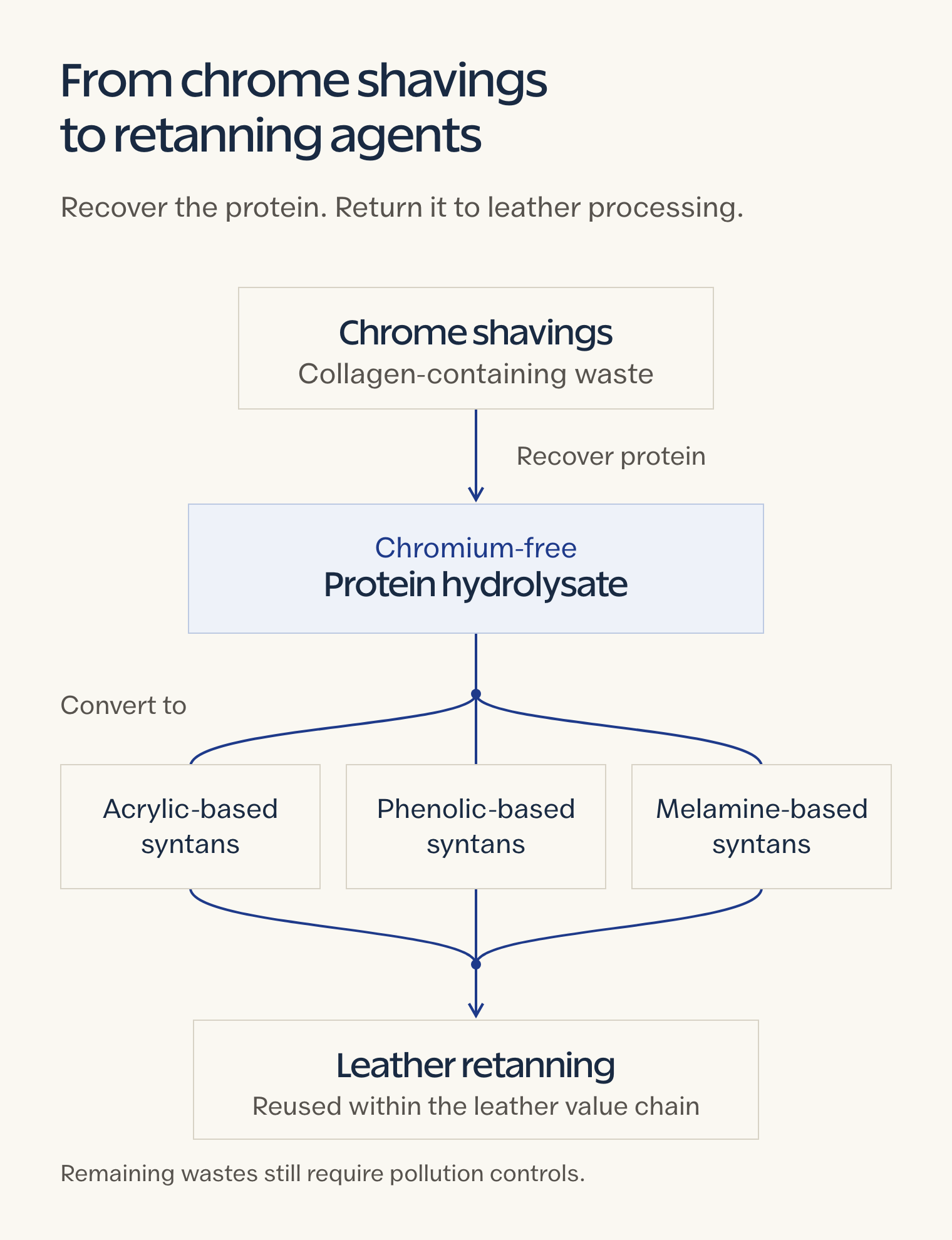
- The process recovers chromium-free protein hydrolysate and converts it into acrylic-, phenolic- and melamine-based syntans.
- The release reports commercial-scale validation at 1,500 kg and says the patented technology is ready for commercial licensing.
- According to CLRI, adoption can reduce total dissolved solids by up to 50% in the post-tanning stream; this is a bounded performance claim.
- Chrome shavings contain valuable collagen protein, but their waste status and chromium content complicate straightforward reuse.
- Recovering that material for retanning connects waste management with input production within the leather-processing chain.
UPSC Relevance
Prelims Relevance
- CSIR-CLRI: Central Leather Research Institute, Chennai.
- Collagen: the protein resource identified in chrome shavings.
- Protein hydrolysate: the recovered protein-derived intermediate used in the announced process.
- Syntans: synthetic tanning agents; the reported products are used in retanning.
- TDS: total dissolved solids, a water-quality measure distinct from an overall toxicity assessment.
Mains Relevance
GS Paper 3
- Circular economy: recovering useful material from industrial waste.
- Science and industry: technology transfer, process validation and commercial adoption.
- Pollution control: measuring specific benefits without losing sight of remaining waste streams.
Essay
- Resource efficiency requires both useful recovery and credible environmental safeguards.
Background and Context
Why leather waste still contains a useful resource
The useful starting point is the material inside the waste, rather than the assumption that every discarded material is ready for reuse.
- Chrome shavings are a solid leather-industry waste containing collagen protein. The announced technology targets this recoverable component, showing how an industrial residue can retain useful material even when it presents a waste-management problem.
- Chromium-free hydrolysate describes the recovered protein intermediate in CLRI’s process. It does not mean the original waste was chromium-free, or that all substances separated during processing can be released without further environmental assessment.
- Material recovery differs from directly adding untreated shavings back into production. The announced route first produces a usable intermediate and then converts it into retanning agents, making processing quality central to the claimed circular pathway.
- Product specifications matter because a recovered material must perform a useful function in its next application. Waste diversion alone cannot establish that the resulting chemical is suitable for consistent use in industrial leather processing.
- Circularity connects recovery with a credible end use. The wider question, also raised by e-waste recovery decisions, is whether economic value and environmental protection improve together rather than simply shifting a waste burden elsewhere.

From protein intermediate to retanning agents
The pathway has distinct stages: recover the intermediate, manufacture useful agents, and return them to leather processing.
- The first reported output is protein hydrolysate recovered without chromium. This intermediate is the bridge between a difficult waste stream and further chemical manufacture; it should not be confused with the finished retanning formulation.
- The hydrolysate is converted into acrylic-, phenolic- and melamine-based syntans. These are the product categories identified by the release, not a sequence in which acrylic becomes phenolic and then transforms into melamine.
- Retanning is the destination of these products within leather processing. CLRI’s technical description explains that protein-based agents can contribute to fullness and grain properties, illustrating why recovery must be connected to useful product performance.
- The reuse connection is within the leather value chain: material recovered from a leather-industry residue becomes an input for further leather processing. This does not establish complete recovery of every constituent of the original shavings.
- Industrial validation helps assess whether the method can operate beyond laboratory conditions. Like testing an industrial by-product for road use, the step is demonstrating application-specific performance rather than assuming all recovered material is automatically usable.
What the pollution claim establishes and what it does not
An environmental result must retain its metric, process boundary and attribution before it can support a wider sustainability argument.
- Total dissolved solids measures dissolved material in water. A reduction in this measure can be useful, but it does not by itself identify every contaminant or demonstrate that an entire effluent stream is harmless.
- The reported benefit concerns the post-tanning stream. Extending it to every stage of a tannery would change the claim’s scope; the release does not establish an equivalent reduction across the plant’s combined wastewater discharge.
- Up to indicates a maximum reported potential rather than a guaranteed result for every operator. CLRI attributes the benefit to adoption of the technology; routine plant performance would still need measurement under operating conditions.
- Separated residues remain part of environmental assessment even when the recovered intermediate is useful. A responsible appraisal should ask what happens to chromium-bearing material and other outputs, without inventing a disposal route absent from the announcement.
- Commercial readiness is different from widespread adoption. The release’s validation and licensing statements support industrial potential, but they do not show nationwide deployment, universal cost savings or a measured reduction in the sector’s total pollution burden.
Way Forward
Validate the whole material balance
- Require clear input, product and residue records so recovery can be assessed without overlooking material that leaves the useful-product pathway.
- Verify retanning performance and stream-specific TDS under actual operating conditions, using comparable measurements before and after adoption.
- Pair technology-transfer support with handling guidance, quality checks and responsible management of remaining wastes.
Conclusion
- The chrome-shavings pathway illustrates useful circular manufacturing: recover a protein intermediate, convert it into retanning agents and connect waste recovery with a defined industrial application.
- For an exam answer, preserve the distinction between resource recovery and complete pollution control. A bounded TDS benefit strengthens the case for assessment; it does not remove the need to manage other outputs.
UPSC Practice Questions
Prelims MCQ 1
With reference to the announced CSIR-CLRI technology, consider the following statements:
- Chromium-free protein hydrolysate is recovered from chrome shavings.
- The recovered intermediate is converted into syntans for leather retanning.
- The reported TDS benefit proves that all tannery effluent is harmless.
How many of the above statements are correct?
(a) Only one (b) Only two (c) All three (d) None
Answer: (b) Only two
Explanation:
Statements 1 and 2 describe the announced pathway. Statement 3 overstates a claim limited to TDS in the post-tanning stream.
Prelims MCQ 2
Which sequence correctly represents the announced material pathway?
(a) Chrome shavings → chromium-free protein hydrolysate → syntans → leather retanning (b) Chrome shavings → steel aggregate → road construction (c) Finished syntans → raw collagen → chromium extraction from ore (d) Untreated shavings → direct discharge into post-tanning water
Answer: (a) Chrome shavings → chromium-free protein hydrolysate → syntans → leather retanning
Explanation:
CLRI recovers a protein intermediate, converts it into acrylic-, phenolic- and melamine-based syntans, and uses these in retanning.
UPSC Mains Questions
- Explain how recovering protein-based retanning agents from chrome shavings illustrates circular-economy principles. What safeguards should accompany industrial adoption?
- Why must environmental claims specify their metric and process boundary? Discuss with reference to the reported TDS benefit of CLRI’s leather-processing technology.
Sources: PIB, Ministry of Science & Technology and CSIR-CLRI, Leather Chemicals.
Frequently Asked Questions
What are chrome shavings in this technology?
They are a solid waste from the leather industry containing useful collagen protein. The CLRI process recovers a chromium-free protein intermediate from this material for further conversion into retanning agents.
What products are made from the recovered protein?
The announced process converts protein hydrolysate into acrylic-, phenolic- and melamine-based syntans. These are useful categories of retanning agents, not three successive stages in a single chemical conversion sequence.
Does lower TDS mean all effluent is safe?
No. TDS measures dissolved material, while overall environmental safety involves other characteristics too. The reported reduction concerns the post-tanning stream and cannot establish harmlessness of all wastewater or remaining residues.
Is the technology already used throughout the leather industry?
The release reports commercial-scale validation and readiness for licensing. Those statements support industrial potential, but they do not establish nationwide adoption or measured environmental gains across the entire leather industry.
Why is this a circular-economy example?
It links a leather-industry waste to a useful input for retanning. That recovery reduces reliance on disposal as the only pathway, while remaining residues and product performance still require assessment.
Source: https://anantamias.com/current-affairs/chrome-shavings-protein-syntans-circular-leather/
Swachh Seva Aankalan: Gram Sabha Validation of Sanitation Services
Why in News?
On 16 September 2026, the Jal Shakti Ministry reported the launch of Swachh Seva Aankalan, an annual sanitation self-assessment framework with Gram Sabha validation, on the previous day.
- The Department of Drinking Water and Sanitation developed the framework under Swachh Bharat Mission (Grameen) 2.0.
- Its stated assessment scope covers ODF Plus (Model) declared Gram Panchayats, working with village committees and communities.
- It examines sanitation conditions alongside functionality and maintenance of relevant assets.
- Validated findings go to district and State/UT review, supporting identification of gaps and improvement plans.
- A sanitation asset can exist on paper while failing to provide a reliable day-to-day service.
- Community validation can connect administrative reporting with lived experience, but its quality depends on meaningful participation and follow-up.
UPSC Relevance
Prelims Relevance
- SSA: Swachh Seva Aankalan, an annual digital self-assessment framework.
- VWSC: Village Water and Sanitation Committee.
- Gram Sabha: the forum for discussion and validation of assessment findings.
- SLWM: Solid and Liquid Waste Management.
- O&M: Operation and Maintenance of assets.
Mains Relevance
GS Paper 2
- Participatory local governance, accountability and the quality of public-service monitoring.
- Connecting village-level feedback with district and State corrective planning.
GS Paper 3
- Sustaining rural sanitation and waste-management services after asset creation.
Essay
- A public service succeeds when the institution continues working after the infrastructure is built.
Background and Context
Measure a working service, not only an installed asset
The framework brings the condition and continuing use of sanitation infrastructure into the assessment.
- ODF sustainability asks whether the conditions supporting freedom from open defecation endure. A previous declaration should be a starting point for continued scrutiny rather than a reason to stop examining sanitation conditions.
- Visual cleanliness and waste management concern what residents encounter in everyday surroundings. Looking beyond construction helps distinguish a facility that has been provided from a service that people can reliably use.
- Functionality asks whether an asset works, while operation and maintenance concern what keeps it working. The distinction matters because a repair, regular staffing and a recurring operating task may require different responses.
- Consider an illustrative community waste facility that exists but is not used consistently. An inventory would record its presence; a service assessment should examine why the intended function is not being delivered to residents.
- The link to rural drinking-water data governance is decision usefulness: collecting information matters when it helps identify a specific service problem. An additional digital record alone does not prove that the problem has been corrected.

Follow the accountability chain
SSA connects local self-reporting, public discussion and administrative review, with each stage performing a different function.
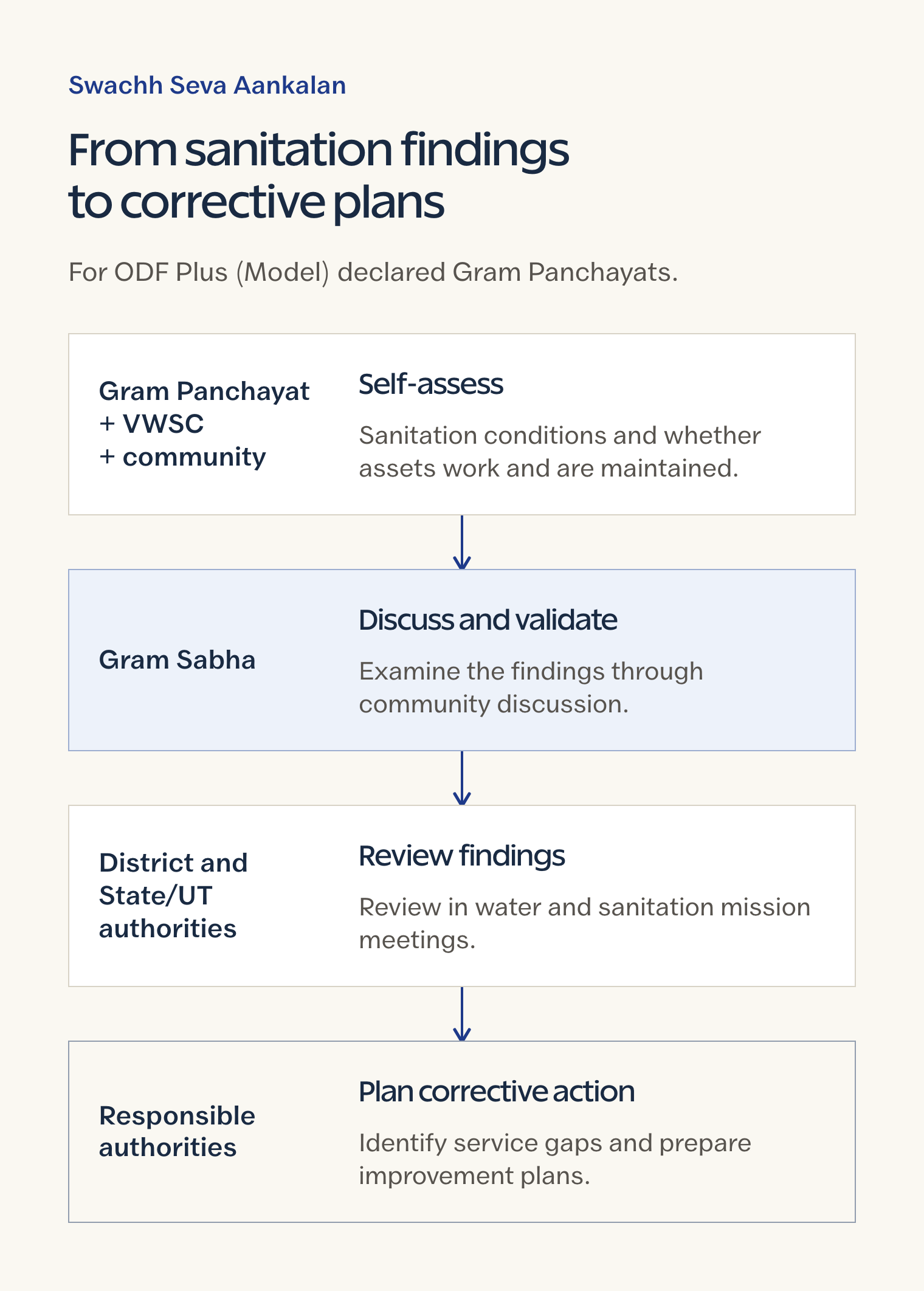
- The Gram Panchayat, VWSC and community undertake the initial self-assessment. This draws on local knowledge of sanitation conditions, including how facilities are functioning, rather than treating assessment solely as an outside reporting exercise.
- The Gram Sabha discusses and validates findings. Its distinct contribution is an opportunity to test the assessment against residents’ experience; a completed form and a publicly examined account are different stages of accountability.
- District and State/UT authorities review the findings in their water and sanitation mission meetings. The reported design connects village observations with authorities able to identify wider service gaps and prepare relevant improvement plans.
- Corrective planning is the intended administrative response to identified gaps. For effective follow-through, a plan should connect the problem with an action, a responsible actor and a check that the action actually restores service.
- The process diagram below separates who reports, who validates and who reviews. Reading these roles separately prevents the mistaken assumption that Gram Sabha discussion itself completes technical repairs or guarantees a functioning sanitation service.
Why validation needs evidence and follow-through
Participation strengthens scrutiny only when people can question the record and see whether their concerns lead to action.
- Self-assessment can reveal locally understood problems, but those reporting performance may also have incentives to present favourable results. This is a governance risk to manage, not evidence that any particular Panchayat has misreported.
- Public validation is not the same as an independent audit. The announcement describes community discussion and administrative review; it does not establish an external auditor, verified accuracy rates or proof that every reported service works.
- Inclusive participation should make it possible for residents with different service experiences to speak. A meeting dominated by a few voices could miss failures affecting less visible households even if the formal discussion takes place.
- Safe maintenance must remain part of service improvement. The concerns discussed in sanitation worker safety show why restoring functionality should not mean transferring avoidable danger to the people responsible for cleaning and upkeep.
- Closure evidence should distinguish a proposed action, an action completed and a service restored. Recording these stages separately would help reviewers see whether an improvement plan has produced a practical change for the community.
Way Forward
Turn validated gaps into tracked actions
- Give Gram Sabha participants accessible findings before discussion, with enough detail to question a reported service condition.
- Record each confirmed gap with a responsible authority and proposed remedy, distinguishing routine maintenance from larger support needs.
- Bring unresolved and completed actions back for community review, checking actual functionality rather than only expenditure or paperwork.
Conclusion
- Swachh Seva Aankalan shifts attention toward sustaining sanitation services in the specified Gram Panchayats. Its contribution is a structured route from local assessment through public validation to higher-level review and corrective planning.
- A strong governance answer distinguishes reporting, validation and verified improvement. The launch establishes a monitoring design; its eventual value depends on whether identified gaps result in safer, dependable services for residents.
UPSC Practice Questions
Prelims MCQ 1
With reference to Swachh Seva Aankalan, consider the following statements:
- Its stated scope includes ODF Plus (Model) declared Gram Panchayats.
- Assessment findings are discussed and validated by the concerned Gram Sabha.
- The announcement establishes an independent external audit of every assessed Gram Panchayat.
How many of the above statements are correct?
(a) Only one (b) Only two (c) All three (d) None
Answer: (b) Only two
Explanation:
Statements 1 and 2 reflect the announced framework. It is a digital self-assessment framework with Gram Sabha validation and administrative review, not an announced independent external audit.
Prelims MCQ 2
Which sequence best represents the announced Swachh Seva Aankalan process?
(a) District certification → automatic funding → community assessment (b) Independent audit → court approval → Panchayat election (c) Local self-assessment → Gram Sabha validation → district/State review and corrective planning (d) Asset construction → permanent exemption from review
Answer: (c) Local self-assessment → Gram Sabha validation → district/State review and corrective planning
Explanation:
The framework links Panchayat, VWSC and community self-assessment with Gram Sabha validation, followed by higher-level review to identify gaps and prepare improvement plans.
UPSC Mains Questions
- How can Gram Sabha validation strengthen accountability in rural sanitation service delivery? Discuss the limits of self-assessment and the need for corrective follow-through.
- Distinguish sanitation asset creation from sustainable service delivery. Explain how local feedback and administrative review can connect the two.
Source: PIB, Ministry of Jal Shakti.
Frequently Asked Questions
What is Swachh Seva Aankalan?
It is an annual digital self-assessment framework for rural sanitation developed under Swachh Bharat Mission (Grameen) 2.0. It connects local assessment, Gram Sabha validation and administrative review for corrective planning.
Which Gram Panchayats are covered in the announcement?
The stated scope covers ODF Plus (Model) declared Gram Panchayats. They assess sanitation conditions with their Village Water and Sanitation Committees and local communities, before findings go through Gram Sabha discussion and validation.
What does the Gram Sabha do?
The concerned Gram Sabha discusses and validates the self-assessment findings. This creates a forum for community scrutiny before the findings are available for district and State/UT review and improvement planning.
Is SSA an independent audit?
The announcement describes self-assessment with public validation and administrative review. It does not establish an independent external audit. Participation can strengthen scrutiny, but it should not be described as automatic proof of service quality.
Why assess operation and maintenance?
An asset’s existence does not establish that it continues to function. Assessing operation and maintenance helps identify recurring service problems and supports decisions about corrective action rather than focusing only on construction.
Source: https://anantamias.com/current-affairs/swachh-seva-aankalan-gram-sabha-validation/
Voyager 1 and Voyager 2
Why in News?
Voyager 1 approaches a distance of one light-day from Earth, approximately 25.9 billion km, implying roughly 24 hours for a radio signal to travel one way.
| UPSC Relevance: GS-3 Science and Technology: Astronomy and Space Technology Prelims: Voyager 1 and Voyager 2 space missions |
About the Missions:
- Agency: NASA; managed by its Jet Propulsion Laboratory (JPL).
- Launch: Voyager 2 (August 1977); Voyager 1 (September 1977). Despite launching later, Voyager 1 followed a faster trajectory.
- Voyager 1: Flew past Jupiter (1979) and Saturn (1980); remains the most distant human-made object.
- Voyager 2: Visited Jupiter, Saturn, Uranus and Neptune; remains the only spacecraft to have visited Uranus and Neptune.
- Technology: Used planetary gravity assists to alter speed and direction while conserving propellant. Electricity comes from radioisotope thermoelectric generators (RTGs), which convert heat from radioactive decay into electricity.
Key Findings:
- Jupiter and its moons: Discovered active volcanoes on Io, the first observed beyond Earth, and Jupiter’s faint rings. Images of Europa’s fractured icy surface provided early clues supporting the possibility of a subsurface ocean.
- Saturn and Titan: Revealed intricate ring structures, including spokes and shepherd-moon interactions; established that Titan’s thick atmosphere is predominantly nitrogen, with methane and complex organic chemistry.
- Uranus (Voyager 2): Discovered new moons and rings, revealed Miranda’s dramatically varied terrain, and measured Uranus’s strongly tilted, off-centre magnetic field.
- Neptune (Voyager 2): Observed the Great Dark Spot, powerful winds and rings; detected geyser-like plumes on Triton, demonstrating activity on a frigid, distant moon.
- Interstellar environment: Their measurements of particles, plasma and magnetic fields revealed how the solar wind interacts with the interstellar medium.
Have Voyager 1 and 2 Left the Solar System?
- Not yet. Both spacecraft have entered interstellar space, but neither has technically left the Solar System.
- Voyager 1 crossed the heliopause in August 2012, while Voyager 2 crossed it in November 2018, becoming the first two human-made objects to enter interstellar space.
- The heliosphere is the vast bubble of solar wind and magnetic fields created by the Sun. Its outer boundary, the heliopause, marks the transition into the interstellar medium.
- However, the Solar System extends much farther to the Oort Cloud. Oort Cloud is a distant reservoir of icy bodies that remains gravitationally bound to the Sun. NASA estimates it may extend from about 1,000 AU to 100,000 AU from the Sun.
At their present speeds, the Voyagers would take around 300 years to reach the inner edge of the Oort Cloud and potentially about 30,000 years to travel beyond it.

Scientific Significance:
- Changed planetary science: Demonstrated that distant moons can be geologically active, helping shape later investigations of ocean worlds and habitability.
- Provided direct measurements: Spacecraft can sample local particles and fields that telescopic images alone cannot reveal.
- Pale Blue Dot: Voyager 1’s 1990 photograph of Earth, taken from about 6 billion km, became a powerful reminder of Earth’s fragility and humanity’s shared home.
Practice MCQ:
Q. With reference to the Voyager missions, consider the following statements:
- Voyager 2 is the only spacecraft to have visited both Uranus and Neptune.
- Crossing the heliopause means that a spacecraft has also crossed the Oort Cloud.
Which of the statements given above are correct?
(a) 1 only
(b) 2 only
(c) Both 1 and 2
(d) Neither 1 nor 2
Answer: (a) Statement 2 is incorrect because the Oort Cloud extends far beyond the heliopause.
Source: https://anantamias.com/current-affairs/voyager-1-and-voyager-2/
Pygmy Hog: An Indicator of Healthy Grasslands
Why in News?
Assam’s pygmy hog conservation efforts have drawn attention to a central challenge: captive breeding can prevent immediate extinction, but long-term survival requires restoration of alluvial grasslands.
| UPSC Relevance: GS-3 Environment and Biodiversity: Species in News, Conservation Prelims: Pygmy Hog |
About Pygmy Hog:
The Pygmy Hog is the smallest and rarest wild pig in the world and is endemic to India. Its last remaining wild population survives in the tall wet grasslands of the Himalayan foothills, primarily inside Manas National Park, Assam.
- Identity: World’s smallest wild pig. Adults stand approximately 25 cm tall.
- Native range: Southern Himalayan foothill grasslands of the Indian subcontinent. Its historical range likely extended from Uttar Pradesh through southern Nepal to Assam, possibly southern Bhutan.
- Present distribution: Surviving populations are restricted to Assam. Manas National Park holds the last surviving original wild population.
- Habitat: Dense, tall alluvial grasslands, providing food, nesting material and concealment.

Behavioural Traits:
- Primarily diurnal: Active during daylight, with reduced activity during intense midday heat.
- Social organisation: Females and young form small family groups, generally 4-6 individuals; adult males are usually solitary.
- Nest-building: Builds grass nests for shelter, temperature regulation and protection of young.
- Omnivorous: Eats roots, tubers, shoots and invertebrates, occasionally small vertebrates; uses its snout to forage through soil and vegetation.
Protection Status:
- IUCN Red List: Endangered
- Wildlife (Protection) Act, 1972: Schedule I
- CITES: Appendix I
Ecological Importance:
- Indicator species: Its dependence on undisturbed grass cover makes its decline an early warning of grassland degradation.
- Wider conservation benefits: Protecting its habitat also safeguards species such as the Bengal florican, hispid hare, hog deer and greater one-horned rhinoceros.
- Evolutionary significance: Its extinction would eliminate an entire surviving genus.
Threats and Conservation Priorities:
- Habitat degradation: Agricultural conversion, overgrazing, invasive plants and altered flood regimes reduce suitable grasslands.
- Unscientific burning: Extensive dry-season fires destroy nests and protective cover; unchecked woody growth can also replace grassland.
- Small-population risks: Inbreeding and diseases transmitted through contact with domestic pigs threaten recovery.
- Conservation programme: Rediscovered in 1971; the Pygmy Hog Conservation Programme was formed in 1995, combining breeding, reintroduction and habitat management.
Practice MCQ:
Q. Consider the following statements about the pygmy hog:
- It is a herbivorous and primarily nocturnal mammal.
- It inhabits dense, tall alluvial grasslands.
- It is currently classified as Endangered by the IUCN.
Which of the statements given above are correct?
(a) 1 and 2 only
(b) 1 and 3 only
(c) 2 and 3 only
(d) 1, 2 and 3
Answer: (c). Statement 1 is incorrect: the pygmy hog is omnivorous and primarily diurnal.
UPSC PYQ 2013
Q. Consider the following:
1. Star tortoise
2. Monitor lizard
3. Pygmy hog
4. Spider monkey
Which of the above are naturally found in India?
(a) 1, 2 and 3 only
(b) 2 and 3 only
(c) 1 and 4 only
(d) 1, 2, 3 and 4
Answer: (a)
Source: https://anantamias.com/current-affairs/pygmy-hog-an-indicator-of-healthy-grasslands/
Dadasaheb Phalke Award for Kannada film artist Anant Nag
Why in News?
Veteran Kannada actor Anant Nag has been selected for the Dadasaheb Phalke Award for 2024, to be presented at the 72nd National Film Awards ceremony in 2026.
| UPSC Relevance: GS-1 Art and Culture: Awards and Honours Prelims: Dadasaheb Phalke Award |
About Dadasaheb Phalke Award:
- Status: India’s highest honour in cinema, recognising lifetime contribution to the growth and development of Indian cinema.
- Instituted: 1969, by the Government of India, in honour of Dhundiraj Govind Phalke, popularly called the Father of Indian Cinema.
- Presentation: Conferred by the President of India at the National Film Awards ceremony, under the Ministry of Information and Broadcasting.
- Selection: Based on recommendations of a committee of eminent film personalities; not restricted to actors.
- First recipient: Devika Rani (1969).
- Award components: Swarna Kamal (Golden Lotus) medallion, shawl and ₹15 lakh.
About Anant Nag:
- Mr Nag has acted in more than 300 movies for over five decades in both mainstream and parallel cinema, with more than 250 of his performances being in Kannada.
- Received the Padma Bhushan in 2025.
- Becomes the second Kannada actor to receive the honour.
Key Fact:
- Dadasaheb Phalke directed Raja Harishchandra (1913), widely recognised as India’s first full-length indigenous feature film. It was a silent film.
Practice MCQ:
Q. With reference to the Dadasaheb Phalke Award, consider the following statements:
- It was instituted in 1969, and Devika Rani was its first recipient.
- It is restricted to actors for outstanding performance in a particular film.
- It is presented as part of the National Film Awards ceremony.
Which of the statements given above are correct?
(a) 1 and 2 only
(b) 1 and 3 only
(c) 2 and 3 only
(d) 1, 2 and 3
Answer: (b)
Explanation: Statement 2 is incorrect: the award recognises lifetime contribution to Indian cinema across cinematic professions, rather than performance in a single film.
Source: https://anantamias.com/current-affairs/dadasaheb-phalke-award-for-kannada-film-artist-anant-nag/
India ranks 131st on the Global Gender Gap Index 2026
Why in News?
India retained the 131st rank among 145 economies, closing 64.5% of its gender gap, in the World Economic Forum’s Global Gender Gap Index 2026. Its score improved marginally, but remained below the global average of 69.2%.
| UPSC Relevance: GS-1 Indian Society: Women and social empowerment; GS-2 Social Justice: Vulnerable sections Prelims: Global Gender Gap Index Mains: Reasons for gender gap in India |
Global Gender Gap Index:
- Publisher: World Economic Forum; introduced in 2006 and released annually.
- Four dimensions:
- Economic Participation and Opportunity
- Educational Attainment
- Health and Survival
- Political Empowerment.
- Score: Ranges from 0 to 1, indicating progress towards gender parity; a higher score means a smaller gap. A 100% score would mean gender parity has been achieved.
- What it measures: Relative gaps between women and men, rather than a country’s overall level of development. Equal outcomes can coexist with inadequate opportunities for both sexes.
Global Gender Gap Index 2026:
(i) Global Highlights:
- Leading countries: Iceland, Finland and Norway; Namibia ranked fourth, while Australia entered the top ten for the first time.
- Iceland: Closed 93% of its gap (the only economy above 90%).
- Time to parity: An estimated 120 years at the prevailing pace, rather than a fixed prediction.
- Regional concern: South Asia remained the weakest region in economic participation and opportunity.
- Unequal influence: Women held 19.1% of CEO roles in the report’s data and accounted for fewer than one in five AI engineers.
(ii) India’s Performance:
In India, progress towards gender parity stands at 64.5%. India’s overall gains towards gender parity amount to a 4.3% advance since 2006, mainly due to improvements in educational attainment.
- Economic Participation and Opportunity: India reported a 41.2% parity score – higher than the previous edition, but lower than its best result in 2013 of 44.6%. Professional and technical worker parity rose, while parity among legislators, senior officials and managers remained only 13.1%.
- Educational Attainment: India’s gender parity score in educational attainment is 96.6%, lower than last year.
- Health and Survival: India’s score improved from last year to 95.6% parity.
- Political Empowerment: India is ranked 67th in the world with 24.5% parity.
What Explains the Persistent Gap?
- Weak transition from education to employment: The contrast between 96.6% educational parity and 41.2% economic parity suggests that schooling gains alone cannot overcome barriers to paid work and earnings.
- Care responsibilities interrupt careers: The report finds women almost twice as likely as men to take career breaks; persistent disadvantages follow parenting breaks in career progression.
- Limited advancement into leadership: India’s 49.9% professional-worker parity, alongside only 13.1% senior-role parity, indicates that entry into skilled work does not ensure equal advancement.
- Presence does not ensure influence: Low ministerial parity highlights the need to examine access to decision-making authority alongside numerical representation.
- New technology can reproduce old inequalities: Women’s underrepresentation in AI engineering risks limiting their access to emerging high-value occupations.
Way Forward:
- Make care infrastructure employment-linked: Locate affordable crèches near workplaces and industrial clusters, with hours matching women’s shifts.
- Convert qualifications into careers: Link skilling incentives to women’s placement, earnings and retention, not enrolment alone.
- Make promotion accountable: Require large employers to disclose gender pay and promotion gaps, including progression after maternity breaks.
- Move SHGs beyond microcredit: Secure procurement contracts and timely payments so women’s enterprises gain sustained revenue.
- Turn representation into authority: Give women winnable party tickets and leadership of influential ministries and legislative committees.
- Budget for measurable gains: Assess gender budgets against women’s paid employment, asset ownership and reduced unpaid-work burden.
UPSC PYQ 2017
Q. Which of the following gives ‘Global Gender Gap Index’ ranking to the countries of the world?
(a) World Economic Forum
(b) UN Human Rights Council
(c) UN Women
(d) World Health Organisation
Answer: (a)
UPSC Mains PYQ 2021 (GS 2)
Q. Can the vicious cycle of gender inequality, poverty and malnutrition be broken through microfinancing of women SHGs? Explain with examples. (Answer in 250 words)
Source: https://anantamias.com/current-affairs/india-ranks-131st-on-the-global-gender-gap-index-2026/
