Why in News?
On 15 September 2026, PIB reported a Department of Rural Development–PFRDA MoU to expand rural pension outreach through a dedicated cadre of Pension Sakhis.
- Pension Sakhis will draw on Banking Correspondent Sakhis and other trained community resource persons within the DAY-NRLM network.
- The planned services cover awareness, enrolment and pension-related support for SHG members, rural women and underserved households.
- The partnership envisages digital monitoring and recordkeeping-agency tracking; the announcement does not establish completed nationwide deployment.
- Retirement inclusion depends on continued participation after registration, especially where earnings follow livelihood cycles.
- A trusted local intermediary can reduce access barriers, but cannot remove income insecurity or change a pension product’s rules.
UPSC Relevance
Prelims Relevance
- DAY-NRLM: community institutional network supporting rural livelihoods.
- PFRDA: pension-sector regulator and partner in the MoU.
- NPS: a defined-contribution pension system.
- Central Recordkeeping Agencies: subscriber records, administration and services.
Mains Relevance
GS Paper 2
- Community institutions and last-mile social security.
- Accountability in assisted delivery and protection against misleading sales.
GS Paper 3
- Irregular rural earnings and continuity of retirement savings.
Essay
- Trust matters when public systems meet households with limited financial security.
Background and Context
What the SHG channel changes
The MoU connects a pension institution with an existing community network; its immediate contribution is a proposed service channel.
- Department of Rural Development brings the DAY-NRLM community network, while PFRDA brings pension-sector expertise. Their partnership concerns access and support, not a newly announced universal retirement payment.
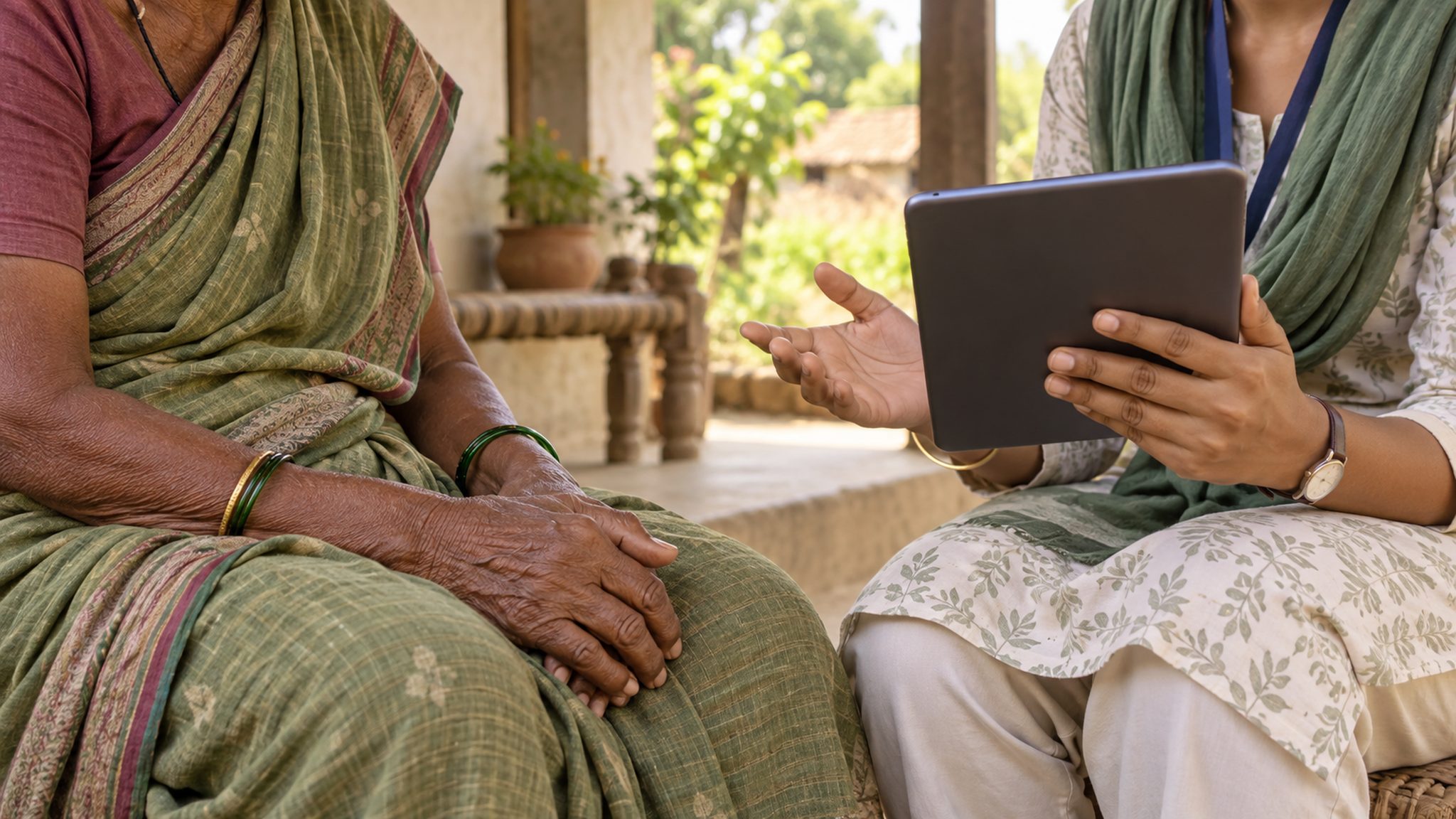
- BC Sakhis and trained community resource persons are intended to explain pension products, facilitate enrolment and provide follow-up support. Local presence can reduce repeated journeys to unfamiliar offices.
- SHG relationships can make questions about documentation and contributions easier to raise. Familiarity creates an opening for explanation, but trust must be supported by accurate information and clear accountability.
- Rural women are explicitly included in the outreach. Participation in a livelihoods group does not itself establish pension enrolment, eligibility for every product, or capacity to make sustained contributions.
- The wider connection between livelihoods and digital access is discussed in rural digital commerce. Here, the distinct challenge is maintaining a long-term relationship after initial pension registration.
Why contribution continuity matters
Understanding a pension product and being able to keep contributing are separate problems for a household with variable earnings.
- Livelihood cycles can produce cash in uneven intervals rather than a monthly salary. The MoU announcement itself recognizes different savings patterns and risk profiles among SHG households.
- Consider a seasonal earner: money available after a sale may fall sharply before the next earning period. This illustrative pattern explains why an enrolment count cannot demonstrate regular retirement saving.
- Contribution gaps leave less money entering an accumulated pension account, all else equal. Outreach can explain account procedures, but cannot manufacture disposable income when essential household expenses absorb earnings.
- Product literacy should explain contributions, charges, access conditions and risks before enrolment. A member needs to understand the actual product, not simply hear that a government-associated pension channel exists.
- Women’s economic participation and retirement security are related but distinct. The female labour-force participation divide provides background; employment alone does not show that earnings are stable or retirement savings adequate.
NPS is different from social assistance
The word pension covers different arrangements; the source of financing and conditions for receiving support determine the distinction.
- NPS is a defined-contribution system: contributions accumulate in an account and are invested. For the voluntary rural subscriber context discussed here, returns are market-linked rather than a newly promised fixed benefit.
- Social assistance supports eligible people through public expenditure instead of requiring them to build an individual investment corpus first. Its eligibility conditions and benefit rules are separate from contributory pension enrolment.
- A delivery intermediary does not change that distinction. Meeting a Pension Sakhi does not automatically confer a social-assistance entitlement or turn a contributory product into a guaranteed government payment.
- No new subsidy or benefit amount is specified in the announcement. Do not infer one from the partnership’s social-security objective, or treat a future implementation commitment as an accomplished outcome.
Monitoring must follow the service, not just sign-ups
Recordkeeping provides a separate accountability mechanism, but a dashboard measures only what its design and follow-up procedures capture.
- The announced approach includes digital dashboards, mobile and web tools, and unique-identifier tracking through Central Recordkeeping Agencies. These are intended to monitor outreach, enrolment and cadre performance.
- Recordkeeping and investment management perform different jobs. PFRDA describes CRAs as handling records, administration and subscriber services; pension funds manage investments. A tracked account does not itself guarantee investment returns.
- Implementation assessment should examine whether members understand the product, can obtain account support and resolve problems. Counting registrations alone misses inactive relationships and households that need further explanation.
- Assisted access needs a route for correcting mistakes without depending indefinitely on one intermediary. This is a governance requirement for the proposed model, not evidence that such arrangements already operate everywhere.
Way Forward
Make continued support measurable
- Train cadres to explain product-specific conditions accurately, distinguish pensions from assistance, and avoid promises unsupported by scheme rules.
- Evaluate continued participation and resolved grievances alongside enrolment, with transparent follow-up responsibilities.
- Offer understandable receipts, account-information access and correction routes so subscriber control survives a change of local intermediary.
Conclusion
- Pension Sakhis offer a community route into retirement services; success depends on informed participation and usable support after enrolment.
- For an answer on inclusive social security, separate the delivery channel, the financing model and the evidence of implementation. Each addresses a different problem.
UPSC Practice Questions
Prelims MCQ 1
With reference to the Pension Sakhis partnership, consider the following statements:
- It proposes using the DAY-NRLM community network for pension outreach.
- The announcement creates a new guaranteed pension amount for every SHG member.
- Central Recordkeeping Agencies are envisaged in monitoring arrangements.
How many of the above statements are correct?
(a) Only one (b) Only two (c) All three (d) None
Answer: (b) Only two
Explanation:
Statements 1 and 3 match the MoU announcement. It does not create a new guaranteed pension amount for every SHG member.
Prelims MCQ 2
Which best distinguishes a defined-contribution pension from non-contributory social assistance?
(a) Both require an individual investment corpus. (b) A local intermediary guarantees both benefits. (c) The former accumulates contributions; the latter provides eligible persons public support without first building such a corpus. (d) Neither depends on applicable eligibility rules.
Answer: (c) The former accumulates contributions; the latter provides eligible persons public support without first building such a corpus.
Explanation:
The distinction concerns financing and benefit design. The use of a community intermediary does not make these arrangements equivalent.
UPSC Mains Questions
- How can SHG networks improve rural retirement inclusion? Discuss the limits of enrolment-led assessment. (150 words)
- Distinguish contributory pensions from social assistance. Explain why irregular earnings complicate retirement inclusion through community intermediaries. (150 words)
Sources: PIB, Ministry of Rural Development and PFRDA, About National Pension System.
Frequently Asked Questions
What are Pension Sakhis?
Pension Sakhis are the proposed community cadre for pension awareness, enrolment facilitation and support under the rural development department’s partnership with PFRDA, drawing on BC Sakhis and other trained resource persons.
Does the MoU announce a guaranteed pension?
No. It announces an outreach and support partnership. It does not specify a new guaranteed pension amount, subsidy or universal entitlement for SHG members and does not change the stated nature of NPS.
Why do irregular earnings matter?
A household may understand a pension product but lack money to contribute consistently. Livelihood cycles and essential expenses affect continuity, so registrations alone cannot establish sustained retirement saving or adequate future security.
Is NPS the same as social assistance?
No. NPS is a defined-contribution pension system. Non-contributory social assistance supports eligible people through public funding without first requiring an individual investment corpus; the arrangements have different conditions and financing.
Are Pension Sakhis already deployed nationwide?
The release records an MoU and a commitment to support deployment. It does not establish that the cadre or every proposed monitoring feature is already functioning across the country.
Tell Google you want more of this.
Add Anantam IAS as a preferred sourceOne tap, and this site shows up more often in your own Top Stories, AI Overviews and AI Mode. Remove it any time.