Daily Digest
UPSC · Civil Services Examination
Current Affairs · Wednesday, 19 August 2026
Current affairs curated and edited by Anantam IAS faculty — pulled from The Hindu, PIB, IDSA, Foreign Affairs and the ministries. Read, annotate, revise.
Old Rajinder Nagar · Delhi 110005 · anantamias.com
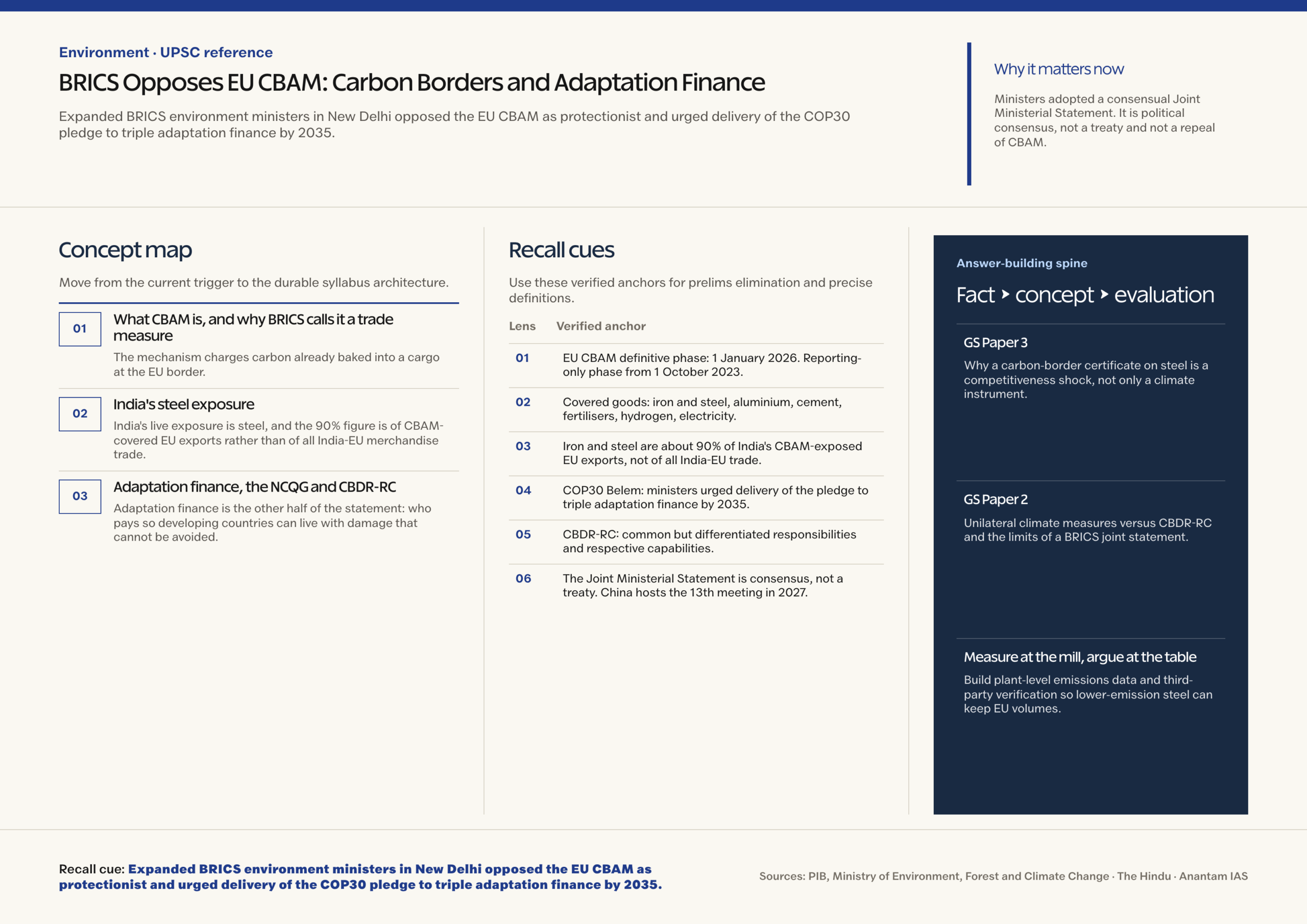
BRICS Opposes EU CBAM: Carbon Borders and Adaptation Finance
Why in News?
The 12th BRICS Environment Ministers’ Meeting, held in New Delhi on 18 August 2026 under India’s chairship, opposed the EU carbon border tax and pressed developed countries for adaptation finance.
- Ministers adopted a consensual Joint Ministerial Statement. It is political consensus, not a treaty and not a repeal of CBAM.
- They opposed what they called unilateral, punitive, discriminatory and protectionist climate measures, including the EU Carbon Border Adjustment Mechanism.
- The EU mechanism entered its definitive phase on 1 January 2026 after a reporting-only phase from 1 October 2023.
- Iron and steel are about 90% of India’s CBAM-exposed EU exports, not of all India-EU trade.
- They urged delivery of the COP30 Belem pledge to triple adaptation finance to developing countries by 2035.
- The statement sits beside an India-EU FTA track. Carbon compliance is a separate instrument from tariff cuts.
- A same-day Commerce session on CBAM reporting shows India is preparing exporters even as BRICS objects.
- Adaptation has historically received a smaller share of climate finance than mitigation.
UPSC Relevance
Prelims Relevance
- EU CBAM definitive phase: 1 January 2026. Reporting-only phase from 1 October 2023.
- Covered goods: iron and steel, aluminium, cement, fertilisers, hydrogen, electricity.
- Iron and steel are about 90% of India’s CBAM-exposed EU exports, not of all India-EU trade.
- COP30 Belem: ministers urged delivery of the pledge to triple adaptation finance by 2035.
- CBDR-RC: common but differentiated responsibilities and respective capabilities.
- The Joint Ministerial Statement is consensus, not a treaty. China hosts the 13th meeting in 2027.
Mains Relevance
GS Paper 3
- Why a carbon-border certificate on steel is a competitiveness shock, not only a climate instrument.
- How adaptation finance differs from mitigation finance, and why the NCQG triple-by-2035 pledge matters.
GS Paper 2
- Unilateral climate measures versus CBDR-RC and the limits of a BRICS joint statement.
- How an India-EU FTA and CBAM can run on the same cargo as two different instruments.
Essay
- A climate rule that only works at someone else’s border is a trade rule.
Background and Context
What CBAM is, and why BRICS calls it a trade measure
The mechanism charges carbon already baked into a cargo at the EU border, which is why BRICS reads it as trade policy rather than shared climate law.
- From 1 January 2026, EU importers of iron and steel, aluminium, cement, fertilisers, hydrogen and electricity must account for embedded production emissions. The legal duty sits on the importer in Europe, not on New Delhi.
- A reporting-only phase ran from 1 October 2023. In the definitive phase from 1 January 2026, importers purchase and surrender certificates tied to carbon emissions embedded in each listed cargo.
- The EU says the levy prevents carbon leakage: carbon-intensive plants leaving the bloc because climate rules are cheaper elsewhere, then selling the same goods back into Europe without paying the EU carbon price.
- The Hindu and Indian Express report that ministers called such measures unilateral, punitive, discriminatory and protectionist, and said they are not in line with international law. That wording is political, not a repeal.
- They said carbon borders can undermine developing countries’ climate and resilience efforts. Treat that as a trade-measure claim, not a science dispute, as in our note on carbon rules as trade rules.
India's steel exposure
India’s live exposure is steel, and the 90% figure is of CBAM-covered EU exports rather than of all India-EU merchandise trade. That distinction is the usual trap.
- The 90% share is of India’s CBAM-exposed EU exports. Treat any answer that applies that share to all India-EU merchandise trade as an exam trap, not a rounding issue.
- A June 2026 analysis in Nature Climate Change matched shipment-level EU trade data with facility-level emissions estimates for Indian steel, and found the reporting phase already moved export volumes and revenues.
- In that reporting phase, high-emission Indian steel firms cut EU export quantities and revenues. Lower-emission firms held volumes, so the border was already sorting plants before certificates began in January.
- The India-EU FTA is a parallel track, not the same instrument. Tariff cuts on a steel cargo do not cancel the need to surrender CBAM certificates at the European border.
- Commerce held a same-day exporter session on embedded-emissions data and verification. Objection in BRICS and mill-level compliance are running together, as with other non-tariff barriers India already faces.
Adaptation finance, the NCQG and CBDR-RC
Adaptation finance is the other half of the statement: who pays so developing countries can live with damage that cannot be avoided, without taking on more debt.
- Adaptation pays to cope with unavoidable impacts on water, agriculture, infrastructure, disaster systems and livelihoods. Mitigation pays to cut greenhouse gases. Do not treat the two as synonyms.
- Adaptation has historically received a smaller share of climate finance than mitigation, even as India’s requirement is increasingly for heat, flood, drought and erratic-rainfall protection rather than only for energy projects.
- Ministers said support should be new, additional, predictable, adequate and accessible, given as grants and concessional finance that does not raise developing-country debt vulnerability, with delivery tracked.
- They urged developed countries to deliver the COP30 Belem NCQG commitment to triple adaptation finance to developing countries by 2035. This is a delivery demand, not a new BRICS fund.
- The statement invoked CBDR-RC: common but differentiated responsibilities and respective capabilities. Cooperation stays voluntary, operational texts are not a treaty, and China hosts the next meeting in 2027.
Way Forward
Measure at the mill, argue at the table
- Build plant-level emissions data and third-party verification so lower-emission steel can keep EU volumes.
- Keep the FTA and CBAM as separate files. Tariff cuts do not retire certificates.
- Press developed countries on NCQG adaptation delivery without turning BRICS into a substitute fund.
- Use CBDR-RC to reject unilateral border taxes while still cutting process emissions at home.
Conclusion
- BRICS has named CBAM a trade measure and asked for adaptation money. The New Delhi text is consensus among ministers, not a rewrite of European carbon-border law.
- For India the live file is steel emissions at the mill and verification of those numbers, not a slogan against every carbon price.
- In an answer, keep the steel-share trap, the certificate phase, the NCQG triple-by-2035 pledge, and CBDR-RC in their correct legal boxes.
UPSC Practice Questions
Prelims MCQ 1
With reference to the 12th BRICS Environment Ministers’ Meeting, consider the following statements:
- The meeting adopted a consensual Joint Ministerial Statement opposing unilateral carbon-border measures such as the EU CBAM.
- Iron and steel account for about 90% of all of India’s exports to the European Union.
- The ministers urged developed countries to meet the COP30 commitment to triple adaptation finance to developing countries by 2035.
How many of the above statements are correct?
(a) Only one (b) Only two (c) All three (d) None
Answer: (b) Only two
Explanation:
Statements 1 and 3 are correct. Statement 2 is not: the 90% share is of India’s CBAM-exposed EU exports, not of all India-EU trade. The New Delhi text is political consensus, not a treaty.
Prelims MCQ 2
The EU Carbon Border Adjustment Mechanism, in its definitive phase beginning 1 January 2026, primarily requires:
(a) Developing-country governments to pay a United Nations levy on steel and aluminium exports (b) EU importers of specified carbon-intensive goods to account for embedded production emissions (c) BRICS members to adopt a common carbon price before trading with Europe (d) India to suspend iron and steel exports to the European Union
Answer: (b) EU importers of specified carbon-intensive goods to account for embedded production emissions
Explanation:
CBAM is an EU importer obligation covering iron and steel, aluminium, cement, fertilisers, hydrogen and electricity. It is not a UN levy, and the BRICS statement created neither a common carbon price nor an export ban.
UPSC Mains Questions
- The EU Carbon Border Adjustment Mechanism is presented as a climate tool and opposed as a trade measure. Examine this tension with reference to India’s steel exports. (250 words)
- Why has adaptation finance lagged mitigation finance, and how does the COP30 pledge to triple adaptation support by 2035 matter for developing countries? (150 words)
Sources: PIB, Ministry of Environment, Forest and Climate Change and The Hindu.
Frequently Asked Questions
What is the EU CBAM?
The Carbon Border Adjustment Mechanism makes EU importers account for greenhouse gases embedded in specified carbon-intensive goods. After a reporting-only phase from October 2023, certificates apply from 1 January 2026.
Why does BRICS call CBAM protectionist?
Ministers said unilateral carbon-border measures can punish developing-country exporters and undermine climate and resilience efforts. They treat CBAM as a trade barrier dressed as climate policy, not as a shared UN rule.
Did the BRICS statement repeal or suspend CBAM?
No. The New Delhi text is a joint ministerial statement. It records political consensus. It does not bind the European Union or create a legal repeal.
What adaptation finance did the ministers ask for?
They wanted new, additional, predictable, adequate and accessible support through grants and concessional finance that does not raise debt. They urged delivery of the COP30 pledge to triple adaptation finance by 2035.
What is CBDR-RC?
Common but differentiated responsibilities and respective capabilities. All countries share the climate problem, but duties and cooperation stay calibrated to national circumstances. BRICS used it to keep commitments voluntary.
Source: https://anantamias.com/current-affairs/brics-eu-cbam-adaptation-finance/
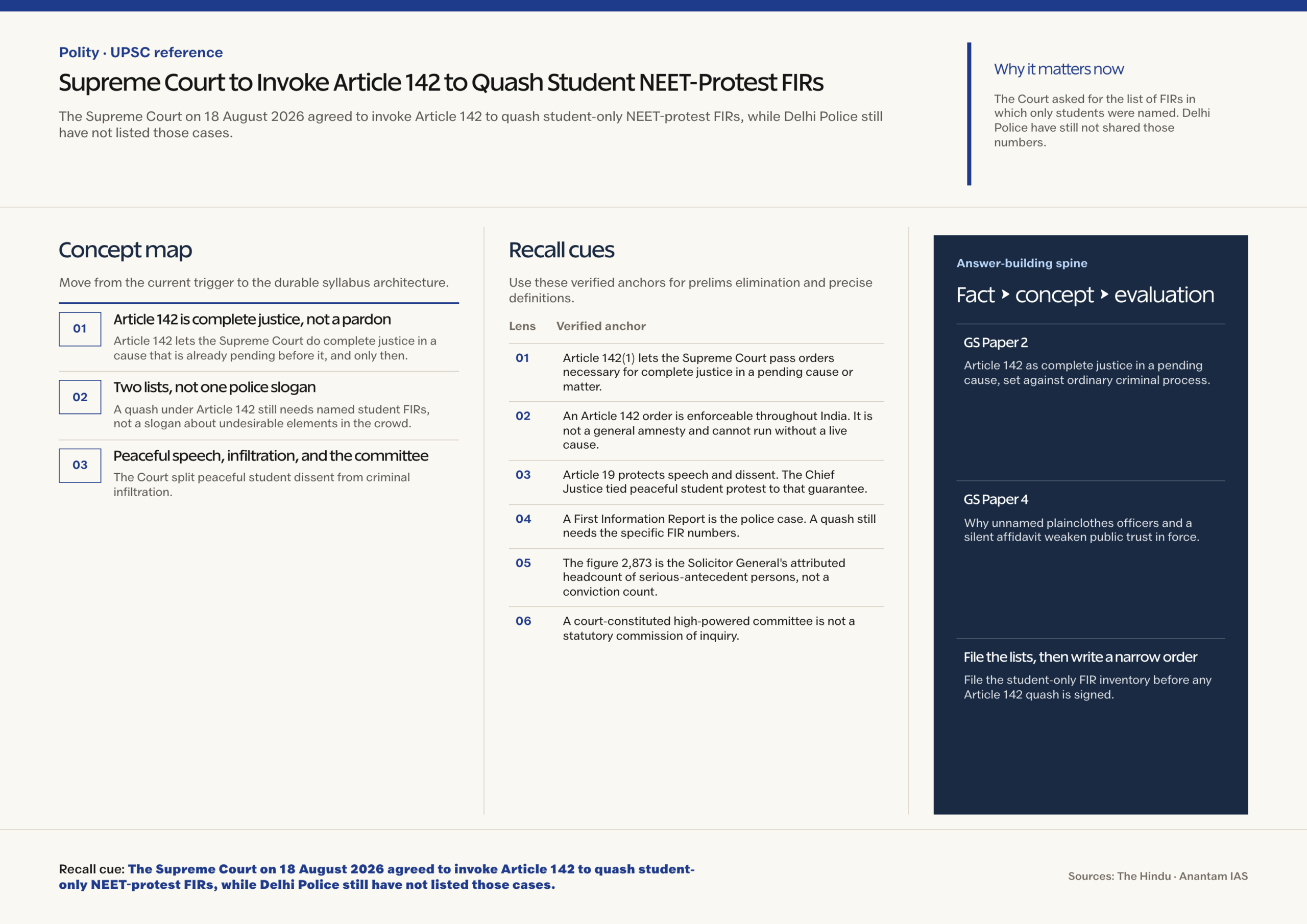
Supreme Court to Invoke Article 142 to Quash Student NEET-Protest FIRs
Why in News?
On 18 August 2026, a three-judge Supreme Court Bench headed by Chief Justice Surya Kant agreed to invoke Article 142 to quash FIRs naming only students in nationwide NEET-UG protest cases.
- The Court asked for the list of FIRs in which only students were named. Delhi Police have still not shared those numbers.
- Chief Justice Kant said the Bench will quash those student-only FIRs under Article 142. Cases with serious criminal antecedents will be heard separately.
- Solicitor General Tushar Mehta, also Delhi Police counsel, said investigation would be confined to 2,873 persons with a serious criminal background identified at the site.
- That 2,873 figure is the SG’s attributed count of history-sheeters, including alleged murder, rape and child sexual abuse charges, not a convicted set.
- The Bench will constitute a high-powered committee on NEET-UG protest issues, invited suggestions, and said the order would come the next day.
- Nationwide student protests over NEET-UG leaks reached the Court after a Delhi crackdown. The grievance is testing failure, not the later force mix.
- Article 142 is complete justice in a pending cause. It is not a standing amnesty for every protest FIR in the country.
- The exam split is peaceful student speech under Article 19 versus identified persons with serious criminal antecedents.
UPSC Relevance
Prelims Relevance
- Article 142(1) lets the Supreme Court pass orders necessary for complete justice in a pending cause or matter.
- An Article 142 order is enforceable throughout India. It is not a general amnesty and cannot run without a live cause.
- Article 19 protects speech and dissent. The Chief Justice tied peaceful student protest to that guarantee.
- A First Information Report is the police case. A quash still needs the specific FIR numbers.
- The figure 2,873 is the Solicitor General’s attributed headcount of serious-antecedent persons, not a conviction count.
- A court-constituted high-powered committee is not a statutory commission of inquiry.
Mains Relevance
GS Paper 2
- Article 142 as complete justice in a pending cause, set against ordinary criminal process.
- Article 19 peaceful protest versus public order when a crowd is infiltrated.
- Police accountability when FIR numbers, named suspects and internal action are missing.
GS Paper 4
- Why unnamed plainclothes officers and a silent affidavit weaken public trust in force.
- How a court should separate student futures from persons with serious criminal antecedents.
Essay
- Complete justice is not the same as a general pardon.
Background and Context
Article 142 is complete justice, not a pardon
Article 142 lets the Supreme Court do complete justice in a cause that is already pending before it, and only then.
- Article 142(1) lets the Court pass any decree or order necessary for doing complete justice in a pending cause or matter. That is the constitutional text, not a slogan from the Bar.
- Any such order is enforceable throughout the territory of India. It is not a free-standing pardon that can run when no cause is on the docket at all.
- On 18 August the three-judge Bench headed by Chief Justice Surya Kant agreed to invoke this power for student-only FIRs. A spoken agreement is still not a signed quash order.
- An objector asked whether the relief would be a one-off or a new precedent. The Court answered in terms of student futures and public confidence in the system, not a protest template.
- Teach Article 142 as case-specific relief inside this cause. It is not a standing amnesty for protest waiting for the next student crowd on the street. That is the exam trap.
Two lists, not one police slogan
A quash under Article 142 still needs named student FIRs, not a slogan about undesirable elements in the crowd. The State must produce both lists.
- The Court asked for every FIR in which only students were named, before any quash can issue. An FIR is a liberty event; see grounds of arrest and personal liberty.
- Delhi Police had promised no action against students who protested peacefully. They have still not disclosed even the FIR numbers on which that promise to the Court depends.
- Counsel Vrinda Grover pointed out that missing inventory. Chief Justice Kant asked how the Bench can quash FIRs that have not been placed before it at all. The list is the first obstacle.
- Justice Joymalya Bagchi said the State cannot refer to undesirable elements in generic terms. Identification is a duty the Court can test, not a courtroom flourish.
- Solicitor General Tushar Mehta said police had identified 2,873 persons with a serious criminal background at the site, including history-sheeters, and that the rest, in his words, are students.
Peaceful speech, infiltration, and the committee
The Court split peaceful student dissent from criminal infiltration, then sent the leftover protest issues to a high-powered committee.
- Chief Justice Kant tied the gathering to the Article 19 right to speech and dissent, so long as students intended to hold a peaceful and lawful protest on their exam demands.
- He drew a clear line between peacefully agitating students and hardened criminals who had infiltrated the protest to spread violence rather than to press exam demands. The two tracks must stay separate.
- Nationwide protests over NEET-UG leaks reached the Court after a Delhi crackdown. The trigger is testing failure, not the later force mix; see also paper-leak courts.
- The Bench will constitute a high-powered committee on protest issues, invited suggestions, heard a request for a woman member, and said the order would be out the next day.
- The panel must look urgently at alleged sexual molestation of women protesters. The Delhi Police affidavit is silent on internal action and admits plainclothes policemen without name tags.
Way Forward
File the lists, then write a narrow order
- File the student-only FIR inventory before any Article 142 quash is signed.
- Identify the 2,873 serious-antecedent cases by name and charge, not only by a rounded headcount.
- Put molestation allegations and unnamed plainclothes officers on the committee’s urgent list.
- Keep the relief inside this cause. Article 142 should not become a standing protest amnesty.
Conclusion
- The news is a promised use of Article 142, not a signed quash. Without the student-only FIR list, complete justice still has no file to act on.
- In an answer, split Article 19 student speech from identified serious-antecedent cases, and treat 2,873 as an attributed police count, not a convicted class.
- Put force, molestation and unnamed officers on the committee’s urgent list. Those facts belong with the panel, not inside the Article 142 paragraph.
UPSC Practice Questions
Prelims MCQ 1
With reference to the Supreme Court’s 18 August 2026 hearing on NEET-UG protest FIRs, consider the following statements:
- Article 142(1) empowers the Supreme Court to pass such decree or make such order as is necessary for doing complete justice in any cause or matter pending before it.
- The Bench agreed to invoke Article 142 for FIRs in which only students were named, while FIRs involving persons with serious criminal antecedents would be decided separately.
- The figure of 2,873 is a Supreme Court finding that 2,873 protesters have been convicted of serious offences.
How many of the above statements are correct?
(a) Only one (b) Only two (c) All three (d) None
Answer: (b) Only two
Explanation:
Statements 1 and 2 follow the constitutional text and the Chief Justice’s 18 August statement. Statement 3 is wrong: 2,873 is the Solicitor General’s attributed count of persons with a serious criminal background identified at the site, not a convicted set.
Prelims MCQ 2
The Supreme Court’s 18 August 2026 response to student FIRs from the NEET-UG protests is best described as:
(a) A final Article 142 order quashing every FIR arising from the protests (b) An agreement to invoke Article 142 for student-only FIRs after the Court obtains that list (c) A direction that Delhi Police drop the 2,873 serious-antecedent investigations (d) A constitutional amendment creating a standing amnesty for student protest
Answer: (b) An agreement to invoke Article 142 for student-only FIRs after the Court obtains that list
Explanation:
The Bench agreed to use Article 142 and asked for the student-only FIR list. It has not signed a quash, has not closed the 2,873 track, and has not rewritten the Constitution.
UPSC Mains Questions
- Article 142 is a power to do complete justice in a pending cause, not a general protest amnesty. Discuss with reference to the 18 August 2026 NEET-UG student FIR hearing. (250 words)
- How should constitutional courts separate peaceful student speech under Article 19 from criminal infiltration of a public protest? (150 words)
Source: The Hindu.
Frequently Asked Questions
Has the Supreme Court quashed the NEET-protest FIRs?
No. On 18 August 2026 the Bench agreed to invoke Article 142 for student-only FIRs. It first wants that list. No quash order is yet on the record.
What is Article 142?
Article 142(1) lets the Supreme Court pass any order needed for complete justice in a cause or matter pending before it. The order is enforceable throughout India.
Who are the 2,873 persons mentioned in court?
The Solicitor General said police would confine investigation to 2,873 persons with a serious criminal background identified at the site. It is an attributed count, not a convicted set.
Why does the Court need the FIR list?
Without FIRs that name only students, the Court cannot identify whom an Article 142 quash would cover. Delhi Police have not shared even the FIR numbers.
What will the high-powered committee examine?
It will examine NEET-UG protest issues, including urgent allegations of sexual molestation of women protesters. The Bench invited suggestions and heard a request for a woman member.
Source: https://anantamias.com/current-affairs/sc-article-142-neet-protest-firs/
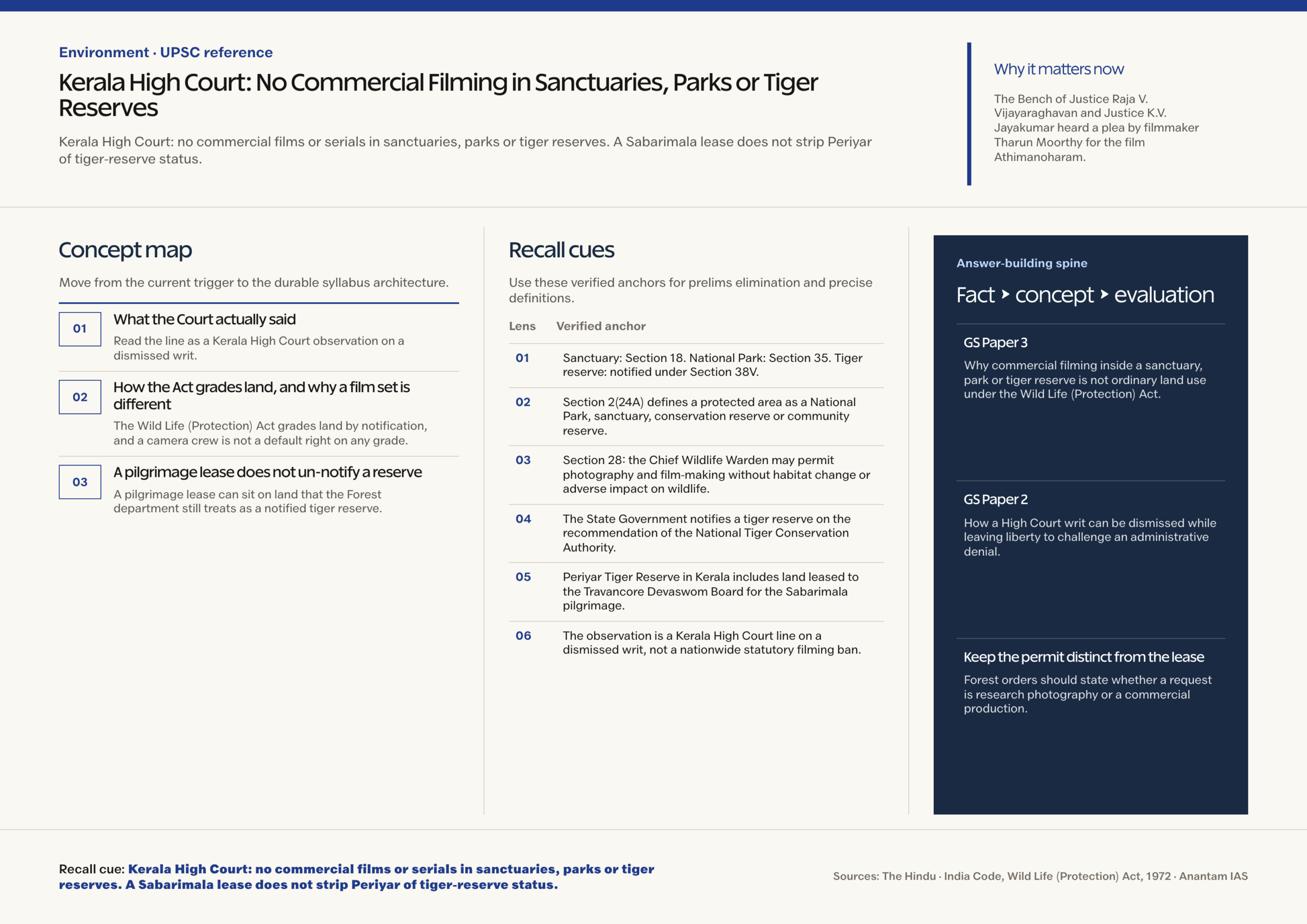
Kerala High Court: No Commercial Filming in Sanctuaries, Parks or Tiger Reserves
Why in News?
A Kerala High Court Division Bench on 19 August 2026 observed that commercial films and television serials cannot be shot in sanctuaries, national parks or tiger reserves.
- The Bench of Justice Raja V. Vijayaraghavan and Justice K.V. Jayakumar heard a plea by filmmaker Tharun Moorthy for the film Athimanoharam.
- The petition sought directions to the Divisional Forest Officer, Ranni, and the Deputy Director, Periyar West Division, Peerumedu, to consider the shooting requests.
- The Travancore Devaswom Board had granted permission subject to Forest clearance. The Deputy Director treated the sites as part of Periyar Tiger Reserve.
- Two locations in the director’s request could be allowed from 18 to 28 August if fees were paid and an agreement executed with the Forest and Wildlife department.
- The petition was dismissed. The court noted the petitioners were still free to challenge the Deputy Director’s denial of permission.
- The exam object is commercial use inside a notified protected area, not a buffer around it.
- A pilgrimage lease does not convert tiger-reserve land into ordinary temple land.
- A High Court observation on a dismissed petition is not a Supreme Court ruling or a WPA amendment.
UPSC Relevance
Prelims Relevance
- Sanctuary: Section 18. National Park: Section 35. Tiger reserve: notified under Section 38V.
- Section 2(24A) defines a protected area as a National Park, sanctuary, conservation reserve or community reserve. A tiger reserve is a separate overlay.
- Section 28: the Chief Wildlife Warden may permit photography and film-making without habitat change or adverse impact on wildlife.
- The State Government notifies a tiger reserve on the recommendation of the National Tiger Conservation Authority.
- Periyar Tiger Reserve in Kerala includes land leased to the Travancore Devaswom Board for the Sabarimala pilgrimage.
- The observation is a Kerala High Court line on a dismissed writ, not a nationwide statutory filming ban.
Mains Relevance
GS Paper 3
- Why commercial filming inside a sanctuary, park or tiger reserve is not ordinary land use under the Wild Life (Protection) Act, 1972.
- How a tiger-reserve overlay under Section 38V sits on, and does not erase, protected-area status.
GS Paper 2
- How a High Court writ can be dismissed while leaving liberty to challenge an administrative denial.
- Why a temple-board lease cannot outrank Forest permission inside a notified reserve.
Essay
- A lease can move pilgrims to a shrine. It cannot un-notify a tiger.
Background and Context
What the Court actually said
Read the line as a Kerala High Court observation on a dismissed writ, not as a new all-India filming statute for every reserve.
- The Division Bench, on the filmmaker’s plea, said permission cannot be granted for shooting commercial films and television serials in wildlife sanctuaries, national parks or tiger reserves.
- The writ asked the Divisional Forest Officer, Ranni, and the Deputy Director, Periyar West Division, Peerumedu, to consider the shooting requests. The court dismissed that plea.
- Two named locations in the director’s request could still be used from 18 to 28 August if required fees were paid and an agreement executed with the Forest and Wildlife department.
- Even after dismissal, the court noted that the petitioners remained free to challenge the Deputy Director’s denial of permission as a separate administrative decision, not a closed filming file.
- The Hindu reported the observation as a High Court line on this plea, not as Parliament rewriting the Wild Life (Protection) Act, 1972.
How the Act grades land, and why a film set is different
The Wild Life (Protection) Act grades land by notification, and a camera crew is not a default right on any grade.
- A sanctuary is declared under Section 18, with regulated entry and permitted uses. A National Park is declared under Section 35 and bars habitat destruction more tightly than a sanctuary.
- A tiger reserve is notified by the State Government on the recommendation of the National Tiger Conservation Authority under Section 38V. Its core is meant to stay inviolate.
- Section 2(24A) lists National Park, sanctuary, conservation reserve and community reserve as protected areas. A tiger reserve is a further overlay, not a fifth name in that list.
- The 2022 amendment of Section 28 lets the Chief Wildlife Warden permit photography and film-making only where there is no habitat change and no adverse impact on wildlife.
- A commercial film or serial brings crews, generators, sets and shooting schedules. That is not ordinary photography or a default use of reserve land. The High Court drew that line for commercial films and serials.
A pilgrimage lease does not un-notify a reserve
A pilgrimage lease can sit on land that the Forest department still treats as a notified tiger reserve.
- After the petition was lodged, the Deputy Director said the requested areas form part of Periyar Tiger Reserve, leased to the Devaswom Board to facilitate the Sabarimala pilgrimage.
- A lease for pilgrimage facilities is only a land-management arrangement. Protected-area and tiger-reserve status come from a WPA notification, not from who holds the lease or who admits a film crew.
- Temple-board permission cannot outrank Forest permission inside a reserve. The Travancore Devaswom Board itself granted its nod only subject to prior permission from Forest officials.
- An eco-sensitive zone is a buffer instrument around a protected area. Today’s dispute is commercial use inside the reserve, not the width of a surrounding belt.
- A tiger reserve still needs inviolate-core logic, as in our note on Buxa tiger reintroduction. Filming is a use question, not a release or corridor question.
Way Forward
Keep the permit distinct from the lease
- Forest orders should state whether a request is research photography or a commercial production.
- Board or temple leases inside reserves should recite that WPA restrictions continue to bind the land.
- Cite High Court observations with the petition outcome: dismissed, with a narrow location window still open.
- A state filming protocol should distinguish non-invasive recording from occupation of habitat by a film set.
Conclusion
- Commercial filming inside a sanctuary, national park or tiger reserve is not ordinary land use, even if a temple board has leased the ground for pilgrimage.
- Cite this as a Kerala High Court observation on a dismissed petition, not as a Supreme Court ruling, a WPA amendment, or a nationwide statutory ban.
- Keep the two-location, fee-and-agreement window in the same answer, or the holding will be overstated as an absolute filming lock with no Forest window at all.
UPSC Practice Questions
Prelims MCQ 1
With reference to commercial filming in protected areas, consider the following statements:
- The Kerala High Court observed that permission cannot be granted for shooting commercial films and television serials in wildlife sanctuaries, national parks or tiger reserves.
- The writ petition seeking directions to Forest officers to consider the shooting request was allowed.
- Under the Wild Life (Protection) Act, 1972, a tiger reserve is notified by the State Government on the recommendation of the National Tiger Conservation Authority.
How many of the above statements are correct?
(a) Only one (b) Only two (c) All three (d) None
Answer: (b) Only two
Explanation:
Statements 1 and 3 are correct. The petition was dismissed, so statement 2 is wrong.
Prelims MCQ 2
Land proposed for a film shoot in Periyar had been leased to the Travancore Devaswom Board for the Sabarimala pilgrimage. Which one of the following is the correct implication?
(a) The lease converts the land into ordinary temple land outside the Wild Life (Protection) Act. (b) Permission from the temple board is a complete substitute for Forest permission. (c) The lease does not, by itself, strip tiger-reserve or protected-area status. (d) The Kerala High Court amended the Wild Life (Protection) Act to create a nationwide filming ban.
Answer: (c) The lease does not, by itself, strip tiger-reserve or protected-area status.
Explanation:
The Deputy Director treated the sites as part of Periyar Tiger Reserve despite the pilgrimage lease. The Board’s own nod was subject to Forest permission. The High Court dismissed the writ; it did not amend the Act.
UPSC Mains Questions
- Commercial filming in a tiger reserve is not ordinary land use. Examine with reference to the Wild Life (Protection) Act, 1972 and the Kerala High Court observation. (250 words)
- A pilgrimage lease over forest land does not extinguish protected-area status. Discuss. (150 words)
Sources: The Hindu and India Code, Wild Life (Protection) Act, 1972.
Frequently Asked Questions
Did the Kerala High Court ban filming nationwide?
No. It observed, on a dismissed Kerala plea, that permission cannot be granted for commercial films and serials in sanctuaries, national parks or tiger reserves. That is not a WPA amendment or a Supreme Court ruling.
What happened to the filmmaker’s petition?
The Division Bench dismissed the writ seeking directions to Forest officers at Ranni and Peerumedu. Petitioners remain free to challenge the Deputy Director’s denial of permission.
Could any shooting still happen?
Yes. Two locations in the director’s request could be allowed from 18 to 28 August if required fees were paid and an agreement was executed with the Forest and Wildlife department.
Does a Sabarimala lease remove Periyar from the WPA?
No. The Deputy Director treated the sites as part of Periyar Tiger Reserve, leased to the Travancore Devaswom Board for pilgrimage. A lease does not un-notify a tiger reserve.
Does the WPA allow any filming in a sanctuary?
Section 28 lets the Chief Wildlife Warden permit photography and film-making without habitat change or adverse impact on wildlife. A commercial film set is not that default permit.
Source: https://anantamias.com/current-affairs/kerala-hc-wildlife-sanctuary-filming-ban/
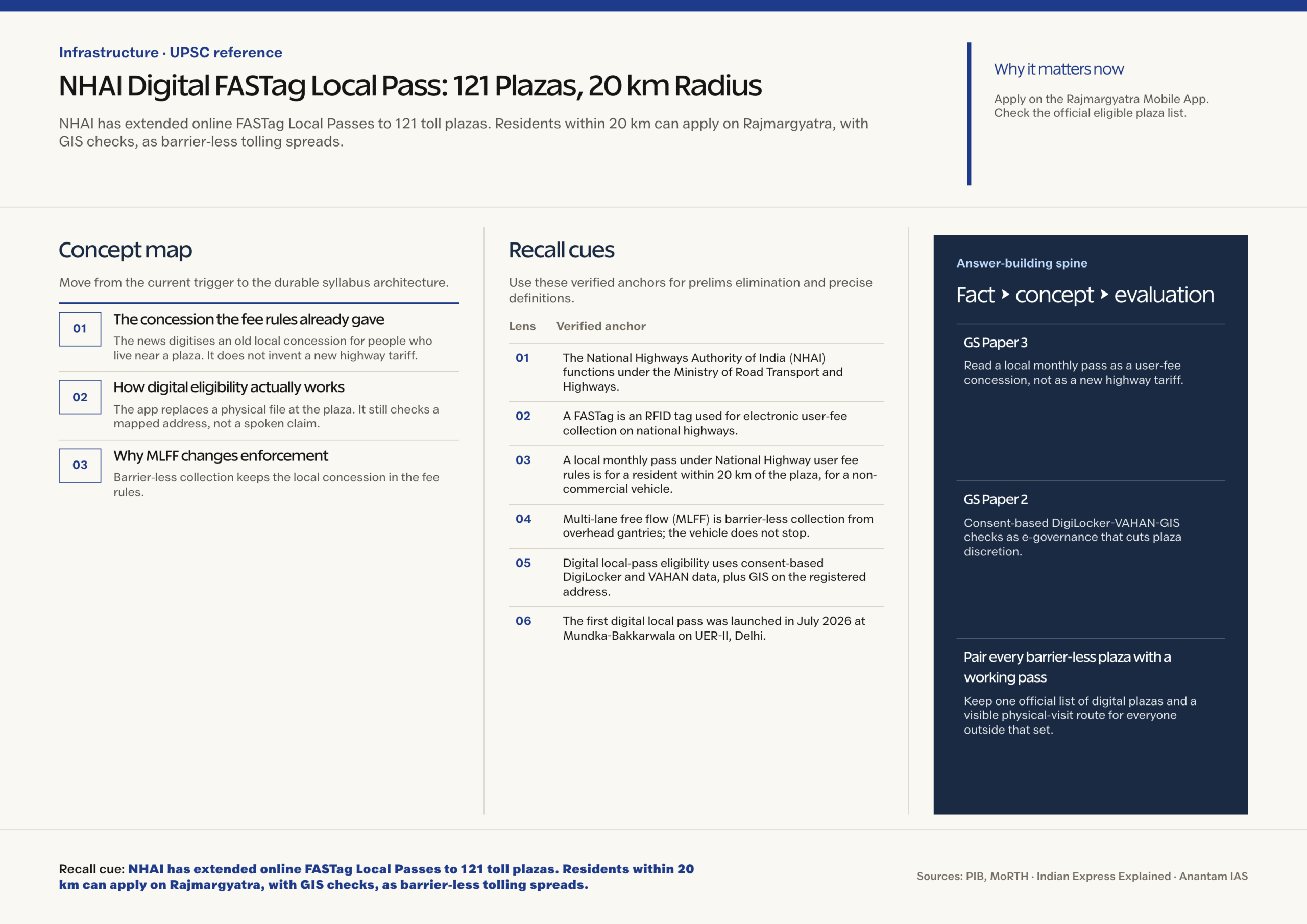
NHAI Digital FASTag Local Pass: 121 Plazas, 20 km Radius
Why in News?
NHAI, on 18 August 2026, extended online FASTag Local Passes to 121 toll plazas, so eligible residents can buy a monthly pass on the Rajmargyatra app.
- Apply on the Rajmargyatra Mobile App. Check the official eligible plaza list.
- Eligibility: residents within 20 km of an eligible plaza. GIS checks the registered address.
- Consent-based pull from DigiLocker, VAHAN and the linked FASTag retrieves address, vehicle and tag.
- The first digital local pass launched in July 2026 at Mundka-Bakkarwala on UER-II, Delhi.
- Indian Express reports MLFF live at six plazas. Unpaid barrier-less travel can attract e-notices.
- With no booth staff, locals who once relied on familiarity now receive e-notices for unpaid user fee.
- Indian Express says unpaid MLFF can mean double the toll. A FASTag-linked digital pass is the compliance path.
- Residents who do not live near these 121 plazas still visit a plaza physically for a monthly pass.
UPSC Relevance
Prelims Relevance
- The National Highways Authority of India (NHAI) functions under the Ministry of Road Transport and Highways.
- A FASTag is an RFID tag used for electronic user-fee collection on national highways.
- A local monthly pass under National Highway user fee rules is for a resident within 20 km of the plaza, for a non-commercial vehicle.
- Multi-lane free flow (MLFF) is barrier-less collection from overhead gantries; the vehicle does not stop.
- Digital local-pass eligibility uses consent-based DigiLocker and VAHAN data, plus GIS on the registered address.
- The first digital local pass was launched in July 2026 at Mundka-Bakkarwala on UER-II, Delhi.
Mains Relevance
GS Paper 3
- Read a local monthly pass as a user-fee concession, not as a new highway tariff.
- Explain why barrier-less MLFF turns an informal booth waiver into e-notices and double-toll risk.
GS Paper 2
- Consent-based DigiLocker-VAHAN-GIS checks as e-governance that cuts plaza discretion.
- The limit: a stale registered address can deny a person who actually lives inside 20 km.
Essay
- When collection becomes automatic, a neighbour is no longer a fee waiver.
Background and Context
The concession the fee rules already gave
The news digitises an old local concession for people who live near a plaza. It does not invent a new highway tariff.
- National Highway user fee rules already issue a monthly pass at the concerned plaza to a resident for a non-commercial vehicle, which is the legal hook this digital channel now uses.
- Indian Express cites the listed monthly fee as Rs 350 for that resident vehicle. Treat it as the existing rule price, not a tariff born in August 2026.
- The pass is plaza-specific. It allows unlimited travel through that plaza during the month, as per applicable provisions, not a free run across every national highway plaza.
- Eligibility is residency within 20 km of the plaza. A long commute from farther away does not create the same monthly-pass right, even if the driver uses that gate daily.
- Commercial vehicles sit outside this resident monthly-pass design. Do not write the digital channel as a general cut in freight user fee or as a rebate for every repeat crossing.
How digital eligibility actually works
The app replaces a physical file at the plaza. It still checks a mapped address, not a spoken claim.
- Apply on the Rajmargyatra Mobile App. Earlier, the resident visited the plaza and filed papers to prove the 20 km address, which is the queue this channel is meant to cut.
- With the applicant’s consent, the stack retrieves residential address, vehicle details and the linked tag from DigiLocker, VAHAN and the linked FASTag, so the file is not a self-typed claim.
- GIS then tests whether that registered address falls inside the 20 km radius of the chosen eligible plaza. Distance is measured from the record, not from where the driver says home is.
- If the registered address sits outside 20 km, the application can fail even when the person actually lives nearby. That is a data-quality limit, not a small software glitch.
- The eligible-plaza list is on the official Rajmargyatra page. Digital issue today covers 121 plazas; residents outside that set still go to a plaza in person, though PIB said more plazas will follow.
Why MLFF changes enforcement
Barrier-less collection keeps the local concession in the fee rules. It removes the person who once waved a neighbour through.
- Multi-lane free flow (MLFF) reads FASTag from an overhead gantry. The vehicle does not stop, and there is no booth clerk left to recognise a local face and waive the fee.
- Indian Express reports barrier-less MLFF live at six plazas: Choryasi, Mundaka, Daulatpura, Gharaunda, Manoharpur and Shahjahanpur. That six is a collection design, not the 121-plaza digital-pass list.
- Mundka-Bakkarwala on UER-II, Delhi, went MLFF on 11 May 2026. The first digital local pass followed at that same plaza in July 2026, after e-notices showed the gap.
- Officials told Indian Express that residents within 20 km were a large share of e-notices, because many crossed on familiarity with booth staff rather than on a pass.
- Unpaid MLFF can attract double the toll. A monthly pass linked to FASTag is the lawful way to keep the local concession once the barrier is gone, which is enforcement rather than a new tax.
Way Forward
Pair every barrier-less plaza with a working pass
- Keep one official list of digital plazas and a visible physical-visit route for everyone outside that set.
- Build a redress path when GIS rejects a person whose life is inside 20 km but whose registered address is stale.
- Do not switch a plaza to MLFF until a working FASTag-linked local pass exists for that 20 km ring.
- Score the reform on fewer wrongful e-notices and cleaner local compliance, not on app-download counts.
Conclusion
- The 121-plaza roll-out digitises a 20 km resident concession that already lived in National Highway user fee rules, and it is not a new user-fee schedule for the whole network.
- MLFF removes the informal waiver at the booth. Without a FASTag-linked pass, the same local now faces e-notices and a double-toll risk, which is the enforcement point of barrier-less collection.
- In an answer, separate the old concession, the GIS eligibility stack, and the enforcement change at barrier-less plazas; mixing those three is how this topic gets muddled.
UPSC Practice Questions
Prelims MCQ 1
With reference to NHAI’s digital FASTag Local Pass, consider the following statements:
- Residents living within 20 km of an eligible toll plaza can apply for a digital local pass on the Rajmargyatra app.
- The monthly pass for a resident’s non-commercial vehicle is a new NHAI tariff notified with the 121-plaza digital extension.
- Digital eligibility uses consent-based retrieval from DigiLocker and VAHAN, plus GIS verification of the registered address.
How many of the above statements are correct?
(a) Only one (b) Only two (c) All three (d) None
Answer: (b) Only two
Explanation:
Statements 1 and 3 are correct. The monthly pass already existed under National Highway user fee rules; August 2026 digitised the channel at 121 plazas.
Prelims MCQ 2
The first Digital FASTag Local Pass facility in India was launched at:
(a) Choryasi toll plaza in Gujarat, which also hosts barrier-less MLFF (b) Mundka-Bakkarwala toll plaza on Urban Extension Road-II (UER-II) in Delhi (c) All 121 notified plazas, in a single July 2026 launch (d) Every FASTag plaza on the Golden Quadrilateral
Answer: (b) Mundka-Bakkarwala toll plaza on Urban Extension Road-II (UER-II) in Delhi
Explanation:
PIB says the first Digital Local Pass facility was launched in July 2026 at Mundka-Bakkarwala on UER-II, Delhi. Choryasi is among the six MLFF plazas, not that first digital-pass site.
UPSC Mains Questions
- Barrier-less tolling changes how a local user-fee concession is enforced. Discuss with reference to NHAI’s digital FASTag local pass. (250 words)
- Digitising eligibility can shrink booth-level discretion. Examine the governance trade-off in GIS address checks for FASTag local passes. (150 words)
Sources: PIB, Ministry of Road Transport and Highways and Indian Express Explained.
Frequently Asked Questions
What did NHAI announce on 18 August 2026?
NHAI extended online FASTag Local Passes to 121 toll plazas. Eligible residents can buy a monthly pass on the Rajmargyatra app instead of filing papers at the plaza.
Who can apply for the digital local pass?
Residents living within 20 km of an eligible plaza can apply. GIS checks the registered address pulled, with consent, from DigiLocker, VAHAN and the linked FASTag, not a verbal claim.
Is Rs 350 a new NHAI price?
No. Indian Express cites Rs 350 as the existing National Highway user-fee monthly pass for a resident’s non-commercial vehicle. The August 2026 news is the digital channel, not a new rate.
Why does MLFF make the local pass urgent?
Barrier-less plazas have no booth staff. Locals who crossed on familiarity now get e-notices, and unpaid MLFF can mean double the toll. A FASTag-linked pass is the compliance path.
What if a person does not live near these 121 plazas?
That person still visits a plaza physically to obtain a monthly pass. The digital facility is plaza-listed, not a nationwide online pass for every FASTag user.
Source: https://anantamias.com/current-affairs/nhai-digital-fastag-local-pass/
Census 2027 Population Enumeration: Parental Data and New Fields
Why in News?
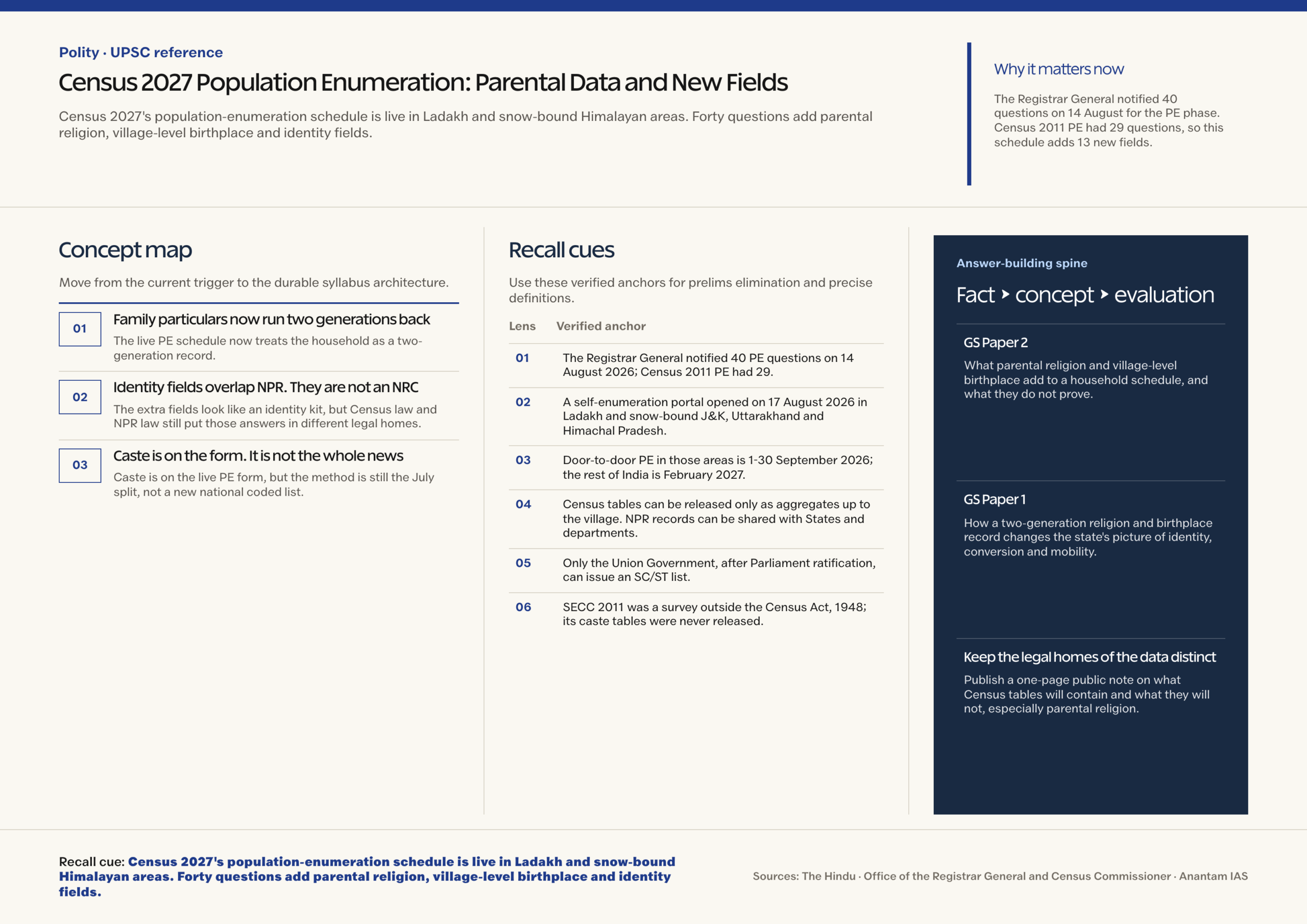
The Hindu reports that the Census 2027 population-enumeration schedule went live on 17 August 2026 in Ladakh and snow-bound Himalayan areas, and now asks for both parents’ religion and village-level place of birth.
- The Registrar General notified 40 questions on 14 August for the PE phase. Census 2011 PE had 29 questions, so this schedule adds 13 new fields.
- Under Family Particulars, the form records religion, date of birth and place of birth up to the village for both father and mother, with an option if born outside India.
- A self-enumeration portal opened on 17 August in Ladakh and snow-bound J&K, Uttarakhand and Himachal. Door-to-door there is 1-30 September; the rest of India is February 2027.
- Other first-time items sit as one class of identity and digital fields: spouse’s name, nationality, digital literacy, permanent address, vaccination place, bank accounts, and IDs if available.
- Caste is marked mandatory. SC/ST pick a drop-down; others type a name. Options include Does not want to declare Caste and No Caste.
- Parental religion and village-level birthplace turn the form into a family-history record, not only a snapshot of who lives in the house now.
- Several new fields overlap the 2019 NPR rehearsal. NPR is a resident database. Overlap is not an NRC, and the two instruments must stay distinct.
- Caste enumeration is Independent India’s first beyond SC and ST, but the live news is the wider PE schedule, not a replay of the July method fight.
UPSC Relevance
Prelims Relevance
- The Registrar General notified 40 PE questions on 14 August 2026; Census 2011 PE had 29.
- A self-enumeration portal opened on 17 August 2026 in Ladakh and snow-bound J&K, Uttarakhand and Himachal Pradesh.
- Door-to-door PE in those areas is 1-30 September 2026; the rest of India is February 2027.
- Census tables can be released only as aggregates up to the village. NPR records can be shared with States and departments.
- Only the Union Government, after Parliament ratification, can issue an SC/ST list.
- SECC 2011 was a survey outside the Census Act, 1948; its caste tables were never released.
Mains Relevance
GS Paper 2
- What parental religion and village-level birthplace add to a household schedule, and what they do not prove.
- Why Census aggregates and an NPR resident file are different instruments even when some questions overlap.
GS Paper 1
- How a two-generation religion and birthplace record changes the state’s picture of identity, conversion and mobility.
Essay
- What a state asks about parents, it is preparing to see as a lineage, not only a household.
Background and Context
Family particulars now run two generations back
The live PE schedule now treats the household as a two-generation record, not only a list of people present on the count day in that house.
- Under Family Particulars, the form seeks religion, date of birth and place of birth up to the village for both father and mother, not only for the person being enumerated.
- If a parent was born outside India, that fact can be recorded as such. The field is a migration and origin hook. It is not, by itself, a citizenship or NRC question.
- Six religions appear as listed options: Hindu, Christian, Sikh, Buddhist, Muslim and Jain. Anyone else can record other religion in a separate column on the same family head.
- Asking the parents’ religion as well as the person’s lets later tables show conversion, inter-faith households and inherited identity, but only if those tables are actually published.
- Village-level parental birthplace is finer than a state-of-origin box. It can map one-generation mobility between villages and districts, which a usual-residence question on the same person cannot show by itself.
Identity fields overlap NPR. They are not an NRC
The extra fields look like an identity kit, but Census law and NPR law still put those answers in different legal homes, not one register.
- First-time PE items form one class of identity and digital access: spouse’s name, nationality, digital literacy, permanent address, COVID-19 vaccination place, number of bank accounts, and IDs if available.
- Some of those fields, including parental particulars and ID numbers if available, mirror the 2019 NPR rehearsal. Overlap of questions is still not proof that this Census is an NRC.
- NPR was first prepared in 2011 and updated in 2015. It already holds a family-wise database of 119 crore residents. A planned update with the first phase of houselisting was deferred.
- Census output can be released only as aggregates up to the village. NPR records can be shared with States and departments. That legal difference, not the shared questions, is the exam point.
- The NPR update sat on the back burner amid NRC fears. Keep the instruments apart in every answer: a Census schedule that asks similar questions is still not a citizenship register.
Caste is on the form. It is not the whole news
Caste is on the live PE form, but the method is still the July split, not a new national coded list.
- Question 10(C) reads: if the person is not SC/ST in this State/UT, enter the caste name. Those caste fields are marked mandatory. This is the live PE schedule, not a July rehearsal sheet.
- This is Independent India’s first caste count beyond SC and ST. SC and ST pick a drop-down; others type. Options include Does not want to declare Caste and No Caste.
- Only the Union Government can issue an SC/ST list after Parliament ratifies it. That is why the drop-down is State/UT-specific, not a free national menu of every caste.
- One comparison: SECC 2011, a survey outside the Census Act, 1948, returned over 46 lakh caste names; the 1931 Census listed 4,147. SECC caste tables were never released.
- The July rehearsal already tested this split. See our note on the Census 2027 caste open-column test. Today’s news is that the same design now sits on a notified PE schedule.
Way Forward
Keep the legal homes of the data distinct
- Publish a one-page public note on what Census tables will contain and what they will not, especially parental religion, birthplace and ID fields.
- Train enumerators that IDs are recorded if available, so a missing Aadhaar, passport or voter card is not treated as a failed count.
- Issue caste coding and synonym rules before the February 2027 national PE, or the open field will splinter names the way SECC did.
- Keep NPR and Census on separate legal tracks in every official briefing, so overlap of questions is not read as a citizenship drive.
Conclusion
- The PE schedule is now live in snow-bound India, ahead of the rest of the country. The new fields that matter are parental religion and village-level birthplace, plus a class of identity and digital items.
- In an answer, name the 14 August Gazette, the 17 August portal, the September snow-bound calendar, and the Census-versus-NPR release rule before any politics.
- Caste is on the form, but it is one field among 40. Do not treat the schedule as an NRC, and do not rebuild the July method debate.
UPSC Practice Questions
Prelims MCQ 1
With reference to the Census 2027 population-enumeration schedule, consider the following statements:
- The Registrar General notified a 40-question PE schedule on 14 August 2026.
- Self-enumeration opened on 17 August 2026 in Ladakh and specified snow-bound areas.
- Door-to-door PE in those snow-bound areas is scheduled for February 2027.
How many of the above statements are correct?
(a) Only one (b) Only two (c) All three (d) None
Answer: (b) Only two
Explanation:
Statements 1 and 2 are correct. Door-to-door PE in Ladakh and the snow-bound areas is 1-30 September 2026. February 2027 is the rest of India, so statement 3 is wrong.
Prelims MCQ 2
Which one of the following correctly distinguishes Census data from the National Population Register?
(a) Both can be released only as village-level aggregates (b) Census tables are released as aggregates up to the village; NPR records can be shared with States and departments (c) NPR is conducted under the Census Act, 1948, while the Census is not (d) The Census records only houses; NPR records only individuals
Answer: (b) Census tables are released as aggregates up to the village; NPR records can be shared with States and departments
Explanation:
Census output is statistical and aggregate. NPR is a family-wise resident database that can be shared with States and departments. Shared questions do not make them the same instrument.
UPSC Mains Questions
- The Census 2027 PE schedule asks for religion and village-level birthplace of both parents. What does this change about the state’s picture of the household? (150 words)
- Overlap between Census 2027 questions and the 2019 NPR rehearsal has revived NRC fears. Distinguish the two instruments and explain why the legal home of the data matters. (250 words)
Sources: The Hindu and Office of the Registrar General and Census Commissioner, India.
Frequently Asked Questions
What is new in the Census 2027 PE schedule?
The notified PE form has 40 questions against 29 in 2011. The live change is family particulars: religion, date of birth and village-level birthplace of both parents, plus a class of identity and digital fields.
Where has the PE schedule gone live first?
On 17 August 2026, through a self-enumeration portal in Ladakh and snow-bound parts of Jammu and Kashmir, Uttarakhand and Himachal Pradesh. Door-to-door visits there run from 1 to 30 September 2026.
Does this Census create an NRC?
No. Some new questions overlap the 2019 NPR rehearsal, and NPR was deferred amid NRC fears. Census tables are village-level aggregates. NPR is a shareable resident database. Shared questions are not a citizenship register.
How is caste being recorded on the live form?
SC and ST respondents pick from a State/UT drop-down. Others type a caste name. Options include Does not want to declare Caste and No Caste. Fields are mandatory. Only the Union, after Parliament, can notify SC/ST lists.
When is PE in the rest of India?
February 2027. The snow-bound calendar is earlier so Himalayan areas can be counted before winter closes the field. The 40 questions were notified on 14 August 2026.
Source: https://anantamias.com/current-affairs/census-2027-population-enumeration-schedule/
NTA Removes 600 Exam Experts and Rebuilds Confidential Operations
Why in News?
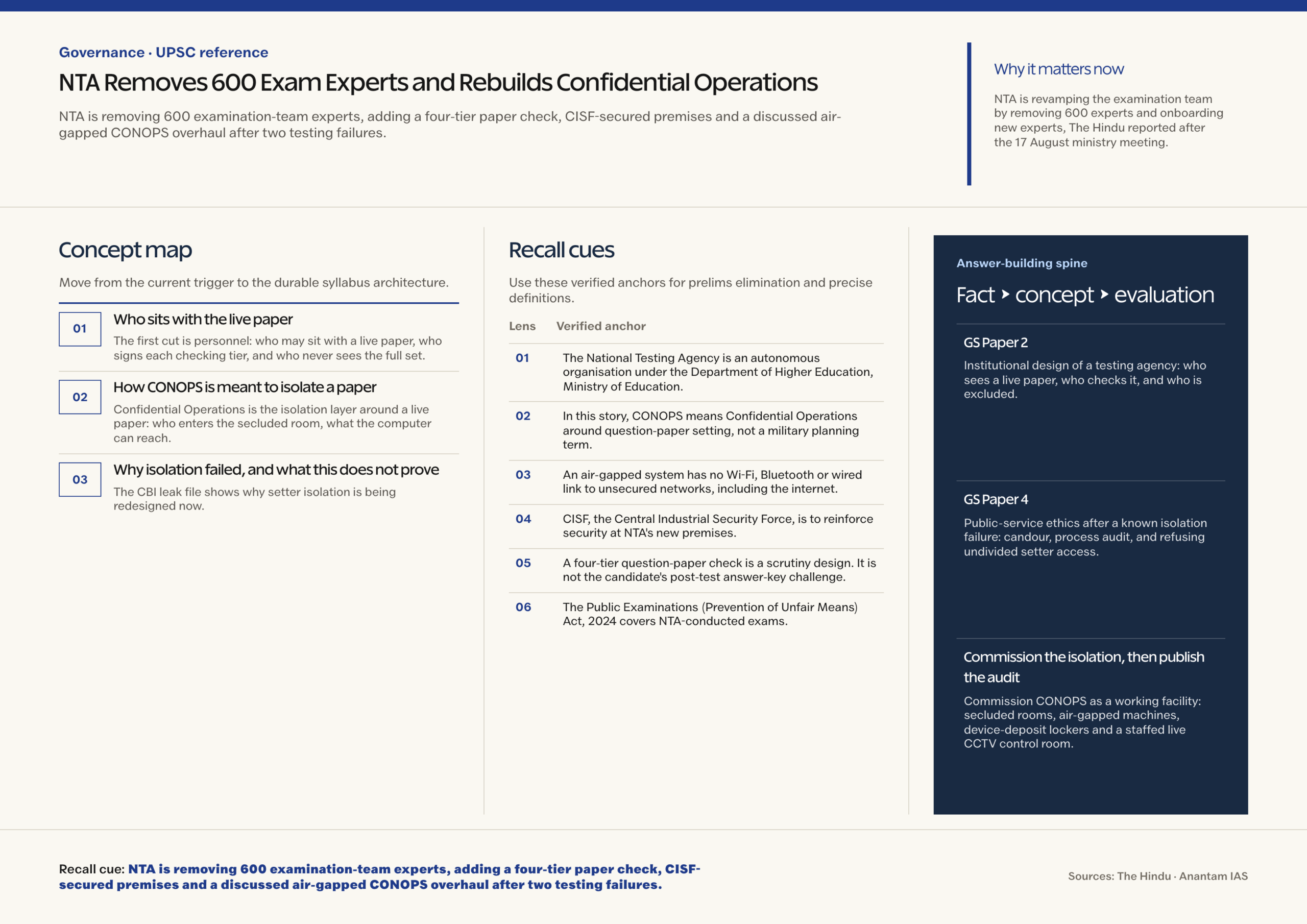
A day after the Union Education Ministry sought a detailed reform report, NTA told The Hindu it is removing 600 examination-team experts and remaking confidential operations.
- NTA is revamping the examination team by removing 600 experts and onboarding new experts, The Hindu reported after the 17 August ministry meeting.
- A four-tier question-paper checking system will be put in place to strengthen scrutiny of examination papers.
- Twenty to 25 new officials will be inducted over two to three weeks, while offices shift to new premises with CISF cover.
- Separately, more than fifty staffers have been removed. That cut is not the same as the 600 examination-team experts.
- Ten professional leadership posts, including CTO, CISO and psychometrics, are being advertised or onboarded, with private-sector specialists for cyber security and paper design.
- After two testing failures this year, the live question is who writes papers and how confidential operations stay isolated.
- A criminal statute can punish a leak after it happens. Isolation of setters, devices and networks is what stops a paper from walking out.
- The fast-track court track is for prosecution. This note is about the testing shop: personnel, four-tier checks and CONOPS.
UPSC Relevance
Prelims Relevance
- The National Testing Agency is an autonomous organisation under the Department of Higher Education, Ministry of Education, set up in November 2017 as a society.
- In this story, CONOPS means Confidential Operations around question-paper setting, not a military planning term.
- An air-gapped system has no Wi-Fi, Bluetooth or wired link to unsecured networks, including the internet.
- CISF, the Central Industrial Security Force, is to reinforce security at NTA’s new premises.
- A four-tier question-paper check is a scrutiny design. It is not the candidate’s post-test answer-key challenge.
- The Public Examinations (Prevention of Unfair Means) Act, 2024 covers NTA-conducted exams. It is a criminal statute, not an operations manual.
Mains Relevance
GS Paper 2
- Institutional design of a testing agency: who sees a live paper, who checks it, and who is excluded.
- Equality of opportunity: a leak or a defective paper both convert a public exam into a lottery.
GS Paper 4
- Public-service ethics after a known isolation failure: candour, process audit, and refusing undivided setter access.
Essay
- A public examination tests the candidate. Its isolation architecture tests the State.
Background and Context
Who sits with the live paper
The first cut is personnel: who may sit with a live paper, who signs each checking tier, and who never sees the full set.
- NTA is revamping the examination team by removing 600 experts and onboarding new ones, a reset of who can sit with a live national paper after the old panel’s access failed.
- Sources also said more than fifty staffers have been removed. Keep that number apart from the 600, because staff corridors and expert panels are different leak paths and must not be added.
- Twenty to 25 new officials will be inducted over the next two to three weeks, while NTA offices move swiftly to new premises where CISF teams will reinforce security of the campus.
- Ten professional leadership posts, including CTO and CISO and a psychometrics lead, plus test-security and research heads, have been advertised and are being onboarded so security and item science share one table.
- Domain specialists from the private sector are being brought in for cyber security, psychometrics and question-paper design, skills a leak or a defective item exploits and a purely academic panel often lacks.
How CONOPS is meant to isolate a paper
Confidential Operations is the isolation layer around a live paper: who enters the secluded room, what the computer can reach, and which device stays outside.
- Sources said a complete overhaul of Confidential Operations (CONOPS) was discussed, covering rooms, networks and devices. Treat that as a design on the table, not a facility already built.
- The discussed design uses secluded rooms for people who handle paper-setting and other confidential material, so a live item is not assembled in an open office, corridor or shared workstation.
- An air-gapped system is a computer or network physically and wirelessly isolated from unsecured networks such as the internet, with no Wi-Fi, Bluetooth or wired link that a remote attacker could use.
- Device-deposit protocols would force phones and other gadgets out of the room before a setter touches a live item, closing the simplest path for a photographed paper to walk out.
- A four-tier question-paper checking system is to strengthen scrutiny before a paper becomes a national result. Isolation stops a leak; independent tiers, not the original setter, catch a defective item.
Why isolation failed, and what this does not prove
The CBI leak file shows why setter isolation is being redesigned now. It does not prove that secluded rooms, air-gaps and cameras already exist.
- In the CBI chargesheet on the summer paper leak, Biology, Chemistry and Physics setters had full access to the questions they then leaked. That undivided access is what CONOPS is meant to break.
- Those experts faced no physical checking or frisking on the way in or out of restricted confidential zones, so a printed or photographed paper could leave unchecked with the setter.
- The same facility lacked a dedicated live CCTV monitoring control room, so there was no staffed real-time watch on who entered a confidential zone and what left it with them.
- After two testing failures this year, the ministry has asked NTA for a thorough process audit and a detailed reform report, not only a change of names on the expert list.
- A discussed overhaul is not proof that air-gaps, device-deposit, frisking or a live CCTV room already exist. Ask what is commissioned and staffed, not what was said in a meeting.
Way Forward
Commission the isolation, then publish the audit
- Commission CONOPS as a working facility: secluded rooms, air-gapped machines, device-deposit lockers and a staffed live CCTV control room, not a slide.
- Split paper-setting so no single expert holds a full subject paper, the undivided access the CBI file showed.
- Keep the four-tier check independent of the original setters, with a written trail of who drafted, who checked and who signed.
- Publish the process audit the ministry has demanded, with enough operational detail that the isolation claim can be tested.
Conclusion
- Today’s news is institutional redesign: who sits with a live paper, how many independent times it is checked, and how the room is isolated from the open network.
- Hold the two personnel numbers apart: 600 experts and more than fifty staffers. Hold CONOPS as discussed until secluded rooms, air-gaps, device-deposit and a live CCTV watch exist.
- For Mains, treat NTA as a testing institution whose credibility rests on setter isolation and independent four-tier scrutiny, not on another circular issued after a public failure.
UPSC Practice Questions
Prelims MCQ 1
With reference to the recent NTA revamp, consider the following statements:
- NTA has said it is removing 600 experts from its examination team and onboarding new experts.
- A four-tier question-paper checking system is to be put in place to strengthen scrutiny.
- The complete overhaul of CONOPS, including air-gapped systems, has already been implemented and certified.
How many of the above statements are correct?
(a) Only one (b) Only two (c) All three (d) None
Answer: (b) Only two
Explanation:
Statements 1 and 2 match NTA’s account. CONOPS, including air-gaps, was discussed, not shown as already built or certified.
Prelims MCQ 2
In the context of NTA’s Confidential Operations discussion, an air-gapped system is best described as:
(a) A computer connected only to a government email server (b) A computer or network with no Wi-Fi, Bluetooth or wired link to unsecured networks (c) A question paper stored on an encrypted cloud drive (d) A CCTV feed uploaded in real time to a central command
Answer: (b) A computer or network with no Wi-Fi, Bluetooth or wired link to unsecured networks
Explanation:
Air-gapped systems are physically and wirelessly isolated from unsecured networks such as the internet, with no Wi-Fi, Bluetooth or wired link.
UPSC Mains Questions
- High-stakes testing fails when a single setter holds a full paper and can walk it out. Examine NTA’s proposed CONOPS redesign as an institutional response. (250 words)
- Changing experts without commissioning isolation will not restore trust in public examinations. Discuss. (150 words)
Source: The Hindu.
Frequently Asked Questions
What did NTA say it is changing?
NTA said it is removing 600 examination-team experts and onboarding new ones, adding a four-tier paper check, inducting 20 to 25 officials, and shifting offices under CISF cover.
What is CONOPS in this note?
In this NTA story, CONOPS means Confidential Operations around question-paper setting. Officials discussed secluded rooms, air-gapped systems and device-deposit protocols, not a facility already certified.
What is an air-gapped system?
A computer or network physically and wirelessly isolated from unsecured networks such as the internet, with no Wi-Fi, Bluetooth or wired link that would let a remote attacker in.
Did NTA remove 650 people in one cut?
No. It removed 600 examination-team experts and, separately, more than fifty staffers. The two numbers are different access paths. Do not add them into one headline.
Has the CONOPS overhaul been implemented?
Not yet. This report shows a discussed overhaul of secluded rooms, air-gaps and device-deposit. It does not show those controls already commissioned, staffed and certified.
Source: https://anantamias.com/current-affairs/nta-exam-team-revamp-conops/
UAE Accuses Iran of Firing Two Ballistic Missiles at Its Territory
Why in News?
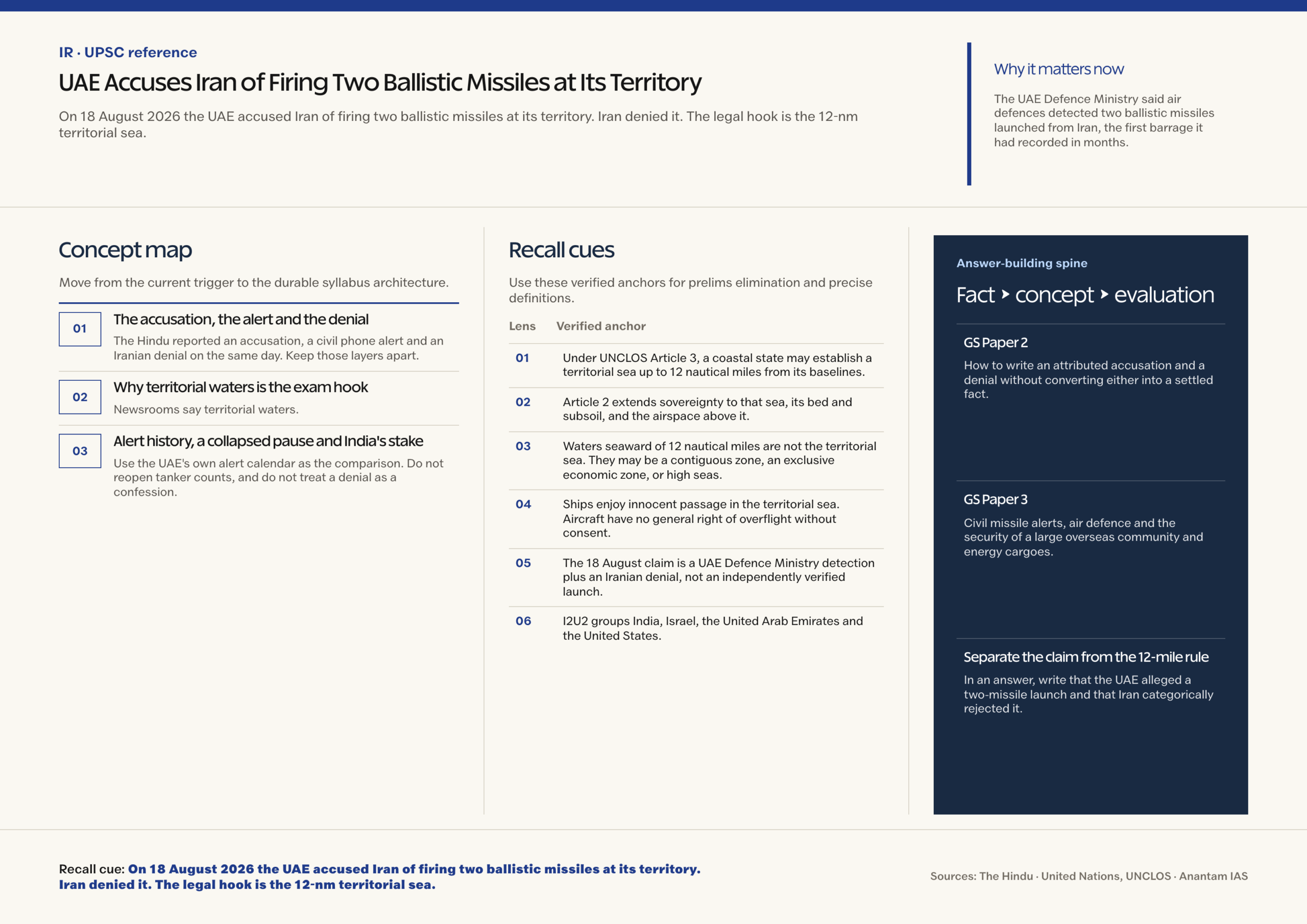
The Hindu reported on 18 August 2026 that the UAE accused Iran of firing two ballistic missiles at its territory; Tehran denied it.
- The UAE Defence Ministry said air defences detected two ballistic missiles launched from Iran, the first barrage it had recorded in months.
- It said the first missile fell outside territorial waters and the second fell within those waters.
- The Interior Ministry issued a phone alert about two hours earlier, telling residents to seek a safe building, then lifted it.
- Iran’s Foreign Ministry spokesman Esmaeil Baqaei categorically rejected the claim and called it harmful to regional trust and security efforts.
- The legal split in the UAE statement is the 12-nautical-mile territorial sea, not a tanker-count story.
- A collapsed June pause and recent tanker attacks are atmosphere. They do not prove Tuesday’s launcher.
- For India the live stakes are a large UAE-based community, energy supply and the I2U2 partnership, not a verdict on who fired.
UPSC Relevance
Prelims Relevance
- Under UNCLOS Article 3, a coastal state may establish a territorial sea up to 12 nautical miles from its baselines.
- Article 2 extends sovereignty to that sea, its bed and subsoil, and the airspace above it.
- Waters seaward of 12 nautical miles are not the territorial sea. They may be a contiguous zone, an exclusive economic zone, or high seas.
- Ships enjoy innocent passage in the territorial sea. Aircraft have no general right of overflight without consent.
- The 18 August claim is a UAE Defence Ministry detection plus an Iranian denial, not an independently verified launch.
- I2U2 groups India, Israel, the United Arab Emirates and the United States.
Mains Relevance
GS Paper 2
- How to write an attributed accusation and a denial without converting either into a settled fact.
- Why the 12-nautical-mile territorial sea, including airspace, is the legal test in the UAE statement.
GS Paper 3
- Civil missile alerts, air defence and the security of a large overseas community and energy cargoes.
Essay
- A claim of attack is not proof of attack. Law still needs a line on the water.
Background and Context
The accusation, the alert and the denial
The Hindu reported an accusation, a civil phone alert and an Iranian denial on the same day. Keep those layers apart.
- On 18 August 2026 the UAE Defence Ministry said on X that air defences had detected two ballistic missiles launched from Iran, the first barrage aimed at the country in months.
- The ministry said the first missile fell outside the country’s territorial waters and the second fell within them. That is a sovereignty claim, not a weather report.
- The Interior Ministry had already pushed a phone alert: because of potential missile threats, seek a safe place in the closest secure building. It lifted the alert shortly after.
- The Hindu said this was the first such alert since a false alarm in June and a July alert for an attack that ultimately did not enter UAE territory.
- Foreign Ministry spokesman Esmaeil Baqaei categorically rejected the UAE claim that Iran had launched a missile toward that country, calling it harmful to regional trust and security efforts.
Why territorial waters is the exam hook
Newsrooms say territorial waters. The treaty term is territorial sea, and twelve nautical miles of 1.852 kilometres each turn water into sovereign space.
- UNCLOS Article 3 lets every coastal state establish a territorial sea up to 12 nautical miles from its baselines. The normal baseline is the low-water line.
- Article 2 says sovereignty over that belt covers the water column, the bed and subsoil, and the airspace above it. A ballistic missile travels through that air.
- Ships enjoy innocent passage in the territorial sea if the passage is continuous, expeditious and not prejudicial to peace, good order or security. Aircraft have no such general overflight right.
- The contiguous zone may reach 24 nautical miles and is only an enforcement belt. The exclusive economic zone may reach 200 nautical miles and gives resource rights, not full sovereignty.
- A fall outside territorial waters is not, by that fact alone, a high-seas strike. High seas begin beyond the exclusive economic zone. Do not upgrade the UAE wording.
Alert history, a collapsed pause and India's stake
Use the UAE’s own alert calendar as the comparison. Do not reopen tanker counts, and do not treat a denial as a confession.
- Before this week, The Hindu said, the last missile warning was in early May. June produced a false alarm. July produced an alert for an attack that never entered UAE territory.
- After a June memorandum took effect, later collapsed, the UAE reported no attacks, unlike other Gulf states. That is prior context, not today’s proof.
- The Hindu also notes that ADNOC tankers have been targeted repeatedly in the past few weeks. Use that as atmosphere. It does not identify Tuesday’s launcher.
- India’s stake is a large community living and working in the UAE, Gulf energy cargoes, and the I2U2 partnership with Israel and the United States. Skip invented trade totals.
- If you cannot show an independent record of the launch, do not write that Iran attacked the UAE. Write what Abu Dhabi alleged and what Tehran rejected.
Way Forward
Separate the claim from the 12-mile rule
- In an answer, write that the UAE alleged a two-missile launch and that Iran categorically rejected it. Do not promote the claim to a finding.
- Apply the 12-nautical-mile territorial-sea test to the inside/outside split. Do not call the outer fall a high-seas strike unless the zone is known.
- For India, watch diaspora safety and energy cargoes. A partnership such as I2U2 does not require you to referee a denied launch.
- Leave chokepoint geography and crossing counts in the earlier note. This file is attribution, civil alerts and the territorial sea.
Conclusion
- Tuesday’s story is a two-missile accusation and a categorical denial. The durable line on the water is the 12-nautical-mile territorial sea, not the launcher’s name.
- Use the note to separate territorial sea from waters beyond it, and to keep civil alerts distinct from a verified strike.
- India’s file here is people, energy and a close UAE partnership. It is not a licence to name a launcher the evidence has not shown.
UPSC Practice Questions
Prelims MCQ 1
With reference to the territorial sea under UNCLOS, consider the following statements:
- A coastal State may establish a territorial sea up to a limit not exceeding 12 nautical miles from its baselines.
- Sovereignty over the territorial sea does not extend to the airspace above it.
- Any area seaward of the territorial sea is, by definition, high seas.
How many of the above statements are correct?
(a) Only one (b) Only two (c) All three (d) None
Answer: (a) Only one
Explanation:
Statement 1 restates Article 3. Article 2 extends sovereignty to the airspace. Beyond the territorial sea lie the contiguous zone and exclusive economic zone before the high seas.
Prelims MCQ 2
According to the UAE Defence Ministry statement reported by The Hindu on 18 August 2026:
(a) Both missiles fell inside UAE territorial waters (b) Both missiles fell outside UAE territorial waters (c) The first missile fell outside territorial waters and the second fell within them (d) Iran admitted launching two ballistic missiles at the UAE
Answer: (c) The first missile fell outside territorial waters and the second fell within them
Explanation:
That is the ministry’s attributed split. Iran categorically rejected the launch claim.
UPSC Mains Questions
- Distinguish a coastal state’s territorial sea from waters beyond it. Why did that distinction matter in the UAE’s 18 August 2026 missile claim? (150 words)
- Attributed accusations in a live conflict are not established facts. Discuss how a UPSC answer should handle such claims, with reference to India-UAE stakes. (250 words)
Sources: The Hindu and United Nations, UNCLOS.
Frequently Asked Questions
What did the UAE claim on 18 August 2026?
The Defence Ministry said air defences detected two ballistic missiles launched from Iran. It said the first fell outside territorial waters and the second fell inside them.
Did Iran accept the charge?
No. Spokesman Esmaeil Baqaei categorically rejected the UAE claim and said it was harmful to regional trust and security efforts. The launch is denied, not conceded.
What are territorial waters in UNCLOS language?
The usual treaty term is territorial sea. UNCLOS Article 3 allows a belt up to 12 nautical miles from baselines. Sovereignty covers the water, bed, subsoil and airspace.
Why does the 12-nautical-mile line matter here?
A missile that falls inside the belt, if proved, hits sovereign space, including airspace. A fall outside it is not a territorial-sea strike and is not automatically a high-seas event.
What is the India angle in this note?
A large Indian community lives and works in the UAE. Energy cargoes and the I2U2 partnership sit in the same theatre. None of that proves who fired on 18 August.
Source: https://anantamias.com/current-affairs/uae-accuses-iran-ballistic-missiles/
Delhi High Court: LLM Training Can Fall Under Fair Dealing
Why in News?
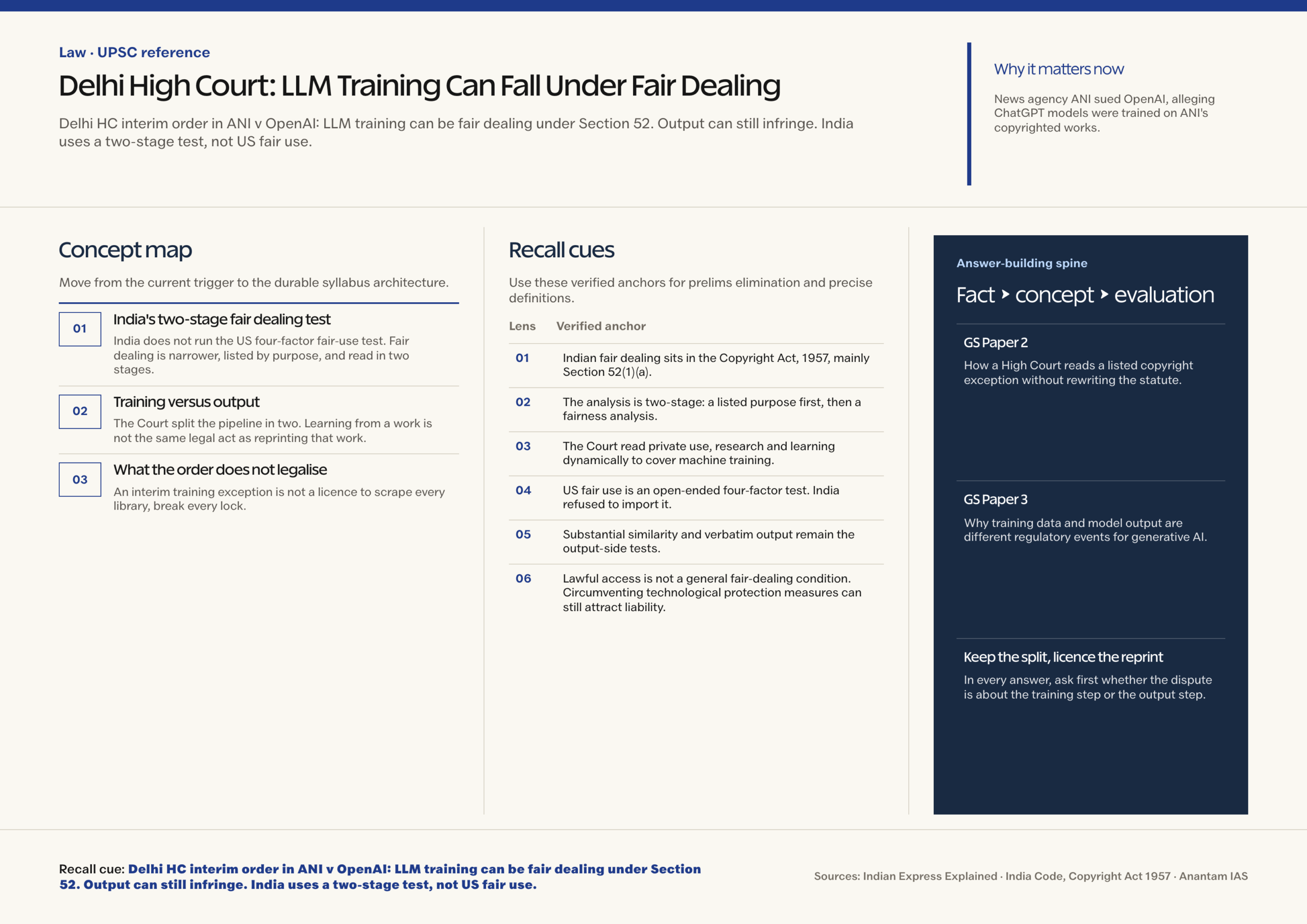
The Delhi High Court, in an interim order on 24 July 2026 in ANI v OpenAI, held that using copyrighted works to train large language models can fall within India’s fair dealing exception.
- News agency ANI sued OpenAI, alleging ChatGPT models were trained on ANI’s copyrighted works.
- The holding is interim and appealable. It is legal cover for training, not a blanket licence.
- Arul George Scaria of NLSIU Bengaluru, the Court’s amicus, framed the split between training and output.
- Training can be fair dealing. Output can still infringe if it is verbatim or substantially similar.
- Two US district courts last year held training can be fair use. The Delhi High Court refused to import that test.
- A contrary holding could have chilled indigenous model-building, including Indian developers such as Sarvam.
- Consumer AI agents raise a different problem: agency and control, not training copyright.
- News facts have thinner copyright than novels or music. Nobody owns a raw fact.
UPSC Relevance
Prelims Relevance
- Indian fair dealing sits in the Copyright Act, 1957, mainly Section 52(1)(a).
- The analysis is two-stage: a listed purpose first, then a fairness analysis.
- The Court read private use, research and learning dynamically to cover machine training.
- US fair use is an open-ended four-factor test. India refused to import it.
- Substantial similarity and verbatim output remain the output-side tests.
- Lawful access is not a general fair-dealing condition. Circumventing technological protection measures can still attract liability.
Mains Relevance
GS Paper 2
- How a High Court reads a listed copyright exception without rewriting the statute.
- Why an interim, appealable order is cover for developers, not a permanent licence.
GS Paper 3
- Why training data and model output are different regulatory events for generative AI.
- Where licensing still matters once retrieval-augmented generation reprints publisher text.
Essay
- An exception that lets a machine learn is not a licence that lets it reprint.
Background and Context
India's two-stage fair dealing test
India does not run the US four-factor fair-use test. Fair dealing is narrower, listed by purpose, and read in two stages.
- Fair dealing sits in Section 52 of the Copyright Act, 1957, mainly clause (1)(a). The Court treated it as a purpose-limited exception, not an open US-style fair-use clause that a judge can stretch at will.
- Stage one asks whether the use is for a listed purpose. The Court read private use, research and learning dynamically so machine training could enter that gate without waiting for a new statute.
- If that purpose gate fails, the fairness analysis never starts. That is why the dynamic reading of research and private use mattered more than any imported US four-factor test in this case.
- Stage two is a fairness analysis that balances rights holders and users. The Court laid down a three-factor test, including whether the use would cause market harm to the plaintiff on these facts.
- For ANI, market harm meant substitution of paid syndication by LLM answers. The Court found customers would not switch, and also weighed the public-interest value of large language models.
Training versus output
The Court split the pipeline in two. Learning from a work is not the same legal act as reprinting that work.
- Training can fall inside fair dealing. That finding is the interim cover now available to OpenAI and to Indian developers such as Sarvam. It is not a statutory licence to copy everything.
- Output is a separate facts case. Verbatim paragraphs or substantially similar answers can still be infringement even if the training step was fair. The rights holder can still sue on later facts.
- ANI’s cited ChatGPT examples carried dates after August 2024. The relevant training cut-offs were April 2022 for GPT-4 and April 2024 for GPT-4o, so those pieces were not in the trained set at all.
- Most outputs were also not substantially similar. The model produced different wording in response to user prompts, so the infringement threshold was not met on the examples cited by ANI.
- News has thinner copyright than a novel or a song. You can own expression. You cannot own the fact, and there are only so many ways to state one in a wire story.
What the order does not legalise
An interim training exception is not a licence to scrape every library, break every lock, or reprint every publisher story as an answer.
- The order is interim and subject to appeal. Indian law has not permanently legalised all AI training on every copyrighted work in every dataset, and a later bench can still narrow it.
- Lawful access is not a general fair-dealing condition. A shadow-library source is not automatically fatal if the use fits the exception. That is a legal point, not a defence of piracy.
- Circumventing technological protection measures, such as paywalls or crawler blocks, can still attract liability even when the later training use might otherwise be fair dealing. The lock and the learning are separate.
- Retrieval-augmented generation and verbatim reproduction stay on the output side. Licensing is the path publishers and model-makers already use for that risk. Different facts can still produce infringement.
- US district courts in the Anthropic and Meta cases last year treated training as fair use. That comparison is useful. Copying their four factors into an Indian answer is not. The statutes differ.
Way Forward
Keep the split, licence the reprint
- In every answer, ask first whether the dispute is about the training step or the output step.
- Use publisher licences where the product retrieves or reprints text, especially through retrieval-augmented generation.
- Do not treat an interim High Court order as a statute that legalises every crawl or every dataset.
- If Parliament wants more certainty, it can write a dedicated text-and-data-mining exception. Until then, the two-stage test is the working law.
Conclusion
- The news is a split, not a licence. Training on copyrighted works can be Indian fair dealing at the interim stage. Reprinting those works in an answer can still infringe on different facts.
- Write the two-stage test, the no-substitution finding on ANI syndication, and the interim tag. Do not import the US four-factor fair-use test into the Indian analysis in a Mains answer.
- If the product retrieves or reprints publisher text, especially through RAG, licensing remains the safe path. An appeal can still narrow the training cover without touching that output risk.
UPSC Practice Questions
Prelims MCQ 1
With reference to the Delhi High Court’s interim order in ANI v OpenAI, consider the following statements:
- Using copyrighted works to train a large language model can fall within India’s fair dealing exception.
- The Court applied the US four-factor fair use test as India’s fairness analysis.
- Verbatim or substantially similar model output can still amount to copyright infringement.
How many of the above statements are correct?
(a) Only one (b) Only two (c) All three (d) None
Answer: (b) Only two
Explanation:
Statements 1 and 3 are correct. Training can be fair dealing; output can still infringe. The Court refused to import the US four-factor test because Indian fair dealing is narrower and two-stage.
Prelims MCQ 2
In Indian copyright law, the first stage of the fair dealing analysis asks:
(a) whether the use is transformative under the US four-factor test (b) whether the use is for a purpose listed in the exception (c) whether the defendant had a licence from every publisher in the dataset (d) whether lawful access is proved in every case before fairness is examined
Answer: (b) whether the use is for a purpose listed in the exception
Explanation:
Indian fair dealing is two-stage. The court first asks whether the use is for a listed purpose such as private use or research. Only then does a fairness analysis begin. Lawful access is not a general first-stage requirement.
UPSC Mains Questions
- The Delhi High Court’s interim order in ANI v OpenAI splits training from output. Examine how India’s two-stage fair dealing analysis differs from US fair use, and why that split matters for AI policy. (250 words)
- An exception for machine learning is not a licence to reproduce. Discuss with reference to output-side copyright risk, retrieval-augmented generation and technological protection measures. (150 words)
Sources: Indian Express Explained and India Code, Copyright Act 1957.
Frequently Asked Questions
Did the Delhi High Court legalise all AI training in India?
No. The 24 July 2026 order is interim and appealable. Training can be fair dealing on these facts. It is not a permanent, across-the-board licence.
How is Indian fair dealing different from US fair use?
US fair use is an open-ended four-factor test. Indian fair dealing is two-stage: a listed purpose first, then a fairness analysis. The Court refused to import the US factors.
Can ChatGPT still infringe ANI’s copyright in its answers?
Yes. Training and output are separate. Verbatim or substantially similar answers can still infringe. Most of ANI’s cited examples failed on date and on similarity.
Does a shadow-library source automatically kill a fair dealing defence?
No. Lawful access is not a general requirement under fair dealing. If the use fits the exception, the source is not automatically fatal. Circumventing technical locks can still be liability.
Why do news agencies have a weaker copyright case than novelists?
Copyright protects expression, not facts. There are only so many ways to state a news fact. Novels and music carry more protected expression than a wire story.
Source: https://anantamias.com/current-affairs/delhi-hc-llm-training-fair-dealing/
Employment Guarantee has slipped into Limbo
Why in News?
India’s transition from the Mahatma Gandhi National Rural Employment Guarantee Act (MGNREGA), 2005, to the Viksit Bharat-Guarantee for Rozgar and Ajeevika Mission (Gramin) Act, 2025 (VB-G RAM G) has coincided with a sharp fall in rural employment generation.
According to provisional data cited by economists, MGNREGA and VB-G RAM G together generated only 70 crore person-days during April-July 2026, compared with 128 crore and 119 crore during the corresponding periods of the previous two years (a decline of about 43% from their average).
July 2026 alone recorded a year-on-year decline of more than 40%. The fall was particularly severe in poorer States such as Uttar Pradesh, Madhya Pradesh and Jharkhand.

| UPSC Relevance: GS-2 Social Justice: Welfare Schemes; Employment Prelims: Mahatma Gandhi National Rural Employment Guarantee Act, 2025; Viksit Bharat- Guarantee for Rozgar and Ajeevika Mission (Gramin) Act, 2025. Mains: Shift From MGNREGS to VB-G RAM G (Need, Benefits and Challenges). |
What changed after VB-G RAM G?
Operational from July 1, 2026, the VB-G RAM G Act replaced MGNREGA and:
- Statutory employment guarantee: Increased from 100 to 125 days per rural household annually.
- Funding pattern: Unlike MGNREGA, VB-G RAM G is a Centrally Sponsored Scheme, with the Centre-State sharing generally at 60:40, and 90:10 for North-Eastern/Himalayan States and full central funding for eligible Union Territories.
- Budget: The Centre has allocated ₹95,692 crore for 2026-27; including States’ contribution, the programme outlay is expected to exceed ₹1.51 lakh crore.
- Wages: The minimum notified wage has been raised to ₹300/day, with a national average of about ₹327.4/day, an increase of over 10%.
- Provides for a 60-day suspension of public works during peak agricultural seasons to ensure farm-labour availability.
- Emphasises digital attendance, Direct Benefit Transfer, real-time monitoring and Panchayat-led planning.
- Focus: Greater emphasis on durable rural assets, water-related works, rural infrastructure, livelihoods, agricultural productivity and climate/extreme-weather mitigation.
Emerging Concerns:
- Disruptive transition: Delays in framing rules, administrative preparedness, and uncertainty among field functionaries have reportedly prevented the opening of new works during April-June (the peak demand season).
- From demand-driven to allocation-driven: State-wise normative allocations may constrain expenditure even when genuine employment demand is higher.
- Fiscal pressure on States: The shift to 60:40 Centre-State funding may impose a greater fiscal burden on States, particularly poorer States with high dependence on rural employment programmes.
- Seasonal suspension: A uniform 60-day pause may overlook variations in cropping seasons, labour demand and rural distress.
- Digital exclusion: Technology-enabled monitoring can improve transparency, but excessive dependence on digital authentication, biometric/facial-recognition systems and online processes risks excluding workers because of connectivity, authentication or documentation failures.
Why does it matter to India?
Rural employment guarantee is not merely a welfare programme. It serves as:
- Income security during agricultural slack periods.
- A rural safety net during economic and climatic shocks.
- A mechanism for women’s labour-force participation and financial autonomy.
- A source of rural asset creation, especially water conservation and land development.
- A tool for reducing distress migration and strengthening rural demand.
- An instrument of inclusive growth and cooperative federalism.
Wider Implications:
- Rural livelihood security: Disruptions in guaranteed employment can depress rural incomes and demand, while increasing indebtedness, food insecurity and distress migration.
- Women’s economic empowerment: Rural employment programmes provide women with paid work, independent incomes and greater bargaining power, making continuity of employment an important gender-equity concern.
- Cooperative federalism: Greater State cost-sharing and fiscal responsibility could strain poorer States and create disparities in the implementation of a nationally significant social-security programme.
- Rights-based governance: Weakening access to employment can undermine the broader constitutional commitment to dignity under Article 21, the right to work under Article 41 and decentralised rural governance under Article 40.
- Rural asset creation: Lower employment generation can also mean fewer water-conservation, land-development, irrigation and climate-resilient community assets, weakening the programme’s developmental role.
- Rural demand and inclusive growth: Reduced wage flows can weaken local consumption and aggregate rural demand, with implications for MSMEs, agriculture-linked markets and overall inclusive growth.
Way Forward:
- Ensure uninterrupted transition and immediately honour all registered demand for work.
- Make allocations responsive to actual demand rather than rigid fiscal ceilings.
- Provide temporary central assistance to fiscally constrained States.
- Index wages to inflation and guarantee timely payment with automatic compensation.
- Permit flexible, region-specific agricultural pauses.
- Retain offline attendance alternatives and conduct independent audits of digital exclusions.
- Strengthen Gram Sabha planning, social audits, grievance redressal and public disclosure of real-time data.
The central issue is not simply whether VB-G RAM G provides more days and more money, but whether the new architecture can preserve the rights-based, demand-driven and accessible character of rural employment guarantee while improving asset quality, accountability and fiscal sustainability.
Increasing the statutory guarantee to 125 days is meaningful only if work remains available on demand. Thus, VB-G RAM G must preserve the essential character of an employment guarantee.
Source: https://anantamias.com/current-affairs/employment-guarantee-has-slipped-into-limbo/
Time to Push Back (India-U.S. Trade Frictions)
Why in News?
A White House report titled The Great Transshipment Scam has placed India in the highest-risk category of countries allegedly facilitating the evasion of U.S. tariffs on Chinese goods. The latest U.S. allegation highlights a broader challenge: the growing use of trade policy by the US to pursue wider economic and geopolitical objectives.
The Recent Trigger:
- The U.S. has identified India among more than 40 economies at risk of being used for Chinese transshipment—where Chinese goods are routed through third countries, subjected to limited assembly, repackaging or relabelling, and exported to the U.S. under a different country of origin, to circumvent higher U.S. tariffs. India has been placed in the highest-risk category alongside major industrial economies.
- The concern is significant because China is India’s largest source of imports, accounting for about 15.7% of India’s total imports in 2024-25.
However, Chinese inputs increasingly form part of India’s manufacturing and global value chains. Distinguishing legitimate value-added production from tariff circumvention is therefore essential.
| Transshipment versus Legitimate Manufacturing: Illegal transshipment involves routing goods through another country without substantial transformation, while falsely declaring their origin to evade tariffs. Legitimate manufacturing occurs when imported inputs undergo substantial processing that creates a commercially distinct product. The use of Chinese components does not automatically make an Indian export a Chinese product. |
Why India should resist Unilateral Pressure?
- To Protect Make in India: Chinese intermediate goods support domestic assembly and manufacturing. Automatically restricting such imports could raise input costs and undermine India’s integration into global value chains.
- To preserve strategic autonomy: India must avoid excessive dependence on any single major power and retain policy space in trade, technology and energy.
- Ensure Rules-based trade: Genuine cases of customs fraud should be investigated, but unilateral accusations should not become a basis for arbitrary trade restrictions.
- Energy security: The earlier U.S. pressure over Russian oil demonstrated the economic consequences of linking trade access with foreign-policy choices. India subsequently reduced Russian oil purchases, although later disruptions in West Asia again pushed Russian crude’s share sharply upward; it reached a record 50.8% of India’s crude imports in July 2026.
- Domestic policy space: Excessive concessions on tariffs, investment or market access can constrain India’s ability to pursue industrial, agricultural and digital-economy policies suited to its development needs.
India needs to Address Legitimate Concerns:
India should not defend actual tariff evasion or fraudulent rules-of-origin declarations. Instead, it should:
- strengthen rules-of-origin and customs verification;
- improve traceability of Chinese inputs in export products;
- distinguish genuine domestic value addition from simple transshipment;
- cooperate with U.S. customs authorities against fraudulent consignments;
- diversify critical imports from China while avoiding indiscriminate decoupling.
Way Forward:
- Demand product- and transaction-specific evidence instead of accepting blanket allegations.
- Strengthen digital certificates of origin, input traceability and value-addition audits.
- Penalise shell companies, false invoices and mere relabelling operations.
- Establish an industry-customs mechanism to help MSMEs comply with U.S. origin rules.
- Build domestic ecosystems for components, tooling, semiconductors, APIs and capital goods rather than focusing only on final assembly.
- Diversify input sources through partnerships with Japan, South Korea, Taiwan, ASEAN and Europe.
- Avoid pre-emptive concessions; trade-offs should follow transparent economic and stakeholder assessment.
- Diversify export markets through FTAs and stronger engagement with the EU, Africa, West Asia and the Global South.
- Challenge discriminatory measures through bilateral consultations and WTO-compatible mechanisms where feasible.
- Use platforms such as BRICS, G20, SCO and WTO to build coalitions against arbitrary trade coercion.
India’s response should be firm but not confrontational: cooperate against genuine customs fraud, but reject attempts to dictate legitimate trade and foreign-policy choices. The objective should be diversification rather than decoupling—reducing excessive dependence on China while retaining access to competitively priced intermediate goods.
Source: https://anantamias.com/current-affairs/time-to-push-back-india-u-s-trade-frictions/
A vision for an inclusive Bangladesh
Context:
Bangladesh’s July Uprising of 2024, beginning with student protests over public-employment quotas, expanded into a movement against repression, unemployment and unaccountable governance. It ended Sheikh Hasina’s rule and led to an interim government headed by Muhammad Yunus.
In February 2026, the Bangladesh Nationalist Party (BNP) secured a two-thirds parliamentary majority, and Tarique Rahman became Prime Minister. The government presents 2024 as a democratic renewal complementing the legacy of the 1971 Liberation War.
Constitutional Basis:
Bangladesh’s Constitution combines secular and religious principles:
- Islam is the state religion, but other religions enjoy equal status and rights.
- The Constitution opposes communalism, religious discrimination and misuse of religion in politics, and guarantees equality and non-discrimination, alongside protecting freedom of religion.
However, genuine inclusion requires institutional protection rather than symbolic appointments.
Major Challenges:
- Democratic consolidation: An independent judiciary, Election Commission, police and anti-corruption machinery are essential. The BNP’s large majority must not reproduce past executive dominance. Accountability for the former regime must follow due process rather than political vengeance.
- Minority security: Attacks on Hindus and violations against ethnic communities reveal a gap between official assurances and ground realities. Communal violence requires prompt prosecution, property restitution and accountable policing.
- Rule of law: Mob violence, arbitrary detention and attacks on journalists, women and cultural groups threaten democratic transition.
- Justice for 2024: A UN investigation reported serious violations during the uprising’s suppression, with around 1,400 deaths. Independent investigation, victim compensation and fair trials are necessary.
- Women and marginalised groups: Women played a major role in the uprising but remain under-represented. Inclusion must address gender violence, labour rights and the participation of indigenous and disadvantaged communities.
- Economic inclusion: Youth unemployment and unequal opportunity contributed to the uprising. Bangladesh needs merit-based recruitment, job-intensive manufacturing, MSME growth, economic diversification, skill development and a smooth transition from Least Developed Country status.
- Climate and Rohingya challenge: As a vulnerable delta, Bangladesh needs climate-resilient agriculture, housing and social protection. It must also support over one million Rohingya refugees while pursuing their safe and voluntary repatriation.
Reconciling 1971 and 2024:
- The 1971 Liberation War created Bangladesh’s sovereign identity, while the 2024 uprising renewed demands for democratic accountability.
- Treating them as complementary can strengthen national unity; using either legacy to delegitimise opponents would deepen polarisation.
Implications for India:
- Bangladesh is crucial for India’s Northeast connectivity, border security, trade, energy exchange, management of 54 shared rivers and cooperation through BIMSTEC, BBIN and SAARC.
- Relations remain strained by Sheikh Hasina’s presence in India and Bangladesh’s extradition demands.
- India should engage the elected government without appearing partisan, respect Bangladeshi sovereignty and address minority concerns through sustained diplomacy.
An inclusive Bangladesh requires political pluralism, minority security, independent institutions, economic opportunity and accountability without revenge. Its democratic stability is equally important for India and the wider Bay of Bengal region.
Source: https://anantamias.com/current-affairs/a-vision-for-an-inclusive-bangladesh/
PM CARES donations have dropped, and Utilisation is Abysmal
Why in News?
Audited statements of the Prime Minister’s Citizen Assistance and Relief in Emergency Situations (PM CARES) Fund for 2023-24 and 2024-25 were released in August 2026 after a prolonged disclosure gap. They reveal a growing corpus, falling donations and exceptionally low expenditure.
About PM CARES:
Established in March 2020 during the COVID-19 pandemic, PM CARES is a public charitable trust intended to respond to public-health emergencies, natural or human-made disasters and other situations of distress.
- The Prime Minister is its ex-officio chairperson; the Defence, Home and Finance Ministers are ex-officio trustees.
- It receives voluntary contributions without direct budgetary support.
- Donations enjoy 100% deduction under Section 80G, qualify as Corporate Social Responsibility expenditure and may be received from abroad under an FCRA exemption.
- Its accounts are audited by an auditor appointed by the trustees.
Key Findings:
- The Fund’s closing balance increased from approximately ₹6,284 crore in 2022-23 to ₹8,452 crore in 2024-25.
- Donations fell by about 30% in 2024-25 to nearly ₹480 crore.
- Interest income reached approximately ₹475 crore, almost equalling donations, as about 93% of the corpus was held in fixed deposits.
- Only ₹87.85 lakh was spent during 2024-25; around 0.01% of the closing balance.
- Implementing agencies returned approximately ₹324.66 crore, but the published statement does not identify these agencies, projects or reasons for the refunds.
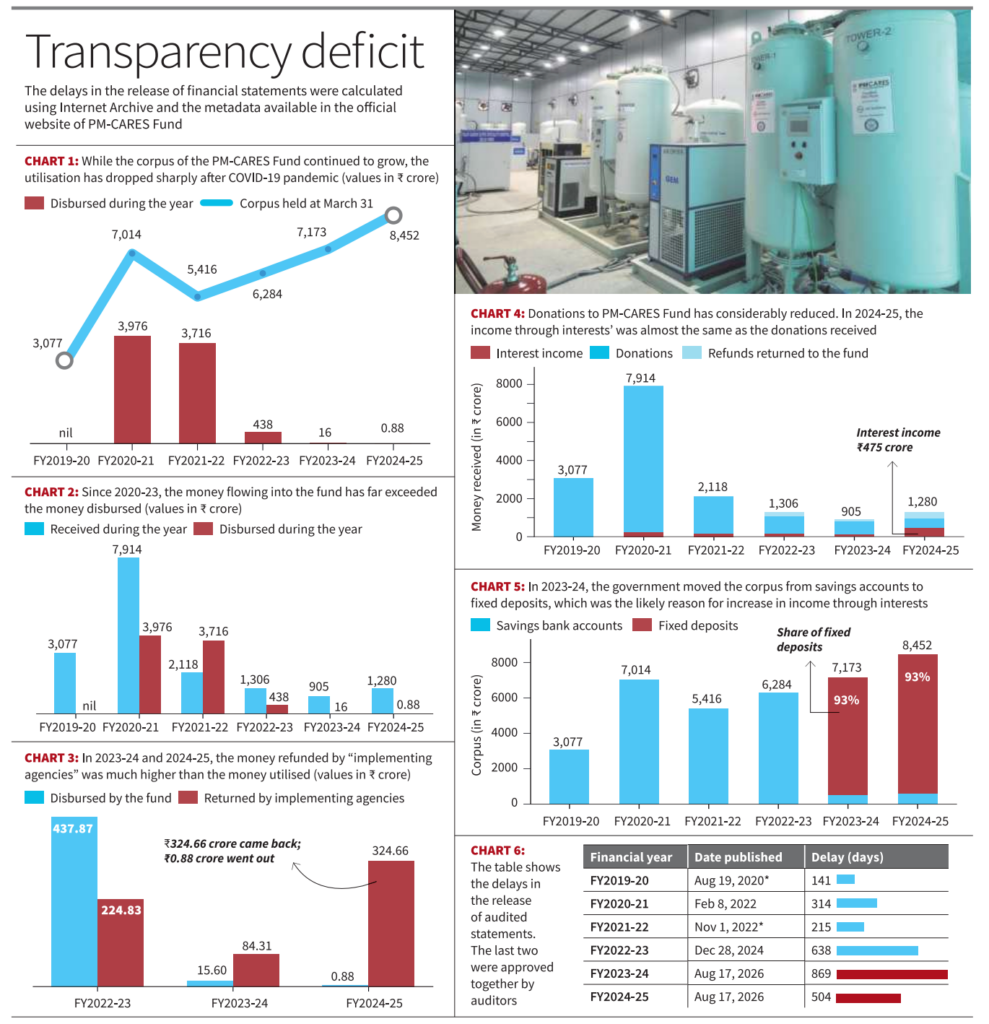
Major Concerns:
- Opportunity cost: Maintaining a contingency reserve is prudent, but prolonged accumulation means resources remain unavailable for disaster preparedness, public health and relief.
- Mission-utilisation mismatch: A fund created for emergency assistance must combine financial reserves with timely and outcome-oriented deployment.
- Transparency deficit: Delayed disclosures, aggregate accounts and absence of project-wise information prevent assessment of whether allocations achieved their intended outcomes.
- Unexplained refunds: Large refunds may indicate project completion savings, cancellation, procurement failures or weak implementation. Without explanatory notes, their significance cannot be evaluated.
- RTI ambiguity: PM CARES maintains that it is not a “public authority” under Section 2(h) of the RTI Act. However, its official character, tax concessions, CSR eligibility and administrative support from the PMO generate a strong expectation of public accountability.
- Limited external oversight: The Fund is independently audited but is not routinely subjected to CAG or parliamentary scrutiny.
- Institutional overlap: Its relationship with the National Disaster Response Fund, State Disaster Response Funds and Prime Minister’s National Relief Fund remains insufficiently defined, risking fragmentation of disaster financing.
Counter-Perspective:
- Low annual expenditure does not by itself establish misuse. The decline may reflect the end of the acute COVID-19 phase, while a large liquid corpus can enable rapid response to future pandemics or disasters.
- Similarly, the Fund receives voluntary rather than budgetary contributions.
Nevertheless, emergency reserves require a transparent strategy specifying how much should be retained and when funds should be deployed.
Way Forward:
- Prescribe a fixed deadline for publication of audited annual accounts.
- Release project-wise data on sanctions, disbursements, beneficiaries, outcomes and implementing agencies.
- Explain all refunds, cancellations and unspent balances.
- Frame a publicly available reserve and disbursement policy with objective emergency triggers.
- Undertake third-party performance and social audits while protecting individual donor privacy.
- Clarify coordination with statutory disaster-management funds to avoid duplication.
- Consider CAG-equivalent oversight or review by an independent multi-stakeholder body.
The credibility of an emergency fund depends not merely on the size of its corpus but on its capacity to deliver timely relief. PM CARES must reconcile operational flexibility with transparency, accountability and measurable public outcomes.
Source: https://anantamias.com/current-affairs/pm-cares-donations-have-dropped-and-utilisation-is-abysmal/
Education must change to account for AI
Context:
Rapid advances in Artificial Intelligence (AI), automation and intelligent agents are transforming the nature of work. For India, this creates an urgent need to redesign education; not merely to produce AI users, but to prepare citizens for jobs where judgement, creativity, domain expertise and adaptability complement machines.
How is AI Transforming Work?
AI agents, robotics and machine vision can convert many existing tasks into automated routines. In pharmaceuticals, AI can assist molecule screening, formulation and quality control. In vaccine production, it can support antigen design, automated bioreactors, fill-finish processes and logistics.
Consequently:
- Many routine and entry-level jobs may decline.
- Fewer workers may be required for execution, with humans concentrating on supervision and complex decisions.
- Demand will increase for workers possessing deep domain expertise, interdisciplinary understanding and sound judgement.
- Companies may become more productive without proportionately increasing employment.
The disappearance of entry-level positions creates a particular problem: such jobs traditionally allow young workers to acquire the experience necessary for becoming experts.
Limits of the existing Educational Model:
- Earlier technological revolutions were addressed by extending the duration of formal education: from basic literacy to school, college and professional degrees. This approach emphasised acquiring and retaining increasing quantities of information.
AI weakens the value of mere information retention because knowledge can be retrieved rapidly. The comparative human advantage increasingly lies in:
- Identifying what requires deep understanding.
- Distinguishing reliable information from misleading outputs.
- Synthesising knowledge from multiple disciplines.
- Exercising ethical and contextual judgement.
- Learning rapidly in unfamiliar situations.
- Formulating the right questions and verifying AI-generated answers.
The objective should not simply be to add more content, but to develop the capacity to learn and apply knowledge.
What should change in Education?
- From rote learning to problem-solving: Students should confront open-ended problems where answers are not predetermined.
- From knowledge accumulation to knowledge application: AI can retrieve information; humans must develop the ability to verify, synthesise and exercise judgement.
- Experiential learning: Greater emphasis on laboratories, field projects, apprenticeships, internships and industry-linked learning.
- AI literacy: Students across disciplines should understand AI’s capabilities, limitations, biases, ethics and responsible use.
- Interdisciplinary learning: AI increasingly intersects with medicine, agriculture, law, manufacturing, biotechnology and public policy; education must therefore break rigid disciplinary silos.
- Lifelong learning: Universities should prepare students to continuously reskill and upskill, rather than treat graduation as the endpoint of learning.
Implications for Higher Education:
The National Education Policy (NEP) 2020 provides space for multidisciplinary education, research and experiential learning. Its implementation should increasingly focus on:
- greater industry-university-research laboratory linkages;
- apprenticeships and real-world projects;
- flexible curricula that can be periodically updated;
- stronger research and innovation ecosystems;
- greater integration of AI tools into teaching while retaining human oversight;
- assessment based on reasoning, application and originality, rather than memorisation.
Key Challenges:
- Digital divide and unequal access to AI-enabled education.
- Shortage of trained faculty and AI-capable teachers.
- Risk of overdependence on AI undermining foundational learning and independent thinking.
- Algorithmic bias, privacy concerns and academic integrity.
- Unequal exposure to experiential learning between elite and mass higher-education institutions.
The AI era requires a shift from “learning more” to “learning how to learn, think and adapt”. Education policy must therefore move from curriculum-centric knowledge accumulation towards experiential learning, critical judgement, domain expertise and lifelong adaptability.
Source: https://anantamias.com/current-affairs/education-must-change-to-account-for-ai/
What drives Corporate Investment?
Why in News?
Corporate investment is crucial for expanding productive capacity, creating employment and raising long-term economic growth. However, the recent analysis estimates that corporate investment in India declined from about 13.5% of GDP in 2015-16 to 10.3% in 2024-25, remaining below even its Global Financial Crisis-era level (2007-2009).
The decline accelerated after demonetisation, although it must also be understood alongside the earlier twin-balance-sheet problem, the GST transition, the IL&FS-led NBFC crisis, COVID-19 and global uncertainty. Therefore, demonetisation constitutes an important inflection point, but not necessarily the sole cause.
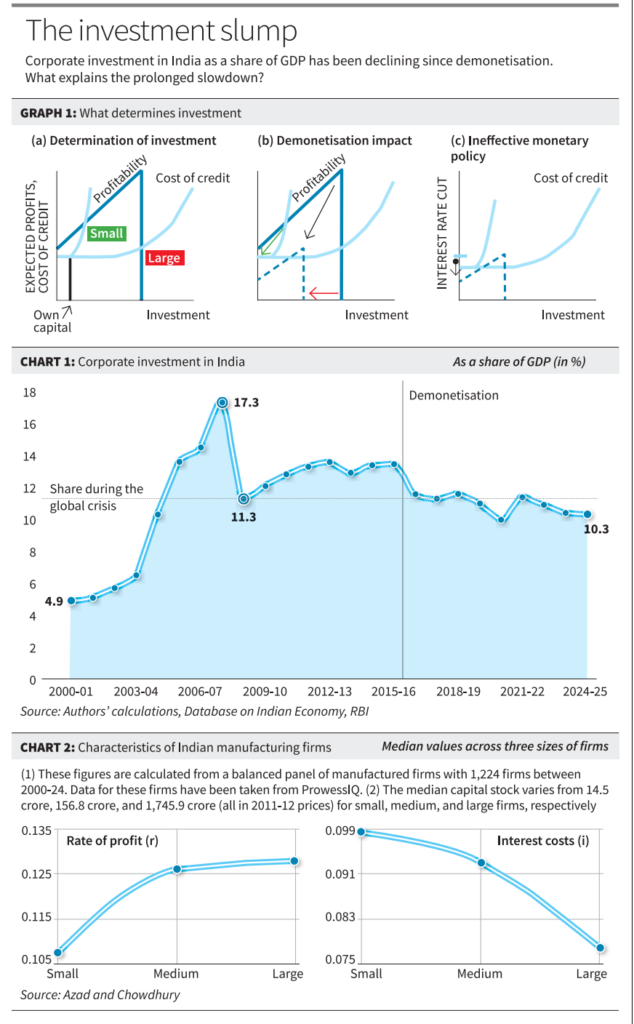
What Determines Corporate Investment?
- Expected profitability: Firms invest when expected returns from additional capacity exceed the cost of investment. Weak demand and uncertain sales reduce the incentive to invest.
- Business confidence (animal spirits): Expectations about future demand, policy stability and macroeconomic conditions influence investment decisions. Persistent uncertainty can delay even otherwise profitable projects.
- Cost and availability of credit: Higher borrowing costs discourage investment, particularly among MSMEs, which have limited internal capital and face higher financing costs.
- Market demand: Large firms often possess sufficient internal resources and cheaper access to finance; their primary constraint may therefore be insufficient market demand, rather than interest rates.
- Internal funds and firm size: Larger firms generally have greater retained earnings and easier access to capital markets, while smaller firms are more dependent on costly external finance. Thus, access to capital itself can reinforce differences in investment capacity.
- Capacity utilisation: Firms are unlikely to create substantial new capacity when existing capacity is underutilised.
Why has Investment Remained Weak?
- Demonetisation shock: The disruption to cash-intensive sectors particularly affected MSMEs and weakened demand and profitability.
- Weak consumption and demand expectations: Cautious private investment reflects uncertainty over the strength and durability of demand.
- COVID-19 shock: The pandemic further disrupted investment, although the slowdown had begun before 2020.
- Credit constraints: Lower policy rates may not benefit credit-constrained MSMEs if banks continue to perceive them as risky, while large firms may not require additional borrowing.
- Tax cuts alone are insufficient: In 2019, India reduced the base corporate tax rate to 22% for eligible existing domestic companies and 15% for new manufacturing companies, subject to specified conditions. Such supply-side measures improve post-tax profitability, but investment depends on expected demand and capacity utilisation, not merely tax rates.
- Structural constraints: Land, logistics, infrastructure bottlenecks, regulatory uncertainty and skill shortages can also raise the cost and risk of investment.
Thus, monetary easing and tax concessions are enabling but not sufficient conditions for investment.
Emerging Signs of Recovery:
- The outlook is not uniformly pessimistic. RBI project-finance data show that investment intentions moderated from ₹5.48 lakh crore in 2023-24 to ₹4.97 lakh crore in 2024-25, but pipeline projects indicated envisaged capital expenditure of about ₹2.67 lakh crore during 2025-26.
- Healthier corporate balance sheets, rising capacity utilisation, infrastructure investment, PLI schemes and easier liquidity provide grounds for cautious optimism.
However, investment announcements may not always translate into actual expenditure.
Why Corporate Investment Matters?
- Economic growth: Raises productive capacity and productivity.
- Employment: Generates direct and indirect employment, particularly when investment is labour-intensive.
- Crowding-in: Private investment can stimulate complementary investment across supply chains.
- Structural transformation: Supports manufacturing, infrastructure and technology adoption.
- Exports: Enhances scale, productivity and global competitiveness.
- Fiscal sustainability: Higher investment-led growth broadens the tax base and improves the sustainability of public finances.
Way Forward:
India needs to shift from an exclusive cost-of-capital approach towards a broader demand-and-profitability strategy:
- Sustain public capital expenditure in infrastructure to crowd in private investment.
- Strengthen rural and urban consumption demand through employment generation, rural incomes and targeted social expenditure.
- Improve MSME access to affordable institutional credit through credit guarantees, cash-flow-based lending, TReDS and timely settlement of government and corporate dues.
- Reduce regulatory uncertainty, ensure predictable taxation and improve the ease of doing business.
- Deepen corporate-bond and development-finance markets for long-term capital.
- Make incentives such as PLI time-bound and linked to additional investment, jobs and technology transfer.
- Strengthen logistics, power, skills and industrial infrastructure.
- Strengthen contract enforcement, competitive markets, skills and R&D.
Hence, reviving India’s investment cycle requires a combination of strong demand, business confidence, public investment, affordable finance and structural reforms rather than relying on monetary easing or tax incentives alone.
Source: https://anantamias.com/current-affairs/what-drives-corporate-investment/
H1N1 cases on the rise
Why in News?
Several States are reporting increased influenza-like illnesses during the monsoon. Delhi recorded 1,344 H1N1 cases by early August, while Mumbai reported 309 cases between June and mid-August. Kerala has recorded 7,421 influenza cases and 88 deaths in 2026, though these are not all necessarily H1N1 cases.
Understanding H1N1:
- Influenza viruses are enveloped, single-stranded RNA viruses belonging to the Orthomyxoviridae family. They are classified into four types:
- Influenza A: infects humans and several animal species and can cause epidemics and pandemics. E.g., H1N1 (Swine Flu), H5N1 (Bird Flu)
- Influenza B: primarily infects humans and generally evolves more slowly.
- Influenza C: usually causes mild illness.
- Influenza D: mainly affects cattle and is not known to cause human disease.
- H1N1 is a subtype of Influenza A virus. “H” and “N” refer to its surface proteins: haemagglutinin and neuraminidase.
- Influenza viruses undergo frequent antigenic drift (gradual mutations in H and N proteins enable the virus to partially evade existing immunity) and produce seasonal outbreaks. This necessitates periodic updating of vaccines.
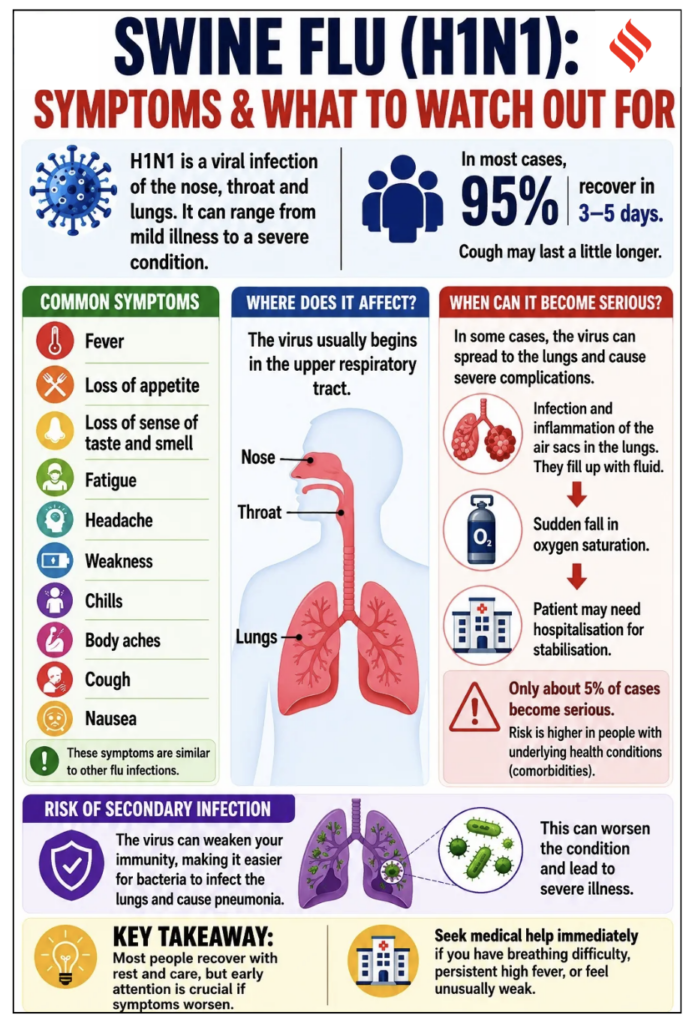
Transmission and Control:
- Transmission: The infection spreads mainly through respiratory droplets and aerosols, particularly in crowded spaces such as schools.
- Symptoms: Fever, cough, sore throat, nasal congestion, body ache and fatigue. Severe cases may cause pneumonia, respiratory failure or aggravation of existing illnesses.
- Control: Oseltamivir is a commonly used antiviral and is most beneficial when started early under medical supervision. Other influenza-specific antivirals also exist. Most patients recover without hospitalisation.
On June 11, 2009, the WHO declared H1N1 a pandemic; 74 countries and territories had already
The rise in cases does not indicate a new pandemic, but limited testing and deaths among vulnerable groups justify preparedness without public alarm.
UPSC PYQ 2015:
Q. H1N1 virus is sometimes mentioned in the news with reference to which one of the following diseases?
(a) AIDS
(b) Bird flu
(c) Dengue
(d) Swine flu
Answer: (d)
Source: https://anantamias.com/current-affairs/h1n1-cases-on-the-rise/