Why in News?
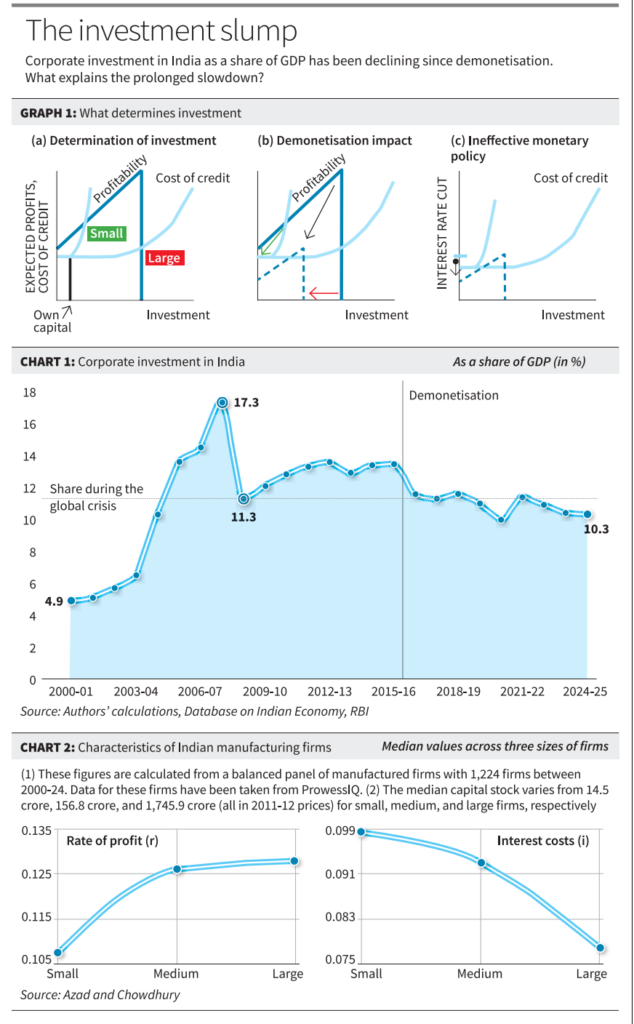
Corporate investment is crucial for expanding productive capacity, creating employment and raising long-term economic growth. However, the recent analysis estimates that corporate investment in India declined from about 13.5% of GDP in 2015-16 to 10.3% in 2024-25, remaining below even its Global Financial Crisis-era level (2007-2009).
The decline accelerated after demonetisation, although it must also be understood alongside the earlier twin-balance-sheet problem, the GST transition, the IL&FS-led NBFC crisis, COVID-19 and global uncertainty. Therefore, demonetisation constitutes an important inflection point, but not necessarily the sole cause.
What Determines Corporate Investment?
- Expected profitability: Firms invest when expected returns from additional capacity exceed the cost of investment. Weak demand and uncertain sales reduce the incentive to invest.
- Business confidence (animal spirits): Expectations about future demand, policy stability and macroeconomic conditions influence investment decisions. Persistent uncertainty can delay even otherwise profitable projects.
- Cost and availability of credit: Higher borrowing costs discourage investment, particularly among MSMEs, which have limited internal capital and face higher financing costs.
- Market demand: Large firms often possess sufficient internal resources and cheaper access to finance; their primary constraint may therefore be insufficient market demand, rather than interest rates.
- Internal funds and firm size: Larger firms generally have greater retained earnings and easier access to capital markets, while smaller firms are more dependent on costly external finance. Thus, access to capital itself can reinforce differences in investment capacity.
- Capacity utilisation: Firms are unlikely to create substantial new capacity when existing capacity is underutilised.
Why has Investment Remained Weak?
- Demonetisation shock: The disruption to cash-intensive sectors particularly affected MSMEs and weakened demand and profitability.
- Weak consumption and demand expectations: Cautious private investment reflects uncertainty over the strength and durability of demand.
- COVID-19 shock: The pandemic further disrupted investment, although the slowdown had begun before 2020.
- Credit constraints: Lower policy rates may not benefit credit-constrained MSMEs if banks continue to perceive them as risky, while large firms may not require additional borrowing.
- Tax cuts alone are insufficient: In 2019, India reduced the base corporate tax rate to 22% for eligible existing domestic companies and 15% for new manufacturing companies, subject to specified conditions. Such supply-side measures improve post-tax profitability, but investment depends on expected demand and capacity utilisation, not merely tax rates.
- Structural constraints: Land, logistics, infrastructure bottlenecks, regulatory uncertainty and skill shortages can also raise the cost and risk of investment.
Thus, monetary easing and tax concessions are enabling but not sufficient conditions for investment.
Emerging Signs of Recovery:
- The outlook is not uniformly pessimistic. RBI project-finance data show that investment intentions moderated from ₹5.48 lakh crore in 2023-24 to ₹4.97 lakh crore in 2024-25, but pipeline projects indicated envisaged capital expenditure of about ₹2.67 lakh crore during 2025-26.
- Healthier corporate balance sheets, rising capacity utilisation, infrastructure investment, PLI schemes and easier liquidity provide grounds for cautious optimism.
However, investment announcements may not always translate into actual expenditure.
Why Corporate Investment Matters?
- Economic growth: Raises productive capacity and productivity.
- Employment: Generates direct and indirect employment, particularly when investment is labour-intensive.
- Crowding-in: Private investment can stimulate complementary investment across supply chains.
- Structural transformation: Supports manufacturing, infrastructure and technology adoption.
- Exports: Enhances scale, productivity and global competitiveness.
- Fiscal sustainability: Higher investment-led growth broadens the tax base and improves the sustainability of public finances.
Way Forward:
India needs to shift from an exclusive cost-of-capital approach towards a broader demand-and-profitability strategy:
- Sustain public capital expenditure in infrastructure to crowd in private investment.
- Strengthen rural and urban consumption demand through employment generation, rural incomes and targeted social expenditure.
- Improve MSME access to affordable institutional credit through credit guarantees, cash-flow-based lending, TReDS and timely settlement of government and corporate dues.
- Reduce regulatory uncertainty, ensure predictable taxation and improve the ease of doing business.
- Deepen corporate-bond and development-finance markets for long-term capital.
- Make incentives such as PLI time-bound and linked to additional investment, jobs and technology transfer.
- Strengthen logistics, power, skills and industrial infrastructure.
- Strengthen contract enforcement, competitive markets, skills and R&D.
Hence, reviving India’s investment cycle requires a combination of strong demand, business confidence, public investment, affordable finance and structural reforms rather than relying on monetary easing or tax incentives alone.
Tell Google you want more of this.
Add Anantam IAS as a preferred sourceOne tap, and this site shows up more often in your own Top Stories, AI Overviews and AI Mode. Remove it any time.