

Why in News?
MGNREGS (Mahatma Gandhi National Rural Employment Guarantee Scheme) recorded a sharp contraction in scale in its final operational year (2025-26). Despite a rise in registered households, employment generation dropped, leading to an average income loss of ₹1221 for each household during the financial year; 40% fewer households completed 100 days of work.
The Parliament has passed the Viksit Bharat-Guarantee for Rozgar and Ajeevika Mission (Gramin) Act, 2025, to replace MGNREGS in FY 2026-27. The VB-G RAM G Act is to take effect on July 1, 2026.
| UPSC Relevance: GS-2 Social Justice: Welfare Schemes; Employment Prelims: Mahatma Gandhi National Rural Employment Guarantee Act, 2025; Viksit Bharat- Guarantee for Rozgar and Ajeevika Mission (Gramin) Act, 2025. Mains: Shift From MGNREGS to VB-G RAM G (Need, Benefits and Challenges). |
What is MGNREGA?
The Mahatma Gandhi National Rural Employment Guarantee Act, 2025 (MGNREGA) was India’s most ambitious rights-based welfare legislation for rural labour.
MGNREGA transformed rural employment from a state charity into a legal entitlement. The Act shifts employment from a negative right under Article 21 to a positive statutory obligation on the government to provide employment on demand.
Key Features of MGNREGS:
- Guarantee: 100 days of unskilled wage employment per rural household per year
- Coverage: 15.46 crore registered households (2025-26)
- Nature: Demand-driven, rights-based; work to be provided within 15 days of application
- Wage: Average ~₹267/day in 2024-25; state-specific rates
- Ministry: Ministry of Rural Development; executed through Gram Panchayats.
- Assets: Focuses on the creation of durable rural assets- water conservation, roads, land development
- Safeguard: Unemployment allowance payable if work is not provided within 15 days.
MGNREGS served as a livelihood buffer, poverty-alleviation tool and women’s empowerment scheme (~50% women workers).
Issues associated with MGNREGA:
- Chronic underfunding: ₹86,000 crore allocated in 2025-26, a mere 0.26% of GDP vs World Bank’s recommended 1.7%. Revised Estimates routinely exceed Budget Estimates, indicating supply suppression of demand.
- Low wages: Wages (~₹267/day) fall short of inflation-adjusted living costs; the Parliamentary panel recommended a minimum of ₹400/day. Estimated >70% transactions of wage payments under MNREGA are delayed beyond the mandated time.
- Reports of rampant corruption through fake job cards to divert funds and overcharging for materials. Gram Panchayat capacity gaps in planning, execution, and record-keeping.
- Implementation Issue: Aadhaar-Based Payment System (ABPS) mandatory from Jan 2024: ~27.5% of all workers excluded due to non-compliance.
- Mass job card deletions: 78 million deletions between 2022-2024; ~15% estimated wrongful. Only 7% of households received the full 100 days in 2024-25.
- Lack of financial inclusion: Poor rural banking infrastructure (limited bank branches, ATMs, and unstable connectivity) significantly hinders Direct Benefit Transfer (DBT) payments under the scheme. This forces long-distance travel, transaction failures (e.g., failed biometrics), and reliance on middlemen.
- Unsustainable employment: MGNREGA provides mainly unskilled manual work, which neither results in skill development of rural labour nor provides sustainable employment opportunities to them.
- Flawed Compensation Calculation System (MIS) delays compensation: Management and Information System (MIS) often underestimates or denies compensation by only calculating Stage 1 delays (time taken by state governments to generate an electronic pay order). It typically fails to calculate the delay caused by the central government in releasing funds (the major component of the total delay).
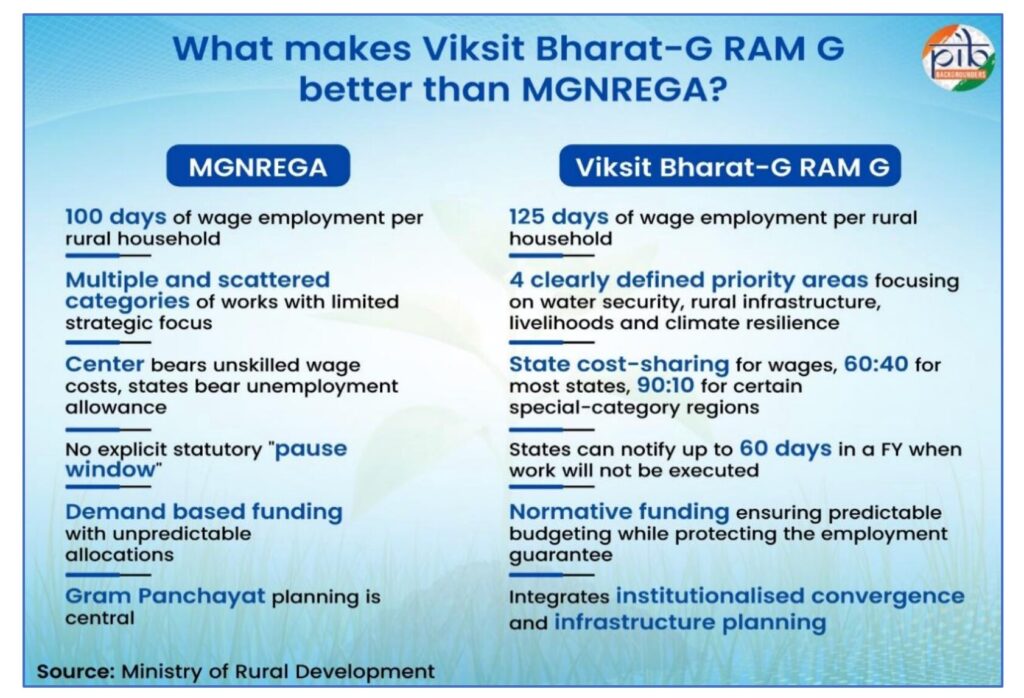
The new rural employment scheme, Viksit Bharat – Guarantee for Rozgar and Ajeevika Mission Act, is set to replace MGNREGS.
Viksit Bharat- Guarantee for Rozgar and Ajeevika Mission (Gramin) Act, 2025:
Aligned with Viksit Bharat @2047, the Act repositions rural employment from a standalone welfare intervention into an integrated instrument of national development.
Key components of the Act:
- Empowerment: Enhanced statutory guarantee of 125 days of wage employment per household per year (up from 100).
- Growth: Focuses on creating durable assets to improve climate resilience, water management, and rural infrastructure, directly linking employment to long-term rural growth.
- Convergence: Integrates local development plans through Viksit Gram Panchayat Plans (VGPPs), aligning them with the National PM Gati Shakti framework for optimised infrastructure development.
- Saturation: Extends coverage to all eligible rural households through a saturation-based delivery model to ensure no eligible household is left out.
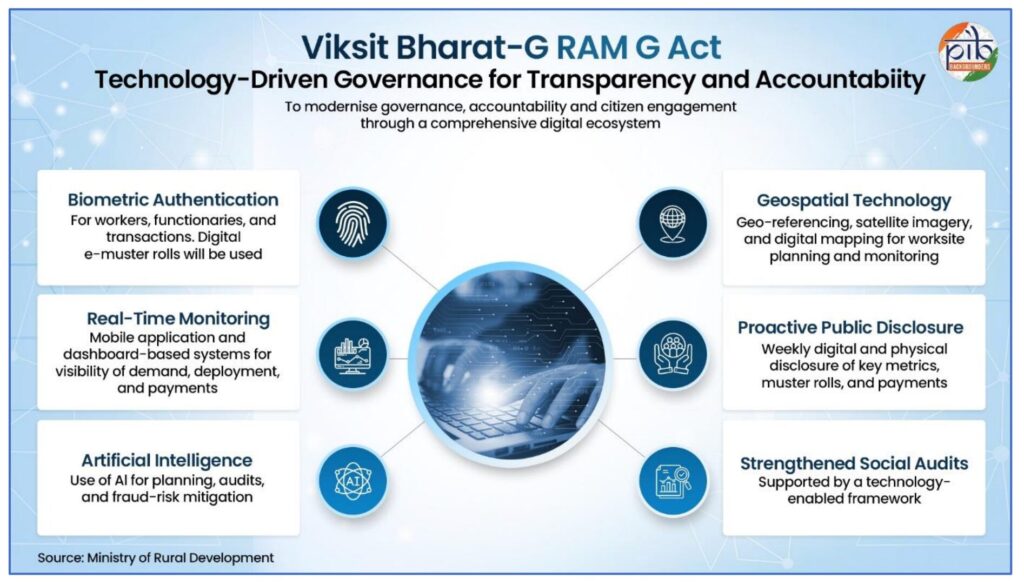
- Governance: Leverages digital governance tools, including geo-tagging of assets, biometric attendance, and social audits to enhance transparency and ensure timely wage payments.
- Funding: Centrally Sponsored Scheme with a 60: 40 cost-sharing ratio between the Centre and States; 90:10 for North Eastern & Himalayan States.
The Central Government shall determine the State-wise normative allocation for each state based on objective parameters as may be prescribed by the Central Government.
Implementing and Monitoring Authorities:
- Central and State Gramin Rozgar Guarantee Councils: provide policy guidance, review implementation, and strengthen accountability.
- National and State Steering Committees: drive strategic direction, convergence, and performance review.
- Panchayati Raj Institutions: lead planning and execution, with Gram Panchayats implementing at least half of the works in terms of cost.
- District Programme Coordinators and Programme Officers: manage planning, compliance, payments, and social audits.
- Gram Sabha: role in conducting social audits and ensuring transparency through access to all records.
Need to replace MGNREGA:
- Rural poverty has declined sharply from nearly 25.7% in 2011-12 to around 5% in 2023-24, reducing the need for distress-relief-only employment.
- Viksit Bharat @2047’s development vision requires a transition from a purely wage-support programme to a productivity-oriented rural employment architecture focused on durable asset creation, skilling, rural enterprise, and local economic transformation.
- Address MGNREGS’s acknowledged weaknesses: fund leakages, poor asset quality, weak state capacity, and capping of demand.
- Integrate employment guarantee with PM Gati Shakti infrastructure planning at the national level.
Concerns associated with the shift from MGREGS to Vikshit Bharat- G RAM G:
- Lack of Public Consultation: The NREGA Sangharsh Morcha and other stakeholders have raised concerns that replacing the rights-based MGNREG Act was done without adequate transparency or engagement with rural workers.
- Shift from Demand-Driven to Budget-Capped Model: Critics worry the new structure may prioritise fixed, planned works, potentially limiting the legal entitlement of workers and replacing it with a more restricted, centrally controlled framework. This could risk dilution of the rights-based framework.
- Increased State Financial Burden: The shift to a centrally sponsored scheme model requires states to bear a higher share (up to 40% vs. roughly 10% in some aspects of the previous system), which risks discouraging participation from resource-constrained, poorer states.
- Low Funding for Transition: Only ₹30,000 crore was allocated for the 2025-26 transition year, which experts argue is insufficient to maintain the current scale of work, threatening to disrupt 15+ crore registered households.
- Administrative and Structural Shifts: The Act moves toward stricter digital accountability, such as the National Mobile Monitoring System (NMMS), which critics argue may lead to systemic exclusion.
For the financial year 2026-27, a Central share provision of ₹95,692 crores has been made for the Viksit Bharat-Guarantee for Rozgar and Ajeevika Mission (Gramin), representing the largest allocation ever for a rural employment programme at the Budget Estimate Stage.
Tell Google you want more of this.
Add Anantam IAS as a preferred sourceOne tap, and this site shows up more often in your own Top Stories, AI Overviews and AI Mode. Remove it any time.





