Daily Digest
UPSC · Civil Services Examination
Current Affairs · Friday, 21 August 2026
Current affairs curated and edited by Anantam IAS faculty — pulled from The Hindu, PIB, IDSA, Foreign Affairs and the ministries. Read, annotate, revise.
Old Rajinder Nagar · Delhi 110005 · anantamias.com
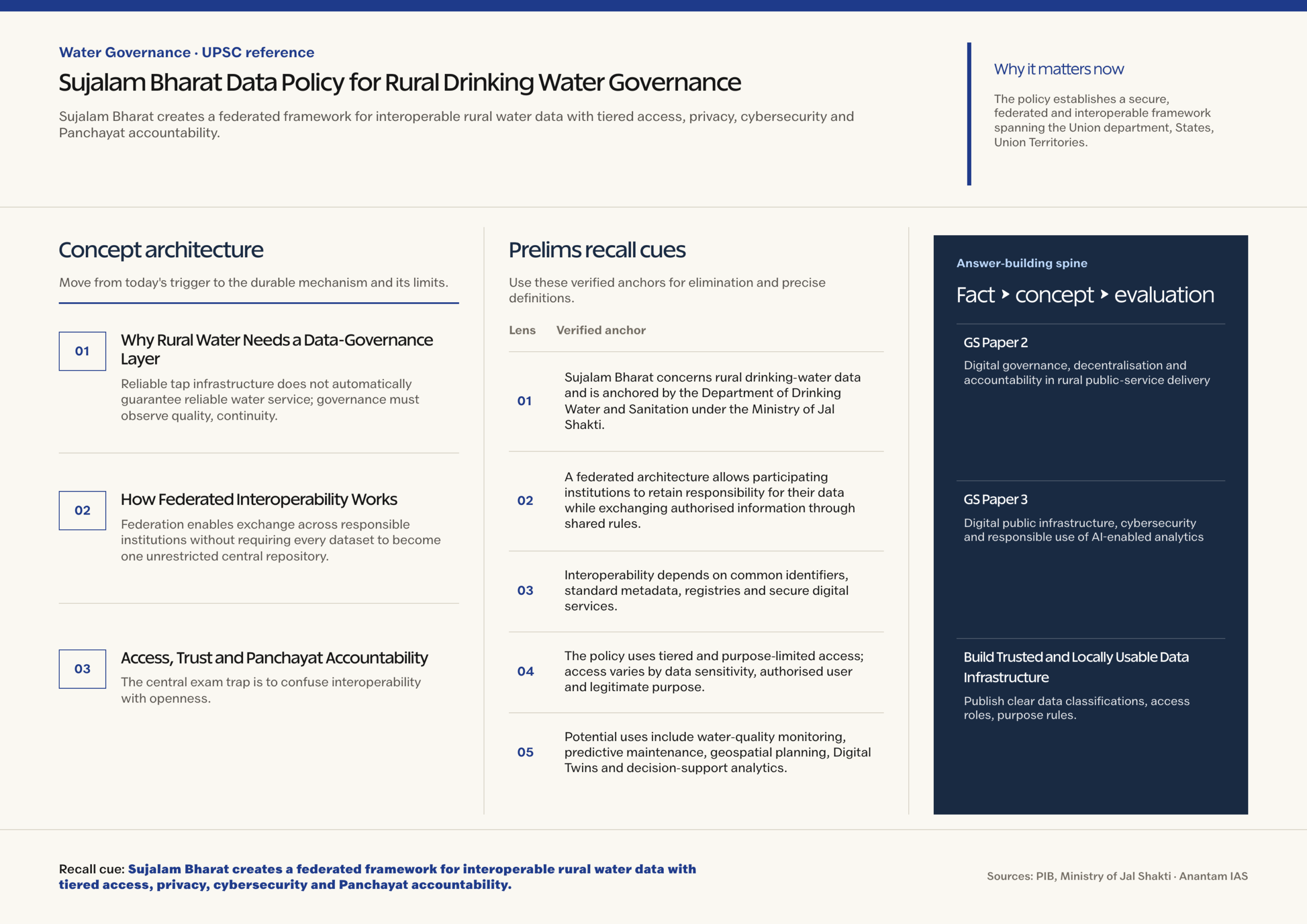
Sujalam Bharat Data Policy for Rural Drinking Water Governance
Why in News?
The Department of Drinking Water and Sanitation issued the Sujalam Bharat data-sharing policy on 20 August 2026 for governed exchange of rural drinking-water data.
- The policy establishes a secure, federated and interoperable framework spanning the Union department, States, Union Territories, local institutions and approved stakeholders.
- It promotes common identifiers, standardised metadata and interoperable registries so authorised systems can exchange information without erasing institutional responsibility.
- Its tiered, purpose-based access protects personal information and sensitive infrastructure; it does not make all rural water data openly accessible.
- The framework links data use with Panchayat-centric accountability, citizen participation, grievance redressal, participatory asset monitoring and service assurance.
- Rural water governance must track the service lifecycle, including source sustainability, water quality, maintenance, breakdowns and grievance resolution, not merely infrastructure creation.
- Shared standards can improve coordination, but trustworthy digital infrastructure also needs clear access rights, auditability and protection against misuse or cyber disruption.
- Local accountability matters because data becomes useful only when Gram Panchayats can verify assets, monitor service and act on problems affecting residents.
UPSC Relevance
Prelims Relevance
- Sujalam Bharat concerns rural drinking-water data and is anchored by the Department of Drinking Water and Sanitation under the Ministry of Jal Shakti.
- A federated architecture allows participating institutions to retain responsibility for their data while exchanging authorised information through shared rules.
- Interoperability depends on common identifiers, standard metadata, registries and secure digital services, not merely placing datasets on one portal.
- The policy uses tiered and purpose-limited access; access varies by data sensitivity, authorised user and legitimate purpose.
- Potential uses include water-quality monitoring, predictive maintenance, geospatial planning, Digital Twins and decision-support analytics.
Mains Relevance
GS Paper 2
- Digital governance, decentralisation and accountability in rural public-service delivery
- Privacy, grievance redressal and citizen participation in data-enabled welfare systems
GS Paper 3
- Digital public infrastructure, cybersecurity and responsible use of AI-enabled analytics
- Water security, source sustainability and lifecycle management of rural infrastructure
Essay
- Public data creates public value only when technological interoperability is matched by institutional trust, local capacity and enforceable accountability.
Background and Context
Why Rural Water Needs a Data-Governance Layer
Reliable tap infrastructure does not automatically guarantee reliable water service; governance must observe quality, continuity, maintenance and source conditions over time.
- Rural water information is produced across multiple institutions, including the Union department, State agencies, field units, laboratories, local bodies and service operators.
- When systems use incompatible names, formats or asset records, the same habitation, source or pipeline may be difficult to reconcile across databases.
- Interoperable records can connect an asset with its location, condition, water-quality result, maintenance history and responsible institution, reducing delays caused by fragmented evidence during diagnosis.
- This supports a shift from counting completed works to measuring service assurance: whether safe water is delivered reliably, complaints are resolved and failures are corrected promptly.
- Data can also expose recurring breakdowns, water-quality patterns or source stress, helping administrators prioritise preventive maintenance and sustainability measures instead of repeated emergency repairs.
How Federated Interoperability Works
Federation enables exchange across responsible institutions without requiring every dataset to become one unrestricted central repository.
- Common identifiers help different systems recognise the same village, household connection, source, laboratory, asset or grievance without relying on ambiguous text matching.
- Standardised metadata records what a dataset contains, who maintains it, how current it is, its quality limits and the conditions governing reuse.
- Interoperable registries and secure services allow an authorised system to discover and exchange relevant information in a consistent machine-readable form.
- A federated model preserves institutional accountability: the agency responsible for collecting or maintaining information remains answerable for its quality, correction, security and authorised disclosure.
- Approved data exchange can support water-quality alerts, geospatial planning, predictive maintenance and Digital Twins, but analytics should remain decision support, not unreviewed automated authority.
Access, Trust and Panchayat Accountability
The central exam trap is to confuse interoperability with openness: usable data may still require strict limits because water systems include personal and sensitive infrastructure information.
- Tiered access means different users receive different permissions according to data classification, public purpose, institutional role, operational need and the sensitivity of the requested information.
- Purpose limitation requires authorised data to be used for the approved task; permission for maintenance analysis does not create unrestricted permission for unrelated profiling, commercial reuse or onward sharing.
- Privacy safeguards must cover collection, access and onward use, while cybersecurity must protect availability, integrity and confidentiality of operational systems and records.
- Sensitive details about water assets can create operational risk if exposed, so transparency should publish service-relevant accountability information without revealing exploitable infrastructure data.
- Gram Panchayats need usable local records, training and grievance workflows so communities can verify assets, flag failures, track closure and identify which institution must act.
Way Forward
Build Trusted and Locally Usable Data Infrastructure
- Publish clear data classifications, access roles, purpose rules, retention limits and appeal mechanisms so every exchange has an accountable legal and administrative basis.
- Adopt minimum-quality checks, provenance records and update schedules so interoperable systems do not spread stale or inaccurate data more efficiently.
- Use encryption, access logs, incident response and independent security testing to protect both personal data and sensitive infrastructure across participating systems.
- Provide Panchayats with dashboards, local-language support, training and auditable grievance closure so digital tools strengthen decentralised oversight rather than centralise control.
Conclusion
- Sujalam Bharat should be understood as governed digital public infrastructure: shared standards enable service coordination, while federation, tiered access, data quality and cybersecurity preserve trust and responsibility.
- In a Mains answer, connect interoperability with last-mile accountability: better data matters only when Panchayats and citizens can verify services and secure timely institutional action.
UPSC Practice Questions
Prelims MCQ 1
With reference to the Sujalam Bharat data-sharing policy, consider the following statements:
- It promotes common identifiers and standardised metadata for rural drinking-water data.
- It requires all participating datasets to be made openly accessible to every citizen.
- It provides for tiered and purpose-based stakeholder access.
How many of the above statements are correct?
(a) Only one (b) Only two (c) All three (d) None
Answer: (b) Only two
Explanation:
Statements 1 and 3 are correct. The policy provides governed, tiered and purpose-based access; interoperability does not mean unrestricted open access to all information.
Prelims MCQ 2
Which one of the following best describes a federated data architecture in the context of Sujalam Bharat?
(a) Every record is transferred permanently to one public database (b) Data exchange is prohibited between different levels of government (c) Responsible institutions retain accountability while exchanging authorised data through common standards (d) Private stakeholders receive automatic access to all operational data
Answer: (c) Responsible institutions retain accountability while exchanging authorised data through common standards
Explanation:
Federation enables governed exchange across participating systems while preserving the responsibility of the institutions that maintain and disclose the data.
UPSC Mains Questions
- Interoperability can improve rural drinking-water services, but it does not justify unrestricted data access. Discuss with reference to privacy, cybersecurity and accountable data governance.
- How can digital public infrastructure strengthen Panchayat-centric accountability in rural water delivery? Explain the institutional capacities and safeguards required.
Source: PIB, Ministry of Jal Shakti.
Frequently Asked Questions
What is the Sujalam Bharat data-sharing policy?
It is a Department of Drinking Water and Sanitation framework for secure, federated and interoperable exchange of rural drinking-water data among governments, local institutions and approved stakeholders.
Does tiered access mean rural water data is open to everyone?
No. Access is classified, authorised and purpose-limited. Personal information and sensitive infrastructure data require safeguards even when standardised systems make permitted exchange easier.
What does interoperability mean in this policy?
It means different systems can recognise and exchange authorised information through common identifiers, standard metadata, interoperable registries and secure digital services.
Why are Gram Panchayats important to Sujalam Bharat?
Panchayats are closest to rural service delivery. Usable local data can support asset verification, participatory monitoring, grievance redressal and clear accountability for fixing failures.
What is the main governance risk in rural water data systems?
Poorly controlled access can expose personal or sensitive operational information, while inaccurate data can misdirect decisions. Classification, audit trails, cybersecurity and local verification reduce these risks.
Source: https://anantamias.com/current-affairs/sujalam-bharat-rural-water-data-policy/
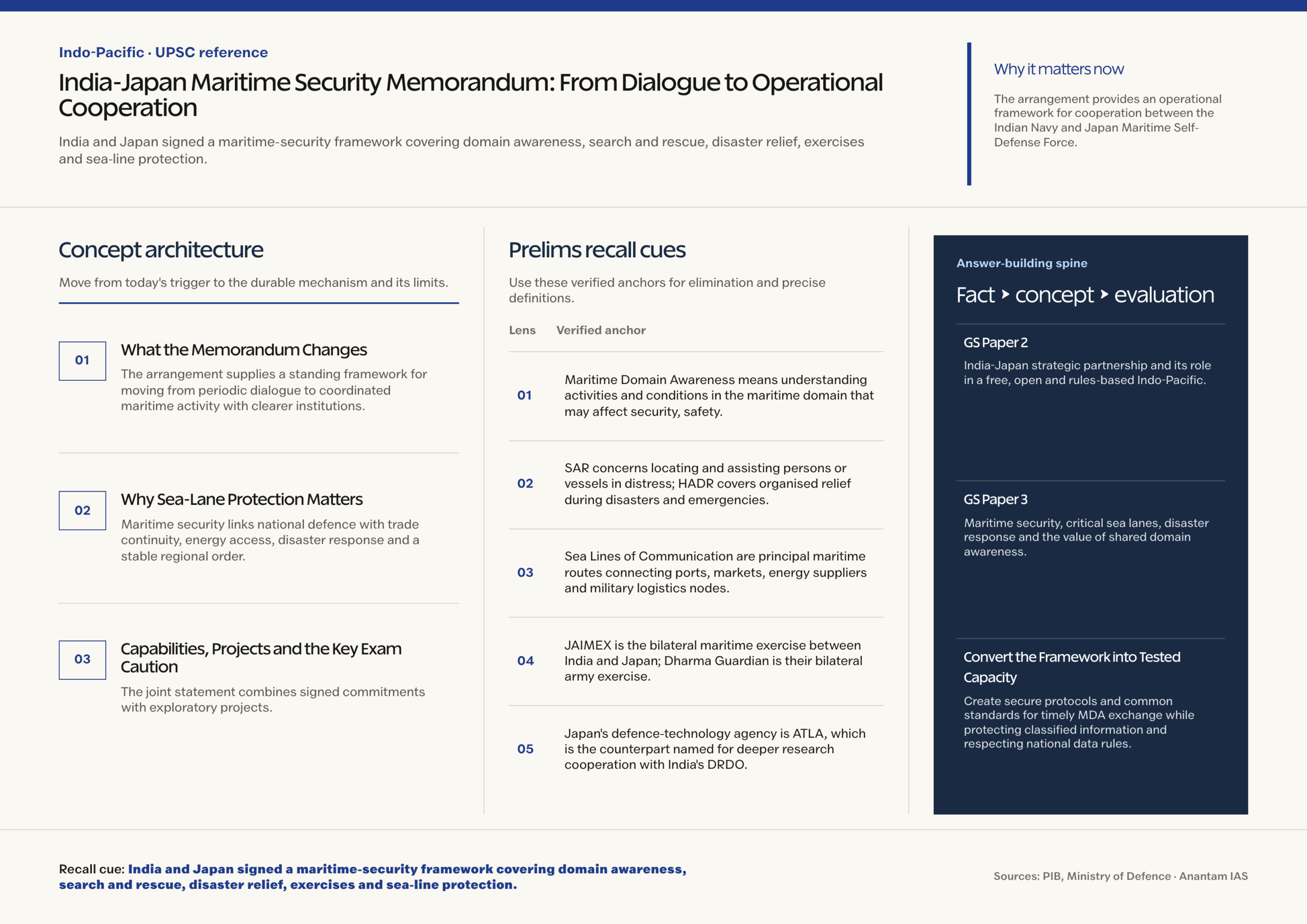
India-Japan Maritime Security Memorandum: From Dialogue to Operational Cooperation
Why in News?
India and Japan signed a Memorandum of Arrangement on Maritime Security Cooperation in New Delhi on 20 August 2026 to deepen practical naval cooperation.
- The arrangement provides an operational framework for cooperation between the Indian Navy and Japan Maritime Self-Defense Force.
- It covers Maritime Domain Awareness information-sharing, Search and Rescue, and Humanitarian Assistance and Disaster Relief.
- Both sides proposed ship visits, exercises, expert exchanges, port access, logistics, maintenance and repair cooperation to protect Sea Lines of Communication.
- A director-general or joint-secretary-level working group will coordinate operational, intelligence, equipment, technology and industrial tracks while respecting sovereign choices.
- India and Japan depend on open sea routes for trade, energy flows and supply-chain resilience across the Indian and Pacific Oceans.
- The framework turns broad Indo-Pacific convergence into repeatable mechanisms for information exchange, coordinated response and naval interoperability.
UPSC Relevance
Prelims Relevance
- Maritime Domain Awareness means understanding activities and conditions in the maritime domain that may affect security, safety, economy or environment.
- SAR concerns locating and assisting persons or vessels in distress; HADR covers organised relief during disasters and emergencies.
- Sea Lines of Communication are principal maritime routes connecting ports, markets, energy suppliers and military logistics nodes.
- JAIMEX is the bilateral maritime exercise between India and Japan; Dharma Guardian is their bilateral army exercise.
- Japan’s defence-technology agency is ATLA, which is the counterpart named for deeper research cooperation with India’s DRDO.
Mains Relevance
GS Paper 2
- India-Japan strategic partnership and its role in a free, open and rules-based Indo-Pacific.
- How minilateral and bilateral security arrangements can supply regional public goods without creating a formal alliance.
GS Paper 3
- Maritime security, critical sea lanes, disaster response and the value of shared domain awareness.
- Defence technology, shipbuilding, repair ecosystems and interoperability as elements of national security capacity.
Essay
- Security partnerships become durable when strategic trust is converted into institutions, shared capabilities and public goods.
Background and Context
What the Memorandum Changes
The arrangement supplies a standing framework for moving from periodic dialogue to coordinated maritime activity with clearer institutions, tasks and implementation channels.
- MDA information-sharing can improve the common operating picture by linking observations about shipping, hazards, suspicious activity and emerging incidents across connected maritime zones.
- Cooperation on SAR and HADR can reduce response time when ships, coastal communities or partner countries face accidents and disasters requiring coordinated assets.
- Naval visits, exercises and expert exchanges build familiarity with each side’s procedures, communication practices and operational constraints before a crisis demands rapid joint action.
- Port use, maintenance and repair arrangements can extend operational reach and sustain deployments, but each activity remains subject to national policy and separate implementation decisions.
- The working group provides institutional follow-through across operational, intelligence, equipment, technology and industry domains, allowing bottlenecks to be reviewed rather than leaving coordination to isolated events.
Why Sea-Lane Protection Matters
Maritime security links national defence with trade continuity, energy access, disaster response and a stable regional order.
- Sea Lines of Communication carry commercial shipping and strategic supplies; disruption can raise freight, insurance and energy costs for importers and consumers far beyond the incident area.
- The Indian Ocean and western Pacific form a connected strategic space because shipping routes pass through narrow chokepoints and link Asian production, energy suppliers and consumption centres.
- Better domain awareness helps distinguish routine traffic from piracy, coercive activity, accidents or environmental hazards, supporting proportionate responses and reducing the risk of miscalculation.
- Interoperable forces can coordinate evacuation, relief delivery, search patterns and logistics without waiting to devise common procedures, compatible communications and task divisions during an emergency.
- Joint capacity can also provide regional public goods, especially safe navigation and disaster assistance, while supporting freedom of navigation and overflight without requiring a formal military alliance.
Capabilities, Projects and the Key Exam Caution
The joint statement combines signed commitments with exploratory projects, so their legal and operational status must be separated.
- The signed memorandum is a cooperation framework; it is not a mutual-defence treaty and does not create an automatic obligation to enter a conflict or host forces.
- Mine-countermeasure cooperation and possible joint naval shipbuilding were identified for further work, not announced as completed capabilities, approved designs or contracted projects.
- The proposed reciprocal ship-repair arrangement is still to be concluded, even though both sides expressed support for using repair facilities and progressing negotiations soon.
- The shipborne UNICORN antenna project was described as the first bilateral defence-equipment transfer project, but the ministers committed only to working toward its early realisation.
- DRDO-ATLA research cooperation and a planned Defence Industry Forum can connect operational needs with technology, production and supply-chain resilience, provided discussions produce governed and deliverable projects.
Way Forward
Convert the Framework into Tested Capacity
- Create secure protocols and common standards for timely MDA exchange while protecting classified information and respecting national data rules.
- Run scenario-based SAR, HADR and mine-countermeasure exercises that test communications, logistics, command relationships and after-action learning.
- Conclude transparent ship-repair and port-support arrangements with clear scope, access procedures, cost rules and accountability.
- Set measurable working-group milestones for equipment transfer, research and industrial cooperation without overstating exploratory discussions as completed outcomes.
Conclusion
- The memorandum matters because it converts strategic convergence into operational cooperation across information, exercises, relief, logistics and technology.
- In a Mains answer, present it as flexible capacity-building that strengthens maritime resilience, while noting that projects require implementation and the arrangement is not a defence alliance.
UPSC Practice Questions
Prelims MCQ 1
With reference to the India-Japan Memorandum of Arrangement on Maritime Security Cooperation, consider the following statements:
- It includes information-sharing in Maritime Domain Awareness.
- It provides for cooperation in Search and Rescue and Humanitarian Assistance and Disaster Relief.
- It creates an automatic mutual-defence obligation between India and Japan.
How many of the above statements are correct?
(a) Only one (b) Only two (c) All three (d) None
Answer: (b) Only two
Explanation:
Statements 1 and 2 reflect the signed framework. Statement 3 is incorrect because the memorandum is an operational cooperation arrangement, not a mutual-defence treaty.
Prelims MCQ 2
Which one of the following is correctly matched?
(a) JAIMEX — India-Japan army exercise (b) Dharma Guardian — India-Japan air exercise (c) ATLA — Japan’s defence technology agency (d) UNICORN — A multilateral disaster-relief network
Answer: (c) ATLA — Japan's defence technology agency
Explanation:
ATLA is Japan’s Acquisition, Technology and Logistics Agency. JAIMEX is maritime, Dharma Guardian is an army exercise, and UNICORN is a shipborne integrated communications antenna system.
UPSC Mains Questions
- India-Japan maritime cooperation is shifting from strategic dialogue to operational capacity-building. Discuss the significance and limits of the new maritime-security memorandum.
- How can Maritime Domain Awareness, logistics cooperation and HADR exercises strengthen regional public goods in the Indo-Pacific? Explain with reference to India-Japan cooperation.
Source: PIB, Ministry of Defence.
Frequently Asked Questions
What did India and Japan sign in August 2026?
Their defence ministries signed a Memorandum of Arrangement establishing a framework for practical maritime-security cooperation between the Indian Navy and Japan Maritime Self-Defense Force.
What areas does the maritime-security memorandum cover?
It covers Maritime Domain Awareness information-sharing, Search and Rescue, HADR, exercises, expert exchanges, naval visits, logistics and coordination for protecting Sea Lines of Communication.
Is the memorandum a mutual-defence treaty?
No. It is a cooperation framework and does not create an automatic obligation for either country to enter a conflict on the other’s behalf.
What is Maritime Domain Awareness?
It is an understanding of maritime activities and conditions that may affect security, safety, the economy or the environment, built through observation and information-sharing.
Were the UNICORN and shipbuilding projects completed by this agreement?
No. The ministers supported early realisation of UNICORN and exploration of shipbuilding cooperation; the statement did not announce completed transfer or joint-development outcomes.
Source: https://anantamias.com/current-affairs/india-japan-maritime-security-memorandum/
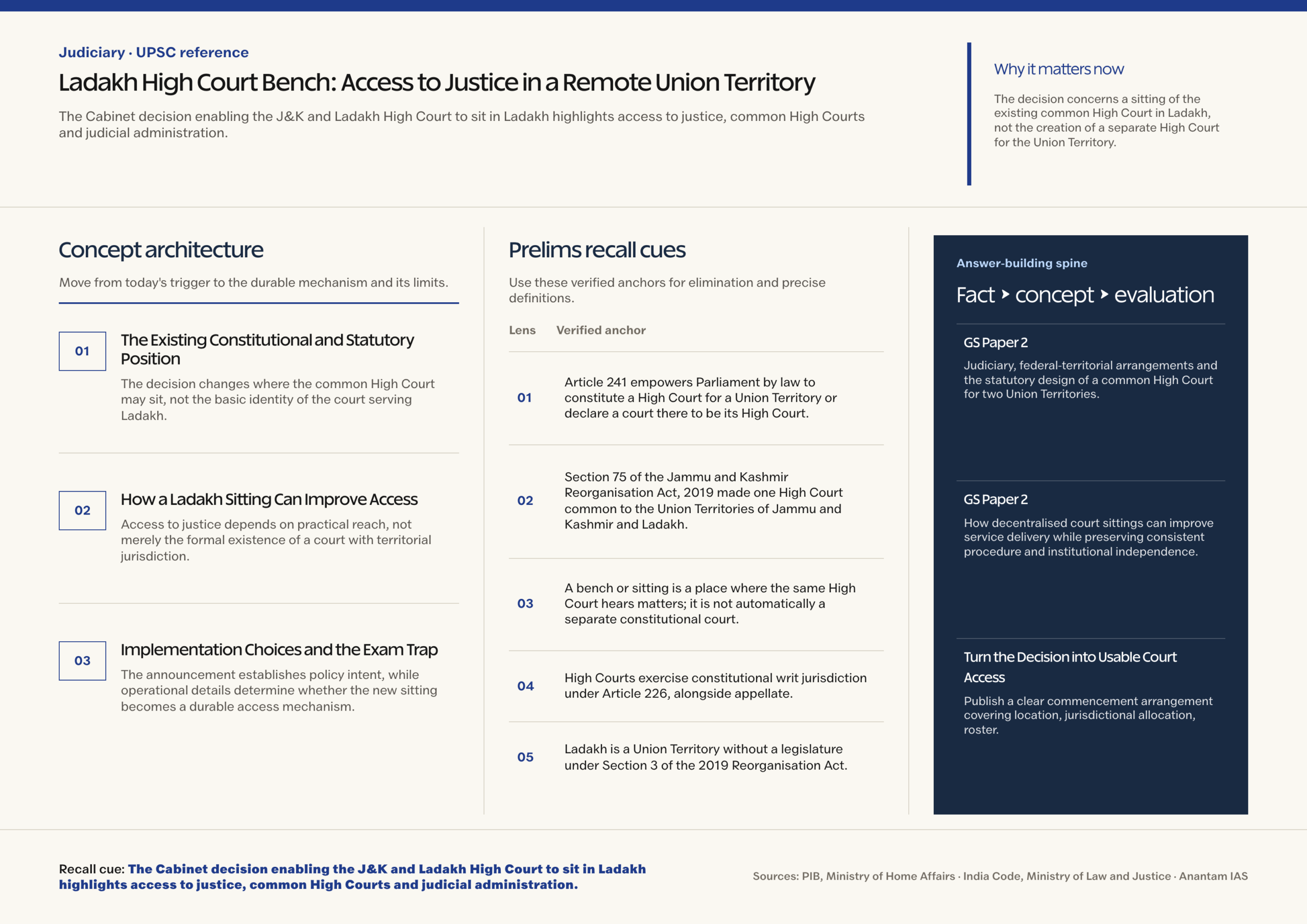
Ladakh High Court Bench: Access to Justice in a Remote Union Territory
Why in News?
On 20 August 2026, the Union Cabinet decided to enable the High Court of Jammu & Kashmir and Ladakh to sit in Ladakh, aiming to improve access to justice in remote areas.
- The decision concerns a sitting of the existing common High Court in Ladakh, not the creation of a separate High Court for the Union Territory.
- The official release links the move to reducing the time residents need to obtain legal services, especially across Ladakh’s remote and difficult terrain.
- The announcement enables a bench to sit in Ladakh; it should not be described as an already operational permanent bench without a notified implementation arrangement.
- Physical distance, travel costs, seasonal constraints and limited local legal infrastructure can turn formal judicial rights into difficult-to-use remedies.
- A local sitting can improve territorial access while preserving the jurisdiction and institutional unity of the common High Court.
UPSC Relevance
Prelims Relevance
- Article 241 empowers Parliament by law to constitute a High Court for a Union Territory or declare a court there to be its High Court.
- Section 75 of the Jammu and Kashmir Reorganisation Act, 2019 made one High Court common to the Union Territories of Jammu and Kashmir and Ladakh.
- A bench or sitting is a place where the same High Court hears matters; it is not automatically a separate constitutional court.
- High Courts exercise constitutional writ jurisdiction under Article 226, alongside appellate, supervisory and other jurisdiction conferred by law.
- Ladakh is a Union Territory without a legislature under Section 3 of the 2019 Reorganisation Act.
Mains Relevance
GS Paper 2
- Judiciary, federal-territorial arrangements and the statutory design of a common High Court for two Union Territories.
- Access to justice as a governance outcome shaped by distance, cost, language, legal aid, infrastructure and case administration.
GS Paper 2
- How decentralised court sittings can improve service delivery while preserving consistent procedure and institutional independence.
- The difference between a Cabinet decision, a notified operational arrangement and the creation of a separate High Court by law.
Essay
- A right becomes meaningful only when institutions are physically, financially and linguistically accessible to those entitled to use it.
Background and Context
The Existing Constitutional and Statutory Position
The decision changes where the common High Court may sit, not the basic identity of the court serving Ladakh.
- The Jammu and Kashmir Reorganisation Act, 2019 divided the former State into the Union Territories of Jammu and Kashmir and Ladakh from the appointed day.
- Under Section 75, the former Jammu and Kashmir High Court became the common High Court for both Union Territories, with the existing judges continuing in the common court.
- The court is now known as the High Court of Jammu & Kashmir and Ladakh, while its common territorial jurisdiction remains the exam-relevant statutory principle.
- Article 241 provides Parliament’s constitutional route for High Courts concerning Union Territories, while the 2019 Act supplies Ladakh’s specific institutional arrangement.
- A bench is part of the same High Court: its orders carry that court’s authority, and creating it does not divide jurisdiction into a new judicial institution.
How a Ladakh Sitting Can Improve Access
Access to justice depends on practical reach, not merely the formal existence of a court with territorial jurisdiction.
- A local sitting can reduce travel time and cost for litigants, lawyers, witnesses and officials who would otherwise travel outside Ladakh for High Court proceedings.
- Shorter journeys can matter especially for urgent writs, bail, service disputes and public-law cases where delay may weaken the value of the eventual remedy.
- Closer hearings can improve lawyer-client consultation, production of records and participation by residents from remote districts, although digital access and legal aid remain necessary complements.
- A local judicial presence can make constitutional remedies under Article 226 more usable without altering their legal scope or the High Court’s control over its procedure.
- The access gain will depend on listing frequency, case categories, judge availability, registry support and reliable hybrid-hearing systems, not on the announcement alone.
Implementation Choices and the Exam Trap
The announcement establishes policy intent, while operational details determine whether the new sitting becomes a durable access mechanism.
- The PIB release says the Cabinet decision enables the High Court to sit in Ladakh; it does not establish a separate Ladakh High Court.
- It should not yet be labelled an operational permanent bench because the cited announcement does not provide commencement, roster, location, staffing or sitting-frequency details.
- Judicial administration must preserve independence and roster authority; executive support for premises and staffing cannot become control over case assignment or adjudication.
- A functional registry should support filing, certified copies, translation, legal-aid referrals and digital case access, so the bench does not become only an occasional ceremonial sitting.
- Consistent procedure across Jammu, Srinagar and Ladakh sittings can prevent forum confusion while allowing scheduling suited to geography, weather and litigant needs.
Way Forward
Turn the Decision into Usable Court Access
- Publish a clear commencement arrangement covering location, jurisdictional allocation, roster, filing routes and predictable sitting calendars.
- Build a staffed registry with e-filing, video hearings, translation, certified-copy services and trained support for litigants who lack reliable connectivity.
- Coordinate legal services institutions, the local Bar and district courts so eligible residents receive advice, representation and referral before matters reach the High Court.
- Track travel burden, disposal time, adjournments and user experience while protecting judicial independence and avoiding performance targets that distort adjudication.
Conclusion
- The Ladakh sitting is best understood as decentralising access within one common High Court, rather than creating a new court or changing Ladakh’s constitutional status.
- In a Mains answer, connect constitutional design with practical access, then test success through predictable hearings, registry capacity, legal aid, digital inclusion and judicial independence.
UPSC Practice Questions
Prelims MCQ 1
With reference to the High Court arrangement for Ladakh, consider the following statements:
- Section 75 of the Jammu and Kashmir Reorganisation Act, 2019 provides a common High Court for the Union Territories of Jammu and Kashmir and Ladakh.
- A High Court bench sitting in Ladakh would necessarily constitute a separate High Court for Ladakh.
- Article 241 concerns High Courts for Union Territories.
How many of the above statements are correct?
(a) Only one (b) Only two (c) All three (d) None
Answer: (b) Only two
Explanation:
Statements 1 and 3 are correct. Statement 2 is incorrect because a bench or sitting remains part of the same High Court unless a separate court is lawfully constituted.
Prelims MCQ 2
What is the most accurate description of the Union Cabinet’s August 2026 decision concerning Ladakh?
(a) It created a separate Supreme Court circuit for Ladakh (b) It immediately constituted a separate High Court for Ladakh (c) It enabled the existing High Court of Jammu & Kashmir and Ladakh to sit in Ladakh (d) It transferred Ladakh’s High Court jurisdiction to the Delhi High Court
Answer: (c) It enabled the existing High Court of Jammu & Kashmir and Ladakh to sit in Ladakh
Explanation:
The decision enables a sitting of the existing common High Court in Ladakh. The official announcement does not create a separate High Court or establish that a permanent bench is already operational.
UPSC Mains Questions
- The physical location of judicial institutions can determine whether constitutional remedies are genuinely accessible. Discuss with reference to the decision enabling the J&K and Ladakh High Court to sit in Ladakh.
- Distinguish between creating a separate High Court and establishing a bench or sitting of an existing High Court. What administrative safeguards should guide the Ladakh arrangement?
Sources: PIB, Ministry of Home Affairs and India Code, Ministry of Law and Justice.
Frequently Asked Questions
Has a separate High Court been created for Ladakh?
No. Section 75 of the 2019 Reorganisation Act provides one common High Court for Jammu and Kashmir and Ladakh; the decision enables that court to sit in Ladakh.
Is the Ladakh bench already an operational permanent bench?
The cited PIB announcement does not establish that. It reports a Cabinet decision enabling a sitting, without specifying commencement, permanent status, roster, staffing or frequency.
Which law governs Ladakh’s existing High Court arrangement?
Section 75 of the Jammu and Kashmir Reorganisation Act, 2019 makes the High Court common to the Union Territories of Jammu and Kashmir and Ladakh.
How can a High Court sitting improve access to justice?
It can reduce travel time and expense, support urgent hearings and bring filing and registry services closer, provided sittings are predictable and supported by legal aid and digital access.
Which constitutional provision addresses High Courts for Union Territories?
Article 241 empowers Parliament by law to constitute a High Court for a Union Territory or declare a court in that territory to be its High Court.
Source: https://anantamias.com/current-affairs/ladakh-high-court-bench-access-to-justice/
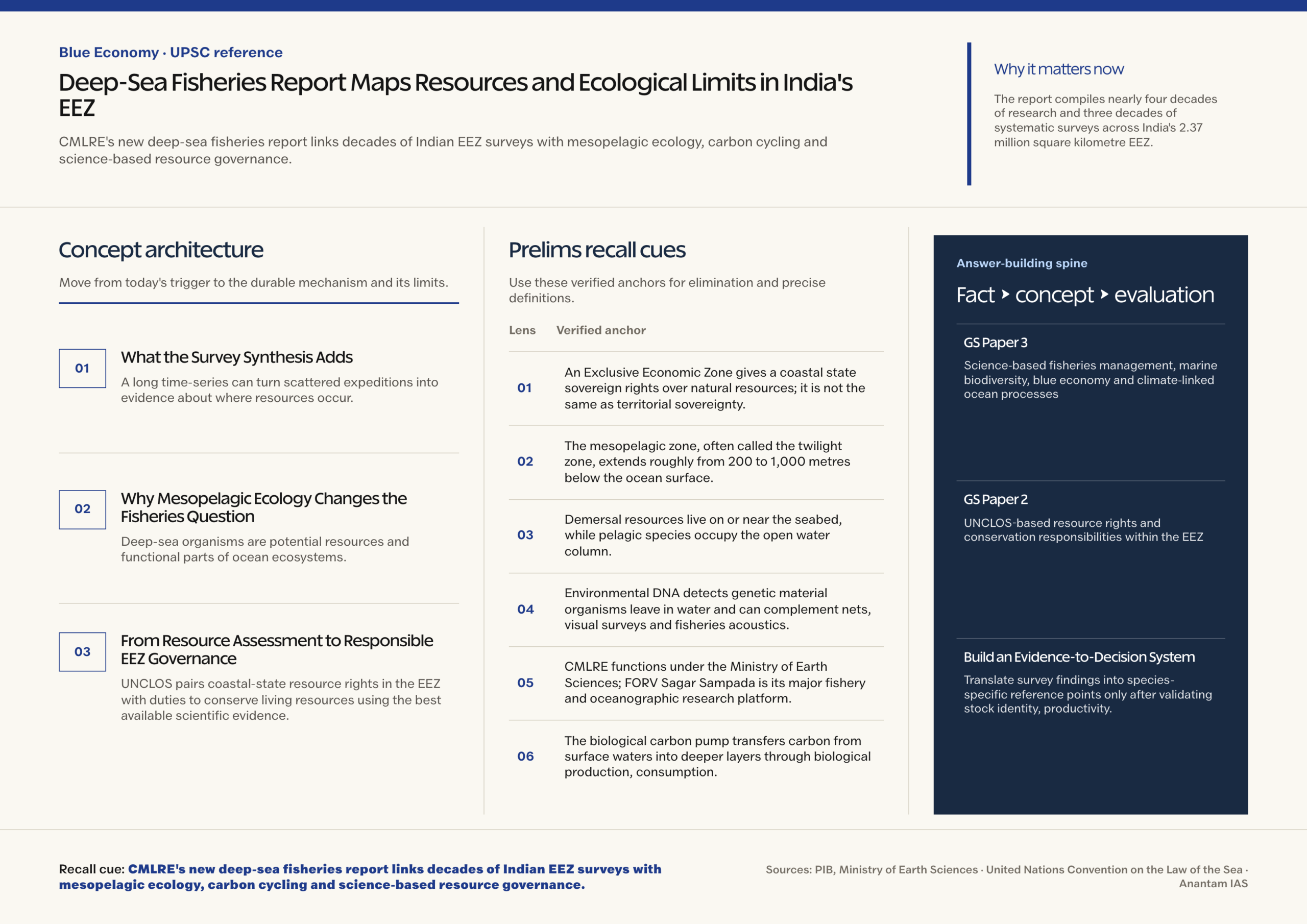
Deep-Sea Fisheries Report Maps Resources and Ecological Limits in India’s EEZ
Why in News?
On 20 August 2026, the Ministry of Earth Sciences released CMLRE’s national report synthesising deep-sea fishery and ecological research across India’s Exclusive Economic Zone.
- The report compiles nearly four decades of research and three decades of systematic surveys across India’s 2.37 million square kilometre EEZ.
- Its evidence base includes more than 400 oceanographic cruises since the early 1990s under the Marine Living Resources Programme.
- It assesses mesopelagic communities, continental-slope resources, open-ocean species and ecologically important nursery and habitat areas.
- The synthesis combines historical observations with acoustics, eDNA, satellites, autonomous platforms, artificial intelligence and ecosystem modelling.
- The report is a scientific assessment, not permission to harvest every identified stock or proof that exploitation would be commercially viable.
- Deep-sea evidence can reduce uncertainty in fishery policy, but abundance estimates must be read alongside reproduction, food-web roles, habitat sensitivity and monitoring capacity.
- The report connects food security and economic opportunity with SDG 14, biodiversity conservation and the ocean’s role in climate regulation.
- Marine spatial planning can separate potential fishing grounds, sensitive habitats, research zones and competing ocean uses before investments create ecological lock-in.
UPSC Relevance
Prelims Relevance
- An Exclusive Economic Zone gives a coastal state sovereign rights over natural resources; it is not the same as territorial sovereignty.
- The mesopelagic zone, often called the twilight zone, extends roughly from 200 to 1,000 metres below the ocean surface.
- Demersal resources live on or near the seabed, while pelagic species occupy the open water column.
- Environmental DNA detects genetic material organisms leave in water and can complement nets, visual surveys and fisheries acoustics.
- CMLRE functions under the Ministry of Earth Sciences; FORV Sagar Sampada is its major fishery and oceanographic research platform.
- The biological carbon pump transfers carbon from surface waters into deeper layers through biological production, consumption, migration and sinking material.
Mains Relevance
GS Paper 3
- Science-based fisheries management, marine biodiversity, blue economy and climate-linked ocean processes
- Balancing resource use with precaution, habitat protection and long-term monitoring
GS Paper 2
- UNCLOS-based resource rights and conservation responsibilities within the EEZ
- Institutional coordination between science agencies, fishery regulators and coastal stakeholders
Essay
- The blue economy becomes durable only when scientific knowledge sets ecological limits before extraction decisions are made.
Background and Context
What the Survey Synthesis Adds
A long time-series can turn scattered expeditions into evidence about where resources occur, how environments vary and which knowledge gaps remain.
- The synthesis brings together species distribution, abundance and environmental observations collected across the Arabian Sea, Bay of Bengal, island waters and adjoining deep-sea systems.
- Repeated cruises help distinguish persistent patterns from a single-season observation, although survey coverage, seasonal timing, gear selectivity and species detectability still shape every estimate.
- Fisheries acoustics can infer the distribution of organisms from sound reflections, while sampling is needed to identify species and calibrate acoustic signals.
- eDNA and autonomous platforms can expand observation across difficult waters, but neither replaces taxonomic expertise, physical samples or transparent uncertainty ranges.
- Satellite observations add surface context such as productivity and ocean conditions; ecosystem models connect these inputs to food webs and management scenarios.
Why Mesopelagic Ecology Changes the Fisheries Question
Deep-sea organisms are potential resources and functional parts of ocean ecosystems, so biomass alone cannot define a safe harvest level.
- The mesopelagic layer between about 200 and 1,000 metres supports lanternfishes, shrimps, cephalopods and predators linked through complex food webs.
- Many organisms migrate upward at night to feed and return to deeper water, moving consumed carbon below the sunlit surface.
- This vertical migration contributes to the biological carbon pump, which helps store carbon at depth and links fishery decisions with climate regulation.
- Removing a forage species can affect predators, prey competition and carbon transport even when the target appears abundant, making cumulative ecosystem effects relevant before commercial scaling.
- Deep-water species may grow slowly, mature late or recover unevenly; such life-history traits can make depletion difficult to reverse.
From Resource Assessment to Responsible EEZ Governance
UNCLOS pairs coastal-state resource rights in the EEZ with duties to conserve living resources using the best available scientific evidence.
- A resource estimate describes potential abundance under stated methods and assumptions; it does not establish allowable catch, profitability or ecosystem-safe extraction by itself.
- Managers need stock structure, recruitment, bycatch, habitat impacts, predator dependence, climate variability and enforcement capacity before setting effort, gear, season or area rules.
- Documented banks, slopes, terraces and island habitats may function as nurseries or biodiversity hotspots, strengthening the case for spatial safeguards and baseline monitoring.
- Adaptive management should begin with cautious pilots, independent observation and review triggers rather than committing capacity before ecological response is understood.
- Transparent data, uncertainty statements and stakeholder participation can align research institutions, regulators and fishing communities around enforceable limits and shared evidence.
Way Forward
Build an Evidence-to-Decision System
- Translate survey findings into species-specific reference points only after validating stock identity, productivity, food-web role and uncertainty.
- Use marine spatial planning to protect sensitive habitats and separate fishing, conservation, research, shipping and energy uses.
- Require vessel monitoring, bycatch reporting, independent observers and periodic stock reassessment before expanding any deep-sea fishery.
- Publish methods and non-sensitive datasets so researchers and coastal stakeholders can test assumptions and identify emerging ecological risks.
Conclusion
- The report’s main value is a national evidence base connecting resource possibilities with mesopelagic food webs, carbon transfer and vulnerable habitats, rather than a catalogue of commercially available fish stocks.
- In a Mains answer, distinguish assessment from authorisation: use the report to support precautionary, spatially informed and continuously monitored management within India’s EEZ.
- A credible blue-economy pathway must make ecological thresholds, uncertainty and recovery capacity as visible in investment decisions as estimated biomass and potential economic value, protecting long-term food security from short-lived gains.
UPSC Practice Questions
Prelims MCQ 1
With reference to the mesopelagic zone and the biological carbon pump, consider the following statements:
- The mesopelagic zone generally extends from about 200 to 1,000 metres below the ocean surface.
- Daily vertical migration by marine organisms can transport carbon from surface waters to deeper layers.
- Every organism detected in this zone can be treated as commercially harvestable biomass.
How many of the above statements are correct?
(a) Only one (b) Only two (c) All three (d) None
Answer: (b) Only two
Explanation:
Statements 1 and 2 are correct. Detection or abundance does not establish commercial viability or ecological harvestability; life history, food-web roles and uncertainty must also be assessed.
Prelims MCQ 2
Which one of the following best describes a coastal state’s position in its Exclusive Economic Zone under UNCLOS?
(a) It possesses complete territorial sovereignty identical to its land territory (b) It has sovereign rights over natural resources along with conservation and management responsibilities (c) It may exploit all living resources without considering scientific evidence (d) Foreign navigation is prohibited unless the coastal state grants individual permission
Answer: (b) It has sovereign rights over natural resources along with conservation and management responsibilities
Explanation:
UNCLOS grants resource-related sovereign rights and jurisdiction in specified matters within the EEZ, while requiring conservation based on the best available scientific evidence.
UPSC Mains Questions
- A deep-sea resource assessment should be treated as the beginning of fisheries governance, not as an extraction licence. Discuss with reference to India’s EEZ.
- Explain how mesopelagic organisms connect marine food security, biodiversity and the biological carbon pump. What safeguards should guide any new fishery?
Sources: PIB, Ministry of Earth Sciences and United Nations Convention on the Law of the Sea.
Frequently Asked Questions
What is new about the CMLRE deep-sea fisheries report?
It consolidates decades of Indian oceanographic surveys into a national assessment of deep-sea resources, habitats, mesopelagic ecology and tools for science-based marine planning.
Does the report authorise commercial extraction?
No. A scientific assessment estimates resources and ecological conditions. Regulators still need stock reference points, impact safeguards, monitoring and legally valid management decisions.
What is the mesopelagic zone?
It is the low-light ocean layer roughly 200 to 1,000 metres deep, inhabited by lanternfishes, shrimps, cephalopods and other organisms that support deep food webs.
How do mesopelagic organisms support the biological carbon pump?
Many feed near the surface at night and return to depth, transporting consumed carbon downward through respiration, waste, predation and sinking biological material.
Why is marine spatial planning relevant to fisheries?
It helps allocate ocean space among fishing, conservation, research and other uses while protecting nurseries, vulnerable habitats and ecological processes identified by scientific surveys.
Source: https://anantamias.com/current-affairs/deep-sea-fisheries-indian-eez-report/
Supreme Court Separates New ‘Industry’ Definition from 1978 Precedent
Why in News?
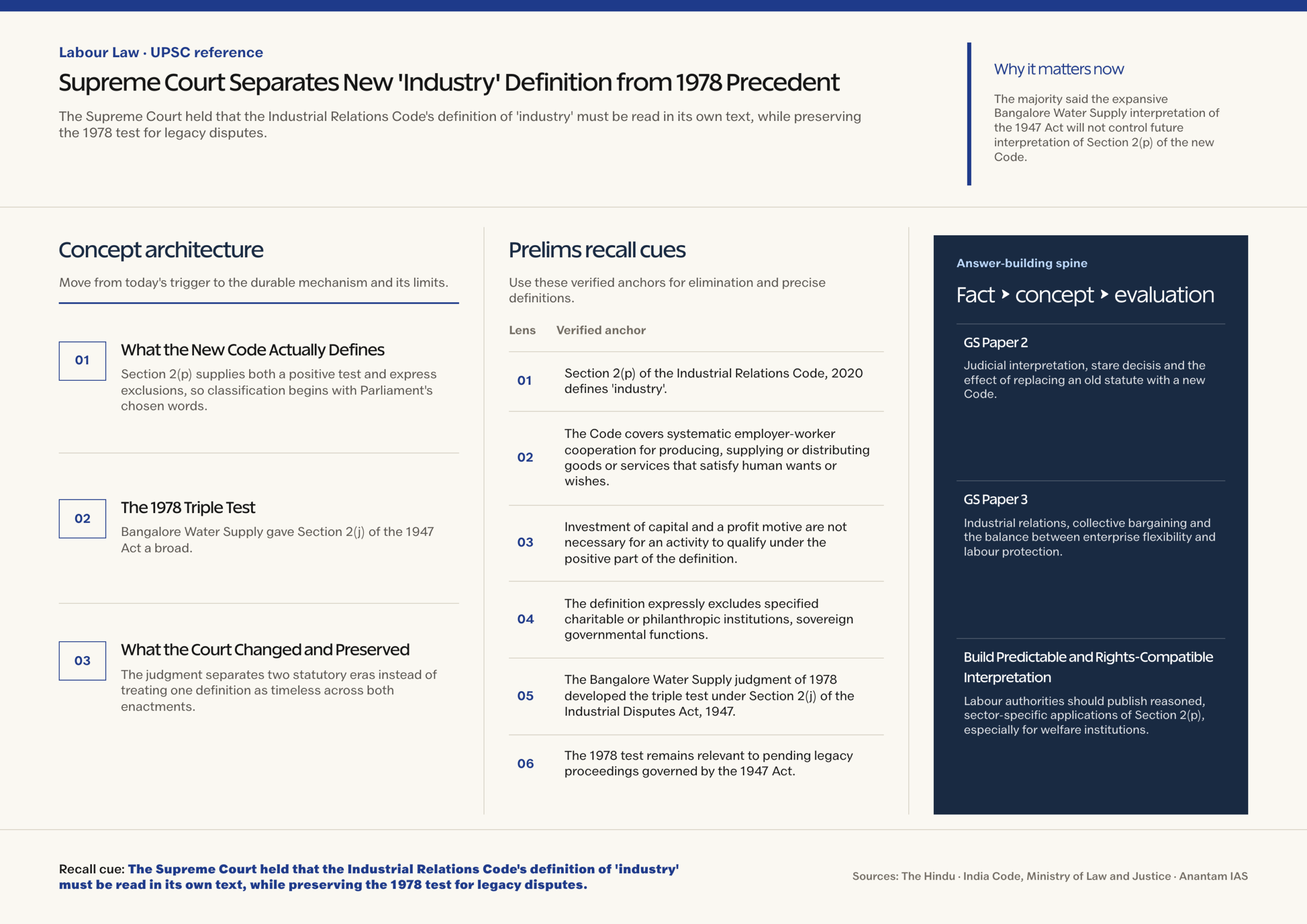
On August 20, 2026, a nine-judge Supreme Court Bench held that ‘industry’ under the Industrial Relations Code, 2020 must be interpreted in the Code’s own text and context.
- The majority said the expansive Bangalore Water Supply interpretation of the 1947 Act will not control future interpretation of Section 2(p) of the new Code.
- Proceedings still governed by the Industrial Disputes Act, 1947 must continue to apply the 1978 precedent; concluded cases are not reopened.
- The decision creates a statute-specific boundary: it does not declare every principle of the older judgment wrong for every legal setting.
- Several judges defended the older test’s worker-protective logic, revealing a continuing constitutional debate over labour remedies in a privatised economy.
- Whether an activity is an industry determines access to industrial-dispute institutions, collective bargaining protections and remedies linked to the governing labour statute.
- The ruling illustrates how precedent and legislative change interact: a new statutory text may require fresh interpretation without retrospectively erasing law under the repealed enactment.
- For UPSC answers, distinguish a court’s interpretation of a new Code from wholesale overruling of a precedent developed under an older Act.
UPSC Relevance
Prelims Relevance
- Section 2(p) of the Industrial Relations Code, 2020 defines ‘industry’.
- The Code covers systematic employer-worker cooperation for producing, supplying or distributing goods or services that satisfy human wants or wishes.
- Investment of capital and a profit motive are not necessary for an activity to qualify under the positive part of the definition.
- The definition expressly excludes specified charitable or philanthropic institutions, sovereign governmental functions, domestic service and notified activities.
- The Bangalore Water Supply judgment of 1978 developed the triple test under Section 2(j) of the Industrial Disputes Act, 1947.
- The 1978 test remains relevant to pending legacy proceedings governed by the 1947 Act.
Mains Relevance
GS Paper 2
- Judicial interpretation, stare decisis and the effect of replacing an old statute with a new Code.
- Access to justice and institutional remedies for workers affected by the statutory boundary of ‘industry’.
GS Paper 3
- Industrial relations, collective bargaining and the balance between enterprise flexibility and labour protection.
Essay
- Economic reform is durable when institutional flexibility and worker protection are treated as complements rather than opposites.
Background and Context
What the New Code Actually Defines
Section 2(p) supplies both a positive test and express exclusions, so classification begins with Parliament’s chosen words.
- An activity must be systematic and carried on through cooperation between an employer and workers, including workers engaged through an agency or contractor.
- Its object must be the production, supply or distribution of goods or services to satisfy human wants or wishes, excluding wants that are merely spiritual or religious.
- The activity may qualify even when no capital is invested or no gain or profit is sought. Commercial form is relevant evidence, but profit is not decisive.
- Express exclusions cover certain charitable, social or philanthropic institutions; sovereign governmental functions; domestic service; and activities later notified by the Union government.
- The sovereign-function exclusion specifically includes Central departments dealing with defence research, atomic energy and space, while its wider application remains tied to statutory interpretation.
The 1978 Triple Test
Bangalore Water Supply gave Section 2(j) of the 1947 Act a broad, functional interpretation centred on the nature of the activity.
- The judgment asked whether there was a systematic activity, organised through employer-employee cooperation, for producing or distributing goods or services that meet human wants.
- It treated profit motive and capital investment as unnecessary, allowing hospitals, educational bodies and municipal activities to fall within ‘industry’ when their functional character met the test.
- Under the dominant nature test, an organisation carrying mixed activities was classified by its predominant activity; severable departments could still be assessed separately.
- Strict sovereign functions such as defence, law and order and administration of justice remained outside, but merely being performed by the State did not automatically make an activity sovereign.
- Its practical importance was remedial: workers in covered establishments could use industrial adjudication and collective mechanisms against employment disputes and unfair labour practices.
What the Court Changed and Preserved
The judgment separates two statutory eras instead of treating one definition as timeless across both enactments.
- For disputes arising under the Industrial Relations Code, the Court said Section 2(p) begins on a clean interpretive slate and is not anchored to Bangalore Water Supply’s reading of Section 2(j).
- That approach respects legislative choice: the new definition resembles parts of the functional test but also contains express exclusions that the older judicial formulation did not create.
- For proceedings governed by the repealed 1947 Act, courts, tribunals and labour authorities must still apply Bangalore Water Supply; the ruling does not reopen final decisions.
- The split opinions matter. Some judges considered the older precedent settled and worker-protective, while others accepted that its interpretation should not encumber the new Code.
- The exam trap is to say the 1978 precedent was simply abolished. Its authority is context-bound: preserved for legacy law, but not controlling the new statutory definition.
Way Forward
Build Predictable and Rights-Compatible Interpretation
- Labour authorities should publish reasoned, sector-specific applications of Section 2(p), especially for welfare institutions, mixed establishments and outsourced workforces.
- Courts should test exclusions narrowly against statutory text and constitutional values, avoiding assumptions that every public activity is sovereign or every charitable label is decisive.
- Governments should monitor whether excluded workers retain effective grievance, safety and unfair-dismissal remedies under other labour and service-law routes.
- Employers and unions should update classifications and dispute-resolution arrangements without disturbing rights already crystallised under saved proceedings or final decisions.
Conclusion
- The ruling is best understood as statutory reset, not historical erasure: Section 2(p) governs the new Code, while Bangalore Water Supply continues to govern legacy disputes under the 1947 Act.
- A strong Mains answer should connect textual interpretation with practical access to labour remedies and evaluate whether the new exclusions preserve a fair balance between sovereign autonomy and worker protection.
UPSC Practice Questions
Prelims MCQ 1
With reference to the definition of ‘industry’ under the Industrial Relations Code, 2020, consider the following statements:
- A profit motive is essential for an activity to qualify as an industry.
- Domestic service is expressly excluded from the definition.
- Workers engaged through a contractor may be considered in the employer-worker cooperation test.
How many of the above statements are correct?
(a) Only one (b) Only two (c) All three (d) None
Answer: (b) Only two
Explanation:
Statements 2 and 3 are correct. Section 2(p) states that profit motive and capital investment are not essential, and it includes workers engaged through an agency or contractor.
Prelims MCQ 2
What is the most accurate implication of the Supreme Court’s 2026 ruling on the term ‘industry’?
(a) Bangalore Water Supply was erased for all past and future legal purposes (b) Every government welfare activity is now outside labour law (c) Section 2(p) of the new Code must be interpreted independently, while the older precedent continues for legacy proceedings (d) Profit-seeking activity alone can qualify as an industry
Answer: (c) Section 2(p) of the new Code must be interpreted independently, while the older precedent continues for legacy proceedings
Explanation:
The Court separated the new Code’s interpretation from the 1978 precedent but preserved that precedent for proceedings governed by the Industrial Disputes Act, 1947.
UPSC Mains Questions
- The Supreme Court’s interpretation of ‘industry’ under the Industrial Relations Code is a statutory reset rather than an erasure of precedent. Examine.
- How should courts balance sovereign autonomy, legislative text and workers’ access to remedies while interpreting exclusions from the definition of ‘industry’?
Sources: The Hindu and India Code, Ministry of Law and Justice.
Frequently Asked Questions
What did the Supreme Court decide about ‘industry’ under the new Code?
It held that Section 2(p) of the Industrial Relations Code must be interpreted from its own text and context, without treating the 1978 Bangalore Water Supply test as controlling.
Was the Bangalore Water Supply judgment completely overruled?
No. The Court preserved its interpretation for pending proceedings governed by the Industrial Disputes Act, 1947, and said concluded cases should not be reopened.
What is the positive test in Section 2(p)?
It covers systematic employer-worker cooperation for producing, supplying or distributing goods or services that satisfy human wants, regardless of capital investment or profit motive.
Which activities are expressly excluded from the new definition?
The Code excludes specified charitable or philanthropic institutions, sovereign governmental functions, domestic service and other activities that the Central Government may notify.
Why does the definition matter for workers?
Classification affects whether a dispute enters the industrial-relations framework, including institutional adjudication and collective mechanisms available under the governing labour statute.
Source: https://anantamias.com/current-affairs/industrial-relations-code-industry-definition/
PhonePe Transaction Data in PM GatiShakti Planning
Why in News?
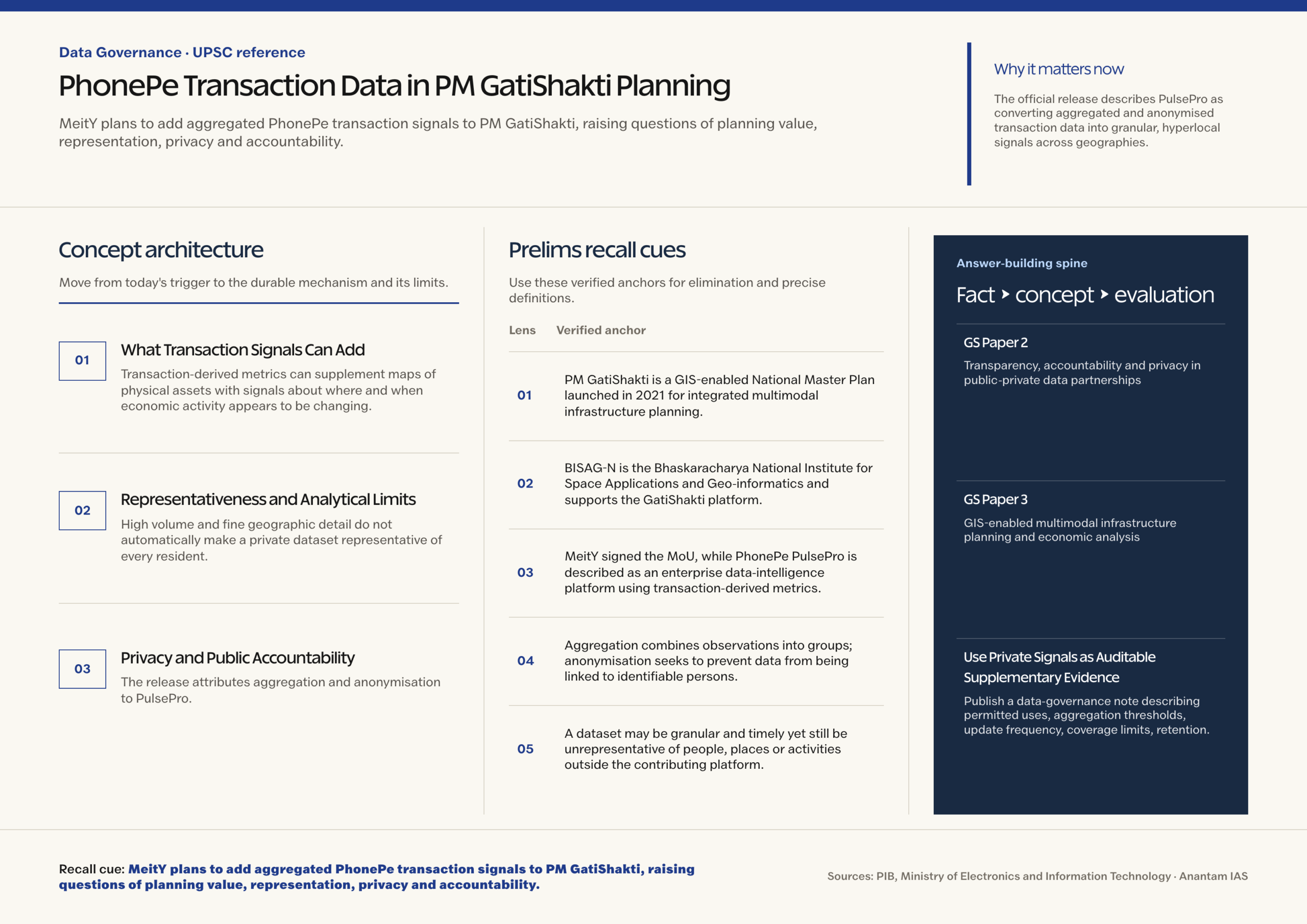
MeitY signed an MoU with PhonePe on 20 August 2026 to integrate PhonePe PulsePro metrics into the PM GatiShakti National Master Plan portal.
- The official release describes PulsePro as converting aggregated and anonymised transaction data into granular, hyperlocal signals across geographies, categories and markets.
- The planned integration is intended to support infrastructure planning, economic analysis, and urban and rural development by complementing datasets already available to planners.
- The portal is managed in collaboration with BISAG-N, the Bhaskaracharya National Institute for Space Applications and Geo-informatics.
- The announcement establishes a data-sharing partnership; it does not yet demonstrate completed integration, better project selection, lower costs or improved public-service outcomes.
- Private transaction signals may reveal changing commercial activity faster and at finer spatial scales than periodic administrative datasets, but they capture platform-mediated behaviour, not the entire economy.
- Planning decisions can affect land, budgets and access to services, so supplementary private data needs representativeness checks, privacy safeguards and reasons that public authorities can defend.
- The case illustrates a wider shift from government-held datasets alone toward public-private data partnerships for evidence-based governance.
UPSC Relevance
Prelims Relevance
- PM GatiShakti is a GIS-enabled National Master Plan launched in 2021 for integrated multimodal infrastructure planning.
- BISAG-N is the Bhaskaracharya National Institute for Space Applications and Geo-informatics and supports the GatiShakti platform.
- MeitY signed the MoU, while PhonePe PulsePro is described as an enterprise data-intelligence platform using transaction-derived metrics.
- Aggregation combines observations into groups; anonymisation seeks to prevent data from being linked to identifiable persons.
- A dataset may be granular and timely yet still be unrepresentative of people, places or activities outside the contributing platform.
Mains Relevance
GS Paper 2
- Transparency, accountability and privacy in public-private data partnerships
- Use of supplementary private data in reasoned and reviewable public decisions
GS Paper 3
- GIS-enabled multimodal infrastructure planning and economic analysis
- Digital data quality, representativeness and responsible analytics
Essay
- Data becomes a public asset only when faster insight is matched by fairness, institutional accountability and protection of individual rights.
Background and Context
What Transaction Signals Can Add
Transaction-derived metrics can supplement maps of physical assets with signals about where and when economic activity appears to be changing.
- A GIS platform can place transaction indicators beside roads, logistics nodes, markets, settlements and public facilities, helping planners explore whether infrastructure and observed activity align spatially.
- Near-real-time signals may identify an emerging activity cluster sooner than a periodic survey or annual administrative series, creating a lead for further field investigation.
- Category-level patterns could help planners ask whether commercial growth is matched by transport access, storage, digital connectivity or other enabling infrastructure.
- Transaction data measures observed platform activity, not infrastructure need itself; a signal can generate a planning question but cannot by itself establish the correct project response.
- The official release says PulsePro metrics will complement existing datasets, which is the sounder approach than replacing surveys, censuses, administrative records or local consultation.
Representativeness and Analytical Limits
High volume and fine geographic detail do not automatically make a private dataset representative of every resident, enterprise or transaction in an area.
- PhonePe-derived metrics reflect activity within a particular digital ecosystem; cash use, other payment channels and people with limited digital access may be absent or differently represented.
- Platform adoption can vary across income groups, age groups, regions, business types and network conditions, producing systematic gaps rather than random statistical noise.
- A change in the metric may arise from customer acquisition, product design or payment preferences, not only from an underlying change in local economic demand.
- Planners should validate signals against independent official data, field evidence and local knowledge, and document where coverage or classification limits make comparisons unreliable.
- Models should report uncertainty and avoid converting correlation into causation; transaction concentration near a corridor does not prove that a proposed alignment is socially optimal.
Privacy and Public Accountability
The release attributes aggregation and anonymisation to PulsePro, but it does not publish the technical thresholds or governance controls used for this integration.
- Aggregation can reduce direct visibility of individual records, while anonymisation aims to prevent identification; neither label alone explains cell sizes, access controls or residual re-identification risk.
- Very small geographic or category groups and combinations with other datasets can increase inference risk, so planners need minimum thresholds, suppression rules and limits on drill-down.
- Purpose limitation should restrict access to defined planning tasks, supported by data minimisation, retention limits, authentication, audit logs and controls on onward sharing.
- The public authority remains responsible for lawful and proportionate decisions; a private metric should not become an opaque substitute for recorded reasons, consultation or statutory appraisal.
- Contracts and operating rules should specify data quality duties, security incidents, correction, independent review, termination and vendor dependence so public capability is not locked to one provider.
Way Forward
Use Private Signals as Auditable Supplementary Evidence
- Publish a data-governance note describing permitted uses, aggregation thresholds, update frequency, coverage limits, retention, access roles and the accountability of each partner.
- Benchmark transaction signals against surveys, administrative records and field checks, with bias and uncertainty reports before they influence project prioritisation.
- Apply privacy-by-design controls, independent security testing, audit trails and grievance routes while preventing individual or business profiling unrelated to the stated public purpose.
- Record how each dataset influenced a decision and preserve human review, consultation and statutory safeguards so planners can explain and contest the resulting recommendation.
Conclusion
- The MoU should be read as an announced data integration, not evidence that transaction analytics has already improved infrastructure outcomes. Its value must be demonstrated through transparent pilots and independent evaluation.
- In a Mains answer, balance innovation with representativeness, privacy and public accountability: private signals can sharpen questions, but legitimate infrastructure choices still require plural evidence and reasoned government judgment.
UPSC Practice Questions
Prelims MCQ 1
With reference to the announced PhonePe PulsePro integration with PM GatiShakti, consider the following statements:
- MeitY signed the Memorandum of Understanding with PhonePe.
- The official release describes PulsePro metrics as derived from aggregated and anonymised transaction data.
- The announcement demonstrates that the integration has already reduced infrastructure project costs.
How many of the above statements are correct?
(a) Only one (b) Only two (c) All three (d) None
Answer: (b) Only two
Explanation:
Statements 1 and 2 are correct. The release announces an MoU and intended integration; it does not present demonstrated project outcomes or cost reductions.
Prelims MCQ 2
Which one of the following best explains why a large digital transaction dataset may still be unrepresentative for public planning?
(a) Digital datasets cannot be placed on GIS platforms (b) Aggregated information is always legally unusable (c) Platform users and transactions may not mirror all people, businesses and payment channels (d) Administrative data must never be combined with private data
Answer: (c) Platform users and transactions may not mirror all people, businesses and payment channels
Explanation:
Dataset size does not remove coverage bias. Adoption, access and payment behaviour can differ across populations, places and commercial activities.
UPSC Mains Questions
- Private transaction data can make infrastructure planning more responsive, but volume and granularity do not guarantee representative evidence. Discuss.
- What safeguards should govern public-private data partnerships when commercially generated data informs decisions affecting public infrastructure and services?
Source: PIB, Ministry of Electronics and Information Technology.
Frequently Asked Questions
What did MeitY and PhonePe announce?
They signed an MoU to integrate PhonePe PulsePro metrics into the PM GatiShakti National Master Plan portal as supplementary inputs for planning and economic analysis.
Has the PhonePe data integration already improved infrastructure outcomes?
The PIB release announces intended integration and uses. It does not present completed deployment, evaluated projects, cost reductions or measured public-service outcomes.
Why can transaction data be unrepresentative despite its large volume?
It reflects a platform’s users and transactions. Cash activity, other payment channels and groups with unequal digital access may be missing or differently represented.
Does aggregated and anonymised data eliminate every privacy risk?
No. Risk depends on group size, geographic detail, possible linkage with other datasets, access controls and permitted uses. Technical and institutional safeguards remain necessary.
How should planners use private transaction signals?
They should treat them as supplementary leads, validate them against official and field evidence, document uncertainty, preserve human review and explain how each input affected decisions.
Source: https://anantamias.com/current-affairs/pm-gatishakti-phonepe-transaction-data-planning/
Somalia Piracy: Indian Seafarers and Security in the Gulf of Aden
Why in News?
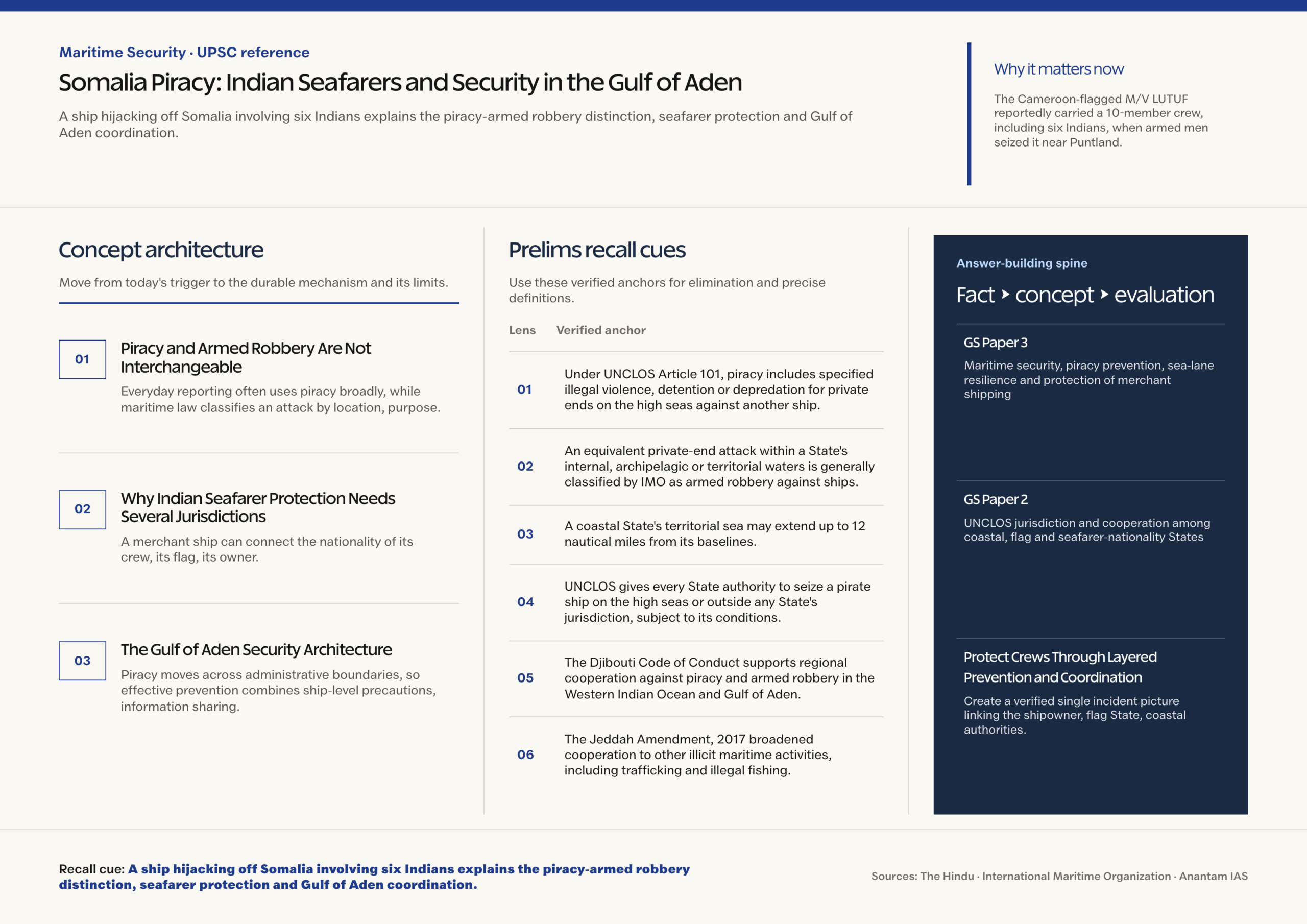
The Hindu reported on 21 August 2026 that a cargo ship with six Indian crew members had been hijacked off Somalia’s Puntland coast on 17 August.
- The Cameroon-flagged M/V LUTUF reportedly carried a 10-member crew, including six Indians, when armed men seized it near Puntland.
- The reported seizure point was about 3.5 nautical miles offshore, and the vessel was taken toward the Nugaal coast.
- The ship’s cargo reportedly included weapons and communications equipment bound for a Turkish military training facility in Mogadishu.
- The crew’s condition and vessel’s status were not immediately clear; several incident details remained independently unverified when the report was published.
- The episode renews attention to seafarer safety, coastal enforcement and coordinated maritime surveillance around Somalia and the Gulf of Aden.
- The Gulf of Aden links the Arabian Sea with the Red Sea route toward the Suez Canal, making disruption relevant to trade, energy movement and shipping insurance.
- Indian nationals serve on both Indian- and foreign-flagged vessels, so protection can require coordination among the flag State, coastal State, employer, India and regional forces.
- Precise legal classification matters because jurisdiction, reporting and prosecution differ between piracy on the high seas and armed robbery within territorial waters.
UPSC Relevance
Prelims Relevance
- Under UNCLOS Article 101, piracy includes specified illegal violence, detention or depredation for private ends on the high seas against another ship.
- An equivalent private-end attack within a State’s internal, archipelagic or territorial waters is generally classified by IMO as armed robbery against ships.
- A coastal State’s territorial sea may extend up to 12 nautical miles from its baselines.
- UNCLOS gives every State authority to seize a pirate ship on the high seas or outside any State’s jurisdiction, subject to its conditions.
- The Djibouti Code of Conduct supports regional cooperation against piracy and armed robbery in the Western Indian Ocean and Gulf of Aden.
- The Jeddah Amendment, 2017 broadened cooperation to other illicit maritime activities, including trafficking and illegal fishing.
Mains Relevance
GS Paper 3
- Maritime security, piracy prevention, sea-lane resilience and protection of merchant shipping
- Risk assessment, ship hardening, reporting networks and coordinated surveillance in the Western Indian Ocean
GS Paper 2
- UNCLOS jurisdiction and cooperation among coastal, flag and seafarer-nationality States
- India’s consular responsibility and regional partnerships for protecting nationals aboard foreign-flagged ships
Essay
- Freedom of navigation is sustained not only by naval power but also by law, regional trust and protection of the people who operate global supply chains.
Background and Context
Piracy and Armed Robbery Are Not Interchangeable
Everyday reporting often uses piracy broadly, while maritime law classifies an attack by location, purpose, actors and the ships involved.
- UNCLOS Article 101 covers illegal violence, detention or depredation committed for private ends by people aboard a private ship and directed against another ship on the high seas.
- It also covers voluntary participation in operating a pirate ship and intentional facilitation of a qualifying act, preventing organisers and enablers from escaping the definition.
- IMO defines armed robbery against ships as comparable private-end conduct within a State’s internal, archipelagic or territorial waters, placing primary enforcement responsibility on that coastal State.
- Because the reported LUTUF seizure occurred about 3.5 nautical miles offshore, it would ordinarily fall within Somalia’s territorial sea if measured from the applicable baseline.
- This is an exam trap: a violent boarding at sea is not automatically UNCLOS piracy, and the exact coordinates and legal maritime zone must be established.
Why Indian Seafarer Protection Needs Several Jurisdictions
A merchant ship can connect the nationality of its crew, its flag, its owner, its cargo and the coastal waters where an incident occurs.
- The flag State exercises jurisdiction and control over its ship, while the coastal State investigates and enforces law when an attack occurs inside its territorial waters.
- India’s immediate concern is the safety of its nationals, requiring verified crew information, contact with the employer and flag State, diplomatic coordination and communication with families.
- Rescue or interdiction must follow a clear operational picture; unverified action around a detained ship can increase risks to hostages, nearby vessels and responding personnel.
- Shipowners retain preventive duties: voyage-specific threat assessment, crew drills, secure communications, lookout discipline, physical barriers and timely reporting under recognised Best Management Practices.
- Armed guards are not a universal substitute for prevention. Their carriage depends on flag, port and coastal-State law and requires rules on weapons, accountability and escalation.
The Gulf of Aden Security Architecture
Piracy moves across administrative boundaries, so effective prevention combines ship-level precautions, information sharing, coastal capacity and coordinated patrols.
- The Gulf of Aden is the approach between the Arabian Sea and Bab el-Mandeb, connecting Indian Ocean shipping with the Red Sea and the route toward the Suez Canal.
- The Djibouti Code of Conduct promotes information sharing, national legislation, interdiction capability, training and coordination among States in the Western Indian Ocean and Gulf of Aden.
- Its 2017 Jeddah Amendment recognises that piracy overlaps with trafficking, illegal fishing and other organised maritime crime, widening the institutional lens beyond ship hijacking alone.
- Merchant vessels support collective awareness by registering or reporting through recognised maritime-security channels and rapidly transmitting position, attack method and crew-risk information.
- Naval presence can deter and respond, but durable control also needs accountable coastal policing, courts, prisons, economic alternatives and prosecution based on admissible evidence.
Way Forward
Protect Crews Through Layered Prevention and Coordination
- Create a verified single incident picture linking the shipowner, flag State, coastal authorities, Indian agencies and regional maritime-security centres.
- Require route-specific threat assessments, crew drills, citadel and communication readiness, enhanced watchkeeping and prompt reporting for vessels entering exposed waters.
- Expand information sharing and joint training under the Djibouti Code framework while strengthening Somali coastal enforcement and evidence-led prosecution.
- Maintain family liaison, medical and psychological support, wage protection and post-release rehabilitation as core parts of seafarer protection, not afterthoughts.
Conclusion
- The new hijacking shows that reduced attack levels do not eliminate Somalia-linked maritime risk; prevention must connect prepared ships, protected crews, coastal enforcement and regional information sharing.
- In a Mains answer, first classify the incident by maritime zone, then map responsibilities across the coastal State, flag State, seafarer-nationality State, shipowner and coordinating security mechanisms.
- India’s maritime-security approach should treat merchant seafarers as essential human infrastructure, combining consular readiness and naval coordination with enforceable industry safeguards and long-term regional capacity.
UPSC Practice Questions
Prelims MCQ 1
With reference to piracy under the United Nations Convention on the Law of the Sea, consider the following statements:
- It includes specified private-end violence or detention by persons aboard a private ship against another ship on the high seas.
- It includes voluntary participation in operating a ship with knowledge that it is a pirate ship.
- Every armed attack against a ship inside territorial waters is classified as piracy under Article 101.
How many of the above statements are correct?
(a) Only one (b) Only two (c) All three (d) None
Answer: (b) Only two
Explanation:
Statements 1 and 2 reflect UNCLOS Article 101. A comparable private-end attack within territorial waters is generally treated by IMO as armed robbery against ships, not UNCLOS piracy.
Prelims MCQ 2
What was the principal effect of the 2017 Jeddah Amendment to the Djibouti Code of Conduct?
(a) It replaced UNCLOS rules on the breadth of the territorial sea (b) It abolished coastal-State jurisdiction over armed robbery against ships (c) It broadened regional cooperation to cover other illicit maritime activities beyond piracy and armed robbery (d) It created a single permanent navy for all Western Indian Ocean States
Answer: (c) It broadened regional cooperation to cover other illicit maritime activities beyond piracy and armed robbery
Explanation:
The amendment expanded cooperation to threats such as maritime terrorism, trafficking, illegal fishing and other organised maritime crime while retaining the regional anti-piracy framework.
UPSC Mains Questions
- The legal distinction between piracy and armed robbery against ships is operationally significant, not merely semantic. Explain with reference to jurisdiction and enforcement off Somalia.
- Protecting Indian seafarers in the Western Indian Ocean requires action beyond naval deployment. Discuss the preventive, consular, legal and regional-cooperation measures needed.
Sources: The Hindu and International Maritime Organization.
Frequently Asked Questions
How many Indians were reportedly aboard the hijacked vessel?
The reported 10-member crew included six Indian nationals. At publication, the vessel’s status and the crew’s condition had not been independently confirmed.
What is piracy under UNCLOS?
Article 101 covers specified private-end violence, detention or depredation by people aboard a private ship against another ship on the high seas or outside any State’s jurisdiction.
How does armed robbery against ships differ from piracy?
The conduct may look similar, but armed robbery occurs within internal, archipelagic or territorial waters, where the coastal State ordinarily has primary enforcement jurisdiction.
Why is the Gulf of Aden strategically important?
It connects Arabian Sea shipping with Bab el-Mandeb and the Red Sea route toward the Suez Canal, making security there important for trade and seafarer safety.
What does the Djibouti Code of Conduct do?
It supports regional information sharing, legal development, training and enforcement cooperation against piracy and armed robbery across the Western Indian Ocean and Gulf of Aden.
Source: https://anantamias.com/current-affairs/somalia-piracy-indian-seafarers-maritime-security/
Core Sector growth slows to 5.4% in July
Why in the News?
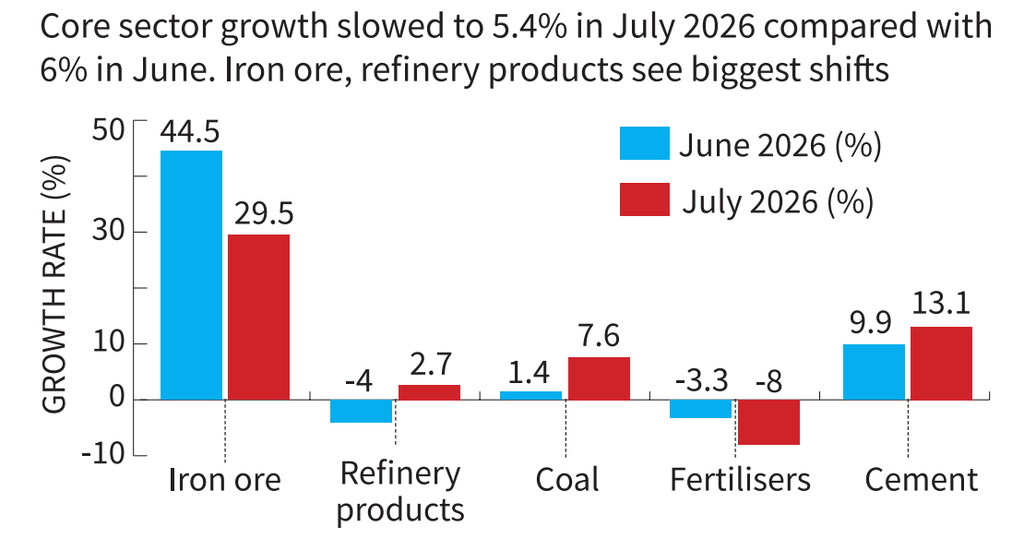
India’s Index of Core Industries (ICI) grew by 5.4% in July 2026, moderating from the revised growth of 6% in June. However, it remained the second-highest growth recorded in the preceding seven months.
| UPSC Relevance: GS-3 Economy: Manufacturing sector Prelims: Index of Core Industries (Key facts) |
Sectoral Performance:
- Strong growth: Iron ore (29.5%), cement (13.1%), electricity (9%), coal (7.6%), steel (2.9%) and refinery products (2.7%).
- Contraction: Fertilisers (-8%), crude oil (-5.3%) and natural gas (-3.7%).
- Cumulative core-sector growth during April-July 2026 increased to 4.3%, compared with 1.5% during the corresponding period of 2025.
Although iron-ore and coal production registered high growth, this partly reflected a low-base effect, as their output had contracted during the corresponding period of 2025. Slower steel growth and continued contraction in crude oil and natural gas indicate uneven industrial recovery.
Revised Index of Core Industries:
The Index of Core Industries (ICI) in India tracks the production performance of foundational infrastructure sectors. In July 2026, the government introduced a revised Index of Core Industries (ICI) series:
- Base year: Changed from 2011-12 to 2022-23.
- Number of sectors: Increased from eight to nine, with iron ore added.
- Nine core industries: Coal, crude oil, natural gas, refinery products, fertilisers, steel, cement, electricity and iron ore.
- It is compiled monthly by the Office of the Economic Adviser, Department for Promotion of Industry and Internal Trade, Ministry of Commerce and Industry.
- The nine industries constitute 32.88% of the weight of the revised Index of Industrial Production, down from 40.27% under the previous series.
- Under the revised ICI, electricity has the highest weight (30.932%), while fertilisers have the lowest (2.731%).
Economic Significance:
- The ICI acts as a lead indicator of industrial and infrastructure activity. Strong cement and electricity production suggest continuing construction and infrastructure demand.
- However, persistent weakness in domestic crude oil and natural gas production raises concerns regarding energy import dependence, while fertiliser contraction may affect agricultural input availability.
Source: https://anantamias.com/current-affairs/core-sector-growth-slows-to-5-4-in-july/
Odisha forms panel to examine relocation of villages from Satkosia Tiger Reserve
Why in the News?
The Odisha government has constituted a high-level committee to investigate allegations of forced and procedurally irregular relocation of villages from the Satkosia Tiger Reserve (STR).
Formed at the direction of the Odisha Human Rights Commission, the committee will examine all village relocations except Raiguda and submit its report within six weeks. It will verify beneficiary selection, compensation, livelihood rehabilitation and compliance with wildlife and forest rights laws.
| UPSC Relevance: GS-3 Environment: Protected Areas- Tiger Reserves Prelims: Satkosia Tiger Reserve, Tiger, Wildlife Conservation |
Legal Safeguards for Relocation:
Relocation from a tiger reserve cannot be treated as an ordinary eviction:
- Wildlife (Protection) Act, 1972: Section 38V permits relocation from critical tiger habitats only on mutually agreed terms. It requires informed consent of the Gram Sabha and affected persons, proof that coexistence is not reasonably possible, and completion of rehabilitation facilities.
- Forest Rights Act, 2006: Individual and community forest rights must first be recognised and settled. No forest dweller can be evicted until the recognition process is complete.
- National Tiger Conservation Authority (NTCA) guidelines: Relocation must be voluntary and provide affected families a choice between monetary compensation (currently ₹15 lakh per family) and State-assisted resettlement with land, housing and livelihood facilities.
The committee may recommend differential compensation, restoration of rights, livelihood assistance and departmental or criminal action against responsible officials.
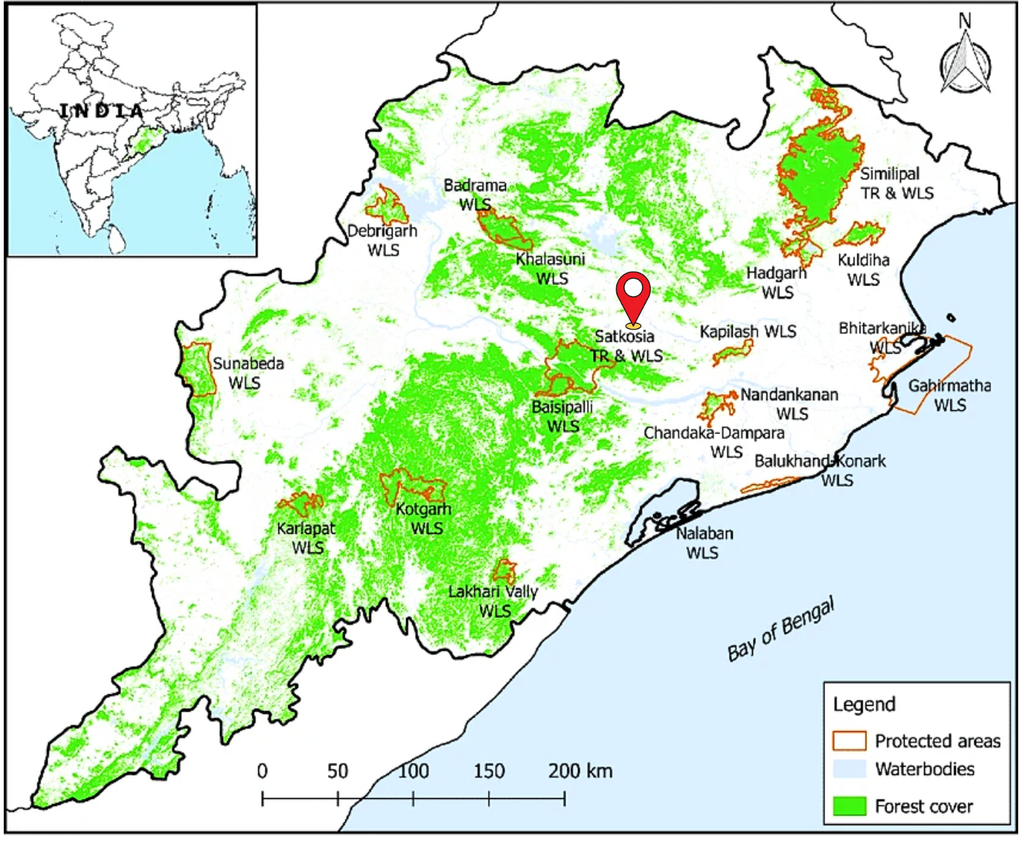
About Satkosia Tiger Reserve:
- Created in 2007 by combining the Satkosia Gorge and Baisipalli Wildlife Sanctuaries.
- Spread across Angul, Cuttack, Boudh and Nayagarh districts of Odisha. Covers 1,136.70 sq. km, including a core area of 523.61 sq. km.
- Located at the meeting point of the Deccan Peninsula and Eastern Ghats biogeographic regions.
- The Mahanadi forms the approximately 22-km-long Satkosia Gorge, which is also a Ramsar site.
- Fauna: It supports elephants, leopards, gharials, mugger crocodiles, wild dogs and diverse riverine biodiversity.
Despite recording 12 tigers in 2007, the reserve had no recorded tigers in the 2022 estimation. This demonstrates that village relocation alone cannot ensure conservation without adequate prey, habitat connectivity, protection and local community participation.
Key Facts about Tigers:
- The tiger is an apex predator, flagship and umbrella species. Protecting its large habitats helps conserve numerous associated species, forests, watersheds and carbon stocks.
- India contains the world’s largest wild tiger population: over 70% of the global population.
- The All India Tiger Estimation is conducted once every four years by the NTCA in collaboration with the Wildlife Institute of India and State Forest Departments.
- The latest completed estimation, AITE 2022, placed India’s tiger population at an average of 3,682. The corresponding 2018 estimate was 2,967.
- The State-wise leaders (AITE 2022) were:
- Madhya Pradesh: 785
- Karnataka: 563
- Uttarakhand: 560
- Maharashtra: 444
- Conservation status:
- IUCN Red List: Endangered
- Wildlife (Protection) Act, 1972: Schedule I
- CITES: Appendix I
Conservation must move beyond the “fortress conservation” model. Durable tiger recovery requires rights-based, scientifically justified and genuinely voluntary relocation, with forest communities treated as conservation partners rather than encroachers.
Gadchiroli Mining Project and the Tadoba-Indravati Tiger Corridor
Why in the News?
The Nagpur Bench of the Bombay High Court has directed a petitioner challenging an iron-ore mining project in Maharashtra’s Gadchiroli district to first approach the National Tiger Conservation Authority (NTCA).
The petition challenged the environmental clearance, Stage-II forest clearance and exemption from wildlife clearance granted for the diversion of 937.077 hectares of forest land to Lloyds Metals and Energy Ltd. The petitioner argued that the project falls within the Tadoba-Indravati tiger corridor.
The Court observed that the NTCA was the specialised statutory body best placed to determine the corridor’s status.
| UPSC Relevance: GS-3 Environment: Protected Areas, Statutory bodies Prelims: National Tiger Conservation Authority, Tadoba-Andhari Tiger Reserve, Indravati Tiger Reserve |
Why are Tiger Corridors Important?
The Tadoba-Indravati corridor connects the Tadoba-Andhari Tiger Reserve in Maharashtra with the Indravati Tiger Reserve in Chhattisgarh through the forested Gadchiroli landscape.
Such corridors:
- Facilitate tiger dispersal between protected areas;
- Maintain genetic diversity and prevent isolated populations;
- Provide access to prey and breeding territories; and
- Reduce human-wildlife conflict by preserving natural movement routes.
Mining may fragment forests through excavation, roads, blasting, transport and increased human activity. Its impact, therefore, extends beyond the mining lease itself.
What is the NTCA?
The National Tiger Conservation Authority is a statutory body under the Ministry of Environment, Forest and Climate Change. The wildlife conservation agency was formed to protect the endangered Bengal tiger in India.
- It was constituted in 2006 under the Wildlife (Protection) Act, 1972.
- Chairperson: The Union Environment Minister
- It provides statutory oversight to Project Tiger, launched in 1973.
- NTCA approves Tiger Conservation Plans, sets conservation standards, monitors tiger reserves and evaluates ecologically unsustainable activities such as mining.
- It must protect tiger reserves and areas connecting one protected area with another from unsustainable diversion, except in the public interest and with the approval of the National Board for Wildlife on NTCA’s advice.
About the Tiger Reserves:
1. Tadoba-Andhari Tiger Reserve:
- Location: Chandrapur district in the Vidarbha region of Maharashtra.
- Formation: Comprises Tadoba National Park, established in 1955, and Andhari Wildlife Sanctuary, notified in 1986. It was brought under Project Tiger.
- Area: 1,727.59 sq. km, with a core area of 625.82 sq. km
- Physical features: Named after Tadoba Lake and the Andhari River, which flows through the reserve.
- Vegetation: Southern tropical dry-deciduous forests, dominated by teak and bamboo.
- Fauna: Bengal tiger, leopard, dhole, sloth bear, gaur, sambar and mugger crocodile.
- Importance: It constitutes one of Central India’s major tiger-source populations, from which tigers disperse into the surrounding Chandrapur and Gadchiroli forests.
- Concerns: Mining, linear infrastructure, forest fires and increasing human-tiger conflict in the buffer landscape.
2. Indravati Tiger Reserve:
- Location: Bijapur district in the Bastar region of Chhattisgarh.
- Formation: Indravati became a national park in 1981 and was included under Project Tiger in 1982-83.
- Area: 2,799.07 sq. km with a core area of 1,258.37 sq. km.
- Physical features: Named after the Indravati River, a tributary of the Godavari, which forms its northern boundary.
- Vegetation: Tropical moist and dry deciduous forests, with teak, bamboo, sarai and extensive grasslands.
- Fauna: Tiger, leopard, dhole, sloth bear, gaur and the endangered wild water buffalo.
- Importance: It forms part of a larger inter-State forest landscape connecting Maharashtra, Chhattisgarh, Telangana and Odisha.
- Concerns: Left-Wing Extremism has historically constrained patrolling, wildlife estimation and habitat management; other threats include poaching and infrastructure-driven fragmentation.
The continuity of the Tadoba-Andhari and Indravati Tiger reserves runs largely through the forests of Gadchiroli.
The case demonstrates that tiger conservation cannot remain confined to notified reserve boundaries. Development decisions must adopt a landscape-level and cumulative-impact approach, supported by scientific corridor mapping and transparent scrutiny.
Vanashakti verdict is Balanced and Pragmatic
Context:
In Vanashakti v. Union of India (July 2026), the Supreme Court clarified the legal position concerning projects that commenced without obtaining mandatory prior Environmental Clearance (EC) under the EIA Notification, 2006.
| UPSC Relevance: GS-3 Environment: EIA, Environmental governance and sustainable development Prelims: Environmental governance (key judgements- Vanashakti verdict), EIA |
Key Highlights:
- Prior EC is mandatory: Projects requiring Environmental Clearance (EC) cannot begin construction, land preparation (except securing the land), or operations without first obtaining clearance.
- 2017 Notification upheld: The Court upheld the 2017 violation mechanism as valid delegated legislation because it was statutory, narrowly tailored, time-bound and applicable to a closed category of existing violations.
- 2021 OM quashed prospectively: The open-ended 2021 Office Memorandum was invalid because an administrative instruction cannot modify the statutory prior-EC regime or create a perpetual post-facto clearance mechanism.
- No fresh applications: No new application can now be entertained under the 2017 Notification or 2021 OM.
- Scope for a fresh statutory mechanism: The Central Government retains powers under Section 3 of the Environment (Protection) Act, 1986 to frame a fresh statutory mechanism for dealing with violation cases, if considered necessary in the larger public interest.
The Court’s Balancing Approach:
The judgment reconciles environmental rule of law with practical governance:
- Environmental regulation cannot encourage a routine “violate first, regularise later” approach.
- At the same time, automatic demolition may disproportionately harm innocent homebuyers, workers or essential public, infrastructural and environmental projects.
- However, sunk investment, private commercial loss or willingness to pay compensation cannot independently justify regularisation.
Significance of the judgment:
- Reinforces the precautionary principle and preventive character of EIA.
- Distinguishes delegated legislation from administrative instructions.
- Prevents post-facto clearance from becoming a permanent parallel route.
- Protects innocent third parties and essential public projects from mechanical demolition.
- Applies reasonable classification and proportionality under Article 14.
- Balances the right to a clean environment with sustainable development under Article 21.
Any future mechanism should therefore be:
- one-time, exceptional and time-bound
- issued through statutory notification, not an executive OM
- confined to clearly defined categories involving supervening public interest
- based on independent environmental-damage assessment
- accompanied by remediation, restoration and resource augmentation
- subject to deterrent environmental compensation; and
- conditional upon strict future compliance and official accountability.
Hence, prior EC remains the rule. Post-facto regularisation can only be a narrowly tailored statutory exception based on supervening public interest, not an administrative or permanent route for environmental violators.
Source: https://anantamias.com/current-affairs/vanashakti-verdict-is-balanced-and-pragmatic/
India’s Fiscal Outlook for 2026-27
Why in News?
India’s fiscal position in the first quarter of 2026-27 presents a mixed picture. Weak tax collections and higher subsidy expenditure have created pressure, but strong non-tax receipts (particularly RBI dividends) have kept the Centre broadly on course.
A major fiscal deviation appears unlikely under present conditions, but an escalation of the West Asian conflict could disturb this balance through higher crude prices, inflation and rupee depreciation.
| UPSC Relevance: GS-3 Economy: Government budgeting; Fiscal policy; Taxation Prelims: Key trends |
India’s Fiscal Outlook for 2026-27:
1. Revenue Receipts: Emerging Pressure:
- Gross Tax Revenue (GTR) grew only 3.7% in Q1 2026-27, reflecting weak growth in Personal Income Tax (PIT) and GST following extensive tax-rate rationalisation in 2025-26.
- PIT revenue grew only 6.8% in Q1, while GST revenue contracted 11%.
- The revenue sacrifice from tax-rate reductions was expected to be offset eventually by tax-base expansion and improved compliance, but this has not yet fully materialised.
- Union Excise Duty collections contracted 22.4%, partly because the government reduced fuel excise duties to cushion consumers from elevated global crude prices.
Nominal GDP growth (total value of all goods and services produced in the country using current market prices) is expected to provide some support. The article expects 12.5-13% nominal GDP growth in 2026-27, compared with the Budget assumption of 10.04%.
| Tax-rate rationalisation: GST and personal income-tax rates were rationalised in 2025-26. The underlying expectation was: Lower rates → improved compliance and demand → wider tax base → higher future revenue. Owing to tax rationalisation, the revenue sacrifice occurred immediately, while base expansion takes time. Personal income-tax growth was almost stagnant in 2025-26, indicating negligible tax buoyancy. |
2. Government’s Revenue-Correction Measures:
To compensate for revenue pressures, the government has undertaken several measures:
- Introduction of the Health Security and National Security (HSNS) Cess from February 2026, replacing the GST Compensation Cess.
- Increase in the windfall tax on exports of petroleum products.
- Higher import duties on gold, silver and certain precious-metal products.
- Restoration of fuel excise duties may become necessary once global oil-price pressures ease.
3. Transfers to States:
- States’ share in the divisible pool remains 41%, as retained by the Sixteenth Finance Commission.
- However, the introduction of the non-shareable HSNS Cess could marginally reduce the pool available for tax devolution.
- Tax devolution to States contracted 19.5% in Q1 2026-27, although higher transfers are expected later.
- Finance Commission grants to States are budgeted to decline by around ₹23,556 crore.
| Fiscal Federalism: The tension between Union fiscal consolidation and States’ fiscal space continues to be an important aspect of India’s fiscal federal framework. The Sixteenth Finance Commission has retained the States’ share in the divisible pool of central taxes at 41%. However, under Article 270 of the Constitution, cesses and surcharges levied by the Union are not part of the divisible pool and are therefore not shared with States. Consequently, when the Centre mobilises additional revenue through cesses and surcharges rather than shareable taxes, the proportion of gross tax revenue available for devolution to States declines. Greater reliance on non-shareable levies can thus reduce the effective volume of resources transferred to States, even if the devolution percentage remains unchanged. The Finance Commission has highlighted that the growing use of cesses and surcharges reduced the share of the divisible pool in the Centre’s gross tax revenue from about 89.1% in 2014-15 to around 74-80% during much of the Fifteenth Finance Commission period. Lower or delayed transfers can affect State expenditure on health, education, agriculture, policing and infrastructure. |
4. Non-Tax Revenue: Key Fiscal Cushion:
- Strong non-tax revenues are helping compensate for weak tax receipts.
- The RBI dividend transfer provided substantial support: 77% of the budgeted dividends and profits had already been received within the first quarter.
- The article expects budgeted non-tax and non-debt capital receipts to be broadly realised.
5. Expenditure: Subsidy Pressure vs Capital Expenditure:
- Major subsidies increased 37.4% in Q1, driven primarily by higher global crude prices.
- If this pace persists, annual subsidy expenditure could exceed the budget estimate by approximately ₹50,000 crore.
- Despite higher subsidies, overall revenue expenditure grew only 7.4%.
- The government raised capital expenditure by 23.7% in the first quarter. This front-loading helped support the growth-oriented component of fiscal policy.
6. Fiscal Deficit and Debt Outlook:
- The official Union Budget estimated the fiscal deficit at 4.3% of GDP and Central government debt at 55.6% of GDP for 2026-27.
- The article projects a fiscal deficit of about ₹18.16 lakh crore, equivalent to 4.6% of GDP, and debt of 55.8% of GDP, after considering the new GDP series and emerging fiscal pressures.
Thus, significant deviation from the Budget targets appears unlikely at present.
| The GDP base year has been revised from 2011-12 to 2022-23, involving new data sources and estimation methods. |
Major Risks to the Fiscal Outlook:
- Geopolitical risk: Prolonged or escalating conflict in West Asia could push crude prices higher. Higher oil prices can simultaneously:
- increase subsidies;
- reduce fuel-tax collections if excise duties are cut;
- worsen the current account deficit;
- put pressure on the rupee;
- raise imported inflation; and
- weaken overall economic growth.
- Tax-revenue risk: GST and PIT collections remain vulnerable following recent rate rationalisation. Expected gains from higher compliance and a wider tax base may take time to materialise.
- Expenditure risk: Persistent energy-price shocks can increase subsidy requirements and create fiscal slippage.
- External-sector risk: Sustained rupee pressure and higher external debt could increase the government’s financing burden.
The central message is that India’s fiscal position is resilient but not insulated from external shocks. Strong non-tax receipts, RBI dividends, higher nominal GDP growth and controlled revenue expenditure are currently cushioning weak tax collections and subsidy pressures.
However, an escalation of the West Asian conflict could simultaneously worsen revenues, expenditure, inflation, the rupee and growth, creating a much larger fiscal challenge.
Source: https://anantamias.com/current-affairs/indias-fiscal-outlook-for-2026-27/
How will Gaganyaan’s Thermal Shield protect the crew?
Context:
Gaganyaan’s Crew Module will re-enter the atmosphere at approximately 7.5-8 km per second. The intense aerodynamic heating generated during this phase could melt the spacecraft without a robust Thermal Protection System (TPS).
| UPSC Relevance: GS-3 Science and Technology: Space Technology Prelims & Mains: Gaganyaan Mission, Thermal Protection System |
About Gaganyaan Mission:
- India’s first indigenous human spaceflight programme led by ISRO.
- Designed to carry three crew members to a 400-km Low Earth Orbit for approximately three days and safely return them to Earth.
- Will use the human-rated HLVM3 launch vehicle.
- The Crew Module will return through atmospheric re-entry and splash down in Indian waters.
- Implementation is coordinated by ISRO’s Human Space Flight Centre.
- The first uncrewed mission carrying Vyommitra is targeted for the fourth quarter of 2026, followed by two additional uncrewed missions in 2027 before the crewed flight.
Upon completion, India will become the fourth nation to conduct an independent human spaceflight after Russia, the United States and China.
The crew module must withstand extreme conditions during atmospheric re-entry, making the Thermal Protection System (TPS) a critical safety technology.
Why is Thermal Protection System (TPS) Necessary?
- During re-entry, the crew module will enter the atmosphere at around 7.5-8 km/s.
- Atmospheric compression and friction convert a large part of its kinetic energy into intense heat.
- The external surface can experience temperatures of around 1,800°C, while the crew compartment must remain within safe temperature limits.
- Since re-entry is extremely rapid and offers little scope for human intervention, passive thermal protection and autonomous systems are essential.
How Does Gaganyaan’s Ablative Heat Shield Work?
Gaganyaan uses an ablative TPS, in which the heat shield is deliberately sacrificed to protect the spacecraft.
- The heat causes the shield material to decompose, char and release gases.
- The removal of material carries thermal energy away from the spacecraft.
- The released gases form a protective boundary layer, reducing heat transfer to the underlying structure.
- Thus, the outer shield gradually erodes while keeping the crew module within safe temperatures.
Simple analogy: Like a block of wax that protects its inner portion by gradually melting and shedding its outer layers.
| Major Types of Thermal Protection Systems: Ablative TPS: Sacrifices material through decomposition and erosion; suitable for single-use spacecraft. Radiative TPS: Absorbs heat and radiates it back into the atmosphere/space; useful for reusable spacecraft. Heat-sink TPS: Absorbs thermal energy by increasing its own temperature without undergoing major physical/chemical change. |
Why Ablative TPS for Gaganyaan?
- High reliability for extreme and fluctuating heat loads.
- Well suited to a single-use crew module.
- Requires relatively less complex maintenance than reusable thermal protection systems.
- Builds upon India’s established ablative-heat-shield technology.
India’s Technological Experience:
- Space Capsule Recovery Experiment, 2007: Demonstrated atmospheric re-entry and recovery using ablative materials.
- LVM3-X/CARE mission, 2014: Tested a crew-module-shaped vehicle, including its heat shield, aerodynamic deceleration, parachutes and sea recovery.
- Gaganyaan tests: The engineering model of its TPS has been developed and tested, according to the government’s latest update.
Significance for India:
- Demonstrates mastery of human-rated spacecraft, re-entry and recovery technologies.
- Strengthens India’s capabilities in human spaceflight and advanced materials.
- Builds technological foundations for future space stations and more sophisticated crewed missions.
- Contributes to India’s long-term ambition of developing an independent human-spaceflight ecosystem.
Source: https://anantamias.com/current-affairs/how-will-gaganyaans-thermal-shield-protect-the-crew/
NAMASTE Scheme: Centre set to expand Mechanised Sanitation Scheme to Rural India
Why in News?
The Centre plans to expand the National Action for Mechanised Sanitation Ecosystem (NAMASTE) from urban to rural India, covering a wider range of sanitation workers and strengthening efforts to eliminate hazardous manual cleaning.
| UPSC Relevance: GS-2 Social Justice: Vulnerable sections, Government schemes Prelims: NAMASTE Scheme |
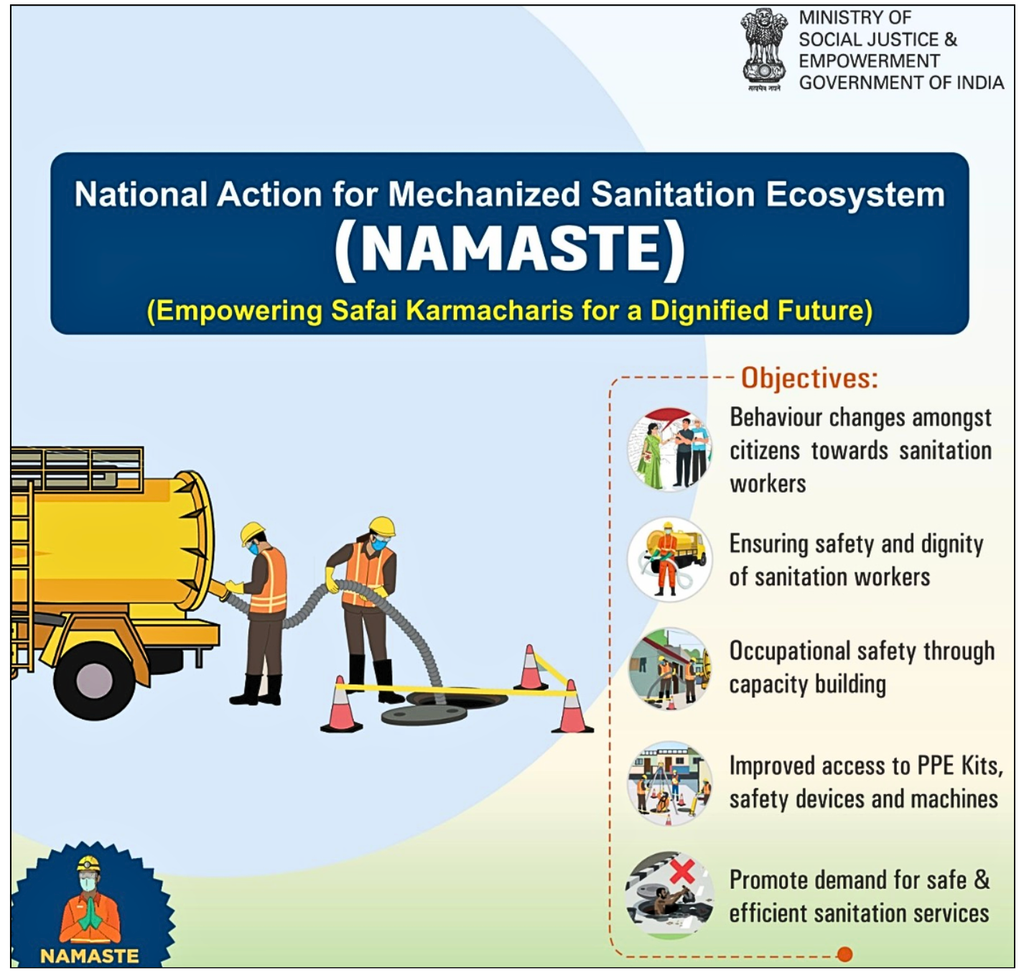
NAMASTE Scheme- Key Features:
- Launched in 2023-24, NAMASTE aims to eliminate deaths and injuries from hazardous sewer and septic-tank cleaning and promote mechanised sanitation.
- Initially covered Sewer and Septic Tank Workers (SSWs) and was subsequently expanded to include waste pickers.
- The proposed rural expansion would cover:
- Drain cleaners;
- Workers in Sewage Treatment Plants (STPs); and
- Workers in Faecal Sludge Treatment Plants (FSTPs).
- Proposed additional outlay: around ₹498.73 crore for 2026-27 to 2030-31.
- 90,915 SSWs and 1.3 lakh waste pickers have been profiled so far.
- Benefits include:
- Capital subsidy up to 50% of project cost for sanitation-related enterprises
- Support for Emergency Response Sanitation Units
- Skill and safety training; and
- Personal Protective Equipment (PPE).
Significance:
- Promotes dignity of labour and occupational safety.
- Advances the goal of eliminating manual scavenging and hazardous sanitation work.
- Mechanisation can reduce worker exposure to toxic gases, pathogens and confined-space hazards.
- Extending the scheme to rural areas addresses the urban-rural gap in sanitation safety.
- Supports social justice, livelihood diversification and rehabilitation of vulnerable sanitation workers.
The Persistent Challenge:
Despite the scheme’s objectives, implementation remains weak:
- Government data recorded 498 deaths during hazardous sewer and septic-tank cleaning between January 2019 and June 2026.
- The National Commission for Scheduled Castes (NCSC) has repeatedly raised concerns about high rejection rates under the self-employment and capital-subsidy components. Of 810 SSWs approved for capital subsidies, only 147 had received funds by March 2026.
- Credit-linked subsidies may remain inaccessible to workers lacking collateral, documentation or the capacity to finance the remaining project cost.
- Outsourcing often obscures the accountability of local bodies and principal employers.
- Rural sanitation depends heavily on septic tanks and informal workers, but institutional capacity for mechanised cleaning remains limited.
Way Forward:
- Improve transparency and simplify application and subsidy approval procedures.
- Strengthen local bodies’ capacity for mechanised sewer and septic-tank cleaning.
- Ensure timely provision of PPE, training and insurance/social-security support.
- Establish stronger monitoring and accountability for sanitation-related deaths.
- Promote locally appropriate mechanised technologies, particularly for rural and smaller settlements.
NAMASTE’s rural expansion can transform sanitation from hazardous caste-linked labour into formal and mechanised employment, but success will depend on implementation, finance and enforceable accountability.
Master Plan for Delhi 2047 Notified
Why in News?
The Master Plan for Delhi 2047 (MPD-2047) has been notified as a 20-year framework for managing Delhi’s housing, transport, redevelopment and economic expansion. It seeks to accommodate a population projected to reach approximately 3.2 crore by 2047.
Prepared by the Delhi Development Authority (DDA) under the Delhi Development Act, 1957, the plan envisages more than 40 lakh additional affordable houses.
| UPSC Relevance: GS-1 Indian Society: Urbanisation; GS-2 Polity and Governance: Urban governance; GS-3 Economy: Infrastructure; GS-3 Environment: Sustainable cities Prelims: Master Plan for Delhi 2047 Mains: Planned Urban development (Need, Challenges, Govt schemes) |
Major Provisions:
- Transit-Oriented Development: High-density, mixed-use development within 500 metres of Metro corridors and around Regional Rapid Transit System (RRTS) and railway stations.
- Higher FAR: Maximum Floor Area Ratio (FAR) under transit-oriented development (TOD) increased from 300 to 500, permitting built-up area up to five times the plot area.
- Vertical development: Maximum height restrictions for buildings of all kinds, including residential and commercial, have been removed across most of the national capital, except in areas including the Lutyens’ Bungalow Zone, Civil Lines Bungalow Area, Connaught Place, the Yamuna floodplains, the Ridge, land pooling and low-density areas, and locations subject to restrictions imposed by the Archaeological Survey of India and the National Monuments Authority.
- Land pooling: Nearly 200 sq. km of planned urban expansion, providing about 12 lakh homes and about 600 km road network.
- Redevelopment: Minimum plot size for group housing redevelopment has been reduced from 40,000 sq. m to 3,000 sq. m.
- Affordable housing: Approximately 18 lakh houses proposed in TOD zones, along with in-situ slum rehabilitation and rental housing.
- Economic diversification: Data centres, start-up hubs, co-working spaces, warehousing and integrated industrial parks permitted.
- Regulatory simplification: Land-use categories reduced from 133 to 45, with online single-window approvals.
- Green-blue infrastructure: Restoration of approximately 1,700 hectares of Yamuna floodplains, cycle tracks, rainwater harvesting and low-carbon buildings.
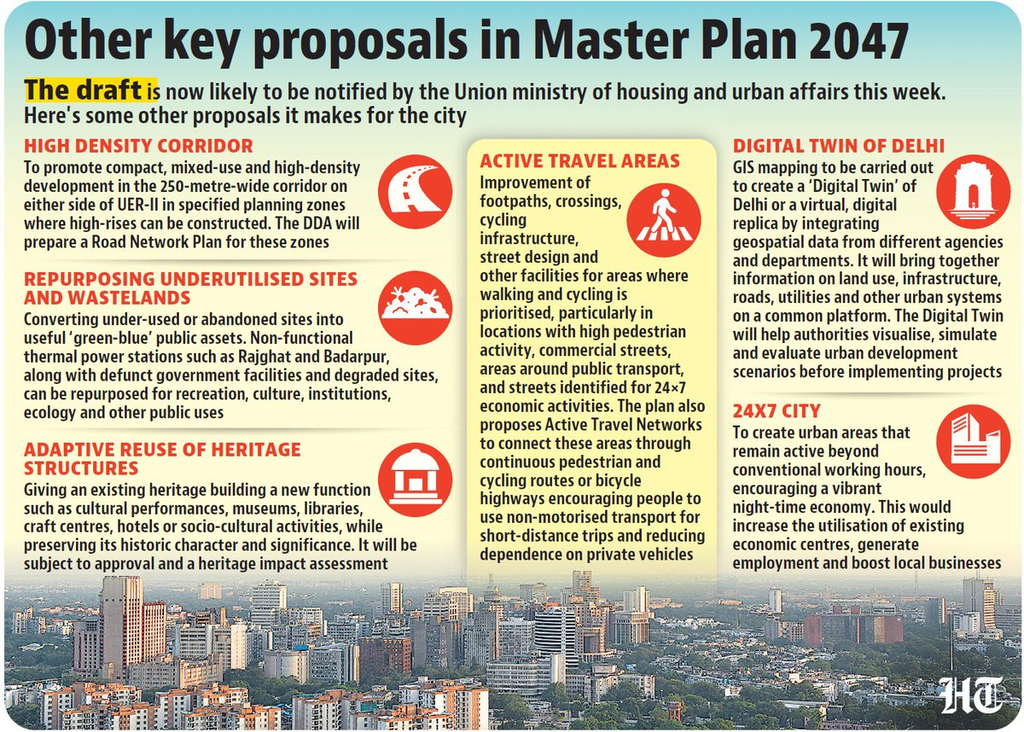
Significance:
- MPD-2047 seeks to shift Delhi from horizontal sprawl towards a compact, transit-oriented and mixed-use urban model.
- Higher density near mass transit can reduce commuting distances, private-vehicle dependence and pressure on peripheral agricultural land.
- Land pooling and redevelopment can also unlock housing supply in a land-scarce city.
Major Challenges:
- Unplanned verticalisation could overwhelm Delhi’s water supply, sewerage, waste-management and transport systems.
- Land pooling may face fragmented ownership and farmer participation issues, while construction of houses does not automatically ensure their affordability.
- Fragmented responsibilities among the DDA, Delhi government, municipal bodies and Union government may also obstruct implementation.
Development permissions should be linked to prior augmentation of public transport and civic infrastructure. Affordable rental housing, in-situ rehabilitation, pedestrian infrastructure and strict protection of the Ridge, Yamuna floodplains and heritage zones must remain central to implementation.
Source: https://anantamias.com/current-affairs/master-plan-for-delhi-2047-notified/