

Why in News?
On August 20, 2026, a nine-judge Supreme Court Bench held that ‘industry’ under the Industrial Relations Code, 2020 must be interpreted in the Code’s own text and context.
- The majority said the expansive Bangalore Water Supply interpretation of the 1947 Act will not control future interpretation of Section 2(p) of the new Code.
- Proceedings still governed by the Industrial Disputes Act, 1947 must continue to apply the 1978 precedent; concluded cases are not reopened.
- The decision creates a statute-specific boundary: it does not declare every principle of the older judgment wrong for every legal setting.
- Several judges defended the older test’s worker-protective logic, revealing a continuing constitutional debate over labour remedies in a privatised economy.
- Whether an activity is an industry determines access to industrial-dispute institutions, collective bargaining protections and remedies linked to the governing labour statute.
- The ruling illustrates how precedent and legislative change interact: a new statutory text may require fresh interpretation without retrospectively erasing law under the repealed enactment.
- For UPSC answers, distinguish a court’s interpretation of a new Code from wholesale overruling of a precedent developed under an older Act.
UPSC Relevance
Prelims Relevance
- Section 2(p) of the Industrial Relations Code, 2020 defines ‘industry’.
- The Code covers systematic employer-worker cooperation for producing, supplying or distributing goods or services that satisfy human wants or wishes.
- Investment of capital and a profit motive are not necessary for an activity to qualify under the positive part of the definition.
- The definition expressly excludes specified charitable or philanthropic institutions, sovereign governmental functions, domestic service and notified activities.
- The Bangalore Water Supply judgment of 1978 developed the triple test under Section 2(j) of the Industrial Disputes Act, 1947.
- The 1978 test remains relevant to pending legacy proceedings governed by the 1947 Act.
Mains Relevance
GS Paper 2
- Judicial interpretation, stare decisis and the effect of replacing an old statute with a new Code.
- Access to justice and institutional remedies for workers affected by the statutory boundary of ‘industry’.
GS Paper 3
- Industrial relations, collective bargaining and the balance between enterprise flexibility and labour protection.
Essay
- Economic reform is durable when institutional flexibility and worker protection are treated as complements rather than opposites.
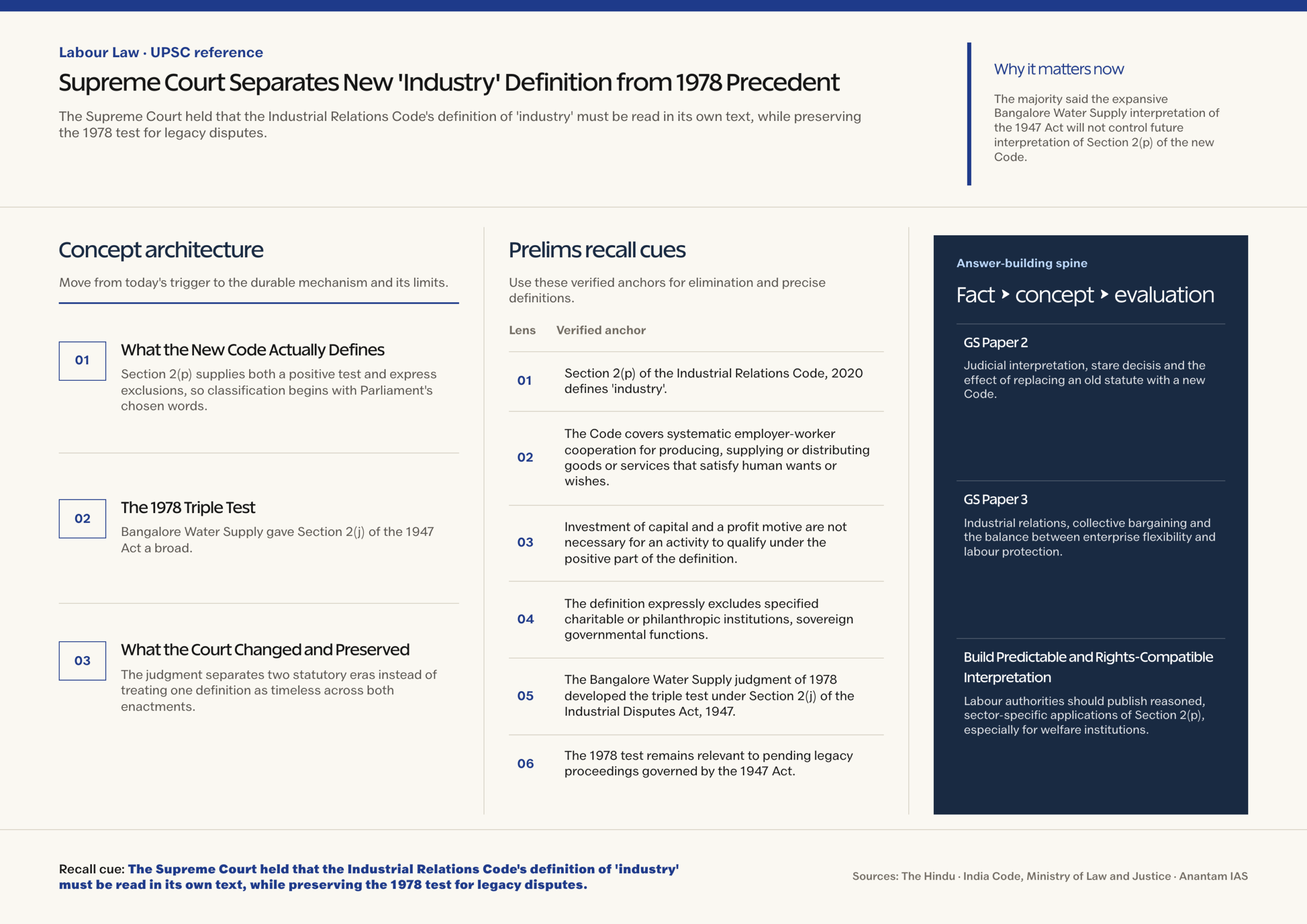
Background and Context
What the New Code Actually Defines
Section 2(p) supplies both a positive test and express exclusions, so classification begins with Parliament’s chosen words.
- An activity must be systematic and carried on through cooperation between an employer and workers, including workers engaged through an agency or contractor.
- Its object must be the production, supply or distribution of goods or services to satisfy human wants or wishes, excluding wants that are merely spiritual or religious.
- The activity may qualify even when no capital is invested or no gain or profit is sought. Commercial form is relevant evidence, but profit is not decisive.
- Express exclusions cover certain charitable, social or philanthropic institutions; sovereign governmental functions; domestic service; and activities later notified by the Union government.
- The sovereign-function exclusion specifically includes Central departments dealing with defence research, atomic energy and space, while its wider application remains tied to statutory interpretation.
The 1978 Triple Test
Bangalore Water Supply gave Section 2(j) of the 1947 Act a broad, functional interpretation centred on the nature of the activity.
- The judgment asked whether there was a systematic activity, organised through employer-employee cooperation, for producing or distributing goods or services that meet human wants.
- It treated profit motive and capital investment as unnecessary, allowing hospitals, educational bodies and municipal activities to fall within ‘industry’ when their functional character met the test.
- Under the dominant nature test, an organisation carrying mixed activities was classified by its predominant activity; severable departments could still be assessed separately.
- Strict sovereign functions such as defence, law and order and administration of justice remained outside, but merely being performed by the State did not automatically make an activity sovereign.
- Its practical importance was remedial: workers in covered establishments could use industrial adjudication and collective mechanisms against employment disputes and unfair labour practices.
What the Court Changed and Preserved
The judgment separates two statutory eras instead of treating one definition as timeless across both enactments.
- For disputes arising under the Industrial Relations Code, the Court said Section 2(p) begins on a clean interpretive slate and is not anchored to Bangalore Water Supply’s reading of Section 2(j).
- That approach respects legislative choice: the new definition resembles parts of the functional test but also contains express exclusions that the older judicial formulation did not create.
- For proceedings governed by the repealed 1947 Act, courts, tribunals and labour authorities must still apply Bangalore Water Supply; the ruling does not reopen final decisions.
- The split opinions matter. Some judges considered the older precedent settled and worker-protective, while others accepted that its interpretation should not encumber the new Code.
- The exam trap is to say the 1978 precedent was simply abolished. Its authority is context-bound: preserved for legacy law, but not controlling the new statutory definition.
Way Forward
Build Predictable and Rights-Compatible Interpretation
- Labour authorities should publish reasoned, sector-specific applications of Section 2(p), especially for welfare institutions, mixed establishments and outsourced workforces.
- Courts should test exclusions narrowly against statutory text and constitutional values, avoiding assumptions that every public activity is sovereign or every charitable label is decisive.
- Governments should monitor whether excluded workers retain effective grievance, safety and unfair-dismissal remedies under other labour and service-law routes.
- Employers and unions should update classifications and dispute-resolution arrangements without disturbing rights already crystallised under saved proceedings or final decisions.
Conclusion
- The ruling is best understood as statutory reset, not historical erasure: Section 2(p) governs the new Code, while Bangalore Water Supply continues to govern legacy disputes under the 1947 Act.
- A strong Mains answer should connect textual interpretation with practical access to labour remedies and evaluate whether the new exclusions preserve a fair balance between sovereign autonomy and worker protection.
UPSC Practice Questions
Prelims MCQ 1
With reference to the definition of ‘industry’ under the Industrial Relations Code, 2020, consider the following statements:
- A profit motive is essential for an activity to qualify as an industry.
- Domestic service is expressly excluded from the definition.
- Workers engaged through a contractor may be considered in the employer-worker cooperation test.
How many of the above statements are correct?
(a) Only one (b) Only two (c) All three (d) None
Answer: (b) Only two
Explanation:
Statements 2 and 3 are correct. Section 2(p) states that profit motive and capital investment are not essential, and it includes workers engaged through an agency or contractor.
Prelims MCQ 2
What is the most accurate implication of the Supreme Court’s 2026 ruling on the term ‘industry’?
(a) Bangalore Water Supply was erased for all past and future legal purposes (b) Every government welfare activity is now outside labour law (c) Section 2(p) of the new Code must be interpreted independently, while the older precedent continues for legacy proceedings (d) Profit-seeking activity alone can qualify as an industry
Answer: (c) Section 2(p) of the new Code must be interpreted independently, while the older precedent continues for legacy proceedings
Explanation:
The Court separated the new Code’s interpretation from the 1978 precedent but preserved that precedent for proceedings governed by the Industrial Disputes Act, 1947.
UPSC Mains Questions
- The Supreme Court’s interpretation of ‘industry’ under the Industrial Relations Code is a statutory reset rather than an erasure of precedent. Examine.
- How should courts balance sovereign autonomy, legislative text and workers’ access to remedies while interpreting exclusions from the definition of ‘industry’?
Sources: The Hindu and India Code, Ministry of Law and Justice.
Frequently Asked Questions
What did the Supreme Court decide about ‘industry’ under the new Code?
It held that Section 2(p) of the Industrial Relations Code must be interpreted from its own text and context, without treating the 1978 Bangalore Water Supply test as controlling.
Was the Bangalore Water Supply judgment completely overruled?
No. The Court preserved its interpretation for pending proceedings governed by the Industrial Disputes Act, 1947, and said concluded cases should not be reopened.
What is the positive test in Section 2(p)?
It covers systematic employer-worker cooperation for producing, supplying or distributing goods or services that satisfy human wants, regardless of capital investment or profit motive.
Which activities are expressly excluded from the new definition?
The Code excludes specified charitable or philanthropic institutions, sovereign governmental functions, domestic service and other activities that the Central Government may notify.
Why does the definition matter for workers?
Classification affects whether a dispute enters the industrial-relations framework, including institutional adjudication and collective mechanisms available under the governing labour statute.
Tell Google you want more of this.
Add Anantam IAS as a preferred sourceOne tap, and this site shows up more often in your own Top Stories, AI Overviews and AI Mode. Remove it any time.






