Why in News?
India and Japan signed a Memorandum of Arrangement on Maritime Security Cooperation in New Delhi on 20 August 2026 to deepen practical naval cooperation.
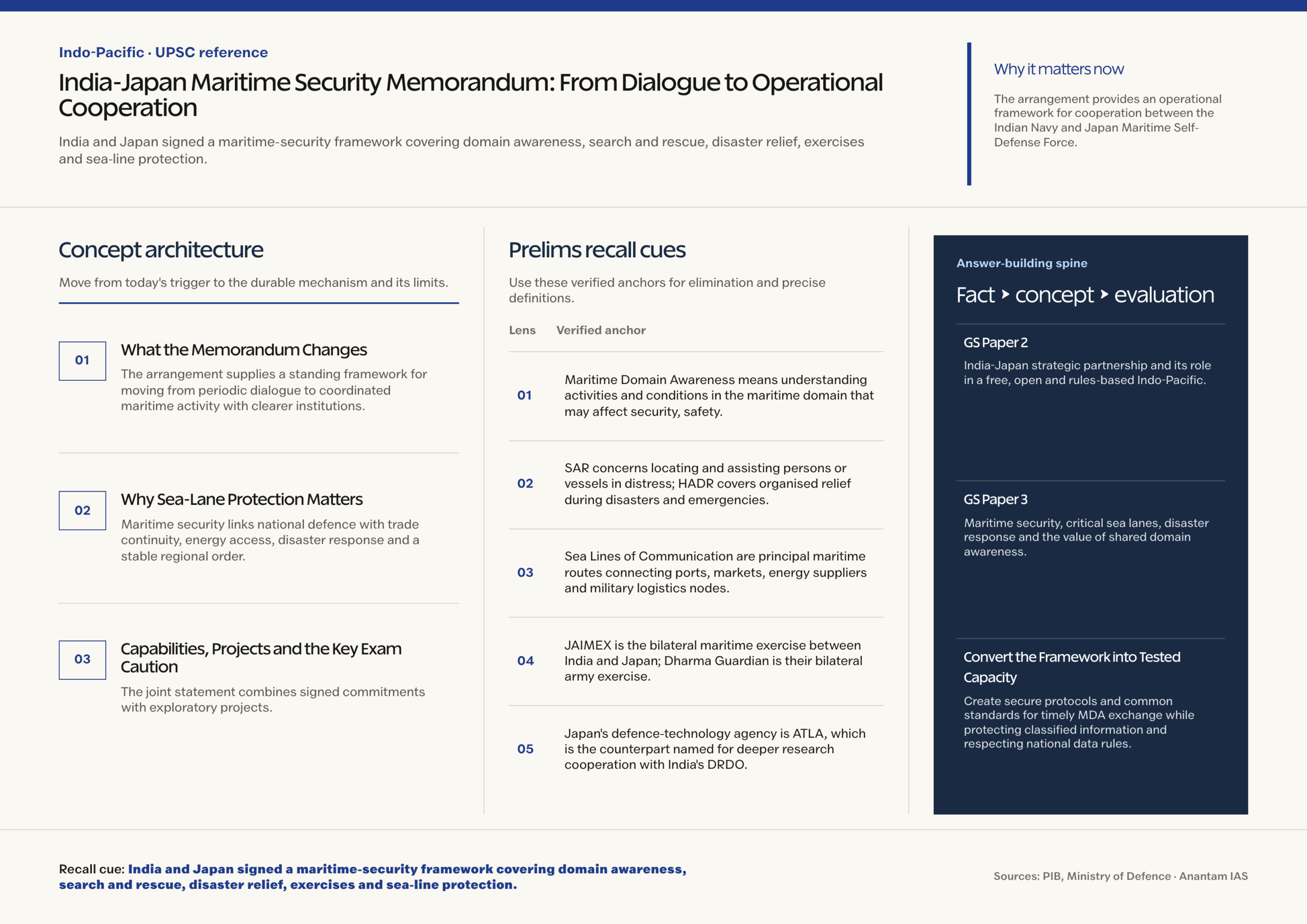
- The arrangement provides an operational framework for cooperation between the Indian Navy and Japan Maritime Self-Defense Force.
- It covers Maritime Domain Awareness information-sharing, Search and Rescue, and Humanitarian Assistance and Disaster Relief.
- Both sides proposed ship visits, exercises, expert exchanges, port access, logistics, maintenance and repair cooperation to protect Sea Lines of Communication.
- A director-general or joint-secretary-level working group will coordinate operational, intelligence, equipment, technology and industrial tracks while respecting sovereign choices.
- India and Japan depend on open sea routes for trade, energy flows and supply-chain resilience across the Indian and Pacific Oceans.
- The framework turns broad Indo-Pacific convergence into repeatable mechanisms for information exchange, coordinated response and naval interoperability.
UPSC Relevance
Prelims Relevance
- Maritime Domain Awareness means understanding activities and conditions in the maritime domain that may affect security, safety, economy or environment.
- SAR concerns locating and assisting persons or vessels in distress; HADR covers organised relief during disasters and emergencies.
- Sea Lines of Communication are principal maritime routes connecting ports, markets, energy suppliers and military logistics nodes.
- JAIMEX is the bilateral maritime exercise between India and Japan; Dharma Guardian is their bilateral army exercise.
- Japan’s defence-technology agency is ATLA, which is the counterpart named for deeper research cooperation with India’s DRDO.
Mains Relevance
GS Paper 2
- India-Japan strategic partnership and its role in a free, open and rules-based Indo-Pacific.
- How minilateral and bilateral security arrangements can supply regional public goods without creating a formal alliance.
GS Paper 3
- Maritime security, critical sea lanes, disaster response and the value of shared domain awareness.
- Defence technology, shipbuilding, repair ecosystems and interoperability as elements of national security capacity.
Essay
- Security partnerships become durable when strategic trust is converted into institutions, shared capabilities and public goods.
Background and Context
What the Memorandum Changes
The arrangement supplies a standing framework for moving from periodic dialogue to coordinated maritime activity with clearer institutions, tasks and implementation channels.
- MDA information-sharing can improve the common operating picture by linking observations about shipping, hazards, suspicious activity and emerging incidents across connected maritime zones.
- Cooperation on SAR and HADR can reduce response time when ships, coastal communities or partner countries face accidents and disasters requiring coordinated assets.
- Naval visits, exercises and expert exchanges build familiarity with each side’s procedures, communication practices and operational constraints before a crisis demands rapid joint action.
- Port use, maintenance and repair arrangements can extend operational reach and sustain deployments, but each activity remains subject to national policy and separate implementation decisions.
- The working group provides institutional follow-through across operational, intelligence, equipment, technology and industry domains, allowing bottlenecks to be reviewed rather than leaving coordination to isolated events.
Why Sea-Lane Protection Matters
Maritime security links national defence with trade continuity, energy access, disaster response and a stable regional order.
- Sea Lines of Communication carry commercial shipping and strategic supplies; disruption can raise freight, insurance and energy costs for importers and consumers far beyond the incident area.
- The Indian Ocean and western Pacific form a connected strategic space because shipping routes pass through narrow chokepoints and link Asian production, energy suppliers and consumption centres.
- Better domain awareness helps distinguish routine traffic from piracy, coercive activity, accidents or environmental hazards, supporting proportionate responses and reducing the risk of miscalculation.
- Interoperable forces can coordinate evacuation, relief delivery, search patterns and logistics without waiting to devise common procedures, compatible communications and task divisions during an emergency.
- Joint capacity can also provide regional public goods, especially safe navigation and disaster assistance, while supporting freedom of navigation and overflight without requiring a formal military alliance.
Capabilities, Projects and the Key Exam Caution
The joint statement combines signed commitments with exploratory projects, so their legal and operational status must be separated.
- The signed memorandum is a cooperation framework; it is not a mutual-defence treaty and does not create an automatic obligation to enter a conflict or host forces.
- Mine-countermeasure cooperation and possible joint naval shipbuilding were identified for further work, not announced as completed capabilities, approved designs or contracted projects.
- The proposed reciprocal ship-repair arrangement is still to be concluded, even though both sides expressed support for using repair facilities and progressing negotiations soon.
- The shipborne UNICORN antenna project was described as the first bilateral defence-equipment transfer project, but the ministers committed only to working toward its early realisation.
- DRDO-ATLA research cooperation and a planned Defence Industry Forum can connect operational needs with technology, production and supply-chain resilience, provided discussions produce governed and deliverable projects.
Way Forward
Convert the Framework into Tested Capacity
- Create secure protocols and common standards for timely MDA exchange while protecting classified information and respecting national data rules.
- Run scenario-based SAR, HADR and mine-countermeasure exercises that test communications, logistics, command relationships and after-action learning.
- Conclude transparent ship-repair and port-support arrangements with clear scope, access procedures, cost rules and accountability.
- Set measurable working-group milestones for equipment transfer, research and industrial cooperation without overstating exploratory discussions as completed outcomes.
Conclusion
- The memorandum matters because it converts strategic convergence into operational cooperation across information, exercises, relief, logistics and technology.
- In a Mains answer, present it as flexible capacity-building that strengthens maritime resilience, while noting that projects require implementation and the arrangement is not a defence alliance.
UPSC Practice Questions
Prelims MCQ 1
With reference to the India-Japan Memorandum of Arrangement on Maritime Security Cooperation, consider the following statements:
- It includes information-sharing in Maritime Domain Awareness.
- It provides for cooperation in Search and Rescue and Humanitarian Assistance and Disaster Relief.
- It creates an automatic mutual-defence obligation between India and Japan.
How many of the above statements are correct?
(a) Only one (b) Only two (c) All three (d) None
Answer: (b) Only two
Explanation:
Statements 1 and 2 reflect the signed framework. Statement 3 is incorrect because the memorandum is an operational cooperation arrangement, not a mutual-defence treaty.
Prelims MCQ 2
Which one of the following is correctly matched?
(a) JAIMEX — India-Japan army exercise (b) Dharma Guardian — India-Japan air exercise (c) ATLA — Japan’s defence technology agency (d) UNICORN — A multilateral disaster-relief network
Answer: (c) ATLA — Japan's defence technology agency
Explanation:
ATLA is Japan’s Acquisition, Technology and Logistics Agency. JAIMEX is maritime, Dharma Guardian is an army exercise, and UNICORN is a shipborne integrated communications antenna system.
UPSC Mains Questions
- India-Japan maritime cooperation is shifting from strategic dialogue to operational capacity-building. Discuss the significance and limits of the new maritime-security memorandum.
- How can Maritime Domain Awareness, logistics cooperation and HADR exercises strengthen regional public goods in the Indo-Pacific? Explain with reference to India-Japan cooperation.
Source: PIB, Ministry of Defence.
Frequently Asked Questions
What did India and Japan sign in August 2026?
Their defence ministries signed a Memorandum of Arrangement establishing a framework for practical maritime-security cooperation between the Indian Navy and Japan Maritime Self-Defense Force.
What areas does the maritime-security memorandum cover?
It covers Maritime Domain Awareness information-sharing, Search and Rescue, HADR, exercises, expert exchanges, naval visits, logistics and coordination for protecting Sea Lines of Communication.
Is the memorandum a mutual-defence treaty?
No. It is a cooperation framework and does not create an automatic obligation for either country to enter a conflict on the other’s behalf.
What is Maritime Domain Awareness?
It is an understanding of maritime activities and conditions that may affect security, safety, the economy or the environment, built through observation and information-sharing.
Were the UNICORN and shipbuilding projects completed by this agreement?
No. The ministers supported early realisation of UNICORN and exploration of shipbuilding cooperation; the statement did not announce completed transfer or joint-development outcomes.
Tell Google you want more of this.
Add Anantam IAS as a preferred sourceOne tap, and this site shows up more often in your own Top Stories, AI Overviews and AI Mode. Remove it any time.