Why in News?
MeitY signed an MoU with PhonePe on 20 August 2026 to integrate PhonePe PulsePro metrics into the PM GatiShakti National Master Plan portal.
- The official release describes PulsePro as converting aggregated and anonymised transaction data into granular, hyperlocal signals across geographies, categories and markets.
- The planned integration is intended to support infrastructure planning, economic analysis, and urban and rural development by complementing datasets already available to planners.
- The portal is managed in collaboration with BISAG-N, the Bhaskaracharya National Institute for Space Applications and Geo-informatics.
- The announcement establishes a data-sharing partnership; it does not yet demonstrate completed integration, better project selection, lower costs or improved public-service outcomes.
- Private transaction signals may reveal changing commercial activity faster and at finer spatial scales than periodic administrative datasets, but they capture platform-mediated behaviour, not the entire economy.
- Planning decisions can affect land, budgets and access to services, so supplementary private data needs representativeness checks, privacy safeguards and reasons that public authorities can defend.
- The case illustrates a wider shift from government-held datasets alone toward public-private data partnerships for evidence-based governance.
UPSC Relevance
Prelims Relevance
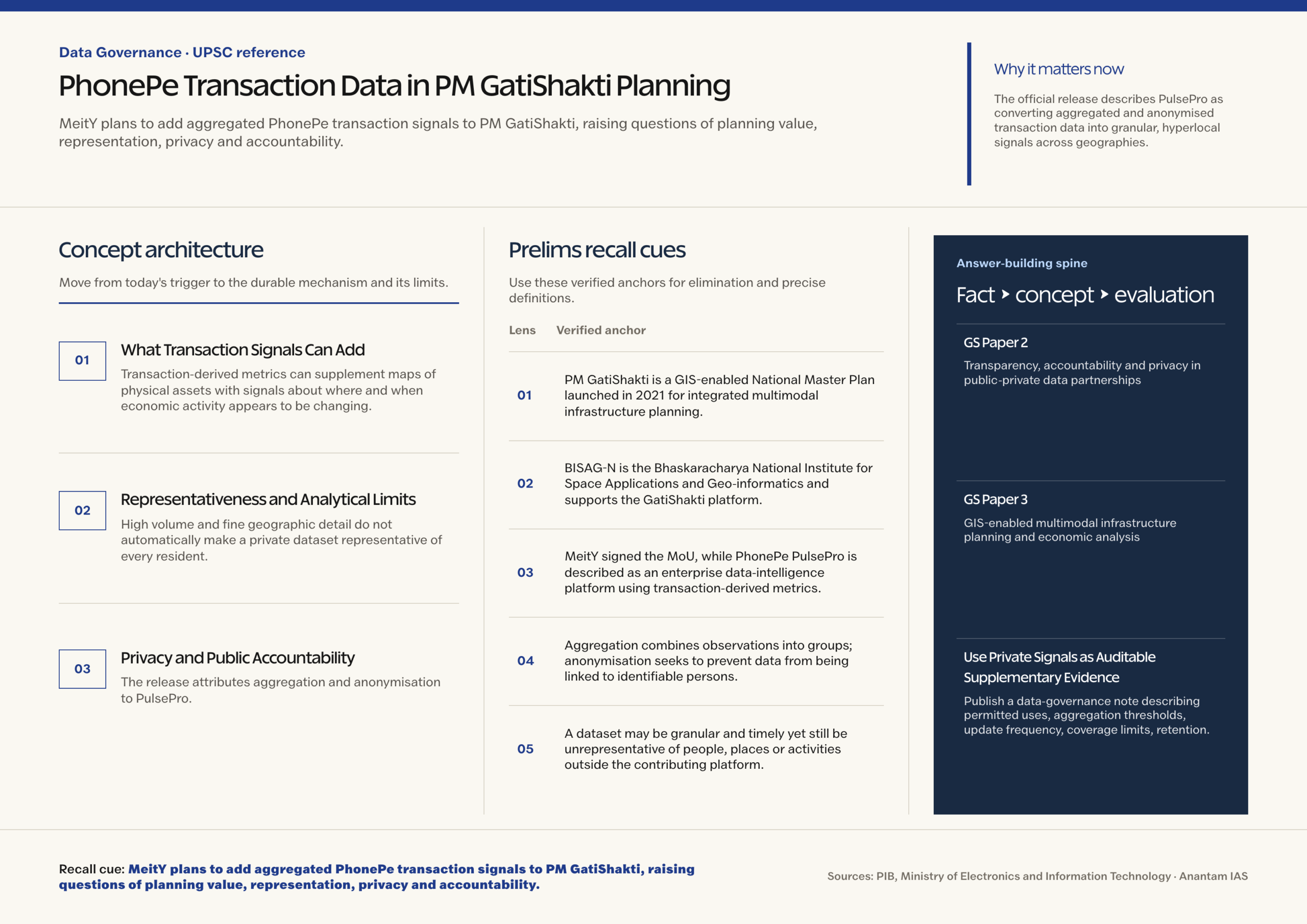
- PM GatiShakti is a GIS-enabled National Master Plan launched in 2021 for integrated multimodal infrastructure planning.
- BISAG-N is the Bhaskaracharya National Institute for Space Applications and Geo-informatics and supports the GatiShakti platform.
- MeitY signed the MoU, while PhonePe PulsePro is described as an enterprise data-intelligence platform using transaction-derived metrics.
- Aggregation combines observations into groups; anonymisation seeks to prevent data from being linked to identifiable persons.
- A dataset may be granular and timely yet still be unrepresentative of people, places or activities outside the contributing platform.
Mains Relevance
GS Paper 2
- Transparency, accountability and privacy in public-private data partnerships
- Use of supplementary private data in reasoned and reviewable public decisions
GS Paper 3
- GIS-enabled multimodal infrastructure planning and economic analysis
- Digital data quality, representativeness and responsible analytics
Essay
- Data becomes a public asset only when faster insight is matched by fairness, institutional accountability and protection of individual rights.
Background and Context
What Transaction Signals Can Add
Transaction-derived metrics can supplement maps of physical assets with signals about where and when economic activity appears to be changing.
- A GIS platform can place transaction indicators beside roads, logistics nodes, markets, settlements and public facilities, helping planners explore whether infrastructure and observed activity align spatially.
- Near-real-time signals may identify an emerging activity cluster sooner than a periodic survey or annual administrative series, creating a lead for further field investigation.
- Category-level patterns could help planners ask whether commercial growth is matched by transport access, storage, digital connectivity or other enabling infrastructure.
- Transaction data measures observed platform activity, not infrastructure need itself; a signal can generate a planning question but cannot by itself establish the correct project response.
- The official release says PulsePro metrics will complement existing datasets, which is the sounder approach than replacing surveys, censuses, administrative records or local consultation.
Representativeness and Analytical Limits
High volume and fine geographic detail do not automatically make a private dataset representative of every resident, enterprise or transaction in an area.
- PhonePe-derived metrics reflect activity within a particular digital ecosystem; cash use, other payment channels and people with limited digital access may be absent or differently represented.
- Platform adoption can vary across income groups, age groups, regions, business types and network conditions, producing systematic gaps rather than random statistical noise.
- A change in the metric may arise from customer acquisition, product design or payment preferences, not only from an underlying change in local economic demand.
- Planners should validate signals against independent official data, field evidence and local knowledge, and document where coverage or classification limits make comparisons unreliable.
- Models should report uncertainty and avoid converting correlation into causation; transaction concentration near a corridor does not prove that a proposed alignment is socially optimal.
Privacy and Public Accountability
The release attributes aggregation and anonymisation to PulsePro, but it does not publish the technical thresholds or governance controls used for this integration.
- Aggregation can reduce direct visibility of individual records, while anonymisation aims to prevent identification; neither label alone explains cell sizes, access controls or residual re-identification risk.
- Very small geographic or category groups and combinations with other datasets can increase inference risk, so planners need minimum thresholds, suppression rules and limits on drill-down.
- Purpose limitation should restrict access to defined planning tasks, supported by data minimisation, retention limits, authentication, audit logs and controls on onward sharing.
- The public authority remains responsible for lawful and proportionate decisions; a private metric should not become an opaque substitute for recorded reasons, consultation or statutory appraisal.
- Contracts and operating rules should specify data quality duties, security incidents, correction, independent review, termination and vendor dependence so public capability is not locked to one provider.
Way Forward
Use Private Signals as Auditable Supplementary Evidence
- Publish a data-governance note describing permitted uses, aggregation thresholds, update frequency, coverage limits, retention, access roles and the accountability of each partner.
- Benchmark transaction signals against surveys, administrative records and field checks, with bias and uncertainty reports before they influence project prioritisation.
- Apply privacy-by-design controls, independent security testing, audit trails and grievance routes while preventing individual or business profiling unrelated to the stated public purpose.
- Record how each dataset influenced a decision and preserve human review, consultation and statutory safeguards so planners can explain and contest the resulting recommendation.
Conclusion
- The MoU should be read as an announced data integration, not evidence that transaction analytics has already improved infrastructure outcomes. Its value must be demonstrated through transparent pilots and independent evaluation.
- In a Mains answer, balance innovation with representativeness, privacy and public accountability: private signals can sharpen questions, but legitimate infrastructure choices still require plural evidence and reasoned government judgment.
UPSC Practice Questions
Prelims MCQ 1
With reference to the announced PhonePe PulsePro integration with PM GatiShakti, consider the following statements:
- MeitY signed the Memorandum of Understanding with PhonePe.
- The official release describes PulsePro metrics as derived from aggregated and anonymised transaction data.
- The announcement demonstrates that the integration has already reduced infrastructure project costs.
How many of the above statements are correct?
(a) Only one (b) Only two (c) All three (d) None
Answer: (b) Only two
Explanation:
Statements 1 and 2 are correct. The release announces an MoU and intended integration; it does not present demonstrated project outcomes or cost reductions.
Prelims MCQ 2
Which one of the following best explains why a large digital transaction dataset may still be unrepresentative for public planning?
(a) Digital datasets cannot be placed on GIS platforms (b) Aggregated information is always legally unusable (c) Platform users and transactions may not mirror all people, businesses and payment channels (d) Administrative data must never be combined with private data
Answer: (c) Platform users and transactions may not mirror all people, businesses and payment channels
Explanation:
Dataset size does not remove coverage bias. Adoption, access and payment behaviour can differ across populations, places and commercial activities.
UPSC Mains Questions
- Private transaction data can make infrastructure planning more responsive, but volume and granularity do not guarantee representative evidence. Discuss.
- What safeguards should govern public-private data partnerships when commercially generated data informs decisions affecting public infrastructure and services?
Source: PIB, Ministry of Electronics and Information Technology.
Frequently Asked Questions
What did MeitY and PhonePe announce?
They signed an MoU to integrate PhonePe PulsePro metrics into the PM GatiShakti National Master Plan portal as supplementary inputs for planning and economic analysis.
Has the PhonePe data integration already improved infrastructure outcomes?
The PIB release announces intended integration and uses. It does not present completed deployment, evaluated projects, cost reductions or measured public-service outcomes.
Why can transaction data be unrepresentative despite its large volume?
It reflects a platform’s users and transactions. Cash activity, other payment channels and groups with unequal digital access may be missing or differently represented.
Does aggregated and anonymised data eliminate every privacy risk?
No. Risk depends on group size, geographic detail, possible linkage with other datasets, access controls and permitted uses. Technical and institutional safeguards remain necessary.
How should planners use private transaction signals?
They should treat them as supplementary leads, validate them against official and field evidence, document uncertainty, preserve human review and explain how each input affected decisions.
Tell Google you want more of this.
Add Anantam IAS as a preferred sourceOne tap, and this site shows up more often in your own Top Stories, AI Overviews and AI Mode. Remove it any time.