Daily Digest
UPSC · Civil Services Examination
Current Affairs · Monday, 21 September 2026
Current affairs curated and edited by Anantam IAS faculty — pulled from The Hindu, PIB, IDSA, Foreign Affairs and the ministries. Read, annotate, revise.
Old Rajinder Nagar · Delhi 110005 · anantamias.com
AASHVAST Labs: Testing Drone Firmware and Supply-Chain Trust
Why in News?
The Indian Express reported on September 20 that the Indian Army plans six AASHVAST laboratories for mandatory drone firmware inspections, with CCTV equipment envisaged for later coverage.
- One Delhi laboratory had already been inaugurated on August 14; at least five more are planned, so six laboratories are not yet operational.
- AASHVAST expands to Assessment and Analysis of Electronic Systems Hardware for Vulnerabilities and Security Threats.
- The report identifies QuickPay Pvt Ltd as the suite developer for the Directorate General of Electronics and Mechanical Engineering.
- The developer describes checks for hidden commands and location-sensitive failures; these are attributed capability claims, not proof that every vulnerability can be detected.
- A drone can pass a normal flight demonstration while its embedded software contains behavior that appears only under another condition.
- An invoice establishes a transaction, but does not independently establish component origin or the absence of hidden software functions.
UPSC Relevance
Prelims Relevance
- Firmware: software embedded in electronic equipment that controls device functions.
- UAV: an unmanned aerial vehicle, whose reliability depends on hardware and software.
- Supply-chain assurance: evidence about suppliers, components, software and their changes.
- AASHVAST: an Army initiative for vulnerability assessment, initially focused on drones.
Mains Relevance
GS Paper 3
- Cybersecurity risks in defence procurement and embedded systems.
- Balancing domestic manufacturing with verifiable supply-chain assurance.
Essay
- Technological self-reliance requires verifiable trust, not merely domestic assembly.
Background and Context
What firmware testing adds to a flight demonstration
A working drone is not automatically a trustworthy drone: performance and cybersecurity ask different questions about the same machine.
- Firmware operates close to a device’s hardware, translating instructions into actions such as communication and control. A defect here can affect operation even when the outer frame and visible components appear sound.
- A functional test asks whether the drone completes a specified task under observed conditions. Passing it cannot establish how the device will behave at every other location, time or configuration encountered later.
- The developer told The Indian Express that conditional behavior could include hidden commands or location-linked failures. These examples explain the testing objective; they are not independently verified findings about every drone being procured.
- Vulnerability analysis examines software behavior and possible weaknesses rather than relying only on visible performance. Its findings depend on what inspectors can access, the methods used and the conditions their checks actually cover.
- A software update can change the code after an earlier inspection. Confidence in one tested version should not automatically transfer to a different version, even if the supplier and device name remain unchanged.

Why procurement documents and technical checks answer different questions
Supply-chain trust needs several kinds of evidence because paperwork, physical components and executable code reveal different parts of a product’s history.
- An invoice identifies a seller and a purchase, but a distributor can sell components manufactured elsewhere. The country of purchase cannot by itself settle the country of manufacture or the underlying technology’s origin.
- Physical inspection helps relate the delivered equipment to its declared components. It is a different task from establishing what embedded software does, and neither task becomes unnecessary because the product is assembled domestically.
- The report says project participants want to examine active components, embedded keys and remote-access tools. Their concern links procurement assurance with cybersecurity, but does not establish a demonstrated capability to determine everything inside silicon.
- A foreign-origin component is not automatically malicious, just as a domestic label is not a security guarantee. The analytical question concerns access, behavior, supplier accountability and the evidence available for assessing risk.
- Self-reliance is stronger when buyers can scrutinise and maintain the equipment they acquire. Replacing an import without understanding its software can relocate assembly while leaving important dependencies and vulnerabilities insufficiently examined.
What the expansion establishes, and what remains unproven
The reported laboratory expansion is an institutional response to risk, not a certification that all supplied systems are already secure.
- The Delhi facility is the existing starting point; the other proposed laboratories represent intended expansion. Reporting a nationwide plan must not turn future facilities into completed infrastructure or an announced inspection into a finished assessment.
- CCTV screening is described as eventual coverage, whereas drones are the initial focus. Extending scrutiny to another equipment class requires relevant testing capability; its inclusion in the plan does not establish completed camera inspections.
- Detection limits matter because a clean result only addresses the checks performed on the submitted equipment. Undiscovered defects, inaccessible code or later modifications can leave residual risk even after a careful technical review.
- Cyber assurance is also distinct from resilience against every battlefield threat. Firmware scrutiny cannot by itself demonstrate that a drone will withstand all radio interference, navigation disruption, physical damage or adverse operating conditions.
- A credible assurance record should identify the tested device, its software version, findings and unresolved limitations. This makes the result usable for procurement decisions without presenting laboratory inspection as a universal guarantee of operational success.
Way Forward
Make inspection evidence usable throughout service
- Require traceable component declarations and preserve the link between each tested configuration and the equipment delivered.
- Specify retesting triggers for firmware updates and relevant hardware substitutions, with responsibility for correcting discovered weaknesses.
- Separate verified findings from supplier claims and record unresolved limits so procurement officers can judge residual risk.
Conclusion
- AASHVAST highlights a useful distinction: buying a product, observing it work and examining its embedded code provide different forms of assurance. None should be mistaken for complete knowledge of the system.
- For defence procurement, connect self-reliance with verifiable technical access, accountable suppliers and continued scrutiny after updates. The laboratory plan is significant because it addresses an assurance gap, not because it eliminates uncertainty.
UPSC Practice Questions
Prelims MCQ 1
With reference to assurance of military drones, consider the following statements:
- The country shown on a purchase invoice necessarily establishes the manufacturing origin of every component.
- A firmware update can change the software configuration previously inspected.
- Passing a functional test does not establish the absence of every hidden software behavior.
How many of the above statements are correct?
(a) Only one (b) Only two (c) All three (d) None
Answer: (b) Only two
Explanation:
Statements 2 and 3 are correct. A purchase invoice can identify a seller without independently establishing the manufacturing origin of every component.
Prelims MCQ 2
Which measure best preserves the relevance of a laboratory assessment after procurement?
(a) Treating a domestic assembly label as a permanent security guarantee (b) Replacing technical inspection with the purchase invoice (c) Linking findings to the tested version and reassessing relevant changes (d) Assuming every imported component is malicious
Answer: (c) Linking findings to the tested version and reassessing relevant changes
Explanation:
An assessment concerns a particular configuration. Relevant software or hardware changes can alter its security properties and justify renewed scrutiny.
UPSC Mains Questions
- Why are functional demonstrations and procurement invoices insufficient for cybersecurity assurance of defence equipment? Discuss with reference to firmware inspection.
- Examine the relationship between technological self-reliance and supply-chain transparency in military procurement. What limits should accompany claims of technical assurance?
Source: The Indian Express.
Frequently Asked Questions
What is AASHVAST?
AASHVAST is an Army initiative for assessment of electronic-system vulnerabilities. The Indian Express reports that its laboratory network will initially inspect drones, with CCTV equipment envisaged for later coverage.
Are all six AASHVAST laboratories operational?
No. The report identifies one inaugurated laboratory in Delhi and plans for at least five more. The network expansion should be distinguished from facilities that are already operational.
Why can a flight test miss firmware weaknesses?
A flight test observes performance under particular conditions. Embedded software may behave differently after an update or under another location, time or configuration, so observed performance cannot establish universal software trustworthiness.
Does a foreign component necessarily pose a malicious threat?
No. Origin alone does not establish malicious behavior. Assessments need evidence about the component, software, supplier and access arrangements; a domestic label likewise cannot serve as an automatic security guarantee.
Source: https://anantamias.com/current-affairs/aashvast-drone-firmware-supply-chain-assurance/
Court Deposits: Interest Liability and the Need for Common Rules
Why in News?
On 18 September 2026, the Supreme Court upheld interest liability in a court-deposit dispute and requested Law Commission examination of a uniform framework for managing money held by courts and tribunals.
- National Seeds Corporation Ltd. challenged continued interest on money deposited during proceedings concerning an arbitral award; the Supreme Court affirmed the High Court’s order.
- The debtor had resisted withdrawal, and release initially required property security; the creditor did not have unconditional access to the money.
- The affirmed order required 12% annual interest from the award date until the unconditional release order, rather than treating earlier deposits as discharge.
- The Court requested a Law Commission review, including consultation with financial and legal authorities; it did not enact a new national deposit law.
- Winning an award does not necessarily give a creditor usable funds: enforcement, appeals and withdrawal conditions can prolong the economic burden.
- Judicial financial administration affects both access to justice and preservation of private money held pending litigation.
UPSC Relevance
Prelims Relevance
- Arbitral award, award-debtor and award-holder.
- Section 36 of the Arbitration and Conciliation Act: enforcement as if an award were a court decree.
- Order XXI Rule 1 of the Code of Civil Procedure: payment and cessation of interest.
- Conditional security deposit versus unconditional payment in satisfaction.
- Law Commission review versus enacted legislation.
Mains Relevance
GS Paper 2
- Access to justice includes effective enforcement and timely access to awarded money.
- Uniform court-deposit rules require coordination between judicial administration and financial authorities.
GS Paper 3
- Opportunity cost, liquidity and protection of funds during prolonged litigation.
Essay
- Justice delayed can also mean economic value denied.
Background and Context
Why a court deposit may not discharge a debt
The central distinction concerns who can use the money, not merely whether it has left the debtor’s bank account.
- An award-debtor owes money under an arbitral award; the award-holder is entitled to receive it. Depositing funds with a court can secure possible payment while the dispute over enforcement continues.
- A conditional deposit may secure a stay without satisfying the award. Money held by the registry remains unavailable to the creditor if withdrawal depends on furnishing security or obtaining further permission.
- Section 36 makes an arbitral award enforceable as if it were a court decree. This limited legal fiction imports the enforcement framework; it does not convert the award into a decree for every purpose.
- Order XXI Rule 1 links cessation of interest to legally effective payment and prescribed notice. For qualifying court deposits, notice to the creditor matters; the calendar date of deposit alone cannot answer the question.
- In this case, the debtor opposed release even after its initial challenge failed. The creditor was not free to withdraw unconditionally, so the earlier deposits did not end the debtor’s liability for interest.
How the interest rule balances both parties
The judgment protects access to awarded money while also rejecting a creditor’s attempt to earn continuing interest through avoidable inaction.
- Unconditional availability is the key comparison with security pending appeal. Once a deposit satisfies the payment requirements and the creditor can freely withdraw it, continued interest cannot rest simply on delayed collection.
- A creditor must take timely steps when funds become available. The Court explained that failure to seek withdrawal can amount to deemed refusal of the tender, preventing interest claims based on that inaction.
- A qualifying partial payment ends further interest only to the relevant extent. The unpaid balance continues to attract the applicable interest; making one accessible deposit does not erase liability for the entire award.
- Bank-deposit interest and interest owed under an award are different questions. The Court noted that where money remains in fixed deposit at the creditor’s own request, entitlement is to the interest that deposit earns.
- The withdrawal order, notice and parties’ conduct must be read together. A registry receipt cannot establish full satisfaction when the debtor continues resisting release or the creditor lacks the required security.
Why common deposit-management rules matter
Beyond the individual dispute, the Court identified inconsistent arrangements for safeguarding and investing litigants’ funds across courts and tribunals.
- Time value of money means delayed access has an economic cost: the recipient loses opportunities to use funds. Inflation can also reduce purchasing power while litigation and administrative processing keep money unavailable.
- Inconsistent rules govern how court-held funds are deposited, invested and released. The judgment’s survey found variation in institutional arrangements, making predictable treatment of principal and investment returns harder for litigants to assess.
- The Court advocated a common pooling framework for investing deposits beneficially and improving access. This is a reform direction discussed in the judgment, not evidence that a nationwide operational platform now exists.
- The proposed Law Commission examination should consider other countries’ laws and consultation with the Reserve Bank, Finance Ministry and Law Ministry. Financial design must accompany legal clarity about entitlement and release.
- Standardisation should preserve case-specific ownership and withdrawal rights even when investment administration is shared. The governance question is how to protect funds and enable authorised access, without confusing pooled management with public ownership.
Way Forward
Make custody and release traceable
- Deposit orders should clearly record purpose, withdrawal conditions, notice requirements and the treatment of interest, reducing later disputes over whether payment occurred.
- Case-linked accounts should distinguish principal, investment earnings and the amount actually released, so parties can reconcile custody with their legal entitlements.
- Reform design should prioritise safe investment, sufficient liquidity and prompt execution of release orders; investment returns alone cannot compensate for avoidable procedural delay.
Conclusion
- Court custody is not automatically payment: the decisive issue is whether the creditor can access the money under the applicable legal requirements, not whether the debtor has handed funds to the registry.
- The reform remains prospective. The judgment resolves interest liability and seeks examination of common deposit rules; an answer should separate that binding case outcome from legislation or a platform that has not been created.
UPSC Practice Questions
Prelims MCQ 1
With reference to court deposits and enforcement of arbitral awards, consider the following statements:
- Section 36 permits enforcement of an arbitral award as if it were a court decree.
- Every deposit made to obtain a stay automatically extinguishes interest liability.
- A qualifying partial payment need not extinguish interest liability on the unpaid balance.
How many of the above statements are correct?
(a) Only one (b) Only two (c) All three (d) None
Answer: (b) Only two
Explanation:
Statements 1 and 3 are correct. A conditional deposit that does not satisfy the payment requirements does not automatically end interest liability.
Prelims MCQ 2
Which consideration most directly explains the distinction between a conditional court deposit and payment in satisfaction of an award?
(a) Whether the debtor uses a public-sector bank (b) Whether the creditor can access the funds under the applicable payment requirements (c) Whether the arbitration involved a government company (d) Whether the deposit earns any bank interest
Answer: (b) Whether the creditor can access the funds under the applicable payment requirements
Explanation:
Availability for withdrawal, the legal conditions for payment and prescribed notice matter. Merely moving funds beyond the debtor’s control is insufficient.
UPSC Mains Questions
- Explain why depositing money in court may not constitute payment in satisfaction of an arbitral award. Discuss the implications for interest liability. (150 words)
- How can standardised administration of court deposits strengthen access to justice while protecting litigants’ financial interests? (250 words)
Sources: Supreme Court of India, National Seeds Corporation judgment and The Hindu.
Frequently Asked Questions
Does depositing an award amount in court always stop interest?
No. A conditional deposit securing a stay may leave the creditor unable to withdraw. Cessation of interest depends on compliance with the applicable payment requirements, including availability and prescribed notice.
Why does notice to the creditor matter?
For qualifying deposits under Order XXI Rule 1, the rule connects cessation of interest with service of notice. A creditor must know that the money has been placed at their disposal.
Can a creditor delay withdrawal and keep claiming interest?
Not automatically. The judgment requires timely action when deposited money becomes available. Failure to seek withdrawal can be treated as deemed refusal of the tender, defeating an interest claim based on inaction.
Has a new national court-deposit law been enacted?
No. The Supreme Court requested the Law Commission to examine the issues and consider suitable legislation, including consultation with relevant authorities. The judgment does not itself establish a new national deposit-management statute.
Source: https://anantamias.com/current-affairs/court-deposits-interest-payment-standardisation/
Film Certification: Drug Warnings and Parental Guidance
Why in News?
Indian Express reported revised film certification guidelines requiring drug-scene warnings and incorporating existing UA age markers, in a report updated on September 19.
- Reported addition: Indian Express describes a warning requirement for scenes depicting narcotic drugs or psychotropic substances, including their use, consumption or trafficking.
- Existing age framework: The reported revision aligns guidance with UA 7+, UA 13+ and UA 16+, already reflected in the official 2024 certification rules.
- Continuity: The report describes the other provisions of the 1991 guidelines as retained; these should not be presented as newly introduced restrictions.
- Different instruments: A scene-specific warning, an age marker and a decision to restrict exhibition perform different regulatory functions.
- Governance question: Child protection and health communication require clear standards that audiences can understand and film applicants can apply consistently.
UPSC Relevance
Prelims Relevance
- Central Board of Film Certification
- Cinematograph Act, 1952 and certification rules
- UA age markers and parental guidance
- U, UA, A and S certification categories
- Difference between warnings and restrictions on exhibition
Mains Relevance
GS Paper 2
- Delegated regulation, administrative consistency and reasoned certification decisions.
- Balancing child protection, audience information and creative expression.
Essay
- Informing audiences and restricting access are different ways of regulating cultural expression.
Background and Context
A warning does not replace film certification
The reported revision raises a useful distinction between informing viewers about a depicted risk and deciding the conditions under which a film may be exhibited.
- A scene-specific warning communicates a caution at the point where relevant content appears. It answers a different question from classification, which tells an audience about the suitability or permitted exhibition of the film.
- A certification decision concerns the film under the applicable framework. The presence of a warning cannot, by itself, establish which certificate should be granted or demonstrate that all other requirements have been met.
- Depiction and endorsement are distinct analytical questions: a story may depict harmful conduct to criticise it. Evaluating presentation and context is more informative than assuming every depiction necessarily encourages the conduct shown.
- Health communication should be understandable without implying that a film certificate measures the medical accuracy of every scene. Audience information and certification are useful safeguards, but they do not perform the same task.
- For policy analysis, separate the intended effect from demonstrated impact. A warning is intended to discourage harm; a claim that it actually changes behaviour would need evidence beyond the announcement of a requirement.
UA markers guide parents; they are not adult-only certificates
The official 2024 rules already distinguish parental caution at specified ages from categories that restrict public exhibition to particular audiences.
- The Cinematograph (Certification) Rules, 2024 provide for UA with an age marker. They describe caution for parents or guardians considering whether a child below the relevant age should see a film.
- UA 7+, UA 13+ and UA 16+ give more differentiated guidance within the UA category. Their appearance in a later guideline update should not be confused with the original creation of that age-based framework.
- An A certificate means public exhibition restricted to adults, while UA retains parental or guardian consideration. Treating a UA marker as an identical, automatic exclusion rule erases the distinction made in the official rules.
- A U certificate concerns unrestricted public exhibition. The separate S category concerns exhibition restricted to members of a profession or class, having regard to the film’s nature, content and theme.
- The practical reading test is to ask who makes the decision. Parental guidance asks a parent or guardian to consider suitability; restricted certification defines an eligible audience under the certification framework itself.

Rules, guidelines and reasoned decisions
A reported guideline revision belongs within an existing legal and administrative system, rather than automatically replacing every rule governing cinema.
- The 2024 rules were made under the Cinematograph Act and govern certification procedure. They require examination with regard to the statutory principles and government guidelines; rules and guidelines are connected instruments with distinct roles.
- The Examining Committee records members’ opinions with reasons after examining a film. This matters because a certificate should follow an identifiable assessment, rather than merely restating a general preference for acceptable content.
- The rules contemplate different outcomes, including a certificate, specified modifications or refusal. A reported new warning does not establish that every film depicting the relevant subject must receive the same outcome.
- Administrative consistency requires comparable cases to be assessed through intelligible criteria. For filmmakers, knowing whether a concern calls for guidance, a warning or modification is more useful than an unexplained adverse decision.
- Scope must remain precise: a report about CBFC certification does not establish equivalent new obligations for every online video or platform. Any claim about those services needs its own applicable legal instrument and evidence.
Way Forward
Make the distinction usable for audiences and applicants
- CBFC and industry bodies: Explain the operative guidance with examples distinguishing a scene warning, parental age advice and restricted exhibition.
- Certification authorities: Give clear reasons linking the identified concern to the required action, so applicants can understand and address it.
- Exhibitors and distributors: Communicate the correct certificate and age marker prominently rather than converting parental guidance into an inaccurate blanket label.
- Policy evaluation: Assess whether warnings are noticed and understood before claiming behavioural success; distinguish public-health objectives from proven outcomes.
Conclusion
- Warnings, age guidance and exhibition restrictions are different tools. Their effectiveness depends on clear communication, accurate scope and decisions that connect the concern identified to the regulatory response chosen.
- Preserve the chronology. The reported guideline update concerns a drug-warning addition and alignment with an existing age-marker framework; it should not be described as creating UA age guidance for the first time.
UPSC Practice Questions
Prelims MCQ 1
With reference to film certification under the Cinematograph (Certification) Rules, 2024, consider the following statements:
- UA certification includes appropriate age markers for parental or guardian consideration.
- Every UA certificate restricts public exhibition exclusively to adults.
- An S certificate concerns exhibition restricted to members of a profession or class.
How many of the above statements are correct?
(a) Only one (b) Only two (c) All three (d) None
Answer: (b) Only two
Explanation:
Statements 1 and 3 are correct. Adult-only public exhibition belongs to the A category; UA involves parental or guardian consideration linked to an age marker.
Prelims MCQ 2
Which statement best distinguishes a scene-specific warning from a film certificate?
(a) A warning automatically grants unrestricted certification. (b) A warning removes the need to assess the rest of the film. (c) A warning communicates a caution, while certification determines the film’s exhibition category or conditions. (d) A warning always converts a UA film into an adult-only film.
Answer: (c) A warning communicates a caution, while certification determines the film’s exhibition category or conditions.
Explanation:
Warnings and certification perform different functions. A warning does not independently determine the certificate or displace the applicable examination framework.
UPSC Mains Questions
- Distinguish audience warnings, parental age guidance and restrictions on exhibition as regulatory tools in film certification.
- How can reasoned decisions and clear public communication improve the consistency of film certification while addressing child-protection concerns?
Sources: Indian Express and CBFC, Cinematograph (Certification) Rules, 2024.
Frequently Asked Questions
Were UA 7+, UA 13+ and UA 16+ created by the reported new guidelines?
No. The official Cinematograph (Certification) Rules, 2024 already provide for UA certification with appropriate age markers. The reported later guideline revision should be understood against that existing legal baseline.
Does a UA marker mean the film is restricted to adults?
No. UA involves parental or guardian consideration for children below the relevant age marker. The official rules separately describe the A category as public exhibition restricted to adults.
Does adding a warning decide the certificate a film receives?
No. A warning communicates a caution about relevant content. Certification still involves assessment under the applicable framework, and a warning alone does not establish the appropriate certificate or resolve every concern.
What is the source for the new drug-warning requirement?
The addition is described in Indian Express reporting updated on September 19. The official 2024 rules separately establish the certification and age-marker baseline; they are not evidence of the reported new warning.
Source: https://anantamias.com/current-affairs/film-certification-drug-warning-age-guidance/
Mount Mantap: Nuclear Tests and Delayed Fault Reactivation
Why in News?
The Hindu on 21 September 2026 reported Science research linking North Korea’s underground nuclear tests at Mount Mantap to delayed, persistent earthquake activity.
- The Science study, published on 17 September, examined regional seismic records spanning 2008–2025.
- Following the final nuclear test in 2017, local earthquake activity persisted and intensified over subsequent years.
- Earthquake locations aligned along two fault structures, supporting the researchers’ interpretation of delayed fault reactivation.
- The development concerns new research on old tests, not evidence that North Korea conducted another nuclear explosion today.
- The case connects human activity, stored geological stress and the need for monitoring beyond the end of an industrial or military operation.
UPSC Relevance
Prelims Relevance
- Mount Mantap: mountain above North Korea’s Punggye-ri nuclear test site.
- Fault: a fracture or zone of fractures along which rocks have moved.
- Induced seismicity: earthquake activity associated with changes caused by human operations.
- Fault reactivation: renewed slip on an existing fault.
- Seismic monitoring: recording ground motion to investigate earthquake timing, location and source characteristics.
Mains Relevance
GS Paper 1
- Fault movement and the relationship between crustal stress and earthquakes.
GS Paper 3
- Long-term environmental consequences of underground nuclear testing.
- Monitoring human-induced hazards while communicating uncertainty responsibly.
Essay
- The environmental consequences of a decision may outlast the activity that caused them.
Background and Context
What the Mount Mantap research found
The significant finding is the persistence of fault activity after testing ended, rather than the immediate shaking produced by a blast.
- Punggye-ri lies beneath Mount Mantap in North Korea. Its underground nuclear tests disturbed surrounding rock, making the area a useful case for examining whether human interventions leave a lasting seismic response.
- The researchers used regional seismic recordings from China and South Korea to reconstruct local earthquake activity. Records extending before and after the final test allowed them to examine how the pattern changed over time.
- The study identified a delayed increase after the 2017 explosion, followed by activity continuing through 2025. This is different from simply detecting an explosion’s waves travelling outward immediately after detonation.
- Earthquakes concentrated along two fault structures rather than appearing as an entirely scattered cloud. Their spatial organisation matters because locations can help reveal whether an existing geological structure is repeatedly slipping.
- The authors interpret this pattern as fault reactivation associated with repeated nuclear explosions. The finding concerns a local, observed sequence; it does not establish that every underground test produces the same delayed response.

How a disturbance can trigger later fault slip
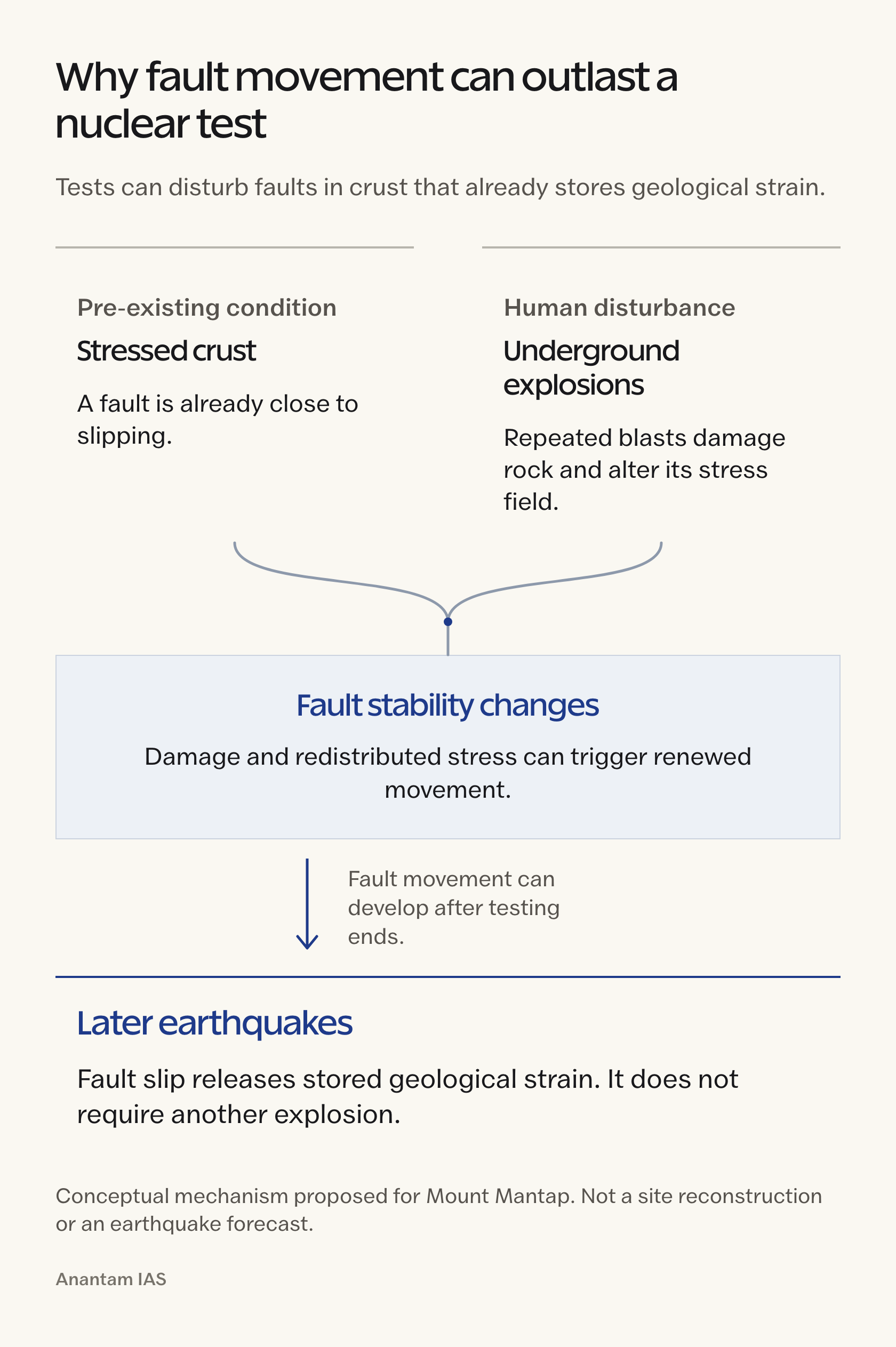
An earthquake releases stored strain when rocks slip; a human disturbance can change the conditions controlling that slip without creating all the underlying stress.
- A fault is a fracture, or fracture zone, with displacement between rock masses. A fault can remain quiet during an observation period while still forming a mechanically weak surface within stressed crust.
- Tectonic forces can load rocks even when a fault is not producing detected earthquakes. Friction and surrounding pressure resist movement, so the absence of recent shaking does not by itself demonstrate an unstressed fault.
- The researchers propose that repeated explosions progressively damaged shallow crust and changed its stress conditions. Such disturbance could bring faults already close to slipping into renewed activity, instead of requiring entirely new faults.
- In this interpretation, delayed reactivation means the seismic response develops after the initiating disturbance. It should not be described as explosive energy remaining underground for years before detonating again: later earthquakes involve fault movement.
- Induced seismicity describes the connection to human-caused changes, while the earthquake itself remains a physical rupture process. The distinction separates the trigger affecting fault stability from the geological system that stores and releases strain.
What the evidence permits us to conclude
The comparison is between a short-lived post-blast response and prolonged fault activity, not between a harmless test and a guaranteed future catastrophe.
- Many reported post-explosion sequences fade relatively quickly. Mount Mantap’s prolonged activity challenges an assumption that monitoring can end once the immediate response subsides; it does not replace geological assessment with a universal timetable.
- A recorded seismic event is not automatically evidence of another nuclear test. Investigators must examine its location, signal and surrounding sequence before attributing it to an explosion, fault slip or another underground process.
- A convincing causal interpretation combines when events occurred, where they clustered and a plausible physical mechanism. Temporal coincidence alone would be weaker evidence, particularly in a region where natural tectonic stress also exists.
- More frequent small earthquakes do not supply an exact prediction of the next damaging earthquake. Hazard assessment asks what could occur under stated conditions; prediction would require specifying an event’s timing, location and size.
- The findings also do not establish an impending volcanic eruption or quantify regional damage from a future event. Keep conclusions within the observed fault behaviour rather than turning uncertainty into unsupported alarm about neighbouring areas.
Way Forward
Monitor beyond the operational period
- Maintain long-term seismic records around former test sites, with consistent methods that allow changes before and after operations to be compared.
- Combine event locations and source analysis before classifying later tremors; avoid treating every detected event as a fresh explosion.
- Publish uncertainty and detection limits alongside findings so that monitoring supports risk assessment without implying exact earthquake prediction.
Conclusion
- Mount Mantap illustrates how human disturbance can reactivate an already stressed geological system long after an operation ends, making the duration of environmental effects different from the duration of the activity.
- For disaster-management analysis, distinguish the initiating disturbance, observed fault movement and uncertain future consequences. Continued monitoring is a defensible response; claims of a predictable catastrophe are not established by this research.
UPSC Practice Questions
Prelims MCQ 1
With reference to induced seismicity, consider the following statements:
- Human activities can change conditions controlling slip on an existing fault.
- A fault without recently detected earthquakes must be free of geological stress.
- A seismic event detected near a former nuclear test site necessarily proves a new nuclear explosion.
How many of the above statements are correct?
(a) Only one (b) Only two (c) All three (d) None
Answer: (a) Only one
Explanation:
Only the first statement is correct. A quiet fault can remain stressed, and a detected seismic event needs source analysis before it can be classified as an explosion.
Prelims MCQ 2
In the Mount Mantap study, earthquakes aligning along existing fault structures most directly support which interpretation?
(a) A nuclear explosion occurs each time a tremor is detected. (b) Renewed slip is organised along geological weaknesses. (c) The date of the next major earthquake is known. (d) A volcanic eruption is certain.
Answer: (b) Renewed slip is organised along geological weaknesses.
Explanation:
Spatial alignment along faults supports the interpretation of fault reactivation. It does not establish a new explosion, exact earthquake prediction or an impending eruption.
UPSC Mains Questions
- Explain how human activities can influence fault stability. Discuss the monitoring implications of delayed induced seismicity. (150 words)
- Distinguish scientific evidence of an observed hazard from prediction of a future disaster, using the Mount Mantap research as an example. (150 words)
Sources: Pusan National University research release and The Hindu, Science Snapshots.
Frequently Asked Questions
What is fault reactivation?
Fault reactivation is renewed movement along an existing geological fault. Human activity can alter stress conditions and influence this movement, although the surrounding rocks may already contain strain accumulated through natural processes.
What is new about the Mount Mantap research?
The study describes delayed and persistent earthquake activity after the final nuclear test in 2017. Events clustered along fault structures, supporting an interpretation of prolonged reactivation rather than only brief shaking after an explosion.
Does the research report a new nuclear test?
No. It analyses the consequences of earlier tests using regional seismic records. A later earthquake near a test site cannot automatically be classified as another explosion without examining its source characteristics.
Can this study predict the next major earthquake?
No. Observed changes in fault activity can inform monitoring and hazard assessment, but they do not provide an exact date, location and magnitude for a future damaging earthquake or establish an impending volcanic eruption.
Source: https://anantamias.com/current-affairs/mantap-nuclear-tests-delayed-fault-reactivation/
Methanol Regulation: Public Safety and Proportionate Restrictions
Why in News?
On 18 September 2026, the Supreme Court held Maharashtra’s challenged methanol rules unconstitutional in Balaji Formalin, finding the restrictions arbitrary and disproportionate to their public-safety purpose.
- Rules 18A and 18B restricted purchases, required colourant and bitterant before specified sales, and provided confiscation for possession without a Form A licence.
- The Court found violations of Articles 14 and 19(1)(g); its decision concerned these impugned rules, not the abolition of chemical-safety regulation.
- The judgment accepted preventing deaths from methanol-adulterated liquor as a legitimate objective, but rejected the particular means chosen to pursue it.
- Industrial methanol supports legitimate manufacturing, yet diversion into illicit liquor creates serious public-health risks that require effective enforcement.
- This dispute tests regulatory design: whether restrictions reach the source of harm without disabling lawful activity that does not cause that harm.
UPSC Relevance
Prelims Relevance
- Methanol is methyl alcohol; ethanol is ethyl alcohol, the alcohol in alcoholic beverages. They are not interchangeable.
- Article 14 constrains arbitrary state action, including subordinate legislation.
- Article 19(1)(g) protects occupation, trade and business, subject to reasonable restrictions under Article 19(6).
- Form A was the seller’s licence; Form B provided a permit route for purchasers under the existing framework.
- Proportionality examines legitimate aim, suitability, necessity and balancing.
Mains Relevance
GS Paper 2
- Judicial review of delegated legislation and proportionate restrictions on fundamental rights.
- Accountable licensing and coordination between enforcement, industry and health authorities.
GS Paper 3
- Chemical supply-chain oversight that protects public health while preserving legitimate industrial activity.
Essay
- A worthy public purpose cannot substitute for evidence that a policy works.
Background and Context
What the methanol rules required
The dispute concerned how Maharashtra controlled a poisonous industrial chemical, rather than whether the chemical should be regulated at all.
- Methanol is used in chemical manufacturing, including formaldehyde and related products. The judgment distinguishes this legitimate industrial demand from its diversion into illicit liquor, where it remains a dangerous poison rather than potable alcohol.
- Rule 18A(1) required a seller to establish the purchaser’s intended use by checking a Form A licence. But that licence covered selling or possessing poisons for sale, creating difficulty for downstream industrial consumers.
- Rule 18A(2) required colourant and bitterant before sale, with an exception for certified drug manufacture. The State argued that visible colour and unpleasant taste would help identify methanol and discourage its misuse in liquor.
- Rule 18B required confiscation when methanol was possessed without Form A. Yet the wider rules recognised purchasers holding Form B permits, so the new requirement undermined another lawful route for obtaining the same chemical.
- The industrial objection concerned altered feedstock quality, not a right to unsafe trade. Affidavits described colour contamination, catalyst damage and unacceptable downstream products when the mandatory additives entered manufacturing processes requiring suitable chemical purity.

How the Court applied proportionality
A legitimate objective begins constitutional scrutiny; it does not finish the inquiry into whether restrictions on a protected activity are justified.
- Legitimate aim: preventing deaths from adulterated liquor was unquestionably important. The Court expressly accepted methanol’s hazardous character and the need to regulate its sale and possession, rejecting any suggestion that toxicity was being overlooked.
- Suitability: the Court questioned whether the selected restrictions addressed diversion. Illicit suppliers could operate outside licensed sales, while the addition of colour and bitterness did not itself prevent methanol from entering illegal liquor production.
- Necessity: the State had not established the absence of equally effective, less restrictive alternatives. Existing sales records, stock registers and inspection powers offered ways to investigate diversion without compromising every legitimate industrial purchase.
- Balancing: the Court weighed continuing industrial burdens against uncertain identification benefits. Documented effects on product quality, equipment and production mattered because the State had not adequately demonstrated that these burdens would deliver the promised protection.
- Article 14 also required scrutiny of arbitrariness: a rule must connect rationally with its purpose. The Court found that treating a seller’s licence as proof of an industrial purchaser’s intended use did not work.
What the ruling changes, and what it does not
Read the operative holding separately from the judgment’s wider suggestions for preventing hooch tragedies and improving administration across States and Union Territories.
- The operative conclusion held the impugned rules unconstitutional. It did not invalidate the entire Poisons Act, erase every licensing requirement or authorise methanol’s use in drinks; the challenge concerned specific restrictions within an existing framework.
- Commercial inconvenience alone does not invalidate regulation. The Court acknowledged that fair and reasonable safeguards may impose costs; the constitutional defect arose from excessive burdens, internal inconsistencies and an insufficient connection between means and ends.
- Identification differs from prevention: an additive may make a substance noticeable, but accountable movement and stock records address where it goes. This distinction explains why the judgment favoured scrutiny of pilferage and diversion.
- Suggested reforms included closer licence scrutiny, reconciled consumption records, controlled handling of surplus stock and tamper-evident transport. These were matters for governments to examine, not proof that a uniform replacement regime already operates nationwide.
- Methanol and ethanol must remain distinct in an answer. The ruling addresses dangerous adulteration and industrial regulation; it neither declares beverage alcohol harmless nor establishes a consumer entitlement to drink poisonous industrial methanol.
Way Forward
Make diversion detectable
- Require stock reconciliation linking receipts, actual industrial consumption and closing balances, with unexplained shortages investigated instead of accepted as routine paperwork.
- Review licence and permit design so each category matches the activity authorised, including legitimate industrial consumption and any conditions needed to verify it.
- Assess transport and surplus-stock controls against actual diversion pathways, and publish clear responsibilities for inspection and enforcement.
- Prepare health-system emergency protocols alongside supply-chain enforcement; preventing diversion and responding to poisoning incidents require different administrative capabilities.
Conclusion
- Proportionality protects sound regulation: the State must connect its chosen controls to demonstrated risks, consider workable alternatives and justify the burden placed on legitimate activity rather than relying only on the importance of its objective.
- For an answer on public safety and economic freedom, use this case to separate the legitimacy of regulating a poison from the constitutionality of particular restrictions, and distinguish judicial suggestions from implemented administrative reforms.
UPSC Practice Questions
Prelims MCQ 1
With reference to the Supreme Court’s methanol judgment, consider the following statements:
- The Court accepted preventing deaths from adulterated liquor as a legitimate state aim.
- The Court abolished all licensing requirements governing methanol.
- The Court examined whether less restrictive alternatives could address diversion.
How many of the above statements are correct?
(a) Only one (b) Only two (c) All three (d) None
Answer: (b) Only two
Explanation:
Statements 1 and 3 are correct. The Court invalidated the impugned rules while affirming the legitimacy of methanol regulation; it did not abolish the entire licensing framework.
Prelims MCQ 2
Which issue best illustrates the inconsistency identified in Maharashtra’s methanol rules?
(a) A seller’s licence was treated as necessary even where the existing framework recognised a purchaser’s permit. (b) The rules exempted every industrial chemical from inspection. (c) Form B authorised consumption of methanol as a beverage. (d) The Poisons Act prevented States from regulating poisons.
Answer: (a) A seller's licence was treated as necessary even where the existing framework recognised a purchaser's permit.
Explanation:
Form A served sellers and possession for sale, while Form B supplied a permit route for purchasers. Requiring Form A indiscriminately undermined that distinction.
UPSC Mains Questions
- A legitimate public-safety objective does not automatically justify every regulatory restriction. Discuss with reference to the Supreme Court’s methanol judgment.
- How can States prevent diversion of hazardous industrial chemicals without imposing disproportionate restrictions on legitimate manufacturing?
Source: Supreme Court, Balaji Formalin judgment.
Frequently Asked Questions
What did the Supreme Court decide about methanol regulation?
It held the challenged Maharashtra rules unconstitutional under Articles 14 and 19(1)(g). The Court accepted the importance of regulating methanol but found these particular restrictions arbitrary and disproportionate.
Did the judgment make methanol safe or legal to drink?
No. Methanol remains a poisonous industrial chemical. The judgment concerned restrictions on legitimate industrial activity and expressly recognised the need to prevent its diversion into illicit liquor.
Why did the colourant and bitterant requirement fail?
The Court found that identification through additives did not adequately address illegal diversion, while harming industrial production. The State had not justified those burdens against less restrictive, potentially effective safeguards.
Are the suggested replacement controls already nationwide rules?
The judgment asked governments to examine measures including licensing scrutiny, stock reconciliation and transport supervision. These suggestions should not be described as an already implemented, uniform national replacement regime.
Source: https://anantamias.com/current-affairs/methanol-regulation-proportionality-industrial-use/
Monsoon Withdrawal: Why Retreat Can Coexist With Heavy Rain
Why in News?
The India Meteorological Department’s September 20 bulletin recorded southwest monsoon withdrawal from parts of western Rajasthan on September 19 while warning of heavy rainfall associated with a Bay of Bengal low-pressure system.
- Observed withdrawal: Retreat had begun in western Rajasthan; further withdrawal from adjoining areas was described as favourable, not already completed.
- Observed system: A low-pressure area lay over the eastcentral Bay of Bengal and adjoining north Andaman Sea on September 20.
- Forecast intensification: The bulletin expected a depression on September 21 and a deep depression on September 22; these remained forecasts in that release.
- Rainfall warning: Isolated extremely heavy rainfall was possible over south Odisha and north coastal Andhra Pradesh on September 23–24.
- Regional transition: Withdrawal from a dry northwestern sector does not end moisture-bearing circulation over the rest of the country.
- Risk communication: A seasonal retreat announcement must not override district rainfall warnings or the separate marine advisory for fishing operations.
UPSC Relevance
Prelims Relevance
- IMD criteria for southwest monsoon withdrawal
- Lower-tropospheric anticyclone and moisture reduction
- Bay of Bengal low-pressure systems
- Difference between observed weather and forecast development
- Spatial continuity of monsoon withdrawal
Mains Relevance
GS Paper 1
- Spatial differences during the retreat of the southwest monsoon.
GS Paper 3
- Translating rainfall and marine forecasts into local disaster preparedness.
Essay
- Public communication must distinguish a broad seasonal pattern from the immediate risks faced by individual communities.
Background and Context
Withdrawal is a circulation diagnosis
IMD identifies withdrawal through a combination of persistent weather conditions, rather than treating one rainless day as the end of the monsoon.
- For the first retreat from western northwest India, IMD’s criteria include five continuous days without rainfall. A brief dry spell alone does not establish that the seasonal circulation has withdrawn.
- A lower-tropospheric anticyclone must also become established. This circulation feature matters because a change in the atmospheric setting, rather than only a decline in recorded rainfall, helps distinguish retreat from temporary inactivity.
- Reduced atmospheric moisture provides another check, using satellite water-vapour imagery and atmospheric profiles. Together, these observations help establish whether the environment supporting widespread monsoon rain has weakened over the region being assessed.
- As withdrawal advances, IMD considers spatial continuity, dry weather and moisture reduction. The withdrawal line follows a regional transition; it cannot be reconstructed simply by picking isolated districts reporting little rain.
- The official withdrawal criteria also require a changed wind regime before retreat is declared complete across the country. An announcement covering western Rajasthan should never be read as a nationwide declaration that monsoon rainfall has ended.
Why a Bay system can still produce heavy rain
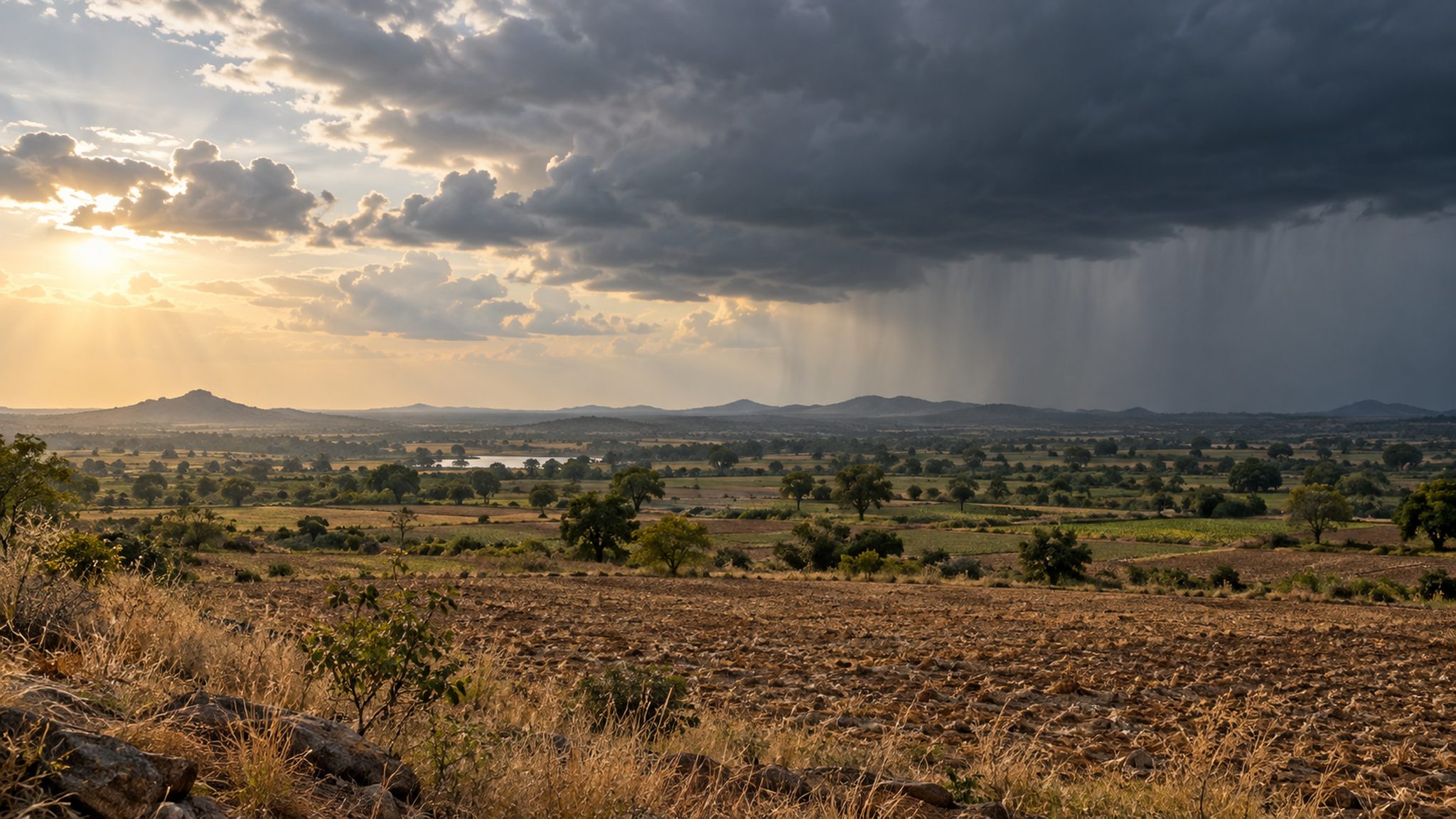
Northwestern drying and an active Bay of Bengal disturbance describe different atmospheric conditions operating across a large country at the same time.
- The Bay of Bengal low-pressure area was an observed system in the September 20 release. Associated circulations and troughs provided the weather setting for rainfall warnings across eastern, central and peninsular regions.
- Near a low-pressure system, converging moist air can rise, cool and form rain-bearing clouds. This regional mechanism can remain active while drier circulation establishes itself far away over parts of northwest India.
- The bulletin anticipated west-northwestward movement towards the north Andhra Pradesh–south Odisha coastal sector. Its forecast path helps explain the area of concern, but is not evidence that the projected movement had already occurred.
- Warnings also extended inland, including Chhattisgarh and Telangana. A Bay-origin disturbance is not exclusively a coastal hazard: rainfall associated with its circulation can affect inland catchments and communities as the system evolves.
- The useful comparison is northwestern withdrawal versus regional rainfall risk, not an all-India dry-versus-wet label. Different circulation regimes can coexist, so local forecasts remain necessary even after the first withdrawal announcement.
Read observations, forecasts and impacts separately
The date of an observed development and the time window of a forecast answer different questions and should remain separate in an exam answer.
- Withdrawal on September 19 was reported as an established development. The September 20 publication date identifies the bulletin, not a new date for the start of withdrawal; conflating them changes the factual timeline.
- Depression and deep-depression development were predicted stages in this bulletin. Do not convert them into an observed cyclone, name a storm, or claim landfall without a later authoritative update confirming the relevant development.
- Isolated extremely heavy rainfall describes a forecast intensity and distribution. It does not mean every location in a named state will receive that intensity, or that severe rain must persist throughout the forecast period.
- Flood consequences depend on where rain falls and the condition of the receiving landscape. Saturated catchments, blocked drainage and exposed settlements can turn a rainfall event into a more damaging local emergency.
- Marine and land warnings serve different decisions. A community may need preparations for heavy rain while fishing vessels must follow sea-condition restrictions; a general statement about monsoon retreat cannot safely substitute for either advisory.
Way Forward
Use the latest local warning for operational decisions
- District administrations: Match the latest rainfall window to vulnerable drainage routes and settlements, and prepare access restrictions where inundation would isolate people. Read local weather observations alongside these bulletins.
- Farmers: Use local agrometeorological advice to time harvesting, secure harvested produce and clear field drainage instead of assuming withdrawal means an uninterrupted dry spell.
- Fishing communities: Follow updated IMD marine warnings for the named sea areas and valid periods; check revisions before departure.
- Public communication: Label each statement as observed, forecast or recommended action, and retain its location and validity period when sharing alerts.
Conclusion
- Monsoon withdrawal is regional and progressive. It describes a changing circulation over a specified area, while active weather systems elsewhere can continue generating substantial rainfall and requiring local preparedness.
- Keep weather status separate from weather risk. In an answer, connect the withdrawal criteria to northwestern drying, explain the independent Bay-system mechanism, and preserve the distinction between observations and forecasts.
UPSC Practice Questions
Prelims MCQ 1
With reference to southwest monsoon withdrawal, consider the following statements:
- IMD considers persistent cessation of rainfall along with circulation and moisture conditions.
- Withdrawal from western Rajasthan automatically marks withdrawal from the entire country.
- Further withdrawal is assessed while maintaining spatial continuity.
How many of the above statements are correct?
(a) Only one (b) Only two (c) All three (d) None
Answer: (b) Only two
Explanation:
Statements 1 and 3 are correct. Withdrawal is regional and progressive; retreat from western Rajasthan does not establish complete withdrawal across India.
Prelims MCQ 2
Which best explains how monsoon withdrawal in northwest India can coexist with heavy rain farther east?
(a) Withdrawal immediately reverses winds uniformly across India. (b) Every monsoon low-pressure area ends when withdrawal begins. (c) A regional Bay of Bengal disturbance can sustain rainfall away from the withdrawn sector. (d) Withdrawal is declared solely from an all-India rainfall average.
Answer: (c) A regional Bay of Bengal disturbance can sustain rainfall away from the withdrawn sector.
Explanation:
Withdrawal concerns circulation and moisture over a specific region. A separate low-pressure system can sustain moist convergence and rainfall elsewhere.
UPSC Mains Questions
- Explain why the initial withdrawal of the southwest monsoon does not imply an immediate end to rainfall hazards across India.
- How should disaster-management authorities distinguish observed weather, forecast development and local impacts when communicating monsoon-transition risks?
Sources: IMD, September20 bulletin and IMD withdrawal criteria.
Frequently Asked Questions
What is monsoon withdrawal?
It is the progressive retreat of the southwest monsoon circulation from a region. IMD assesses persistent dry weather, circulation changes and reduced moisture rather than declaring withdrawal after a single rainless day.
Can heavy rain occur while the monsoon is withdrawing?
Yes. Withdrawal from one region can coexist with active weather systems elsewhere. A Bay of Bengal low-pressure disturbance may sustain rainfall over eastern or central India while northwestern areas become drier.
Did the September 20 bulletin confirm a cyclone?
No. It described an observed low-pressure area and forecast its intensification into a depression and deep depression. Predicted stages must not be presented as observed developments or as a confirmed cyclone.
Why does a local warning matter after withdrawal starts?
An initial withdrawal announcement covers a specified region. District rainfall warnings and marine advisories address immediate hazards in their own areas and valid periods, so they remain essential for operational decisions.
Source: https://anantamias.com/current-affairs/monsoon-withdrawal-regional-rainfall-warning/
SLINEX: Building Interoperability From Harbour to Sea
Why in News?
A Defence Ministry release on 20 September 2026 reported SLINEX underway at Visakhapatnam from 17 to 21 September, with harbour activities preceding a planned sea phase for Indian and Sri Lankan naval units.
- SLINEX is the India-Sri Lanka bilateral maritime exercise; the current programme combines professional engagement ashore or alongside with coordinated activities at sea.
- The announced Indian participants are INS Kavaratti, an indigenous anti-submarine warfare corvette, and INS Jyoti, a fleet tanker; Sri Lanka is represented by SLNS Sindurala.
- The harbour phase includes professional interactions, cross-deck visits and sharing of best practices, alongside sports, yoga and cultural activities.
- The release describes the sea phase prospectively. It does not confirm completion of particular tactical serials, live firing or anti-submarine drills.
- Maritime cooperation needs working relationships between crews as well as agreements between governments; an exercise helps connect diplomatic intent with operational preparation.
- Interoperability concerns the ability to work together despite different equipment and procedures, rather than requiring both navies to become identical.
UPSC Relevance
Prelims Relevance
- SLINEX: bilateral maritime exercise between India and Sri Lanka.
- Visakhapatnam: location of the current exercise.
- Harbour phase and sea phase: preparation and coordinated activity.
- Corvette and fleet tanker: different naval platform roles.
- Interoperability: practical ability of different forces to work together.
Mains Relevance
GS Paper 2
- Bilateral defence engagement as a practical component of India-Sri Lanka relations.
- Confidence building without treating cooperation as a military alliance.
GS Paper 3
- Operational coordination and logistical support in maritime security.
- The relationship between preparation, communication and safe execution at sea.
Essay
- Cooperation becomes credible when institutions can work together in practice.
Background and Context
Why preparation begins in harbour
The exercise sequence separates preparation from execution: crews first build familiarity before attempting coordinated activity in a less forgiving maritime environment.
- The harbour phase provides time for professional discussions and shared understanding before units go to sea. PIB confirms that this phase began under the Eastern Naval Command, including an opening engagement aboard INS Kavaratti.
- Cross-deck visits mean personnel visit one another’s ships. Their general value lies in seeing another crew’s working environment, equipment arrangements and routines, making later exchanges less dependent on assumptions about identical practices.
- Sharing best practices allows crews to explain how they approach common professional tasks. The point is mutual learning: a procedure familiar within one navy may need clarification before personnel from another navy can follow it.
- Personal familiarity complements formal preparation. Sports and cultural exchanges can make counterparts easier to approach, but they should not be presented as proof that communications, manoeuvres or other operational tasks have already been mastered.
- The planned sea phase moves cooperation into actual coordinated activity. However, the official release gives a broad objective rather than a detailed exercise schedule, so its specific manoeuvres and results should not be invented.
What interoperability means for ships and crews
Working together requires compatible actions, not identical fleets; the practical question is whether different units can understand and support a shared task.
- Interoperability is the ability of units from different forces to operate together effectively. In general, this requires understanding each other’s procedures and coordinating actions; participation in an exercise is practice toward that goal.
- Communication must produce a shared understanding of instructions and intentions. Different terminology or routines can create confusion, so preparation matters even when crews possess capable ships and experienced personnel within their own organisations.
- Coordination at sea involves timing actions while vessels remain in motion and conditions change. This explains why a harbour discussion and an at-sea activity serve complementary purposes, rather than being interchangeable forms of cooperation.
- The announced corvette and fleet tanker illustrate different platform roles: one is a combat vessel, while a tanker supports fuel supply. Their inclusion does not prove that a replenishment manoeuvre occurred during this exercise.
- Platform capability must be separated from the published activity list. Kavaratti’s anti-submarine role describes the ship; it is not evidence that SLINEX included a particular submarine hunt, weapon firing or classified tactical procedure.

Bilateral cooperation and its limits
SLINEX is best understood as recurring naval engagement between neighbouring countries, with operational learning as its central purpose rather than an automatic security guarantee.
- Bilateral format brings two navies into a shared programme. It allows focused professional engagement, but the existence of an exercise alone does not establish a mutual-defence obligation or commitment to join future conflicts.
- Mutual understanding can reduce avoidable uncertainty about a partner’s procedures. That is a practical contribution to cooperation, although lasting confidence also depends on the wider relationship and the conduct of both governments.
- Institutional continuity matters because personnel and platforms change. Recurring contact creates opportunities to renew familiarity, share lessons and practise working arrangements, rather than assuming knowledge gained by one participating crew automatically reaches every successor.
- Operational cooperation should be assessed through what participating units actually practise and learn. Announced intentions explain an exercise’s purpose; they cannot, by themselves, establish readiness for every emergency or prove a measured improvement in performance.
- The source supports a harbour-to-sea training sequence and the goal of improved interoperability. A careful account should retain that scope, without adding unsupported claims about completed combat drills, intelligence integration or permanent joint command.
Way Forward
Turn engagement into usable learning
- Professional exchanges should identify procedural differences before coordinated activity, giving crews time to clarify instructions and responsibilities.
- Post-exercise reviews should distinguish tasks attempted, problems encountered and lessons retained, rather than treating attendance as proof of operational success.
- Public reporting should separate planned and completed activities, while protecting sensitive details and avoiding claims that exceed the evidence.
- Distinguish bilateral naval practice from multilateral coordination forums such as the Colombo Security Conclave; their participants and working formats serve different purposes.
Conclusion
- SLINEX links preparation with practice: harbour interactions build familiarity, while coordinated activity at sea tests how different crews work together. The distinction explains interoperability more usefully than memorising the exercise’s edition number.
- Keep claims proportionate to the source. The release confirms the programme and its objectives, while describing the sea phase as forthcoming; it does not establish specific completed drills or a new alliance commitment.
UPSC Practice Questions
Prelims MCQ 1
With reference to SLINEX, consider the following statements:
- It is a bilateral maritime exercise between India and Sri Lanka.
- Its harbour phase can include professional interactions and cross-deck visits.
- Participation automatically creates a mutual-defence treaty obligation.
How many of the above statements are correct?
(a) Only one (b) Only two (c) All three (d) None
Answer: (b) Only two
Explanation:
Statements 1 and 2 are correct. An exercise provides professional cooperation; participation does not automatically establish a mutual-defence treaty.
Prelims MCQ 2
Which statement best explains naval interoperability?
(a) All participating navies must operate identical ships (b) Naval forces surrender their national command structures (c) Different naval units can coordinate and operate effectively together (d) Every maritime exercise requires live weapon firing
Answer: (c) Different naval units can coordinate and operate effectively together
Explanation:
Interoperability concerns effective cooperation across different forces, equipment and procedures. It does not require identical fleets, surrendered command or any particular firing activity.
UPSC Mains Questions
- Explain how harbour-phase interactions can support interoperability during bilateral naval exercises. (150 words)
- Discuss the contribution and limits of bilateral naval exercises as instruments of maritime cooperation between neighbouring states. (250 words)
Source: PIB, Ministry of Defence.
Frequently Asked Questions
What is SLINEX?
SLINEX is the bilateral maritime exercise between India and Sri Lanka. The current programme at Visakhapatnam brings naval units together for harbour activities followed by a planned sea phase to strengthen cooperation.
Why does a naval exercise include a harbour phase?
Harbour activities allow crews to interact, visit partner ships and exchange professional practices before coordinated activity at sea. They build familiarity, but do not by themselves prove that operational tasks have been mastered.
Does interoperability require identical ships?
No. Interoperability means different naval units can understand procedures and coordinate effectively. Fleets can retain different equipment and national structures while practising ways to work together on a shared task.
Does Kavaratti’s participation confirm anti-submarine drills?
No. PIB identifies Kavaratti as an anti-submarine warfare corvette, which describes its role. The release does not specify such drills, and a platform’s capability should not be mistaken for a confirmed exercise activity.
Source: https://anantamias.com/current-affairs/slinex-maritime-interoperability-harbour-sea/
What does Tulu’s new official language status mean?
Why in News ?
The Karnataka Cabinet, in a significant move on September 18 in Mangaluru, approved the grant of additional official (administrative) language status to the Tulu language.
UPSC Relevance
Prelims- Constitutional provisions in news
Tulu is an independent, Dravidian language spoken in coastal Karnataka (Dakshina Kannada, Udupi) and northern Kerala (Kasaragod). The Registrar General and Census Commissioner recognize Tulu speakers as a distinct linguistic community. Despite its cultural and historical significance, Tulu is classified as an “important non-scheduled language” and is NOT included in the Eighth Schedule of the Constitution of India.
Administrative Scope of Tulu as official language
- Geographical Jurisdiction: This status applies to the Dakshina Kannada district, southern Udupi district in Karnataka, and northern Kasaragod in Kerala.
- Administrative Implementation:
- Governance: Tulu will be utilized for administrative matters within Dakshina Kannada and Udupi.
- Legislative Participation: Elected representatives are authorized to speak Tulu in local government bodies, ranging from Gram Sabhas to City Corporations.
- Documentation: Government circulars and orders in these specific districts will be issued in Tulu.
- Citizen Engagement: Citizens have the right to submit applications to government departments in Tulu.
- Capacity Building: For officials unfamiliar with the language, the state will provide translations, professional translators, or basic language training.
- Financial Allocation: An annual budget of ₹82 lakh is designated for translation services, training modules, and general language implementation.
Statutory & Legislative Process Required
The transition from a Cabinet decision to legal reality requires specific statutory steps:
- Constitutional Basis: Under Article 345, State Legislatures are empowered to adopt regional languages for official purposes.
- Legislative Amendment: The Cabinet decision necessitates an amendment to Section 2 of the Karnataka Official Language Act, 1963, which currently recognizes only Kannada as the official language.
- Finalization: The amendment must be passed by the Karnataka Legislature and receive assent from the Governor before a final official notification is issued.
Constitutional Framework for States
- State Legislative Power (Article 345): The Legislature of a State may by law adopt any one or more of the languages in use in the State or Hindi as the language to be used for all or any of the official purposes of that State with the assent of the Governor.
- Role of the Governor:
- Judiciary (Article 348(2)): The Governor, with President’s consent, may authorize the use of Hindi or the state language in High Court proceedings (excluding judgments).
- Ordinances (Article 213): Power to issue language-related ordinances during legislative recess.
- Presidential Power (Article 347): If a substantial proportion of a state’s population desires their language to be recognized, the President may direct that such language shall also be officially recognized throughout that State or any part thereof.
CONSTITUTIONAL PROVISIONS ON LANGUAGES IN INDIA [ Part XVII ]
| Article | Provision | Details |
|---|---|---|
| Art. 343 | Official Language of the Union | Hindi in Devanagari script; numerals in international form. |
| Art. 344 | Commission on Official Language | President constitutes a commission at 5 and 10 years to monitor Hindi usage. |
| Art. 346 | Language for Communication | Governs Inter-state and State-Union communication (English is default). |
| Art. 348 | Language of Higher Judiciary | Mandates English for SC, HCs, and authoritative texts of Bills/Acts. |
| Art. 350 | Grievance Redressal | Right to submit representations in any language used in the Union/State. |
| Art. 350A | Primary Instruction | Facilities for instruction in mother tongue at the primary stage for minorities. |
| Art. 350B | Special Officer | Appointment of a Special Officer for Linguistic Minorities by the President. |
| Art. 351 | Hindi Promotion | Directive to the Union to develop and spread the Hindi language. |
Eighth Schedule & Scheduled Languages
The Eighth Schedule originally contained 14 languages in 1950. It now includes 22 officially recognized languages through various amendments:
- 21st Amendment Act, 1967: Added Sindhi.
- 71st Amendment Act, 1992: Added Konkani, Manipuri, and Nepali.
- 92nd Amendment Act, 2003: Added Bodo, Dogri, Maithili, and Santali.
- 96th Amendment Act, 2011: Renamed “Oriya” to “Odia”.
Practice MCQ
Q. Consider the following statements with reference to the Tulu language and the official language provisions under the Constitution of India:
- Tulu is recognized as an independent language by the Registrar General and Census Commissioner, but it is currently a non-scheduled language not included in the Eighth Schedule of the Constitution.
- Article 345 empowers a State Legislature to adopt any regional language spoken in the State as an additional official language, without requiring any statutory amendment to state-level acts.
- Under Article 347, the Governor of state can direct the official recognition of a language across a State or part of it if a substantial proportion of the population demands it.
Which one of the following conclusions based on the above statements is correct?
a. All three statements are correct.
b. There is no correct statement.
c. There are two correct statements that include statement 3.
d. There is only one correct statement.
Answer : D
Source: https://anantamias.com/current-affairs/what-does-tulus-new-official-language-status-mean/
India’s NGOs at a New Funding Crossroads
Why in News ?
Foreign Contribution Regulations Act Amendment Bill, 2026 has raised apprehension among civil society groups.
UPSC Relevance
Prelims- laws and Provisions in news
Mains,
GS2, Development Processes and the Development Industry — the Role of NGOs, SHGs, various groups and associations, donors, charities, institutional and other stakeholders.
Enacted to shield sovereign democracy from covert external influences, the Foreign Contribution (Regulation) Act (FCRA) forms a national security shield. However, its tightening regulatory grip creates friction with civil society’s operational independence, testing the constitutional balance between state security and a vibrant democracy.
Author’s observations on FCRA
- Political Continuity: FCRA passed in 1976 under a different political regime, yet underlying apprehensions remain the same—fear that foreign powers could destabilize India through NGOs.
- Unstated Religious Concerns: Unstated government fears persist regarding foreign-funded religious conversions, particularly targeting Christian and minority communities.
- Government Rationale: The government argues foreign funds form an opaque web bypassing state accounting to finance politically charged advocacy, campaigns, and proselytisation ( the act of trying to persuade someone to change their religious faith, political views, or way of life ).
- Declining Active Registrations: FCRA registrations dropped by 22,496 since 2015, leaving only 14,466 active associations eligible by September 2026.
Trends in Domestic philanthropy
- Wealth Expansion: India ranks 3rd globally with 229 billionaires (Forbes 2026 list).
- Private Giving: Domestic philanthropy projected at ₹1.43 lakh crore ($16 billion) in FY25; retail giving adds ~₹37,000 crore annually.
- Projections & Funding Gap: Demand outstrips supply, with the philanthropic gap projected at ₹18 lakh crore ($210 billion) by 2030.
- Shift in Priorities: Modern tech philanthropists prioritize ecosystem building, scientific research, and higher education over traditional health/education sectors.
- CSR Mandate: Corporate Social Responsibility under Companies Act, 2013 provided ₹22,563 crore in FY25 (up 17.5%), offering traditional NGOs vital partnership opportunities.
Significance of Foreign Funding
- Financial Scale: Foreign funding totals remain significantly higher compared to 2006–07 figures (₹12,289.6 crore from private international donors).
- Flexibility & Tailored Support: Foreign funding is uniquely valuable because it is flexible, has fewer restrictions, and aligns directly with specific NGO operational needs.
- Developmental Contributions: Historically introduced essential innovation, tech, modern organizational models, and ideas when domestic philanthropy and state budgets fell short.
- Need for Funding Diversity : A healthy democracy requires a vibrant, multi-funded civil society independent of any single funding source.
- Declining Foreign Aid: Global donors are withdrawing due to home economic stresses and the perception that India (aiming for 3rd largest economy status) no longer requires foreign aid.
FCRA Act & Key Provisions
Objective & Mandate – Central legislation to regulate foreign contributions/hospitality, ensuring foreign money does not compromise national security, democratic processes, or public interest.
Evolution of Amendments
- FCRA, 1976: Enacted during the Emergency period to prevent foreign interference in domestic political and electoral processes.
- FCRA, 2010: Replaced the 1976 Act to consolidate regulations regarding foreign hospitality and contributions, introducing a mandatory 5-year validity for registration certificates.
- FCRA Amendment Act, 2020: Introduced major structural changes, including capping administrative expenses, banning sub-granting/transfer of funds, and mandating specific bank accounts (SBI Main Branch, New Delhi) for foreign contribution receipt.
- FCRA Amendment Bill, 2026 (Proposed): Seeks to further tighten control over unmonitored capital and introduces strict provisions regarding the vesting of assets created via foreign contributions if an FCRA registration lapses or is cancelled.
Core Provisions
- Dual Eligibility Channels: Registration (5-year validity for established NGOs) or Prior Permission (project/donor-specific).
- Mandatory SBI Account: Primary receipts restricted strictly to SBI Main Branch, New Delhi.
- Prohibition on Fund Transfer: Total ban on sub-granting/transferring foreign funds to other entities (even FCRA-registered ones).
- Administrative Spending Cap: Restricted to 20% of total foreign receipts.
- Mandatory Biometric ID: Aadhaar/Passport identification required for key functionaries.
- Absolute Prohibitions (Section 3) – Election candidates, journalists/media houses, judges, public servants, MPs/MLAs, and political parties are strictly barred from receiving foreign contributions.
Proposed Legislation & NGO Concerns (FCRA Amendment Bill, 2026)
- Asset Vesting: Cancelled, surrendered, or lapsed FCRA certificates lead to immediate vesting of foreign contributions and assets in a government-appointed “designated authority”.
- Asset Recovery vs. Sale: Organizations can recover assets if registration is restored within a stipulated timeframe; otherwise, assets are permanently vested, sold, or transferred to government departments (proceeds credited to Consolidated Fund of India).
- Judicial Remedy: Provides for revision and appeal before the District Judge.
- Grassroots Impact: Threatens non-religion-neutral application; severe disruption to schools, hospitals, and old-age homes in vulnerable regions (e.g., Northeast and tribal areas).
Supreme Court Judgments, Committee Recommendations on NGO Autonomy
- Noel Harper v. Union of India (2022): Foreign aid is a statutory privilege, not a fundamental right (Art 19). Upheld ban on fund transfers and mandatory SBI Delhi account citing sovereign economic security.
- INSAF v. Union of India (2020): Peaceful advocacy, public agitations, and democratic criticism do not automatically make an NGO an “organisation of political nature” under FCRA.
- Law Commission (154th/255th Reports): Proportionality in penalties; procedural delays must not cause automatic license cancellations or asset seizures.
- 2nd Administrative Reforms Commission (ARC): Shift from “control/inspectorate” model to self-regulation; single-window clearance portal (NITI Aayog Darpan / FCRA / 12A, Income Tax Act).
- Joint Parliamentary Committee (2026): Timely processing of asset vesting; protection of social/religious identity of community assets during government takeover.
Way Forward – Balanced Reforms for Civil Society Independence
- Stakeholder Dialogue: Constructive engagement needed between NGOs and domestic donors to address operational dissatisfaction.
- Clear Definitions: Statutory clarity for ambiguous terms like “public interest” to prevent arbitrary executive action.
- Tiered Sub-Granting: Allow monitored, digital-trail sub-granting to support small grassroots rural NGOs.
- Statutory Appeal Mechanism: Independent administrative appellate tribunal for FCRA dispute resolution.
- Co-Regulation: Voluntary self-regulatory bodies working alongside state oversight.
- Adopting Best Practices: Domestic donors and state bodies must learn from foreign funding models (flexibility, dialogue, efficiency).
- Indigenous Generosity: Domestic philanthropy must form the core foundation of civil society, treating foreign aid as “cherry on the cake”.
Practice MCQ
Consider the following statements with reference to the Foreign Contribution (Regulation) Act (FCRA) and civil society regulation in India:
- Receiving foreign contribution is a fundamental right under Article 19(1)(a) and Article 19(1)(g) for non-governmental organizations registered under the Act.
- Registered organizations are strictly prohibited from transferring or sub-granting foreign contributions to any other entity, even if the recipient entity holds a valid FCRA registration.
- Primary foreign contributions received by any registered association must be deposited exclusively into a designated account in the State Bank of India (Main Branch), New Delhi.
Which one of the following conclusions based on the above statements is correct?
a. All three statements are correct.
b. There is no correct statement.
c. There are two correct statements that include statement 3.
d. There is only one correct statement.
Correct Option: C
Practice Question
“While regulatory oversight under the Foreign Contribution (Regulation) Act (FCRA) is essential to safeguard national security and state accounting, excessive central control risks squeezing civil society institutions and disrupting welfare delivery.” Critically examine. (15 Marks, 250 Words)
Source: https://anantamias.com/current-affairs/indias-ngos-at-a-new-funding-crossroads/
Northeast’s largest power project initiated in Assam
Why in News?
The foundation stone for a 3200 MW Ultra-Supercritical Thermal Power Plant (USTPP) was laid at Chapar in Dhubri district, Assam. The project is expected to become the Northeast’s largest power plant upon completion, with phased commissioning planned from December 2030.
The project is part of a broader ₹63,000-crore power investment in Assam, including two pumped-storage projects with a combined capacity of 2700 MW.
| UPSC Relevance: GS-3 Economy: Energy infrastructure Prelims: Thermal power technology; pumped storage projects |
Key features of the Project:
- Developer: Adani Power Limited.
- Location: Chapar, Dhubri district, Assam
- Capacity: 3200 MW or 3.2 GW
- Investment: Approximately ₹48,000 crore
- Technology: Coal-based ultra-supercritical power generation.
- Wider power investment: The plant forms part of a ₹63,000-crore investment package, also covering two pumped storage projects with a combined capacity of 2700 MW.
What is an Ultra-Supercritical Thermal Power Plant?
- An ultra-supercritical (USC) plant is an advanced thermal power plant that uses very high steam temperatures and pressures to generate electricity more efficiently.
- Its basic working is the same as that of a conventional coal plant: Coal is burned → water is heated → steam drives a turbine → the turbine runs a generator → electricity is produced. The steam is then cooled back into water and reused.
Understanding Supercritical plants:
Water’s critical point is approximately 374°C and 22.1 MPa (Mega Pascal pressure). Above both these conditions, liquid water and steam are no longer clearly distinguishable.
- Subcritical plants operate below the critical pressure.
- Supercritical plants operate above the critical pressure.
- Ultra-supercritical plants use higher steam temperatures and demanding pressure conditions to improve efficiency.
Why does this matter?
- Higher efficiency means more electricity from the same quantity of coal, or less coal for the same electricity output.
Evolution of coal-based thermal power technology
| Parameter | Subcritical | Supercritical (SC) | Ultra-supercritical (USC) | Advanced ultra-supercritical (AUSC) |
| Steam pressure | Below 22.1 MPa | Above 22.1 MPa | Typically 25-30 MPa | Generally 30-35 MPa |
| Steam temperature | Around 535-540°C | Around 540-580°C | Around 600-620°C | Around 700-760°C |
| Indicative efficiency | 33-38% | 38-42% | 42-45% | 46-48% targeted |
| Coal use and CO₂ per unit of electricity | Relatively high | Lower | Further reduced | Expected to be lowest among these technologies |
| Materials | Conventional boiler and turbine steels | Improved heat-resistant steels | High-performance steels and alloys | Advanced alloys, including nickel-based alloys |
| Status | Established; common in older plants | Commercially established | Commercially established | Development and demonstration ongoing |
India’s technological initiative: BHEL, NTPC and IGCAR have collaborated on indigenous AUSC technology. The Ministry of Heavy Industries cites a 46% efficiency target, with approximately 11% lower coal consumption and CO₂ emissions than supercritical plants.
Significance for Assam and the Northeast:
- Strengthening energy security: The project can help meet rising household, commercial and industrial electricity demand. Its contribution will depend on reliable coal supply, timely commissioning and sufficient transmission capacity.
- Supporting industrial development: Reliable electricity can support food processing, cold storage, manufacturing and local enterprises, improving the region’s attractiveness for investment.
- Generating employment and business opportunities: Construction and operation can create opportunities for workers, contractors, transporters and suppliers. Local recruitment, skill development and procurement will determine the extent of regional benefits.
- Complementing hydropower: The Northeast has substantial hydropower potential, but generation can vary with seasonal water availability. Thermal generation can help diversify supply, while storage can balance fluctuations.
- Improving fuel efficiency: USC technology requires less coal per unit of electricity than an otherwise comparable subcritical plant. This can reduce fuel requirements, ash generation and CO₂ emissions intensity.
Role of the accompanying pumped storage projects
- A pumped storage project is an energy-storage system that stores energy by moving water between reservoirs at different heights.
- When surplus electricity is available, water is pumped uphill.
- During peak demand, water flows downhill through turbines to generate electricity.
- Benefits: Meeting peak demand, balancing solar and wind generation, and supporting grid stability.
Major concerns:
- Continued dependence on coal: Higher efficiency reduces emissions per unit, but the plant will still emit substantial CO₂. A long-lived coal asset also creates a risk of continued fossil-fuel dependence.
- Air pollution and fly ash: Coal combustion produces particulate matter, sulphur dioxide, nitrogen oxides and ash. USC technology does not replace the need for dedicated emissions controls and safe ash management.
- Water demand and ecological impacts: Cooling and other operations require water. Water withdrawal, wastewater and heated discharges can affect local water availability and aquatic ecosystems.
- Displacement and livelihood loss of families for the project.
- Financial and logistical risks: Construction delays, cost overruns, coal-transport requirements and changing electricity demand can affect viability.
The Chapar project could improve electricity availability and support the Northeast’s industrial development. Its success will depend on combining efficient generation with reliable delivery, local economic benefits and strong environmental and social safeguards.
Prelims Practice MCQ
Q. Consider the following statements:
- Ultra-supercritical technology can reduce coal consumption per unit of electricity compared with a conventional subcritical plant.
- Pumped storage plants consume electricity while pumping water uphill.
Which statements are correct?
(a) 1 only
(b) 2 only
(c) Both 1 and 2
(d) Neither 1 nor 2
Answer: (c)
Source: https://anantamias.com/current-affairs/northeasts-largest-power-project-initiated-in-assam/
Copyright Stakes in the India-EU FTA
Why in News?
The India-EU Free Trade Agreement (FTA) negotiations concluded in January 2026, and the European Commission has published the negotiated texts. The FTA contains a dedicated Intellectual Property (IP) Chapter (Chapter 10).
The copyright provisions of the FTA have raised concerns about their possible impact on education, research, libraries and Internet services in India. However, the agreement will not automatically amend India’s Copyright Act 1957.
| UPSC Relevance: GS-2 International Relations: International groupings; GS-3 Science and Technology: Intellectual Property Rights Prelims: India’s Copyright Act, 1957; WIPO Copyright Treaty Mains: Intellectual property rights, digital economy and innovation |
What is the core issue?
- India’s Copyright Act, 1957 protects creators while allowing certain uses of their works without permission, for example, specified educational activities, research and library preservation.
- The editorial argues that the FTA could strengthen copyright enforcement without adequately safeguarding these public-interest exceptions.
Key Legal Concepts Defined:
- National Treatment Clause: A foundational rule in international trade. It requires a country to treat foreign citizens and businesses the same as its own domestic citizens. In this context, it means foreign copyright owners should get the same rights and protections as Indian copyright owners.
- WIPO Copyright Treaty (WCT):
- An international treaty that protects copyright in the digital environment. It covers computer programs, qualifying databases, online communication of works and protection against interference with digital safeguards.
- WCT also recognises the need to balance authors’ rights with education, research and access to information. It includes guidelines for both protecting digital content and allowing exceptions for public interest (like teaching or research).
- Technological Protection Measures (TPMs) / Digital Locks: Software or encryption used by creators to stop people from copying or accessing digital content (e.g., password protections, digital rights management or DRM).
- Rights-Management Information (RMI): Digital data attached to a work that identifies the creator, copyright owner, and terms of use (e.g., digital watermarks).
The Main Concerns Explained:
1. Imbalance of Power (Stronger enforcement, fewer safeguards):
- The draft FTA explicitly protects digital locks and RMI. This makes it much easier for copyright owners to block access to their digital material and legally punish anyone who tries to bypass these locks.
- However, the agreement does not give equal clarity to the “safeguards”- the rules that protect the public’s right to use material.
2. The Exclusion of the WIPO Copyright Treaty (WCT):
- Because the WCT is excluded from the National Treatment clause, the balanced framework is not fully integrated into the treaty’s equal-treatment rules. This creates an imbalance:
- The FTA strongly enforces the restrictive parts of copyright law.
- The FTA does not give clarity about the legal protections for exceptions that India’s domestic laws currently guarantee.
3. Threats to Public Interest Exceptions
- Indian copyright law currently has “fair dealing” exceptions that allow students, researchers, libraries, and software developers to use copyrighted material without paying or getting permission.
- The fear is that under the new FTA, a foreign company could use digital locks to block a student or researcher, and Indian law might not have the clear authority to stop them.
This structural imbalance directly threatens Section 65A of India’s Copyright Act, 1957, which deals with TPMs. Section 65A(2) provides exceptions under which technological protection can be circumvented, particularly for the purposes permitted therein. 65A(2) acts as a crucial safety valve, ensuring that technical restrictions do not completely block legitimate, lawful activities such as education, research, software testing, and library preservation that are already permitted under Indian copyright law.
| What protections does Indian law provide? India’s Copyright Act, 1957 contains several conditional exceptions, rather than a general exemption for every educational or research activity: Fair dealing Section 52(1)(a): Permits specified uses, including private or personal use involving research, criticism, review and reporting current events; computer programs are treated separately. Education Section 52(1)(i): Covers reproduction by a teacher or pupil in the course of instruction and specified examination uses. Software study and interoperability Sections 52(1)(ab) and (ac): Permit specified activities to understand software and enable independently created programs to work together. Libraries Section 52: Allows specified preservation and copying activities by non-commercial public libraries. Temporary digital storage Section 52(1)(b) and (c): Protect specified transient or incidental storage involved in electronic transmission and access. Digital locks Section 65A: Makes circumvention punishable when undertaken with the intention of infringing copyright, while preserving specified lawful activities. These provisions help ensure that copyright supports both creative production and the wider use of knowledge. |
Core Impact Areas:
1. Education & Research:
- The Risk: Digital locks can block teachers and students from accessing or copying portions of e-books and online journals.
- The Consequence: Users face heavy dependence on expensive extra licenses for actions otherwise legally permitted for classroom instruction.
2. Software Innovation:
- The Risk: Broad bans on bypassing digital locks restrict developers from studying existing software code.
- The Consequence: Fear of litigation discourages legitimate software testing, security research, and building compatible (interoperable) programs.
3. Libraries & Archives:
- The Risk: Technical restrictions can legally block libraries from copying protected digital collections.
- The Consequence: Staff cannot migrate files out of obsolete formats, causing digital content to become permanently unreadable.
4. Internet Service Providers (ISPs)
- The Risk: Internet routing automatically creates temporary digital copies in computer memory and network caches.
- The Consequence: Without clear exceptions for these routine technical operations, ISPs face high compliance costs and increased lawsuit risks.
Judicial Precedent: The Delhi University Photocopy Case (2016)
- The Precedent: This landmark case affirmed the strength of India’s educational exceptions (Section 52(1)(i)), ruling that copying for instructional use does not constitute copyright infringement.
- The Limitation: While it protects legitimate teaching and research, it does not grant blanket permission to copy entire works or bypass digital locks indiscriminately.
Way Forward:
- Preserve WCT-consistent flexibility: India should seek clarity that the FTA does not prevent the country from maintaining limitations and exceptions recognised under its Copyright Act and compatible with international obligations.
- Reconcile enforcement with exceptions: Anti-circumvention and rights-management provisions should operate alongside, rather than override, legitimate statutory exceptions.
- Protect legitimate research: Exceptions for interoperability, software testing, cybersecurity research and education should remain legally effective even in a DRM-dominated environment.
- Safeguard digital intermediaries: The treatment of transient and incidental copies should be clearly aligned with India’s statutory framework so that routine Internet operations do not generate disproportionate copyright liability.
- Protect libraries and archives: Copyright policy should recognise the special requirements of digital preservation, format-shifting and archival access, subject to safeguards against commercial misuse.
- Maintain parliamentary policy space: Any international commitment should preserve Parliament’s ability to calibrate copyright law in response to technological change, educational needs and public interest.
- Establish a continuing India-EU copyright dialogue: A dedicated mechanism for discussing emerging issues such as AI training, text-and-data mining, digital preservation, cybersecurity research and generative AI would help prevent future conflicts between trade commitments and domestic digital policy.
Copyright exceptions must apply to certain special cases, avoid conflict with the work’s normal exploitation, and avoid unreasonable prejudice to the rightsholder’s legitimate interests. This test already appears in TRIPS Article 13 and WCT Article 10.
India should use the FTA to strengthen protection for creators while keeping lawful education, research and preservation accessible.
Prelims Practice MCQ
Q. With reference to digital copyright, consider the following statements:
- Technological Protection Measures may restrict access to or copying of digital works.
- The WIPO Copyright Treaty allows appropriate limitations and exceptions in the digital environment.
- Every educational use of a copyrighted work is exempt from copyright liability in India.
Which statements are correct?
(a) 1 and 2 only
(b) 2 and 3 only
(c) 1 and 3 only
(d) 1, 2 and 3
Answer: (a). Educational exceptions under Indian law have a defined scope and conditions.
Mains Practice Question:
Q. How can India balance copyright protection with access to education and research in the digital age? Discuss in the context of its trade agreements.
Source: https://anantamias.com/current-affairs/copyright-stakes-in-the-india-eu-fta/
Missing measure in India’s Magnet Mission: India’s Rare-Earth Magnet Strategy
Why in News?
China’s export controls on rare-earth materials and magnets in 2025 exposed the vulnerability of industries ranging from automobiles to defence. China accounted for about 60% of global mined production of magnet rare earths, 91% of refined output and 94% of sintered permanent-magnet production in 2024.
For India, the issue is not merely access to rare-earth ore. The larger challenge is developing capabilities across the entire value chain— from mining and separation to metals, alloys and finished magnets. The editorial identifies this measurement and capability gap through the proposed Integrated Techno-Economic Mapping (ITEM) framework.
| UPSC Relevance: GS-1 Geography: Distribution of key natural resources and their utilisation; GS-3 Economy: Critical minerals, industrial policy, manufacturing Prelims: Rare-earth elements, permanent magnets, government initiatives |
What are rare-earth permanent magnets?
- Rare-earth elements (REEs) comprise 17 elements: 15 lanthanides, scandium and yttrium. Many are relatively abundant, but economically recoverable concentrations and their separation are challenging.
- Permanent magnets retain their magnetic properties without continuous external electricity.
- Among them, Ferrite and Alnico magnets do not require rare earth elements.
- Neodymium-Iron-Boron (NdFeB) and Samarium-Cobalt (SmCo) magnets require rare earth elements. NdFeB magnets are particularly important because they combine very high magnetic strength with a high power-to-weight ratio.
- Applications: EV traction motors, certain wind-turbine generators, industrial robots, precision equipment, electronics and aerospace systems.
Why are they strategically important?
- Clean-energy security: Dependence on imported magnets can constrain domestic EV and wind-energy manufacturing.
- Industrial competitiveness: A relatively small component can interrupt production of much higher-value vehicles and machinery.
- Defence preparedness: Reliable supplies support precision actuators, sensors and aerospace equipment.
- Geoeconomic vulnerability: For magnet rare earths, China accounted for approximately 60% of global mining and 91% of separation/refining in 2024. Its share of rare-earth permanent-magnet manufacturing was around 94%. This shows how dominance intensifies downstream.
India’s resource advantage and its limits:
- India has approximately 13.15 million tonnes of monazite containing 7.23 million tonnes of in-situ rare-earth oxides, distributed across coastal and inland deposits, including Odisha, Andhra Pradesh, Tamil Nadu and Kerala.
- Separately, GSI has identified 482.6 million tonnes of rare-earth-bearing ore resources. This is an ore figure, not an equivalent quantity of recoverable rare-earth metals.
However, resource availability does not establish commercial viability.
- The production sequence explains why: Exploration → mining → mineral processing → chemical separation → individual oxides → metals → alloys → finished magnets → industrial applications.
- Each stage requires distinct technologies, equipment and skills. Consequently, securing deposits can still leave India dependent on foreign separation technology, alloys or finished magnets.
Major Bottlenecks in India’s Magnet Ecosystem (Key concerns raised by the Editorial):
- India’s magnet economy is inadequately measured: India’s Annual Survey of Industries estimates the domestic permanent magnet market at around ₹750 crore. But international trade statistics indicate import values several times larger. Policymakers lack data about how many magnets India produces, imports and consumes and which industries use them, including magnets embedded in imported motors and machinery.
- Mineral availability is being confused with technological self-reliance: Possessing rare-earth deposits or acquiring mines overseas does not automatically create the ability to manufacture high-performance magnets. India may secure raw materials but remain dependent on foreign capabilities for separation, refining, metallisation, alloy-making or magnet manufacturing. Resource security is only one part of industrial security.
- The intermediate stages receive insufficient attention:
- Policy discussions often focus on the two ends of the chain: mineral resources and finished magnets. However, the intervening stages require different technologies, equipment, skills and quality standards.
- India already possesses capabilities across several stages. But there is no comprehensive assessment to show which capabilities are globally competitive, which need scaling up, and which require technology partnerships.
Without examining these stages individually, policy may overlook the particular bottleneck that prevents domestic resources from becoming usable industrial products.
- Commercial-scale technological gaps: High-purity separation, metallisation, alloying and consistent magnet quality require specialised expertise.
- Incomplete information can misdirect investment: Without identifying the binding constraints, incentives may expand one stage while another remains unable to supply the required inputs.
Integrated Techno-Economic Mapping (ITEM):
The editorial proposes ITEM as a framework to map industrial capabilities and strategic dependencies at every stage of the permanent-magnet value chain, from mineral extraction to finished magnets. The framework will combine engineering capabilities with economic and trade data.
It would examine:
- Stage-wise capabilities: What can India produce domestically, at what scale, and to which quality standards?
- Critical bottlenecks: Where do gaps in separation, refining, alloy-making or magnet manufacturing constrain the entire chain?
- Hidden dependencies: Does domestic manufacturing rely on imported intermediate materials, equipment or technology?
- Commercial viability: Can domestic production meet industry requirements at competitive costs?
- Investment priorities: Which gaps should be addressed through domestic investment, R&D, technology partnerships or diversified imports?
E.g., India may possess rare-earth deposits and magnet-making facilities but lack sufficient capacity to convert oxides into high-purity metals. ITEM would identify this intermediate bottleneck and help direct support towards metallisation.
Thus, it would enable targeted industrial policy, helping ensure that spending on mines and factories translates into a functioning, resilient supply chain.
Major Government Initiatives:
- National Critical Mineral Mission (NCCM): Approved in 2025 for 2024-25 to 2030-31, with ₹16,300 crore expenditure and ₹18,000 crore expected investment by PSUs and others. It covers critical minerals’ exploration, processing, overseas sourcing, recycling and technological development. Its components include: 1200 exploration projects through GSI. Overseas acquisition of critical-mineral assets through entities such as Khanij Bidesh India Limited (KABIL), etc.
- Sintered Rare Earth Permanent Magnets (REPM) Manufacturing Scheme: Approved in 2025 with ₹7280 crore outlay, targeting 6000 tonnes annually of integrated manufacturing capacity. Support includes ₹6450 crore sales-linked incentives and ₹750 crore capital subsidy, covering conversion from oxides to metals, alloys and magnets.
- Rare-Earth Corridors: Budget 2026-27 announced corridors in Odisha, Kerala, Andhra Pradesh and Tamil Nadu, connecting mining, processing, research and manufacturing.
- Recycling support: A ₹1500-crore incentive scheme under NCMM supports recovery of critical minerals from secondary sources.
- Mineral diplomacy: KABIL and international partnerships support diversified sourcing. Its five lithium blocks in Argentina illustrate overseas asset acquisition, although lithium assets do not directly resolve rare-earth magnet dependence.
Way Forward:
India needs a whole-of-value-chain strategy rather than a mineral-extraction strategy.
- Map the entire value chain through ITEM-style techno-economic mapping and improve statistical classification of rare-earth products.
- Prioritise separation, refining and alloy production, rather than focusing disproportionately on mining or final assembly.
- Operationalise the ₹7280-crore REPM scheme with incentives linked to actual integrated output and technological performance.
- Diversify international supply through KABIL, overseas acquisitions and strategic partnerships, particularly for heavy rare earths.
- Build a magnet-recycling ecosystem with material-specific recovery targets.
- Promote R&D into material efficiency and substitutes, including rare-earth-free motor technologies; the government’s PLI-Auto framework already recognises rare-earth magnets and alternative motor technologies as relevant areas.
- Strengthen environmental safeguards, as rare-earth processing can generate chemical waste and wastewater.
- Develop skilled manpower and specialised R&D in metallurgy, separation chemistry, materials science and magnet engineering.
India’s magnet strategy will succeed when mineral resources translate into reliable, competitive and environmentally responsible industrial capability. Mapping dependence at every production stage is essential to directing investment effectively.
Prelims Practice MCQ:
Q. Consider the following statements:
- All permanent magnets contain rare-earth elements.
- A country with substantial rare-earth resources may still depend on imported finished magnets.
- Rare Earth Permanent Magnets (REPM) Manufacturing scheme seeks to establish an integrated value chain rather than merely assemble finished magnets.
Which statements are correct?
(a) 1 and 2 only
(b) 2 and 3 only
(c) 1 and 3 only
(d) 1, 2 and 3
Answer: (b). Ferrite and Alnico magnets do not require rare earths. Mineral resources alone do not ensure downstream manufacturing capability.