
Why in News?
China’s export controls on rare-earth materials and magnets in 2025 exposed the vulnerability of industries ranging from automobiles to defence. China accounted for about 60% of global mined production of magnet rare earths, 91% of refined output and 94% of sintered permanent-magnet production in 2024.
For India, the issue is not merely access to rare-earth ore. The larger challenge is developing capabilities across the entire value chain— from mining and separation to metals, alloys and finished magnets. The editorial identifies this measurement and capability gap through the proposed Integrated Techno-Economic Mapping (ITEM) framework.
| UPSC Relevance: GS-1 Geography: Distribution of key natural resources and their utilisation; GS-3 Economy: Critical minerals, industrial policy, manufacturing Prelims: Rare-earth elements, permanent magnets, government initiatives |
What are rare-earth permanent magnets?
- Rare-earth elements (REEs) comprise 17 elements: 15 lanthanides, scandium and yttrium. Many are relatively abundant, but economically recoverable concentrations and their separation are challenging.
- Permanent magnets retain their magnetic properties without continuous external electricity.
- Among them, Ferrite and Alnico magnets do not require rare earth elements.
- Neodymium-Iron-Boron (NdFeB) and Samarium-Cobalt (SmCo) magnets require rare earth elements. NdFeB magnets are particularly important because they combine very high magnetic strength with a high power-to-weight ratio.
- Applications: EV traction motors, certain wind-turbine generators, industrial robots, precision equipment, electronics and aerospace systems.
Why are they strategically important?
- Clean-energy security: Dependence on imported magnets can constrain domestic EV and wind-energy manufacturing.
- Industrial competitiveness: A relatively small component can interrupt production of much higher-value vehicles and machinery.
- Defence preparedness: Reliable supplies support precision actuators, sensors and aerospace equipment.
- Geoeconomic vulnerability: For magnet rare earths, China accounted for approximately 60% of global mining and 91% of separation/refining in 2024. Its share of rare-earth permanent-magnet manufacturing was around 94%. This shows how dominance intensifies downstream.
India’s resource advantage and its limits:
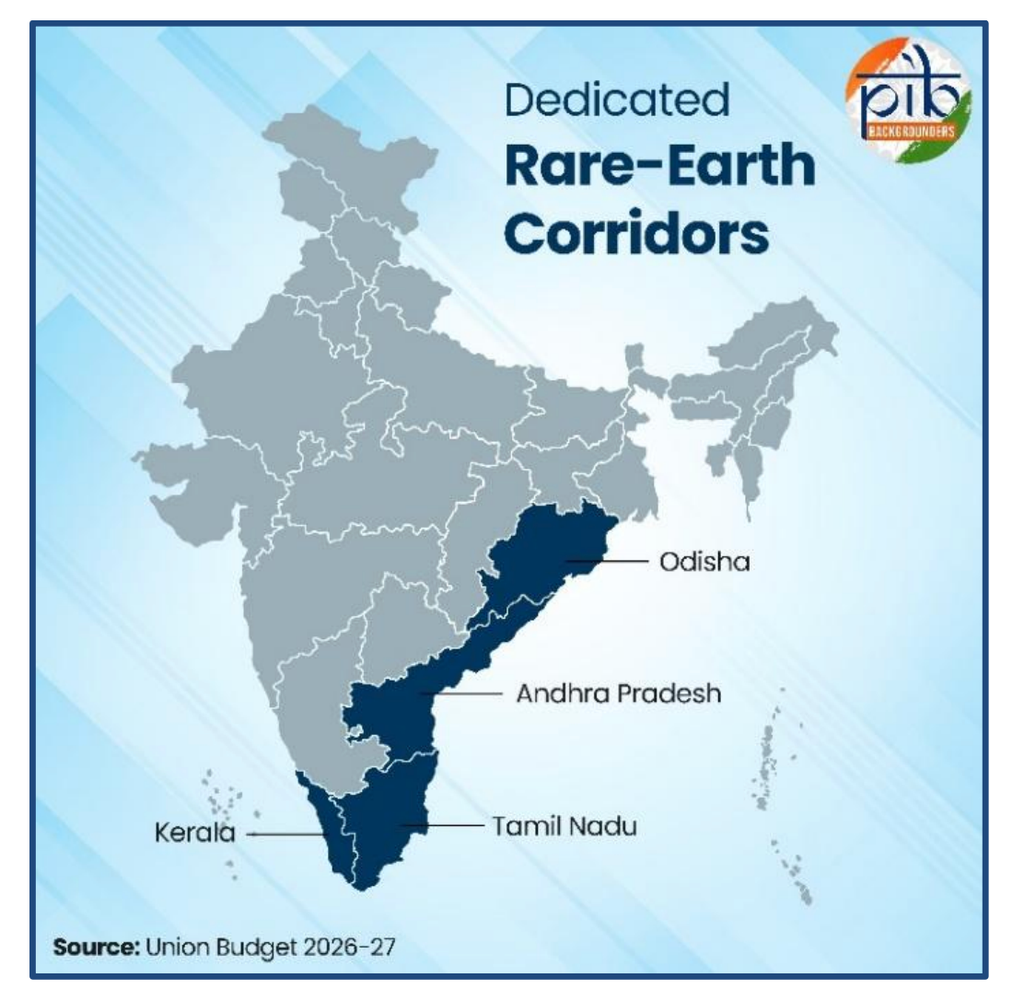
- India has approximately 13.15 million tonnes of monazite containing 7.23 million tonnes of in-situ rare-earth oxides, distributed across coastal and inland deposits, including Odisha, Andhra Pradesh, Tamil Nadu and Kerala.
- Separately, GSI has identified 482.6 million tonnes of rare-earth-bearing ore resources. This is an ore figure, not an equivalent quantity of recoverable rare-earth metals.
However, resource availability does not establish commercial viability.
- The production sequence explains why: Exploration → mining → mineral processing → chemical separation → individual oxides → metals → alloys → finished magnets → industrial applications.
- Each stage requires distinct technologies, equipment and skills. Consequently, securing deposits can still leave India dependent on foreign separation technology, alloys or finished magnets.
Major Bottlenecks in India’s Magnet Ecosystem (Key concerns raised by the Editorial):
- India’s magnet economy is inadequately measured: India’s Annual Survey of Industries estimates the domestic permanent magnet market at around ₹750 crore. But international trade statistics indicate import values several times larger. Policymakers lack data about how many magnets India produces, imports and consumes and which industries use them, including magnets embedded in imported motors and machinery.
- Mineral availability is being confused with technological self-reliance: Possessing rare-earth deposits or acquiring mines overseas does not automatically create the ability to manufacture high-performance magnets. India may secure raw materials but remain dependent on foreign capabilities for separation, refining, metallisation, alloy-making or magnet manufacturing. Resource security is only one part of industrial security.
- The intermediate stages receive insufficient attention:
- Policy discussions often focus on the two ends of the chain: mineral resources and finished magnets. However, the intervening stages require different technologies, equipment, skills and quality standards.
- India already possesses capabilities across several stages. But there is no comprehensive assessment to show which capabilities are globally competitive, which need scaling up, and which require technology partnerships.
Without examining these stages individually, policy may overlook the particular bottleneck that prevents domestic resources from becoming usable industrial products.
- Commercial-scale technological gaps: High-purity separation, metallisation, alloying and consistent magnet quality require specialised expertise.
- Incomplete information can misdirect investment: Without identifying the binding constraints, incentives may expand one stage while another remains unable to supply the required inputs.
Integrated Techno-Economic Mapping (ITEM):
The editorial proposes ITEM as a framework to map industrial capabilities and strategic dependencies at every stage of the permanent-magnet value chain, from mineral extraction to finished magnets. The framework will combine engineering capabilities with economic and trade data.
It would examine:
- Stage-wise capabilities: What can India produce domestically, at what scale, and to which quality standards?
- Critical bottlenecks: Where do gaps in separation, refining, alloy-making or magnet manufacturing constrain the entire chain?
- Hidden dependencies: Does domestic manufacturing rely on imported intermediate materials, equipment or technology?
- Commercial viability: Can domestic production meet industry requirements at competitive costs?
- Investment priorities: Which gaps should be addressed through domestic investment, R&D, technology partnerships or diversified imports?
E.g., India may possess rare-earth deposits and magnet-making facilities but lack sufficient capacity to convert oxides into high-purity metals. ITEM would identify this intermediate bottleneck and help direct support towards metallisation.
Thus, it would enable targeted industrial policy, helping ensure that spending on mines and factories translates into a functioning, resilient supply chain.
Major Government Initiatives:
- National Critical Mineral Mission (NCCM): Approved in 2025 for 2024-25 to 2030-31, with ₹16,300 crore expenditure and ₹18,000 crore expected investment by PSUs and others. It covers critical minerals’ exploration, processing, overseas sourcing, recycling and technological development. Its components include: 1200 exploration projects through GSI. Overseas acquisition of critical-mineral assets through entities such as Khanij Bidesh India Limited (KABIL), etc.
- Sintered Rare Earth Permanent Magnets (REPM) Manufacturing Scheme: Approved in 2025 with ₹7280 crore outlay, targeting 6000 tonnes annually of integrated manufacturing capacity. Support includes ₹6450 crore sales-linked incentives and ₹750 crore capital subsidy, covering conversion from oxides to metals, alloys and magnets.
- Rare-Earth Corridors: Budget 2026-27 announced corridors in Odisha, Kerala, Andhra Pradesh and Tamil Nadu, connecting mining, processing, research and manufacturing.
- Recycling support: A ₹1500-crore incentive scheme under NCMM supports recovery of critical minerals from secondary sources.
- Mineral diplomacy: KABIL and international partnerships support diversified sourcing. Its five lithium blocks in Argentina illustrate overseas asset acquisition, although lithium assets do not directly resolve rare-earth magnet dependence.
Way Forward:
India needs a whole-of-value-chain strategy rather than a mineral-extraction strategy.
- Map the entire value chain through ITEM-style techno-economic mapping and improve statistical classification of rare-earth products.
- Prioritise separation, refining and alloy production, rather than focusing disproportionately on mining or final assembly.
- Operationalise the ₹7280-crore REPM scheme with incentives linked to actual integrated output and technological performance.
- Diversify international supply through KABIL, overseas acquisitions and strategic partnerships, particularly for heavy rare earths.
- Build a magnet-recycling ecosystem with material-specific recovery targets.
- Promote R&D into material efficiency and substitutes, including rare-earth-free motor technologies; the government’s PLI-Auto framework already recognises rare-earth magnets and alternative motor technologies as relevant areas.
- Strengthen environmental safeguards, as rare-earth processing can generate chemical waste and wastewater.
- Develop skilled manpower and specialised R&D in metallurgy, separation chemistry, materials science and magnet engineering.
India’s magnet strategy will succeed when mineral resources translate into reliable, competitive and environmentally responsible industrial capability. Mapping dependence at every production stage is essential to directing investment effectively.
Prelims Practice MCQ:
Q. Consider the following statements:
- All permanent magnets contain rare-earth elements.
- A country with substantial rare-earth resources may still depend on imported finished magnets.
- Rare Earth Permanent Magnets (REPM) Manufacturing scheme seeks to establish an integrated value chain rather than merely assemble finished magnets.
Which statements are correct?
(a) 1 and 2 only
(b) 2 and 3 only
(c) 1 and 3 only
(d) 1, 2 and 3
Answer: (b). Ferrite and Alnico magnets do not require rare earths. Mineral resources alone do not ensure downstream manufacturing capability.
Tell Google you want more of this.
Add Anantam IAS as a preferred sourceOne tap, and this site shows up more often in your own Top Stories, AI Overviews and AI Mode. Remove it any time.