Why in News?
The Indian Express reported on September 20 that the Indian Army plans six AASHVAST laboratories for mandatory drone firmware inspections, with CCTV equipment envisaged for later coverage.
- One Delhi laboratory had already been inaugurated on August 14; at least five more are planned, so six laboratories are not yet operational.
- AASHVAST expands to Assessment and Analysis of Electronic Systems Hardware for Vulnerabilities and Security Threats.
- The report identifies QuickPay Pvt Ltd as the suite developer for the Directorate General of Electronics and Mechanical Engineering.
- The developer describes checks for hidden commands and location-sensitive failures; these are attributed capability claims, not proof that every vulnerability can be detected.
- A drone can pass a normal flight demonstration while its embedded software contains behavior that appears only under another condition.
- An invoice establishes a transaction, but does not independently establish component origin or the absence of hidden software functions.
UPSC Relevance
Prelims Relevance
- Firmware: software embedded in electronic equipment that controls device functions.
- UAV: an unmanned aerial vehicle, whose reliability depends on hardware and software.
- Supply-chain assurance: evidence about suppliers, components, software and their changes.
- AASHVAST: an Army initiative for vulnerability assessment, initially focused on drones.
Mains Relevance
GS Paper 3
- Cybersecurity risks in defence procurement and embedded systems.
- Balancing domestic manufacturing with verifiable supply-chain assurance.
Essay
- Technological self-reliance requires verifiable trust, not merely domestic assembly.
Background and Context
What firmware testing adds to a flight demonstration
A working drone is not automatically a trustworthy drone: performance and cybersecurity ask different questions about the same machine.
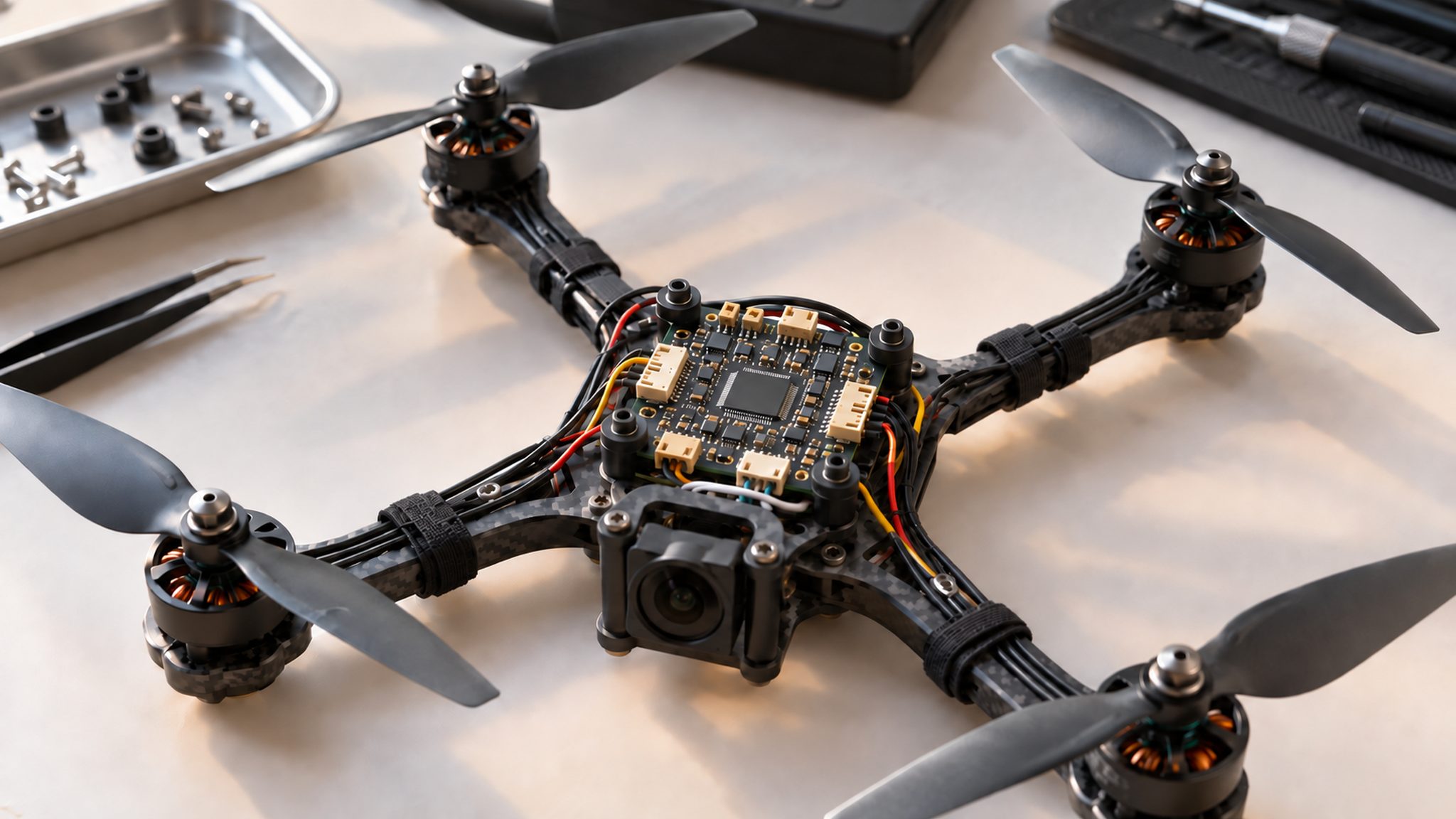
- Firmware operates close to a device’s hardware, translating instructions into actions such as communication and control. A defect here can affect operation even when the outer frame and visible components appear sound.
- A functional test asks whether the drone completes a specified task under observed conditions. Passing it cannot establish how the device will behave at every other location, time or configuration encountered later.
- The developer told The Indian Express that conditional behavior could include hidden commands or location-linked failures. These examples explain the testing objective; they are not independently verified findings about every drone being procured.
- Vulnerability analysis examines software behavior and possible weaknesses rather than relying only on visible performance. Its findings depend on what inspectors can access, the methods used and the conditions their checks actually cover.
- A software update can change the code after an earlier inspection. Confidence in one tested version should not automatically transfer to a different version, even if the supplier and device name remain unchanged.
Why procurement documents and technical checks answer different questions
Supply-chain trust needs several kinds of evidence because paperwork, physical components and executable code reveal different parts of a product’s history.
- An invoice identifies a seller and a purchase, but a distributor can sell components manufactured elsewhere. The country of purchase cannot by itself settle the country of manufacture or the underlying technology’s origin.
- Physical inspection helps relate the delivered equipment to its declared components. It is a different task from establishing what embedded software does, and neither task becomes unnecessary because the product is assembled domestically.
- The report says project participants want to examine active components, embedded keys and remote-access tools. Their concern links procurement assurance with cybersecurity, but does not establish a demonstrated capability to determine everything inside silicon.
- A foreign-origin component is not automatically malicious, just as a domestic label is not a security guarantee. The analytical question concerns access, behavior, supplier accountability and the evidence available for assessing risk.
- Self-reliance is stronger when buyers can scrutinise and maintain the equipment they acquire. Replacing an import without understanding its software can relocate assembly while leaving important dependencies and vulnerabilities insufficiently examined.
What the expansion establishes, and what remains unproven
The reported laboratory expansion is an institutional response to risk, not a certification that all supplied systems are already secure.
- The Delhi facility is the existing starting point; the other proposed laboratories represent intended expansion. Reporting a nationwide plan must not turn future facilities into completed infrastructure or an announced inspection into a finished assessment.
- CCTV screening is described as eventual coverage, whereas drones are the initial focus. Extending scrutiny to another equipment class requires relevant testing capability; its inclusion in the plan does not establish completed camera inspections.
- Detection limits matter because a clean result only addresses the checks performed on the submitted equipment. Undiscovered defects, inaccessible code or later modifications can leave residual risk even after a careful technical review.
- Cyber assurance is also distinct from resilience against every battlefield threat. Firmware scrutiny cannot by itself demonstrate that a drone will withstand all radio interference, navigation disruption, physical damage or adverse operating conditions.
- A credible assurance record should identify the tested device, its software version, findings and unresolved limitations. This makes the result usable for procurement decisions without presenting laboratory inspection as a universal guarantee of operational success.
Way Forward
Make inspection evidence usable throughout service
- Require traceable component declarations and preserve the link between each tested configuration and the equipment delivered.
- Specify retesting triggers for firmware updates and relevant hardware substitutions, with responsibility for correcting discovered weaknesses.
- Separate verified findings from supplier claims and record unresolved limits so procurement officers can judge residual risk.
Conclusion
- AASHVAST highlights a useful distinction: buying a product, observing it work and examining its embedded code provide different forms of assurance. None should be mistaken for complete knowledge of the system.
- For defence procurement, connect self-reliance with verifiable technical access, accountable suppliers and continued scrutiny after updates. The laboratory plan is significant because it addresses an assurance gap, not because it eliminates uncertainty.
UPSC Practice Questions
Prelims MCQ 1
With reference to assurance of military drones, consider the following statements:
- The country shown on a purchase invoice necessarily establishes the manufacturing origin of every component.
- A firmware update can change the software configuration previously inspected.
- Passing a functional test does not establish the absence of every hidden software behavior.
How many of the above statements are correct?
(a) Only one (b) Only two (c) All three (d) None
Answer: (b) Only two
Explanation:
Statements 2 and 3 are correct. A purchase invoice can identify a seller without independently establishing the manufacturing origin of every component.
Prelims MCQ 2
Which measure best preserves the relevance of a laboratory assessment after procurement?
(a) Treating a domestic assembly label as a permanent security guarantee (b) Replacing technical inspection with the purchase invoice (c) Linking findings to the tested version and reassessing relevant changes (d) Assuming every imported component is malicious
Answer: (c) Linking findings to the tested version and reassessing relevant changes
Explanation:
An assessment concerns a particular configuration. Relevant software or hardware changes can alter its security properties and justify renewed scrutiny.
UPSC Mains Questions
- Why are functional demonstrations and procurement invoices insufficient for cybersecurity assurance of defence equipment? Discuss with reference to firmware inspection.
- Examine the relationship between technological self-reliance and supply-chain transparency in military procurement. What limits should accompany claims of technical assurance?
Source: The Indian Express.
Frequently Asked Questions
What is AASHVAST?
AASHVAST is an Army initiative for assessment of electronic-system vulnerabilities. The Indian Express reports that its laboratory network will initially inspect drones, with CCTV equipment envisaged for later coverage.
Are all six AASHVAST laboratories operational?
No. The report identifies one inaugurated laboratory in Delhi and plans for at least five more. The network expansion should be distinguished from facilities that are already operational.
Why can a flight test miss firmware weaknesses?
A flight test observes performance under particular conditions. Embedded software may behave differently after an update or under another location, time or configuration, so observed performance cannot establish universal software trustworthiness.
Does a foreign component necessarily pose a malicious threat?
No. Origin alone does not establish malicious behavior. Assessments need evidence about the component, software, supplier and access arrangements; a domestic label likewise cannot serve as an automatic security guarantee.
Tell Google you want more of this.
Add Anantam IAS as a preferred sourceOne tap, and this site shows up more often in your own Top Stories, AI Overviews and AI Mode. Remove it any time.