Why in News?
The Hindu on 21 September 2026 reported Science research linking North Korea’s underground nuclear tests at Mount Mantap to delayed, persistent earthquake activity.
- The Science study, published on 17 September, examined regional seismic records spanning 2008–2025.
- Following the final nuclear test in 2017, local earthquake activity persisted and intensified over subsequent years.
- Earthquake locations aligned along two fault structures, supporting the researchers’ interpretation of delayed fault reactivation.
- The development concerns new research on old tests, not evidence that North Korea conducted another nuclear explosion today.
- The case connects human activity, stored geological stress and the need for monitoring beyond the end of an industrial or military operation.
UPSC Relevance
Prelims Relevance
- Mount Mantap: mountain above North Korea’s Punggye-ri nuclear test site.
- Fault: a fracture or zone of fractures along which rocks have moved.
- Induced seismicity: earthquake activity associated with changes caused by human operations.
- Fault reactivation: renewed slip on an existing fault.
- Seismic monitoring: recording ground motion to investigate earthquake timing, location and source characteristics.
Mains Relevance
GS Paper 1
- Fault movement and the relationship between crustal stress and earthquakes.
GS Paper 3
- Long-term environmental consequences of underground nuclear testing.
- Monitoring human-induced hazards while communicating uncertainty responsibly.
Essay
- The environmental consequences of a decision may outlast the activity that caused them.
Background and Context
What the Mount Mantap research found
The significant finding is the persistence of fault activity after testing ended, rather than the immediate shaking produced by a blast.
- Punggye-ri lies beneath Mount Mantap in North Korea. Its underground nuclear tests disturbed surrounding rock, making the area a useful case for examining whether human interventions leave a lasting seismic response.
- The researchers used regional seismic recordings from China and South Korea to reconstruct local earthquake activity. Records extending before and after the final test allowed them to examine how the pattern changed over time.
- The study identified a delayed increase after the 2017 explosion, followed by activity continuing through 2025. This is different from simply detecting an explosion’s waves travelling outward immediately after detonation.
- Earthquakes concentrated along two fault structures rather than appearing as an entirely scattered cloud. Their spatial organisation matters because locations can help reveal whether an existing geological structure is repeatedly slipping.
- The authors interpret this pattern as fault reactivation associated with repeated nuclear explosions. The finding concerns a local, observed sequence; it does not establish that every underground test produces the same delayed response.
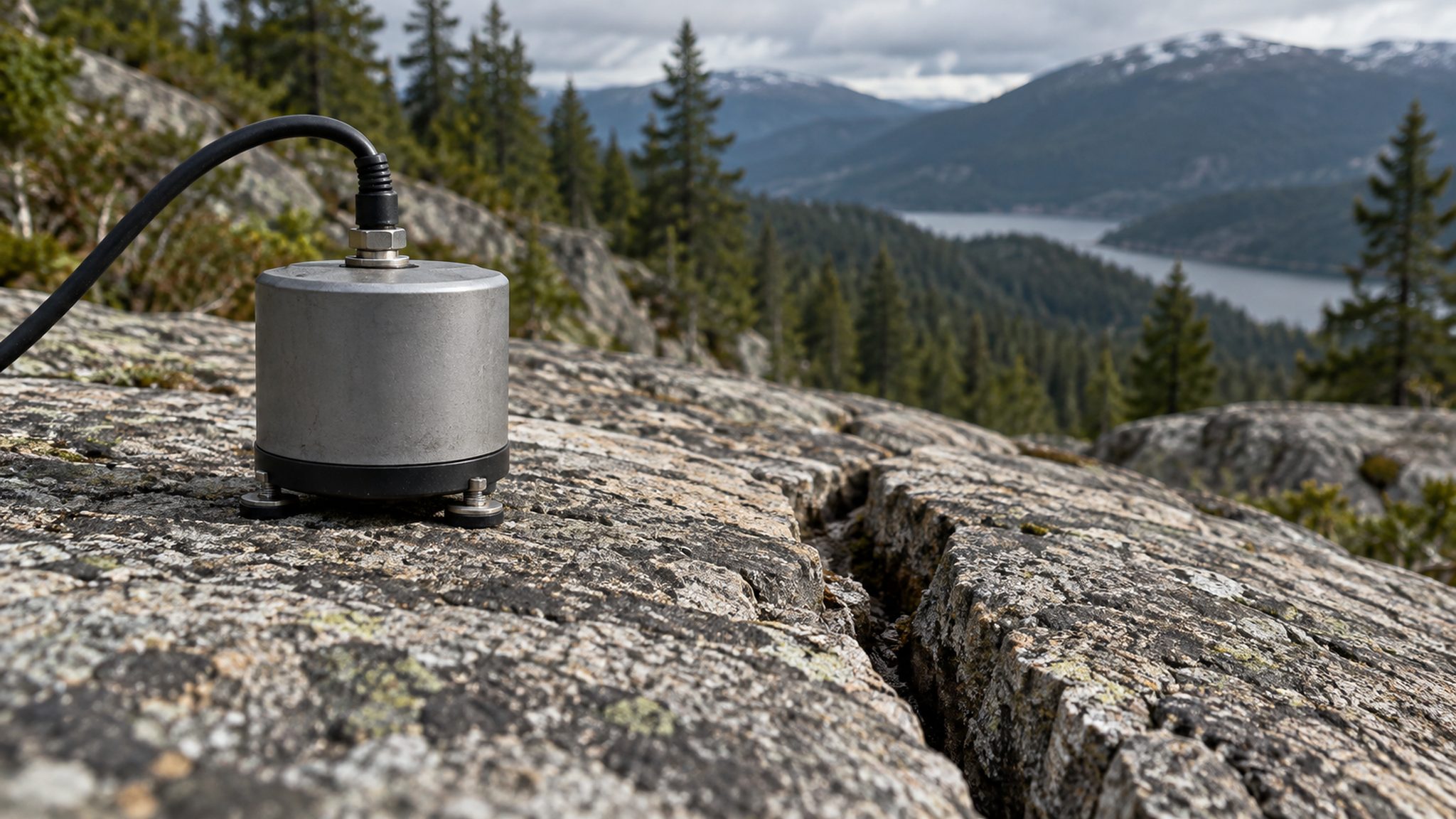
How a disturbance can trigger later fault slip
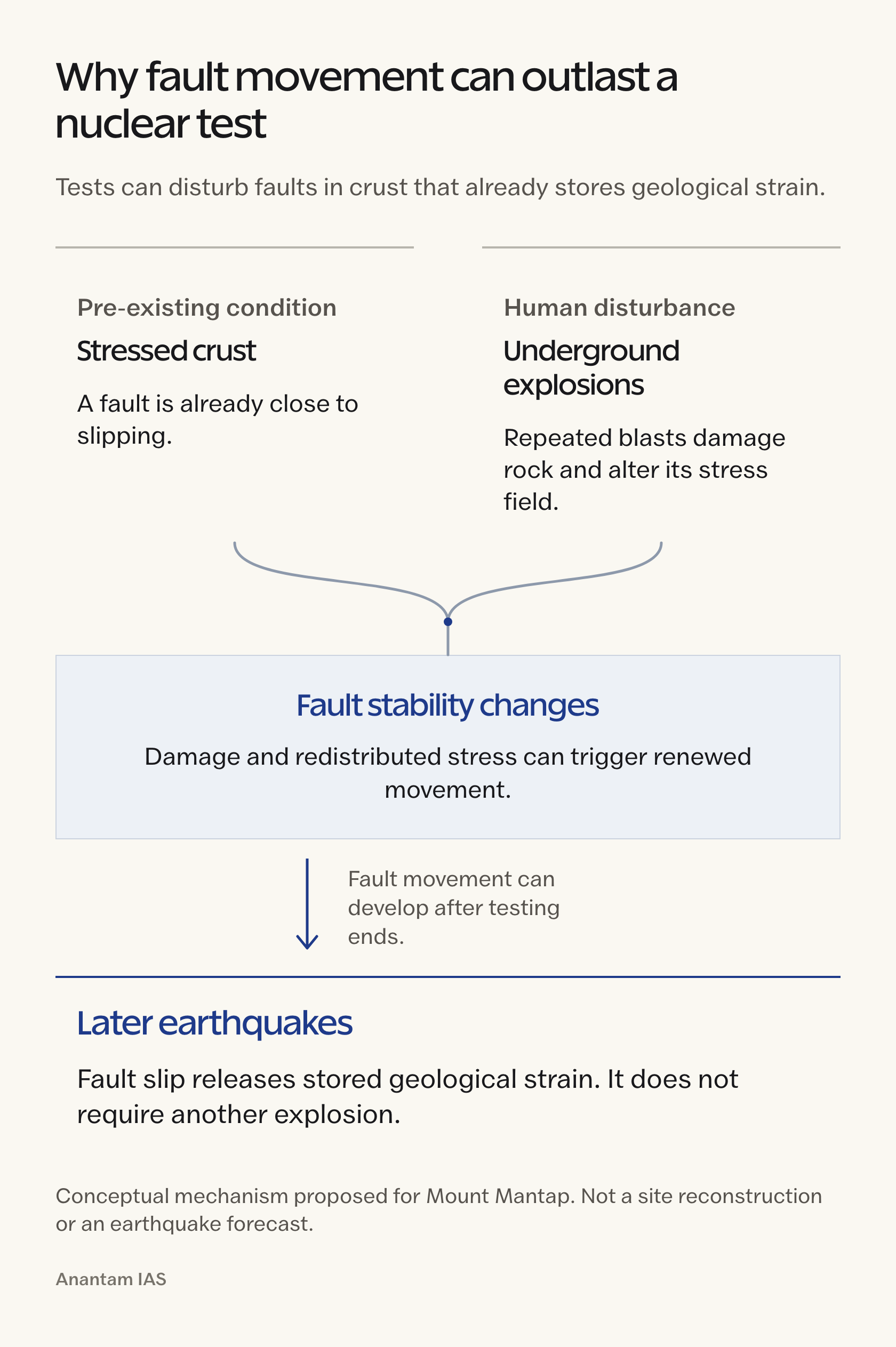
An earthquake releases stored strain when rocks slip; a human disturbance can change the conditions controlling that slip without creating all the underlying stress.
- A fault is a fracture, or fracture zone, with displacement between rock masses. A fault can remain quiet during an observation period while still forming a mechanically weak surface within stressed crust.
- Tectonic forces can load rocks even when a fault is not producing detected earthquakes. Friction and surrounding pressure resist movement, so the absence of recent shaking does not by itself demonstrate an unstressed fault.
- The researchers propose that repeated explosions progressively damaged shallow crust and changed its stress conditions. Such disturbance could bring faults already close to slipping into renewed activity, instead of requiring entirely new faults.
- In this interpretation, delayed reactivation means the seismic response develops after the initiating disturbance. It should not be described as explosive energy remaining underground for years before detonating again: later earthquakes involve fault movement.
- Induced seismicity describes the connection to human-caused changes, while the earthquake itself remains a physical rupture process. The distinction separates the trigger affecting fault stability from the geological system that stores and releases strain.
What the evidence permits us to conclude
The comparison is between a short-lived post-blast response and prolonged fault activity, not between a harmless test and a guaranteed future catastrophe.
- Many reported post-explosion sequences fade relatively quickly. Mount Mantap’s prolonged activity challenges an assumption that monitoring can end once the immediate response subsides; it does not replace geological assessment with a universal timetable.
- A recorded seismic event is not automatically evidence of another nuclear test. Investigators must examine its location, signal and surrounding sequence before attributing it to an explosion, fault slip or another underground process.
- A convincing causal interpretation combines when events occurred, where they clustered and a plausible physical mechanism. Temporal coincidence alone would be weaker evidence, particularly in a region where natural tectonic stress also exists.
- More frequent small earthquakes do not supply an exact prediction of the next damaging earthquake. Hazard assessment asks what could occur under stated conditions; prediction would require specifying an event’s timing, location and size.
- The findings also do not establish an impending volcanic eruption or quantify regional damage from a future event. Keep conclusions within the observed fault behaviour rather than turning uncertainty into unsupported alarm about neighbouring areas.
Way Forward
Monitor beyond the operational period
- Maintain long-term seismic records around former test sites, with consistent methods that allow changes before and after operations to be compared.
- Combine event locations and source analysis before classifying later tremors; avoid treating every detected event as a fresh explosion.
- Publish uncertainty and detection limits alongside findings so that monitoring supports risk assessment without implying exact earthquake prediction.
Conclusion
- Mount Mantap illustrates how human disturbance can reactivate an already stressed geological system long after an operation ends, making the duration of environmental effects different from the duration of the activity.
- For disaster-management analysis, distinguish the initiating disturbance, observed fault movement and uncertain future consequences. Continued monitoring is a defensible response; claims of a predictable catastrophe are not established by this research.
UPSC Practice Questions
Prelims MCQ 1
With reference to induced seismicity, consider the following statements:
- Human activities can change conditions controlling slip on an existing fault.
- A fault without recently detected earthquakes must be free of geological stress.
- A seismic event detected near a former nuclear test site necessarily proves a new nuclear explosion.
How many of the above statements are correct?
(a) Only one (b) Only two (c) All three (d) None
Answer: (a) Only one
Explanation:
Only the first statement is correct. A quiet fault can remain stressed, and a detected seismic event needs source analysis before it can be classified as an explosion.
Prelims MCQ 2
In the Mount Mantap study, earthquakes aligning along existing fault structures most directly support which interpretation?
(a) A nuclear explosion occurs each time a tremor is detected. (b) Renewed slip is organised along geological weaknesses. (c) The date of the next major earthquake is known. (d) A volcanic eruption is certain.
Answer: (b) Renewed slip is organised along geological weaknesses.
Explanation:
Spatial alignment along faults supports the interpretation of fault reactivation. It does not establish a new explosion, exact earthquake prediction or an impending eruption.
UPSC Mains Questions
- Explain how human activities can influence fault stability. Discuss the monitoring implications of delayed induced seismicity. (150 words)
- Distinguish scientific evidence of an observed hazard from prediction of a future disaster, using the Mount Mantap research as an example. (150 words)
Sources: Pusan National University research release and The Hindu, Science Snapshots.
Frequently Asked Questions
What is fault reactivation?
Fault reactivation is renewed movement along an existing geological fault. Human activity can alter stress conditions and influence this movement, although the surrounding rocks may already contain strain accumulated through natural processes.
What is new about the Mount Mantap research?
The study describes delayed and persistent earthquake activity after the final nuclear test in 2017. Events clustered along fault structures, supporting an interpretation of prolonged reactivation rather than only brief shaking after an explosion.
Does the research report a new nuclear test?
No. It analyses the consequences of earlier tests using regional seismic records. A later earthquake near a test site cannot automatically be classified as another explosion without examining its source characteristics.
Can this study predict the next major earthquake?
No. Observed changes in fault activity can inform monitoring and hazard assessment, but they do not provide an exact date, location and magnitude for a future damaging earthquake or establish an impending volcanic eruption.
Tell Google you want more of this.
Add Anantam IAS as a preferred sourceOne tap, and this site shows up more often in your own Top Stories, AI Overviews and AI Mode. Remove it any time.