Daily Digest
UPSC · Civil Services Examination
Current Affairs · Tuesday, 25 August 2026
Current affairs curated and edited by Anantam IAS faculty — pulled from The Hindu, PIB, IDSA, Foreign Affairs and the ministries. Read, annotate, revise.
Old Rajinder Nagar · Delhi 110005 · anantamias.com
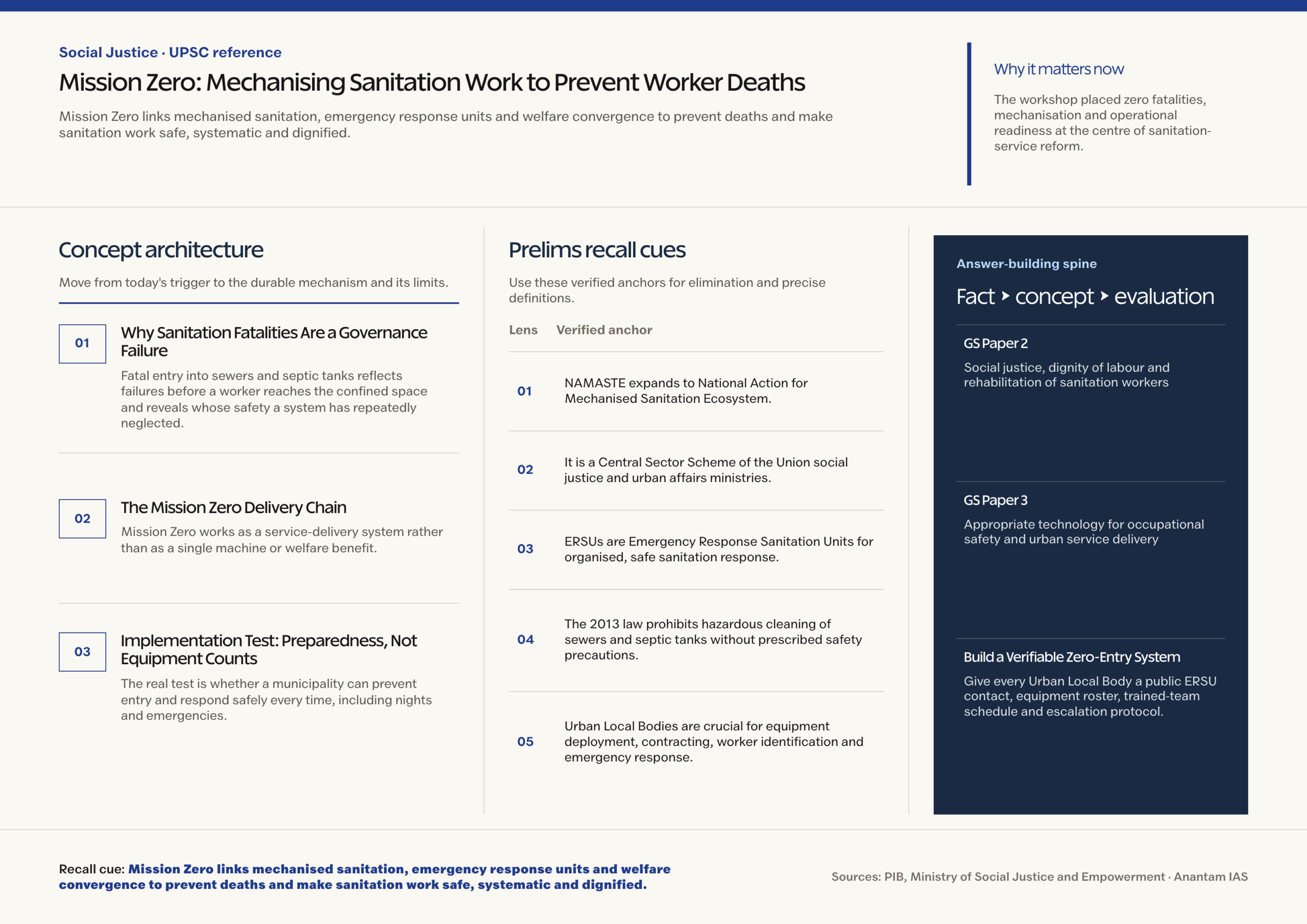
Mission Zero: Mechanising Sanitation Work to Prevent Worker Deaths
Why in News?
A national workshop on Mission Zero in Bhubaneswar on 22 August 2026 reviewed institutional preparedness, technology and mechanised sanitation for ending worker fatalities.
- The workshop placed zero fatalities, mechanisation and operational readiness at the centre of sanitation-service reform.
- The government said NAMASTE has been extended to 2031 and will use Emergency Response Sanitation Units for systematic service delivery.
- The Swachhata Sarthi component, introduced in 2024, brings waste pickers within social and economic empowerment measures.
- NAMASTE and Odisha’s GARIMA approach connect safety with health, education, social security and livelihood support for workers and dependants.
- A sewer emergency is a public-system failure, not an individual worker’s occupational choice.
- Mechanisation succeeds only when equipment, trained teams, rapid response, procurement and municipal accountability operate as one chain.
- Welfare convergence matters because unsafe sanitation work is sustained by caste-linked vulnerability, informality and weak bargaining power.
UPSC Relevance
Prelims Relevance
- NAMASTE expands to National Action for Mechanised Sanitation Ecosystem.
- It is a Central Sector Scheme of the Union social justice and urban affairs ministries.
- ERSUs are Emergency Response Sanitation Units for organised, safe sanitation response.
- The 2013 law prohibits hazardous cleaning of sewers and septic tanks without prescribed safety precautions.
- Urban Local Bodies are crucial for equipment deployment, contracting, worker identification and emergency response.
Mains Relevance
GS Paper 2
- Social justice, dignity of labour and rehabilitation of sanitation workers
- Municipal capacity, accountability and convergence across government levels
GS Paper 3
- Appropriate technology for occupational safety and urban service delivery
- Formalisation, skilling and livelihood diversification in sanitation work
Essay
- Technology advances justice only when institutions redesign unsafe work instead of transferring risk to invisible workers.
Background and Context
Why Sanitation Fatalities Are a Governance Failure
Fatal entry into sewers and septic tanks reflects failures before a worker reaches the confined space and reveals whose safety a system has repeatedly neglected.
- Sewers may contain toxic gases, oxygen-deficient air, pathogens and sudden liquid flows, making unplanned entry capable of killing workers and would-be rescuers.
- An informal contractor chain can blur responsibility for training, protective equipment, insurance, supervision and emergency rescue while the public authority still receives the service.
- Protective gear alone cannot make avoidable human entry safe; the first control should be elimination or mechanisation of exposure, followed by strict protocols for exceptional entry.
- The constitutional lens combines Article 21 dignity and life with Article 17’s anti-untouchability commitment, because hazardous sanitation work remains tied to entrenched social exclusion.
- The 2013 prohibition and rehabilitation law treats hazardous sewer or septic-tank cleaning without prescribed precautions as unlawful, shifting attention from charity to enforceable duty.
The Mission Zero Delivery Chain
Mission Zero works as a service-delivery system rather than as a single machine or welfare benefit.
- A citizen complaint or blockage alert should reach an ERSU that can assess risk, deploy suitable machinery and coordinate rescue capacity before any confined-space decision.
- Jetting, suction, desilting and inspection equipment move sanitation from manual exposure toward machine-led operations; equipment availability must match local sewer and septic-tank conditions.
- Worker profiling and training convert dispersed labour into a skilled workforce whose competencies, health needs and entitlements can be recorded rather than left to informal contractors.
- Occupational health coverage, personal protective equipment and social-security convergence reduce vulnerability, while livelihood assistance helps workers or dependants avoid returning to hazardous work.
- The workshop’s whole-of-government framing connects Union ministries, states, Urban Local Bodies, technology suppliers and worker organisations around a common zero-fatality outcome.
Implementation Test: Preparedness, Not Equipment Counts
The real test is whether a municipality can prevent entry and respond safely every time, including nights and emergencies.
- Machines can remain unused when procurement ignores maintenance, operators, spare parts, narrow lanes or the geometry of local sanitation assets; lifecycle readiness matters more than purchase.
- A credible ERSU needs an accessible contact route, trained crews, hazard-assessment protocols, response-time tracking and links to fire, health and police services for complex rescues.
- Contracts should prohibit unauthorised human entry, identify the responsible officer and contractor, and create auditable records of each call, deployment and exception to mechanised cleaning.
- Waste pickers and sewer or septic-tank workers face different hazards; expanding welfare coverage should not erase the need for occupation-specific safeguards and worker participation.
- Fatality reporting, independent inquiry and corrective action must close the feedback loop; a zero-fatality mission cannot rely on self-reported compliance alone.
Way Forward
Build a Verifiable Zero-Entry System
- Give every Urban Local Body a public ERSU contact, equipment roster, trained-team schedule and escalation protocol.
- Link sanitation contracts and payments to machine deployment records, safety checks and prohibition of unauthorised confined-space entry.
- Provide worker-led safety audits, health surveillance, insurance access and time-bound rehabilitation or livelihood choices.
- Publish fatality and near-miss reviews with responsibility fixed across the municipal and contractor chain.
Conclusion
- Mission Zero is best understood as institutional redesign: prevent exposure through mechanisation, prepare emergency units, formalise responsibility and secure workers against occupational and economic risk.
- In a Mains answer, connect technology with municipal capacity, legal accountability, social protection and worker voice; machinery without this chain cannot guarantee dignity or safety.
UPSC Practice Questions
Prelims MCQ 1
With reference to NAMASTE, consider the following statements:
- It seeks to promote a mechanised sanitation ecosystem.
- It is a Central Sector Scheme involving the Union social justice and urban affairs ministries.
- Emergency Response Sanitation Units are part of its systematic sanitation-service approach.
How many of the above statements are correct?
(a) Only one (b) Only two (c) All three (d) None
Answer: (c) All three
Explanation:
NAMASTE promotes mechanisation and coordinated worker safety. PIB stated that its extension uses ERSUs to support systematic sanitation-service delivery.
Prelims MCQ 2
Which one of the following best captures the role of an Emergency Response Sanitation Unit?
(a) It conducts household sanitation surveys only (b) It organises trained and mechanised response to sanitation emergencies (c) It certifies all municipal solid-waste facilities (d) It adjudicates compensation claims under labour law
Answer: (b) It organises trained and mechanised response to sanitation emergencies
Explanation:
ERSUs are intended to institutionalise safe, systematic sanitation response, including risk assessment, trained deployment and mechanised operations.
UPSC Mains Questions
- Sanitation-worker deaths are failures of urban governance, not unavoidable occupational accidents. Discuss with reference to Mission Zero and mechanised sanitation.
- How can Emergency Response Sanitation Units combine technology, accountability and social protection to eliminate hazardous human entry into sewers and septic tanks?
Source: PIB, Ministry of Social Justice and Empowerment.
Frequently Asked Questions
What is Mission Zero in sanitation work?
Mission Zero is the zero-fatality approach that combines mechanisation, institutional preparedness, worker safety, social security and livelihood support in sanitation-service delivery.
What does NAMASTE stand for?
NAMASTE stands for National Action for Mechanised Sanitation Ecosystem, a Central Sector Scheme focused on safe, skilled and mechanised sanitation work.
What is an ERSU?
An Emergency Response Sanitation Unit is an organised municipal response mechanism intended to deploy trained personnel, appropriate machinery and safety protocols during sanitation emergencies.
Why is personal protective equipment not enough?
Protective equipment reduces some exposure but cannot remove confined-space hazards. Prevention requires machine-first cleaning, risk assessment, trained supervision and rescue readiness.
How should Mission Zero be used in a UPSC answer?
Present it as a governance chain linking dignity, legal duty, municipal capacity, mechanisation, occupational health, contractor accountability and rehabilitation rather than as an equipment scheme.
Source: https://anantamias.com/current-affairs/mission-zero-sanitation-worker-safety/
Biodiversity Benefit Sharing: How Commercial Use Funds Conservation
Why in News?
On 22 August 2026, the National Biodiversity Authority announced an Access and Benefit-Sharing disbursement arising from commercial use of India’s biological resources.
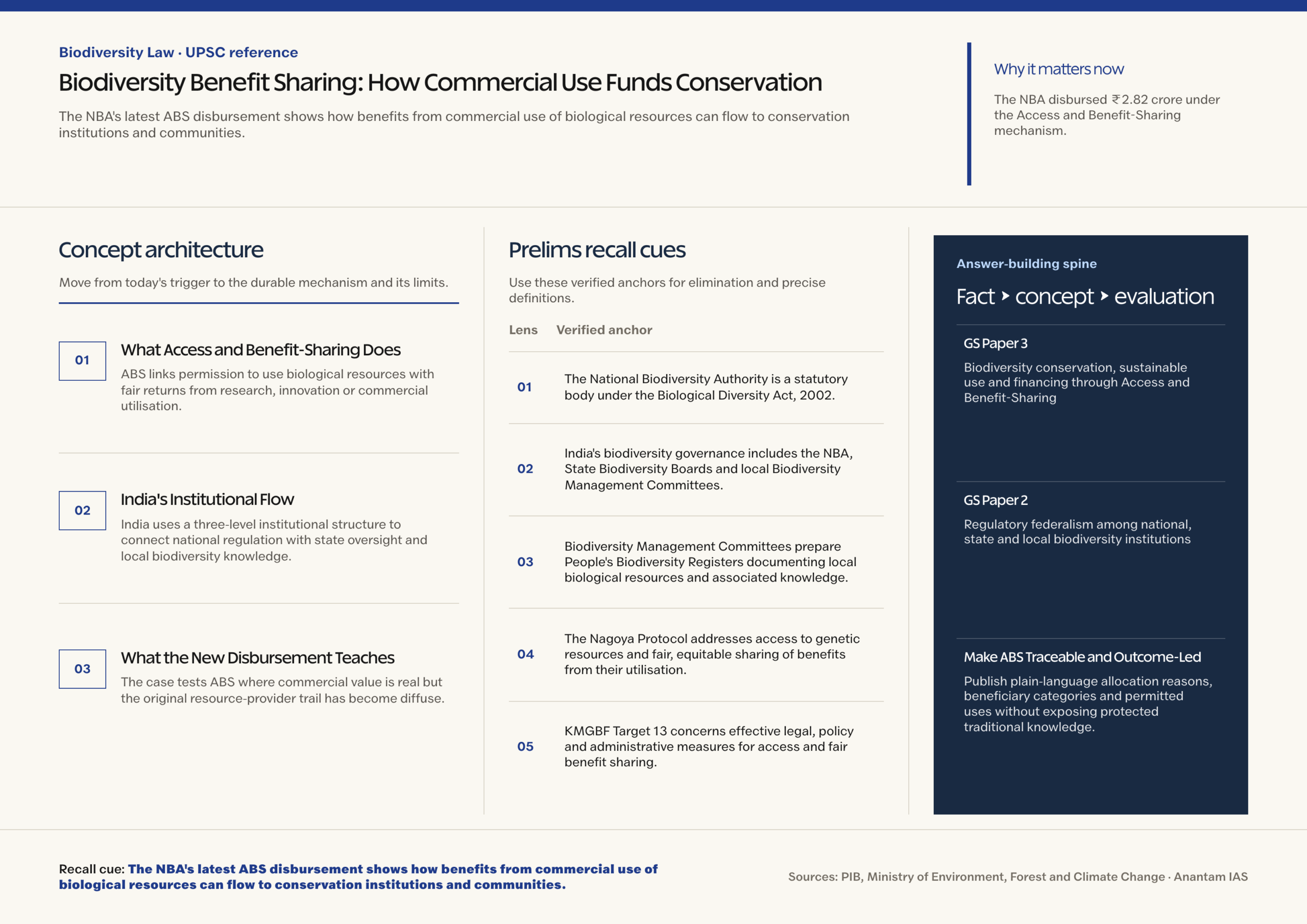
- The NBA disbursed ₹2.82 crore under the Access and Benefit-Sharing mechanism.
- Of this, ₹2.80 crore went to 27 State Biodiversity Boards and three Union Territory Biodiversity Councils.
- The commercial plant genetic resources could not be traced to specific farmers, communities or one geographic source after a corporate acquisition.
- An approved modality used the cultivation pattern of the concerned horticultural crops to distribute the benefit across states and Union Territories.
- A separate share went to ICAR-IIHR, the public research institution that supplied two microbial strains used for research and commercial purposes.
- ABS converts biodiversity from a free commercial input into a resource whose providers and stewards have a claim to fair benefits.
- The case demonstrates a fallback route when direct benefit claimers cannot be identified, preventing traceability gaps from defeating conservation finance.
- Disbursement is only the midpoint; utilisation, community participation and verifiable conservation outcomes determine whether benefit sharing becomes equitable.
UPSC Relevance
Prelims Relevance
- The National Biodiversity Authority is a statutory body under the Biological Diversity Act, 2002.
- India’s biodiversity governance includes the NBA, State Biodiversity Boards and local Biodiversity Management Committees.
- Biodiversity Management Committees prepare People’s Biodiversity Registers documenting local biological resources and associated knowledge.
- The Nagoya Protocol addresses access to genetic resources and fair, equitable sharing of benefits from their utilisation.
- KMGBF Target 13 concerns effective legal, policy and administrative measures for access and fair benefit sharing.
Mains Relevance
GS Paper 3
- Biodiversity conservation, sustainable use and financing through Access and Benefit-Sharing
- Institutional design for genetic resources, traditional knowledge and local stewardship
GS Paper 2
- Regulatory federalism among national, state and local biodiversity institutions
- India’s implementation of the CBD, Nagoya Protocol and Kunming-Montreal framework
Essay
- Fair benefit sharing turns conservation from an imposed restriction into a negotiated relationship between knowledge, commerce and ecological stewardship.
Background and Context
What Access and Benefit-Sharing Does
ABS links permission to use biological resources with fair returns from research, innovation or commercial utilisation.
- The access side regulates how biological resources and associated knowledge are obtained; the benefit side determines how gains from their utilisation are shared.
- Benefits may be monetary or non-monetary, including technology transfer, research collaboration, institutional capacity, conservation support or livelihood gains, depending on the applicable terms and regulation.
- The core equity principle is that commercial value often rests on ecosystems, crop diversity, community stewardship or public repositories that markets did not create by themselves.
- ABS also creates an incentive for documentation and sustainable use when resource custodians can see a credible route from utilisation to local ecological benefit.
- The Nagoya Protocol supplements the Convention on Biological Diversity by providing an international framework for legal certainty, compliance and fair sharing from genetic-resource utilisation.
India's Institutional Flow
India uses a three-level institutional structure to connect national regulation with state oversight and local biodiversity knowledge.
- The NBA administers national-level functions under the Biological Diversity Act, including approval and benefit-sharing roles for categories of access covered by the central authority.
- State Biodiversity Boards perform state-level regulatory and advisory functions, while Union Territory Biodiversity Councils provide the corresponding institutional channel in Union Territories.
- Local bodies constitute Biodiversity Management Committees, which support conservation, sustainable use and documentation of biological resources and associated knowledge through People’s Biodiversity Registers.
- When an identifiable provider or community is linked to the resource, benefit sharing should follow that connection; public research repositories can also be legitimate institutional beneficiaries.
- Section 27 provides for the National Biodiversity Fund, through which relevant receipts can support benefit claimers, conservation and socio-economic development consistent with the Act.
What the New Disbursement Teaches
The case tests ABS where commercial value is real but the original resource-provider trail has become diffuse.
- Plant genetic resources linked to commercial hybrids had entered through a company acquisition, so the NBA could not identify one farmer, community or geographic source as the direct claimant.
- An expert process recommended a distribution modality, and the Authority allocated the principal share using where the concerned horticultural crops are cultivated as a defensible proxy.
- Recipient boards and councils may use funds for People’s Biodiversity Registers, in-situ or ex-situ conservation, ecosystem restoration, Biodiversity Heritage Sites, committee capacity and community livelihoods.
- The public research-institution example follows a clearer chain: microbial strains came from ICAR-IIHR, so part of the benefit could return to the institution for repositories, research and conservation work.
- Both routes preserve the same principle: benefit sharing should follow traceable stewardship where possible and use a transparent, ecologically relevant modality when traceability fails.
Way Forward
Make ABS Traceable and Outcome-Led
- Publish plain-language allocation reasons, beneficiary categories and permitted uses without exposing protected traditional knowledge.
- Strengthen People’s Biodiversity Registers as living, community-validated records rather than one-time inventories.
- Track utilisation certificates alongside ecological and livelihood outcomes, not expenditure alone.
- Create clear fallback rules for acquisitions, mixed-origin resources and diffuse claimants while retaining meaningful community participation.
Conclusion
- The disbursement shows ABS in operation: commercial use creates a sharing obligation, institutions identify the beneficiary route, and funds are tied to conservation, sustainable use or associated livelihoods.
- For Mains, assess not only money collected but also traceability, participation, federal coordination and whether spending strengthens the communities and ecosystems that sustain biological resources.
UPSC Practice Questions
Prelims MCQ 1
With reference to India’s biodiversity governance, consider the following statements:
- The National Biodiversity Authority is a statutory body under the Biological Diversity Act, 2002.
- Biodiversity Management Committees are constituted at the local-body level.
- People’s Biodiversity Registers document local biological resources and associated knowledge.
How many of the above statements are correct?
(a) Only one (b) Only two (c) All three (d) None
Answer: (c) All three
Explanation:
India’s three-level biodiversity governance connects the statutory NBA and state boards with local Biodiversity Management Committees, which prepare People’s Biodiversity Registers.
Prelims MCQ 2
Kunming-Montreal Global Biodiversity Framework Target 13 is most directly associated with which one of the following?
(a) Equitable access and benefit sharing from genetic resources (b) Elimination of every invasive alien species (c) Universal legal rights for all ecosystems (d) Replacement of in-situ conservation by seed banks
Answer: (a) Equitable access and benefit sharing from genetic resources
Explanation:
Target 13 calls for effective measures to facilitate appropriate access and ensure fair and equitable sharing of benefits from genetic resources and digital sequence information, as applicable.
UPSC Mains Questions
- Explain how Access and Benefit-Sharing can align commercial use of biological resources with conservation and socio-economic justice.
- When direct biodiversity benefit claimers cannot be identified, what principles should guide allocation, participation and accountability?
Source: PIB, Ministry of Environment, Forest and Climate Change.
Frequently Asked Questions
What is Access and Benefit-Sharing?
ABS is the framework that regulates access to biological or genetic resources and shares benefits from their utilisation fairly with legitimate providers, custodians or conservation institutions.
Why did state boards receive the principal share in this case?
Specific farmers, communities or one source region could not be traced after a corporate acquisition, so an approved modality distributed funds using crop cultivation patterns.
What can recipient biodiversity institutions use ABS funds for?
Permitted uses include biodiversity documentation, habitat restoration, in-situ and ex-situ conservation, heritage-site support, committee capacity and community livelihood enhancement.
How is the Nagoya Protocol connected to ABS?
The Nagoya Protocol provides an international framework under the Convention on Biological Diversity for access, legal certainty, compliance and fair sharing of benefits from genetic-resource utilisation.
What is the main governance challenge after disbursement?
Authorities must verify that spending produces conservation and livelihood outcomes, includes legitimate stakeholders and does not reduce benefit sharing to a paper transfer between institutions.
Source: https://anantamias.com/current-affairs/biodiversity-access-benefit-sharing-disbursement/
Digital-Arrest Fraud: How Cybercrime Proceeds Move Through Mule Networks
Why in News?
The Enforcement Directorate arrested two persons in a Goa-linked money-laundering probe that allegedly exposed a multi-state network moving proceeds from digital-arrest frauds.
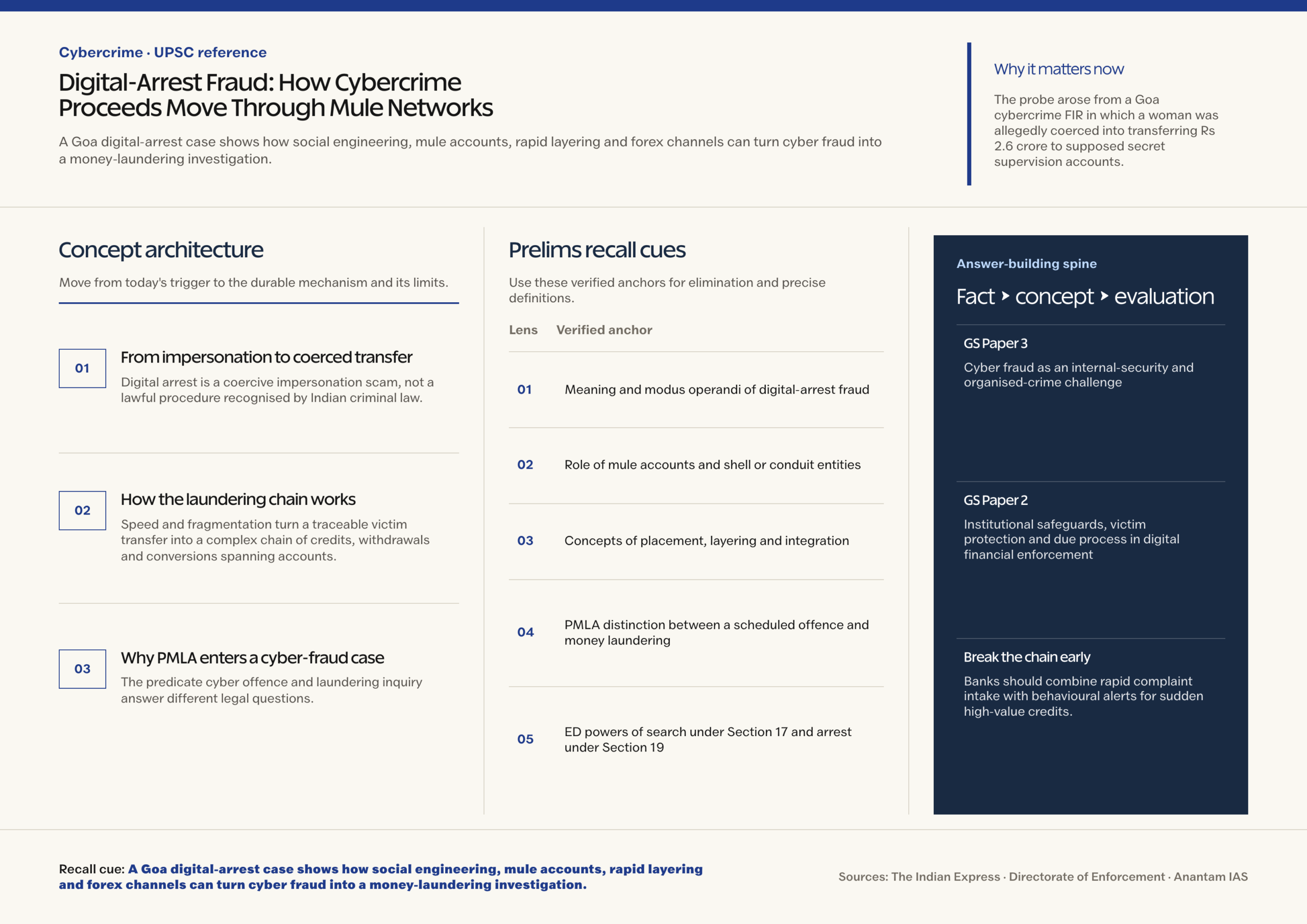
- The probe arose from a Goa cybercrime FIR in which a woman was allegedly coerced into transferring Rs 2.6 crore to supposed secret supervision accounts.
- The ED said the connected accounts figure in 330 victim complaints and 163 FIRs across 20 states and Union Territories.
- Investigators alleged that the Goa victim’s money was fragmented within hours across more than 400 beneficiary accounts.
- The two persons were arrested under Section 19 of PMLA; the allegations remain subject to investigation and judicial determination.
- The case links the initial social-engineering fraud with the separate financial process used to disguise, move or convert its proceeds.
- It illustrates why cybercrime control needs coordination among police, banks, telecom platforms, financial-intelligence bodies and specialised investigators.
UPSC Relevance
Prelims Relevance
- Meaning and modus operandi of digital-arrest fraud
- Role of mule accounts and shell or conduit entities
- Concepts of placement, layering and integration
- PMLA distinction between a scheduled offence and money laundering
- ED powers of search under Section 17 and arrest under Section 19
Mains Relevance
GS Paper 3
- Cyber fraud as an internal-security and organised-crime challenge
- Technology, financial channels and inter-state coordination in proceeds tracing
GS Paper 2
- Institutional safeguards, victim protection and due process in digital financial enforcement
Essay
- Digital trust depends as much on accountable institutions and informed citizens as on technical security.
Background and Context
From impersonation to coerced transfer
Digital arrest is a coercive impersonation scam, not a lawful procedure recognised by Indian criminal law; it exploits fear of immediate detention and secrecy.
- Fraudsters pose as police, investigators, courts or regulators, claim that the target is linked to a serious offence, and present private payment instructions as official procedure.
- They use video calls, forged documents, isolation and threats of arrest to create authority, urgency and fear, often discouraging contact with family, banks or police.
- The victim is instructed to transfer money for verification, bail or supervision; a genuine agency does not demand such a transfer to clear a person.
- The first recipient is often a mule account controlled by another actor, distancing the victim-facing impersonator from later movement and withdrawal of funds.
- Fast reporting matters because banks may be able to hold funds before successive transfers disperse them beyond the first identifiable beneficiary account.
How the laundering chain works
Speed and fragmentation turn a traceable victim transfer into a complex chain of credits, withdrawals and conversions spanning accounts, entities and jurisdictions.
- At the placement stage, criminal proceeds enter accounts presented as ordinary business or personal receipts, creating the first separation between victim and principal operator.
- During layering, funds are split and routed through dormant, newly opened or intermediary accounts to multiply transactions, mix flows and obscure their criminal origin.
- Conduit companies can give transfers a commercial appearance even when nominal directors do not exercise real control over banking credentials, records or business decisions.
- The ED alleged that parts of the investigated network converted banking credits into cash and then foreign currency through licensed money-changing businesses controlled by others.
- Cash withdrawal or currency conversion can interrupt the digital trail, while integration seeks to return funds as apparently legitimate wealth, assets or business receipts.
Why PMLA enters a cyber-fraud case
The predicate cyber offence and laundering inquiry answer different legal questions, although evidence from the same transaction trail can connect the two investigations.
- Police investigate the underlying cheating, impersonation or computer-related conduct; when covered as a scheduled offence, it may generate proceeds of crime examined under PMLA.
- The ED examines whether a person knowingly assisted, possessed, used, concealed or projected those proceeds as untainted property, rather than reinvestigating every element of the victim-facing deception.
- A large transaction trail is investigative evidence, not automatic proof that every account holder, director or transaction forms part of a laundering conspiracy.
- Investigators must establish beneficial control and knowledge through account operation, communications, device records, cash handling and the economic purpose of transfers.
- Arrest, search and seizure powers remain subject to statutory conditions, recorded reasons, court supervision and procedural rights; an agency allegation is not a finding of guilt.
Way Forward
Break the chain early
- Banks should combine rapid complaint intake with behavioural alerts for sudden high-value credits, quick fragmentation and accounts inconsistent with customer profiles.
- Law-enforcement agencies need time-bound inter-state preservation requests so account, device and telecom evidence is not lost while jurisdiction is being resolved.
- Customer warnings should state the decisive rule: no police, court or regulator places citizens under digital arrest or demands money for verification.
- Enforcement should distinguish deceived or coerced account holders from knowing facilitators through control, benefit, communication and transaction evidence.
Conclusion
- Digital-arrest fraud is not only a deceptive call; it is a networked financial crime whose resilience comes from specialisation across impersonators, account recruiters, mules, shell entities and cash or currency converters.
- A strong Mains answer should connect citizen awareness with faster complaint transmission, transaction freezing, financial intelligence, inter-state evidence sharing, beneficial-ownership scrutiny and due-process safeguards.
UPSC Practice Questions
Prelims MCQ 1
With reference to digital-arrest fraud and money laundering, consider the following statements:
- Digital arrest is a procedure expressly recognised under Indian criminal law.
- Layering seeks to obscure the origin of funds through multiple transactions.
- A scheduled offence may generate proceeds of crime examined under PMLA.
How many of the above statements are correct?
(a) Only one (b) Only two (c) All three (d) None
Answer: (b) Only two
Explanation:
Statements 2 and 3 are correct. Digital arrest is a fraud tactic, not a lawful arrest procedure.
Prelims MCQ 2
Which one of the following best describes a mule account in a cyber-fraud chain?
(a) A court-controlled account for disputed funds (b) An account used to receive or move illicit funds for another actor (c) An RBI reserve account for money changers (d) A victim-compensation account maintained by police
Answer: (b) An account used to receive or move illicit funds for another actor
Explanation:
A mule account receives or transfers criminal proceeds on behalf of others, helping distance the main operators from the originating fraud.
UPSC Mains Questions
- Digital-arrest fraud combines social engineering with a layered financial network. Explain the mechanism and suggest institutional responses that can improve disruption and recovery.
- Distinguish the investigation of a predicate cyber offence from a money-laundering inquiry under PMLA. Why is this distinction important for effective and fair enforcement?
Sources: The Indian Express and Directorate of Enforcement.
Frequently Asked Questions
What is digital-arrest fraud?
It is an impersonation scam in which criminals pose as authorities, isolate a victim through calls or video, threaten arrest and demand transfers for supposed verification or supervision.
Is digital arrest a valid legal procedure?
No. Indian law does not permit an agency to keep someone under arrest through a video call or demand a money transfer to avoid arrest.
What is a mule account?
It is an account used to receive or move illicit funds for another actor. The holder may be a knowing facilitator, a recruited participant or, in some cases, deceived.
Why does the ED investigate a cyber-fraud case?
When a scheduled offence generates proceeds of crime, the ED may investigate alleged concealment, possession, use, transfer or projection of those proceeds under PMLA.
What should a person do after such a demand?
End the call, preserve messages and transaction details, contact the bank immediately, and report the incident through the official cybercrime reporting and police channels.
Source: https://anantamias.com/current-affairs/digital-arrest-fraud-money-laundering-network/
India-China Boundary Talks: What the Special Representatives Mechanism Can Deliver
Why in News?
India’s National Security Advisor Ajit Doval and China’s Wang Yi were scheduled to co-chair the 25th Special Representatives round on the boundary question in Beijing on August 25, 2026.
- The Chinese foreign ministry announced the meeting after agreement between the two sides; no negotiated outcome had been officially reported in the cited announcement.
- The round concerns the unresolved boundary question, while management of day-to-day friction along the Line of Actual Control also involves military and diplomatic channels.
- The live exam issue is the distinction among disengagement, de-escalation, peace and tranquillity, clarification of the LAC, and a final boundary settlement.
- The meeting tests whether political-level dialogue can turn a calmer frontier into verifiable risk reduction without overstating progress on the underlying territorial dispute.
- Border stability affects bilateral trust, military deployment costs, trade diplomacy and India’s wider strategic choices in the Indo-Pacific.
- Mechanisms matter because an undemarcated and differently perceived LAC can generate patrol encounters even when neither side has agreed to alter the territorial status quo.
- Aspirants should treat any announced understanding as process evidence unless both governments specify implementation, locations, sequencing and verification.
UPSC Relevance
Prelims Relevance
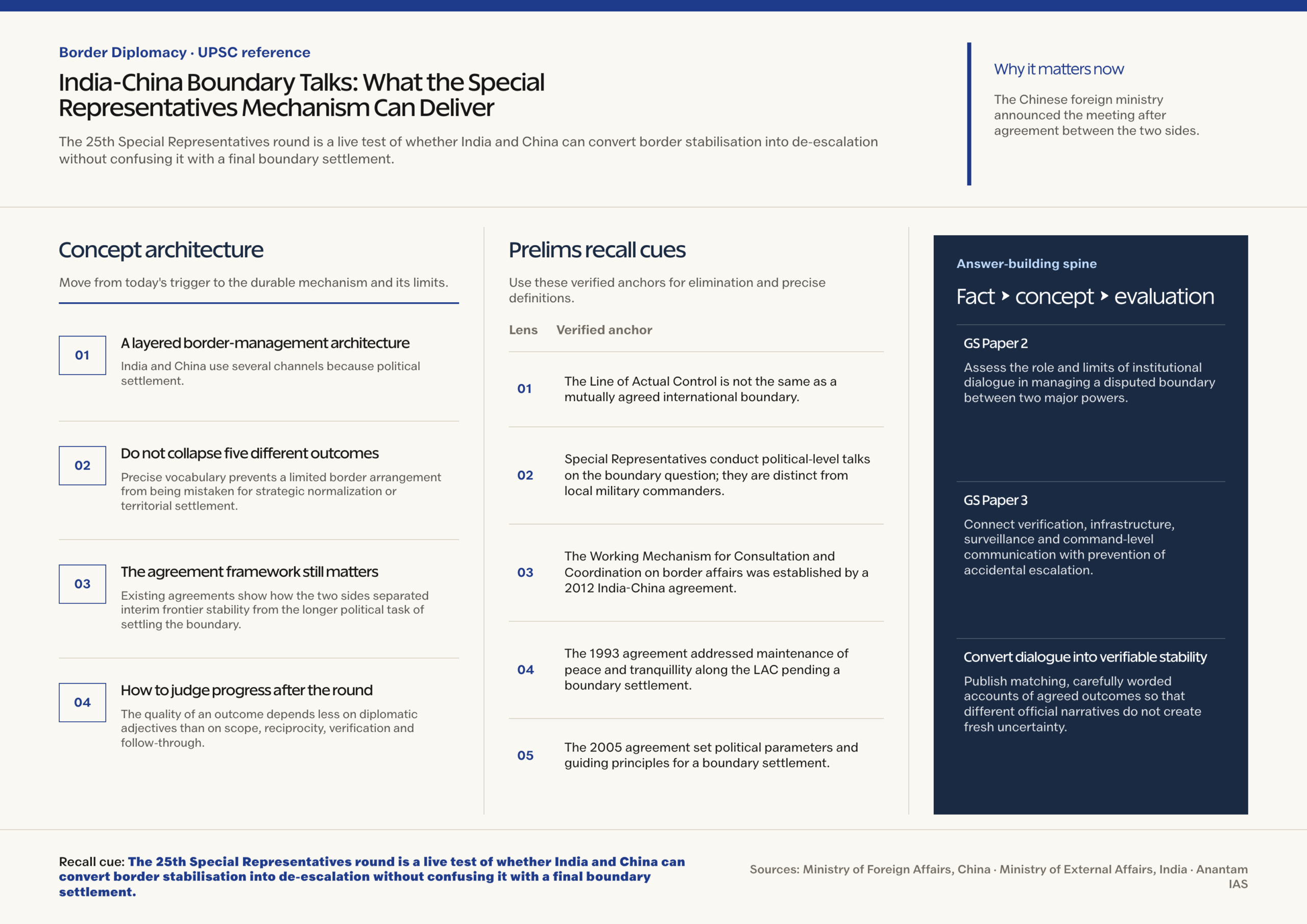
- The Line of Actual Control is not the same as a mutually agreed international boundary.
- Special Representatives conduct political-level talks on the boundary question; they are distinct from local military commanders.
- The Working Mechanism for Consultation and Coordination on border affairs was established by a 2012 India-China agreement.
- The 1993 agreement addressed maintenance of peace and tranquillity along the LAC pending a boundary settlement.
- The 2005 agreement set political parameters and guiding principles for a boundary settlement.
Mains Relevance
GS Paper 2
- Assess the role and limits of institutional dialogue in managing a disputed boundary between two major powers.
- Explain why border peace is a necessary condition for stable India-China relations but not a substitute for settlement.
GS Paper 3
- Connect verification, infrastructure, surveillance and command-level communication with prevention of accidental escalation.
- Examine how prolonged forward deployment creates security, fiscal and logistical costs.
Essay
- Durable peace depends on institutions that manage disagreement while political conditions for settlement remain incomplete.
Background and Context
A layered border-management architecture
India and China use several channels because political settlement, diplomatic coordination and field-level risk control are different tasks.
- The Special Representatives mechanism provides high-level political direction on the boundary question and can explore principles, trade-offs and the broader bilateral environment.
- The Working Mechanism for Consultation and Coordination brings diplomatic and military officials together to address border affairs, but it does not negotiate the final boundary settlement.
- Corps Commander and other military meetings focus on operational matters such as troops, patrols, buffers, communications and implementation at specific friction points.
- Border Personnel Meetings, flag meetings and hotlines can contain incidents locally before tactical confusion becomes a political or military crisis.
- These channels are complementary: political authorization without field verification is fragile, while local arrangements without sustained political backing may remain temporary.
Do not collapse five different outcomes
Precise vocabulary prevents a limited border arrangement from being mistaken for strategic normalization or territorial settlement.
- Disengagement separates troops at an identified face-off point through agreed sequencing, distance, temporary arrangements or limits on patrolling.
- De-escalation is broader and usually concerns reducing forward-deployed forces, heavy equipment, readiness or supporting infrastructure across a larger theatre.
- Peace and tranquillity describe the desired security condition along the LAC; they do not prove that competing territorial claims have been reconciled.
- LAC clarification would reduce ambiguity over differing perceptions, but clarification is still distinct from delimitation and demarcation of an international boundary.
- A final settlement needs a mutually acceptable political agreement covering the dispute; the 2005 guiding principles provide a framework, not evidence that settlement has occurred.
The agreement framework still matters
Existing agreements show how the two sides separated interim frontier stability from the longer political task of settling the boundary.
- The 1993 peace and tranquillity agreement accepted that forces would respect the LAC pending an ultimate boundary solution, making interim restraint compatible with unresolved claims.
- The 1996 confidence-building agreement addressed military conduct near the LAC, while the 2005 implementation protocol supplied more detailed modalities for confidence-building measures.
- The 2012 Working Mechanism agreement created a consultation channel for border affairs, but expressly did not replace the Special Representatives mechanism on the boundary question.
How to judge progress after the round
The quality of an outcome depends less on diplomatic adjectives than on scope, reciprocity, verification and follow-through.
- First identify the status: a scheduled discussion, joint understanding, completed disengagement and verified implementation are not interchangeable stages.
- Look for precise scope, including whether an arrangement covers one friction point, several sectors, patrol access, force levels or only future consultations.
- Test reciprocity by asking whether obligations apply to both sides in comparable ways and whether sequencing prevents either side from gaining a unilateral advantage.
- Verification requires agreed observation, commander-level confirmation and procedures for alleged violations; vague assurances alone cannot sustain a sensitive military arrangement.
- Even genuine border progress may not restore the wider relationship automatically because structural competition, strategic distrust and unresolved claims can continue alongside dialogue.
Way Forward
Convert dialogue into verifiable stability
- Publish matching, carefully worded accounts of agreed outcomes so that different official narratives do not create fresh uncertainty.
- Define sector-specific implementation, timelines, patrol arrangements and verification before presenting a political understanding as completed operational progress.
- Strengthen hotlines, commander contacts and incident protocols to prevent patrol encounters or infrastructure activity from triggering rapid escalation.
- Keep final-settlement diplomacy active while ensuring that interim confidence-building measures do not prejudice either side’s stated territorial position.
Conclusion
- The Special Representatives mechanism can supply political direction, but durable stability requires its understandings to be translated into reciprocal, field-verifiable arrangements through diplomatic and military channels.
- In a Mains answer, separate immediate crisis management from de-escalation and final settlement, then evaluate progress through scope, reciprocity, verification and implementation rather than summit language.
UPSC Practice Questions
Prelims MCQ 1
With reference to India-China border mechanisms, consider the following statements:
- The Special Representatives mechanism addresses the boundary question at the political level.
- The Working Mechanism for Consultation and Coordination was established through a bilateral agreement in 2012.
- The Line of Actual Control is a mutually delimited international boundary.
How many of the above statements are correct?
(a) Only one (b) Only two (c) All three (d) None
Answer: (b) Only two
Explanation:
Statements 1 and 2 are correct. The LAC is not a mutually agreed, delimited international boundary; differing perceptions are one source of friction.
Prelims MCQ 2
Which one of the following best describes de-escalation in a border crisis?
(a) Adoption of political principles for a future settlement (b) Separation of troops only at one face-off point (c) Broader reduction of forward military posture and supporting capabilities (d) Legal demarcation of the international boundary on the ground
Answer: (c) Broader reduction of forward military posture and supporting capabilities
Explanation:
De-escalation is broader than point-specific disengagement and is distinct from political settlement, delimitation or physical demarcation.
UPSC Mains Questions
- Why must disengagement, de-escalation and boundary settlement be treated as distinct stages in India-China relations? Discuss.
- Evaluate the utility and limitations of the Special Representatives mechanism in securing durable peace along the India-China frontier.
Sources: Ministry of Foreign Affairs, China and Ministry of External Affairs, India.
Frequently Asked Questions
What is the Special Representatives mechanism?
It is a high-level India-China political channel for addressing the boundary question. It provides strategic direction but relies on diplomatic and military mechanisms for detailed field implementation.
Is the Line of Actual Control the international boundary?
No. The LAC reflects the line up to which each side exercises control, and perceptions can differ. A settled international boundary would require mutual delimitation and demarcation.
How is disengagement different from de-escalation?
Disengagement separates forces at a specific face-off point. De-escalation reduces the wider forward military posture, which may include troops, equipment, readiness and supporting deployments.
What did the 2005 India-China agreement do?
It recorded political parameters and guiding principles for seeking a fair, reasonable and mutually acceptable boundary solution. It did not itself settle or demarcate the boundary.
Did the 25th round produce a settlement?
The cited Chinese announcement confirmed the scheduled August 25 meeting but reported no outcome. Any later claim should be assessed against official details on scope, implementation and verification.
Source: https://anantamias.com/current-affairs/india-china-25th-special-representatives-boundary-talks/
Operation Sindoor Cyberterror Case: When Online Propaganda Becomes a Security Offence
Why in News?
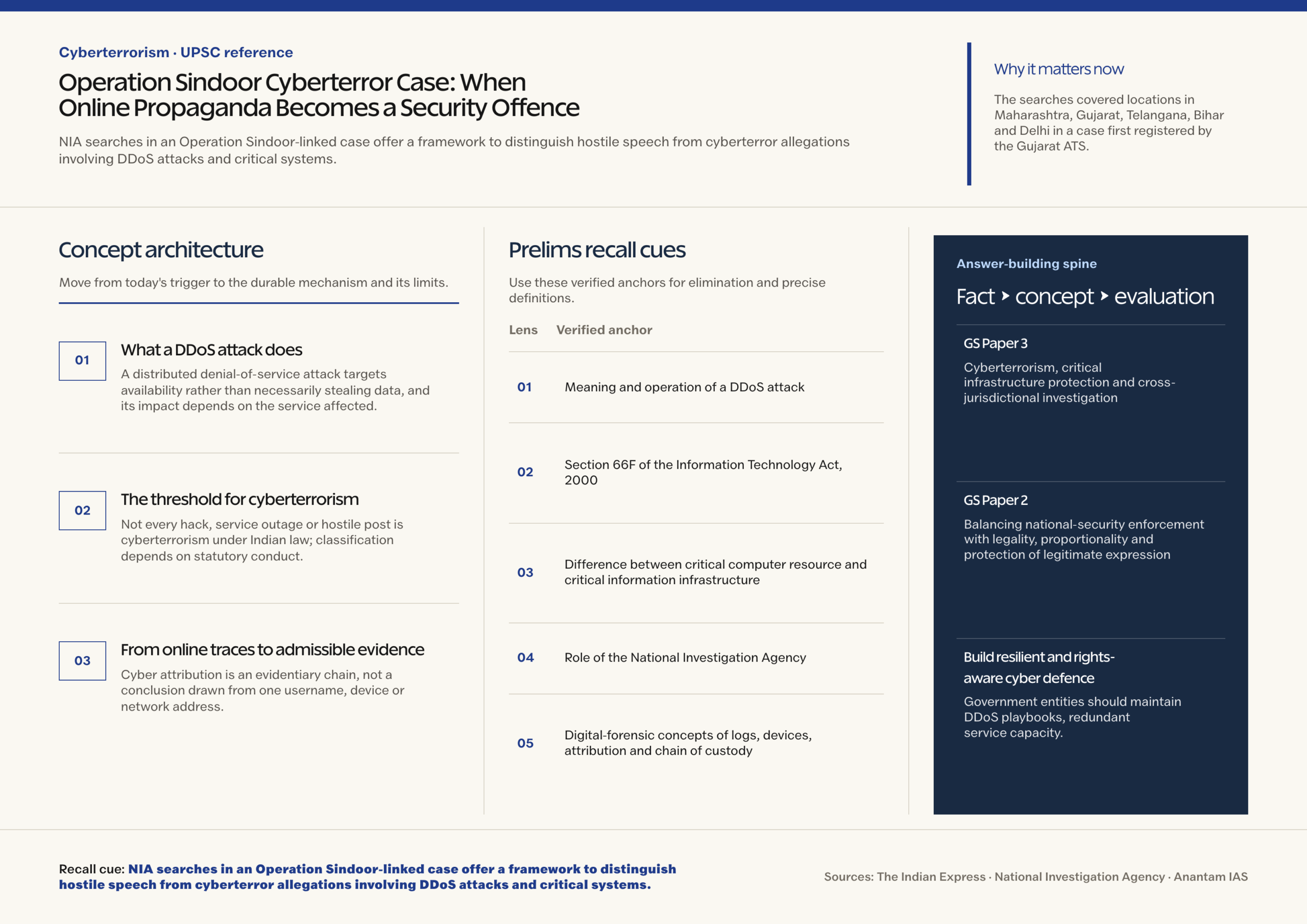
The NIA searched five locations in five states while investigating an alleged DDoS campaign against government websites during Operation Sindoor.
- The searches covered locations in Maharashtra, Gujarat, Telangana, Bihar and Delhi in a case first registered by the Gujarat ATS.
- The agency alleged an attempted DDoS attack against 54 government-entity websites, including critical computer resources and critical information infrastructure.
- Investigators said the searched suspects allegedly supported the accused in preparing for and improving skills used for the attacks.
- Digital devices and documents were seized for examination; the searches and seizures do not by themselves establish guilt.
- The case shows how an online act may move beyond objectionable content when it allegedly combines hostile intent with technical interference against protected systems.
- Attribution is difficult because distributed attacks can involve compromised devices, anonymising services, encrypted platforms and participants with different levels of knowledge.
UPSC Relevance
Prelims Relevance
- Meaning and operation of a DDoS attack
- Section 66F of the Information Technology Act, 2000
- Difference between critical computer resource and critical information infrastructure
- Role of the National Investigation Agency
- Digital-forensic concepts of logs, devices, attribution and chain of custody
Mains Relevance
GS Paper 3
- Cyberterrorism, critical infrastructure protection and cross-jurisdictional investigation
- DDoS capability, online coordination and evidentiary attribution
GS Paper 2
- Balancing national-security enforcement with legality, proportionality and protection of legitimate expression
Essay
- A resilient democracy must defend both its digital infrastructure and the legal distinctions that protect legitimate dissent.
Background and Context
What a DDoS attack does
A distributed denial-of-service attack targets availability rather than necessarily stealing data, and its impact depends on the service affected, duration and defensive capacity.
- Attackers direct traffic or requests from many sources toward a server, service or network until capacity is exhausted and legitimate users cannot obtain normal access.
- The distributed sources may include compromised devices in a botnet, making blocking and attribution harder than with a single-source attack launched from one address.
- A DDoS event can interrupt public services even when the attacker does not enter the underlying database, steal records or alter stored information.
- Attack traffic can target bandwidth, network protocols or application functions, so defenders must identify the exhausted layer before choosing an effective mitigation.
- Defenders use traffic filtering, rate limiting, distributed capacity and incident coordination, while investigators preserve server logs, provider records and configuration evidence.
The threshold for cyberterrorism
Not every hack, service outage or hostile post is cyberterrorism under Indian law; classification depends on statutory conduct, intended threat and the protected consequence.
- Section 66F of the IT Act links prohibited computer conduct with a specified terror-related intent and the consequence or likelihood described by the provision.
- Relevant intent includes threatening India’s unity, integrity, security or sovereignty, or striking terror among people or a section of people through the prohibited conduct.
- The provision covers certain unauthorised access, denial of access or introduction of computer contaminants where death, injury, property damage or essential-service disruption is caused or likely.
- Access to restricted information affecting security, sovereignty, friendly relations or specified protected interests can also enter the provision’s scope when its knowledge and intent conditions exist.
- Prosecution must prove the required conduct, connection, knowledge and intent; a political view or inflammatory message alone does not automatically satisfy every statutory element.
From online traces to admissible evidence
Cyber attribution is an evidentiary chain, not a conclusion drawn from one username, device or network address, because technical origin and human responsibility may differ.
- Investigators correlate forensic device images, server and network logs, account records, communications, payment trails and tool-use artefacts across a common, independently corroborated incident timeline.
- A device’s presence shows access or possession, but investigators must connect a person to control, knowledge and relevant acts, including preparation or assistance where alleged.
- VPNs, shared devices, compromised systems and false identities can obscure origin, requiring corroboration from independent technical, platform, provider and human evidence.
- A reliable chain of custody records how electronic material was collected, sealed, preserved, copied, analysed and produced, allowing integrity challenges to be tested.
- Court-authorised searches and forensic examination must remain tied to necessity, relevance and procedural safeguards, particularly when devices contain unrelated private information.
Way Forward
Build resilient and rights-aware cyber defence
- Government entities should maintain DDoS playbooks, redundant service capacity, tested escalation channels and coordinated reporting with sectoral and national incident-response bodies.
- Investigators need standard evidence-preservation requests and interoperable forensic procedures across states, platforms, service providers and affected departments.
- Charges should identify the specific act, protected resource, alleged consequence and required intent instead of collapsing propaganda, association and technical attack into one category.
- Capacity building should cover both advanced technical attribution and judicially reviewable documentation of how each accused person is linked to the alleged operation.
Conclusion
- Cyberterrorism analysis requires a three-part test: technical conduct, protected harm and terror-related intent; provocative online material may support an inference but cannot replace proof of those statutory elements.
- A strong Mains answer should pair infrastructure resilience, incident reporting and forensic cooperation with precise charging, individualised attribution, proportionality, judicial oversight and procedural safeguards.
UPSC Practice Questions
Prelims MCQ 1
With reference to Distributed Denial of Service attacks, consider the following statements:
- They commonly overwhelm a service with traffic from multiple sources.
- They necessarily involve theft of data from the target database.
- Compromised devices may be coordinated as a botnet.
How many of the above statements are correct?
(a) Only one (b) Only two (c) All three (d) None
Answer: (b) Only two
Explanation:
Statements 1 and 3 are correct. A DDoS attack targets service availability and does not necessarily involve data theft.
Prelims MCQ 2
Which provision of the Information Technology Act, 2000 specifically addresses cyberterrorism?
(a) Section 43 (b) Section 66C (c) Section 66F (d) Section 79
Answer: (c) Section 66F
Explanation:
Section 66F defines and punishes cyberterrorism, subject to its specified conduct, intent and consequence requirements.
UPSC Mains Questions
- Not every cyberattack or inflammatory online message amounts to cyberterrorism. Explain the legal and evidentiary thresholds that should guide such a determination.
- DDoS attacks expose both technical and institutional weaknesses in public digital infrastructure. Discuss a resilience strategy that also protects due process and legitimate expression.
Sources: The Indian Express and National Investigation Agency.
Frequently Asked Questions
What is a DDoS attack?
It is an attempt to make a server, service or network unavailable by flooding it with illegitimate traffic or requests from multiple, often compromised, sources.
Does every DDoS attack amount to cyberterrorism?
No. Cyberterrorism under Section 66F requires the specified computer conduct plus the provision’s intent and harm-related conditions; an ordinary service disruption does not automatically qualify.
What is critical information infrastructure?
It is a computer resource whose incapacitation or destruction would have a debilitating impact on national security, economy, public health or safety, under the IT Act framework.
Why is attribution difficult in a distributed attack?
Traffic may pass through compromised devices, shared systems, VPNs and false identities. Investigators must corroborate technical traces with evidence of control, knowledge, communication and intent.
Why does chain of custody matter for digital evidence?
It documents collection, preservation, copying, analysis and transfer of electronic material, helping a court assess whether the evidence remained authentic and unaltered.
Source: https://anantamias.com/current-affairs/operation-sindoor-cyberterror-investigation/
National Security Strategies Conference and India’s Internal-Security Coordination
Why in News?
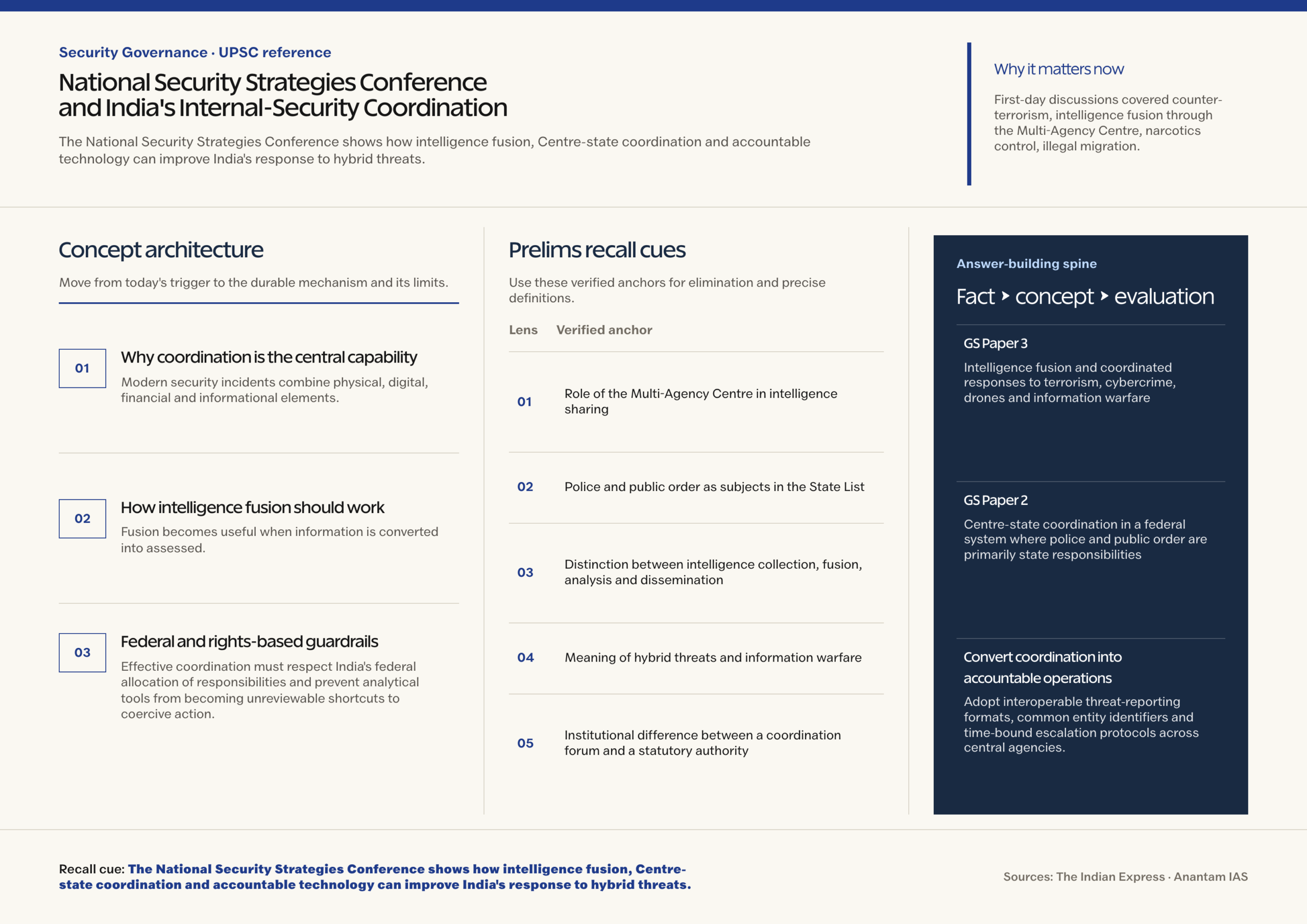
The ninth two-day National Security Strategies Conference began in New Delhi on August 24, bringing national and state security officials together to examine interconnected internal-security threats.
- First-day discussions covered counter-terrorism, intelligence fusion through the Multi-Agency Centre, narcotics control, illegal migration, cybercrime and cross-border proxy warfare.
- The conference called for AI-assisted analysis of information available on MAC platforms to help develop standard operating procedures for different security challenges.
- The second-day agenda included sub-aerial threats, protection of the blue economy, information warfare and a national bio-security framework.
- Held annually since 2021, the conference connects senior decision-makers with state police leaders, field-level officers and specialised domain experts.
- Hybrid threats cross territorial and departmental boundaries, while the information needed to detect them is often distributed across police units, intelligence agencies, regulators and infrastructure operators.
- A conference matters only when shared diagnosis becomes timely intelligence, clear ownership, interoperable procedures and measurable operational follow-up.
UPSC Relevance
Prelims Relevance
- Role of the Multi-Agency Centre in intelligence sharing
- Police and public order as subjects in the State List
- Distinction between intelligence collection, fusion, analysis and dissemination
- Meaning of hybrid threats and information warfare
- Institutional difference between a coordination forum and a statutory authority
Mains Relevance
GS Paper 3
- Intelligence fusion and coordinated responses to terrorism, cybercrime, drones and information warfare
- Technology-assisted threat analysis, operational interoperability and capacity gaps
GS Paper 2
- Centre-state coordination in a federal system where police and public order are primarily state responsibilities
- Accountability, due process and data safeguards in security governance
Essay
- National security depends as much on institutional trust and coordination as on the accumulation of coercive power.
Background and Context
Why coordination is the central capability
Modern security incidents combine physical, digital, financial and informational elements, so no single agency usually possesses the complete operational picture.
- A cyber intrusion may reveal financing, foreign direction or planned physical violence only when technical logs are connected with financial, criminal and human intelligence.
- Counter-terrorism, narcotics trafficking, illegal migration and proxy networks may share routes or facilitators, yet each is investigated under different mandates, laws and evidentiary requirements.
- Coordination creates a common threat picture: agencies compare fragments, remove duplication, identify gaps and decide which lead requires immediate collection or operational action.
- Field officers contribute local behaviour, language and network knowledge, while national agencies add cross-state patterns, strategic intelligence and access to specialised analytical capabilities.
- The conference is a coordination forum, not a substitute for statutory powers, lawful investigation or the established command responsibilities of participating institutions.
How intelligence fusion should work
Fusion becomes useful when information is converted into assessed, timely and appropriately shared intelligence rather than merely accumulated in a central database.
- The Multi-Agency Centre provides a platform for intelligence exchange; its value depends on prompt contributions, common identifiers and access rules suited to operational need.
- Analysts must evaluate source reliability, corroborate claims and distinguish facts from assessments before disseminating a lead, because unverified volume can create false confidence.
- AI can help cluster records, flag anomalies and connect recurring entities, but a human analyst must test context, alternative explanations and operational relevance.
- A standard operating procedure should define who validates an alert, which agency leads, how states are informed, what evidence is preserved and when escalation becomes necessary.
- The intelligence cycle needs feedback: recipients should report whether a lead proved accurate, which action followed and what additional collection would sharpen later assessments.
Federal and rights-based guardrails
Effective coordination must respect India’s federal allocation of responsibilities and prevent analytical tools from becoming unreviewable shortcuts to coercive action.
- Because police and public order are State List subjects, state forces remain central to local intelligence, investigation, public order management and courtroom evidence.
- Central bodies add value where threats cross state or national borders, but protocols should preserve clear jurisdiction, documented requests and accountable transfer of leads.
- AI-assisted analysis can reproduce biased inputs, generate false associations and obscure reasoning; consequential outputs require verification, audit trails, access controls and periodic error review.
- Investigations under security laws still require individualised evidence, lawful procedure and judicial scrutiny; attendance in a network or an automated match cannot establish criminal guilt.
- Success should be measured through faster validated alerts, reduced duplication, completed follow-up and better prosecutions, not by conference frequency, data volume or the number of agencies connected.
Way Forward
Convert coordination into accountable operations
- Adopt interoperable threat-reporting formats, common entity identifiers and time-bound escalation protocols across central agencies, state police and relevant infrastructure operators.
- Create joint analytical teams for complex threats while retaining a named lead agency, recorded decisions and an evidence-preservation plan for every operational referral.
- Audit AI-assisted outputs for false positives, discriminatory patterns and explainability, and prohibit adverse action based solely on an automated association.
- Use after-action reviews and state-level feedback to revise standard operating procedures, training priorities and information-sharing permissions after major incidents and exercises.
Conclusion
- India’s internal-security advantage will come from a disciplined cycle of collection, fusion, assessment, dissemination and feedback, not from centralising every decision or accumulating unfiltered information.
- A strong Mains answer should connect multi-agency coordination with federal clarity, field capacity, interoperable procedures, human-reviewed technology, evidentiary discipline and judicially enforceable safeguards.
UPSC Practice Questions
Prelims MCQ 1
With reference to internal-security coordination in India, consider the following statements:
- Police and public order are subjects in the State List.
- The Multi-Agency Centre facilitates intelligence sharing among agencies.
- The National Security Strategies Conference is a constitutional authority that can direct state police forces.
How many of the above statements are correct?
(a) Only one (b) Only two (c) All three (d) None
Answer: (b) Only two
Explanation:
Statements 1 and 2 are correct. The conference is a coordination forum, not a constitutional authority with command power over state police.
Prelims MCQ 2
Which one best describes intelligence fusion?
(a) Collecting the largest possible quantity of unfiltered data (b) Replacing field intelligence with automated predictions (c) Integrating and assessing information from multiple sources into actionable intelligence (d) Transferring all state police powers to a central agency
Answer: (c) Integrating and assessing information from multiple sources into actionable intelligence
Explanation:
Fusion combines, corroborates and assesses information from different sources so that decision-makers receive a usable threat picture rather than disconnected raw inputs.
UPSC Mains Questions
- Intelligence sharing is not merely a technological problem but an institutional coordination challenge. Discuss with reference to India’s internal-security architecture.
- How can India use AI-assisted security analysis while preserving federal accountability, evidentiary reliability and civil liberties?
Source: The Indian Express.
Frequently Asked Questions
What is the National Security Strategies Conference?
It is an annual coordination forum that brings central and state security officials, field officers and experts together to discuss major national-security challenges and possible operational responses.
What is the Multi-Agency Centre?
The Multi-Agency Centre is an intelligence-sharing and coordination platform that enables participating agencies to exchange inputs, connect threat information and support timely operational assessment.
Why are states essential to internal-security coordination?
Police and public order are State List subjects. State forces provide local intelligence, conduct much of the investigation and convert shared national inputs into lawful ground-level action.
How can AI support security analysis?
AI can cluster records, detect patterns and prioritise anomalies, but human analysts must verify context, document reasoning and prevent automated associations from becoming unsupported adverse action.
How should coordination success be measured?
Useful measures include timely validated alerts, reduced duplication, completed operational follow-up, improved evidence quality and lessons incorporated into revised procedures, rather than meetings or data volume alone.
Source: https://anantamias.com/current-affairs/national-security-strategies-conference-coordination/
UNMISS Peacekeeper Attack: Mandate, Protection and Accountability
Why in News?
Unidentified armed individuals ambushed a UNMISS patrol travelling to Pajut in South Sudan’s Jonglei state on 24 August, killing two peacekeepers and injuring seven people.
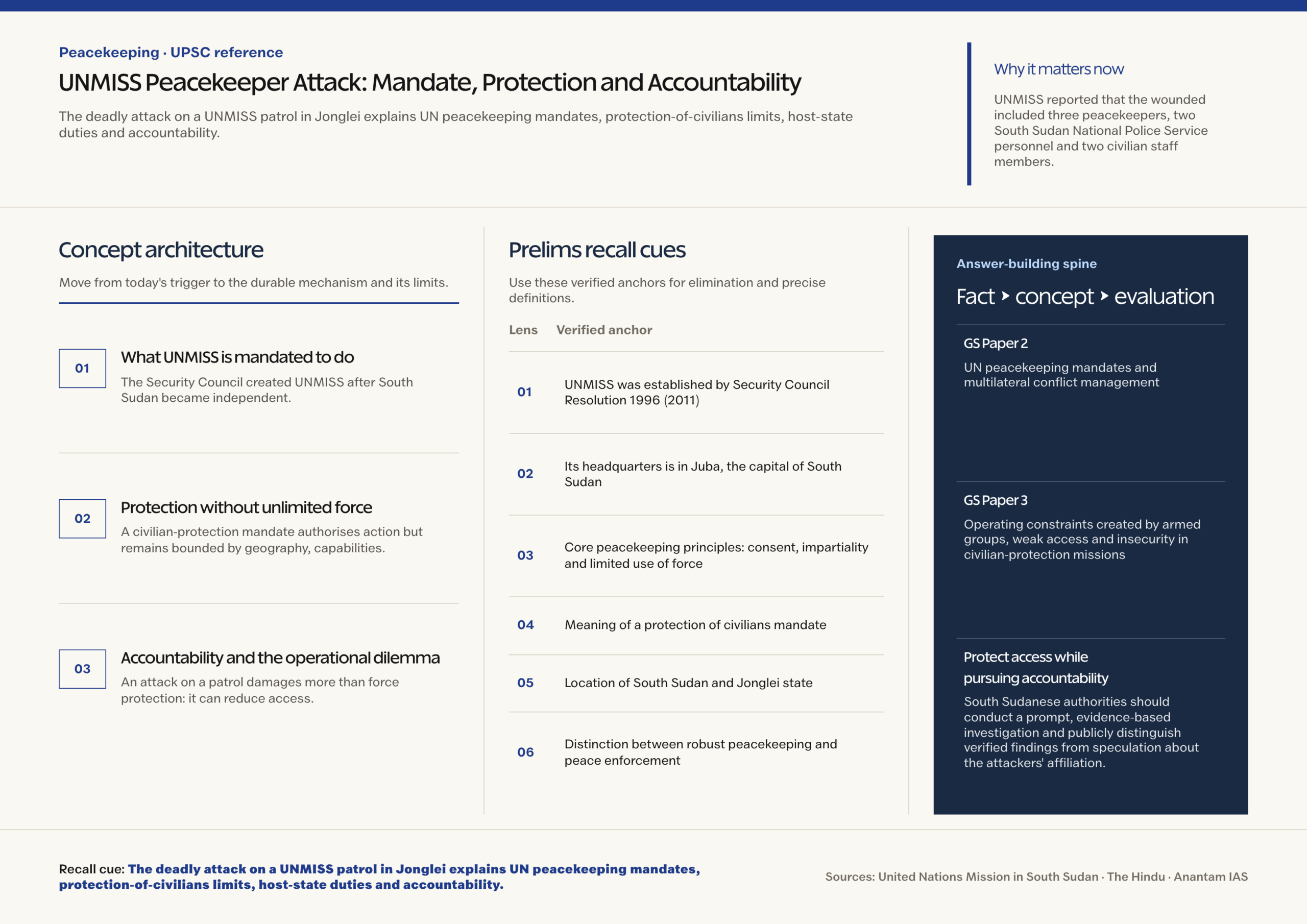
- UNMISS reported that the wounded included three peacekeepers, two South Sudan National Police Service personnel and two civilian staff members.
- A UN spokesperson, as reported by the Associated Press, said the five killed or wounded peacekeepers were Ethiopian.
- No group had immediately claimed responsibility; the mission described the attackers only as unidentified armed individuals.
- UNMISS deployed a Quick Reaction Force to secure the area and support the emergency response, while calling for a prompt investigation.
- The attack shows how peacekeepers implementing a civilian-protection mandate can themselves become targets while travelling through insecure and remote areas.
- It raises an exam-relevant distinction between robust peacekeeping, which retains host-state consent, and peace enforcement, which need not depend on such consent.
UPSC Relevance
Prelims Relevance
- UNMISS was established by Security Council Resolution 1996 (2011)
- Its headquarters is in Juba, the capital of South Sudan
- Core peacekeeping principles: consent, impartiality and limited use of force
- Meaning of a protection of civilians mandate
- Location of South Sudan and Jonglei state
- Distinction between robust peacekeeping and peace enforcement
Mains Relevance
GS Paper 2
- UN peacekeeping mandates and multilateral conflict management
- Host-state responsibility, consent and accountability for attacks on mission personnel
GS Paper 3
- Operating constraints created by armed groups, weak access and insecurity in civilian-protection missions
Essay
- The legitimacy of collective security depends on matching international mandates with access, capability and accountable local institutions.
Background and Context
What UNMISS is mandated to do
The Security Council created UNMISS after South Sudan became independent, then refocused the mission when civil war transformed the country’s security environment.
- South Sudan became independent in July 2011, and Resolution 1996 established UNMISS to consolidate peace and security and help create conditions for development.
- After conflict erupted in December 2013, Resolution 2155 (2014) reprioritised the mission toward civilian protection, human-rights monitoring and support for humanitarian delivery.
- The current mission also supports implementation of the 2018 Revitalized Peace Agreement and monitors, investigates and reports alleged violations of international law and human rights.
- The Security Council renewed UNMISS in April 2026 until 30 April 2027, keeping it active amid renewed political and armed tensions.
- Patrols provide presence, assess threats, engage communities, support safe humanitarian access and deter violence; they do not replace ordinary government administration.
Protection without unlimited force
A civilian-protection mandate authorises action but remains bounded by geography, capabilities, mission rules and the basic principles of United Nations peacekeeping.
- The host state retains primary responsibility for protecting its population; a peacekeeping mission supports that duty rather than acquiring sovereignty over the territory.
- Protection is a whole-of-mission task involving civilian, police and military components through dialogue, early warning, human-rights work, patrols and physical protection.
- Where authorised, peacekeepers may use all necessary means, including force, to protect civilians under physical threat within their capabilities and areas of deployment.
- The three basic principles are consent of the parties, impartiality, and non-use of force except in self-defence or defence of the mandate.
- Robust peacekeeping permits tactical force under Security Council authority and host-state consent; peace enforcement may operate without consent and is conceptually different.
Accountability and the operational dilemma
An attack on a patrol damages more than force protection: it can reduce access, weaken deterrence and leave threatened communities beyond the mission’s practical reach.
- UNMISS said attacks against peacekeepers may constitute war crimes; that wording is conditional because investigators must establish the conflict context, protected status and intent.
- Peacekeeping personnel are protected from intentional attack while entitled to civilian protection under international humanitarian law; participation in hostilities can alter that legal assessment.
- The host authorities must secure evidence, identify suspects and pursue lawful prosecution; the mission can preserve incident records and support cooperation but does not substitute for a criminal court.
- Force protection can require escorts, route assessment and rapid reaction, yet an overly defensive posture may reduce the patrol presence needed to deter threats against civilians.
- For India, a major contributor to UN peacekeeping, the incident reinforces the case for clear mandates, adequate equipment, reliable intelligence and accountability for attacks on deployed personnel.
Way Forward
Protect access while pursuing accountability
- South Sudanese authorities should conduct a prompt, evidence-based investigation and publicly distinguish verified findings from speculation about the attackers’ affiliation.
- UNMISS should combine route intelligence, community-alert networks, medical evacuation planning and proportionate rapid-reaction capacity without abandoning essential civilian-protection patrols.
- The Security Council and contributing countries should align mandates with mobility, surveillance, communications, medical support and other resources required in remote terrain.
- Political engagement must reinforce the 2018 peace framework, freedom of movement for UNMISS and local dialogue that reduces armed mobilisation around vulnerable communities.
Conclusion
- The Pajut ambush illustrates the central peacekeeping paradox: a mission must maintain consent and impartiality while retaining enough reach and force protection to implement a demanding civilian-protection mandate.
- A strong Mains answer should connect the attack to mandate design, host-state responsibility, operational capability, the limits on force and evidence-based accountability rather than assigning blame before investigation.
UPSC Practice Questions
Prelims MCQ 1
With reference to United Nations peacekeeping, consider the following statements:
- Protection of civilians remains primarily the responsibility of the host state.
- Robust peacekeeping and peace enforcement both necessarily require host-state consent.
- A peacekeeping mission may be authorised to use force in defence of its mandate.
How many of the above statements are correct?
(a) Only one (b) Only two (c) All three (d) None
Answer: (b) Only two
Explanation:
Statements 1 and 3 are correct. Robust peacekeeping retains consent, while peace enforcement may operate without the consent of the main parties.
Prelims MCQ 2
The United Nations Mission in South Sudan was originally established by which one of the following Security Council resolutions?
(a) Resolution 1265 (1999) (b) Resolution 1325 (2000) (c) Resolution 1996 (2011) (d) Resolution 2155 (2014)
Answer: (c) Resolution 1996 (2011)
Explanation:
Resolution 1996 established UNMISS in 2011. Resolution 2155 later reprioritised its mandate after conflict erupted in South Sudan.
UPSC Mains Questions
- The attack on a UNMISS patrol exposes the gap between an ambitious protection-of-civilians mandate and difficult field conditions. Examine the mandate, constraints and responsibilities involved.
- Distinguish robust United Nations peacekeeping from peace enforcement. How do consent, force protection and accountability shape a mission’s legitimacy and effectiveness?
Sources: United Nations Mission in South Sudan and The Hindu.
Frequently Asked Questions
What happened to the UNMISS patrol near Pajut?
Unidentified armed individuals ambushed the patrol in Jonglei on 24 August 2026. UNMISS reported two peacekeepers killed and seven people injured; no group immediately claimed responsibility.
What is UNMISS?
UNMISS is the United Nations Mission in South Sudan, established by Security Council Resolution 1996 in 2011 to support peace and security after the country’s independence.
What does protection of civilians mean in peacekeeping?
It combines dialogue, early warning, human-rights work and physical protection, including authorised force when necessary, within the mission’s capabilities and deployment area.
Can United Nations peacekeepers use force?
Yes, when authorised, they may use proportionate force in self-defence or defence of the mandate. Robust peacekeeping remains distinct from strategic peace enforcement.
Is every attack on a peacekeeper automatically a war crime?
No. It may constitute a war crime when the relevant legal elements are proved, including conflict context, intent and the personnel’s protected status at the time.
Source: https://anantamias.com/current-affairs/unmiss-peacekeeper-attack-south-sudan/
Newborn Healthcare and Safety in India
Why in News?
Three newborns died after a ventilator reportedly caught fire in the Special Newborn Care Unit (SNCU) of a district hospital in Amravati, Maharashtra.
Although 36 infants were rescued, the reported failure of fire alarms and automatic sprinklers has raised questions about hospital safety, equipment maintenance and accountability in public-health institutions.
| UPSC Relevance: GS-2 Social Justice: Health services, Children and Vulnerable Sections Prelims: SNCUs, JSSK, RBSK, HBNC, NMR, and Universal Immunisation Programme Mains: Neonatal healthcare, public-health infrastructure and regulatory accountability |
What are Special Newborn Care Units?
- SNCUs are established under the Facility-Based Newborn Care programme of the National Health Mission at district hospitals, sub-district hospitals and medical colleges.
- They provide round-the-clock secondary care to premature, low-birth-weight and critically ill newborns.
Issues Highlighted by the Incident:
- Fire-safety failures: Non-functional alarms and sprinklers can turn an equipment malfunction into a mass-casualty event.
- Equipment maintenance: Ventilators, incubators and oxygen-rich environments require regular electrical and preventive safety audits.
- Weak enforcement: Newly constructed buildings may remain unsafe if fire clearances and periodic inspections become procedural formalities.
- Evacuation difficulties: Critically ill newborns cannot be disconnected or shifted as easily as other patients.
- Staff preparedness: Hospitals require trained personnel, evacuation drills and neonatal-specific disaster protocols.
- Fragmented accountability: Hospital management, fire authorities, equipment suppliers and public works agencies may operate without unified responsibility.
- Quality beyond access: Expansion of institutional deliveries and SNCUs must be accompanied by safety, infection control and reliable infrastructure.
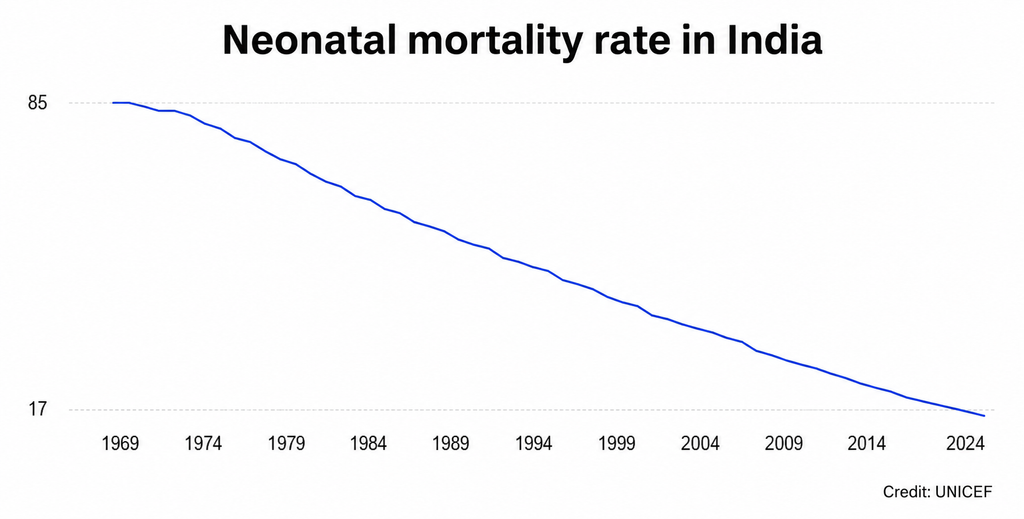
Neonatal Mortality Rate in India:
- India’s neonatal mortality rate (the number of infant deaths during the first 28 days of life per 1,000 live births) dropped from 28 per 1000 live births in 2015 to 17 per 1000 live births by 2023.
Major Central Initiatives for Newborns:
- Facility-Based Newborn Care (FBNC): Implemented by the Ministry of Health and Family Welfare (MoHFW) under the National Health Mission. It creates a three-tier system:
- Newborn Care Corners at delivery points for immediate care and resuscitation
- Newborn Stabilisation Units at CHCs and first-referral units for stabilisation before referral
- Special Newborn Care Units at district hospitals for resuscitation, stabilisation and treatment of premature, low-birth-weight and sick newborns.
- Home-Based Newborn Care (HBNC): Implemented by MoHFW through NHM and ASHA workers, it extends newborn care from health facilities to households. ASHAs undertake six visits after an institutional delivery (on days 3, 7, 14, 21, 28 and 42) and an additional first-day visit following a home delivery to promote breastfeeding, warmth, hygiene and early referral of sick newborns.
- Janani Shishu Suraksha Karyakram (JSSK): Launched in 2011 by MoHFW, it seeks to eliminate out-of-pocket expenditure associated with childbirth and infant illness. It guarantees pregnant women and sick infants up to one year free treatment, medicines, diagnostics, blood, diet, referral transport and exemption from user charges in public health institutions.
- Janani Suraksha Yojana (JSY): A 100% Centrally Sponsored Scheme under NHM, launched in 2005 to reduce maternal and neonatal mortality by promoting institutional deliveries. Cash assistance varies by area and State category. E.g., Eligible mothers in Low-Performing States receive ₹1,400 in rural and ₹1,000 in urban areas, with separate incentives for ASHAs.
- Universal Immunisation Programme (UIP): Implemented by MoHFW, UIP provides vaccines free of cost against diseases covered by the National Immunisation Schedule. Birth doses include BCG, zero-dose oral polio vaccine and hepatitis-B vaccine, while subsequent doses protect against diseases such as diphtheria, pertussis, tetanus, measles, rubella and pneumonia.
- Rashtriya Bal Swasthya Karyakram (RBSK): Implemented by MoHFW under NHM, it screens children from birth to 18 years for the 4Ds (defects at birth, diseases, deficiencies and developmental delays), covering identified health conditions. Children receive free referral, early intervention, treatment and, where necessary, surgery through District Early Intervention Centres and empanelled institutions.
- SUMAN (Surakshit Matritva Aashwasan): Launched by MoHFW in 2019, SUMAN assures pregnant women, mothers up to six months after delivery and sick newborns respectful, dignified and zero-expense healthcare in public facilities. It also emphasises assured referral, grievance redressal and zero tolerance for denial of essential services.
- LaQshya (Labour Room Quality Improvement Initiative): Launched by MoHFW in 2017, it improves the quality of care in labour rooms and maternity operation theatres of public hospitals. It focuses on standardised clinical protocols, respectful maternity care, infection control and prevention of avoidable maternal and newborn deaths; compliant facilities receive quality certification.
- Mission Indradhanush: Launched by MoHFW in 2014, it identifies and vaccinates children and pregnant women who are unvaccinated or partially vaccinated under UIP. Its intensified rounds focus on districts, urban slums, migratory settlements and other pockets with low immunisation coverage; vaccines are provided free of cost.
- Saksham Anganwadi and POSHAN 2.0: Implemented by the Ministry of Women and Child Development, it subsumes Anganwadi Services, POSHAN Abhiyaan and nutritional support for specified beneficiaries. It provides supplementary nutrition, growth monitoring, health check-ups, immunisation linkages and referral services for children below 6 years, pregnant women and lactating mothers, with special emphasis on the first 1,000 days.
- Pradhan Mantri Matru Vandana Yojana (PMMVY): A Centrally Sponsored maternity-benefit scheme implemented by the Ministry of Women and Child Development under Mission Shakti. Eligible women receive ₹5,000 through DBT for the first child in two instalments and ₹6,000 for the second child if the child is a girl, subject to pregnancy registration, antenatal care, birth registration and initial immunisation.
Way Forward:
- Conduct mandatory electrical, fire and medical equipment audits of all SNCUs
- Link hospital empanelment and accreditation to valid fire safety certification
- Install functional alarms, sprinklers, smoke extraction systems and uninterrupted backup power
- Frame neonatal-specific evacuation protocols and conduct regular mock drills
- Ensure preventive maintenance and traceability of ventilators and incubators
- Fix responsibility across hospital administrators, contractors and equipment suppliers; and
- Expand SNCUs without compromising trained manpower, infection control and quality standards.
The Amravati tragedy demonstrates that institutional delivery alone cannot guarantee newborn survival. India must move from merely expanding neonatal facilities to ensuring safe, accountable and quality-assured care, consistent with Article 21 and the Sustainable Development Goal of ending preventable newborn deaths.
Source: https://anantamias.com/current-affairs/newborn-healthcare-and-safety-in-india/
NCDC Amendment Act 2026 and Federalism Concerns
Why in News?
The Samyukt Kisan Morcha (SKM) has criticised the National Co-operative Development Corporation (Amendment) Act, 2026, alleging that it weakens the federal rights of States, centralises control over cooperatives and may divert resources from agriculture and rural development towards urban and non-agricultural activities.
The legislation, passed by Parliament on August 12, amends the National Co-operative Development Corporation Act, 1962, substantially widening the financial and operational mandate of NCDC.
| UPSC Relevance: GS-2 Polity and Governance: Federalism, Cooperative Societies; GS-3 Economy: Agriculture and Institutional Finance Prelims: NCDC; Constitutional status of cooperatives; 97th Constitutional Amendment Mains: Cooperative federalism, Autonomy of cooperatives and agricultural finance |
What is the NCDC?
- The National Co-operative Development Corporation is a statutory corporation established in 1963 under the NCDC Act, 1962. It functions under the Ministry of Cooperation.
- Its traditional mandate covers planning, promotion and financing of cooperative programmes relating to:
- Production, processing and marketing of agricultural produce
- Storage, export and import of agricultural commodities
- Dairy, livestock, poultry, fisheries and handloom activities
- Sugar, textiles, food processing and cold-chain infrastructure; and
- Rural industries and specified services.
- NCDC provides loans and grants through State governments and also directly finances eligible cooperative societies. During 2025-26, it reportedly sanctioned approximately ₹1.55 lakh crore and disbursed ₹1.27 lakh crore.
Major Provisions of the 2026 Amendment:
- Wider concept of Cooperative Development: The Act introduces cooperative development, i.e., the planning, promotion and financing of programmes for cooperative societies, either directly or through an intermediary entity. This shifts NCDC’s mandate from financing programmes primarily through cooperative societies to financing the wider cooperative development ecosystem.
- Direct financing through intermediary entities: NCDC can provide loans and grants directly (bypassing traditional bureaucratic layers) to cooperative societies or any entity engaged in cooperative development. Such assistance may be made conditional upon the furnishing of security. NCDC Board will determine which institutions qualify as entities engaged in cooperative development. These may include specialised agencies providing infrastructure, technology, marketing or processing services to cooperatives.
- Participation in share capital: With the approval of the Union government, NCDC may acquire or participate in the share capital of cooperative societies and entities engaged in cooperative development. This is intended to expand the availability of patient capital but has generated concerns about government influence over member-owned institutions.
- Wider range of eligible activities: NCDC can finance the production, processing, marketing, storage, import and export of agricultural produce, foodstuffs and livestock, notified commodities and services and Industrial goods. The definition of foodstuffs has been expanded to include processed food, other edible products and additional food items notified by the Union government.
- Removal of rural-area restriction: Earlier, eligible industrial goods were linked to industrial cooperatives, cottage and village industries or allied industries situated in rural areas. The amendment removes the expression “in the rural area”. NCDC assistance can consequently support industrial and craft-based cooperative activities irrespective of their rural or urban location.
- Wider incidental powers: NCDC may undertake activities necessary, incidental or consequential to discharging its functions under the NCDC Act or any other applicable law. This provides greater operational flexibility but leaves the precise limits of these powers open to administrative interpretation.
- Sharing of credit information: NCDC may collect credit or other relevant information from (or furnish it to) the Union government, Reserve Bank of India, Banks and Financial institutions notified by the Union government. The provision is intended to improve credit appraisal, risk management and financial coordination.
Rationale Behind the Amendment:
- Diversification of cooperatives: Cooperatives now operate in sectors such as housing, tourism, energy, healthcare, logistics and digital services.
- Faster financing: Direct assistance can reduce delays associated with routing every proposal through State governments.
- Specialised intermediaries: Technology, infrastructure and marketing agencies may support cooperatives even if they are not themselves registered as cooperative societies.
- Greater access to capital: Loans, grants and equity participation provide multiple financing channels.
- Urban cooperatives: Removal of the rural restriction recognises that cooperatives also serve artisans, workers, consumers and service providers in urban areas.
- Professional credit management: Information-sharing provisions may improve appraisal and reduce defaults.
Federalism and Autonomy Concerns:
- Erosion of States’ intermediary role: Although Entry 32 of the State List empowers States to regulate cooperatives operating within their territory, NCDC can now finance State-registered cooperatives and supporting entities directly, bypassing the traditional channel of State governments.
- Indirect Central influence: NCDC, with Union government approval, may participate in the share capital of cooperatives. Lending conditions and equity participation could consequently influence their priorities and functioning without formally transferring the regulatory powers of State Registrars.
- Threat to cooperative autonomy: Government equity or conditional financing may weaken democratic member control, autonomy and independence (principles recognised by the International Cooperative Alliance), particularly if accompanied by board representation or administrative conditions.
- Centralised administrative discretion: The NCDC Board can determine which intermediary entities qualify as being engaged in “cooperative development”. The absence of detailed statutory criteria may create scope for selective financing and excessive central discretion.
- Possible dilution of rural focus: Removal of the requirement that eligible industrial and village cooperatives operate only in rural areas enables assistance to urban cooperatives. However, without sectoral safeguards, it could divert limited resources away from agriculture, primary cooperatives and village industries.
The amendment does not expressly take away the States’ regulatory authority. The principal concern is whether Central financial leverage could indirectly weaken cooperative autonomy and the effective role of State governments.
Way Forward:
- Preserve the regulatory authority of States over State-registered cooperatives
- Consult State governments while financing large projects involving their cooperative institutions
- Require the prior, informed approval of a cooperative’s general body before NCDC equity participation
- Establish transparent criteria for selecting intermediary entities
- Ring-fence an adequate share of NCDC resources for agriculture, PACS and rural industries
- Disclose financing decisions, equity holdings, defaults and developmental outcomes
- Include representatives of States and cooperative federations in decision-making; and
- Ensure that financial support strengthens rather than displaces democratic member control.
The amendment can modernise cooperative finance by permitting direct funding, equity support and assistance through specialised intermediaries.
Nevertheless, the success of the reform will depend on maintaining a careful distinction between central financial assistance and State regulatory authority. Cooperative development must remain consistent with federalism, democratic control and the principle that cooperatives are institutions owned by their members, not extensions of governments or corporations.
Source: https://anantamias.com/current-affairs/ncdc-amendment-act-2026-and-federalism-concerns/
Youth Unemployment has a Household Cost
Why in News?
The Periodic Labour Force Survey 2025 reported an unemployment rate of 14.8% among youth aged 18-29, rising to 29.4% among tertiary-educated youth.
Beyond the individual jobseeker, prolonged unemployment also imposes substantial financial and social costs on families that financed higher education and continue to support the transition from education to employment.
| UPSC Relevance: GS-2 Social Justice: Education and human-resource development; GS-3 Economy: Employment and inclusive growth Prelims: PLFS; unemployment rate; labour-force participation; NEET Mains: Educated unemployment, demographic dividend and household welfare. |
Understanding the Indicators:
- Unemployment rate measures unemployed persons as a proportion of the labour force. A person must be without work but actively seeking or available for work to be counted as unemployed. It does not include those who have stopped searching, are unavailable for work or remain outside the labour force due to care responsibilities, mobility restrictions or discouragement.
- NEET (Not in Employment, Education or Training) is a wider measure. Around 40.1% of tertiary-educated youth reportedly fall within this category. Among tertiary-educated young women classified as NEET, approximately 74.7% are outside the labour force, highlighting the gendered nature of labour-market exclusion.
Household Costs of Youth Unemployment:
- Reduced consumption: Households supporting an unemployed, tertiary-educated young person spend, on average, around ₹1,087 less per month overall and ₹710 less per household member than comparable households without an educated unemployed youth.
- Fewer earners: Such households have an average of 1.5 earning members, compared with two among households without an educated unemployed youth. Around 14.4% have no active earner, while 39.5% depend on a single earner.
- Weak income security: Nearly 62.5% of affected households have no member holding a regular salaried job. Consequently, income may depend on casual labour, agriculture or precarious self-employment.
- Prolonged financial support: Around 58% of unemployed tertiary-educated youth have searched for work for more than a year, while 28.9% have remained unemployed for over two years. Families must continue financing food, housing, transport, coaching, examinations and job applications during this period.
- Depletion of household assets: Extended unemployment may reduce savings, increase indebtedness, defer healthcare and education expenditure and prevent investment in the education of younger siblings.
- Forced occupational downgrading: Poorer households cannot sustain an extended search for suitable work. Their young members may be compelled to accept insecure or low-paid jobs unrelated to their qualifications, leading to underemployment and skill erosion.
- Unequal opportunity: Wealthier households can finance longer job searches, unpaid internships, migration and competitive examination preparation. Household income therefore influences not only access to education but also the ability to wait for an appropriate job.
Why Educated Youth Face Greater Unemployment?
- Education-employment mismatch: Degrees may not provide the technical, digital, communication and practical skills demanded by employers.
- Insufficient quality jobs: Economic growth has not generated enough secure and productive jobs matching the aspirations of educated youth.
- Public recruitment delays: Vacancies, prolonged examinations, litigation and paper leaks extend the transition from education to employment.
- Qualification inflation: Young people acquire additional degrees because entry-level qualifications no longer guarantee employment.
- Spatial mismatch: Jobs are concentrated in major cities, while migration involves unaffordable housing, transport and social costs.
- Gender barriers: Unpaid care work, safety concerns, discriminatory hiring and lack of transport or childcare push many educated women outside the labour force.
- Preference for secure employment: Low wages and insecurity in private employment encourage prolonged preparation for limited government jobs.
Existing Government Initiatives:
- Pradhan Mantri Viksit Bharat Rojgar Yojana: Provides incentives to first-time formal-sector employees and employers generating additional employment. First-time employees may receive one month’s wage up to ₹15,000.
- Prime Minister’s Internship Scheme: Provides 12 months of workplace exposure, with government support of ₹5,000 per month and one-time assistance of ₹6,000, to eligible youth.
- Skill India and PMKVY: Promote short-term, industry-oriented skill training and certification.
- National Apprenticeship Promotion Scheme: Encourages establishments to engage apprentices by sharing training-related costs.
- National Career Service: Connects jobseekers, employers, counsellors and training providers through an integrated employment platform.
- ITI Upgradation Scheme: Seeks to upgrade 1,000 government ITIs and skill 20 lakh youth through industry-linked training.
Limitations of the Existing Approach:
Employment policy generally treats joblessness as an individual deficiency to be addressed through skilling, apprenticeships or hiring incentives. This can overlook:
- The shortage of suitable jobs
- The household cost of financing prolonged searches
- Recruitment delays created by public institutions
- Gendered labour-force withdrawal; and
- Differences in families’ capacity to support unemployed youth.
Skilling without corresponding labour demand may simply produce more qualified jobseekers.
Way Forward:
- Track duration of unemployment and NEET status, alongside the headline unemployment rate.
- Publish disaggregated data by education, gender, caste, region and household income.
- Establish fixed recruitment calendars, fill sanctioned vacancies and strengthen safeguards against examination paper leaks.
- Expand apprenticeships and paid internships, particularly for youth from low-income households.
- Align university and vocational curricula with local industry through employer partnerships.
- Provide affordable hostels, transport, childcare and safe workplaces to increase women’s participation.
- Develop employment-intensive sectors such as textiles, food processing, tourism, healthcare, construction and MSMEs.
- Strengthen unemployment assistance, job-search allowances or targeted income support linked to counselling and training.
- Measure schemes by sustained employment, wages and job quality rather than enrolment or certification alone.
Youth unemployment is not merely an individual labour-market outcome; it represents a continuing transfer of costs to families. Unless India shortens the transition from education to productive work and generates sufficient quality employment, its demographic dividend may deepen household insecurity, inequality and social frustration.
Source: https://anantamias.com/current-affairs/youth-unemployment-has-a-household-cost/
Pollution Threat to Assam’s Semiconductor Facility
Why in News?
Environmental groups have warned that dust, blasting and vibrations from stone quarries and crushers near the upcoming Tata Semiconductor Assembly and Test (TSAT) facility at Jagiroad in Assam could threaten its operations.
The controversy highlights the need to integrate industrial policy, environmental regulation and land-use planning while developing strategically important high-technology infrastructure.
| UPSC Relevance: GS-3 Economy: Industrial policy and infrastructure; GS-3 Environment: Pollution and environmental governance Prelims: India Semiconductor Mission, OSAT/ATMP, Semiconductor value chain Mains: Strategic manufacturing, environmental regulation and sustainable industrialisation |
About Jagiroad Semiconductor Project:
- Jagiroad is an OSAT/ATMP facility, not a semiconductor wafer-fabrication plant. An Outsourced Semiconductor Assembly and Test facility cuts fabricated wafers into individual dies, packages them, establishes electrical connections and tests the finished chips.
- The facility is being developed by Tata Semiconductor Assembly and Test Private Limited at Jagiroad in Assam’s Morigaon district.
- It involves an investment of approximately ₹27,000 crore and is being constructed on the site of a former Hindustan Paper Corporation unit.
- Its proposed capacity is up to 48 million semiconductor chips per day. The project is expected to generate approximately 15,000 direct and 11,000-13,000 indirect jobs.
- It will use packaging technologies such as wire bonding, flip-chip and Integrated Systems Packaging.
- The packaged chips will serve automotive, electric-vehicle, telecommunications, consumer-electronics and network-infrastructure markets.
Strategic Significance:
- Reduces dependence on imported chips
- Strengthens supply-chain resilience against geopolitical disruptions
- Supports electronics, defence, telecommunications, automobiles and renewable energy
- Attracts investment in materials, equipment, design and component manufacturing
- Generates high-skilled employment; and
- Promotes balanced regional development by locating advanced manufacturing in the Northeast.
Why Dust and Blasting remain Serious Risks?
- Particulate contamination: Stone crushers release coarse and fine particulate matter, including respirable dust. Microscopic dust can contaminate semiconductor dies, bonding surfaces and electrical contacts. It can cause defective connections, reduce production yield, increase filtration costs and result in product rejection. High ambient dust also puts continuous pressure on cleanroom filtration and air-handling systems.
- Vibrations from blasting: Quarry blasting and crushing operations generate ground vibrations that can disrupt precision instruments, robotic systems, advanced packaging equipment and structural installations. A safe buffer should therefore be determined through a scientific vibration-propagation study.
- Water-security concerns: Semiconductor assembly requires reliable supplies of high-quality water for cleaning, cooling and other utilities. Quarry run-off, sedimentation and groundwater disturbance may threaten both industrial operations and community water security.
- Risk to public investment: Semiconductor projects receive substantial government support. Uncontrolled pollution could delay production, weaken export commitments, waste public resources and damage India’s credibility as a destination for precision manufacturing.
| India Semiconductor Mission: The India Semiconductor Mission, administered through the Ministry of Electronics and Information Technology, was launched under the ₹76,000 crore Semicon India Programme to develop a sustainable semiconductor and display manufacturing ecosystem. The Modified Semicon India Programme offers up to 50% fiscal support on a pari-passu basis for eligible semiconductor projects. Its major components include: Modified Scheme for semiconductor fabrication plants; Modified Scheme for display fabs; Scheme for compound semiconductors, silicon photonics, sensors and discrete semiconductors; Scheme for ATMP/OSAT facilities; and Design Linked Incentive Scheme for semiconductor design companies. |
Governance Issues Highlighted:
- Fragmented approvals: Mining, forest, pollution control and industrial agencies may grant clearances without considering their cumulative impact.
- Incompatible land use: High-pollution industries and precision manufacturing should not be located within the same airshed without proper zoning.
- Grandfathering of polluters: Exempting existing or pipeline projects may defeat the purpose of creating a protected environment around strategic facilities.
- Weak monitoring: Conditions imposed at the clearance stage may remain unenforced after operations begin.
- Development-environment conflict: Protecting the semiconductor plant alone, while overlooking the health and livelihood concerns of surrounding communities, would be inadequate.
- Absence of cumulative assessment: Individual quarry clearances may fail to capture the combined impact of multiple mines and crushers.
Way Forward:
- Conduct an independent cumulative environmental and industrial risk assessment covering air pollution, blasting vibrations, hydrology, forest loss and flood risks.
- Determine a scientifically justified buffer or clean-industry protection zone around the facility; the proposed 15-km radius should be evaluated rather than accepted automatically.
- Install continuous monitoring stations for PM10, PM2.5, silica dust, noise and ground vibration, with publicly accessible data.
- Review the consent, mining lease, environmental clearance and forest approval of every quarry and crusher in the affected zone.
- Suspend illegal or non-compliant operations and relocate incompatible units through a transparent process with compensation and rehabilitation.
- Require enclosure of crushers, water-spraying systems, covered conveyors, paved roads and covered transportation of minerals.
- Undertake catchment restoration, slope stabilisation and afforestation in quarry-affected hills.
- Ensure water recycling, rainwater harvesting and a project-specific water security plan for TSAT without compromising local needs.
- Establish a joint monitoring mechanism involving MeitY, the Assam government, the State Pollution Control Board, ISM, local bodies, community representatives and technical experts.
- Incorporate environmental and locational risk assessments at the project-selection stage of future semiconductor clusters.
The Jagiroad controversy demonstrates that industrial incentives alone cannot create a competitive semiconductor ecosystem. Precision manufacturing depends on clean air, stable ground, dependable water and sound land-use planning.
Source: https://anantamias.com/current-affairs/pollution-threat-to-assams-semiconductor-facility/
In-Principle Approval for Airports’ Privatisation
Why in News?
The Public Private Partnership Appraisal Committee (PPPAC) has granted in-principle approval to lease 11 Airports Authority of India (AAI) airports to private operators under the PPP model.
The airports have been grouped into five bundles for a proposed 50-year concession, with an estimated private investment of ₹8622 crore.
| UPSC Relevance: GS-3 Economy: Infrastructure, PPPs and Investment Models Prelims: PPPAC, AAI, AERA, airport bundling |
Proposed Airport Bundles:
The 11 airports have been grouped into five bundles:
- Amritsar-Kangra-Gaggal
- Varanasi-Gaya-Kushinagar
- Bhubaneswar-Hubballi
- Raipur-Aurangabad
- Tiruchirappalli-Tirupati
Each bundle combines a relatively stronger airport with one or more smaller airports. This allows revenue from commercially viable airports to support investment and operations at less profitable ones.
What Does Privatisation Mean?
The airports are not being permanently sold. Private concessionaires would operate, manage and develop them for the concession period, while ownership would remain with AAI.
- Air traffic control and communication, navigation and surveillance services will remain with AAI.
- Airport tariffs will continue to be regulated by the Airports Economic Regulatory Authority (AERA).
- Bids are expected to be evaluated primarily on the per-passenger fee offered to AAI.
- A one-year joint-management period involving AAI employees has been proposed, followed by retention of at least 60% of them for up to three years.
The proposal requires a final PPPAC recommendation before being placed before the Cabinet Committee on Economic Affairs (CCEA).
Why Privatise Airports?
- Mobilising capital: Reduces dependence on public funds for expansion and modernisation.
- Operational efficiency: Private operators may introduce better technology, management and passenger services.
- Revenue for AAI: Lease and passenger-linked payments can finance airports in remote and underserved regions.
- Regional connectivity: Bundling can improve the viability of smaller airports.
- Asset monetisation: Unlocks the value of existing public infrastructure without transferring ownership permanently.
Key Concerns:
- Market concentration: Airport operations are already concentrated among a few private groups. In the 2019 round, the Adani Group won all six airports offered, after recommendations to cap awards at two airports per bidder were not accepted.
- Over-leveraging: Excessive borrowing by one operator could create risks across several airports.
- Higher user charges: Private operators may prioritise commercial returns, affecting passenger affordability.
- Cross-subsidisation risk: Smaller airports may receive inadequate attention if traffic and revenue remain weak.
- Long concession period or lease reduces opportunities for competitive rebidding.
- Regulatory capacity: Effective AERA oversight is essential to prevent monopoly pricing and deterioration in service quality.
Safeguards Proposed:
The Civil Aviation Ministry plans to cap the number of airport bundles that a single bidder can win. The exact limit is yet to be finalised.
Additional safeguards should include:
- Strict financial and technical qualification criteria
- Assessment of bidder debt and related-party exposure
- Measurable service-quality and capacity-expansion obligations
- Periodic performance reviews
- Protection of employees and passenger interests; and
- Strong competition and tariff regulation.
Airport PPPs can mobilise capital and improve services, but airports are strategic public utilities with natural-monopoly characteristics. The latest round should therefore combine private efficiency with competition, affordable tariffs, strong regulation and protection against excessive concentration.
Source: https://anantamias.com/current-affairs/in-principle-approval-for-airports-privatisation/
What has fuelled the Backlash against Flock Cameras in the U.S.?
Why in News?
Flock Safety, which operates a large network of Automated Licence Plate Reader (ALPR) cameras in the U.S., is facing criticism after reports that some police officers misused its databases, including to track former partners.
The controversy has raised wider concerns about mass surveillance, data sharing, purpose creep and the growing role of private companies in policing.
| UPSC Relevance: GS-2 Polity and Governance: Fundamental Rights, Privacy, Data protection; GS-3 Science and Technology: AI and surveillance Prelims: ALPR/ANPR, Facial recognition, DPDP Act Mains: Balance between public safety and civil liberties |
How do Flock Cameras Work?
Flock follows a surveillance-as-a-service model, providing cameras, cloud storage, alerts and searchable databases through subscriptions.
Its ALPR cameras record:
- Vehicle registration plate
- Time and location
- Make, model, colour and body type; and
- Features such as stickers, dents or roof racks.
The data can be matched with lists of stolen or wanted vehicles. Police departments may also share access with other agencies, turning local cameras into a wider surveillance network.
While Flock uses AI-based image recognition, it maintains that its ALPR system does not use facial recognition, predictive policing or demographic profiling.

Potential Benefits:
Flock cameras can help police:
- Trace stolen or wanted vehicles
- Locate missing persons
- Investigate hit-and-run and organised crime cases; and
- Generate evidence where other investigative leads are limited.
However, many claims regarding crimes solved using the technology are based on company and customer estimates rather than uniform independent evaluation.
What has Fuelled the Backlash?
- Mass tracking: Aggregated plate sightings can reconstruct a person’s movements and reveal visits to hospitals, protests, religious institutions or political meetings.
- Official misuse: Police officers have allegedly used the database to stalk partners and relatives, exposing weak access controls and supervision.
- Mission creep: A system promoted for serious crimes has reportedly been used for minor matters such as noise complaints, background checks and school-residency verification.
- Sensitive enforcement: A Texas sheriff’s office reportedly searched a vast ALPR network during an abortion-related investigation, demonstrating how surveillance can be redirected towards personal healthcare decisions.
- Uncontrolled data sharing: Information collected by one community may be searched by agencies in other States or by federal authorities for different purposes, including immigration enforcement.
- Private control: A commercial company manages infrastructure performing a public-policing function, raising questions about data ownership, cybersecurity, transparency and accountability.
- Lack of public consent: Cameras have often been installed through administrative contracts without adequate public consultation or clarity over retention and sharing policies.
- Chilling effect: Fear of being tracked may discourage people from attending protests, political meetings, places of worship or healthcare facilities.
Public opposition has included protests, mapping cameras through the DeFlock platform and demands for cancellation of municipal contracts.
Flock’s Response:
The company has announced:
- Reduction of default data retention from 30 to seven days
- Mandatory case codes for searches
- Offence-based search restrictions
- Multi-factor authentication
- Tools to detect unusual search behaviour; and
- Temporary lockouts pending administrative review.
Effectiveness depends on independent audits, active supervision and penalties for misuse.
Relevance for India:
India increasingly uses ANPR cameras, facial-recognition systems and AI-enabled surveillance vehicles for traffic enforcement, public safety and policing.
The concerns are similar:
- India has no dedicated law governing facial recognition or ANPR surveillance.
- In K.S. Puttaswamy, the Supreme Court held that privacy restrictions must satisfy legality, necessity and proportionality.
- The DPDP Act regulates personal data processing but does not independently authorise surveillance or prescribe warrant requirements.
- Most substantive DPDP provisions are scheduled to become operational in May 2027.
- The Act provides exemptions for certain law-enforcement and security-related processing.
- India lacks uniform rules governing biometric data, retention periods, inter-agency sharing and independent audits.
The deployment of facial recognition and ANPR-equipped surveillance vehicles at the 2026 Jantar Mantar protests highlights the risk of surveillance discouraging lawful political participation.
Way Forward:
- Enact a comprehensive law governing police surveillance.
- Require judicial authorisation for historical or network-wide searches, except during emergencies.
- Prescribe strict purpose limitation and short retention periods.
- Maintain tamper-proof access logs and independent audits.
- Publish camera locations, data-sharing arrangements and retention policies.
- Prohibit indiscriminate tracking of protesters and lawful assemblies.
- Impose penalties for unauthorised searches and provide remedies for wrongful identification.
- Require verified deletion of government data after contracts end.
The Flock backlash is not merely against roadside cameras. It reflects concern over the combination of networked surveillance, searchable movement histories, private control and weak accountability.
India must establish legal safeguards before fragmented cameras evolve into an integrated system capable of continuously tracking citizens.
Smart Glasses Expose Gaps in India’s Privacy Framework
Why in News?
The growing use of AI-powered smart glasses, equipped with discreet cameras, microphones and speakers, has raised concerns over non-consensual recording, biometric surveillance and misuse of personal data.
Unlike smartphones, these devices can record continuously without attracting attention, making traditional ideas of notice and consent increasingly inadequate.
| UPSC Relevance: GS-2 Polity and Governance: Fundamental Rights, Data protection; GS-3 Science and Technology: AI, cybersecurity and emerging technologies; GS-4 Ethics: Privacy, consent and corporate accountability Prelims: DPDP Act, 2023, Right to Privacy, IT Act, 2000, Data Protection Board Mains: Technology-law gap, Privacy in public spaces, Regulation of AI-enabled wearables |
What are Smart Glasses?
Smart glasses combine conventional eyewear with digital capabilities such as:
- Cameras and microphones for hands-free recording
- Voice assistants, calls, messaging and music
- AI-based translation, navigation and object recognition
- Cloud connectivity and real-time content sharing; and
- Potential facial recognition and augmented-reality applications.
They can improve accessibility for persons with disabilities, industrial productivity, navigation, education and emergency response.
However, their inconspicuous design also converts ordinary eyewear into a potentially continuous surveillance device.

Major Privacy and Ethical Concerns:
- Consent asymmetry: Manufacturers may give control to the wearer, but persons appearing in the frame generally receive no meaningful notice or opportunity to consent. Small LEDs or shutter sounds are inadequate in crowded and noisy spaces and may be obscured or circumvented.
- Privacy does not disappear in public: In K.S. Puttaswamy v. Union of India (2017), the Supreme Court recognised privacy as a fundamental right arising primarily from Article 21. It subsequently reiterated that privacy attaches to the person, not merely to a private place. Thus, entry into a street, classroom or workplace does not amount to blanket consent to persistent recording, identification or profiling.
- Function creep: A recording initially made for personal convenience may later be uploaded to social media, analysed using facial recognition, combined with location and voice data, used for targeted advertising or profiling, or reviewed by third-party contractors.
- Disproportionate impact on vulnerable groups: Covert recording can facilitate voyeurism, stalking, sexual harassment, doxing and child sexual exploitation. NCRB recorded 3,678 cybercrime cases specifically targeting women in 2023, including 2,767 cases involving obscene or sexually explicit material.
- Sensitive institutional spaces: Smart glasses can inadvertently or deliberately capture:
- Medical records and patient consultations
- Confidential workplace documents
- Examination papers and classroom lectures
- Court proceedings
- Private conversations; and
- Copyright-protected performances and films.
The long battery life of such devices magnifies the scale of incidental data collection.
India’s Existing Legal Framework:
Digital Personal Data Protection Act, 2023:
- The DPDP Act is technology-neutral and covers digitally processed personal data relating to an identifiable individual. It provides for consent, purpose limitation, security safeguards, erasure and additional protection for children.
However, several gaps remain:
- Personal or domestic use exemption: Data processed by an individual purely for a personal or domestic purpose falls outside the Act. This may shield initial recording by an individual, though subsequent commercial processing by a platform may still be regulated.
- Bystander problem: Rights under the Act are difficult to exercise when people do not know that they have been recorded or which entity is processing their data.
- No separate category of sensitive personal data: The Act does not expressly impose differentiated protection for biometric, health or sexual data.
- Publicly available data: The exclusion applies only when data have been made public by the individual concerned or under a legal obligation. Merely being present in a public place does not automatically make one’s image “publicly available”.
- Phased implementation: As of August 2026, many substantive obligations relating to consent, data-fiduciary duties and individual rights are scheduled to become operational only in May 2027.
Other applicable laws:
- Section 66E, IT Act: Punishes capturing or transmitting images of a person’s private area without consent, but is narrower than a general prohibition on covert recording.
- Sections 67A and 67B, IT Act: Address sexually explicit electronic material and child sexual abuse material.
- Section 77, Bharatiya Nyaya Sanhita: Penalises watching, capturing, or sharing images of a woman engaged in a private act without her consent.
- POCSO Act: Criminalises using children for pornographic purposes and possessing or distributing such material.
These provisions address specific harmful outcomes but do not establish a comprehensive framework for routine, non-consensual recording in public or semi-public spaces.
Way Forward:
- Privacy-by-design: Require on-device processing, data minimisation, encrypted storage and automatic deletion by default.
- Tamper-proof signalling: Recording should activate a prominent, non-disableable light; blocking or disabling the indicator should automatically deactivate the camera.
- Bystander protection: Introduce default blurring or anonymisation of non-target individuals and accessible mechanisms for deletion and grievance redressal.
- Special protection for biometric data: Facial recognition and identity matching should require explicit consent or clear statutory authorisation.
- Risk-based regulation: Mandate Data Protection Impact Assessments and independent audits for wearable devices capable of persistent recording or biometric analysis.
- Restricted-use zones: Hospitals, schools, examination centres, courts, changing rooms and sensitive workplaces should be empowered to prohibit or regulate recording wearables.
- Consumer transparency: Manufacturers must disclose whether recordings are uploaded to the cloud, reviewed by humans or shared with third parties.
- Institutional capacity: Strengthen the Data Protection Board, cyber-forensic facilities and coordination among MeitY, CCPA, I4C and State police.
- Public awareness: Promote visible etiquette and social norms governing wearable cameras, similar to rules developed around CCTV and mobile photography.
A blanket ban on smart glasses would undermine beneficial innovation and may soon become technologically unworkable. The objective should be to regulate their capabilities and risks, not merely their physical form.
In the age of ambient AI, privacy protection must extend beyond the device user to the unseen bystander, ensuring that technological convenience does not normalise a society of permanent, invisible surveillance.
Source: https://anantamias.com/current-affairs/smart-glasses-expose-gaps-in-indias-privacy-framework/