Why in News?
India’s National Security Advisor Ajit Doval and China’s Wang Yi were scheduled to co-chair the 25th Special Representatives round on the boundary question in Beijing on August 25, 2026.
- The Chinese foreign ministry announced the meeting after agreement between the two sides; no negotiated outcome had been officially reported in the cited announcement.
- The round concerns the unresolved boundary question, while management of day-to-day friction along the Line of Actual Control also involves military and diplomatic channels.
- The live exam issue is the distinction among disengagement, de-escalation, peace and tranquillity, clarification of the LAC, and a final boundary settlement.
- The meeting tests whether political-level dialogue can turn a calmer frontier into verifiable risk reduction without overstating progress on the underlying territorial dispute.
- Border stability affects bilateral trust, military deployment costs, trade diplomacy and India’s wider strategic choices in the Indo-Pacific.
- Mechanisms matter because an undemarcated and differently perceived LAC can generate patrol encounters even when neither side has agreed to alter the territorial status quo.
- Aspirants should treat any announced understanding as process evidence unless both governments specify implementation, locations, sequencing and verification.
UPSC Relevance
Prelims Relevance
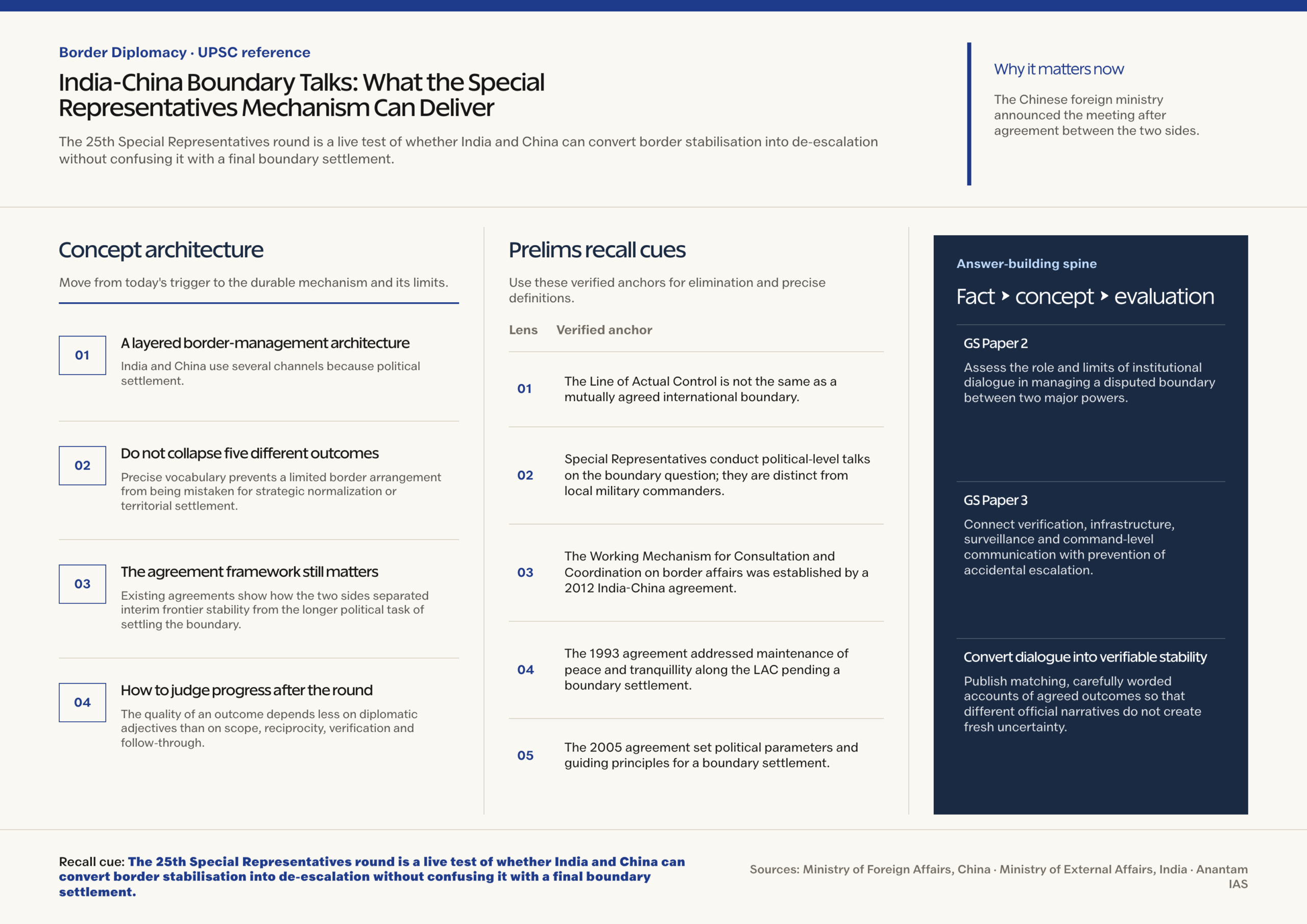
- The Line of Actual Control is not the same as a mutually agreed international boundary.
- Special Representatives conduct political-level talks on the boundary question; they are distinct from local military commanders.
- The Working Mechanism for Consultation and Coordination on border affairs was established by a 2012 India-China agreement.
- The 1993 agreement addressed maintenance of peace and tranquillity along the LAC pending a boundary settlement.
- The 2005 agreement set political parameters and guiding principles for a boundary settlement.
Mains Relevance
GS Paper 2
- Assess the role and limits of institutional dialogue in managing a disputed boundary between two major powers.
- Explain why border peace is a necessary condition for stable India-China relations but not a substitute for settlement.
GS Paper 3
- Connect verification, infrastructure, surveillance and command-level communication with prevention of accidental escalation.
- Examine how prolonged forward deployment creates security, fiscal and logistical costs.
Essay
- Durable peace depends on institutions that manage disagreement while political conditions for settlement remain incomplete.
Background and Context
A layered border-management architecture
India and China use several channels because political settlement, diplomatic coordination and field-level risk control are different tasks.
- The Special Representatives mechanism provides high-level political direction on the boundary question and can explore principles, trade-offs and the broader bilateral environment.
- The Working Mechanism for Consultation and Coordination brings diplomatic and military officials together to address border affairs, but it does not negotiate the final boundary settlement.
- Corps Commander and other military meetings focus on operational matters such as troops, patrols, buffers, communications and implementation at specific friction points.
- Border Personnel Meetings, flag meetings and hotlines can contain incidents locally before tactical confusion becomes a political or military crisis.
- These channels are complementary: political authorization without field verification is fragile, while local arrangements without sustained political backing may remain temporary.
Do not collapse five different outcomes
Precise vocabulary prevents a limited border arrangement from being mistaken for strategic normalization or territorial settlement.
- Disengagement separates troops at an identified face-off point through agreed sequencing, distance, temporary arrangements or limits on patrolling.
- De-escalation is broader and usually concerns reducing forward-deployed forces, heavy equipment, readiness or supporting infrastructure across a larger theatre.
- Peace and tranquillity describe the desired security condition along the LAC; they do not prove that competing territorial claims have been reconciled.
- LAC clarification would reduce ambiguity over differing perceptions, but clarification is still distinct from delimitation and demarcation of an international boundary.
- A final settlement needs a mutually acceptable political agreement covering the dispute; the 2005 guiding principles provide a framework, not evidence that settlement has occurred.
The agreement framework still matters
Existing agreements show how the two sides separated interim frontier stability from the longer political task of settling the boundary.
- The 1993 peace and tranquillity agreement accepted that forces would respect the LAC pending an ultimate boundary solution, making interim restraint compatible with unresolved claims.
- The 1996 confidence-building agreement addressed military conduct near the LAC, while the 2005 implementation protocol supplied more detailed modalities for confidence-building measures.
- The 2012 Working Mechanism agreement created a consultation channel for border affairs, but expressly did not replace the Special Representatives mechanism on the boundary question.
How to judge progress after the round
The quality of an outcome depends less on diplomatic adjectives than on scope, reciprocity, verification and follow-through.
- First identify the status: a scheduled discussion, joint understanding, completed disengagement and verified implementation are not interchangeable stages.
- Look for precise scope, including whether an arrangement covers one friction point, several sectors, patrol access, force levels or only future consultations.
- Test reciprocity by asking whether obligations apply to both sides in comparable ways and whether sequencing prevents either side from gaining a unilateral advantage.
- Verification requires agreed observation, commander-level confirmation and procedures for alleged violations; vague assurances alone cannot sustain a sensitive military arrangement.
- Even genuine border progress may not restore the wider relationship automatically because structural competition, strategic distrust and unresolved claims can continue alongside dialogue.
Way Forward
Convert dialogue into verifiable stability
- Publish matching, carefully worded accounts of agreed outcomes so that different official narratives do not create fresh uncertainty.
- Define sector-specific implementation, timelines, patrol arrangements and verification before presenting a political understanding as completed operational progress.
- Strengthen hotlines, commander contacts and incident protocols to prevent patrol encounters or infrastructure activity from triggering rapid escalation.
- Keep final-settlement diplomacy active while ensuring that interim confidence-building measures do not prejudice either side’s stated territorial position.
Conclusion
- The Special Representatives mechanism can supply political direction, but durable stability requires its understandings to be translated into reciprocal, field-verifiable arrangements through diplomatic and military channels.
- In a Mains answer, separate immediate crisis management from de-escalation and final settlement, then evaluate progress through scope, reciprocity, verification and implementation rather than summit language.
UPSC Practice Questions
Prelims MCQ 1
With reference to India-China border mechanisms, consider the following statements:
- The Special Representatives mechanism addresses the boundary question at the political level.
- The Working Mechanism for Consultation and Coordination was established through a bilateral agreement in 2012.
- The Line of Actual Control is a mutually delimited international boundary.
How many of the above statements are correct?
(a) Only one (b) Only two (c) All three (d) None
Answer: (b) Only two
Explanation:
Statements 1 and 2 are correct. The LAC is not a mutually agreed, delimited international boundary; differing perceptions are one source of friction.
Prelims MCQ 2
Which one of the following best describes de-escalation in a border crisis?
(a) Adoption of political principles for a future settlement (b) Separation of troops only at one face-off point (c) Broader reduction of forward military posture and supporting capabilities (d) Legal demarcation of the international boundary on the ground
Answer: (c) Broader reduction of forward military posture and supporting capabilities
Explanation:
De-escalation is broader than point-specific disengagement and is distinct from political settlement, delimitation or physical demarcation.
UPSC Mains Questions
- Why must disengagement, de-escalation and boundary settlement be treated as distinct stages in India-China relations? Discuss.
- Evaluate the utility and limitations of the Special Representatives mechanism in securing durable peace along the India-China frontier.
Sources: Ministry of Foreign Affairs, China and Ministry of External Affairs, India.
Frequently Asked Questions
What is the Special Representatives mechanism?
It is a high-level India-China political channel for addressing the boundary question. It provides strategic direction but relies on diplomatic and military mechanisms for detailed field implementation.
Is the Line of Actual Control the international boundary?
No. The LAC reflects the line up to which each side exercises control, and perceptions can differ. A settled international boundary would require mutual delimitation and demarcation.
How is disengagement different from de-escalation?
Disengagement separates forces at a specific face-off point. De-escalation reduces the wider forward military posture, which may include troops, equipment, readiness and supporting deployments.
What did the 2005 India-China agreement do?
It recorded political parameters and guiding principles for seeking a fair, reasonable and mutually acceptable boundary solution. It did not itself settle or demarcate the boundary.
Did the 25th round produce a settlement?
The cited Chinese announcement confirmed the scheduled August 25 meeting but reported no outcome. Any later claim should be assessed against official details on scope, implementation and verification.
Tell Google you want more of this.
Add Anantam IAS as a preferred sourceOne tap, and this site shows up more often in your own Top Stories, AI Overviews and AI Mode. Remove it any time.