

Why in News?
Three newborns died after a ventilator reportedly caught fire in the Special Newborn Care Unit (SNCU) of a district hospital in Amravati, Maharashtra.
Although 36 infants were rescued, the reported failure of fire alarms and automatic sprinklers has raised questions about hospital safety, equipment maintenance and accountability in public-health institutions.
| UPSC Relevance: GS-2 Social Justice: Health services, Children and Vulnerable Sections Prelims: SNCUs, JSSK, RBSK, HBNC, NMR, and Universal Immunisation Programme Mains: Neonatal healthcare, public-health infrastructure and regulatory accountability |
What are Special Newborn Care Units?
- SNCUs are established under the Facility-Based Newborn Care programme of the National Health Mission at district hospitals, sub-district hospitals and medical colleges.
- They provide round-the-clock secondary care to premature, low-birth-weight and critically ill newborns.
Issues Highlighted by the Incident:
- Fire-safety failures: Non-functional alarms and sprinklers can turn an equipment malfunction into a mass-casualty event.
- Equipment maintenance: Ventilators, incubators and oxygen-rich environments require regular electrical and preventive safety audits.
- Weak enforcement: Newly constructed buildings may remain unsafe if fire clearances and periodic inspections become procedural formalities.
- Evacuation difficulties: Critically ill newborns cannot be disconnected or shifted as easily as other patients.
- Staff preparedness: Hospitals require trained personnel, evacuation drills and neonatal-specific disaster protocols.
- Fragmented accountability: Hospital management, fire authorities, equipment suppliers and public works agencies may operate without unified responsibility.
- Quality beyond access: Expansion of institutional deliveries and SNCUs must be accompanied by safety, infection control and reliable infrastructure.
Neonatal Mortality Rate in India:
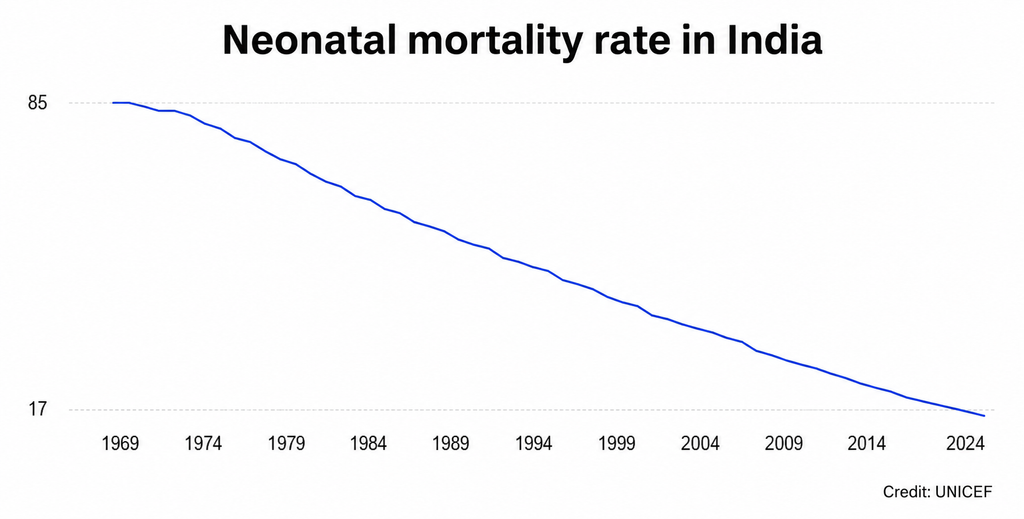
- India’s neonatal mortality rate (the number of infant deaths during the first 28 days of life per 1,000 live births) dropped from 28 per 1000 live births in 2015 to 17 per 1000 live births by 2023.
Major Central Initiatives for Newborns:
- Facility-Based Newborn Care (FBNC): Implemented by the Ministry of Health and Family Welfare (MoHFW) under the National Health Mission. It creates a three-tier system:
- Newborn Care Corners at delivery points for immediate care and resuscitation
- Newborn Stabilisation Units at CHCs and first-referral units for stabilisation before referral
- Special Newborn Care Units at district hospitals for resuscitation, stabilisation and treatment of premature, low-birth-weight and sick newborns.
- Home-Based Newborn Care (HBNC): Implemented by MoHFW through NHM and ASHA workers, it extends newborn care from health facilities to households. ASHAs undertake six visits after an institutional delivery (on days 3, 7, 14, 21, 28 and 42) and an additional first-day visit following a home delivery to promote breastfeeding, warmth, hygiene and early referral of sick newborns.
- Janani Shishu Suraksha Karyakram (JSSK): Launched in 2011 by MoHFW, it seeks to eliminate out-of-pocket expenditure associated with childbirth and infant illness. It guarantees pregnant women and sick infants up to one year free treatment, medicines, diagnostics, blood, diet, referral transport and exemption from user charges in public health institutions.
- Janani Suraksha Yojana (JSY): A 100% Centrally Sponsored Scheme under NHM, launched in 2005 to reduce maternal and neonatal mortality by promoting institutional deliveries. Cash assistance varies by area and State category. E.g., Eligible mothers in Low-Performing States receive ₹1,400 in rural and ₹1,000 in urban areas, with separate incentives for ASHAs.
- Universal Immunisation Programme (UIP): Implemented by MoHFW, UIP provides vaccines free of cost against diseases covered by the National Immunisation Schedule. Birth doses include BCG, zero-dose oral polio vaccine and hepatitis-B vaccine, while subsequent doses protect against diseases such as diphtheria, pertussis, tetanus, measles, rubella and pneumonia.
- Rashtriya Bal Swasthya Karyakram (RBSK): Implemented by MoHFW under NHM, it screens children from birth to 18 years for the 4Ds (defects at birth, diseases, deficiencies and developmental delays), covering identified health conditions. Children receive free referral, early intervention, treatment and, where necessary, surgery through District Early Intervention Centres and empanelled institutions.
- SUMAN (Surakshit Matritva Aashwasan): Launched by MoHFW in 2019, SUMAN assures pregnant women, mothers up to six months after delivery and sick newborns respectful, dignified and zero-expense healthcare in public facilities. It also emphasises assured referral, grievance redressal and zero tolerance for denial of essential services.
- LaQshya (Labour Room Quality Improvement Initiative): Launched by MoHFW in 2017, it improves the quality of care in labour rooms and maternity operation theatres of public hospitals. It focuses on standardised clinical protocols, respectful maternity care, infection control and prevention of avoidable maternal and newborn deaths; compliant facilities receive quality certification.
- Mission Indradhanush: Launched by MoHFW in 2014, it identifies and vaccinates children and pregnant women who are unvaccinated or partially vaccinated under UIP. Its intensified rounds focus on districts, urban slums, migratory settlements and other pockets with low immunisation coverage; vaccines are provided free of cost.
- Saksham Anganwadi and POSHAN 2.0: Implemented by the Ministry of Women and Child Development, it subsumes Anganwadi Services, POSHAN Abhiyaan and nutritional support for specified beneficiaries. It provides supplementary nutrition, growth monitoring, health check-ups, immunisation linkages and referral services for children below 6 years, pregnant women and lactating mothers, with special emphasis on the first 1,000 days.
- Pradhan Mantri Matru Vandana Yojana (PMMVY): A Centrally Sponsored maternity-benefit scheme implemented by the Ministry of Women and Child Development under Mission Shakti. Eligible women receive ₹5,000 through DBT for the first child in two instalments and ₹6,000 for the second child if the child is a girl, subject to pregnancy registration, antenatal care, birth registration and initial immunisation.
Way Forward:
- Conduct mandatory electrical, fire and medical equipment audits of all SNCUs
- Link hospital empanelment and accreditation to valid fire safety certification
- Install functional alarms, sprinklers, smoke extraction systems and uninterrupted backup power
- Frame neonatal-specific evacuation protocols and conduct regular mock drills
- Ensure preventive maintenance and traceability of ventilators and incubators
- Fix responsibility across hospital administrators, contractors and equipment suppliers; and
- Expand SNCUs without compromising trained manpower, infection control and quality standards.
The Amravati tragedy demonstrates that institutional delivery alone cannot guarantee newborn survival. India must move from merely expanding neonatal facilities to ensuring safe, accountable and quality-assured care, consistent with Article 21 and the Sustainable Development Goal of ending preventable newborn deaths.
Tell Google you want more of this.
Add Anantam IAS as a preferred sourceOne tap, and this site shows up more often in your own Top Stories, AI Overviews and AI Mode. Remove it any time.





