Why in News?
Unidentified armed individuals ambushed a UNMISS patrol travelling to Pajut in South Sudan’s Jonglei state on 24 August, killing two peacekeepers and injuring seven people.
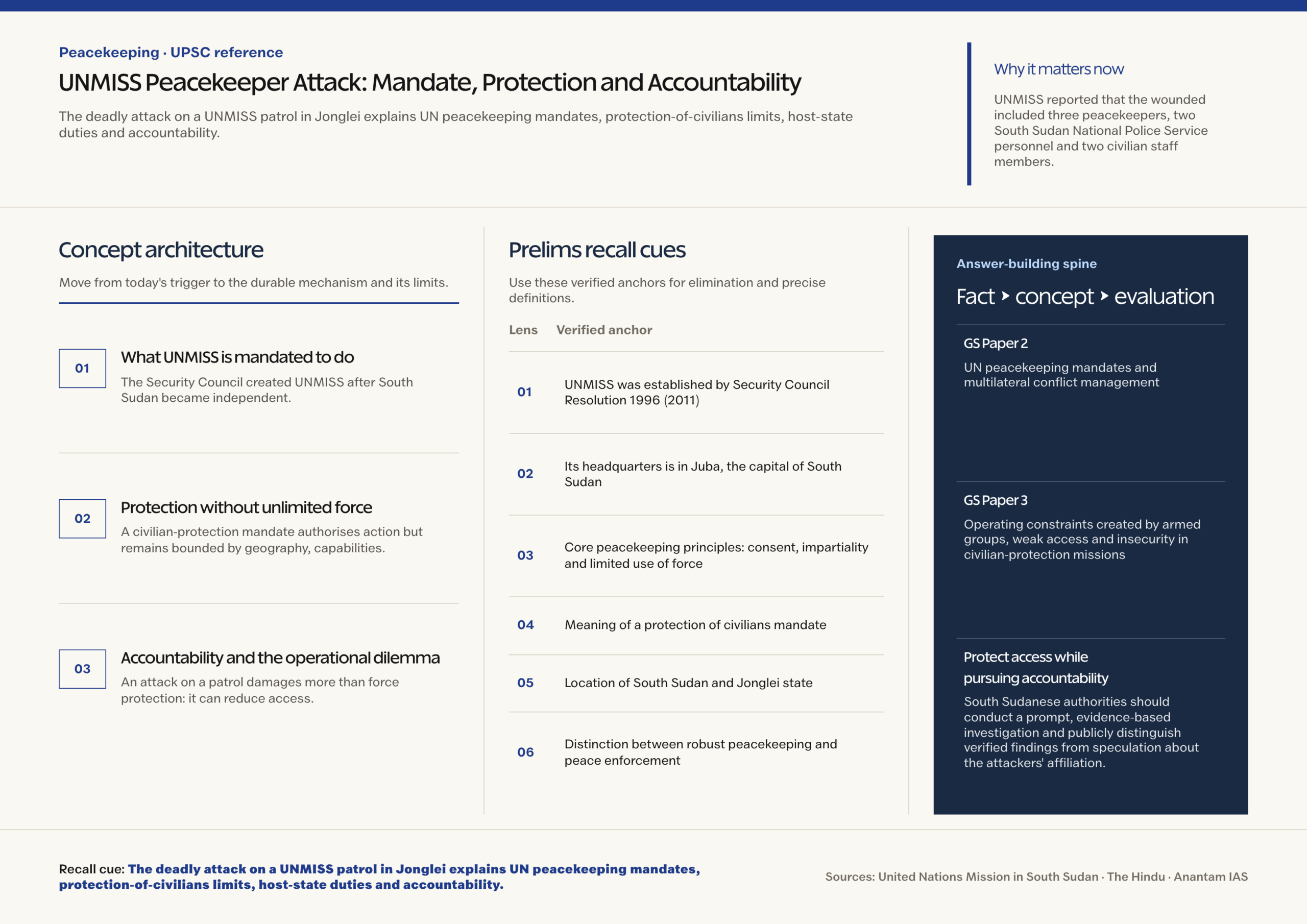
- UNMISS reported that the wounded included three peacekeepers, two South Sudan National Police Service personnel and two civilian staff members.
- A UN spokesperson, as reported by the Associated Press, said the five killed or wounded peacekeepers were Ethiopian.
- No group had immediately claimed responsibility; the mission described the attackers only as unidentified armed individuals.
- UNMISS deployed a Quick Reaction Force to secure the area and support the emergency response, while calling for a prompt investigation.
- The attack shows how peacekeepers implementing a civilian-protection mandate can themselves become targets while travelling through insecure and remote areas.
- It raises an exam-relevant distinction between robust peacekeeping, which retains host-state consent, and peace enforcement, which need not depend on such consent.
UPSC Relevance
Prelims Relevance
- UNMISS was established by Security Council Resolution 1996 (2011)
- Its headquarters is in Juba, the capital of South Sudan
- Core peacekeeping principles: consent, impartiality and limited use of force
- Meaning of a protection of civilians mandate
- Location of South Sudan and Jonglei state
- Distinction between robust peacekeeping and peace enforcement
Mains Relevance
GS Paper 2
- UN peacekeeping mandates and multilateral conflict management
- Host-state responsibility, consent and accountability for attacks on mission personnel
GS Paper 3
- Operating constraints created by armed groups, weak access and insecurity in civilian-protection missions
Essay
- The legitimacy of collective security depends on matching international mandates with access, capability and accountable local institutions.
Background and Context
What UNMISS is mandated to do
The Security Council created UNMISS after South Sudan became independent, then refocused the mission when civil war transformed the country’s security environment.
- South Sudan became independent in July 2011, and Resolution 1996 established UNMISS to consolidate peace and security and help create conditions for development.
- After conflict erupted in December 2013, Resolution 2155 (2014) reprioritised the mission toward civilian protection, human-rights monitoring and support for humanitarian delivery.
- The current mission also supports implementation of the 2018 Revitalized Peace Agreement and monitors, investigates and reports alleged violations of international law and human rights.
- The Security Council renewed UNMISS in April 2026 until 30 April 2027, keeping it active amid renewed political and armed tensions.
- Patrols provide presence, assess threats, engage communities, support safe humanitarian access and deter violence; they do not replace ordinary government administration.
Protection without unlimited force
A civilian-protection mandate authorises action but remains bounded by geography, capabilities, mission rules and the basic principles of United Nations peacekeeping.
- The host state retains primary responsibility for protecting its population; a peacekeeping mission supports that duty rather than acquiring sovereignty over the territory.
- Protection is a whole-of-mission task involving civilian, police and military components through dialogue, early warning, human-rights work, patrols and physical protection.
- Where authorised, peacekeepers may use all necessary means, including force, to protect civilians under physical threat within their capabilities and areas of deployment.
- The three basic principles are consent of the parties, impartiality, and non-use of force except in self-defence or defence of the mandate.
- Robust peacekeeping permits tactical force under Security Council authority and host-state consent; peace enforcement may operate without consent and is conceptually different.
Accountability and the operational dilemma
An attack on a patrol damages more than force protection: it can reduce access, weaken deterrence and leave threatened communities beyond the mission’s practical reach.
- UNMISS said attacks against peacekeepers may constitute war crimes; that wording is conditional because investigators must establish the conflict context, protected status and intent.
- Peacekeeping personnel are protected from intentional attack while entitled to civilian protection under international humanitarian law; participation in hostilities can alter that legal assessment.
- The host authorities must secure evidence, identify suspects and pursue lawful prosecution; the mission can preserve incident records and support cooperation but does not substitute for a criminal court.
- Force protection can require escorts, route assessment and rapid reaction, yet an overly defensive posture may reduce the patrol presence needed to deter threats against civilians.
- For India, a major contributor to UN peacekeeping, the incident reinforces the case for clear mandates, adequate equipment, reliable intelligence and accountability for attacks on deployed personnel.
Way Forward
Protect access while pursuing accountability
- South Sudanese authorities should conduct a prompt, evidence-based investigation and publicly distinguish verified findings from speculation about the attackers’ affiliation.
- UNMISS should combine route intelligence, community-alert networks, medical evacuation planning and proportionate rapid-reaction capacity without abandoning essential civilian-protection patrols.
- The Security Council and contributing countries should align mandates with mobility, surveillance, communications, medical support and other resources required in remote terrain.
- Political engagement must reinforce the 2018 peace framework, freedom of movement for UNMISS and local dialogue that reduces armed mobilisation around vulnerable communities.
Conclusion
- The Pajut ambush illustrates the central peacekeeping paradox: a mission must maintain consent and impartiality while retaining enough reach and force protection to implement a demanding civilian-protection mandate.
- A strong Mains answer should connect the attack to mandate design, host-state responsibility, operational capability, the limits on force and evidence-based accountability rather than assigning blame before investigation.
UPSC Practice Questions
Prelims MCQ 1
With reference to United Nations peacekeeping, consider the following statements:
- Protection of civilians remains primarily the responsibility of the host state.
- Robust peacekeeping and peace enforcement both necessarily require host-state consent.
- A peacekeeping mission may be authorised to use force in defence of its mandate.
How many of the above statements are correct?
(a) Only one (b) Only two (c) All three (d) None
Answer: (b) Only two
Explanation:
Statements 1 and 3 are correct. Robust peacekeeping retains consent, while peace enforcement may operate without the consent of the main parties.
Prelims MCQ 2
The United Nations Mission in South Sudan was originally established by which one of the following Security Council resolutions?
(a) Resolution 1265 (1999) (b) Resolution 1325 (2000) (c) Resolution 1996 (2011) (d) Resolution 2155 (2014)
Answer: (c) Resolution 1996 (2011)
Explanation:
Resolution 1996 established UNMISS in 2011. Resolution 2155 later reprioritised its mandate after conflict erupted in South Sudan.
UPSC Mains Questions
- The attack on a UNMISS patrol exposes the gap between an ambitious protection-of-civilians mandate and difficult field conditions. Examine the mandate, constraints and responsibilities involved.
- Distinguish robust United Nations peacekeeping from peace enforcement. How do consent, force protection and accountability shape a mission’s legitimacy and effectiveness?
Sources: United Nations Mission in South Sudan and The Hindu.
Frequently Asked Questions
What happened to the UNMISS patrol near Pajut?
Unidentified armed individuals ambushed the patrol in Jonglei on 24 August 2026. UNMISS reported two peacekeepers killed and seven people injured; no group immediately claimed responsibility.
What is UNMISS?
UNMISS is the United Nations Mission in South Sudan, established by Security Council Resolution 1996 in 2011 to support peace and security after the country’s independence.
What does protection of civilians mean in peacekeeping?
It combines dialogue, early warning, human-rights work and physical protection, including authorised force when necessary, within the mission’s capabilities and deployment area.
Can United Nations peacekeepers use force?
Yes, when authorised, they may use proportionate force in self-defence or defence of the mandate. Robust peacekeeping remains distinct from strategic peace enforcement.
Is every attack on a peacekeeper automatically a war crime?
No. It may constitute a war crime when the relevant legal elements are proved, including conflict context, intent and the personnel’s protected status at the time.
Tell Google you want more of this.
Add Anantam IAS as a preferred sourceOne tap, and this site shows up more often in your own Top Stories, AI Overviews and AI Mode. Remove it any time.