Daily Digest
UPSC · Civil Services Examination
Current Affairs · Monday, 27 October 2025
Current affairs curated and edited by Anantam IAS faculty — pulled from The Hindu, PIB, IDSA, Foreign Affairs and the ministries. Read, annotate, revise.
Old Rajinder Nagar · Delhi 110005 · anantamias.com
Constitutional Morality: Doctrine, Core Pillars & Latest 2025–26 Supreme Court Cases
Context: The relationship between the Constitution and constitutional morality is intrinsic and dynamic. Constitutional morality is the ethical and philosophical foundation that animates the Constitution, ensuring its provisions are applied in a way that upholds justice, equality, dignity, and the rule of law. In 2025 and 2026, the Supreme Court has invoked constitutional morality to rule on the Tamil Nadu Governor’s pocket veto, on mental health as a fundamental right in Sukdeb Saha, on transgender equality in private workplaces in Jane Kaushik, and on the limits of Article 142 itself. This article explains the doctrine, traces its core elements, and walks you through the latest cases an aspirant must know.
UPSC relevance
Mains 2025: “Constitutional morality is the fulcrum which acts as an essential check upon the high functionaries and citizens alike….” In view of the above observation of the Supreme Court, explain the concept of constitutional morality and its application to ensure balance between judicial independence and judicial accountability in India. (150 words, 10 marks)
Mains 2021: ‘Constitutional Morality’ is rooted in the Constitution itself and is founded on its essential facets. Explain the doctrine of ‘Constitutional Morality’ with the help of relevant judicial decisions. (150 words, 10 marks)
GS Paper II: Indian Constitution — historical underpinnings, evolution, features, amendments, significant provisions, basic structure; functions and responsibilities of the Union and the States; separation of powers; appointment to constitutional posts.
What is constitutional morality?
Constitutional morality means doing things the constitutional way, both in letter and in spirit. It asks citizens, officials, and institutions to follow due process, respect rights, and exercise power with restraint, even when “popular opinion” is demanding shortcuts. The phrase is older than our Constitution. Ambedkar borrowed it from the British historian George Grote, who used it to describe a settled, almost reflexive obedience to constitutional forms, combined with the freedom to criticise the authority that acts under those forms. Ambedkar then planted it firmly inside our Indian setting in his now-famous Constituent Assembly speech of 4 November 1948.
Think of it this way. The Constitution is the script. Constitutional morality is the discipline of actually following the script, even when no one is watching, even when the audience would clap for an off-script performance. A magistrate who sticks to due process during a politically charged trial is practising it. A citizen who accepts a court verdict they personally disagree with is practising it. A government that respects a state law it does not like, instead of starving it through delay, is practising it.
Constitutional morality is not a natural sentiment. It has to be cultivated. We must realise that our people have yet to learn it. Democracy in India is only a top-dressing on an Indian soil, which is essentially undemocratic.
— B. R. Ambedkar, Constituent Assembly, 1948
That last line still does the heavy lifting. Ambedkar was telling the House that writing a fine document is not the same as building a constitutional culture. The document gives us forms. Constitutional morality is what makes those forms come alive in everyday governance.
Where the idea comes from: Ambedkar, Grote, and the Indian context
Grote, writing about ancient Athens in the 1840s, used “constitutional morality” to describe a paradoxical mood: total reverence for the Constitution combined with the freedom to argue with anyone in authority. Ambedkar saw the same paradox as the missing piece in Indian democracy. Indian society, he argued, was steeped in hierarchy, hero-worship, and what he called “graded inequality.” A written Constitution could not survive that soil unless an active culture of constitutional morality grew over it.
Three pieces of his argument matter for us as students of polity:
- The form is fragile. Constitutional procedures, once broken casually, are very hard to repair. A bypassed convention almost never returns by itself.
- Bhakti is dangerous. “Bhakti or hero-worship,” Ambedkar warned, “is a sure road to degradation and to eventual dictatorship.” This is why constitutional morality treats no leader as larger than the office.
- Citizens are not bystanders. Constitutional morality is not a duty owed only by judges and ministers. It is what makes ordinary citizens capable of holding the system to account without burning it down.
For more on how this idea took shape across our Republic, see our deeper read on India’s constitutional journey and the early-republic struggles around Ambedkar’s Mahad Satyagraha, where the demand for equal access to public water was, in spirit, a demand for constitutional morality long before the Constitution existed.
The four core elements of constitutional morality
You can keep these four pillars in mind. Every Mains answer on constitutional morality usually folds back into one or more of them.
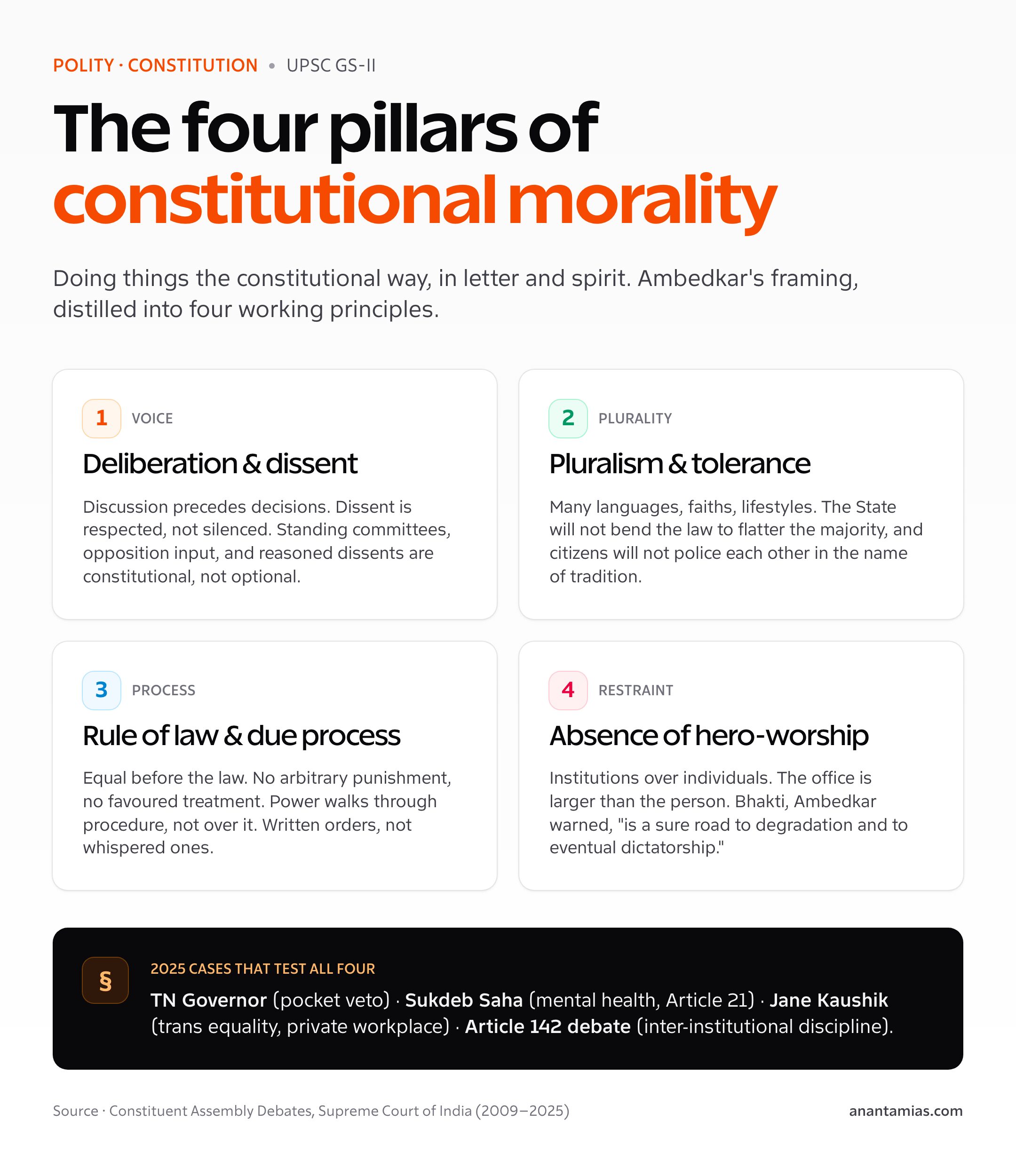
1. Deliberation and dissent — argue, don’t bulldoze
Discussion and debate must precede decisions. Dissent must not just be tolerated, it must be respected. Constitutional morality assumes that the right answer is more likely to emerge from honest argument than from majoritarian noise. This is why Parliamentary committees, judicial benches, and even cabinet meetings exist in the first place.
Examples:
- A Parliamentary Standing Committee dissecting a Bill clause-by-clause before the House votes.
- A Constitution Bench writing a long dissent. The dissent does not change the immediate outcome, but it preserves a path for the future court to correct course.
- A housing society where the secretary insists on hearing the loudest objector before the resolution is signed.
- A classroom where students can question the teacher’s reasoning without fear of being marked down.
2. Pluralism and tolerance — respect for diversity
India is a constitutional democracy because it accepts many languages, faiths, foods, and ways of being. Constitutional morality treats this diversity as a feature, not a bug. The state may not bend the law to please a numerical majority at the expense of a smaller community, and citizens may not police each other’s lifestyles in the name of “tradition.”
Examples:
- A school that celebrates Diwali, Eid, and Christmas with the same warmth.
- A municipal corporation that allots park slots to all communities for cultural programmes without political filtering.
- A workplace that updates its leave policy to cover regional and religious festivals beyond a “default” calendar.
- The 2018 Sabarimala verdict, where the Court held that the bar on women of a certain age age violated constitutional morality, even though “popular morality” wanted the practice to continue. The pending Sabarimala reference in 2025 keeps that conversation alive.
3. Rule of law and due process — no arbitrariness
Everyone is equal before the law. No one can be punished or favoured arbitrarily. Power must walk through procedure, not jump over it. This is the workhorse element of constitutional morality, the one that decides whether ordinary administration is constitutional or merely legal-on-paper.
Examples:
- A student cannot be expelled without a fair chance to explain her side. That is due process.
- A traffic constable fining a businessman and a rickshaw-puller equally for the same red-light jump.
- An IAS probationer following written orders only, refusing to act on an unrecorded phone call from a senior politician.
- The Supreme Court’s 2026 reading-down of Section 294 BNS on “vulgar language”, which insisted that criminal law cannot punish speech without proper standards. That is rule of law in everyday motion.
4. Absence of hero-worship — institutions over individuals
Institutions and laws must be respected more than individuals. Power has to flow through procedure, not through personal charisma or popularity. The moment a system protects a person because of who they are rather than because the rules require it, constitutional morality has slipped.
Examples of erosion:
- An institution hesitates to question the executive because the leader is too popular to embarrass.
- Citizens defend every action of a political leader, even when it clearly violates constitutional norms.
- Officers act on a minister’s verbal instruction and skip the file note that would have created a paper trail.
- A party in power changes its own rulebook the moment its leader is in trouble. The leader is being placed above the institution.
Constitutional morality vs popular morality
This is the cleanest distinction you can carry into a Mains answer. Popular morality is what the majority feels at a given time. Constitutional morality is what the Constitution requires regardless of how the majority feels at that moment. The two often agree, but the doctrine only earns its keep when they collide.
Three quick illustrations, all real:
- Navtej Johar v Union of India (2018): Section 377 fell because constitutional morality, not majority sentiment, was held to be the test of equal citizenship.
- Joseph Shine v Union of India (2018): The Court struck down adultery as a crime, refusing to let a patriarchal social consensus override the constitutional guarantee of equality and personal autonomy for women.
- Triple talaq, Shayara Bano (2017): Instantaneous divorce was rejected even though a section of the community defended it on tradition. Constitutional morality made the call, not custom.
Pratap Bhanu Mehta has written a careful caution alongside this enthusiasm. We have summarised it in a modest plea for constitutional morality: the doctrine is most powerful when judges use it to expand liberty, and most contested when it is used as a vague philosophical override of legislative choice. Hold both ideas at the same time.
Recent 2025 and 2026 cases that test constitutional morality
This is the section that turns a generic Mains answer into a high-scoring one. Four developments stand out from the last two years.
State of Tamil Nadu v Governor of Tamil Nadu (8 April 2025) — no pocket veto
A two-judge bench of Justices J. B. Pardiwala and R. Mahadevan ruled that a Governor cannot sit indefinitely on State Bills. Article 200 uses the words “shall declare” and “as soon as possible,” which means inaction itself is unconstitutional. The Court called the practice of an open-ended, silent veto a “pocket veto” that has no place in our scheme. It also laid down indicative timelines and held that, in extreme cases, courts can deem assent granted under Article 142.
Why it is a constitutional morality case: A Governor who refuses to act is not breaking the text of the Constitution in any single, dramatic way. He is breaking its spirit. The doctrine of constitutional morality is what allows the Court to say, “the Constitution does not contemplate inaction” even though it does not say so in those exact words.
Sukdeb Saha v State of Andhra Pradesh (July 2025) — mental health is a fundamental right
The case arose from the death of a 17-year-old NEET aspirant in a Visakhapatnam hostel. The Court held that mental health is an integral part of the right to life under Article 21. It then issued the binding “Saha Guidelines,” requiring schools, colleges, hostels, and coaching institutes above a threshold size to appoint counsellors, frame mental health policies, and submit to district-level monitoring committees chaired by district magistrates.
Constitutional morality angle: Article 21 is one short sentence. Reading mental health into “life and personal liberty” is a moral move as much as a textual one. The Court’s reasoning is that a Republic that promises dignity cannot watch coaching factories grind teenagers down and call it private affairs. That is constitutional morality at work, holding the Constitution to its own promise of dignity.
Jane Kaushik v Union of India (17 October 2025) — equality reaches private workplaces
Jane Kaushik, a transgender teacher, was terminated by a private school in Delhi soon after her gender identity became known. The Supreme Court held that her dismissal violated Articles 14, 15, and 21 read with the Transgender Persons (Protection of Rights) Act, 2019. Crucially, the bench applied the equality command to a private employer, embracing the doctrine of indirect horizontality. The judgment, citing Navtej Johar, reaffirmed that equality is grounded in constitutional morality, not majoritarian comfort.
Read this alongside the Transgender Persons (Protection of Rights) Amendment Act, 2026, which has now codified parts of the Court’s reasoning into statute. Together, the case and the amendment show how constitutional morality moves from court to code.
The Article 142 controversy — VP Dhankhar and the “nuclear missile” remark
On 17 April 2025, Vice President Jagdeep Dhankhar called Article 142 a “nuclear missile against democratic forces” while addressing Rajya Sabha interns, days after the Tamil Nadu Governor verdict. He argued that the Court was acting like a “super Parliament.” Senior advocates including Kapil Sibal disagreed, calling the remark itself a violation of constitutional morality, since it pulled a high constitutional functionary into open hostility with another organ of the State.
The lesson for an aspirant: Constitutional morality is also an inter-institutional discipline. It tells the executive not to weaponise public office against the judiciary, and it tells the judiciary not to use Article 142 as a shortcut around legislative choice. Both organs are bound by the same script.
For the wider 2025 jurisprudence on Article 21, see our note on safe travel on highways as part of Article 21, and on the expanding meaning of “State” in cooperative societies under Article 12.
Older landmark cases on constitutional morality
The doctrine did not appear in 2025. It has been quietly building since the early 2010s, and the older cases are still the backbone of any Mains answer.
- Naz Foundation v NCT of Delhi (2009): The Delhi High Court used “constitutional morality” to read down Section 377. The phrase entered modern jurisprudence here, even though the SC reversed the decision in 2013 before reviving it later.
- Manoj Narula v Union of India (2014): A Constitution Bench held that constitutional morality binds those who occupy high office and must inform their choices, even where the Constitution is silent on a specific qualification.
- Government of NCT of Delhi v Union of India (2018): Justice Dipak Misra wrote that constitutional morality requires high functionaries to act within the four corners of the Constitution and not arbitrarily, especially in centre–state relations.
- Indian Young Lawyers Assn. v State of Kerala (2018), the Sabarimala judgment: The Court held that the bar on women aged 10–50 was a violation of constitutional morality and could not be saved by popular morality.
- K. S. Puttaswamy v Union of India (2017–18): The privacy and Aadhaar judgments. The Court confirmed privacy as a fundamental right and used constitutional morality to set boundaries around state surveillance and data collection.
- Navtej Johar v Union of India (2018): Constitutional morality was described as “the soul of the Constitution,” embracing justice, equality, and human dignity.
- Joseph Shine v Union of India (2018): Adultery as a crime was struck down. Married women, the Court said, are not the property of their husbands. Constitutional morality requires personal autonomy as a non-negotiable.
- Namit Sharma v Union of India (2013): Transparent functioning of public institutions was anchored in constitutional morality and made intrinsic to the rule of law.
For a parallel debate on faith, custom, and morality, see our explainer on the SC ruling on Scheduled Caste status after religious conversion. It is the same fault line: constitutional morality versus social custom.
Why constitutional morality matters more in 2026 than ever
The pressures on the Indian system in 2026 are different from those of 1950. The forms have held, but they are under stress.
- Speed of governance. Bills move fast, ordinances move faster, and digital platforms move faster than both. Constitutional morality is the brake that says “deliberate before you decide.”
- Hyper-personalised politics. When leaders dominate the news cycle, hero-worship spreads quickly. Constitutional morality keeps the office larger than the person occupying it.
- Federal frictions. Centre–state relations are increasingly contested. The TN Governor judgment shows why an unwritten norm of timely action is itself a constitutional value.
- Digital state power. The Draft IT (Second Amendment) Rules 2026 and earlier debates around digital constitutionalism are testing whether the Constitution’s spirit can govern algorithms, takedowns, and surveillance.
Criticisms and limits of constitutional morality
A good answer must also include the critiques. Three lines of criticism stand out.
- Vagueness. Critics argue the phrase has no fixed content. A judge can pour almost any value into it. The remedy is rigorous reasoning that ties constitutional morality back to specific articles, not free-floating philosophy.
- Counter-majoritarian risk. The doctrine can override democratically expressed preferences. This is a feature when fundamental rights are at stake, but it must not become a habit. Pratap Bhanu Mehta and others have argued for restraint in invoking the doctrine outside the rights core.
- Selective application. If courts invoke constitutional morality only to expand liberty in some cases and stay silent in others, the doctrine can look opportunistic. Consistency is the cure.
The honest position is that constitutional morality is a powerful judicial tool with genuine risks of misuse, and that those risks are best contained by reasoned judgments, clear textual anchors, and self-restraint by all three organs of state.
How citizens, officials, and institutions can practise it
This is where the doctrine stops being abstract. Constitutional morality is built or eroded one decision at a time.
- For citizens: Accept court verdicts even when you disagree. Argue against them in print, in protest, in petition. Do not break them quietly. Vote on policy, not on personality cult.
- For civil servants: Insist on written orders. Maintain file notes. Treat the rulebook as a shield, not an inconvenience. The Saha Guidelines style of compliance, paper trail, monitoring committees, named officers, is constitutional morality in administrative form.
- For ministers and legislators: Refer Bills to standing committees. Respect parliamentary time. Do not use ordinances as the default route. Recognise that opposition is not betrayal.
- For courts: Use Article 142 sparingly. Anchor every invocation of constitutional morality to specific articles or doctrines. Write reasoned judgments that future benches and ordinary readers can both follow.
- For the press and academia: Distinguish between popular outrage and constitutional principle. Both have a place. They should not be mistaken for each other.
How to write a high-scoring Mains answer on constitutional morality
If you have a 150-word, 10-mark question, here is a structure that has consistently worked in our classroom evaluations.
- Definition (1–2 lines): Constitutional morality means doing things the constitutional way, in letter and spirit, with reverence for procedure and freedom to criticise authority.
- Roots (1 line): Borrowed from George Grote, deepened by Ambedkar in the Constituent Assembly on 4 November 1948.
- Four elements (compressed): Deliberation and dissent, pluralism and tolerance, rule of law and due process, absence of hero-worship.
- Two old plus two new cases: Navtej Johar and NCT Delhi v Union of India for the foundation. Tamil Nadu Governor (2025) and Sukdeb Saha (2025) for currency. Add Jane Kaushik (2025) if word count allows.
- One critique (1 line): Risk of vagueness and counter-majoritarian misuse, hence the need for reasoned, text-anchored application.
- Conclusion (1 line): Constitutional morality is the bridge between the written Constitution and a living democracy. Without it, the Constitution becomes a document; with it, the Constitution becomes a practice.
Key takeaways
- Constitutional morality is the ethic of obeying constitutional forms while retaining the right to criticise authority.
- Its four pillars are deliberation and dissent, pluralism and tolerance, rule of law and due process, and absence of hero-worship.
- It is most powerful when it expands liberty against majoritarian sentiment, and most contested when it overrides legislative choice.
- The 2025–26 calendar has produced four moments to remember: Tamil Nadu Governor, Sukdeb Saha, Jane Kaushik, and the Article 142 controversy around the Vice President’s remarks.
- Constitutional morality is built one decision at a time, by citizens, civil servants, legislators, judges, and the press together.
Frequently asked questions
Who first used the phrase “constitutional morality” in India?
Dr. B. R. Ambedkar used the phrase in his speech to the Constituent Assembly on 4 November 1948, drawing on the British historian George Grote’s writing on ancient Athens. In modern Indian jurisprudence, the Delhi High Court’s Naz Foundation verdict in 2009 brought the phrase back into active legal use.
What does constitutional morality actually mean?
It means doing things the constitutional way, in letter and spirit. Citizens, officials, and institutions are expected to follow due process, respect rights, and exercise power with restraint, even when popular opinion is demanding shortcuts. It is the discipline of obeying the script while keeping the freedom to criticise it.
How is constitutional morality different from popular morality?
Popular morality is what the majority feels at a given time. Constitutional morality is what the Constitution requires regardless of that feeling. Sabarimala (2018), Navtej Johar (2018), and Joseph Shine (2018) are textbook examples of constitutional morality prevailing over popular morality.
Is constitutional morality the same as the basic structure doctrine?
No. The basic structure doctrine, from Kesavananda Bharati (1973), tells Parliament what it cannot amend away. Constitutional morality is a broader interpretive ethic that informs how the Constitution is read and applied in everyday life. The two often work together, but they are not identical.
Is constitutional morality binding law?
It is not codified as a stand-alone provision, but courts use it as an interpretative principle to read fundamental rights, federal balance, and procedural fairness into constitutional articles. When a judgment relies on constitutional morality, the holding becomes binding precedent under Article 141.
What did the Naz Foundation case do for constitutional morality?
The Delhi High Court’s 2009 Naz Foundation v NCT of Delhi ruling reintroduced “constitutional morality” into modern Indian jurisprudence while reading down Section 377. The Supreme Court reversed it in 2013, but the doctrine survived and was vindicated in Navtej Johar (2018).
Why is the 2025 Tamil Nadu Governor case important for constitutional morality?
On 8 April 2025 the Supreme Court ruled that a Governor cannot exercise a pocket veto over State Bills. Article 200 uses the words “shall declare” and “as soon as possible,” which means inaction itself is unconstitutional. The Court held that, in extreme cases, courts can deem assent granted under Article 142. The judgment is constitutional morality applied to centre–state relations.
How does the Jane Kaushik (2025) judgment extend constitutional morality?
On 17 October 2025 the Supreme Court held that a private school’s termination of a transgender teacher violated Articles 14, 15, and 21 read with the Transgender Persons (Protection of Rights) Act, 2019. The bench applied the equality command to a private employer through the doctrine of indirect horizontality, anchoring it in constitutional morality rather than majoritarian comfort.
What was the Article 142 “nuclear missile” controversy in 2025?
On 17 April 2025, Vice President Jagdeep Dhankhar called Article 142 a “nuclear missile against democratic forces” days after the Tamil Nadu Governor verdict. Senior advocates such as Kapil Sibal called the remark itself a violation of constitutional morality. The episode underlined that constitutional morality is also an inter-institutional discipline binding the executive and the judiciary.
How can a UPSC aspirant use constitutional morality in a Mains answer?
Define it in 1–2 lines, name Ambedkar and Grote, list the four pillars (deliberation and dissent, pluralism and tolerance, rule of law and due process, absence of hero-worship), cite two old cases (Navtej Johar, NCT Delhi v Union of India) and two new ones (Tamil Nadu Governor 2025, Sukdeb Saha 2025), add one critique on counter-majoritarian risk, and conclude that constitutional morality is the bridge between the written Constitution and a living democracy.
Source: https://anantamias.com/current-affairs/constitutional-morality/
India-ASEAN Summit

Why in the News?
The 22nd ASEAN-India Summit was held on 26 October 2025. Prime Minister Shri Narendra Modi participated virtually in the Summit. Prime Minister and ASEAN leaders jointly reviewed progress in ASEAN-India relations and discussed initiatives for strengthening the Comprehensive Strategic Partnership.
UPSC Relevance
GS2 Mains – Bilateral, Regional and Global Groupings and Agreements involving India and/or affecting India’s interests.
Regional Organisations are asked in Prelims also.
PYQ
2023 – The expansion and strengthening of NATO and a stronger US-Europe strategic partnership works well for India. What is your opinion about this statement? Give reasons and examples to support your answer.
2021- Critically examine the aims and objectives of SCO. What importance does it hold for India?
2018 Prelims
Consider the following countries:
- Australia
- Canada
- China
- India
- Japan
- USA
Which of the above are among the ‘free-trade partners’ of ASEAN?
(a) 1, 2, 4 and 5
(b) 3, 4, 5 and 6
(c) 1, 3, 4 and 5
(d) 2, 3, 4 and 6
The Association of Southeast Asian Nations (ASEAN)
Founding and Initial Members
- Establishment Date: ASEAN was established on 8 August 1967.
- Location: The founding took place in Bangkok, Thailand.
- Founding Document: The establishment was marked by the signing of the ASEAN Declaration (Bangkok Declaration).
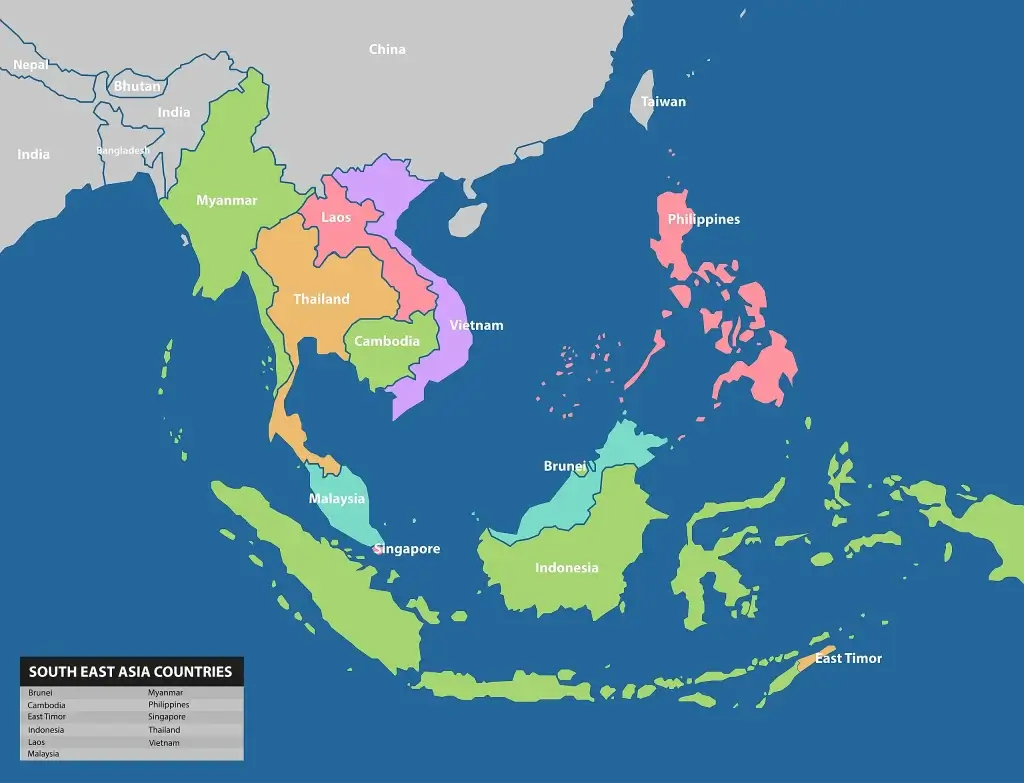
- Total Member States: ASEAN currently comprises Eleven Member States.
- 5 Founding Fathers:
- Indonesia
- Malaysia
- Philippines
- Singapore
- Thailand
- 6 Subsequent Entrants:
- Brunei Darussalam: Joined on 7 January 1984.
- Viet Nam: Joined on 28 July 1995.
- Lao PDR and Myanmar: Both joined on 23 July 1997.
- Cambodia: Joined on 30 April 1999.
- Timor Leste: Joined on 25 October 2025. (Latest)
Three Communities of ASEAN

ASEAN Flag

India-ASEAN Relations’ Timeline
Phase 1: Post-Independence/Cold War Disconnect (1947–Early 1990s)
- 1947–1950s: Initial goodwill and Pan-Asianism, championed by PM Jawaharlal Nehru, but lacking substantial policy follow-up. India was a key player at the 1955 Bandung Conference.
- 1960s–Early 1990s: A period of relative disconnect and strained ties. India’s close relationship with the Soviet Union and its non-aligned, socialist economic model led to anxiety among many pro-Western, capitalist ASEAN nations. Bilateral ties were maintained but not prioritized with the ASEAN grouping.
- ASEAN Formation: ASEAN itself was established in 1967.
Phase 2: The ‘Look East’ Policy (LEP) – Strategic Rapprochement (1991–2014)
- 1991: India launched the Look East Policy (LEP) under PM P.V. Narasimha Rao. This was triggered by the end of the Cold War and India’s economic liberalization, necessitating a shift toward new trading partners and a deeper engagement with the East.
- 1992: India became an ASEAN Sectoral Dialogue Partner (focused on trade, investment, tourism, science & technology).
- 1996: India became a Full Dialogue Partner of ASEAN and a member of the ASEAN Regional Forum (ARF), elevating the political and security dimension.
- 2002: The relationship was upgraded to a Summit-Level Partnership, with annual meetings held between the leaders.
- 2003: India acceded to the Treaty of Amity and Cooperation (TAC) in Southeast Asia, signaling commitment to regional peace.
- 2009/2010: The ASEAN-India Trade in Goods Agreement (AITIGA) was signed and came into effect, establishing a Free Trade Area.
- 2012: The relationship was upgraded to a Strategic Partnership.
Phase 3: The ‘Act East’ Policy (AEP) – Comprehensive Strategic Engagement (2014–Present)
- 2014: The ‘Look East’ Policy was officially upgraded to the Act East Policy (AEP) by PM Narendra Modi. This shift emphasized a more proactive, outcome-oriented approach, expanding engagement from primarily economic to include strategic, security, cultural, and connectivity dimensions.
- Focus Areas: Renewed focus on maritime security (Indo-Pacific), connectivity (e.g., Trilateral Highway, Kaladan Project), and developing India’s Northeast region as a gateway to ASEAN.
- 2015: ASEAN-India Trade in Services and Investment Agreements came into force, completing the ASEAN-India Free Trade Area (FTA).
- 2018: India hosted the ASEAN-India Commemorative Summit, with all ten ASEAN leaders attending India’s Republic Day Parade as Chief Guests.
- 2022: The relationship was elevated to a Comprehensive Strategic Partnership (CSP), marking a commitment to deeper and broader collaboration across all sectors, with ASEAN Centrality reaffirmed as a core pillar of India’s policy.
Areas of convergence between India and ASEAN
- Strategic Alignment: Southeast Asia has become a primary arena for strategic competition between the US and China. Amidst these tensions India strongly supports the ASEAN Outlook on the Indo-Pacific (AOIP), which aims for an inclusive and rules-based regional architecture. India’s own Indo-Pacific Oceans Initiative (IPOI) aligns with AOIP’s maritime objectives. Both India and ASEAN share concerns over regional stability, particularly regarding the South China Sea.
- Defense Cooperation: There is an increase in joint military exercises, intelligence sharing, and defense trade. India’s sale of the BrahMos supersonic cruise missile to the Philippines marks a significant step in defense exports to the region. Both sides also conduct naval exercises like the ASEAN-India Maritime Exercise (AIME).
- Economic Cooperation: Significant cooperation in trade via ASEAN-India Free Trade Area (AIFTA) which is being reviewed to boost gains for India in trade.
- ASEAN is India’s fourth largest trading partner and India is the ASEAN’s sixth largest trading partner.
- Cooperation is also focused on linking digital payment systems and sharing best practices on DPI. The linkage between India’s Unified Payments Interface (UPI) and Singapore’s PayNow is a key example of financial technology integration, promoting seamless, instant cross-border payments.
- Connectivity: Efforts are focused on connecting India’s Northeast with Southeast Asia. The development of the India-Myanmar-Thailand Trilateral Highway and the Kaladan Multimodal Transit Transport Project are vital infrastructure initiatives aimed at enhancing regional commerce and people-to-people links.
- Energy Security and Climate Action: There is growing collaboration on renewable energy and sustainable development. India’s International Solar Alliance (ISA) and the ASEAN-India Green Fund align with ASEAN’s clean energy goals, fostering joint investment in renewable technologies.
- Global Governance: India and ASEAN advocate for multilateralism and a rules-based global order, cooperating in forums like the East Asia Summit (EAS) and the G20.
- Shared Civilizational Heritage: The historical influence of Hinduism and Buddhism from India continues to resonate in ASEAN countries, providing a natural basis for cultural exchange. The enduring popularity and local adaptations of the Indian epics, the Ramayana and Mahabharata, are seen across Southeast Asia, such as the Ramakien in Thailand and the Kakawin Ramayana in Indonesia.
- Tourism Promotion: Both sides are actively promoting tourism by focusing on shared spiritual and historical routes, and enhancing connectivity. Promotion of the Buddhist Circuit in India (connecting sites like Bodh Gaya and Sarnath) targets tourists from predominantly Buddhist ASEAN nations. Initiatives like the ASEAN-India Tourism Work Plan (2023–2027) focus on boosting cruise tourism, promoting joint marketing, and developing sustainable tourism practices.
- Disaster Management: India consistently reaffirms its role as a “First Responder” in times of crisis in the neighborhood, including for ASEAN partners.India has historically provided timely aid and response to disasters in the region, such as its massive multinational Humanitarian Assistance and Disaster Relief (HADR) operation after the 2004 Indian Ocean Tsunami and recent operations like ‘Operation Karuna’ to deliver relief supplies following Cyclone Mocha in Myanmar.
The persistent challenges in India-ASEAN relations
Economic and Trade Challenges
- Widening Trade Deficit: India’s trade deficit with ASEAN has consistently widened, rising significantly over the years. This is largely due to imports from ASEAN growing faster than India’s exports to the region.
- Key concerns in India include the non-tariff barriers and complex technical standards in ASEAN member states that hinder Indian exports, especially in sectors like engineering goods and pharmaceuticals.
- India alleges circumvention of ‘Rules of Origin’, where products from a third country (primarily China) are routed through some ASEAN nations to gain easy, tariff-free access to the Indian market, thus deepening India’s deficit and affecting domestic industries.
Connectivity and Infrastructure Delays
- Delayed Trilateral Highway: The India-Myanmar-Thailand (IMT) Trilateral Highway project, intended to connect Moreh (India) to Mae Sot (Thailand) via Myanmar, has faced significant funding, security, and bureaucratic delays.
- Kaladan Multi-Modal Transit Transport Project (KMMT): This complex project, which aims to connect the eastern Indian seaport of Kolkata with the Sittwe seaport in Myanmar by sea, and then link it by river and road to Mizoram in India, has also been subject to prolonged delays, mainly due to instability in Myanmar.
Geopolitical and Strategic Challenges
- China’s Dominance: ASEAN countries’ deep economic dependence on China often limits the scope for deeper defense and strategic cooperation with India. ASEAN’s combined trade with China is substantially larger than its trade with India, making member states cautious about taking steps that could antagonize Beijing.
- Divergent Approaches to Regional Issues: Differences in diplomatic strategy, particularly regarding internal political crises in member states, can strain relations.
- Example: India and ASEAN have different approaches to the ongoing political crisis in Myanmar. India has maintained a pragmatic relationship with the ruling junta due to border and connectivity concerns, while ASEAN has pursued a diplomatic path via the ‘Five-Point Consensus’.
- South China Sea (SCS) Nuances: While India generally supports the peaceful resolution of SCS disputes based on international law (like UNCLOS), some ASEAN members with direct claims are hesitant for India to take a more proactive or visible role that might be perceived as countering China.
Way Ahead in the recent ASEAN-India Leaders’ Summit
Prime Minister Modi’s Statements and Vision
- Global Stability and Development: PM Modi stated that the India-ASEAN partnership, representing nearly a quarter of the world’s population, is “emerging as a robust foundation for global stability and development” in “this era of uncertainties,” despite ASEAN not picking sides between the US and China.
- A Shared Century: He expressed confidence that the “21st century is our century, the century of India and ASEAN,” with the ASEAN Community Vision 2045 and Viksit Bharat 2047 building a bright future.
- Maritime Cooperation: He declared 2026 as the ‘ASEAN-India Year of Maritime Cooperation,’ a move noted to be made with China’s assertions in regional waters in mind.
- Areas of Cooperation: He outlined expanding cooperation in:
- HADR (Humanitarian Assistance and Disaster Relief) and Maritime Security and the Blue Economy.
- Education, Tourism, Science and Technology, Health, Green Energy, and Cyber Security.
- Shared Values: He emphasized that India and ASEAN are “companions in the Global South,” bound by geography, deep historical ties, shared values, and are both commercial and cultural partners.
- Act East Policy: He reiterated that ASEAN is a “cornerstone of India’s Act East Policy” and affirmed India’s full support for ASEAN centrality and its outlook in the Indo-Pacific.
- Economic Potential: He urged an “early review of the ASEAN-India FTA (AITIGA)” to “unleash the full economic potential” of the relationship.
- Terrorism: He stressed the “importance of unity in the fight against terrorism,” calling it a “serious challenge to global peace and security.”
Key Announcements and Commitments by India
- Year of Maritime Cooperation: Designation of 2026 as the “ASEAN-India Year of Maritime Cooperation.”
- Security Initiatives: Proposed to organize the Second ASEAN-India Defence Ministers’ Meeting and the Second ASEAN-India Maritime Exercise.
- First Responder Role: India will continue its role as a First Responder in times of crisis and further strengthen cooperation in Disaster Preparedness and HADR.
- Skill Development: Training of 400 professionals in renewable energy to support the ASEAN Power Grid initiative.
- Tourism: Adoption of the Joint Leaders’ Statement on Sustainable Tourism to strengthen cooperation during the “ASEAN-India Year of Tourism.”
- New Institutions: Proposed establishment of a Centre for Southeast Asian Studies at Nalanda University.
- Infrastructure & Technology: Emphasized the need for increasing cooperation in infrastructure, semiconductor, emerging technologies, rare earths, and critical minerals.
- Timor-Leste: Extending Quick Impact Projects (QIPs) to Timor-Leste.
ASEAN Leaders’ Perspective
- Malaysian PM Anwar Ibrahim: Called ASEAN-India relations a “force for stability, for mutual prosperity.” He noted discussions on the ASEAN-India Plan of Action 2026-2030 and the goal to conclude the ASEAN-India trade and goods agreement this year.
- Philippines President Ferdinand R. Marcos Jr.: Stressed that as nations of the Global South, they share common challenges, making deeper cooperation essential. He highlighted India’s potential, as a committed dialogue partner, to offer solutions to common concerns.
- Rule of Law in Oceans: Marcos specifically highlighted the great importance of the rule of law in oceans and thanked PM Modi for India’s consistent support for international law and the peaceful settlement of disputes concerning the South China Sea.
Source: https://anantamias.com/current-affairs/india-asean-summit/
World Heritage Outlook 4 report

Context:
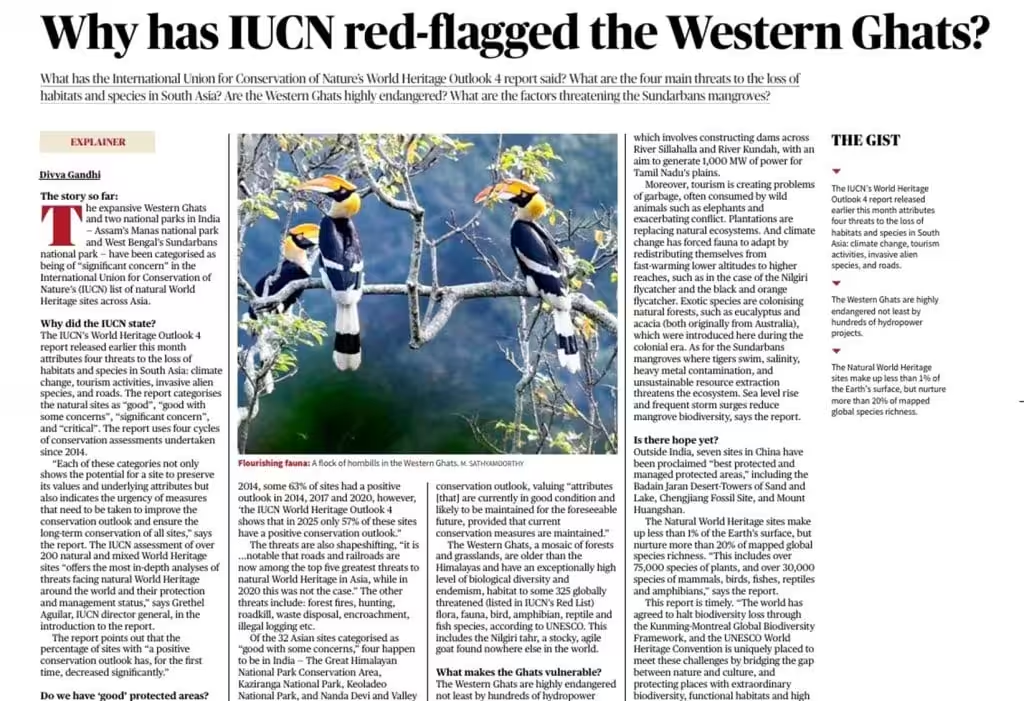
Recently IUCN’s World Heritage Outlook 4 report released earlier this month attributes four threats to the loss of habitats and species in South Asia.
UPSC Relevance:
Environment and IUCN report
UPSC PYQ:
Q. Which one of the following is not a site for in-situ method of conservation of flora? (2011)
(a) Biosphere Reserve
(b) Botanical Garden
(c) National Park
(d) Wildlife Sanctuary
About World Heritage Outlook 4 report:
- The IUCN World Heritage Outlook 4 will be launched at the IUCN World Conservation Congress in October 2025.
- The IUCN World Heritage Outlook is unique in its assessment of all World Heritage sites inscribed for their natural values simultaneously, at regular intervals (every 3-5 years).
- It is the only global assessment of natural World Heritage at a single point in time and recognises good conservation practice, supporting the role of World Heritage sites in demonstrating excellence.
- Implemented by the IUCN World Heritage Team and IUCN’s World Commission on Protected Areas (WCPA), it aims to provide reliable, transparent and independent information on the present situation and future prospects of natural World Heritage through Conservation Outlook Assessments.
- The report categorises the natural sites as “good”, “good with some concerns”, “signi cant concern”, and “critical”.
Objectives:
- Track the state of conservation of all World Heritage sites inscribed for their natural values over time and raise awareness of their importance.
- Recognise well-managed sites for their conservation efforts and encourage the transfer of good management practices between sites.
- Identify the most pressing conservation issues affecting World Heritage sites inscribed for their natural values and the actions needed to remedy those issues.
- Understand and communicate the benefits of World Heritage sites for local and global communities, for example in providing livelihoods and sustaining healthy ecosystems, at a time of fast-moving environmental, economic and humanitarian crises.
Outcome of World Heritage Outlook 4 report:
According to report four threats to the loss of habitats and species in South Asia: climate change, tourism activities, invasive alien species, and roads.
Major Concern in India:
- Western Ghats: The Major Concern:
- The Western Ghats are older than the Himalayas and among the world’s eight biodiversity hotspots. Home to around 325 globally threatened species (IUCN Red List), including the Nilgiri tahr, an endemic mountain goat species.

| Threat | Description |
|---|---|
| Hydropower Projects | Projects like the ₹5,843 crore Sillahalla Pumped Storage Project in Tamil Nadu threaten riverine ecosystems. |
| Tourism Pressure | Litter and garbage, often eaten by wildlife, intensify human–animal conflict. |
| Plantations | Conversion of forests into tea, coffee, and eucalyptus plantations reduces native biodiversity. |
| Climate Change | Species are shifting to higher altitudes (e.g., Nilgiri flycatcher) due to warming. |
| Invasive Species | Eucalyptus and Acacia, introduced during colonial times, are displacing native flora. |
2. Sundarbans: The Mangrove Crisis:
- Threatened by salinity intrusion, heavy metal contamination, and unsustainable resource extraction.
- Sea-level rise and frequent storm surges are degrading mangrove biodiversity.
- The ecosystem is under dual stress — ecological degradation and climate vulnerability.

Hope and Good Practices:
- China’s seven sites are rated among the “Best Protected” globally, reflecting effective management.
- Four Indian sites — Great Himalayan National Park, Kaziranga, Keoladeo, and Nanda Devi–Valley of Flowers — are rated as “Good with Some Concerns.”
- Khangchendzonga National Park (Sikkim) is rated “Good” and can retain this status if current measures continue.
Source: https://anantamias.com/current-affairs/world-heritage-outlook-4-report/
Aatmanirbharta In Farms : Regenerative Agriculture

Why in the News?
On OCTOBER 16, World Food Day was observed under the theme “Hand in Hand for Better Food and a Better Future,”. The theme calls for the collective responsibility to transform our food systems through collaboration between nations, businesses, farmers, policymakers, and scientists. Central to this transformation is regenerative agriculture – a holistic approach that restores soil health, enhances biodiversity, builds climate resilience, and promotes nutritional security.
UPSC Relevance
GS3, Major Crops – Cropping Patterns in various parts of the country, – Different Types of Irrigation and Irrigation Systems; Storage, Transport and Marketing of Agricultural Produce and Issues and Related Constraints; E-technology in the aid of farmers.
Conservation, Environmental Pollution and Degradation, Environmental Impact Assessment.
PYQ
2022 – What is Integrated Farming System? How is it helpful to small and marginal farmers in India?
Challenges to Sustainable Agriculture in Present Times – highlighted in article
The world, and India in particular, faces several critical challenges stemming from rapid population growth and the unintended consequences of past agricultural successes.
- Immense Strain on Finite Global Resources:
- The global population has dramatically increased, multiplying four times in under 100 years to reach 8.2 billion today.
- This rapid expansion places immense strain on finite resources like land (only 29% of Earth’s surface) and the mere 10.7% of land that is farmed.
- Environmental Degradation and Resource Depletion:
- Soil, water, and ecosystems worldwide are under mounting pressure due to overuse, pollution, and climate change.
- In India, despite having 52% arable land, the rising population has led to the depletion of natural resources and environmental degradation, threatening the long-term sustainability of the agriculture sector, which employs nearly 46% of the workforce.
- Soil Distress from Past Innovations (Green Revolution):
- Innovations like the Haber-Bosch process for synthetic fertilisers, while averting mass starvation, created new challenges.
- In India, excessive and unbalanced use of fertilisers (primarily due to distorted pricing of N, P, and K ) has degraded soils, increased greenhouse gas (GHG) emissions, and contaminated groundwater.
- India’s actual NPK usage ratio (9.8:3.7:1 in Kharif 2024) deviates heavily from the recommended 4:2:1 ratio.
- Critically Low Soil Organic Carbon (SOC) Levels:
- India’s average SOC level is below 0.3%, which is far short of the 1% threshold recommended by experts.
- Soil quality depletion is particularly severe in states like Punjab, Haryana, and Rajasthan.
- Water Scarcity and Depletion: Agriculture is the largest consumer of freshwater in India. The over-extraction of groundwater, especially in states like Punjab and Haryana due to the heavy reliance on water-intensive crops (rice and wheat), has led to alarmingly low water tables. Inefficient flood irrigation practices worsen water wastage.
- Loss of Biodiversity: The promotion of monoculture (growing a single crop like wheat, rice, sugarcane etc.) and the heavy use of chemicals have reduced the biodiversity of both crops and ecosystems, making the agricultural system less resilient.
- Lagging Public Sector Innovation:
- Flagship public innovation initiatives like the Atal Innovation Mission (AIM) and the Anusandhan National Research Foundation (ANRF) are still evolving, with substantial breakthroughs yet to fully materialise.
Reforms and Path to a Better Future
The systemic challenges demand systemic solutions, focusing on innovation, collaboration, and a shift to regenerative practices.
- Adopting Regenerative Agriculture:
- It is a holistic approach that aims to restore soil health, enhance biodiversity, build climate resilience, and promote nutritional security. Restoring soil vitality is described as an ecological and economic need.
| Steps to promote Regenerative Agriculture | Key Practices in India | Benefits |
| Embrace Natural/Zero Budget Natural Farming (ZBNF) | Promote Jeevamrit (cow dung/urine-based microbial culture) and Beejamrit (seed treatment) to reduce reliance on external chemical inputs. | Low-cost and indigenous inputs make it accessible to India’s small and marginal farmers (86% of the farming community). |
| Minimize Tillage | Encourage the use of no-till drills and machinery to directly sow seeds into the residue of the previous crop. | Saves fuel, labor, and soil structure, and helps with crop residue management (reducing the need for burning). |
| Promote Crop Diversity & Rotation | Reintroduce and rotate pulses (like moong or tur), oilseeds, and coarse cereals in the crop cycle, especially in the dominant rice-wheat regions. | Naturally fixes nitrogen in the soil, reduces pest pressure, and improves farmers’ nutritional security and income diversification. |
| Agroforestry and Intercropping | Integrate native trees (like Neem, Amla, or Tamarind) or plant cash crops alongside cover crops. | Provides shade, acts as windbreaks, conserves water, sequesters carbon, and offers farmers supplementary income from timber or fruit. |
| Strengthen Farmer Knowledge & Training | Utilize Farmer Producer Organizations (FPOs) and Self-Help Groups (SHGs) for peer-to-peer training and sharing of success stories. | Overcomes the initial knowledge gap and resistance to change by building collective community support and capacity. |
- Leveraging the “4 Ps” (Policies, Products, Practices, and Partnerships):
- The text advocates for transformation through the alignment of policies, products, practices, and partnerships.
- Policies: Set the regulatory environment and provide incentives (subsidies, market access rules) to guide the entire sector toward sustainable goals.
- Products: Include the innovative goods (e.g., high-yield seeds, soil sensors) that are essential to enhance productivity and sustainability on the farm.
- Practices: Refer to the on-farm methods (e.g., precision farming, crop rotation) used by farmers to implement efficiency and environmental protection.
- Partnerships: Facilitate collaboration between the government, private sector, and farmers, enabling technology transfer and investment in infrastructure.
- Innovation generates new products/practices, while collaboration (partnerships) ensures they are scaled and adopted effectively.
- India’s successful journey from a food-deficient nation to the world’s largest rice exporter (the Green Revolution) is cited as a powerful example of what the 4 Ps can achieve.
- The text advocates for transformation through the alignment of policies, products, practices, and partnerships.
- Prioritizing Nutritional Security with Pulses and Oilseeds:
- As nutrition is central to regenerative agriculture, India must prioritize its production of pulses and oilseeds, which naturally fix nitrogen and require fewer inputs.
- The government has launched the Rs 11,440 crore ‘Mission for Aatmanirbharta in Pulses’ (2025-26 to 2030-31) to scale up domestic pulse production to 350 lakh tonnes.
- Need for Crop-Neutral Incentives:
- To achieve self-sufficiency in pulses and oilseeds, there is a critical need for innovative policies that promote crop-neutral incentives.
- It is stated that unless pulses and oilseeds receive incentives and market support similar to rice and wheat, the goal of Atmanirbharta (self-reliance) will be difficult to achieve.
- Fostering Innovation and Global Collaboration:
- The private sector is already taking steps, exemplified by a recent seminar on “Innovations for Regenerative Agriculture” co-hosted by AgVaya and BioSTL.
- The launch of the Global AgXelerate platform aims to connect agricultural innovators with global markets, demonstrating a spirit of innovation that can stem from modest beginnings.
- The ultimate success hinges on effective implementation, substantial R&D investment, and active participation from all stakeholders.
Source: https://anantamias.com/current-affairs/aatmanirbharta-in-farms-regenerative-agriculture/
Koraput Coffee

Why in the News?
Prime Minister Narendra Modi during his Man ki Baat programme on Sunday said that more and more Indian coffee varieties are gaining popularity globally.
UPSC Relevance
Important crops are often asked in Prelims
PYQ
2022 Prelims
Consider the following States:
- Andhra Pradesh
- Kerala
- Himachal Pradesh
- Tripura
How many of the above are generally known as tea-producing States?
(a) Only one State
(b) Only two States
(c) Only three States
(d) All four States
Indian Coffee: Global Popularity and Regional Diversity
The Prime Minister highlighted the growing global popularity and remarkable diversity of Indian coffee, which is a significant source of income for cultivators across the country.The Commerce and Industry Ministry and the Prime Minister specifically highlighted Koraput coffee for its quality and positive socio-economic impact.
- Key Cultivation Regions: The popular varieties are grown in diverse regions, including:
- Karnataka: Chikmagalur, Coorg, and Hassan.
- Tamil Nadu: Pulney, Shevaroy, Nilgiri, and Annamalai.
- Biligiri Region: Located on the Karnataka-Tamil Nadu border.
- Kerala: Wayanad, Travancore, and Malabar.
- The Prime Minister also noted the progress in coffee cultivation in the North-East of India.

The Rise and Impact of Koraput Coffee – from Odisha
- Cultivators: The region has seen successful coffee cultivation driven by passion, including people who left lucrative corporate jobs.
- Socio-Economic Impact:
- The industry has pleasantly transformed the lives of many women, bringing them both respect and prosperity.
- For tribal farmers, it provides a steady cash income in place of subsistence farming.
- The industry is inclusive, with women playing a central role in harvesting and processing.
- Environmental Benefits: Koraput coffee cultivation has helped:
- Restore degraded forest land.
- Reduce soil erosion.
- Market Positioning: With support from the Coffee Board, Koraput coffee is being positioned as a specialty tribal coffee, comparable to Araku, resulting in significant improvement in farmers’ incomes and living standards.
- The GI tag for “Araku Valley Arabica” was granted in 2019 and includes coffee grown in both Andhra Pradesh and Odisha, which covers Koraput.
- The need for a separate tag: Stakeholders argue that Koraput coffee has a distinct flavor profile and unique agricultural practices that warrant its own GI tag.
National Production and Export Figures
The Commerce and Industry Ministry provided key statistics on India’s coffee sector, emphasizing its export focus.
- Cultivation Area & Production: Coffee is grown over 4.90 lakh hectares, producing 3.63 lakh metric tonnes annually.
- Export-Oriented Commodity: Coffee is highly export-oriented, with 70 per cent of the country’s production being exported.
- Global Reach & Earnings: Indian coffee is exported to more than 120 countries, earning $1.80 billion during 2024-25
Read More about Coffee – Coffee crop
Source: https://anantamias.com/current-affairs/koraput-coffee/