Daily Digest
UPSC · Civil Services Examination
Current Affairs · Tuesday, 29 September 2026
Current affairs curated and edited by Anantam IAS faculty — pulled from The Hindu, PIB, IDSA, Foreign Affairs and the ministries. Read, annotate, revise.
Old Rajinder Nagar · Delhi 110005 · anantamias.com
Steel Safety Council: Learning From Near Misses Before Accidents
Why in News?
On 28 September 2026, the Ministry of Steel announced its decision to establish a Steel Industry Safety Council and supporting directorate to strengthen accident prevention across the steel sector.
- The proposed Steel Industry Safety Council (SISC) will be an apex industry safety body under the Ministry of Steel, chaired by its Secretary.
- A supporting Steel Industry Safety Directorate (SISD) will provide expertise spanning steelmaking processes, occupational health, fire engineering and disaster management.
- The announced remit includes safety standards, periodic audits, serious-incident investigation, near-miss information and emergency preparedness reviews.
- Steelmaking brings together high temperatures, heavy equipment and hazardous processes; preventing severe incidents requires reliable plant systems alongside worker protection.
- Shared incident learning can help one plant correct a weakness before a similar failure occurs elsewhere; collecting reports alone cannot deliver that result.
UPSC Relevance
Prelims Relevance
- SISC: proposed apex industry safety body under the Ministry of Steel.
- SISD: proposed technical and professional support directorate.
- Near miss: an event with potential for harm, even when injury does not occur.
- Process safety: prevention and control of hazardous process failures.
- Leading indicators assess preventive controls; lagging indicators record adverse outcomes or failures.
Mains Relevance
GS Paper 3
- Industrial disaster prevention through technical standards, audits and incident learning.
- Worker protection and productive capacity in hazardous industries.
GS Paper 2
- Coordination between industry institutions and existing regulatory organisations.
Essay
- Institutional learning matters when the absence of visible failure creates false confidence.
Background and Context
What the proposed council and directorate would do
The announcement separates an apex body for industry direction from a directorate providing specialised technical work and follow-through.
- The Council will assess industry safety, approve standards and recommended practices, and review serious accidents and near misses. These are announced responsibilities, not evidence of completed operations.
- The Directorate will support implementation through audits, investigations, information sharing and preparedness reviews. Technical expertise matters because steel melting, coke ovens and rolling mills present different operational hazards.
- Representatives from DGMS, PESO and NDMA are envisaged in the Council. Participation connects relevant expertise, but the release does not establish new statutory enforcement powers or replace existing regulators.
- For context, the ore-to-pellet chain explains material preparation, while steel-slag reuse concerns product quality. This initiative addresses operational safety across industrial activities.
Process safety and personal protection address different needs
Process safety asks whether hazardous operations remain controlled; personal protection reduces particular exposures faced by an individual worker.
- A molten-metal handling system illustrates the distinction: reliable containment, equipment condition and operating controls address the process hazard before workers might encounter escaping heat or material.
- Personal protective equipment, such as appropriate protective clothing, remains necessary for relevant tasks. Its presence does not demonstrate that a furnace, lifting system or process-control arrangement is reliable.
- An illustrative maintenance review should ask which equipment can cause serious harm if it fails, whether inspections are overdue, and who can confirm that defects have been corrected.
- A technical audit should examine controls in practice, including equipment condition and operating routines. A written procedure or completed training attendance sheet cannot by itself establish safe operation.

How a near miss should change the next shift
A near miss becomes useful evidence when investigation produces a correction that remains effective after the immediate incident is forgotten.
- A near miss involves potential harm without the corresponding harmful outcome. For example, a suspended load entering an unoccupied work area can expose a weakness even when nobody is injured.
- Investigators should examine underlying causes, including maintenance, supervision and work design, rather than stop at the final human action. Otherwise, the same conditions may recreate the event.
- Useful corrective action identifies the failed safeguard, assigns responsibility and checks implementation. Sharing the lesson helps other plants inspect similar equipment or work arrangements before another incident occurs.
- The HSE distinguishes active learning, where lessons change practices, from passive learning that only records them. Its organisational-learning guidance is an analytical reference, not an Indian legal mandate.
Measure control reliability alongside accident outcomes
Leading and lagging indicators answer different questions; a credible safety review needs both to challenge false reassurance.
- Lagging indicators record adverse outcomes or control failures, such as injuries or hazardous releases. An injury-free period does not establish that every safeguard will work when challenged.
- Leading indicators examine preventive activity and control health. Timely inspection of critical equipment or closure of serious audit findings can reveal weaknesses before a harmful outcome occurs.
- Near-miss counts need interpretation: more reports may reflect better reporting or worsening conditions. Examine incident severity, repeated causes and corrective action rather than treat the count as a simple safety score.
- An emergency drill tests response capability after prevention has failed; it does not substitute for prevention. The proposed SISD remit includes preparedness review, but no achieved accident reduction is established.
Way Forward
Make reporting lead to verified correction
- Develop comparable reporting categories while allowing plant-specific hazard detail, so shared data supports learning without hiding the circumstances of each event.
- Protect candid frontline reporting and include contract workers in reporting and training arrangements; investigate underlying weaknesses while preserving accountability for deliberate unsafe conduct.
- Require closure evidence for serious audit findings and revisit recurring defects. Judge progress through control reliability and outcomes, not the number of circulars or meetings.
Conclusion
- The proposed SISC–SISD arrangement offers a structure for shared safety standards and technical learning; its value will depend on whether plant-level controls actually improve.
- In a Mains answer, connect near-miss reporting to investigation, verified correction and shared learning, while keeping preventive controls distinct from emergency response and personal protection.
UPSC Practice Questions
Prelims MCQ 1
With reference to the proposed Steel Industry Safety Council and Directorate, consider the following statements:
- The Council is envisaged under the administrative control of the Ministry of Steel.
- The Directorate is intended to maintain and disseminate accident and near-miss information.
- The announcement states that the Council will replace DGMS and PESO.
How many of the above statements are correct?
(a) Only one (b) Only two (c) All three (d) None
Answer: (b) Only two
Explanation:
The Ministry announced the first two responsibilities. DGMS and PESO representation is envisaged; their replacement is not announced.
Prelims MCQ 2
Which measure most directly indicates the condition of preventive safety controls before an accident?
(a) Compensation paid after injuries (b) Number of injuries in the previous year (c) Timely inspection of equipment critical to preventing hazardous failures (d) Total production achieved during the month
Answer: (c) Timely inspection of equipment critical to preventing hazardous failures
Explanation:
Inspection of critical equipment tests preventive control health. Injury and compensation figures describe consequences already recorded; production alone does not measure safety.
UPSC Mains Questions
- Explain how near-miss investigation can strengthen industrial disaster prevention. What institutional safeguards help convert reports into corrective action? (150 words)
- Discuss the proposed roles of the Steel Industry Safety Council and Directorate. Why should safety assessment combine process controls, leading indicators and accident outcomes? (250 words)
Sources: PIB, Ministry of Steel and UK Health and Safety Executive: process safety and organisational learning.
Frequently Asked Questions
What is the proposed Steel Industry Safety Council?
It is an apex industry safety body announced under the Ministry of Steel. The proposed Council will assess safety, approve standards and recommended practices, and review accidents and near misses.
What will the Steel Industry Safety Directorate do?
The proposed Directorate will provide technical support through safety audits, serious-incident investigation, information sharing, standards development and preparedness reviews. The announcement describes intended responsibilities rather than demonstrating that all functions are already operational.
Why should a near miss be investigated?
A near miss can expose a failed safeguard even when nobody is hurt. Investigating its underlying causes and verifying corrective action can prevent similar conditions from producing a harmful outcome later.
Does personal protective equipment establish process safety?
No. Appropriate protective equipment reduces particular worker exposures, but it cannot establish the reliability of plant containment, machinery or operating controls. Process safety requires those underlying systems to remain effective.
Are fewer reported near misses always a good sign?
No. A lower count may reflect safer conditions or weaker reporting. Interpretation requires information about incident severity, recurring causes, reporting practices and whether corrective measures have actually been implemented and checked.
Source: https://anantamias.com/current-affairs/steel-industry-safety-council-near-miss-prevention/
August IIP: Reading Industrial Output Across Two Classifications
Why in News?
On 28 September 2026, MoSPI released August Index of Industrial Production quick estimates alongside revised July data, making the comparison between releases especially important.
- August IIP growth was 8.0% year on year; manufacturing output rose 9.0%.
- Statement I gives revised July growth of 7.4%; the release’s introductory comparison still cites July’s earlier quick estimate of 6.7%.
- The release uses 2022-23=100 and NIC-2025; it does not announce a fresh base-year change on this date.
- Sector classification identifies the producing activity; use-based classification identifies the economic purpose of the goods.
- A higher headline growth rate can coexist with uneven sector performance; the composition and estimate’s revision status matter.
UPSC Relevance
Prelims Relevance
- IIP: an index tracking changes in industrial production.
- Sector classification: mining and quarrying; manufacturing; electricity and gas supply; water supply, sewerage and waste management.
- Use-based groups: primary, capital, intermediate, infrastructure/construction goods, consumer durables and consumer non-durables.
- Quick estimates: initial estimates subject to revision as source agencies provide updated production data.
Mains Relevance
GS Paper 3
- Use industrial indicators to distinguish output recovery, investment signals and household demand.
- Assess the balance between timely statistics and revision transparency in economic policymaking.
Background and Context
What the index measures
IIP describes the direction of industrial production; understanding its unit prevents a growth figure from being mistaken for national income.
- Production volume is the central concept: the index tracks changes in industrial output across its basket. A factory’s higher selling prices alone do not establish that it produced more goods.
- The base-period index supplies a common reference for combining different products. It lets output changes be compared without adding tonnes of minerals directly to units of manufactured equipment or electricity.
- GDP value added measures a different economic quantity: output value less intermediate consumption. IIP cannot establish the income generated by an industry, its profitability, or the economy’s overall growth rate.
- Read the companion note on national accounts methods for the broader measurement framework. Industrial production is useful evidence within economic analysis, but it does not cover every source of national income.
- Likewise, consumer price inflation concerns prices. Higher production and higher prices can occur together; neither indicator independently proves how much purchasing power households gained or lost during the reporting period.

Two classifications, two questions
The same industrial basket can be examined by its producing activities or by the role its goods play in the economy.
- The sector view asks where production originates. This release covers mining and quarrying, manufacturing, electricity and gas supply, and water supply, sewerage and waste management as separate industrial sectors.
- The use-based view asks what goods are for. Capital goods support production capacity; intermediate goods enter further production; consumer goods meet final consumption needs, with durable and non-durable categories distinguished.
- These are alternative classifications, not additional industries to stack together. Adding capital-goods growth to manufacturing growth would mix overlapping views of output and produce a meaningless measure of industrial expansion.
- The general index is weighted, so sectors do not count equally. Manufacturing carries the largest weight in Statement I; simply averaging the sector growth rates will not reproduce the headline result.
- Use categories provide signals, not complete explanations. Rising capital-goods output can inform an investment discussion, but domestic production alone cannot show actual installation, imported equipment purchases, or whether factories are operating near capacity.
Read revisions before judging momentum
Every growth comparison needs a stated reference period and a clear distinction between quick and revised estimates.
- The August figure compares output with August of the preceding year. It is not the percentage change from July, and a faster annual rate does not automatically establish a seasonally adjusted monthly acceleration.
- The release’s introductory text retains the earlier July quick estimate, while Statement I incorporates updated July production. Use the revised figure for a current comparison and label the two estimate stages explicitly.
- A quick estimate prioritises timely information from available returns. Subsequent source-agency data can change the aggregate; revisions should be recorded rather than interpreted automatically as evidence of either manipulation or economic deterioration.
- The release reports higher weighted response for revised July than quick August. Response measures data availability under the compilation process; it is not a statistical guarantee that every industrial activity is represented perfectly.
- The base effect also matters: annual growth depends on the corresponding earlier month’s output. To judge persistence, examine several comparable observations and sector composition rather than treating a single headline as a lasting trend.
Way Forward
Make comparisons reproducible
- Cite the reference month, classification and estimate status whenever using IIP in an economic answer.
- Maintain the latest revised series while preserving earlier releases, so readers can distinguish data revisions from new output movements.
- Cross-check production signals with investment, employment and demand evidence before drawing conclusions about industrial recovery.
Conclusion
- IIP is an output indicator whose meaning depends on classification, weighting and comparison period. Its strength is timely industrial evidence; it cannot independently establish national income, household welfare or sustained investment growth.
- For August’s release, start with the revised July comparison, then explain sector and use-based views separately. This produces a stronger answer than reproducing every percentage in the bulletin without interpreting what it measures.
UPSC Practice Questions
Prelims MCQ 1
With reference to the Index of Industrial Production, consider the following statements:
- Sector and use-based classifications provide alternative views of industrial output.
- IIP measures the value added generated by the entire economy.
- Quick estimates may be revised using updated production data.
How many of the above statements are correct?
(a) Only one (b) Only two (c) All three (d) None
Answer: (b) Only two
Explanation:
Statements 1 and 3 are correct. IIP tracks industrial production; it is not a measure of economy-wide value added.
Prelims MCQ 2
Which approach best supports a current comparison of August and July IIP annual growth in the September release?
(a) Average all sector growth rates equally (b) Add capital-goods growth to manufacturing growth (c) Use revised July data and identify August as a quick estimate (d) Treat August annual growth as growth from July
Answer: (c) Use revised July data and identify August as a quick estimate
Explanation:
The latest release incorporates revised July data. Both growth rates compare their respective months with the corresponding month a year earlier.
UPSC Mains Questions
- Explain how sector and use-based classifications of IIP help interpret industrial performance. What conclusions require additional evidence?
- Discuss why revision transparency and the distinction between year-on-year and month-on-month changes matter in interpreting economic indicators.
Sources: PIB, Ministry of Statistics and Programme Implementation and MoSPI, IIP Statements I and III.
Frequently Asked Questions
What is the difference between sector and use-based IIP?
Sector classification groups production by industrial activity. Use-based classification groups goods by economic purpose, such as capital formation or consumption. They provide alternative views and must not be added together.
Why can July’s IIP growth change in a later release?
Quick estimates use available production returns. Updated data received from source agencies can change the index and growth rate. The September release incorporates revised July figures alongside August quick estimates.
Does IIP growth equal GDP growth?
No. IIP tracks industrial production, while national accounts measure value added across a broader economy. Production volumes alone do not establish intermediate costs, income generated, or growth in all services.
Does higher annual IIP growth mean output rose from the previous month?
No. Annual growth compares a month with the same month of the preceding year. A month-to-month comparison uses a different reference and requires attention to seasonal patterns before interpreting momentum.
Source: https://anantamias.com/current-affairs/august-iip-sector-use-classification-revisions/
Cetacean Conservation: Reducing Bycatch and Vessel Collision Risks
Why in News?
India called for scientific evidence and international cooperation in cetacean conservation during its opening statement at IWC-70 in Hobart on 28 September 2026.
- India identified population status, distribution and movements as essential evidence for conservation decisions, alongside breeding ecology and information about threats affecting particular populations.
- The statement called for cooperation among range countries, scientific institutions and local communities, with practical measures suited to conditions where animals and human activities overlap.
- India highlighted the Arabian Sea humpback whale as a conservation priority and described Project Dolphin as covering dolphins, whales, porpoises and associated aquatic ecosystems.
- This was an opening statement outlining priorities; the release does not announce a new treaty, an adopted resolution or newly mandatory shipping restrictions.
- A protected-area boundary cannot by itself prevent encounters with fishing gear or vessels when animals move beyond it; the activity causing harm also needs management.
- The policy challenge combines species protection and livelihoods: fishers and vessel operators need workable measures whose effects can be checked, rather than identical restrictions across different settings.
UPSC Relevance
Prelims Relevance
- Cetaceans: whales, dolphins and porpoises
- Bycatch and fishing-gear entanglement
- Vessel-strike risk and spatial overlap
- International Whaling Commission and range-state cooperation
- Dugongs belong to Sirenia, not Cetacea
Mains Relevance
GS Paper 3
- Threat-specific marine biodiversity protection alongside fisheries and shipping.
- Using imperfect population and incident evidence to prioritise conservation.
GS Paper 2
- Cooperation among range states and international specialist institutions.
Essay
- Shared oceans require responsibility beyond jurisdictional boundaries.
Background and Context
Which animals and institutions are involved?
Cetaceans share a biological grouping, but their habitats and exposure to human activities differ.
- Whales, dolphins and porpoises are cetaceans. Dugongs are marine mammals belonging to Sirenia; appearing together in a marine biodiversity list does not make these groups taxonomically identical.
- The International Whaling Commission addresses whaling management and whale conservation. Its scientific and conservation work includes contemporary pressures such as fishing interactions and vessel collisions.
- Range countries share responsibility when a population uses waters across jurisdictions. Compatible observations help connect local risks with the wider population rather than treating each sighting as an isolated event.
- India’s statement links conservation with local ecological evidence. Knowing where animals occur, and when, makes it possible to identify the human activities that require closer investigation.
- Movement evidence also matters inland: the published Chambal dolphin study concerns river conditions, whereas the present marine challenge centres on fishing and shipping encounters.
How fishing gear creates bycatch risk
Bycatch occurs when fishing gear captures an animal that the fishing operation was not targeting.
- Incidental capture can affect cetaceans in industrial and small-scale fisheries. A conservation response must identify the relevant fishery and gear rather than assuming vessel size alone determines danger.
- Gillnets and entangling nets are particularly important sources of cetacean bycatch. Gear interaction is the mechanism to investigate; a collision-prevention measure does not directly remove that exposure.
- The IWC’s bycatch guidance discusses gear modification, acoustic deterrents and temporary closures. These are options for assessment, not a universally effective package or a newly announced Indian requirement.
- Local trials should test both animal protection and fishing practicality. A device or gear change that works in one fishery cannot automatically be assumed suitable elsewhere.
- Reporting gaps make priorities difficult to establish. Working with fishing communities improves the evidence needed to judge where mitigation is necessary and whether a tested measure succeeds.
How vessel collisions demand a different response
Vessel-strike prevention reduces dangerous overlap between animals and moving vessels.
- A vessel strike is a collision, distinct from capture in fishing gear. Whales can be injured or killed; vessels and people aboard can also suffer harm.
- Spatial separation is central: the IWC identifies keeping vessels and whales apart as the most effective approach, with slowing and lookout measures where separation is impractical.
- Risk mapping combines animal distribution with shipping activity. A busy route through important habitat warrants attention even when recorded collisions are few, because many incidents remain unobserved.
- Incident reports are incomplete evidence, not a census of mortality. The IWC’s vessel-strike database helps identify patterns, but reported totals cannot establish the full scale of harm.
- Cleaner shipping addresses another pressure: Kandla’s e-methanol initiative concerns fuel emissions. Lower-emission propulsion does not itself prevent a vessel from colliding with a whale.

Way Forward
Match prevention to the encounter
- Combine cetacean observations, fishing effort and shipping routes to identify local priorities before selecting interventions.
- Co-design gear trials and operational changes with fishers and vessel operators, recording conservation effects and practical costs.
- Share comparable incident and movement records across range countries; assess mitigation against population risk rather than publicity around individual sightings.
Conclusion
- Effective cetacean conservation connects the animal, the harmful encounter and a tested prevention measure; legal protection and protected areas need complementary action in working seas.
- An exam answer should distinguish fishing-gear interaction from vessel collision, then explain why local evidence and cooperation across jurisdictions determine the appropriate response.
UPSC Practice Questions
Prelims MCQ 1
With reference to cetacean conservation, consider the following statements:
- Whales, dolphins and porpoises are cetaceans.
- Dugongs belong to the same cetacean grouping.
- Bycatch involves incidental capture of non-target species in fishing gear.
How many of the above statements are correct?
(a) Only one (b) Only two (c) All three (d) None
Answer: (b) Only two
Explanation:
Statements 1 and 3 are correct. Dugongs are sirenians, although they too are marine mammals.
Prelims MCQ 2
Which approach most directly addresses vessel-strike risk in an area where whale habitat overlaps a busy shipping route?
(a) Replacing marine fuel alone (b) Increasing fishing-net mesh size alone (c) Separating vessel routes from whale concentrations where feasible (d) Treating reported collisions as a complete mortality census
Answer: (c) Separating vessel routes from whale concentrations where feasible
Explanation:
Spatial separation reduces exposure to collisions. Where separation is impractical, speed and lookout measures can be considered; fuel changes alone do not prevent strikes.
UPSC Mains Questions
- Distinguish fishing-related bycatch from vessel strikes. Explain why cetacean conservation needs interventions tailored to each threat. (150 words)
- Why are protected areas insufficient by themselves to conserve mobile marine mammals? Discuss the role of range-state cooperation and evidence about human activities. (250 words)
Sources: PIB, Ministry of Environment, Forest and Climate Change and International Whaling Commission.
Frequently Asked Questions
What is cetacean bycatch?
Cetacean bycatch is the incidental capture of whales, dolphins or porpoises in fishing gear. It can occur in industrial and small-scale fisheries, requiring measures adapted to the species, gear and local fishing operation.
Are dugongs cetaceans?
No. Dugongs are marine mammals belonging to Sirenia, whereas whales, dolphins and porpoises are cetaceans. Their shared inclusion in marine biodiversity conservation programmes does not make them members of the same biological group.
How can vessels reduce collision risk with whales?
The IWC emphasises keeping vessels and whales apart where feasible. Where separation is impractical, slowing and maintaining a lookout can help. Suitable measures depend on local whale distribution, vessel activity and operational conditions.
Did India’s IWC-70 statement create new mandatory restrictions?
The reported opening statement sets out India’s conservation priorities and support for scientific cooperation. It does not itself establish a new treaty or announce newly mandatory speed restrictions for ships in Indian waters.
Source: https://anantamias.com/current-affairs/iwc-cetacean-conservation-bycatch-vessel-risk/
Vehicle Crash Testing: Turning Impact Events Into Safety Evidence
Why in News?
On September 28, the Ministry of Heavy Industries reported that GARC had begun installing equipment to upgrade automotive testing under PM E-DRIVE.
- GARC, at Oragadam near Chennai, is an authorized testing agency under Rule 126 of the Central Motor Vehicles Rules.
- Planned upgrades cover passive safety, advanced driver assistance systems, batteries and electromagnetic compatibility, alongside other vehicle and component testing.
- New high-speed imaging is intended to record deformation, occupant movement and airbag deployment during frontal, side and rear crash tests.
- Equipment installation has commenced; the announcement does not establish that every upgraded facility is commissioned or that any vehicle has passed testing.
- Vehicle crash testing translates a brief physical impact into evidence about how the vehicle structure and restraints protect occupants.
- Testing infrastructure can support domestic engineering and certification; its public value depends on reliable measurements and credible interpretation.
UPSC Relevance
Prelims Relevance
- GARC: Global Automotive Research Centre; automotive testing and certification.
- Passive safety: protection during a collision.
- Active safety: measures intended to help avoid or mitigate a collision.
- Crash-test dummy: an instrumented surrogate for assessing occupant loading.
- Homologation: conformity assessment against applicable vehicle requirements.
Mains Relevance
GS Paper 3
- Domestic testing capacity as industrial infrastructure.
- Scientific evidence and the limits of controlled safety testing.
GS Paper 2
- Credible regulation and understandable consumer safety information.
Essay
- Public trust depends on the quality of evidence behind a safety claim.
Background and Context
What a crash test needs to observe
A crash is a sequence of interacting movements; the final damaged vehicle reveals only part of that sequence.
- At impact, the vehicle structure deforms while an occupant tends to continue moving. Protection depends on managing that motion and maintaining survivable space, rather than keeping every exterior panel undamaged.
- Seat belts and airbags act together to manage occupant movement. Evaluators examine the restraint sequence and contact with the interior, because a deployed airbag alone does not establish effective protection.
- High-speed cameras divide the brief event into successive images. These show when structural deformation, dummy movement and airbag inflation occur, helping engineers examine their relationship during the same impact.
- Instrumented dummies provide measurements relevant to injury assessment. Their readings complement visible motion: footage can reveal a contact, while measurements help assess the loading associated with that event.
- Interpreting video alongside measurements supports diagnosis of restraint and structural behavior. A visually dramatic crushed front end cannot, by itself, show whether the passenger compartment and occupants were adequately protected.
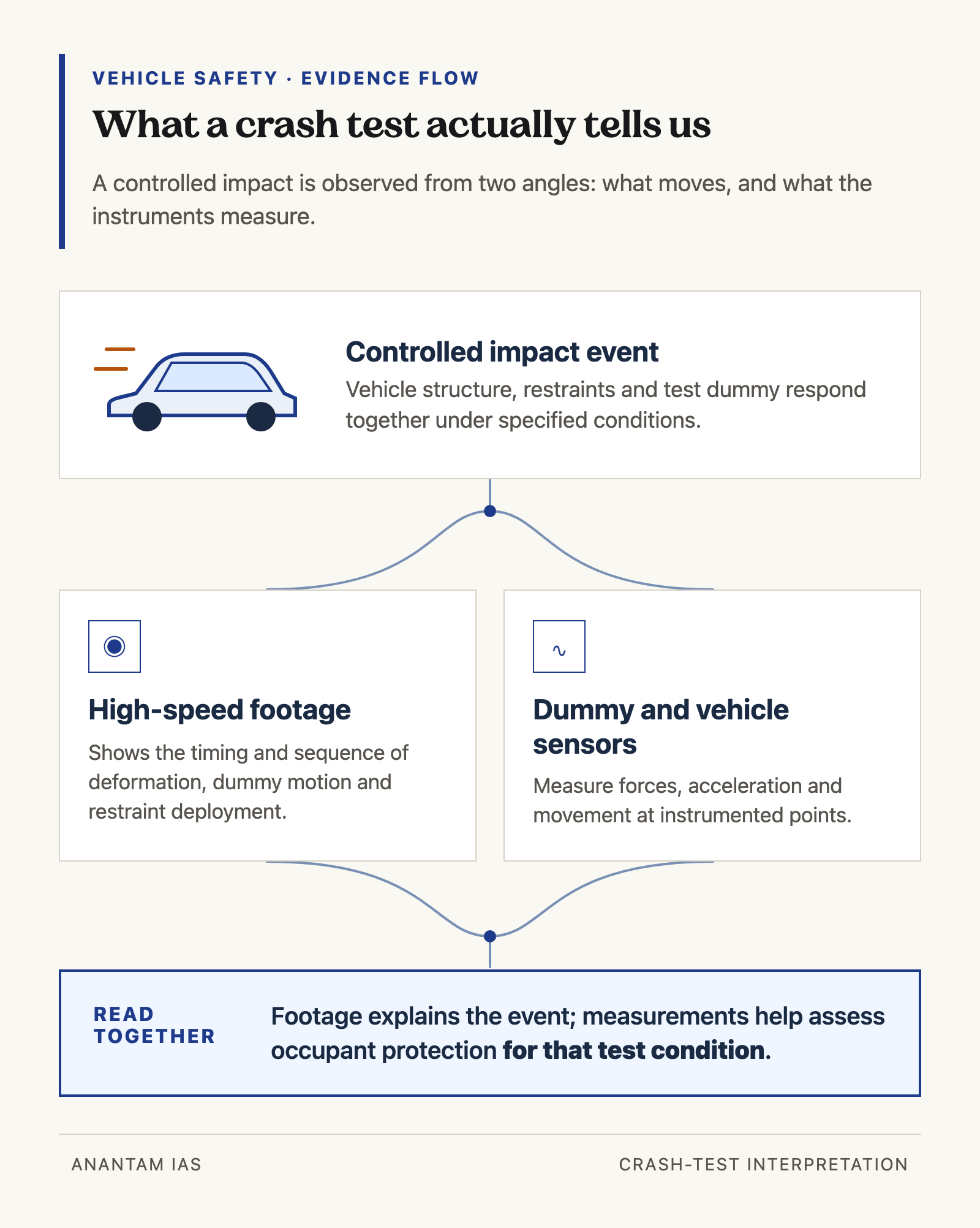
Passive protection and active avoidance
GARC is expanding several testing capabilities, but each addresses a different part of vehicle safety.
- Passive safety concerns protection when a crash occurs, including the structure, seats and restraints. The term describes their protective function; an airbag still uses sensors and an active deployment mechanism.
- Active safety seeks to help prevent or mitigate a collision. Driver assistance testing examines the performance of relevant systems before impact; it does not replace assessment of protection during an actual crash.
- GARC lists ADAS instruments and soft targets separately from passive-safety dummies and calibration equipment. Treating these as interchangeable would confuse detection or avoidance performance with the consequences of an impact.
- Battery testing and electromagnetic compatibility answer additional safety questions. Passing a crash assessment cannot establish every battery property or show that electronic systems will function acceptably amid electromagnetic disturbances.
- The practical lesson is layered protection: a vehicle may need to avoid hazards, protect people during impact and meet other technical requirements. No single test supplies evidence for all these functions.

What the evidence can and cannot establish
A reliable conclusion must stay within the conditions tested and the purpose of the assessment.
- Homologation evaluates conformity with applicable requirements. GARC’s authorization identifies its testing role; an infrastructure announcement is not a conformity certificate for an unnamed vehicle or proof that a particular model passed.
- Consumer star ratings communicate assessed safety performance under a rating protocol. Bharat NCAP is voluntary; purchasing laboratory equipment does not automatically award a manufacturer or vehicle any stars.
- Controlled test conditions make evidence interpretable, but actual collisions differ in direction, severity and occupant circumstances. Results support bounded judgments rather than a promise that every real-world crash will be survivable.
- Calibration and test documentation matter alongside camera quality. For measurements to support engineering decisions, the equipment, setup and interpretation need to be reliable; a clear recording cannot repair an incorrectly conducted test.
- Installation, operational readiness and demonstrated outcomes are separate stages. The release establishes an upgrade in progress, while claims about reduced road deaths would require evidence connecting actual vehicle performance with wider road-safety conditions.
Way Forward
Make testing evidence usable
- Verify operational readiness before treating equipment delivery as an available testing service.
- Document test conditions, calibration and limitations so engineers can trace conclusions to measured evidence.
- Explain results clearly: identify the vehicle configuration, assessment purpose and limits rather than presenting one result as universal safety assurance.
Conclusion
- Crash testing is valuable because it connects a rapid mechanical event with evidence about occupant protection. Its strength lies in the combined interpretation of structure, restraint behavior and measurements.
- For policy analysis, separate testing capacity from operational readiness, vehicle certification and road-safety outcomes. GARC’s upgrade supports the first step; later claims require their own evidence.
UPSC Practice Questions
Prelims MCQ 1
With reference to vehicle safety testing, consider the following statements:
- Passive safety includes protection provided by restraints during a collision.
- High-speed impact footage alone establishes every aspect of occupant injury risk.
- Testing of driver assistance systems and crash occupant protection assesses different functions.
How many of the above statements are correct?
(a) Only one (b) Only two (c) All three (d) None
Answer: (b) Only two
Explanation:
Statements 1 and 3 are correct. Video is interpreted with measurements and test conditions; it does not independently establish every injury risk.
Prelims MCQ 2
What does the reported commencement of equipment installation at GARC establish?
(a) Every upgraded facility has been commissioned (b) All tested vehicles have received five stars (c) The testing-infrastructure upgrade is in progress (d) Road deaths have measurably declined
Answer: (c) The testing-infrastructure upgrade is in progress
Explanation:
The release reports installation in progress, not universal commissioning, model-specific ratings or demonstrated reductions in road deaths.
UPSC Mains Questions
- Explain how high-speed imaging and instrumented measurements complement each other in vehicle crash testing.
- Discuss why domestic vehicle testing capacity is necessary but insufficient for improved road-safety outcomes.
Sources: PIB, Ministry of Heavy Industries and NHTSA, Crashworthiness.
Frequently Asked Questions
What is passive safety?
Passive safety concerns protection during a collision through the vehicle structure, seats and restraints. It is distinct from active-safety measures intended to help prevent or mitigate a collision before impact.
Why are high-speed cameras useful in crash tests?
They reveal the sequence of deformation, occupant movement and airbag deployment during a very brief impact. Engineers interpret this visual record alongside measurements rather than treating footage alone as a safety verdict.
Does GARC’s upgrade mean the facilities are fully operational?
The September 28 release says installation of procured equipment has commenced. It does not establish that every upgraded facility is commissioned, or provide a passing result for any particular vehicle.
Are homologation and consumer star ratings the same?
Homologation concerns conformity with applicable vehicle requirements. Consumer star ratings communicate assessed performance under a rating protocol. Bharat NCAP is a voluntary programme, and a laboratory upgrade does not automatically confer a rating.
Source: https://anantamias.com/current-affairs/garc-vehicle-crash-testing-passive-safety-evidence/
Dam Emergency Plans: Coordinating Warnings Across Cascades
Why in News?
The National Dam Safety Authority reviewed dam emergency action plans at Lonavala and Bhushi on 27 September, focusing on coordination and downstream safety after recent flooding.
- PIB’s 28 September release reports advice to review and strengthen emergency plans using recent incidents, extreme rainfall scenarios and downstream risks.
- Tata Power owns Lonavala Dam; Central Railway owns Bhushi Dam. Both participated in the consultation.
- CWPRS provided technical inputs on preparing, reviewing and finalising plans. Field visits examined the dams’ cascading relationship within the Indrayani River system.
- Connected reservoirs require information to cross institutional boundaries quickly enough for another operator and downstream authorities to act.
- A warning succeeds only when people at risk receive usable instructions and can take protective action before danger arrives.
UPSC Relevance
Prelims Relevance
- National Dam Safety Authority (NDSA)
- Emergency Action Plan (EAP)
- Central Water and Power Research Station (CWPRS)
- Indrayani River system
- Cascade coordination and downstream warning
Mains Relevance
GS Paper 3
- Dam emergency preparedness and last-mile warning
- Operational coordination across connected reservoirs
GS Paper 2
- Accountability at handoffs between infrastructure owners and civil administration
Essay
- Public safety depends on institutions acting together under uncertainty.
Background and Context
Why separate dams need a shared emergency picture
A cascade creates operational dependence: information about one reservoir can matter to another operator and to communities beyond either dam’s immediate boundary.
- Rainfall and changing flows can affect connected reservoirs during the same event. Operators need a shared situation picture because decisions taken at one location may change conditions elsewhere along the system.
- Separate ownership adds a coordination boundary. Each agency may hold useful observations, but downstream preparedness depends on exchanging relevant information rather than assuming another agency already knows about the developing emergency.
- The Lonavala consultation explicitly examined the cascading relationship between the two dams. The release does not establish their geographic upstream order, so that sequence should not be inferred from their names.
- An Emergency Action Plan links identified emergency situations with notification, coordination and response. Its practical purpose is to connect technical information at a dam with decisions that protect exposed people downstream.
- The reported discussion concerned extreme rainfall and flood lessons. It does not establish that either dam failed; emergency preparedness should account for credible hazards without treating every flood as structural failure.
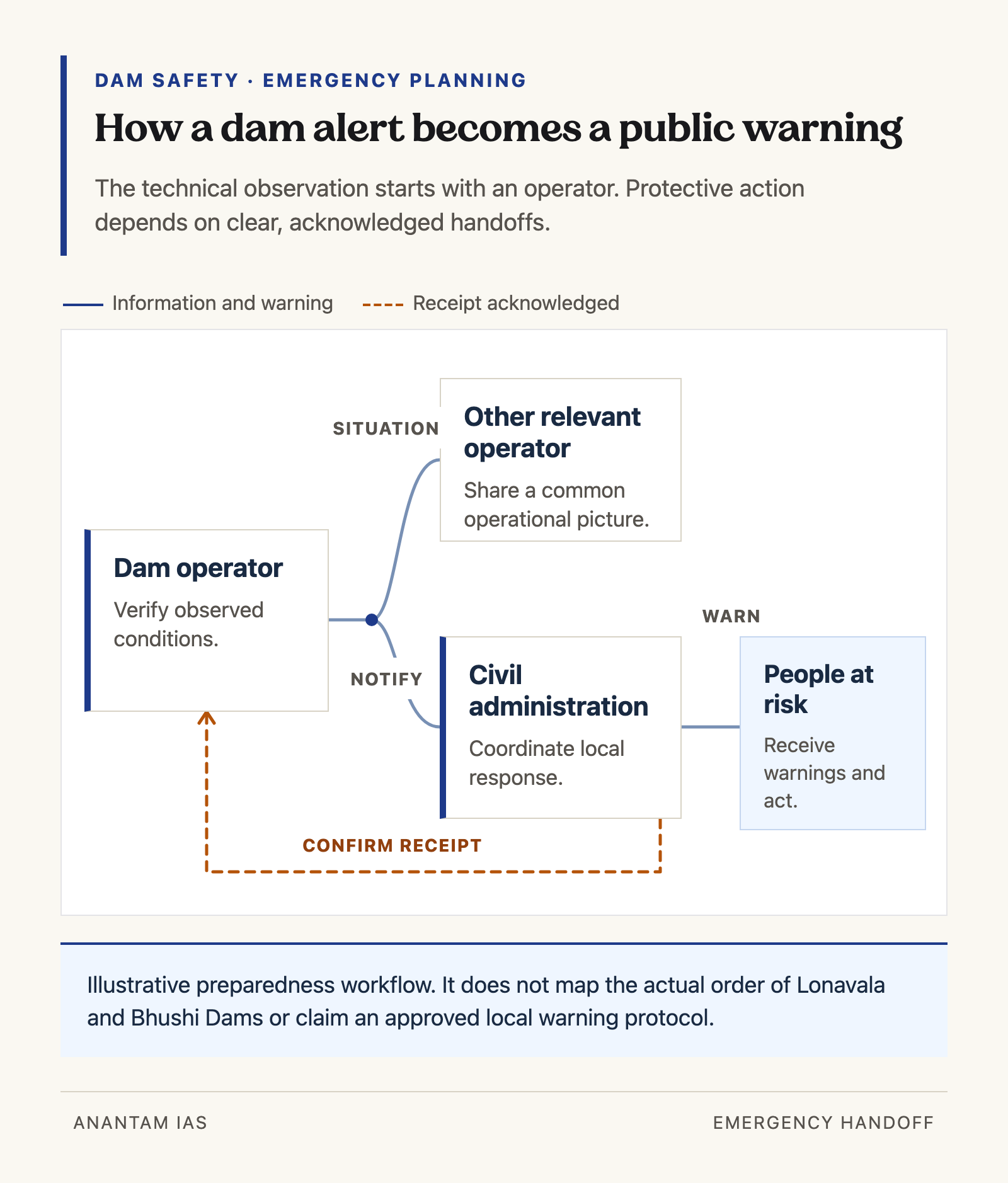
The warning handoff: observation must become action
The following handoff explains general preparedness practice; it is not a newly mandated procedure or an approved local plan announced by this consultation.
- Dam owners monitor relevant conditions and assess an emerging situation against their applicable procedures. They should communicate the nature of the concern, affected locations and available information to designated response contacts.
- Other dam operators need timely notification where the event could affect their operations. A shared message should distinguish observed conditions from forecasts, since those categories carry different kinds of uncertainty for decisions.
- Civil administration and response agencies translate technical notification into public warning and, where necessary, evacuation. People need understandable instructions about the hazard, safe movement and where reliable updates will come from.
- Acknowledgement closes a communication gap: sending a message does not prove the responsible official received it. Contact checks, alternative channels and escalation arrangements help prevent an unanswered alert from becoming a dead end.
- As with weather early warning, lead time is useful only when recipients can act. Reservoir information, local exposure and practical response arrangements must be interpreted together during a developing emergency.
What the consultation changes, and what remains unproven
The verified development is a direction to strengthen preparedness through review, supported by technical consultation and attention to downstream populations.
- NDSA advised a review of both agencies’ plans using recent incidents and identified emergency scenarios. This supports an implementation story about improving preparedness, rather than a claim that a new law was enacted.
- CWPRS supplied technical inputs on preparation, review and finalisation. Participation by a technical institution does not, by itself, demonstrate that revised plans have been completed, approved or tested successfully in the field.
- Warning thresholds must be appropriate to the actual dam and emergency scenario. The release publishes no reservoir-level or discharge trigger; inventing such values would misrepresent both operational risk and the consultation’s outcome.
- Exercises and contact verification are useful ways to test a plan’s handoffs. These are preparedness recommendations here, not reported drill results or proof that every downstream settlement currently has effective warning coverage.
- The broader lesson from disaster reviews is follow-through: lessons should change assigned responsibilities and rehearsed actions. A meeting establishes attention; reliable emergency performance requires evidence that those arrangements actually work.
Way Forward
Test the handoffs before the emergency
- Reconcile owner and district plans so each notification has a named recipient, acknowledgement requirement and fallback contact.
- Rehearse realistic rainfall scenarios across owners and response agencies, recording delays and repairing failed communication links.
- Check community instructions for clarity, local accessibility and workable evacuation arrangements; revise them when downstream exposure changes.
Conclusion
- Dam safety includes coordinated emergency action beyond the structure itself. Connected reservoirs make the reliability of information exchange a public-safety issue across institutional boundaries.
- In an answer, connect monitoring, notification and protective action, then distinguish a preparedness review from evidence that revised plans are approved and operational.
UPSC Practice Questions
Prelims MCQ 1
With reference to dam emergency preparedness, consider the following statements:
- Connected dams may require coordination even when different agencies own them.
- An Emergency Action Plan can connect warning, communication and emergency response.
- A stakeholder consultation alone proves that revised emergency plans have been approved.
How many of the above statements are correct?
(a) Only one (b) Only two (c) All three (d) None
Answer: (b) Only two
Explanation:
The first two statements describe the consultation’s central concerns. Review and technical inputs do not establish approval of revised plans.
Prelims MCQ 2
Which arrangement most directly reduces the risk that a dam emergency notification fails at an institutional handoff?
(a) Sending an alert without identifying its recipient (b) Replacing local instructions with a technical reservoir report (c) Requiring acknowledgement and providing a fallback communication route (d) Assuming separate dam owners face unrelated risks
Answer: (c) Requiring acknowledgement and providing a fallback communication route
Explanation:
Acknowledgement tests receipt; a fallback route addresses non-response or channel failure. These are general preparedness measures, not newly announced local mandates.
UPSC Mains Questions
- Explain why emergency preparedness for connected dams requires coordination across ownership boundaries. Identify the main communication handoffs that need testing.
- An effective warning is measured by protective action, not merely by message transmission. Discuss with reference to downstream dam safety.
Source: PIB, Ministry of Jal Shakti.
Frequently Asked Questions
What is a dam Emergency Action Plan?
It connects identified emergency situations with warning, communication, coordination and response arrangements. Its purpose includes protecting downstream communities by ensuring that technical information leads to timely protective decisions.
Why does a dam cascade require coordination?
Conditions and decisions in a connected reservoir system can affect other operators and downstream communities. Separate owners need timely information exchange and clear response contacts so institutional boundaries do not delay emergency action.
Were new emergency plans approved at Lonavala?
The PIB release reports advice to review, update and strengthen plans, alongside technical inputs from CWPRS. It does not establish that revised plans were approved or that particular warning thresholds were adopted.
Why should emergency messages be acknowledged?
Acknowledgement helps establish that the intended recipient received the notification. Combined with fallback contacts and communication channels, it reduces the chance that a critical alert remains unanswered during an emergency.
Source: https://anantamias.com/current-affairs/dam-emergency-action-plans-cascade-downstream-warning/
CBSE Language Policy: Cohort Transitions and Assessment Safeguards
Why in News?
The Hindu reported on September 28 that the Supreme Court examined extending CBSE third-language assessment relief to the current Class VI cohort.
- The report concerns transitional assessment relief for Class VI, comparable to that already specified for Classes VII–IX.
- The Union government sought to persuade the court to allow implementation for Class VI; the report also describes judicial concern about student comfort.
- Parents questioned school readiness, language choices and access to printed materials; these were submissions during the hearing, not independently established findings.
- Treat this as continuing judicial scrutiny; the report alone does not establish a final nationwide exemption or cancellation of the policy.
- A cohort means students entering the transition together; its assessment rules can differ from those applying to older or later batches.
- The administrative problem is whether learning expectations, teaching support and examination consequences change together in a predictable way.
UPSC Relevance
Prelims Relevance
- CBSE-affiliated schools and board-specific curriculum implementation
- Third language (R3)
- School-based internal assessment versus external board examination
- Transitional cohort relief
- Bhartiya Bhashas and permitted language combinations
Mains Relevance
GS Paper 2
- Designing equitable curriculum transitions and predictable assessment
- Administrative capacity, language choice and access to learning materials
Essay
- Educational reform succeeds when institutional readiness supports the learner.
Background and Context
What the June guidelines actually distinguish
The official baseline separates language study from examination arrangements and assigns different transition rules to different batches.
- Under CBSE’s June 29 guidelines, students in Classes VII–IX during 2026–27 continue third-language study but receive school-based assessment when progressing to Class X.
- The original provision for the Class VI cohort required an R3 board examination on reaching Class X. That difference explains why extending assessment relief has become the current issue.
- The current Class X batch continues with two languages. A transition As a result cannot be described accurately by stating a single rule for every pupil in the school.
- The general combination requires two languages native to India, with specified transitional relaxations. It does not name Hindi as compulsory; language-category rules and the selection of a particular language are different.
- The earlier CBSE transition explainer provides the policy baseline. Today’s additional issue is Class VI assessment treatment under judicial scrutiny, rather than a fresh announcement of the entire language scheme.
Why the form of assessment matters
Curriculum reform has three separate decisions: what students learn, how learning is assessed, and what consequences follow.
- Studying a subject creates teaching and learning obligations. Removing its external examination does not automatically remove classroom instruction, homework or the need for suitable teachers and materials.
- Internal assessment places evaluation within the school. It can support feedback during learning, but its fairness depends on understandable criteria and consistency between teachers; the label alone cannot guarantee either.
- An external board examination changes preparation demands and the stakes attached to performance. Students need to know the applicable arrangement early enough to plan, especially when beginning an unfamiliar language.
- Transitional relief can recognise different prior exposure without abandoning the eventual curriculum objective. A defensible design explains which cohort receives relief, what continues, and which assessment requirement changes.
- The separate debate over English’s classification concerns language categories. It should not obscure the assessment question: changing a category and changing examination consequences are different policy actions.
Readiness, access and the limits of the court report
A workable transition must connect the announced rule to the learning conditions available in each school.
- Teacher availability determines whether a nominal language choice becomes a usable option. Sharing teachers may widen access, but timetables, continuity and opportunities for students to ask questions still require practical coordination.
- Digital availability and effective access are different. A downloadable textbook helps only when learners can reliably obtain and use it; a school should identify students needing print or supported access.
- Readiness claims need an explicit measure: having selected languages, having teachers, supplying materials and delivering regular lessons are different milestones. A broad readiness statement should not substitute for checking the relevant bottleneck.
- The Hindu’s hearing report describes scrutiny of Class VI relief and competing submissions. Read it cautiously while the precise operative order is unverified; do not infer a final constitutional ruling from reported exchanges.
- The official document addresses CBSE-affiliated schools. Applying its provisions automatically to every state-board school would erase an essential institutional boundary and produce an inaccurate account of implementation.
Way Forward
Make the transition usable for each cohort
- Issue a cohort-specific notice identifying the applicable language combination, assessment method and any changes following the operative court order.
- Check teaching and material gaps school by school, with a clear route for parents to report unavailable language instruction or inaccessible resources.
- Explain internal assessment criteria before evaluation and provide a proportionate review process for disputed decisions.
Conclusion
- Predictable transitions join curriculum objectives with teaching capacity and fair assessment; changing examination arrangements alone cannot resolve every difficulty learners face.
- For an answer on education reform, distinguish policy scope, cohort eligibility and assessment consequences before evaluating fairness or recommending implementation safeguards.
UPSC Practice Questions
Prelims MCQ 1
With reference to the CBSE guidelines of June 29, 2026, consider the following statements:
- Third-language study and the requirement of a third-language board examination are separate matters.
- The guidelines prescribed identical transition arrangements for all classes.
- Requiring two native Indian languages necessarily makes Hindi compulsory.
How many of the above statements are correct?
(a) Only one (b) Only two (c) All three (d) None
Answer: (a) Only one
Explanation:
Only statement 1 is correct. The guidelines differentiate cohorts and allow language combinations; a requirement for native Indian languages does not itself make Hindi compulsory.
Prelims MCQ 2
Which measure most directly improves predictability when introducing a new school subject?
(a) Announcing the objective without specifying assessment (b) Publishing cohort-specific learning and assessment arrangements before evaluation (c) Treating online textbook availability as proof of universal access (d) Applying one board’s rules automatically to every school
Answer: (b) Publishing cohort-specific learning and assessment arrangements before evaluation
Explanation:
Cohort-specific arrangements tell students which requirements and consequences apply to them. The other choices leave key implementation questions unresolved.
UPSC Mains Questions
- How can cohort-based transitional arrangements reconcile curriculum reform with fairness to existing students? Discuss with reference to language education.
- Distinguish curriculum requirements from assessment design. What administrative safeguards are needed when schools introduce an additional language?
Sources: CBSE, June 29 implementation guidelines and The Hindu.
Frequently Asked Questions
Has CBSE’s three-language policy been abolished?
The cited report does not establish abolition. It concerns judicial scrutiny of assessment relief for the Class VI cohort. Policy obligations should be read alongside the applicable CBSE guidelines and the precise operative court order.
Does relief from a board examination end third-language study?
No. The June guidelines distinguish studying the third language from taking its external board examination. A cohort may continue learning the subject while receiving school-based assessment under the relevant transitional arrangement.
Does the requirement make Hindi compulsory?
The requirement concerns languages native to India and does not itself prescribe Hindi. The guidelines describe multiple possible combinations and include specific transitional relaxations; the applicable cohort and school arrangements matter.
Why is school readiness more than providing a textbook online?
Students also need access to suitable teachers, a workable timetable, understandable assessment criteria and materials they can actually use. Online availability alone does not establish that every learner can reliably access the resource.
Source: https://anantamias.com/current-affairs/cbse-language-policy-cohort-transition-assessment/
Should Voting be a Fundamental Right?
Why in News?
Reports of eligible voters being excluded from electoral rolls and disagreements within the Election Commission have revived the debate over making the right to vote a fundamental right.
The reported exclusion of 97 eligible voters in Goa, linked to difficulties in reversing deletions through ECINet, highlights how technological and administrative failures can affect electoral participation.
| UPSC Relevance: GS-2: Polity and Governance: Election Reforms, Constitutional Rights, Election Commission Prelims & Mains: Right to Vote, Election Reforms |
Constitutional Foundation of Voting in India:
India adopted universal adult suffrage from the commencement of the Constitution, without property, educational or gender qualifications.
Three constitutional provisions are central:
- Article 324: Entrusts the Election Commission with the superintendence, direction and control of electoral-roll preparation and elections.
- Article 325: Prohibits exclusion from electoral rolls solely on grounds of religion, race, caste or sex, and provides for one general electoral roll for each territorial constituency.
- Article 326: Establishes adult suffrage for Lok Sabha and State Legislative Assembly elections. Eligible Indian citizens aged 18 years or above are entitled to registration, subject to constitutionally permitted disqualifications.
The 61st Constitutional Amendment Act, 1988 reduced the voting age from 21 to 18 years.
Two laws operationalise this framework: the Representation of the People Act, 1950 governs electoral rolls, while the Representation of the People Act, 1951 regulates the conduct of elections and the exercise of voting rights.
Is Voting a Statutory, Constitutional or Fundamental Right?
Voting has a constitutional foundation; its exercise is regulated by statute, and aspects of electoral choice receive fundamental rights protection.
- Kuldip Nayar v. Union of India (2006): A Constitution Bench characterised the right to elect as a statutory right under Section 62 of the RPA 1951, rather than a fundamental right.
- Rajbala v. State of Haryana (2015): A smaller Bench described the right to vote as a constitutional right, reflecting Article 326.
- Anoop Baranwal v. Union of India (2023): The majority opinion did not overturn the larger-Bench position in Kuldip Nayar. Justice Ajay Rastogi, in a separate concurring opinion, supported recognising the right to vote as a fundamental right.
Freedom of voting: The exercise of electoral choice and the voter’s right to information about candidates are protected under Article 19(1)(a).
Why is Fundamental Right status being proposed?
- Stronger protection against exclusion: Wrongful deletion prevents a citizen from participating in government formation. Fundamental-right recognition could strengthen scrutiny of arbitrary restrictions and provide a clearer basis for constitutional remedies.
- Protection of political equality: Universal adult suffrage gives citizens an equal political voice. Exclusion caused by documentation barriers or administrative errors can disproportionately affect migrants, poorer households and other vulnerable groups.
- Accountability in digital electoral administration: Centralised software can improve efficiency, but its design must allow lawful corrections. A technical limitation should not override an eligible citizen’s claim to enrolment or an authorised officer’s decision.
- Recognition of democracy’s essential requirement: The right indispensable to democratic participation deserves explicit protection comparable to other fundamental freedoms.
Concerns and Qualifications:
- Fundamental right status would not create an unrestricted right to vote: Even if voting is recognised as a Fundamental Right, its exercise would remain subject to constitutional and statutory conditions such as citizenship, age, residence and lawful disqualifications. The Supreme Court has also reiterated that political participation operates within a statutory framework.
- The constitutional position is already stronger than a purely statutory right: Article 326 provides the constitutional foundation for adult suffrage, while Section 62 of the RPA, 1951 operationalises the right. The Supreme Court has described the right to vote as a constitutional right in Rajbala and Anoop Baranwal, although earlier Constitution Bench authority in Kuldip Nayar characterised the right to elect as statutory. This unresolved doctrinal tension would need to be addressed before any formal constitutional upgrade.
- The remedy question is more important than the label: Making voting a Fundamental Right could strengthen the basis for invoking Articles 32 and 226 against arbitrary exclusion. However, electoral disputes are also subject to the special constitutional scheme under Article 329(b). Any expansion of judicial remedies would therefore have to distinguish between correcting an individual’s enrolment and allowing courts to interrupt an ongoing election.
- Greater judicial scrutiny could affect electoral administration: Electoral rolls require continuous revision to remove duplicate, deceased or otherwise ineligible entries while protecting eligible voters. The Supreme Court has recently emphasised that electoral-roll revision must balance inclusion of eligible electors with exclusion of ineligible persons, while being accompanied by procedural safeguards.
- Constitutional amendment may not by itself solve exclusion: If exclusion results from outdated databases, migration, documentation difficulties, inadequate notice or inaccessible grievance mechanisms, changing the formal status of the right would not automatically correct these administrative deficiencies.
Way Forward:
- Move to a rights-based electoral roll framework: Whether or not voting is elevated to Part III, wrongful exclusion should be treated as a serious constitutional concern, with clear statutory duties to provide notice, reasons, an opportunity to respond and a time-bound remedy before deletion.
- Create an effective right to restoration: Electoral law should ensure that an eligible citizen whose name is wrongly deleted has a simple, time-bound mechanism for re-enrolment or restoration, including during the period immediately preceding an election, subject to reasonable cut-off dates.
- Build a human override into digital electoral systems: Digital platforms such as ECINet should facilitate (not determine) the exercise of statutory powers. Authorised election officials should be able to rectify erroneous deletions or technical failures through an auditable, reasoned and traceable process.
- Reconcile judicial remedies with electoral finality: If voting receives Fundamental Right protection, Parliament and the courts would need to clarify how Articles 32 and 226 interact with Article 329(b). The objective should be to provide effective remedies for arbitrary exclusion without permitting litigation to routinely stall the electoral process.
- Clarify the constitutional position through authoritative adjudication or amendment: The continuing distinction between the Kuldip Nayar line of reasoning and later judgments describing voting as a constitutional right creates doctrinal uncertainty. A clearer constitutional formulation could settle whether the right to vote merits Fundamental Rights protection.
- Strengthen institutional safeguards within the ECI: The 2023 Act provides that Election Commission business should be transacted unanimously and, where the Commissioners differ, be decided by majority. Transparent recording of important institutional decisions can strengthen accountability without compromising the Commission’s constitutional autonomy.
The real constitutional question is not merely whether the right to vote should be placed in Part III, but whether every eligible citizen has an effective, timely and legally enforceable means of exercising that right.
Mains Practice Question:
Q. Universal adult suffrage requires effective protection against wrongful exclusion from electoral rolls. Discuss in the context of the demand to recognise voting as a fundamental right.
Prelims Practice Question
Q. Which statement is correct?
(a) Article 326 applies to direct elections to both Houses of Parliament.
(b) Temporary absence automatically ends ordinary residence in a constituency.
(c) The 61st Constitutional Amendment reduced the voting age from 21 to 18 years.
(d) All Election Commission decisions must be unanimous.
Answer: (c) Article 326 covers Lok Sabha and State Assembly elections; temporary absence alone does not end ordinary residence; Commission differences may be resolved by majority.
UPSC PYQ 2017
Q. Right to vote and to be elected in India is a:
(a) Fundamental Right
(b) Natural Right
(c) Constitutional Right
(d) Legal Right
Answer: (c) (UPSC official answer key)
Source: https://anantamias.com/current-affairs/should-voting-be-a-fundamental-right/
Form 26 and the Statutory Mandate: Disclosure of Criminal Antecedents in Elections
Why in News?
The Supreme Court dismissed Meenakshi Natarajan’s challenge to the rejection of her Rajya Sabha nomination from Madhya Pradesh over non-disclosure of a pending criminal complaint in Form 26.
The Court directed her towards the post-election remedy of an election petition. It did not finally decide whether the rejection itself was legally correct. The controversy concerns the scope of disclosure requirements and access to timely judicial remedies.
| UPSC Relevance: GS-2: Polity and Governance: Representation of the People Act, Judicial review, Delegated legislation. Prelims: Form 26, Sections 33A and 125A, Article 329(b) Mains: Salient features of the Representation of the People Act |
What is Form 26?
- Form 26 is an affidavit filed with a candidate’s nomination papers under Rule 4A of the Conduct of Elections Rules, 1961. It contains information on criminal cases, assets, liabilities and educational qualifications of the candidate.
- Its constitutional foundation lies in Union of India v. Association for Democratic Reforms (2002), which recognised voters’ right to know candidates’ antecedents under Article 19(1)(a).
Disclosure enables informed voting; it does not itself impose an additional qualification for contesting elections.
What is the Current Controversy?
Issue 1: Can Form 26 require more than Section 33A? (Does Form 26 exceed the Parent Act?)
- For pending criminal cases, Section 33A of the Representation of the People Act, 1951 requires disclosure where:
- The offence is punishable with imprisonment of two years or more; and
- A competent court has framed charges.
- However, paragraph 5 of Form 26, as amended in 2018, mandates the disclosure of all pending criminal cases, including those where charges have not yet been framed. Consequently, its scope extends beyond the specific charge-framing stage outlined in Section 33A of the Representation of the People Act.
- The Concern: Delegated legislation created by the executive must strictly operate within the boundaries authorised by the parent Act. Form 26 arguably exceeds this mandate by broadening the disclosure requirements.
- The Qualification: No court has declared this wider disclosure requirement ultra vires or invalid.
- Section 33A explicitly allows rules to demand additional information.
- In PUCL v. Union of India (2003), the Supreme Court struck down Section 33B, which attempted to limit disclosure, and affirmed the broader constitutional right to information.
Therefore, the assertion that Form 26 impermissibly exceeds its statutory authority remains a contested legal argument.
Issue 2: Can Courts Intervene during Elections?
- Article 329(b) of the Constitution mandates that any challenge to a parliamentary or State legislative election must be raised exclusively through an election petition after the process concludes.
- The Rule against Disruption: In N.P. Ponnuswami v. Returning Officer (1952), the Supreme Court ruled that disputes (such as nomination rejections) should ordinarily wait until the election is complete, ensuring litigation does not stall the electoral schedule.
- The Exception for Facilitation: In Election Commission of India v. Ashok Kumar (2000), the Supreme Court permitted limited judicial intervention, provided it facilitates the electoral process rather than obstructing or delaying it. Crucially, this does not allow candidates to bypass the rules to challenge a rejected nomination mid-election.
Ultimately, post-election recourse remains the standard path: an election petition can be filed before the High Court, and the improper rejection of a nomination is expressly recognised as a ground to declare an election void under Section 100(1)(c) of the Representation of the People Act.
Way Forward:
- Clarify the statutory-form relationship: Parliament or the competent rule-making authority should clearly specify whether Form 26 can require disclosure beyond Section 33A, eliminating ambiguity between the parent statute and the prescribed form.
- Standardise the stages of criminal proceedings: The disclosure framework should clearly distinguish between an FIR, private complaint, investigation, cognisance, framing of charges and conviction to prevent inconsistent interpretation by Returning Officers.
- Strengthen scrutiny guidelines: Returning Officers should have clear, uniform guidelines on when non-disclosure constitutes a legally material defect warranting rejection of a nomination.
- Expediting election petitions: Because Article 329(b) mandates that all disputes be resolved exclusively through post-election petitions, courts must prioritise these cases. Prompt resolution ensures that if a nomination is found to be erroneously rejected, the injustice does not become practically irreversible due to judicial delay and passage of time.
- Preserve the voter’s right to know: Any reform should retain the core principle established in Association for Democratic Reforms that voters are constitutionally entitled to relevant information necessary for an informed electoral choice.
Form 26 connects electoral transparency with voters’ constitutional right to information. Its enforcement requires clear legal obligations, proportionate scrutiny and timely remedies, so that disclosure strengthens democratic choice while protecting candidates against arbitrary exclusion.
Practice Prelims MCQ:
Q. With reference to electoral disclosures in India, consider the following statements:
- Form 26 mandates the disclosure of all pending criminal cases, including those where charges have not yet been framed.
- Every pending criminal case automatically disqualifies a candidate.
- Improper rejection of a nomination is a ground for challenging an election through an election petition.
Which of the statements given above are correct?
(a) 1 and 2 only
(b) 1 and 3 only
(c) 2 and 3 only
(d) 1, 2 and 3
Answer: (b) Disclosure of a pending case does not automatically create a disqualification; improper rejection is covered by Section 100(1)(c).
UPSC Mains PYQ 2022:
Q. Discuss the procedures to decide the disputes arising out of the election of a Member of the Parliament or State Legislature under the Representation of the People Act, 1951. What are the grounds on which the election of any returned candidate may be declared void? What remedy is available to the aggrieved party against the decision? Refer to the case laws.
RTI Exemptions and the Limits of State Power
Why in News?
The Tamil Nadu government has withdrawn its September 21, 2026 Government Order that sought to exempt the Public (Law and Order) Department from the ambit of the Right to Information (RTI) Act, 2005, after criticism from political parties and civil-society groups.
The order had invoked Section 24(4) of the RTI Act, which permits a State Government to exempt specified intelligence and security organisations established by it from the Act.
This raises an important governance question: how should legitimate requirements of confidentiality in law-and-order and security matters be reconciled with transparency and public accountability?
| UPSC Relevance: GS-2: Polity and Governance: Fundamental Rights, Right to Information, Governance Prelims & Mains: Right to Information: Provisions and Concerns |
RTI and the Constitutional Value of Transparency:
- The RTI Act, 2005 establishes a legal framework for citizens to access information held by public authorities.
- Objective: To promote transparency and accountability in the functioning of government.
- Although the RTI Act is statutory, the Supreme Court has recognised the right to information as flowing from Article 19(1)(a), since meaningful freedom of speech and expression requires citizens to have access to relevant information.
- The RTI framework therefore seeks to move governance from a culture of official secrecy towards accountable administration. It simultaneously recognises legitimate exceptions relating to national security, privacy, commercial confidence and other protected interests.
Exemptions under the RTI Act:
(i) Section 24: Exemption for Intelligence and Security Organisations:
- Section 24 creates a special exemption from the RTI regime for specified intelligence and security organisations.
- The Second Schedule to the Act contains a list of Central intelligence and security organisations, including the Intelligence Bureau, Research and Analysis Wing, Directorate of Revenue Intelligence, Enforcement Directorate, CRPF, BSF, CBI, NIA and others.
(ii) What does Section 24(4) provide?
- Section 24(4) allows a State Government, by notification in the Official Gazette, to exempt an intelligence or security organisation established by that State Government from the operation of the Act.
- However, this power is accompanied by safeguards:
- the exemption has to be made through a notification
- the notification has to be laid before the State Legislature; and
- even exempt organisations are not completely insulated from the RTI framework concerning allegations of corruption and human-rights violations, subject to the statutory procedure.
Thus, Section 24 is an exception to the general rule of transparency, rather than a general power to exclude any department dealing with sensitive information.
The Key Issue: Is a Law-and-Order Department an Intelligence or Security Organisation?
This is the central legal and administrative issue raised by the withdrawn Tamil Nadu order.
- The Public (Law and Order) Department deals with highly sensitive subjects, including:
- communal and caste conflicts
- preventive detention under laws such as the NSA and COFEPOSA
- police firing and deaths in police custody
- police torture and deaths of remand prisoners
- law-and-order intelligence and periodic security assessments
- agitations and political protests
- NHRC references
- reports concerning communal and other law-and-order incidents.
The sensitivity of some of this information is therefore undeniable.
- However, dealing with sensitive information is not necessarily the same as being an “intelligence or security organisation” for the purposes of Section 24(4). This distinction is crucial. Otherwise, a broad administrative interpretation could potentially allow ordinary government departments dealing with sensitive subjects to claim the special exemption intended for specifically identified intelligence and security organisations.
Why does the RTI Act already provide Targeted Exemptions?
A major feature of the RTI framework is that confidentiality does not ordinarily require complete departmental exclusion.
- Section 8(1) already provides specific exemptions, including information whose disclosure may prejudicially affect:
- sovereignty and integrity of India
- security, strategic, scientific or economic interests of the State
- relations with foreign States
- investigation or prosecution
- confidentiality protected by law
- privacy of individuals; and
- other legally protected interests.
This means that sensitive information can be protected without necessarily making the entire institution non-transparent.
| Section 24 vs Section 8: Two Different Models of Exemption Section 8 (Information-specific exemption): The public authority remains within the RTI system, but particular information can be withheld when it falls within a statutory exemption. Section 24 (Organisation-specific exemption): The organisation itself is placed outside the ordinary operation of the RTI Act, subject to the statutory exceptions relating to corruption and human-rights violations. Therefore, Section 24 represents a stronger form of exemption and its application requires careful justification. |
Why Transparency matters in Law and Order?
- Law-and-order administration involves significant coercive powers of the State, including policing, preventive detention, crowd control and criminal investigation.
- Transparency is consequently important for accountability in areas such as police firing, custodial deaths, allegations of torture, preventive detention, implementation of recommendations of Commissions of Inquiry, communal and caste violence and exercise of executive discretion in law-and-order matters.
Broader Constitutional Dimensions:
- Article 19(1)(a) and informed citizenship: The right to information strengthens citizens’ ability to scrutinise government action and participate meaningfully in democratic governance.
- Article 14 and non-arbitrariness: Government exemptions from transparency mechanisms must have a legitimate legal basis and rational connection with their objective. A broad classification of an entire department as a security organisation therefore raises questions of administrative reasonableness.
- Rule of law: Executive authorities exercise powers within the limits prescribed by Parliament. Section 24(4) provides a specific statutory mechanism for State Governments; its invocation must therefore remain within the scope and purpose of the provision.
- Accountability of coercive institutions: Where governmental powers directly affect life, liberty and civil rights, mechanisms of oversight become particularly important. The RTI regime is one component of a broader accountability architecture that also includes courts, legislatures, human-rights institutions, audits and departmental mechanisms.
The Larger Governance Challenge:
- The RTI framework can help citizens, journalists, researchers and civil-society organisations examine whether public authorities are acting according to law and following established procedures.
- At the same time, disclosure of operational intelligence, confidential sources or information that could endanger individuals may legitimately require protection.
The challenge is therefore not transparency versus security, but designing a system in which necessary secrecy is protected without creating unnecessary opacity. The answer lies in calibrated transparency rather than either complete secrecy or unrestricted disclosure. This approach is already embedded in the architecture of the RTI Act through Sections 8, 10 and 24.
Section 10: Severability
- Where only a portion of a record is exempt, the RTI framework permits the non-exempt portion to be disclosed after severing the protected material.
This is particularly relevant to sensitive departments because it allows authorities to protect genuinely confidential information without necessarily withholding an entire document.
Way Forward:
- Apply Section 24 narrowly: The power under Section 24(4) should be used only where an organisation genuinely falls within the statutory category of an intelligence or security organisation, rather than merely because the department handles sensitive matters.
- Prefer information-specific exemptions: Where possible, authorities should rely on Section 8 exemptions for particular sensitive information rather than placing an entire department outside the RTI regime.
- Use severability: Under Section 10, confidential portions can be separated from information that can safely be disclosed. This can reconcile operational secrecy with institutional accountability.
- Strengthen proactive disclosure: Greater compliance with Section 4 can reduce the need for individual RTI applications. Departments can proactively publish information such as rules, procedures, organisational structures, budgets, decisions and implementation reports, while withholding genuinely sensitive material.
- Maintain independent oversight: Exemptions should not become a substitute for accountability. Information concerning corruption and human-rights violations remains subject to the special safeguards provided under Section 24, while courts, legislatures, human-rights institutions and other oversight mechanisms continue to perform their respective roles.
The withdrawal of Tamil Nadu’s order highlights an important principle of democratic governance: sensitivity of subject matter does not automatically justify institutional secrecy. The appropriate balance is therefore maximum disclosure with minimum necessary exemption.
Practice Prelims MCQ:
Q. Consider the following statements:
- State governments may notify eligible intelligence and security organisations under Section 24(4).
- Section 24 excludes all information concerning allegations of corruption.
- Human-rights information from an exempt State organisation requires State Information Commission approval and carries a 45-day timeframe.
Which statements are correct?
(a) 1 and 2 only
(b) 1 and 3 only
(c) 2 and 3 only
(d) 1, 2 and 3
Answer: (b) Corruption-related information is expressly excepted from the Section 24 exclusion.
Source: https://anantamias.com/current-affairs/rti-exemptions-and-the-limits-of-state-power/
Authorities lax in ensuring Women’s Safety in Delhi: SC
Why in News?
The Supreme Court took suo motu cognisance of recent sexual assault cases in Delhi-NCR, highlighting failures of law enforcement and public administration. It emphasised that expressions of concern must translate into concrete preventive action and accountability.
The SC directed the Delhi Police to:
- Identify vulnerable locations: Constitute district-level teams to inspect isolated stretches, parks, transport hubs, markets and areas around educational institutions.
- Prepare vulnerability maps: Share information across adjoining police stations to address recurring crime patterns.
- Strengthen patrolling: Increase police presence during hours identified as particularly unsafe.
- Audit lighting and CCTV coverage: Identify blind spots and repair non-functional infrastructure.
- Report existing safeguards: Explain arrangements for protecting women and children in public spaces.
| UPSC Relevance: GS-1 Indian Society: Women’s issues, social empowerment; GS-2 Social Justice: Women, Vulnerable Sections; GS-2: Polity and Governance: Fundamental rights, Govt schemes Prelims: Mission Shakti, Nirbhaya Fund, POSH Act, POCSO Act, constitutional provisions, Govt schemes Mains: Women Safety in India |
Understanding Women’s Safety:
Women’s safety means freedom from physical, sexual, psychological and economic abuse, along with the ability to study, work, travel and participate in society without intimidation.
It therefore requires attention to interconnected spaces:
- Homes: Domestic violence, marital abuse, dowry harassment and coercive control over finances and movement.
- Public spaces: Sexual harassment, stalking, assault and intimidation in streets, parks and markets.
- Transport: Harassment during travel, unsafe last-mile connectivity, isolated stops and inadequate emergency response.
- Workplaces and educational institutions: Sexual harassment, abuse of authority and retaliation against complainants.
- Digital platforms: Cyberstalking, threats, impersonation, doxxing and non-consensual intimate imagery, including sexualised deepfakes.
- Situations of heightened vulnerability: Trafficking, displacement and dependence on employers or intermediaries.
Safety should expand women’s capabilities rather than restrict them. Measures that discourage women from travelling, working or studying in the name of protection can reproduce the very exclusion that safety policies are meant to address.
What do the data indicate?
- Registered crimes against women: NCRB’s Crime in India 2024 places registered crimes against women at approximately 4.41 lakh, compared with 4.48 lakh in 2023, a decline of around 1.5%.
- Violence within households: According to NFHS-5, 2019-21, 29.3% of ever-married women aged 18-49 had experienced spousal violence, compared with 31.2% in NFHS-4.
Constitutional and Governance Dimensions:
(i) Constitutional foundations:
- Article 14: Equality before law and equal protection of laws.
- Article 15(1): Prohibition of discrimination on grounds including sex.
- Article 15(3): Enables special provisions for women and children.
- Article 19: Fear and violence can undermine the meaningful exercise of freedoms, including movement and occupation.
- Article 21: Protection of life and personal liberty encompasses dignity and bodily integrity.
- Article 39(a) and (d): Equal livelihood opportunities and equal pay support women’s economic autonomy.
- Article 51A(e): Places a fundamental duty on citizens to renounce practices derogatory to women’s dignity.
(ii) Safety as a governance responsibility:
- Police and public order are primarily State subjects, but women’s safety is a multi-agency governance issue involving urban local bodies, transport authorities, health institutions, employers, educational institutions, prosecutors and courts.
- Delhi presents an additional coordination challenge because police and public order fall outside the Delhi Legislative Assembly’s legislative competence under Article 239AA. Across Delhi-NCR, policing also spans multiple jurisdictions. This makes inter-agency information sharing, coordinated patrolling and seamless transfer of complaints important for preventing jurisdictional gaps.
Why does Women’s Insecurity Persist?
- Patriarchal attitudes and unequal power: Social acceptance of male control can normalise harassment and abuse. Victim-blaming converts the survivor’s behaviour into the object of scrutiny rather than the perpetrator’s conduct, weakening accountability.
- Economic dependence and weak exit options: Lack of independent income, housing, childcare and social support can make leaving abusive relationships economically difficult. Economic autonomy is therefore also a safety mechanism.
- Under-reporting and barriers to reporting: Fear of retaliation, social stigma, loss of employment and family pressure can deter complaints. Insensitive questioning and repeated narration of traumatic experiences can further discourage survivors.
- Failures in routine policing: Delayed complaint registration, weak patrolling, poor inter-station coordination and inadequate follow-up allow known risk locations and repeat patterns to persist.
- Unsafe public infrastructure: Dark streets, isolated bus stops, inaccessible toilets and poorly maintained public spaces can increase vulnerability. The issue is not merely whether infrastructure exists, but whether it is functional, accessible and connected to a rapid response mechanism.
- Weak investigation and prolonged proceedings: Delayed forensic examination, poor evidence preservation, witness intimidation and prolonged trials can weaken access to justice. Deterrence depends not only on severity of punishment, but also on the certainty and timeliness of detection, investigation and adjudication.
- Unequal access to protection: Rural women, migrant workers, domestic workers, women with disabilities and women facing caste-based discrimination may face additional barriers to police, shelters, legal assistance and safe transport.
Major Legal Safeguards:
(i) Bharatiya Nyaya Sanhita, 2023: The BNS contains provisions addressing rape, sexual harassment, stalking, voyeurism, acid attacks, dowry death and cruelty by a husband or his relatives. Punishments vary depending on the particular offence and circumstances.
(ii) Bharatiya Nagarik Suraksha Sanhita, 2023: Section 173 permits information about a cognizable offence to be given irrespective of where the offence occurred, supporting the Zero FIR mechanism. Information may also be provided electronically, subject to prescribed requirements.
(iii) Protection of Women from Domestic Violence Act, 2005: It recognises physical, sexual, verbal, emotional and economic abuse, and provides remedies such as protection orders, residence orders and monetary relief.
(iv) POSH Act, 2013:
The Act establishes institutional mechanisms for workplace sexual harassment complaints:
- Internal Committee: Required in establishments with 10 or more workers.
- Local Committee: Receives complaints from establishments with fewer than 10 workers, or where the complaint is against the employer.
Thus, workplace protection is not limited to large formal-sector offices.
(v) Other relevant laws:
- POCSO Act, 2012: Protects children below 18 from sexual offences through a gender-neutral framework and child-friendly procedures.
- Dowry Prohibition Act, 1961: Prohibits giving, taking and demanding dowry.
- Prohibition of Child Marriage Act, 2006: Provides mechanisms to prevent child marriage and punish specified violations.
- Immoral Traffic (Prevention) Act, 1956: Addresses commercial sexual exploitation and related trafficking activities.
Important Government Initiatives for Women Safety:
- Nirbhaya Fund: Established in 2013, the non-lapsable Nirbhaya Fund supports projects for women’s safety. As per govt data for 2025: ₹7712 crore has been allocated up to FY 2024-25, of which approximately 76% has been utilised.
- Mission Shakti: The programme has two components:
- Sambal: Safety and security, including One Stop Centres, Women Helpline, Beti Bachao Beti Padhao and Nari Adalat.
- Samarthya: Women’s empowerment, including support for shelter, working women’s accommodation and childcare.
This creates an important safety-empowerment continuum: protection from violence must be accompanied by the economic and social support required for independent decision-making.
- Emergency Assistance and Survivor Support:
- ERSS-112: Integrated emergency assistance involving police, fire and health services.
- Women Helpline-181: Assistance, information and referral.
- One Stop Centres: Medical assistance, legal support, counselling and temporary shelter.
- Women Help Desks: Accessible points of assistance in police stations.
- Project Stree Manoraksha: Strengthens trauma-informed psychosocial support through One Stop Centres.
- Safe City Projects: They seek to improve women’s safety through infrastructure, technology and policing interventions. The initial eight cities include Ahmedabad, Bengaluru, Chennai, Delhi, Hyderabad, Kolkata, Lucknow and Mumbai.
- Workplace redressal and justice delivery:
- SHe Box: Online workplace sexual-harassment complaint mechanism.
- Fast Track Special Courts, including exclusive POCSO courts: Support adjudication of rape and child sexual-abuse cases.
Why do Laws and Schemes fall short?
The principal challenge is the implementation gap between formal protection and lived protection.
- Fragmented accountability: Different agencies control policing, lighting, transport, sanitation and public spaces, but no single authority may be responsible for resolving the complete safety problem.
- Infrastructure without maintenance: A CCTV camera, streetlight or emergency button provides little protection if it is non-functional or disconnected from response systems.
- Formal compliance: Workplace committees may exist without adequate training, independence or awareness among employees.
- Incomplete survivor support: Legal action alone cannot address the need for safe housing, income, childcare and psychological care.
- Uneven institutional capacity: Police staffing, forensic facilities, prosecution support and victim services vary considerably across regions.
- Weak outcome monitoring: Counting cameras installed or funds spent does not reveal whether response times improved or women actually feel safer.
- Digital enforcement difficulties: Rapid circulation of abusive content, anonymous accounts and cross-border platforms complicate investigation and accountability.
The central shift required is from measuring inputs (funds, cameras, committees and schemes) to measuring outcomes (response time, functional infrastructure, access to justice and actual safety).
Why is Women’s Safety a development issue?
Women’s safety directly affects human capital formation, labour-force participation and inclusive urbanisation:
- Education: Unsafe routes and harassment can affect attendance, mobility and educational choices.
- Employment: Fear of travel, unsafe workplaces and restrictions on working hours can narrow access to jobs.
- Economic costs: Women may incur additional expenditure on transport, accommodation or accompaniment- the “mobility penalty” of insecurity.
- Health: Violence can result in injury, trauma and prolonged psychological distress.
- Democratic participation: Threats and intimidation can discourage participation in public meetings, politics and online debate.
- Intergenerational effects: Exposure to domestic violence can have lasting consequences for children.
Thus, women’s safety is not merely a law-and-order issue; it is closely linked to substantive equality, human development and inclusive growth.
Way Forward:
- Institutionalise preventive safety audits: Conduct regular audits of parks, transport hubs, educational institutions and isolated routes with women users participating in identifying risks. Assign each identified deficiency to a responsible agency with a time-bound resolution mechanism.
- Move from smart infrastructure to responsive infrastructure: Integrate CCTV, emergency calls, transport alerts and panic systems with trained personnel and dispatch protocols. Monitor equipment uptime and response time, not merely installation numbers.
- Strengthen police accountability: Ensure accessible complaint registration, effective use of Zero FIR, coordinated investigation across jurisdictions and accountability for repeated failures to address known high-risk locations.
- Improve investigation and prosecution: Strengthen forensic capacity, evidence preservation, witness protection and investigator-prosecutor coordination. Speed must be combined with due process and quality of investigation.
- Create a seamless survivor-support chain: Connect police stations → hospitals → One Stop Centres → legal-services authorities → shelters through defined referral protocols so that survivors do not have to navigate fragmented institutions themselves.
- Make workplace protection substantive: Audit the functioning of Internal and Local Committees, train members, ensure confidentiality and protect complainants from retaliation. Special attention is needed for domestic workers and informal-sector workers who often fall outside conventional workplace structures.
- Treat economic autonomy as a safety intervention: Expand access to livelihoods, affordable housing, childcare and safe transport. These are not merely welfare measures; they strengthen women’s ability to leave abusive situations and make independent choices.
- Address social norms alongside enforcement: Promote consent, gender equality and respectful conduct, particularly among adolescents and young men, while challenging victim-blaming by institutions, communities and media.
Women’s Safety is a specific target under Sustainable Development Goal 5 (SDG 5), which aims to achieve gender equality and empower all women and girls.
The objective should therefore be to move from a reactive model of protection after violence to a preventive model. The goal should be to develop indicators such as emergency response time, infrastructure uptime, complaint resolution, conviction-process timelines, access to support services and women’s perceptions of safety.
At the same time, surveillance technologies must incorporate safeguards for privacy, proportionality and prevention of misuse.
Practice Prelims MCQ:
Q. With reference to mechanisms for women’s safety in India, consider the following statements:
- The Nirbhaya Fund is a non-lapsable fund.
- Under the POSH Act, the Local Committee can receive a complaint against the employer.
- The Sambal component of Mission Shakti includes One Stop Centres and the Women Helpline.
Which of the statements given above are correct?
(a) 1 and 2 only
(b) 2 and 3 only
(c) 1 and 3 only
(d) 1, 2 and 3
Answer: (d)
Practice Mains Question:
Q. “Women’s safety depends on the accountability of everyday institutions as much as on the strength of criminal laws.” Discuss with reference to policing, urban governance and survivor support in India.
UPSC Mains PYQ 2017:
Q. Is the National Commission for Women able to strategise and tackle the problems that women face at both public and private spheres? Give reasons in support of your answer.
Source: https://anantamias.com/current-affairs/authorities-lax-in-ensuring-womens-safety-in-delhi-sc/
A New Governance Model for Ladakh
Why in News?
The Union Ministry of Home Affairs has discussed a directly elected Union Territory-level body for Ladakh through a proposed special constitutional provision referred to as Article 371K.
The administration has described it as a sui generis (unique) governance model, combining legislative, executive and financial powers while retaining Ladakh’s UT status, rather than adopting the conventional UT-with-legislature arrangement.
However, local representatives have sought a detailed draft specifying the allocation of powers. The arrangement remains under negotiation and has not been enacted.
| UPSC Relevance: GS-2 Polity and Governance: Federalism, constitutional amendments, UTs, tribal safeguards Prelims: Articles 239, 239AA, 244, 368 and 371; Sixth Schedule Mains: Ladakh: Constitutional safeguards, democratic representation and regional autonomy. |
What has been proposed?
The Centre has offered Ladakh-specific constitutional safeguards through a proposed new Article 371K. Its broad features under discussion are:
- Directly elected representatives: Elections through territorial constituencies would enable residents to choose representatives for Ladakh-wide matters. Membership, constituency boundaries and electoral arrangements require finalisation.
- Legislative powers over specified subjects: Reported proposals cover land, culture, language, forests, environment and natural resources.
- Executive and financial authority: The institution is envisaged as having implementation and financial responsibilities, but its precise control over officials, development planning, expenditure and revenue remains unresolved.
- Coexistence with Hill Councils: The UT-level body would operate alongside the Ladakh Autonomous Hill Development Councils (LAHDCs). Their respective responsibilities and resources must be clearly divided.
- Distinct constitutional arrangement: The proposal would not itself confer statehood. The institution’s name and the designation of its elected head remain unsettled.
- Unresolved administrative control: The role of the Lieutenant Governor and authority over police, public order and the bureaucracy require clarification.
The administration’s recent briefing (September 2026) confirmed agreement on direct elections through constituencies and consultations over the relationship between the proposed body and LAHDCs.
Why is Ladakh seeking Constitutional Safeguards?
- Gap in democratic representation: Ladakh became a UT without a legislature on 31 October 2019, under the Jammu and Kashmir Reorganisation Act, 2019. Local groups seek meaningful elected oversight of UT-wide policy and administration.
- Protection of land and livelihoods: Communities fear that inadequately regulated land transfers and commercial projects could affect agricultural land, grazing areas and traditional livelihoods, including Changpa pastoralism.
- Preservation of tribal and cultural identity: Ladakh’s distinct languages, customary practices and cultural traditions underpin demands for durable safeguards. In 2019, the NCST recommended Sixth Schedule inclusion to protect these interests.
- Employment security: Local groups seek effective protection of access to public employment and opportunities for Ladakhi youth.
- Ecological vulnerability: Its cold-desert environment, limited water resources and fragile ecosystems require development decisions informed by carrying capacity and local knowledge.
- Limited scope of Hill Councils: LAHDCs operate under the Ladakh Autonomous Hill Development Councils Act, 1997, as amended. They possess important local powers but are statutory institutions, not Sixth Schedule councils, and do not substitute for UT-wide legislative government.
Recent update: In September 2026, the Hill Council framework was notified for all seven districts- Leh, Kargil, Sham, Nubra, Changthang, Zanskar and Drass.
The Constitutional Principle: Asymmetric Federalism
The Ladakh proposal illustrates asymmetric federalism: the principle that different territorial units may have different constitutional arrangements according to their historical, cultural, geographical and strategic circumstances.
- India already accommodates such asymmetry through:
- Article 239A: Special institutional arrangements for Puducherry.
- Article 239AA: Special constitutional framework for Delhi.
- Article 371A: Protection of specified Naga customary, social and land-related interests.
- Article 371G: Protection of specified interests in Mizoram.
- Article 371J: Special provisions for the Hyderabad-Karnataka region.
Therefore, constitutional unity does not require institutional uniformity. A Ladakh-specific model would therefore be an example of differentiated rather than uniform federalism.
Is a Special Governance Model for a UT Constitutionally possible?
Yes, through an appropriately designed constitutional framework.
- Delhi’s special arrangement under Article 239AA demonstrates that UT status can coexist with elected legislative institutions. However, Ladakh’s proposed model would need its own clearly defined powers and institutional relationships.
- Insertion of Article 371K would require an Article 368 constitutional amendment, passed separately by each House through:
- A majority of its total membership; and
- At least two-thirds of members present and voting, followed by Presidential assent.
State ratification is required only if the amendment affects provisions specified in the proviso to Article 368, depending on the final draft.
How does it differ from the Sixth Schedule?
- Constitutional coverage: The Sixth Schedule, read with Article 244(2), applies to specified tribal areas in Assam, Meghalaya, Tripura and Mizoram.
- Institutional level: It establishes autonomous district and regional councils; Article 371K envisages a UT-wide elected institution.
- Nature of powers: Sixth Schedule councils possess specified legislative, administrative, judicial and revenue powers. The proposed Ladakh body’s powers remain to be finalised.
- Local safeguards: Sixth Schedule powers cover matters such as land, customary practices and forests other than reserved forests, subject to constitutional conditions. Ladakh’s protections would depend on the new provision’s wording.
- Statehood: Neither arrangement automatically confers statehood.
Can a UT receive Sixth Schedule Protection?
Yes, a Union Territory (UT) can legally receive Sixth Schedule protection. The primary historical and legal grounds that validate this claim include:
- The Mizoram Precedent: When Mizoram was carved out of Assam as a Union Territory in 1972, its existing Sixth Schedule Autonomous District Councils (such as the Chakma, Lai, and Mara councils) continued to operate normally during its entire UT period. Mizoram retained these protections until it became a full state in 1987.
- The necessity for Legal Changes: While it is legally permissible, Ladakh is not automatically covered. Because the Sixth Schedule explicitly lists only four northeastern states (Assam, Meghalaya, Tripura, and Mizoram), Parliament must pass a legislative amendment to officially add Ladakh to the schedule.
What concerns must the Final Framework Address?
- Effective authority: Law-making powers must be supported by control over implementation, adequate staff and predictable funding; the three Fs: functions, funds and functionaries.
- Lieutenant Governor’s role: Clearly define discretionary powers, assent procedures and mechanisms for resolving disagreements with elected representatives.
- Division of responsibilities: Prevent duplication between the UT-level body, Hill Councils and village institutions.
- Land and cultural safeguards: Specify enforceable protections rather than leaving their scope entirely to future administrative decisions.
- Inclusive representation: Accommodate different districts, smaller communities, pastoral groups and women.
- Ecological accountability: Integrate water availability, grazing rights, waste management and cumulative environmental impacts into development planning.
- National security and autonomy: Defence remains a Union responsibility. Sixth Schedule autonomy does not transfer defence powers, so its incompatibility with national security should not be assumed. Clear coordination procedures can accommodate strategic requirements and local interests.
Way Forward:
A publicly available, consultative draft should specify the institution’s legislative subjects, executive control, financial powers and relationship with the Lieutenant Governor and LAHDCs. It should combine UT-level democratic accountability with meaningful district-level autonomy, while protecting land, livelihoods, culture and the environment.
The decisive test is whether the arrangement provides effective and accountable self-government, backed by enforceable safeguards and adequate resources.
UPSC PYQ 2015
Q. The provisions in Fifth Schedule and Sixth Schedule in the Constitution of India are made in order to:
(a) protect the interests of Scheduled Tribes
(b) determine the boundaries between States
(c) determine the powers, authority and responsibilities of Panchayats
(d) protect the interests of all the border States
Answer: (a) Both provide special arrangements to safeguard tribal interests.
Mains Practice Question:
Q. How can asymmetric federalism accommodate Ladakh’s demands for democratic representation and protection of local interests? Discuss.
Source: https://anantamias.com/current-affairs/a-new-governance-model-for-ladakh/
CAG Report Flags Irregularities in Use of DMF Funds in Odisha
Why in news?
CAG performance audit found Odisha’s DMF funds spent beyond prescribed limits through an ineligible “common affected areas” category.
UPSC Relevance
Prelims: District Mineral Foundation (DMF); Pradhan Mantri Khanij Kshetra Kalyan Yojana (PMKKKY); MMDR Act, 1957; Comptroller and Auditor General (CAG); mineral distribution in Odisha.
Mains GS-II: Constitutional bodies (CAG); government policies and interventions; welfare schemes for vulnerable sections (tribals, mining-affected communities); transparency and accountability.
Key findings of the CAG report
- The Comptroller and Auditor General (CAG) of India has found irregularities in the use of District Mineral Foundation (DMF) funds in Odisha. The CAG found money being spent without following the rules and on ineligible works.
- The findings are part of a performance audit titled ‘Implementation of Pradhan Mantri Khanij Kshetra Kalyan Yojana, including the functioning of District Mineral Foundations in Odisha’, for the year ended March 2024.
- Delay in identification: mineral-bearing districts were late in identifying the people and areas that are directly and indirectly affected by mining. Without this identification, funds cannot be correctly targeted.
- The 40% rule: under Rule 10(D) of the Odisha DMF Rules, 2015, not more than 40% of DMF funds can be used for activities in indirectly affected areas. The rest must go to directly affected areas, where the harm from mining is greatest.
- A ‘new category’ to hide excess spending: in Keonjhar and Sundargarh, the amounts shown as spent in indirectly affected areas appeared to be within the 40% limit. But 30.67% (Keonjhar) and 22.67% (Sundargarh) of the sanctioned amounts were shown under a new category called “common affected areas”, which does not exist in the rules.
- When this amount is counted correctly, spending in indirectly affected areas rose beyond the limit to 45.68% in Keonjhar and 41.10% in Sundargarh.
- The CAG concluded that the new category was created only to fit ineligible spending within the prescribed limits.
What is the District Mineral Foundation (DMF)?
Mining brings revenue to the state but its costs — loss of land and forest, displacement, polluted water and air, and damaged health — fall mostly on local, often tribal, communities. The DMF was created so that a share of mining income is returned to these communities.
| Feature | Details |
| Legal basis | Section 9B of the Mines and Minerals (Development and Regulation) Act, 1957, inserted by the MMDR Amendment Act, 2015 (effective 12 January 2015) |
| Nature | A non-profit trust/body set up by the State Government through notification in every district affected by mining-related operations |
| Objective | To work for the interest and benefit of persons and areas affected by mining-related operations |
| Composition and functions | Prescribed by the State Government (each state frames its own DMF Rules, e.g. Odisha DMF Rules, 2015); the District Collector/Deputy Commissioner heads the body |
| Source of funds | Contribution by mining lease holders, in addition to royalty, as notified by the Centre (up to one-third of royalty) for major minerals; for minor minerals, rates are fixed by the State Government |
| Nature of funds | Funds stay with the DMF at the district level; they are not part of the Consolidated Fund of the State and the Centre has barred their transfer to state treasuries or relief funds |
| Scheme implemented | Pradhan Mantri Khanij Kshetra Kalyan Yojana (PMKKKY) |
| Nodal Ministry | Ministry of Mines |
Rate of contribution to DMF (major minerals)
Under the Mines and Minerals (Contribution to District Mineral Foundation) Rules, 2015:
| Type of mining lease | Contribution to DMF |
| Leases granted before 12 January 2015 | 30% of royalty |
| Leases granted on or after 12 January 2015 (through auction) | 10% of royalty |
Pradhan Mantri Khanij Kshetra Kalyan Yojana (PMKKKY)
- Launched in September 2015 by the Ministry of Mines and implemented by DMFs using DMF funds.
- Revised PMKKKY guidelines were issued in January 2024 to bring greater focus, accountability and uniformity to spending.
- It has three aims: to implement developmental and welfare projects in mining-affected areas that complement existing schemes; to reduce the adverse effects of mining on environment, health and livelihoods; and to ensure long-term sustainable livelihoods for affected people.
| High priority areas (at least 70% of funds) | Other priority areas (up to 30% of funds) |
| Drinking water supply; environment preservation and pollution control; health care; education; welfare of women and children; welfare of aged and disabled people; skill development and livelihood; sanitation; housing, agriculture and animal husbandry | Physical infrastructure (such as roads); irrigation; energy and watershed development; other measures to improve environmental quality in mining districts |
Directly vs indirectly affected areas
| Basis | Directly affected areas | Indirectly affected areas |
| Meaning | Areas where mining operations such as excavation, dumping and processing take place | Areas where local people suffer economic, social or environmental consequences of mining, such as polluted water, loss of livelihood or heavy traffic |
| Extent (2024 guidelines) | Villages and gram panchayats within a 15 km radius of a mine or cluster of mines | Areas up to 25 km from a mine or cluster of mines |
| Share of funds | Bulk of funds (at least 70% under 2024 guidelines; at least 60% under Odisha’s Rule 10(D)) | Remaining share (not more than 40% under Odisha’s Rule 10(D)) |
| Affected people include | Displaced and affected families (as defined under the Land Acquisition, Rehabilitation and Resettlement Act, 2013), people with traditional and usufruct rights over the land, and local users of the area | People living in the wider zone who bear the indirect costs of mining |
Why the DMF matters
- Answer to the resource curse: many of India’s richest mineral districts, such as Keonjhar, are among its poorest in health, nutrition and education. The DMF tries to break this paradox by returning mining wealth to local people.
- Compensatory and distributive justice: mining-affected communities bear the costs of mining but rarely share its gains. DMF funds give them a legal claim to a part of the benefits.
- Tribal rights: most mining districts fall in Fifth Schedule areas. The DMF is meant to work alongside the PESA Act, 1996 and the Forest Rights Act, 2006, which give gram sabhas a say over local resources.
- Large and assured funds: cumulative DMF collections across India have crossed ₹1 lakh crore, making it one of the largest pools of money dedicated to local development.
- States’ rights over minerals: in Mineral Area Development Authority v SAIL (2024), a nine-judge Constitution Bench held (8:1) that royalty is not a tax and that states can tax mineral rights. This makes the proper use of mineral revenue at the local level even more important.
Problems in the working of DMFs
- Diversion from priority needs: audits and studies (such as those by the Centre for Science and Environment) have found that a large share of funds went to roads, buildings and beautification, often in urban areas, instead of drinking water, health and nutrition for affected villages.
- Weak targeting: as the CAG found, delay in identifying directly and indirectly affected people means funds cannot reach those who suffer the most.
- Rule-bending: creating categories such as “common affected areas” to show compliance on paper weakens the entire design of the fund.
- Top-down control: DMFs are run largely by district officials and elected representatives, while gram sabhas and affected communities have little voice, despite PESA and FRA.
- Poor planning: many DMFs lack proper baseline surveys and perspective plans, leading to scattered, one-off projects.
- Large unspent balances: some DMFs sit on huge unused funds while basic needs remain unmet in mining villages.
- Low transparency: websites, annual reports and social audits are often incomplete or outdated, making public scrutiny difficult.
Way ahead
- Timely identification: complete the identification of directly and indirectly affected people and areas through surveys, and place the lists in the public domain.
- Strict adherence to rules: no spending outside categories recognised by the DMF Rules and PMKKKY guidelines; recover or regularise ineligible expenditure.
- Community participation: make gram sabha approval central to planning, especially in Fifth Schedule areas, in line with PESA and FRA.
- Needs-based planning: prepare baseline surveys and five-year perspective plans focused on health, nutrition, education, water and livelihoods.
- Transparency: real-time online dashboards, regular social audits and publication of annual reports.
- Accountability: act on CAG findings through the PAC, and fix responsibility for violations.
- Long-term security: set aside part of the funds as an endowment or trust fund for future generations, since mineral reserves will run out.
The DMF was designed as a tool of justice for people who pay the price of mining. The CAG’s findings in Odisha show that good design is not enough; without honest targeting, community voice and strict accountability, mining wealth may once again bypass the very people it was meant to help.
Practice MCQs
Q1. Consider the following statements about the District Mineral Foundation (DMF):
1. It was created under the Mines and Minerals (Development and Regulation) Act, 1957, through an amendment made in 2015.
2. Its composition and functions are prescribed by the Central Government.
3. For major mineral leases granted after 12 January 2015, the contribution to DMF is 10% of royalty.
Which of the statements given above are correct?
(a) 1 and 2 only
(b) 1 and 3 only
(c) 2 and 3 only
(d) 1, 2 and 3
Answer: (b). Statement 2 is incorrect — the composition and functions of the DMF are prescribed by the State Government.
Q2. Under the Pradhan Mantri Khanij Kshetra Kalyan Yojana, how many of the following are ‘high priority areas’?
1. Drinking water supply
2. Welfare of aged and disabled people
3. Physical infrastructure such as roads
4. Skill development and livelihood
(a) Only one
(b) Only two
(c) Only three
(d) All four
Answer: (c). Physical infrastructure is an ‘other priority area’.
Q3. Consider the following pairs:
District — Mineral for which it is chiefly known
1. Jajpur (Sukinda valley) — Chromite
2. Keonjhar — Iron ore
3. Koraput — Coal
How many of the pairs given above are correctly matched?
(a) Only one
(b) Only two
(c) All three
(d) None
Answer: (b). Koraput is known for bauxite (Panchpatmali in the Koraput region); Talcher and Ib Valley are Odisha’s coalfields.
Mains Practice Questions
District Mineral Foundations were meant to turn mining wealth into local development, yet many mining districts remain among India’s most deprived. Examine the reasons and suggest measures to make DMFs more effective. (250 words, 15 marks)
Tackling Food Loss and Waste: India’s Opportunity
Why in news?
On the International Day of Awareness of Food Loss and Waste (29 September), FAO highlighted India’s opportunity to cut losses.
UPSC Relevance
Prelims
Mains GS-III: Food processing and related industries (scope, location, upstream and downstream requirements, supply chain management); storage, transport and marketing of agricultural produce; food security; conservation and environmental pollution; climate change.
Food Loss and Waste
- Food loss: food that is lost from harvest up to, but not including, the retail stage — on the farm, in storage, transport, processing and wholesale markets (FAO definition).
- Food waste: food discarded at the retail, food service (hotels, restaurants) and household levels.
- SDG Target 12.3: halve per capita global food waste at retail and consumer levels and reduce food losses along production and supply chains by 2030. Progress is tracked through the Food Loss Index (FAO, indicator 12.3.1a) and the Food Waste Index (UNEP, indicator 12.3.1b).
- International Day of Awareness of Food Loss and Waste: designated by the UN General Assembly in 2019 and observed annually on 29 September; FAO and UNEP lead its observance.
- The paradox in India: India produces enough to feed its population of 1.4 billion, yet a significant share of its produce is lost across the value chain.
- The triple win: tackling food loss and waste can (i) strengthen food security and nutrition, (ii) reduce pressure on natural resources and emissions, and (iii) improve incomes and productivity.
India’s Evidence Base: A Global First
- Three national surveys: India is the only country to have conducted three national post-harvest loss surveys.
- Coverage: the Ministry of Food Processing Industries (MoFPI) assessed losses across 45, 45 and 54 commodities in 2005-07, 2012-14 and 2020-22 respectively, covering the supply chain from farm to retail. A fourth round is now under way.
- Scale of loss: the 2020-22 study (conducted by NABCONS) put the value of post-harvest losses at about ₹1.53 lakh crore a year, with perishables worst hit — roughly 6–15% for fruits and 5–12% for vegetables, against about 4–6% for cereals.
- SDG reporting: this sustained effort supports India’s reporting of the Food Loss Index under the SDGs.
- The gap: these estimates mainly cover losses on the farm and in the supply chain. Data on food waste in retail, hotels and restaurants, and households remain far less developed.
Why Food Loss and Waste Matter
- Food security and nutrition: losses are highest in perishables such as fruits, vegetables, milk and fish, which are exactly the foods needed to fight micronutrient deficiencies.
- Resources: when food is lost, so are the land, water, fertiliser, energy and labour used to produce it.
- Climate: organic waste rotting in landfills releases methane, a greenhouse gas far more potent than carbon dioxide over the short term. Globally, food loss and waste account for an estimated 8–10% of greenhouse gas emissions (UNEP).
- Farm incomes: every tonne lost after harvest is income the farmer has already invested in but never earns; distress sales follow when produce cannot be stored.
- Economy: losses raise food prices and inflation volatility (for example, the recurring price spikes of tomato, onion and potato).
What Can Reduce Them
- Post-harvest handling: the scope for cutting losses is greatest through better storage, drying, cooling, moisture management and processing.
- Digital tools: traceability systems can improve how food is moved and managed through the supply chain.
- Policy integration: food loss and waste must be built more systematically into agricultural planning, food-processing strategies, climate action and investment decisions.
- Targeted finance: direct finance to technologies and infrastructure where they have the greatest impact, while keeping solutions affordable for farmers, farmer producer organisations (FPOs) and small businesses.
- Circular approaches: surplus food can be redistributed, while unavoidable organic residues can be converted into compost, biogas or energy — reducing waste and creating economic value.
- FAO’s role: the FAO works with government, research and financial institutions across India’s agrifood systems — generating evidence, testing technologies and mobilising investment from farm to market to city.
Wholesale Markets: An Overlooked Opportunity
- Scale: assessments by the FAO and the National Council of State Agricultural Marketing Boards (COSAMB) found that major wholesale markets can generate up to 100 tonnes of organic waste a day.
- Landfill burden: in some cities, as much as one-fifth of all urban organic waste reaching landfills comes from these markets. Nationally, this adds up to about 3.5 million tonnes a year.
- A resource base, not a waste stream: if treated, this waste can offset about 3.3 million tonnes of CO₂-equivalent emissions a year — worth close to $30 million in carbon credits.
- Example — Surat: a 50-tonne-a-day bio-CNG plant in Surat, Gujarat, run through a private-sector partnership for over five years, reportedly cuts methane-related emissions by about 7,500 tonnes a year.
- Replication: such models can be adapted to local conditions, including the commodity mix and infrastructure of different markets. Municipalities and market committees can improve segregation, collection and treatment of organic waste and develop markets for compost, biogas and other recovered materials.
Investment and Innovation
- From projects to a national approach: India must move from isolated interventions to a connected national approach with financing at its core.
- FAO–SIDBI partnership: the FAO and the Small Industries Development Bank of India (SIDBI) are linking identified food-loss hotspots with climate-resilient technologies such as drying, moisture control, energy-efficient cooling and storage; SIDBI is arranging finance so that MSMEs can adopt them.
- Package of Practices for cities: the FAO is preparing a practical “Package of Practices” for urban food loss and waste management, giving municipalities tools to measure, prevent, reduce, redistribute and valorise waste across households, wholesale markets, retail and food service.
Government Initiatives
- PM Kisan SAMPADA Yojana (MoFPI): umbrella scheme for mega food parks, integrated cold chains and agro-processing clusters.
- Operation Greens: launched in 2018 to stabilise tomato, onion and potato (TOP) supply chains; later widened to other fruits and vegetables.
- Agriculture Infrastructure Fund (2020): a ₹1 lakh crore financing facility for post-harvest infrastructure such as warehouses, cold storage and pack-houses.
- Grain storage in the cooperative sector (2023): plan to create decentralised storage at the level of primary agricultural credit societies (PACS).
- SATAT and GOBARdhan: promote compressed biogas from organic and agricultural waste, supporting models like the Surat plant.
- Swachh Bharat Mission-Urban 2.0: promotes source segregation and processing of wet waste in cities.
- FSSAI’s Save Food Share Food: encourages the recovery and redistribution of surplus food from hotels, weddings and caterers.
Challenges
- Data gaps: reliable, regular data on retail, food service and household waste are lacking, so the scale of consumer-end waste is poorly understood.
- Fragmented supply chains: small landholdings, multiple intermediaries and weak first-mile infrastructure (pack-houses, pre-cooling) push losses up.
- Uneven cold chain: cold storage capacity is concentrated in a few states and dominated by potato; multi-commodity and reefer transport capacity is thin.
- Low processing: only a small share of fruits and vegetables is processed, leaving surpluses with few outlets.
- Weak municipal systems: poor segregation at source means mixed waste reaches landfills, making composting and biogas uneconomical.
- Affordability: technologies often remain out of reach for smallholders and small enterprises without targeted finance.
- Behaviour: large-scale waste at weddings, festivals, hostels and canteens reflects social norms that policy alone cannot change quickly.
Global Good Practices
- France (2016): law barring large supermarkets from destroying unsold edible food and requiring them to donate it.
- Italy (2016): the Gadda Law made food donation easier through incentives rather than penalties.
- South Korea: volume-based fees for household food waste have sharply raised recycling of food waste.
Way Ahead
- Close data gaps: extend national surveys to retail, food service and households, and report on the Food Waste Index alongside the Food Loss Index.
- Direct investment: channel finance to hotspot-specific solutions — drying, storage, energy-efficient cooling — with affordable credit through institutions such as SIDBI and NABARD.
- Strengthen FPOs: help producer groups invest in pack-houses, grading and primary processing near the farm gate.
- Wholesale markets as resource hubs: make organic-waste treatment standard in APMC markets, linked to bio-CNG, compost and carbon-credit markets.
- Empower cities: adopt FAO’s Package of Practices, enforce segregation at source and support redistribution networks.
- Mainstream the issue: make loss reduction part of agricultural, food-processing, urban and climate policy, including India’s climate commitments.
- Behaviour change: public campaigns, food-sharing platforms and norms against waste at large gatherings.
India now has the data, the technology and viable models to reduce food loss and waste. The priority is to close data gaps, direct investment and make loss reduction a core part of agricultural, food-processing, urban and climate policy — turning a persistent problem into a triple win.
Practice MCQ
Q1. Consider the following statements:
Statement I: Treating organic waste from wholesale markets can generate carbon credits.
Statement II: Organic waste decomposing in landfills releases methane, a potent greenhouse gas.
(a) Both statements are correct and Statement II explains Statement I
(b) Both statements are correct but Statement II does not explain Statement I
(c) Statement I is correct but Statement II is incorrect
(d) Statement I is incorrect but Statement II is correct
Answer: (a). Diverting organic waste from landfills to compost or bio-CNG avoids methane emissions, and these avoided emissions can be traded as carbon credits.
Mains Practice Question
Q. “Reducing food loss and waste offers India a triple win for food security, climate and farm incomes.” Discuss the extent and causes of food loss and waste in India and suggest a comprehensive strategy to address them. (250 words, 15 marks)
Source: https://anantamias.com/current-affairs/tackling-food-loss-and-waste-indias-opportunity/
Revisiting the Farmer Question: Relevance of the Swaminathan Commission
Why in news?
On M.S. Swaminathan’s death anniversary, experts call for revisiting the National Commission on Farmers’ recommendations.
UPSC Relevance
Prelims: National Commission on Farmers, MSP
Mains GS-III: Major crops and cropping patterns; issues related to MSP; farm subsidies; agricultural marketing; storage and supply chains; irrigation; food processing; effects of liberalisation (FTAs, WTO) on agriculture.
The Paradox of Indian Agriculture
- Low share, high dependence: agriculture contributes only about 15–18% of GDP but still employs around 46% of India’s workforce.
- Rural livelihoods: a large part of rural India depends directly on farming and allied activities for its livelihood.
- Viability gap: while India has become an economy driven by industry and services, the economic viability of farming has not kept pace — the uncomfortable paradox the author highlights.
- Income reality: the NSO’s Situation Assessment Survey (2019) put the average monthly income of an agricultural household at about ₹10,218, with a growing share coming from wages and livestock rather than cultivation.
About the National Commission on Farmers (NCF)
- Constitution: set up by the Union Government in 2004 under the chairmanship of Prof. M.S. Swaminathan, the architect of India’s Green Revolution.
- Reports: it submitted five reports between 2004 and 2006; its recommendations led to the National Policy for Farmers, 2007.
- Best-known recommendation: MSP should be at least 50% above the weighted average cost of production (popularly read as C2 + 50%).
- Other recommendations: land reforms and distribution of surplus land; expansion of irrigation and water conservation; affordable institutional credit; comprehensive crop and livestock insurance; State Farmers’ Commissions; soil health improvement; knowledge centres and farm schools.
- Recognition: M.S. Swaminathan passed away on 28 September 2023 and was conferred the Bharat Ratna posthumously in 2024.
Structural Challenges in Indian Agriculture
- Small landholdings: about 86% of farmers own less than two hectares (Agriculture Census 2015-16 put the average holding at about 1.08 ha). Small plots limit economies of scale, crop diversification and the adoption of new technology and farming practices.
- Water — too little: around half of all farmed land depends entirely on unpredictable rainfall, exposing farmers to drought and erratic monsoons.
- Water — too much: elsewhere, intensive irrigation has caused groundwater depletion (for example, the paddy–wheat belt of Punjab and Haryana).
- Inter-state water conflict: the Cauvery dispute is, at its core, a case of competing demands on a finite resource.
- Climate change: erratic rainfall, floods, droughts and heat waves are increasingly turning into crop losses.
- Rising input costs: costlier seeds, fertilisers, pesticides and fuel squeeze farm margins.
- Unequal value chain: farmers often receive only a tiny share of the final value of their produce. An RBI study (2024) found farmers get roughly a third of the consumer rupee for tomato, onion and potato.
- Weak bargaining power: poor storage and processing infrastructure, fragmented supply chains and multiple intermediaries leave cultivators with little bargaining power.
What the NCF Got Right : essentials of farming
- Income, not just output: its central insight was that agrarian distress is fundamentally an income and livelihood problem, not merely a productivity problem. Farmer policy should be judged by farmers’ economic well-being rather than by gains in production or yield.
- Access to resources: it looked beyond land ownership to timely access to water, credit, technology, livestock, fisheries and other natural resources.
- Lab to land: it called for closer links between research institutions and cultivators.
- Ecological sustainability: higher productivity could not come at the cost of soil health and water security; efficient water use, sustainable practices and conservation of natural resources had to be integral to farm policy.
- Fixing the value chain: it recognised that farmers were at the wrong end of an unequal value chain and proposed district-level agricultural infrastructure, direct marketing linkages, closer integration of agriculture with rural industry, and better storage, grading, packaging, processing and transport — all to strengthen farmers’ bargaining power.
- Livelihood security, not only cultivation: it did not assume that everyone dependent on rural India could or should remain dependent on cultivation alone. It proposed a broader livelihood-security framework covering agriculture and allied activities, rural enterprises and non-farm employment.
Implementation of NCF Recommendations: Piecemeal
Over the last two decades several NCF recommendations have been taken up through separate schemes and missions, for example:
- Prices: since 2018-19, MSP for kharif and rabi crops has been fixed at a minimum of 1.5 times the cost of production (A2 + FL).
- Income support: PM-KISAN (2019) provides ₹6,000 a year to landholding farmers.
- Risk management: Pradhan Mantri Fasal Bima Yojana (2016).
- Soil and water: Soil Health Card Scheme (2015) and PM Krishi Sinchayee Yojana (2015, “Per Drop More Crop”).
- Markets and aggregation: e-NAM (2016) and the scheme for 10,000 Farmer Producer Organisations (2020).
- Credit: Kisan Credit Card with interest subvention.
However, the Commission’s larger vision — making farming economically viable, reducing risk, strengthening farmers’ bargaining power and integrating production with markets — has not been implemented as one integrated framework.
The MSP Debate and the Cost Formula
- The demand: farm unions, including during the 2020–21 protests against the now-repealed farm laws, have sought a legal guarantee of MSP at C2 + 50%, as recommended by the NCF.
- The government position: MSP is set at 1.5 times A2 + FL (paid-out costs plus the imputed value of family labour); C2 additionally includes the rental value of owned land and interest on fixed capital.
- Case for a legal MSP: for income certainty, lower distress sales and protection against market volatility.
- Case for caution: fiscal burden, risk of distorting cropping patterns (further entrenching water-intensive paddy and wheat), possible WTO concerns, and the limited reach of procurement beyond a few crops and states.
- The middle ground: price support alone cannot deliver viability; it must be combined with risk management, aggregation and value addition — the integrated vision of the NCF.
Agriculture in an Era of Global Trade
- The dilemma the NCF anticipated: Indian agriculture cannot stay insulated from global markets, but small farmers cannot be exposed to them without adequate protection.
- Today’s context: India is implementing Free Trade Agreements (such as with the UK and the EFTA countries) while also dealing with tariff pressure from the U.S., which has pushed for greater access to India’s farm and dairy markets.
- The challenge: to ensure that greater integration with global markets becomes an opportunity for Indian farmers rather than another source of vulnerability.
- The author’s answer: not protectionism, but a combination of remunerative prices, risk management, farmer aggregation, productivity enhancement, value addition and carefully designed trade safeguards.
Way Ahead
- Integrated farmer-income policy: bring pricing, insurance, credit, markets and infrastructure under one framework measured by farmers’ incomes.
- Aggregation: strengthen FPOs and cooperatives to overcome small holdings and improve bargaining power.
- Value chain infrastructure: district-level storage, grading, cold chains and processing to raise the farmer’s share of the consumer rupee.
- Climate resilience: climate-resilient seeds, micro-irrigation, crop diversification away from water-intensive crops, and better weather-linked insurance.
- Research–farmer linkages: revitalise extension services and Krishi Vigyan Kendras, and use digital public infrastructure for advisories.
- Non-farm livelihoods: promote rural enterprises, food processing and allied sectors (dairy, fisheries, livestock) to reduce excess dependence on cultivation.
- Calibrated trade policy: protect sensitive sectors such as dairy and staple grains in FTAs while opening export opportunities in high-value produce.
The task today is not to mechanically reproduce the NCF’s recommendations, but to update and complete their underlying vision — placing the farmer’s income, resilience and dignity at the centre of agricultural policy as envisioned by MS Swaminathan.
Practice MCQ
Consider the following statement regarding Minimum Support Price (MSP) in India:
“While the government announces Minimum Support Prices for 22 mandated crops and fair and remunerative price (FRP) for sugarcane, effective public procurement at MSP remains heavily concentrated in specific foodgrains and geographical regions, leading to structural distortions in cropping patterns and groundwater depletion.”
Which of the following inferences can be correctly drawn from the above statement?
- MSP provides legal entitlement and guaranteed open-ended purchase across all 22 mandated crops across India.
- Distortion in cropping patterns is primarily driven by market price signals rather than government procurement focus.
- Open-ended procurement of specific crops incentivizes farmers to cultivate water-intensive crops even in water-stressed regions.
- Mandatory MSP pricing covers all horticultural crops to ensure price stabilization during bumper harvests.
Select the correct answer using the code given below:
(a) 3 only
(b) 1 and 3 only
(c) 2 and 4 only
(d) 1, 3, and 4 only
Correct Answer: (a) 3 only
Explanation & Analysis
- Inference 1 is incorrect: MSP is an administrative decision by the Executive; it is not a legal statutory right (except FRP for sugarcane under the Essential Commodities Act/Sugarcane Control Order). Furthermore, actual government procurement at MSP is largely restricted to wheat and paddy in specific states (e.g., Punjab, Haryana, Madhya Pradesh), rather than being open-ended across all 22 mandated crops nationwide.
- Inference 2 is incorrect: The statement explicitly states that effective public procurement creates structural distortions in cropping patterns, meaning government policy and selective procurement drive this distortion, not pure market forces.
- Inference 3 is correct: High price assurance and guaranteed procurement for specific water-intensive crops (like paddy and sugarcane) reduce price risks for farmers. As inferred directly from the statement, this leads to regional cropping distortions and severe groundwater depletion in semi-arid and water-stressed states.
- Inference 4 is incorrect: Horticultural crops (fruits and vegetables) are not covered under the 22 MSP-mandated crops. (Price stabilization for perishable horticultural items is covered under schemes like Operation Greens / Price Deficiency Payment Systems, not traditional MSP procurement).
Mains Practice Question
“Agrarian distress in India is fundamentally an income problem, not merely a productivity problem.” Examine the structural challenges facing Indian agriculture and suggest measures to make farming economically viable in an era of trade liberalisation. (250 words, 15 marks)
Nepal’s Flash Floods: Rebuilding Communities after a Disaster
Why in news?
A month after the 26 August flash floods in Nepal, experts call for decentralised, rights-based recovery and reconstruction.
UPSC Relevance
Mains GS-III: Disaster and disaster management; infrastructure (hydropower in the Himalayas); climate change and environmental impact assessment.
The Nepal Floods: What Happened
- The event: on 26 August 2026, flash floods struck Nepal’s Rasuwa, Nuwakot and Dhading districts, wiping out entire towns and communities.
- Immediate damage: roads and bridges were washed away and telecommunication networks went down.
- Phases of response: the first focus was rescuing people trapped under debris and providing relief. A month on, the focus has shifted to rehabilitation, rebuilding and long-term recovery.
- Critical infrastructure lost: the biggest casualties were hydropower projects and road networks; some estimates suggest almost 10% of Nepal’s hydropower infrastructure was wiped out.
Disaster: An Event or a Process?
- Disaster as an event: the common view sees a disaster as an unpredictable event that attracts heavy national and international media attention, as the recent floods did.
- Disaster as a process: the growing consensus is that a disaster results from long-term vulnerabilities — it is not caused by nature alone. Disasters expose governance failures that existed long before the hazard struck.
- The event view is convenient: treating disasters as something beyond human control can absolve state actors of accountability. This was seen in the 2015 earthquake and the pandemic, and the problem is not limited to Nepal.
- The disaster risk equation: disaster risk arises when a hazard meets exposure and vulnerability, reduced by capacity (Risk = Hazard × Vulnerability ÷ Capacity). The hazard may be natural; the scale of the disaster is shaped by human choices.
- Wicked problem: scholars describe disasters as a “wicked problem” because there is no single cause — they result from a combination of natural hazards, risks and vulnerabilities. Climate change will make this even more important.
Human Decisions that Worsen Disasters
- Who decides? the loss of hydropower and roads raises the question of who granted licences to build hydropower projects in these high-risk areas. This is fundamentally a governance question.
- Riverbank construction: decisions to build critical infrastructure such as schools and hospitals on riverbanks are human choices.
- Looking downstream: beyond the climate crisis, we must ask what the government did before the disaster and whether it did enough to protect people.
- Social science lens: disasters should be understood through a governance-centric, social-scientific approach, not only through hazards and physical sciences.
- Indian parallels: the Chamoli disaster (2021) damaged the Rishiganga and Tapovan–Vishnugad hydropower projects in Uttarakhand; the South Lhonak glacial lake outburst flood (2023) breached the Teesta III dam in Sikkim; the Kedarnath floods (2013) and Joshimath land subsidence (2023) raised similar questions about construction in fragile Himalayan zones.
The Pattern of State Response
- Strength in the short term: in the 2015 earthquake, the COVID-19 pandemic and the recent floods, the state acted decisively and quickly, driven by a moral responsibility to save lives, and mobilised emergency and security forces.
- Weakness in the long term: this speed is not matched by a sustained commitment to recovery and reconstruction. Responsibility fades when it comes to listening to affected communities, protecting their rights, ensuring transparency and giving them a say in rebuilding.
- Centralised and top-down: the state’s approach undermines the role of local bodies, which are the frontline responders and know the local context best.
- Militarisation of relief: relying on military and security forces is itself a form of centralisation. Civilian actors must be involved in both relief and policymaking.
Balancing Local Bodies and the Federal Government
- Scale matters: the floods were unprecedented, so Nepal needs support from outside — nationally and internationally.
- But no excuse for exclusion: ward officials, elected representatives, local NGOs and community-based organisations are at the forefront of disaster response. In the Rasuwa floods, questions have been raised about their role being undermined by centralised response.
- Empower local government: local bodies need resources, equipment and infrastructure, and a say in big long-term questions such as how and where communities are resettled.
- Paper committees: ward-level disaster management committees exist but only on paper; they need human and financial resources and physical assets such as ambulances, hospitals and relief shelters.
- Nepal’s framework: Nepal’s federal Constitution (2015) created 753 local governments, and its Disaster Risk Reduction and Management Act, 2017 gives them a role — but capacity has not matched mandate.
Reconstruction versus Recovery
- Bricks over people: in Nepal and elsewhere, reconstruction focuses on physical rebuilding — houses and infrastructure — often not aligned with community priorities.
- What does recovery mean? what if people do not want to move from a place? How are their claims and choices heard? Local governments can play a key role here.
- Build Back Better: the Sendai Framework calls for recovery that reduces future risk, not just replaces what was lost.
- Example — Gujarat (2001): after the Bhuj earthquake, owner-driven reconstruction let families rebuild with support and technical guidance, and is widely cited as a good model.
‘Voice’ and ‘Teeth’: A Rights-Based Approach
- Amartya Sen’s insight: his work on famine prevention showed that famines are not just problems of food production but of entitlement failures — and that communities have the right to demand answers from authorities.
- Voice: the ability of affected people to demand answers. After the 2015 earthquake and the Rasuwa floods, bereaved families have questioned how rescue and relief were organised and raised concerns about fairness and transparency in relief distribution.
- Teeth: the state’s capacity and willingness to respond through concrete policy and programme interventions.
- Bite: scholar Jonathan Fox argues that voice and teeth must come together to produce a “bite” — concrete measures that protect the rights and welfare of disaster-affected communities.
- Democracy test: this is ultimately about the responsiveness of state institutions to citizens’ demands.
The Transboundary Dimension
- Shared risk: many disasters along the Nepal–India border defy national boundaries, requiring a transboundary approach.
- Example — Kosi: the 2008 Kusaha embankment breach on the Kosi river in Nepal caused massive flooding in Bihar.
- Himalayan rivers: rivers such as the Kosi, Gandak and Karnali flow from Nepal into India, so upstream floods, landslide dams and GLOFs directly affect Indian states.
- Way forward for India: real-time flood data sharing, joint early-warning systems and regional platforms such as the Coalition for Disaster Resilient Infrastructure (CDRI, 2019).
Lessons for India
- Legal framework: the Disaster Management Act, 2005 created a three-tier structure (NDMA, SDMAs, DDMAs); the 2025 amendment added urban disaster management authorities and national and state disaster databases.
- Local bodies: disaster management is not explicitly among the subjects devolved to panchayats and municipalities under the 73rd and 74th Amendments; DDMAs remain bureaucracy-led.
- Success story — Odisha: after the 1999 super cyclone, OSDMA and community-based preparedness sharply reduced deaths in cyclones Phailin (2013) and Fani (2019).
- Finance: the Fifteenth Finance Commission created separate funds for mitigation alongside response, recognising that prevention must be funded, not just relief.
Way Ahead
- Decentralise disaster governance: give local bodies real power, funds and resources, not just paper committees.
- Rights-based recovery: ensure affected communities have a say in resettlement and reconstruction, with transparent relief distribution and grievance redress.
- Accountability: audit infrastructure licensing in high-risk zones through strict environmental and disaster impact assessments.
- Civilian capacity: build civilian institutions for relief and recovery rather than relying only on security forces.
- Interdisciplinary planning: combine physical science with social science to address vulnerabilities.
- Transboundary cooperation: joint risk assessment and early warning among Himalayan neighbours.
The Nepal floods show that disasters are as much about governance as about nature. Governments must listen to affected communities, share power and resources with local bodies, and give citizens’ voice real teeth- so that recovery rebuilds lives, not just structures.
Practice MCQ
Q1. Consider the following statements regarding the Sendai Framework for Disaster Risk Reduction:
1. It was adopted at the Third UN World Conference on Disaster Risk Reduction in 2015.
2. It covers the period 2015–2030.
3. It is a legally binding treaty with penalties for non-compliance.
How many of the above statements are correct?
(a) Only one
(b) Only two
(c) All three
(d) None
Answer: (b). Statement 3 is wrong — the Sendai Framework is a voluntary, non-binding agreement.
Q2. Consider the following statements:
Statement I: Disasters are increasingly understood as processes rather than isolated natural events.
Statement II: Disaster risk arises from the interaction of hazards with exposure and vulnerability, which are shaped by human decisions.
(a) Both statements are correct and Statement II explains Statement I
(b) Both statements are correct but Statement II does not explain Statement I
(c) Statement I is correct but Statement II is incorrect
(d) Statement I is incorrect but Statement II is correct
Answer: (a). Because vulnerability builds up over time through human choices, a disaster is seen as a process, not only a sudden event.
Mains Practice Question
Q. “Disasters expose governance failures that exist long before the hazard strikes.” In the light of the recent flash floods in Nepal, discuss the need for a decentralised, rights-based approach to disaster recovery and its lessons for India’s Himalayan states. (250 words, 15 marks)
Source: https://anantamias.com/current-affairs/nepals-flash-floods-rebuilding-communities-after-a-disaster/
