Why in News?
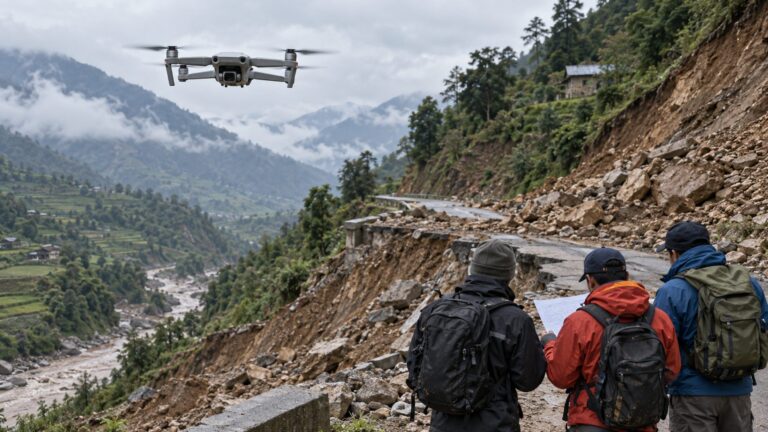
The National Dam Safety Authority reviewed dam emergency action plans at Lonavala and Bhushi on 27 September, focusing on coordination and downstream safety after recent flooding.
- PIB’s 28 September release reports advice to review and strengthen emergency plans using recent incidents, extreme rainfall scenarios and downstream risks.
- Tata Power owns Lonavala Dam; Central Railway owns Bhushi Dam. Both participated in the consultation.
- CWPRS provided technical inputs on preparing, reviewing and finalising plans. Field visits examined the dams’ cascading relationship within the Indrayani River system.
- Connected reservoirs require information to cross institutional boundaries quickly enough for another operator and downstream authorities to act.
- A warning succeeds only when people at risk receive usable instructions and can take protective action before danger arrives.
UPSC Relevance
Prelims Relevance
- National Dam Safety Authority (NDSA)
- Emergency Action Plan (EAP)
- Central Water and Power Research Station (CWPRS)
- Indrayani River system
- Cascade coordination and downstream warning
Mains Relevance
GS Paper 3
- Dam emergency preparedness and last-mile warning
- Operational coordination across connected reservoirs
GS Paper 2
- Accountability at handoffs between infrastructure owners and civil administration
Essay
- Public safety depends on institutions acting together under uncertainty.
Background and Context
Why separate dams need a shared emergency picture
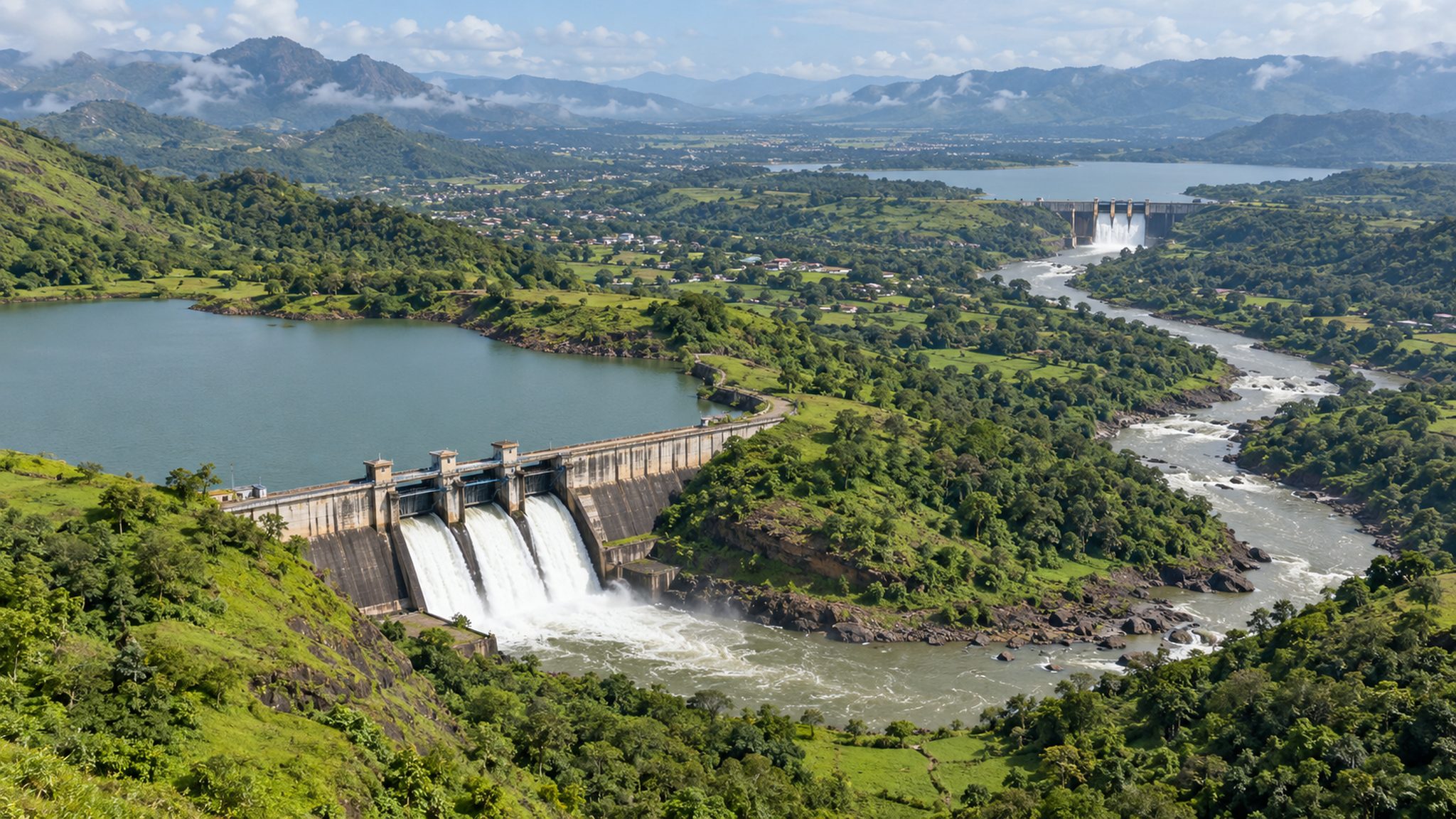
A cascade creates operational dependence: information about one reservoir can matter to another operator and to communities beyond either dam’s immediate boundary.
- Rainfall and changing flows can affect connected reservoirs during the same event. Operators need a shared situation picture because decisions taken at one location may change conditions elsewhere along the system.
- Separate ownership adds a coordination boundary. Each agency may hold useful observations, but downstream preparedness depends on exchanging relevant information rather than assuming another agency already knows about the developing emergency.
- The Lonavala consultation explicitly examined the cascading relationship between the two dams. The release does not establish their geographic upstream order, so that sequence should not be inferred from their names.
- An Emergency Action Plan links identified emergency situations with notification, coordination and response. Its practical purpose is to connect technical information at a dam with decisions that protect exposed people downstream.
- The reported discussion concerned extreme rainfall and flood lessons. It does not establish that either dam failed; emergency preparedness should account for credible hazards without treating every flood as structural failure.
The warning handoff: observation must become action
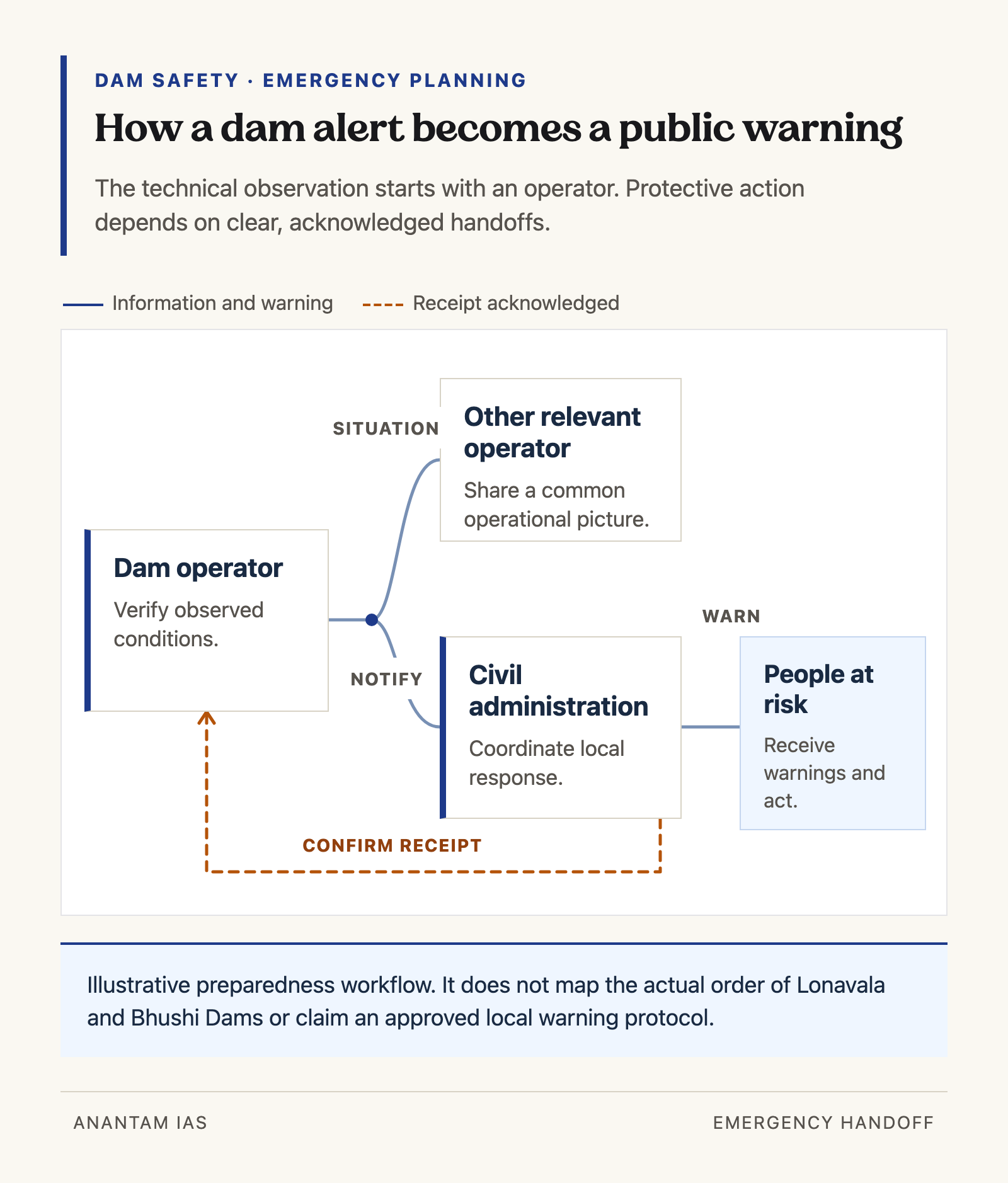
The following handoff explains general preparedness practice; it is not a newly mandated procedure or an approved local plan announced by this consultation.
- Dam owners monitor relevant conditions and assess an emerging situation against their applicable procedures. They should communicate the nature of the concern, affected locations and available information to designated response contacts.
- Other dam operators need timely notification where the event could affect their operations. A shared message should distinguish observed conditions from forecasts, since those categories carry different kinds of uncertainty for decisions.
- Civil administration and response agencies translate technical notification into public warning and, where necessary, evacuation. People need understandable instructions about the hazard, safe movement and where reliable updates will come from.
- Acknowledgement closes a communication gap: sending a message does not prove the responsible official received it. Contact checks, alternative channels and escalation arrangements help prevent an unanswered alert from becoming a dead end.
- As with weather early warning, lead time is useful only when recipients can act. Reservoir information, local exposure and practical response arrangements must be interpreted together during a developing emergency.
What the consultation changes, and what remains unproven
The verified development is a direction to strengthen preparedness through review, supported by technical consultation and attention to downstream populations.
- NDSA advised a review of both agencies’ plans using recent incidents and identified emergency scenarios. This supports an implementation story about improving preparedness, rather than a claim that a new law was enacted.
- CWPRS supplied technical inputs on preparation, review and finalisation. Participation by a technical institution does not, by itself, demonstrate that revised plans have been completed, approved or tested successfully in the field.
- Warning thresholds must be appropriate to the actual dam and emergency scenario. The release publishes no reservoir-level or discharge trigger; inventing such values would misrepresent both operational risk and the consultation’s outcome.
- Exercises and contact verification are useful ways to test a plan’s handoffs. These are preparedness recommendations here, not reported drill results or proof that every downstream settlement currently has effective warning coverage.
- The broader lesson from disaster reviews is follow-through: lessons should change assigned responsibilities and rehearsed actions. A meeting establishes attention; reliable emergency performance requires evidence that those arrangements actually work.
Way Forward
Test the handoffs before the emergency
- Reconcile owner and district plans so each notification has a named recipient, acknowledgement requirement and fallback contact.
- Rehearse realistic rainfall scenarios across owners and response agencies, recording delays and repairing failed communication links.
- Check community instructions for clarity, local accessibility and workable evacuation arrangements; revise them when downstream exposure changes.
Conclusion
- Dam safety includes coordinated emergency action beyond the structure itself. Connected reservoirs make the reliability of information exchange a public-safety issue across institutional boundaries.
- In an answer, connect monitoring, notification and protective action, then distinguish a preparedness review from evidence that revised plans are approved and operational.
UPSC Practice Questions
Prelims MCQ 1
With reference to dam emergency preparedness, consider the following statements:
- Connected dams may require coordination even when different agencies own them.
- An Emergency Action Plan can connect warning, communication and emergency response.
- A stakeholder consultation alone proves that revised emergency plans have been approved.
How many of the above statements are correct?
(a) Only one (b) Only two (c) All three (d) None
Answer: (b) Only two
Explanation:
The first two statements describe the consultation’s central concerns. Review and technical inputs do not establish approval of revised plans.
Prelims MCQ 2
Which arrangement most directly reduces the risk that a dam emergency notification fails at an institutional handoff?
(a) Sending an alert without identifying its recipient (b) Replacing local instructions with a technical reservoir report (c) Requiring acknowledgement and providing a fallback communication route (d) Assuming separate dam owners face unrelated risks
Answer: (c) Requiring acknowledgement and providing a fallback communication route
Explanation:
Acknowledgement tests receipt; a fallback route addresses non-response or channel failure. These are general preparedness measures, not newly announced local mandates.
UPSC Mains Questions
- Explain why emergency preparedness for connected dams requires coordination across ownership boundaries. Identify the main communication handoffs that need testing.
- An effective warning is measured by protective action, not merely by message transmission. Discuss with reference to downstream dam safety.
Source: PIB, Ministry of Jal Shakti.
Frequently Asked Questions
What is a dam Emergency Action Plan?
It connects identified emergency situations with warning, communication, coordination and response arrangements. Its purpose includes protecting downstream communities by ensuring that technical information leads to timely protective decisions.
Why does a dam cascade require coordination?
Conditions and decisions in a connected reservoir system can affect other operators and downstream communities. Separate owners need timely information exchange and clear response contacts so institutional boundaries do not delay emergency action.
Were new emergency plans approved at Lonavala?
The PIB release reports advice to review, update and strengthen plans, alongside technical inputs from CWPRS. It does not establish that revised plans were approved or that particular warning thresholds were adopted.
Why should emergency messages be acknowledged?
Acknowledgement helps establish that the intended recipient received the notification. Combined with fallback contacts and communication channels, it reduces the chance that a critical alert remains unanswered during an emergency.
Tell Google you want more of this.
Add Anantam IAS as a preferred sourceOne tap, and this site shows up more often in your own Top Stories, AI Overviews and AI Mode. Remove it any time.