Why in News?
On September 28, the Ministry of Heavy Industries reported that GARC had begun installing equipment to upgrade automotive testing under PM E-DRIVE.
- GARC, at Oragadam near Chennai, is an authorized testing agency under Rule 126 of the Central Motor Vehicles Rules.
- Planned upgrades cover passive safety, advanced driver assistance systems, batteries and electromagnetic compatibility, alongside other vehicle and component testing.
- New high-speed imaging is intended to record deformation, occupant movement and airbag deployment during frontal, side and rear crash tests.
- Equipment installation has commenced; the announcement does not establish that every upgraded facility is commissioned or that any vehicle has passed testing.
- Vehicle crash testing translates a brief physical impact into evidence about how the vehicle structure and restraints protect occupants.
- Testing infrastructure can support domestic engineering and certification; its public value depends on reliable measurements and credible interpretation.
UPSC Relevance
Prelims Relevance
- GARC: Global Automotive Research Centre; automotive testing and certification.
- Passive safety: protection during a collision.
- Active safety: measures intended to help avoid or mitigate a collision.
- Crash-test dummy: an instrumented surrogate for assessing occupant loading.
- Homologation: conformity assessment against applicable vehicle requirements.
Mains Relevance
GS Paper 3
- Domestic testing capacity as industrial infrastructure.
- Scientific evidence and the limits of controlled safety testing.
GS Paper 2
- Credible regulation and understandable consumer safety information.
Essay
- Public trust depends on the quality of evidence behind a safety claim.
Background and Context
What a crash test needs to observe
A crash is a sequence of interacting movements; the final damaged vehicle reveals only part of that sequence.
- At impact, the vehicle structure deforms while an occupant tends to continue moving. Protection depends on managing that motion and maintaining survivable space, rather than keeping every exterior panel undamaged.
- Seat belts and airbags act together to manage occupant movement. Evaluators examine the restraint sequence and contact with the interior, because a deployed airbag alone does not establish effective protection.
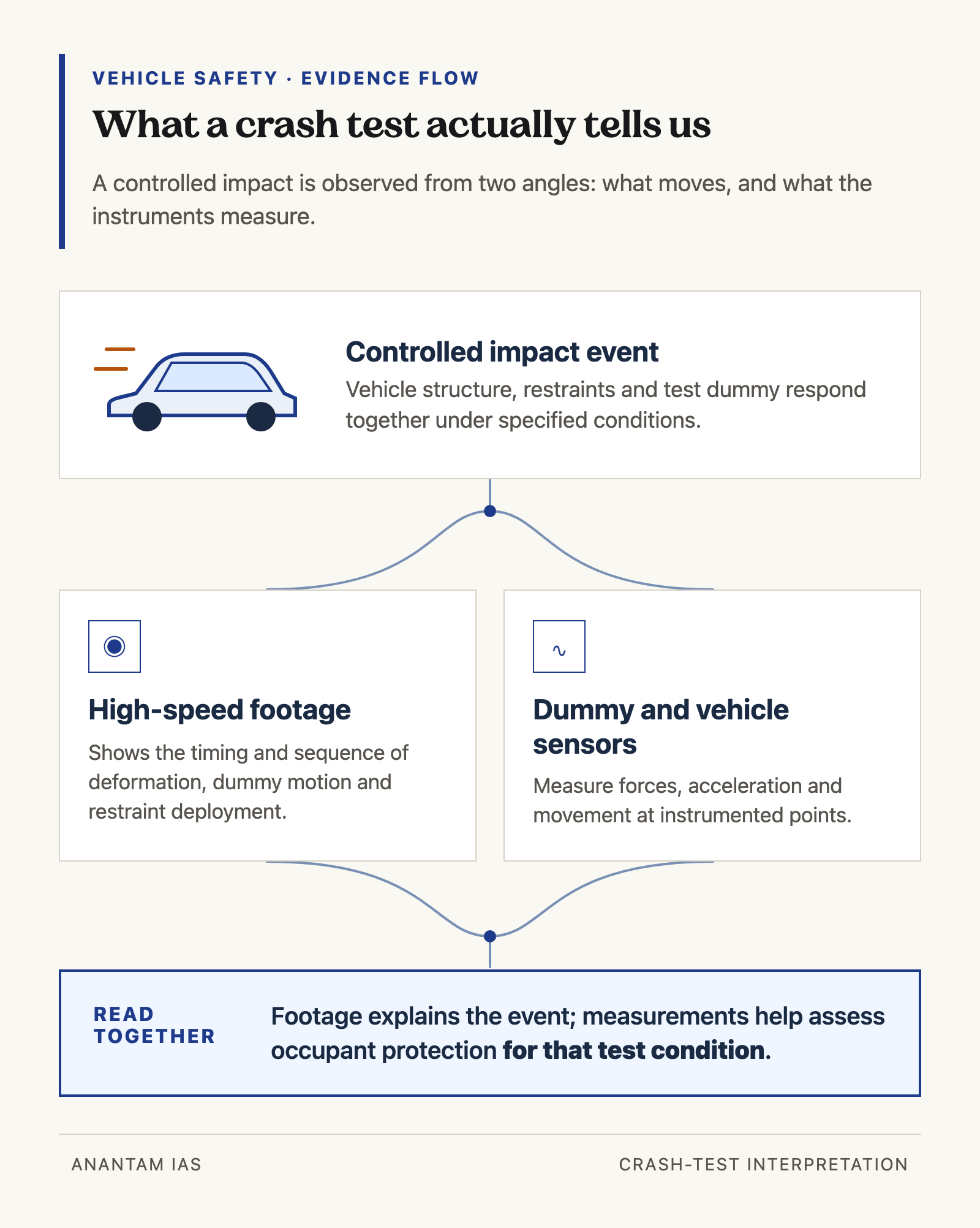
- High-speed cameras divide the brief event into successive images. These show when structural deformation, dummy movement and airbag inflation occur, helping engineers examine their relationship during the same impact.
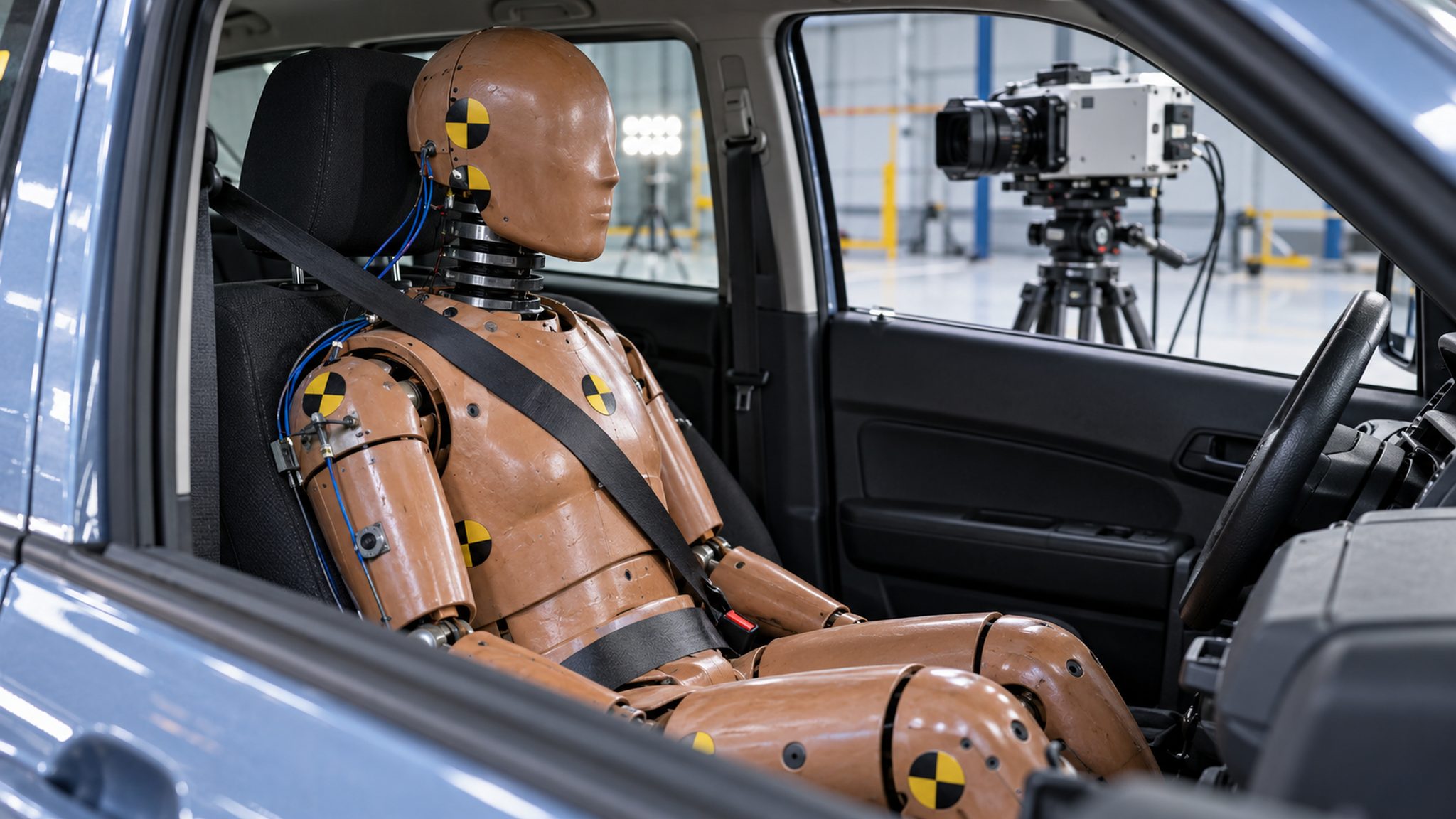
- Instrumented dummies provide measurements relevant to injury assessment. Their readings complement visible motion: footage can reveal a contact, while measurements help assess the loading associated with that event.
- Interpreting video alongside measurements supports diagnosis of restraint and structural behavior. A visually dramatic crushed front end cannot, by itself, show whether the passenger compartment and occupants were adequately protected.
Passive protection and active avoidance
GARC is expanding several testing capabilities, but each addresses a different part of vehicle safety.
- Passive safety concerns protection when a crash occurs, including the structure, seats and restraints. The term describes their protective function; an airbag still uses sensors and an active deployment mechanism.
- Active safety seeks to help prevent or mitigate a collision. Driver assistance testing examines the performance of relevant systems before impact; it does not replace assessment of protection during an actual crash.
- GARC lists ADAS instruments and soft targets separately from passive-safety dummies and calibration equipment. Treating these as interchangeable would confuse detection or avoidance performance with the consequences of an impact.
- Battery testing and electromagnetic compatibility answer additional safety questions. Passing a crash assessment cannot establish every battery property or show that electronic systems will function acceptably amid electromagnetic disturbances.
- The practical lesson is layered protection: a vehicle may need to avoid hazards, protect people during impact and meet other technical requirements. No single test supplies evidence for all these functions.
What the evidence can and cannot establish
A reliable conclusion must stay within the conditions tested and the purpose of the assessment.
- Homologation evaluates conformity with applicable requirements. GARC’s authorization identifies its testing role; an infrastructure announcement is not a conformity certificate for an unnamed vehicle or proof that a particular model passed.
- Consumer star ratings communicate assessed safety performance under a rating protocol. Bharat NCAP is voluntary; purchasing laboratory equipment does not automatically award a manufacturer or vehicle any stars.
- Controlled test conditions make evidence interpretable, but actual collisions differ in direction, severity and occupant circumstances. Results support bounded judgments rather than a promise that every real-world crash will be survivable.
- Calibration and test documentation matter alongside camera quality. For measurements to support engineering decisions, the equipment, setup and interpretation need to be reliable; a clear recording cannot repair an incorrectly conducted test.
- Installation, operational readiness and demonstrated outcomes are separate stages. The release establishes an upgrade in progress, while claims about reduced road deaths would require evidence connecting actual vehicle performance with wider road-safety conditions.
Way Forward
Make testing evidence usable
- Verify operational readiness before treating equipment delivery as an available testing service.
- Document test conditions, calibration and limitations so engineers can trace conclusions to measured evidence.
- Explain results clearly: identify the vehicle configuration, assessment purpose and limits rather than presenting one result as universal safety assurance.
Conclusion
- Crash testing is valuable because it connects a rapid mechanical event with evidence about occupant protection. Its strength lies in the combined interpretation of structure, restraint behavior and measurements.
- For policy analysis, separate testing capacity from operational readiness, vehicle certification and road-safety outcomes. GARC’s upgrade supports the first step; later claims require their own evidence.
UPSC Practice Questions
Prelims MCQ 1
With reference to vehicle safety testing, consider the following statements:
- Passive safety includes protection provided by restraints during a collision.
- High-speed impact footage alone establishes every aspect of occupant injury risk.
- Testing of driver assistance systems and crash occupant protection assesses different functions.
How many of the above statements are correct?
(a) Only one (b) Only two (c) All three (d) None
Answer: (b) Only two
Explanation:
Statements 1 and 3 are correct. Video is interpreted with measurements and test conditions; it does not independently establish every injury risk.
Prelims MCQ 2
What does the reported commencement of equipment installation at GARC establish?
(a) Every upgraded facility has been commissioned (b) All tested vehicles have received five stars (c) The testing-infrastructure upgrade is in progress (d) Road deaths have measurably declined
Answer: (c) The testing-infrastructure upgrade is in progress
Explanation:
The release reports installation in progress, not universal commissioning, model-specific ratings or demonstrated reductions in road deaths.
UPSC Mains Questions
- Explain how high-speed imaging and instrumented measurements complement each other in vehicle crash testing.
- Discuss why domestic vehicle testing capacity is necessary but insufficient for improved road-safety outcomes.
Sources: PIB, Ministry of Heavy Industries and NHTSA, Crashworthiness.
Frequently Asked Questions
What is passive safety?
Passive safety concerns protection during a collision through the vehicle structure, seats and restraints. It is distinct from active-safety measures intended to help prevent or mitigate a collision before impact.
Why are high-speed cameras useful in crash tests?
They reveal the sequence of deformation, occupant movement and airbag deployment during a very brief impact. Engineers interpret this visual record alongside measurements rather than treating footage alone as a safety verdict.
Does GARC’s upgrade mean the facilities are fully operational?
The September 28 release says installation of procured equipment has commenced. It does not establish that every upgraded facility is commissioned, or provide a passing result for any particular vehicle.
Are homologation and consumer star ratings the same?
Homologation concerns conformity with applicable vehicle requirements. Consumer star ratings communicate assessed performance under a rating protocol. Bharat NCAP is a voluntary programme, and a laboratory upgrade does not automatically confer a rating.
Tell Google you want more of this.
Add Anantam IAS as a preferred sourceOne tap, and this site shows up more often in your own Top Stories, AI Overviews and AI Mode. Remove it any time.