Why in news?
A month after the 26 August flash floods in Nepal, experts call for decentralised, rights-based recovery and reconstruction.
UPSC Relevance
Mains GS-III: Disaster and disaster management; infrastructure (hydropower in the Himalayas); climate change and environmental impact assessment.
The Nepal Floods: What Happened
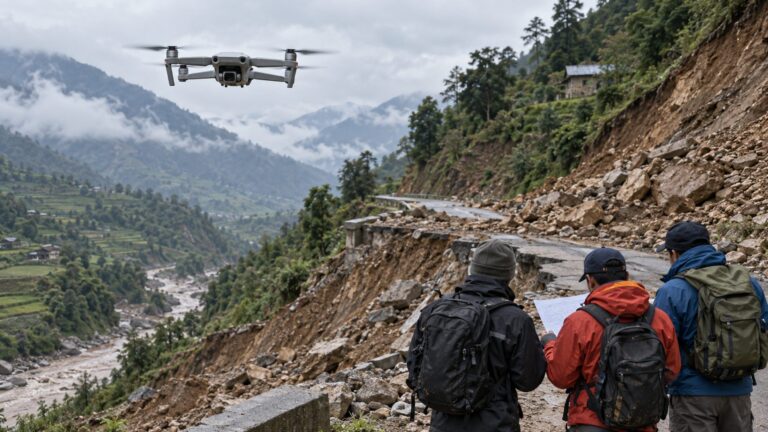
- The event: on 26 August 2026, flash floods struck Nepal’s Rasuwa, Nuwakot and Dhading districts, wiping out entire towns and communities.
- Immediate damage: roads and bridges were washed away and telecommunication networks went down.
- Phases of response: the first focus was rescuing people trapped under debris and providing relief. A month on, the focus has shifted to rehabilitation, rebuilding and long-term recovery.
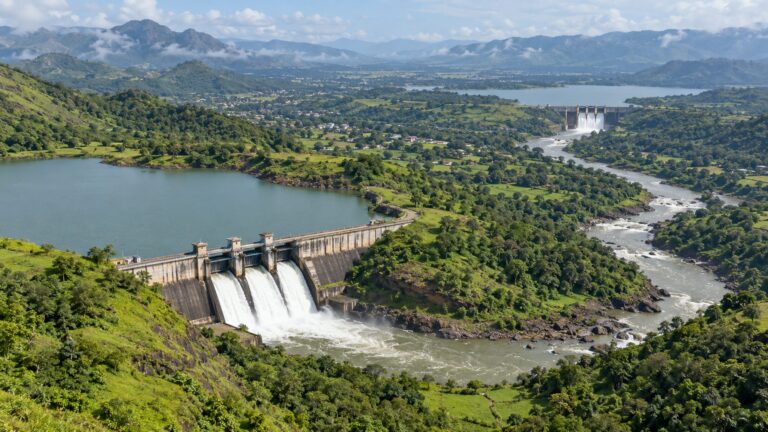
- Critical infrastructure lost: the biggest casualties were hydropower projects and road networks; some estimates suggest almost 10% of Nepal’s hydropower infrastructure was wiped out.
Disaster: An Event or a Process?
- Disaster as an event: the common view sees a disaster as an unpredictable event that attracts heavy national and international media attention, as the recent floods did.
- Disaster as a process: the growing consensus is that a disaster results from long-term vulnerabilities — it is not caused by nature alone. Disasters expose governance failures that existed long before the hazard struck.
- The event view is convenient: treating disasters as something beyond human control can absolve state actors of accountability. This was seen in the 2015 earthquake and the pandemic, and the problem is not limited to Nepal.
- The disaster risk equation: disaster risk arises when a hazard meets exposure and vulnerability, reduced by capacity (Risk = Hazard × Vulnerability ÷ Capacity). The hazard may be natural; the scale of the disaster is shaped by human choices.
- Wicked problem: scholars describe disasters as a “wicked problem” because there is no single cause — they result from a combination of natural hazards, risks and vulnerabilities. Climate change will make this even more important.
Human Decisions that Worsen Disasters
- Who decides? the loss of hydropower and roads raises the question of who granted licences to build hydropower projects in these high-risk areas. This is fundamentally a governance question.
- Riverbank construction: decisions to build critical infrastructure such as schools and hospitals on riverbanks are human choices.
- Looking downstream: beyond the climate crisis, we must ask what the government did before the disaster and whether it did enough to protect people.
- Social science lens: disasters should be understood through a governance-centric, social-scientific approach, not only through hazards and physical sciences.
- Indian parallels: the Chamoli disaster (2021) damaged the Rishiganga and Tapovan–Vishnugad hydropower projects in Uttarakhand; the South Lhonak glacial lake outburst flood (2023) breached the Teesta III dam in Sikkim; the Kedarnath floods (2013) and Joshimath land subsidence (2023) raised similar questions about construction in fragile Himalayan zones.
The Pattern of State Response
- Strength in the short term: in the 2015 earthquake, the COVID-19 pandemic and the recent floods, the state acted decisively and quickly, driven by a moral responsibility to save lives, and mobilised emergency and security forces.
- Weakness in the long term: this speed is not matched by a sustained commitment to recovery and reconstruction. Responsibility fades when it comes to listening to affected communities, protecting their rights, ensuring transparency and giving them a say in rebuilding.
- Centralised and top-down: the state’s approach undermines the role of local bodies, which are the frontline responders and know the local context best.
- Militarisation of relief: relying on military and security forces is itself a form of centralisation. Civilian actors must be involved in both relief and policymaking.
Balancing Local Bodies and the Federal Government
- Scale matters: the floods were unprecedented, so Nepal needs support from outside — nationally and internationally.
- But no excuse for exclusion: ward officials, elected representatives, local NGOs and community-based organisations are at the forefront of disaster response. In the Rasuwa floods, questions have been raised about their role being undermined by centralised response.
- Empower local government: local bodies need resources, equipment and infrastructure, and a say in big long-term questions such as how and where communities are resettled.
- Paper committees: ward-level disaster management committees exist but only on paper; they need human and financial resources and physical assets such as ambulances, hospitals and relief shelters.
- Nepal’s framework: Nepal’s federal Constitution (2015) created 753 local governments, and its Disaster Risk Reduction and Management Act, 2017 gives them a role — but capacity has not matched mandate.
Reconstruction versus Recovery
- Bricks over people: in Nepal and elsewhere, reconstruction focuses on physical rebuilding — houses and infrastructure — often not aligned with community priorities.
- What does recovery mean? what if people do not want to move from a place? How are their claims and choices heard? Local governments can play a key role here.
- Build Back Better: the Sendai Framework calls for recovery that reduces future risk, not just replaces what was lost.
- Example — Gujarat (2001): after the Bhuj earthquake, owner-driven reconstruction let families rebuild with support and technical guidance, and is widely cited as a good model.
‘Voice’ and ‘Teeth’: A Rights-Based Approach
- Amartya Sen’s insight: his work on famine prevention showed that famines are not just problems of food production but of entitlement failures — and that communities have the right to demand answers from authorities.
- Voice: the ability of affected people to demand answers. After the 2015 earthquake and the Rasuwa floods, bereaved families have questioned how rescue and relief were organised and raised concerns about fairness and transparency in relief distribution.
- Teeth: the state’s capacity and willingness to respond through concrete policy and programme interventions.
- Bite: scholar Jonathan Fox argues that voice and teeth must come together to produce a “bite” — concrete measures that protect the rights and welfare of disaster-affected communities.
- Democracy test: this is ultimately about the responsiveness of state institutions to citizens’ demands.
The Transboundary Dimension
- Shared risk: many disasters along the Nepal–India border defy national boundaries, requiring a transboundary approach.
- Example — Kosi: the 2008 Kusaha embankment breach on the Kosi river in Nepal caused massive flooding in Bihar.
- Himalayan rivers: rivers such as the Kosi, Gandak and Karnali flow from Nepal into India, so upstream floods, landslide dams and GLOFs directly affect Indian states.
- Way forward for India: real-time flood data sharing, joint early-warning systems and regional platforms such as the Coalition for Disaster Resilient Infrastructure (CDRI, 2019).
Lessons for India
- Legal framework: the Disaster Management Act, 2005 created a three-tier structure (NDMA, SDMAs, DDMAs); the 2025 amendment added urban disaster management authorities and national and state disaster databases.
- Local bodies: disaster management is not explicitly among the subjects devolved to panchayats and municipalities under the 73rd and 74th Amendments; DDMAs remain bureaucracy-led.
- Success story — Odisha: after the 1999 super cyclone, OSDMA and community-based preparedness sharply reduced deaths in cyclones Phailin (2013) and Fani (2019).
- Finance: the Fifteenth Finance Commission created separate funds for mitigation alongside response, recognising that prevention must be funded, not just relief.
Way Ahead
- Decentralise disaster governance: give local bodies real power, funds and resources, not just paper committees.
- Rights-based recovery: ensure affected communities have a say in resettlement and reconstruction, with transparent relief distribution and grievance redress.
- Accountability: audit infrastructure licensing in high-risk zones through strict environmental and disaster impact assessments.
- Civilian capacity: build civilian institutions for relief and recovery rather than relying only on security forces.
- Interdisciplinary planning: combine physical science with social science to address vulnerabilities.
- Transboundary cooperation: joint risk assessment and early warning among Himalayan neighbours.
The Nepal floods show that disasters are as much about governance as about nature. Governments must listen to affected communities, share power and resources with local bodies, and give citizens’ voice real teeth- so that recovery rebuilds lives, not just structures.
Practice MCQ
Q1. Consider the following statements regarding the Sendai Framework for Disaster Risk Reduction:
1. It was adopted at the Third UN World Conference on Disaster Risk Reduction in 2015.
2. It covers the period 2015–2030.
3. It is a legally binding treaty with penalties for non-compliance.
How many of the above statements are correct?
(a) Only one
(b) Only two
(c) All three
(d) None
Answer: (b). Statement 3 is wrong — the Sendai Framework is a voluntary, non-binding agreement.
Q2. Consider the following statements:
Statement I: Disasters are increasingly understood as processes rather than isolated natural events.
Statement II: Disaster risk arises from the interaction of hazards with exposure and vulnerability, which are shaped by human decisions.
(a) Both statements are correct and Statement II explains Statement I
(b) Both statements are correct but Statement II does not explain Statement I
(c) Statement I is correct but Statement II is incorrect
(d) Statement I is incorrect but Statement II is correct
Answer: (a). Because vulnerability builds up over time through human choices, a disaster is seen as a process, not only a sudden event.
Mains Practice Question
Q. “Disasters expose governance failures that exist long before the hazard strikes.” In the light of the recent flash floods in Nepal, discuss the need for a decentralised, rights-based approach to disaster recovery and its lessons for India’s Himalayan states. (250 words, 15 marks)
Tell Google you want more of this.
Add Anantam IAS as a preferred sourceOne tap, and this site shows up more often in your own Top Stories, AI Overviews and AI Mode. Remove it any time.