Daily Digest
UPSC · Civil Services Examination
Current Affairs · Monday, 7 September 2026
Current affairs curated and edited by Anantam IAS faculty — pulled from The Hindu, PIB, IDSA, Foreign Affairs and the ministries. Read, annotate, revise.
Old Rajinder Nagar · Delhi 110005 · anantamias.com
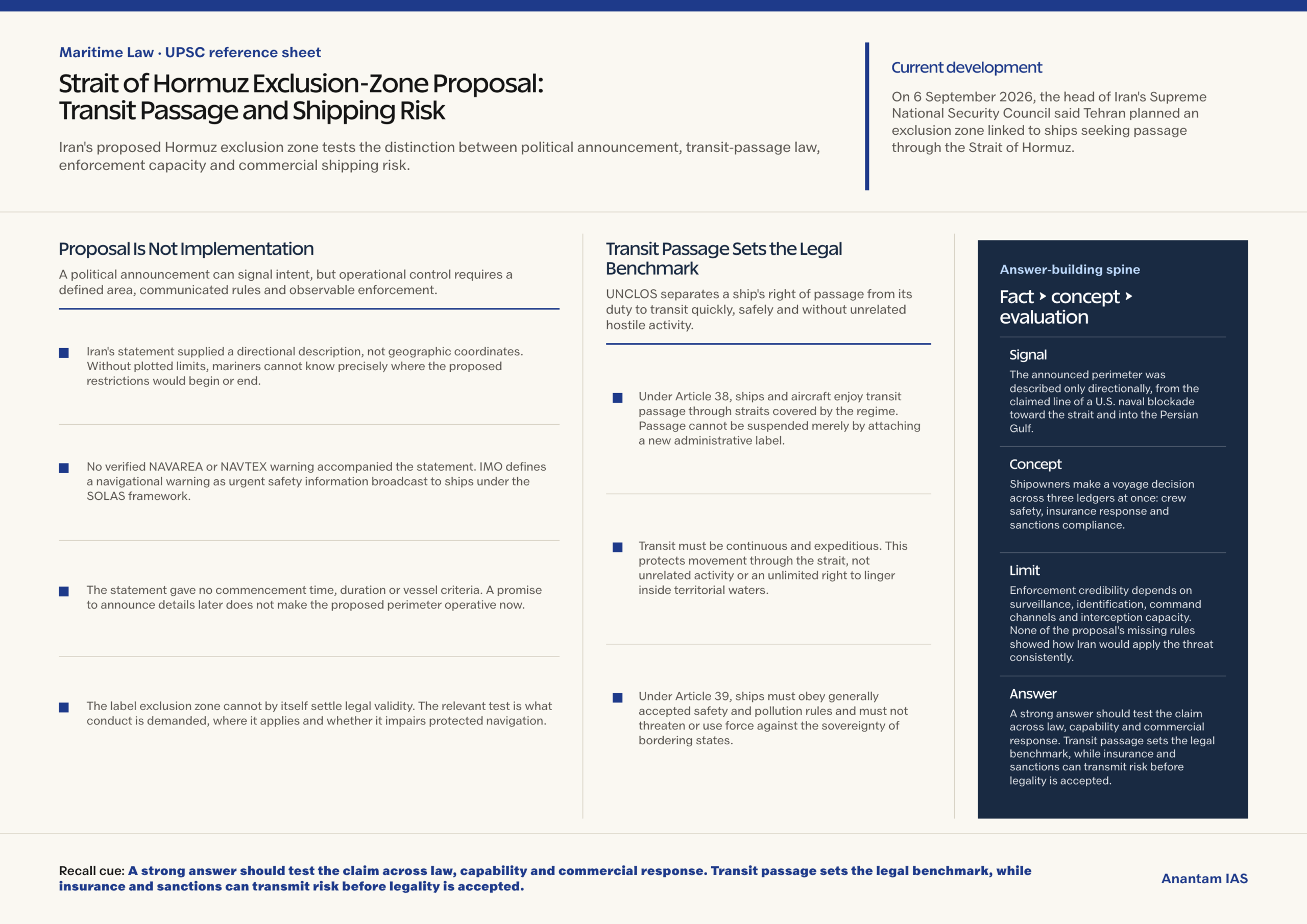
Strait of Hormuz Exclusion-Zone Proposal: Transit Passage and Shipping Risk
Why in News?
On 6 September 2026, the head of Iran’s Supreme National Security Council said Tehran planned an exclusion zone linked to ships seeking passage through the Strait of Hormuz.
- The announced perimeter was described only directionally, from the claimed line of a U.S. naval blockade toward the strait and into the Persian Gulf.
- Iran said the zone would be announced in the coming days or weeks and threatened identified ships entering it with placement on an Iranian sanctions list.
- At review time, Iran had published no coordinates, legal terms, commencement time or operative navigational warning defining the proposed zone.
- The development remained a proposal and coercive signal, not evidence of an operational, internationally accepted or consistently enforceable maritime regime.
- Three questions must stay separate: whether a zone has been formally specified, whether it is legally compatible with transit passage and whether Iran can enforce it in practice.
- Commercial effects may precede legal settlement because shipowners and insurers respond to threat probability, unclear operating rules and possible sanctions exposure, not only to an accepted legal claim.
- For India, the useful lens is energy-shipping resilience: maritime coercion can raise voyage costs and uncertainty even without producing a lawful closure.
UPSC Relevance
Prelims Relevance
- UNCLOS Part III governs straits used for international navigation; Article 38 states the right of transit passage for all ships and aircraft in covered straits.
- Transit passage means continuous and expeditious transit, while allowing entry, departure or return to a bordering state under that state’s conditions.
- Under Article 39, ships and aircraft must proceed without delay and refrain from threats or force unrelated to normal transit, except in distress or force majeure.
- Under Article 42, bordering states may regulate specified matters, but their laws cannot discriminate or have the practical effect of denying, hampering or impairing transit passage.
- Article 44 says bordering states shall not hamper transit passage and must appropriately publicize known dangers to navigation or overflight.
- Iran signed UNCLOS in 1982 but the UN Treaty Collection does not list a ratification; treaty status and customary-law arguments should not be collapsed into one claim.
Mains Relevance
GS Paper 2
- Effect of policies and politics of developed and developing countries on India’s interests; rules governing straits used for international navigation.
- Examine the gap between unilateral maritime-control claims, international legal standards and negotiated de-escalation.
GS Paper 3
- Indian economy and issues relating to mobilization of resources, growth and infrastructure, with emphasis on energy-shipping and insurance exposure.
- Assess how enforcement credibility, war-risk pricing and overlapping sanctions regimes transmit geopolitical risk into trade costs.
Essay
- Power at sea is exercised not only through recognized law, but also through uncertainty that changes the calculations of crews, insurers and trading firms.
Background and Context
Proposal Is Not Implementation
A political announcement can signal intent, but operational control requires a defined area, communicated rules and observable enforcement.
- Iran’s statement supplied a directional description, not geographic coordinates. Without plotted limits, mariners cannot know precisely where the proposed restrictions would begin or end.
- No verified NAVAREA or NAVTEX warning accompanied the statement. IMO defines a navigational warning as urgent safety information broadcast to ships under the SOLAS framework.
- The statement gave no commencement time, duration or vessel criteria. A promise to announce details later does not make the proposed perimeter operative now.
- The label exclusion zone cannot by itself settle legal validity. The relevant test is what conduct is demanded, where it applies and whether it impairs protected navigation.
- Iran’s threatened sanctions listing is also distinct from interdiction. Listing can deter commercial actors, while physical exclusion requires detection, communication and a credible capacity to compel compliance.
Transit Passage Sets the Legal Benchmark
UNCLOS separates a ship’s right of passage from its duty to transit quickly, safely and without unrelated hostile activity.
- Under Article 38, ships and aircraft enjoy transit passage through straits covered by the regime. Passage cannot be suspended merely by attaching a new administrative label.
- Transit must be continuous and expeditious. This protects movement through the strait, not unrelated activity or an unlimited right to linger inside territorial waters.
- Under Article 39, ships must obey generally accepted safety and pollution rules and must not threaten or use force against the sovereignty of bordering states.
- Under Article 42, bordering states can adopt non-discriminatory laws on navigation safety, traffic, pollution, fishing and customs-related matters within the Convention’s limits.
- The boundary is decisive: such laws cannot have the practical effect of denying, hampering or impairing transit passage, and Article 44 separately prohibits hampering it.
Coercive Effect Can Arrive Before Legal Acceptance
Shipowners make a voyage decision across three ledgers at once: crew safety, insurance response and sanctions compliance.
- Enforcement credibility depends on surveillance, identification, command channels and interception capacity. None of the proposal’s missing rules showed how Iran would apply the threat consistently.
- The Hindu reported earlier attacks on commercial shipping. That history makes the threat commercially relevant, but it does not prove a new zone exists or can be uniformly enforced.
- The Lloyd’s Market Association explains that war policies commonly contain cancellation-notice mechanisms, allowing insurers to renegotiate terms when the assessed risk to vessels rises.
- Insurance availability and safe passage are not identical. Cover may remain available while premium terms, route approval and owner or master decisions change because physical danger remains high.
- Sanctions create another filter. OFAC recommends sanctions-exclusion clauses and risk-based due diligence, so an Iranian listing threat may interact with separate contractual and regulatory screening obligations.
Way Forward
Replace Ambiguity With Verifiable Maritime Information
The immediate task is to reduce dangerous uncertainty without treating a unilateral proposal as lawful merely because it has been announced.
- Iran should disclose any claimed coordinates, duration, vessel rules, legal basis and safety procedures through recognized maritime-information channels before asserting that ships have entered a defined area.
- Relevant maritime authorities should circulate verified navigational warnings that distinguish observed hazards from contested political claims and give crews usable safety information.
- Shipowners should conduct separate safety, insurance and sanctions reviews; clearance under one ledger does not automatically satisfy the other two.
- Diplomatic deconfliction should preserve continuous and expeditious passage, protect crews and prevent ambiguous signalling from becoming an accidental interception or armed encounter.
Conclusion
- The durable distinction is proposal versus implementation: without coordinates, operative notice, defined rules and observable enforcement, Iran’s statement remained a threatened control measure rather than an established zone.
- A strong answer should test the claim across law, capability and commercial response. Transit passage sets the legal benchmark, while insurance and sanctions can transmit risk before legality is accepted.
UPSC Practice Questions
Prelims MCQ 1
With reference to transit passage under the United Nations Convention on the Law of the Sea, consider the following statements:
- All ships and aircraft enjoy the right of transit passage through straits covered by the regime.
- A bordering state may suspend transit passage whenever it announces an exclusion zone.
- Ships exercising transit passage must proceed without delay and refrain from threats or force unrelated to normal transit.
How many of the above statements are correct?
(a) Only one (b) Only two (c) All three (d) None
Answer: (b) Only two
Explanation:
Statements 1 and 3 are correct under Articles 38 and 39. UNCLOS does not permit a bordering state to suspend transit passage merely by announcing an exclusion zone.
Prelims MCQ 2
Which option best describes a navigational warning in the IMO’s World-Wide Navigational Warning Service?
(a) A treaty automatically changing a maritime boundary (b) An urgent safety message broadcast to ships under the SOLAS framework (c) A sanctions designation issued by a coastal state’s finance ministry (d) A private insurer’s final decision to withdraw all marine cover
Answer: (b) An urgent safety message broadcast to ships under the SOLAS framework
Explanation:
IMO defines a navigational warning as a message containing urgent information relevant to safe navigation and broadcast to ships under SOLAS arrangements.
UPSC Mains Questions
- A unilateral maritime exclusion-zone proposal may create commercial effects before acquiring legal acceptance or operational credibility. Critically examine with reference to transit passage through international straits.
- Discuss how navigational information, enforcement capacity, marine insurance and sanctions compliance shape shipping decisions during a geopolitical crisis.
Sources: The Hindu (Associated Press) and United Nations Convention on the Law of the Sea, Part III.
Frequently Asked Questions
Was Iran’s proposed exclusion zone operational on 7 September 2026?
No. Iran had announced an intention, but no coordinates, operative navigational warning, commencement time or complete rules had been published at review time.
What is transit passage under UNCLOS?
It is the continuous and expeditious passage of ships and aircraft through straits covered by UNCLOS, subject to duties concerning delay, safety, pollution and non-hostile conduct.
Can a state bordering a strait regulate passing ships?
Yes, within Article 42’s specified fields and without discrimination. Its laws cannot have the practical effect of denying, hampering or impairing transit passage.
Why do coordinates and navigational warnings matter?
Coordinates define the claimed area. Recognized warnings give mariners urgent, usable safety information; a vague political statement alone cannot provide the same operational certainty.
Why can shipping risk rise before a zone gains legal acceptance?
Owners, masters and insurers assess physical danger, coverage terms and sanctions exposure. Those commercial decisions can change immediately even while the legal status remains disputed.
Source: https://anantamias.com/current-affairs/hormuz-exclusion-zone-transit-passage/
India’s Narcotics-Control Roadmap: From Seizures to Network Disruption
Why in News?
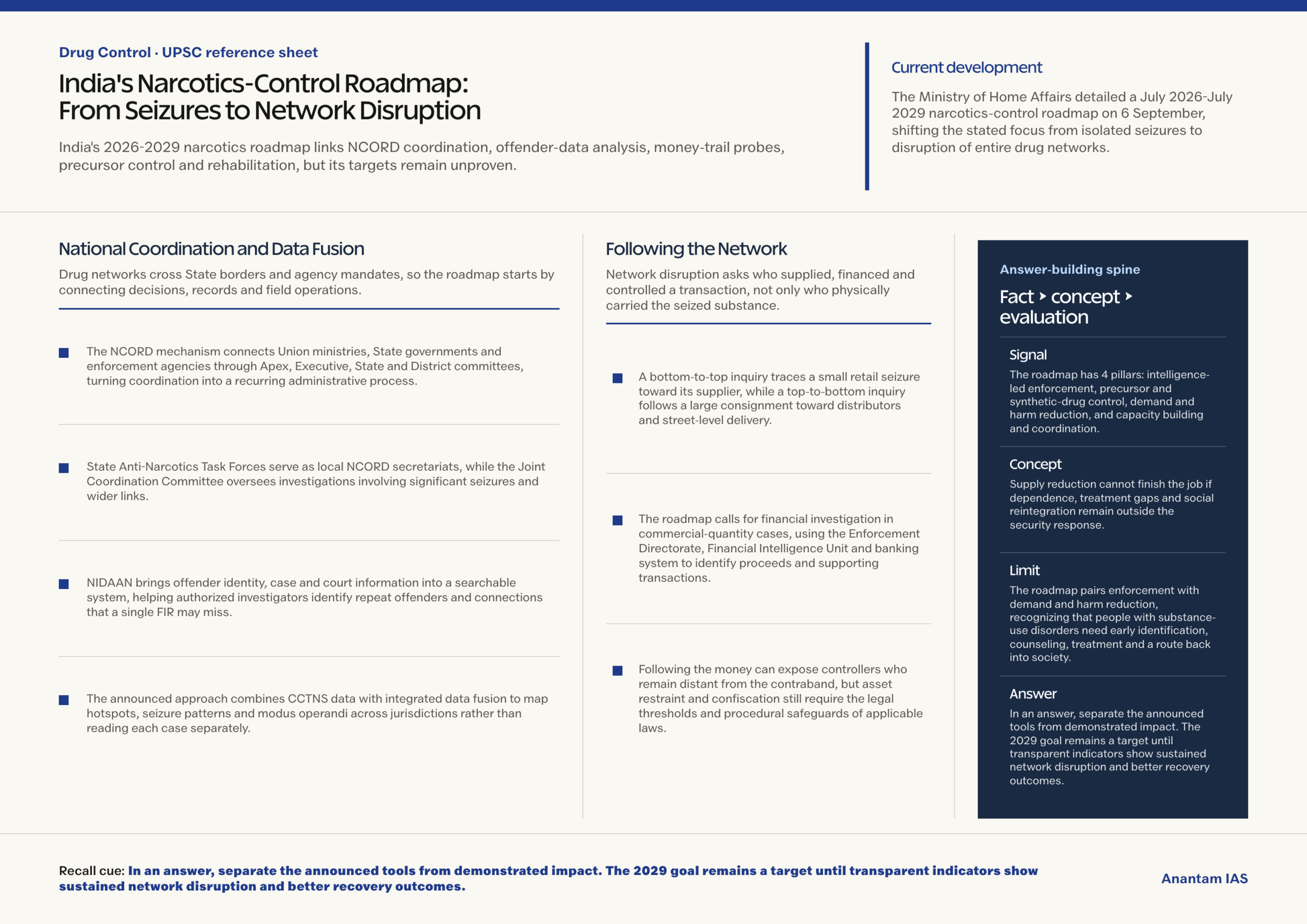
The Ministry of Home Affairs detailed a July 2026-July 2029 narcotics-control roadmap on 6 September, shifting the stated focus from isolated seizures to disruption of entire drug networks.
- The roadmap has 4 pillars: intelligence-led enforcement, precursor and synthetic-drug control, demand and harm reduction, and capacity building and coordination.
- It assigns timelines, measurable targets and quarterly reviews to Union ministries, central agencies and State governments.
- The announcement emphasizes backward and forward linkages: tracing a retail packet to its source and a large consignment to its intended distribution chain.
- The claim of achieving a drug-free India by 2029 is a government target, not an outcome established by the announcement.
- Drug trafficking crosses police, customs, border, financial and public-health jurisdictions, so a seizure by one agency may reveal only one part of the network.
- The policy test is whether shared intelligence produces prosecutions, confiscation of proceeds, lower precursor diversion and sustained treatment access, not only larger seizure totals.
UPSC Relevance
Prelims Relevance
- The Narcotics Control Bureau is India’s nodal agency for drug-law-enforcement coordination and functions under the Ministry of Home Affairs.
- The NCORD mechanism has Apex, Executive, State and District levels for Centre-State and inter-agency coordination.
- NIDAAN is the National Integrated Database on Arrested Narco-Offenders, developed by NCB with the Inter-Operable Criminal Justice System.
- Section 9A of the NDPS Act, 1985 empowers the Union government to control and regulate substances that may be diverted for illicit drug manufacture.
- The Ministry of Social Justice and Empowerment is the nodal ministry for drug-demand reduction, including treatment and rehabilitation measures.
Mains Relevance
GS Paper 3
- Linkages between organized crime, illicit finance, darknet-enabled trafficking and internal security.
- Role of intelligence sharing, financial investigation and border-management agencies in dismantling narcotics networks.
GS Paper 2
- Functions and responsibilities of the Union and the States, and mechanisms for coordinated policy implementation.
- Government policies in health and social sectors, with emphasis on rehabilitation rather than treating dependence only as a policing issue.
Essay
- A durable security response must be firm against organized traffickers while keeping treatment, dignity and social reintegration available to people with substance-use disorders.
Background and Context
National Coordination and Data Fusion
Drug networks cross State borders and agency mandates, so the roadmap starts by connecting decisions, records and field operations.
- The NCORD mechanism connects Union ministries, State governments and enforcement agencies through Apex, Executive, State and District committees, turning coordination into a recurring administrative process.
- State Anti-Narcotics Task Forces serve as local NCORD secretariats, while the Joint Coordination Committee oversees investigations involving significant seizures and wider links.
- NIDAAN brings offender identity, case and court information into a searchable system, helping authorized investigators identify repeat offenders and connections that a single FIR may miss.
- The announced approach combines CCTNS data with integrated data fusion to map hotspots, seizure patterns and modus operandi across jurisdictions rather than reading each case separately.
- Data fusion should generate testable leads, but a shared database isn’t proof of guilt; investigators must still establish admissible evidence, protect access and correct inaccurate records.
Following the Network
Network disruption asks who supplied, financed and controlled a transaction, not only who physically carried the seized substance.
- A bottom-to-top inquiry traces a small retail seizure toward its supplier, while a top-to-bottom inquiry follows a large consignment toward distributors and street-level delivery.
- The roadmap calls for financial investigation in commercial-quantity cases, using the Enforcement Directorate, Financial Intelligence Unit and banking system to identify proceeds and supporting transactions.
- Following the money can expose controllers who remain distant from the contraband, but asset restraint and confiscation still require the legal thresholds and procedural safeguards of applicable laws.
- Precursor chemicals have legitimate industrial uses but may be diverted to manufacture synthetic drugs; control must track suspicious transactions without treating lawful chemical trade as criminal.
- India regulates notified controlled substances under Section 9A of the NDPS Act and the Regulation of Controlled Substances Order, linking industry records with enforcement oversight.
Rehabilitation and the Evidence Limit
Supply reduction cannot finish the job if dependence, treatment gaps and social reintegration remain outside the security response.
- The roadmap pairs enforcement with demand and harm reduction, recognizing that people with substance-use disorders need early identification, counseling, treatment and a route back into society.
- The Ministry of Social Justice and Empowerment leads drug-demand reduction through Nasha Mukt Bharat Abhiyaan and the National Action Plan for Drug Demand Reduction.
- Health departments, social-justice institutions and prison administrations must coordinate referrals, because an arrest or prison term by itself doesn’t treat dependence or prevent relapse after release.
- The MANAS helpline separates two needs within one access point: citizens may report drug activity and people seeking help may ask for counseling or rehabilitation support.
- The hard exam distinction is between inputs and outcomes: meetings, databases, targets and seizure figures show activity, while reduced availability, disrupted finances and recovery require separate evidence.
Way Forward
Measure Network-Level Results
Quarterly review will matter only if agencies measure what changed beyond the immediate seizure.
- Track cases that identify financiers, controllers and cross-State links, alongside the value of proceeds frozen or confiscated after judicial scrutiny.
- Audit NIDAAN and CCTNS data quality, authorized access and correction procedures so intelligence sharing does not magnify errors across agencies.
- Monitor precursor diversion through risk-based industry compliance, Customs intelligence and suspicious-transaction analysis while protecting legitimate pharmaceutical and chemical supply chains.
- Publish treatment entry, completion, relapse-support and reintegration indicators separately from enforcement statistics, with privacy safeguards for people seeking care.
Conclusion
- India’s narcotics roadmap is strongest as an administrative design: coordinate nationally, connect the data, follow the money, control diversion and keep rehabilitation inside the response.
- In an answer, separate the announced tools from demonstrated impact. The 2029 goal remains a target until transparent indicators show sustained network disruption and better recovery outcomes.
UPSC Practice Questions
Prelims MCQ 1
With reference to India’s narcotics-control architecture, consider the following statements:
- NCORD operates through Apex, Executive, State and District levels.
- NIDAAN is a database concerning arrested narco-offenders.
- The Ministry of Social Justice and Empowerment is the nodal ministry for drug-demand reduction.
How many of the above statements are correct?
(a) Only one (b) Only two (c) All three (d) None
Answer: (c) All three
Explanation:
All 3 statements are correct. NCORD provides the coordination structure, NIDAAN supports offender-data analysis and the Social Justice Ministry leads demand-reduction policy.
Prelims MCQ 2
Which provision most directly empowers the Union government to regulate substances that may be diverted for illicit drug manufacture?
(a) Section 9A of the NDPS Act, 1985 (b) Section 66A of the Information Technology Act, 2000 (c) Article 263 of the Constitution (d) Section 144 of the Bharatiya Nagarik Suraksha Sanhita, 2023
Answer: (a) Section 9A of the NDPS Act, 1985
Explanation:
Section 9A authorizes the Union government to control and regulate controlled substances, including notified precursor chemicals vulnerable to diversion.
UPSC Mains Questions
- Drug seizures are necessary but insufficient for dismantling organized narcotics networks. Examine the role of data fusion, financial investigation and precursor control in moving from interdiction to network disruption.
- A narcotics policy must distinguish traffickers from people who need treatment. Discuss how Centre-State coordination can combine firm enforcement with demand reduction, rehabilitation and accountable outcome measurement.
Source: PIB, Ministry of Home Affairs.
Frequently Asked Questions
What is the 2026-2029 narcotics-control roadmap?
It is a Ministry of Home Affairs plan built around intelligence-led enforcement, precursor and synthetic-drug control, demand and harm reduction, and capacity building and coordination.
What is NCORD?
The Narco-Coordination Centre is a 4-tier mechanism that links Union, State and District authorities for policy review, intelligence sharing and coordinated action against drug trafficking.
How does NIDAAN help investigators?
NIDAAN consolidates authorized offender, case and court information so investigators can spot repeat offenders and cross-jurisdiction links. Database matches remain leads, not substitutes for admissible evidence.
Why are precursor chemicals part of drug control?
Precursors are dual-use chemicals with lawful industrial roles that can also be diverted for illicit manufacture. Regulation focuses on notified substances, records, transactions and suspicious diversion risks.
Has India achieved the roadmap’s 2029 goal?
No. The announcement states a government target and an implementation plan. Outcomes require later evidence on network disruption, illicit finance, drug availability, treatment access and sustained recovery.
Source: https://anantamias.com/current-affairs/narcotics-roadmap-network-disruption/
Jhiram Ghati Verdict: What the Convictions Settle and Leave Open
Why in News?
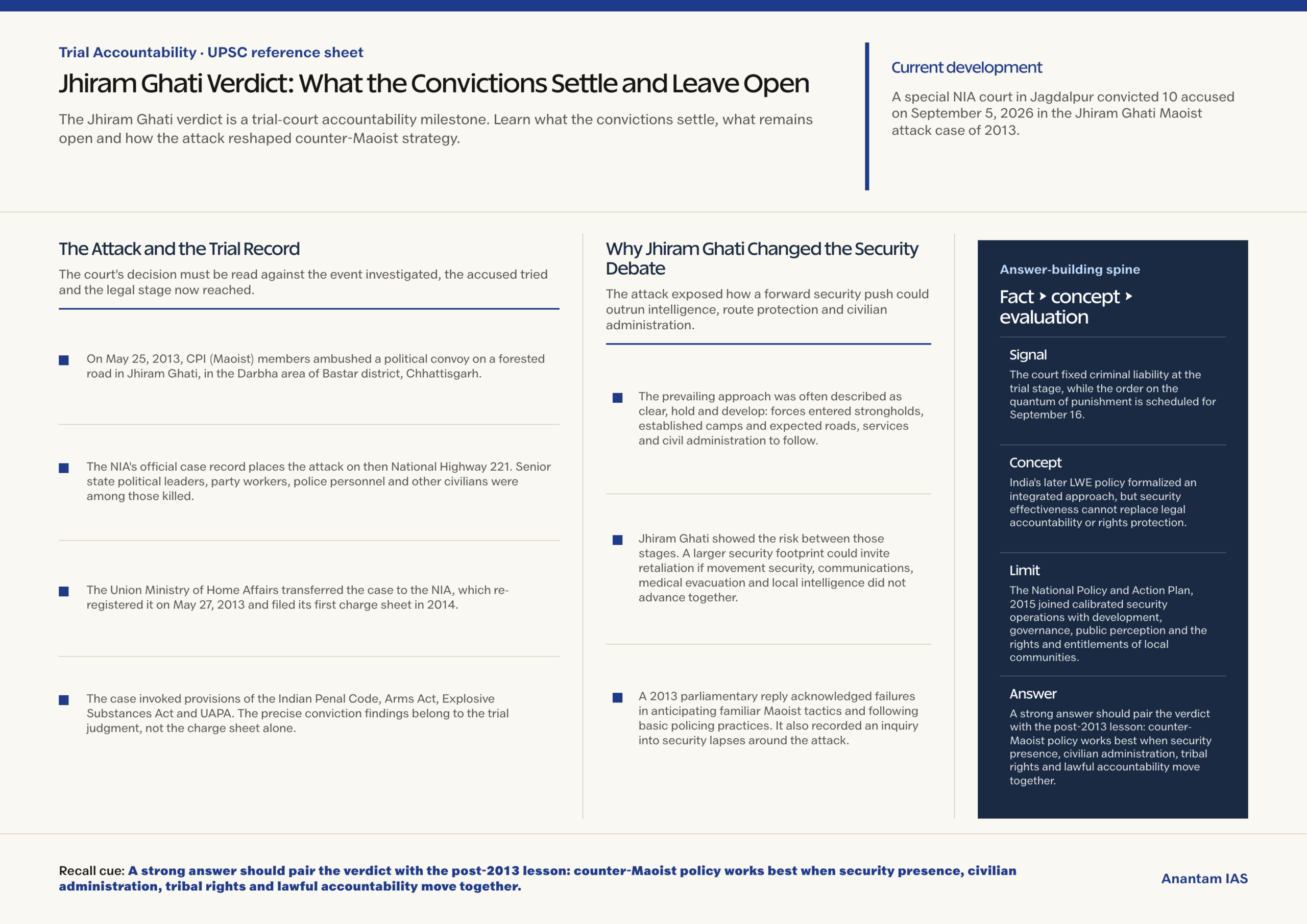
A special NIA court in Jagdalpur convicted 10 accused on September 5, 2026 in the Jhiram Ghati Maoist attack case of 2013.
- The court fixed criminal liability at the trial stage, while the order on the quantum of punishment is scheduled for September 16.
- The defence said it would appeal. The convictions can still face appellate review on facts and law before the competent High Court.
- The NIA’s case record says the ambush killed 27 people, including 10 police personnel, injured 38 and involved the loss or looting of weapons.
- The verdict concerns the accused tried in this case. It does not by itself close every disputed question about the wider conspiracy or alleged security lapses.
- Jhiram Ghati became a political and operational turning point because Maoists struck a civilian political convoy while security forces were pushing deeper into core areas.
- The durable lesson is that prosecution, intelligence, force protection, roads, communications, public services and tribal rights must reinforce one another in an LWE-affected area.
UPSC Relevance
Prelims Relevance
- Police and public order are State List subjects, while the Union coordinates and supports states against Left Wing Extremism.
- The National Investigation Agency Act, 2008 provides for Special Courts to try scheduled offences investigated by the NIA.
- Under Section 21 of the NIA Act, an appeal from a Special Court’s judgment or sentence lies to the High Court on facts and law.
- The CPI (Maoist) and its formations are listed as a terrorist organization under the Unlawful Activities (Prevention) Act, 1967.
- The Union’s National Policy and Action Plan, 2015 combines security, development, rights and entitlements, governance and perception management.
Mains Relevance
GS Paper 3
- Linkages between development and spread of extremism; role of state and non-state actors in internal-security challenges.
- Operational lessons from Maoist ambushes, including intelligence, route security, medical evacuation and Centre-State coordination.
GS Paper 2
- Accountability through special courts, appellate safeguards and the distinction between criminal trials and wider institutional inquiries.
- Federal responsibilities in policing, development administration and protection of tribal rights in conflict-affected districts.
Essay
- Internal security becomes durable only when state capacity is matched by constitutional accountability and public trust.
Background and Context
The Attack and the Trial Record
The court’s decision must be read against the event investigated, the accused tried and the legal stage now reached.
- On May 25, 2013, CPI (Maoist) members ambushed a political convoy on a forested road in Jhiram Ghati, in the Darbha area of Bastar district, Chhattisgarh.
- The NIA’s official case record places the attack on then National Highway 221. Senior state political leaders, party workers, police personnel and other civilians were among those killed.
- The Union Ministry of Home Affairs transferred the case to the NIA, which re-registered it on May 27, 2013 and filed its first charge sheet in 2014.
- The case invoked provisions of the Indian Penal Code, Arms Act, Explosive Substances Act and UAPA. The precise conviction findings belong to the trial judgment, not the charge sheet alone.
- Conviction means the trial court found guilt proved for the accused before it. Sentencing decides punishment, while an appeal tests the judgment before a higher court.
Why Jhiram Ghati Changed the Security Debate
The attack exposed how a forward security push could outrun intelligence, route protection and civilian administration.
- The prevailing approach was often described as clear, hold and develop: forces entered strongholds, established camps and expected roads, services and civil administration to follow.
- Jhiram Ghati showed the risk between those stages. A larger security footprint could invite retaliation if movement security, communications, medical evacuation and local intelligence did not advance together.
- A 2013 parliamentary reply acknowledged failures in anticipating familiar Maoist tactics and following basic policing practices. It also recorded an inquiry into security lapses around the attack.
- The immediate policy response included high-level Centre-State meetings on operational effectiveness and development delivery. The political convoy’s vulnerability made Maoist violence a direct governance concern, not only a policing file.
- The lesson was not to abandon area domination. It was to connect each security gain with administration, roads, communications and trusted local engagement so that a camp did not remain an isolated island.
The Post-2013 Strategy and Its Constitutional Limit
India’s later LWE policy formalized an integrated approach, but security effectiveness cannot replace legal accountability or rights protection.
- The National Policy and Action Plan, 2015 joined calibrated security operations with development, governance, public perception and the rights and entitlements of local communities.
- The Union supports states through central forces, intelligence sharing, police capacity, security expenditure and infrastructure. States retain primary responsibility because police and public order are State List subjects.
- Roads and mobile connectivity can improve access, evacuation and administration. These gains become durable only when schools, health services, welfare delivery and lawful grievance redress reach residents as well.
- Rights are not an optional soft component. The Supreme Court’s 2011 rejection of arming tribal youth as Special Police Officers showed that an anti-Maoist method can fail constitutional scrutiny despite security claims.
- A falling violence trend may indicate operational success, but it cannot answer who planned every past attack, whether every lapse was examined or whether each prosecution will survive appeal.
Way Forward
Make Security Gains Legally and Administratively Durable
The next step is to join case accountability with field lessons, rather than treating either as a substitute for the other.
- Prosecutors should preserve witness, forensic and chain-of-custody records in an appeal-ready case file, especially when a trial extends across many years.
- Governments should separately track criminal guilt, wider conspiracy leads and institutional lapses so that a conviction in one trial does not prematurely close other legitimate inquiries.
- Operational reviews should convert known ambush patterns into route planning, intelligence checks, communications redundancy and casualty evacuation protocols for every civilian or security movement in vulnerable terrain.
- Area security should carry a matching delivery plan for roads, health, education, forest rights and grievance redress, with independent checks against coercion and unlawful collective punishment.
Conclusion
- The Jhiram Ghati verdict is a major trial-court accountability milestone. It is not yet the final word because sentencing, appeal and questions beyond the tried accused remain open.
- A strong answer should pair the verdict with the post-2013 lesson: counter-Maoist policy works best when security presence, civilian administration, tribal rights and lawful accountability move together.
UPSC Practice Questions
Prelims MCQ 1
With reference to the institutional framework relevant to the Jhiram Ghati case, consider the following statements:
- The NIA re-registered the case after an order of the Union Ministry of Home Affairs.
- Section 21 of the NIA Act allows an appeal from a Special Court judgment to the High Court on facts and law.
- Police and public order are subjects in the Union List.
How many of the above statements are correct?
(a) Only one (b) Only two (c) All three (d) None
Answer: (b) Only two
Explanation:
Statements 1 and 2 are correct. Police and public order are State List subjects, although the Union supports and coordinates LWE responses.
Prelims MCQ 2
Which one of the following best describes the Union government’s National Policy and Action Plan, 2015 for Left Wing Extremism?
(a) A security-only doctrine centered on central armed police operations (b) A judicial scheme transferring all LWE cases to the Supreme Court (c) An integrated approach combining security, development, governance and rights and entitlements (d) A constitutional amendment moving police to the Concurrent List
Answer: (c) An integrated approach combining security, development, governance and rights and entitlements
Explanation:
The policy joins security measures with development, governance, public perception and protection of local communities’ rights and entitlements.
UPSC Mains Questions
- The Jhiram Ghati verdict is an accountability milestone, but a criminal conviction cannot by itself resolve every institutional question raised by an insurgent attack. Critically examine.
- India’s experience with Left Wing Extremism shows that area domination without responsive administration produces fragile gains. Discuss with reference to security, development, tribal rights and Centre-State coordination.
Sources: Indian Express Explained and National Investigation Agency.
Frequently Asked Questions
What did the special NIA court decide in the Jhiram Ghati case?
The Jagdalpur court convicted 10 accused in the 2013 Maoist attack case. The decision fixes guilt at the trial stage; it does not yet determine punishment or conclude appellate review.
When will the convicted accused be sentenced?
The court scheduled its order on the quantum of punishment for September 16, 2026. Sentencing is a separate stage after conviction and may itself become part of an appeal.
Why are the convictions not the final legal word?
Section 21 of the NIA Act permits appeals from a Special Court’s judgment or sentence to the High Court on both facts and law. The defence has said it will appeal.
Why was the Jhiram Ghati attack a turning point?
It struck a political convoy during a deeper security push into Maoist-held areas. The attack exposed gaps between camp expansion, route security, intelligence, communications, evacuation and civilian administration.
What is the main policy lesson from Jhiram Ghati?
Counter-Maoist operations need synchronized security, administration, infrastructure, justice and protection of tribal rights. A security camp can hold ground, but legitimate governance must make that gain durable.
Source: https://anantamias.com/current-affairs/jhiram-ghati-verdict-maoist-accountability/
India-China Corps Commander Talks: The New Wacha-Damai Channel
Why in News?
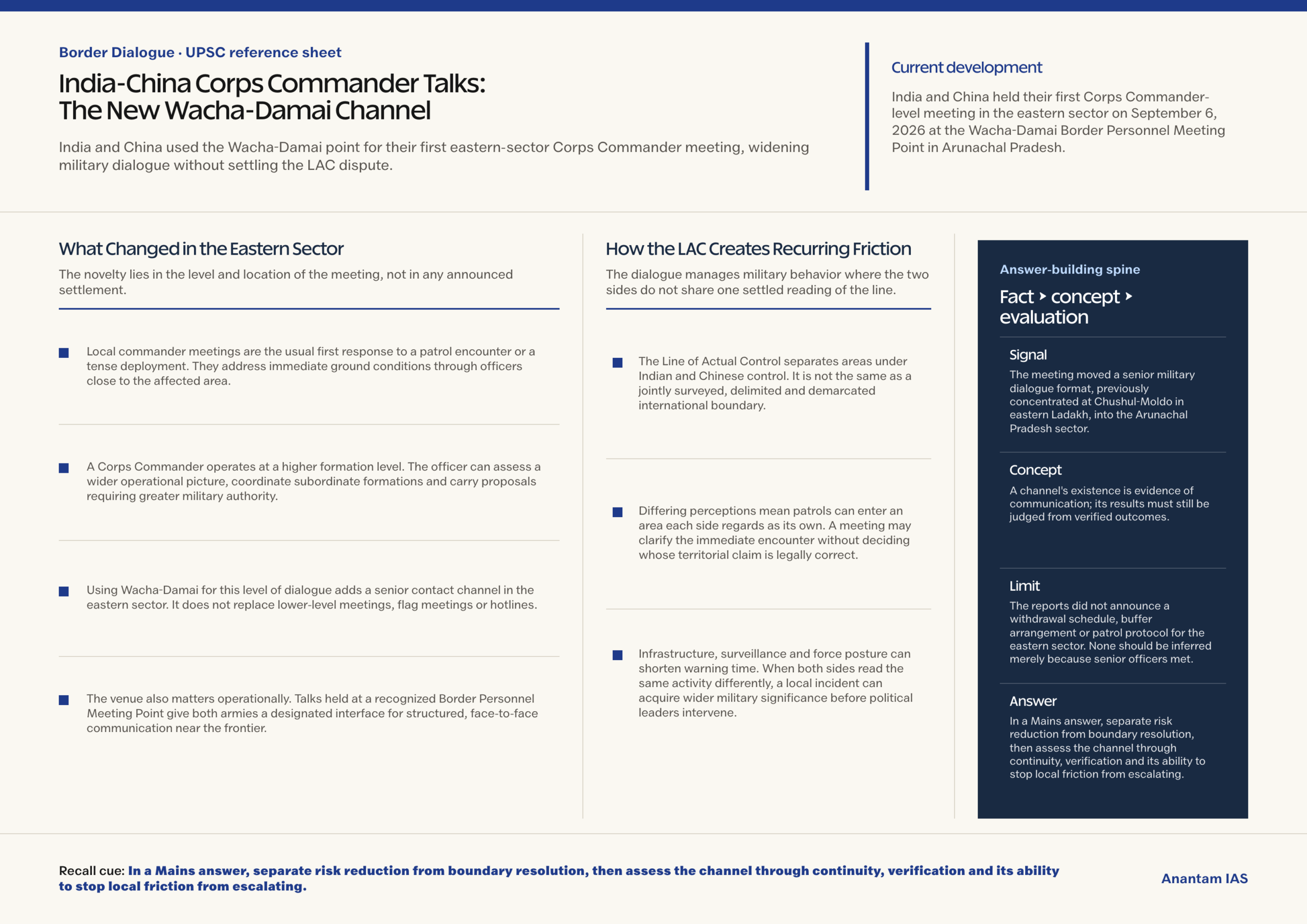
India and China held their first Corps Commander-level meeting in the eastern sector on September 6, 2026 at the Wacha-Damai Border Personnel Meeting Point in Arunachal Pradesh.
- The meeting moved a senior military dialogue format, previously concentrated at Chushul-Moldo in eastern Ladakh, into the Arunachal Pradesh sector.
- The talks followed several meetings between local commanders amid reported tensions near Taksing in Upper Subansiri district.
- Wacha, in the Kibithoo sector, is India’s easternmost Border Personnel Meeting Point, according to the Indian Express report.
- The reports confirmed that talks occurred but announced no disengagement agreement, troop reduction or boundary settlement.
- The change matters because a higher command channel can examine sector-wide operational risks that may exceed the authority of local border commanders.
- The exam trap is simple: a meeting mechanism can manage incidents along the LAC, but it cannot by itself settle competing territorial claims.
UPSC Relevance
Prelims Relevance
- Wacha-Damai is a Border Personnel Meeting Point in the Kibithoo sector of Arunachal Pradesh.
- The Line of Actual Control is the line of military control, not a mutually delimited and demarcated international boundary.
- India’s 3 Corps is headquartered at Rangapahar in Nagaland and has operational responsibility along parts of the Arunachal Pradesh frontier.
- The 4 Corps, based at Tezpur, is the other Army corps formation responsible for the frontier in Arunachal Pradesh.
- Chushul-Moldo in eastern Ladakh has been the principal venue for earlier Corps Commander-level talks linked to the western sector standoff.
Mains Relevance
GS Paper 2
- India and its neighborhood: bilateral relations with China and management of an unsettled boundary.
- Effect of border-management mechanisms on bilateral stability without conflating dialogue with dispute resolution.
GS Paper 3
- Security challenges and their management in border areas, including escalation control, command communication and infrastructure-linked friction.
Essay
- Dialogue is most valuable when it prevents a manageable disagreement from becoming an uncontrollable crisis.
Background and Context
What Changed in the Eastern Sector
The novelty lies in the level and location of the meeting, not in any announced settlement.
- Local commander meetings are the usual first response to a patrol encounter or a tense deployment. They address immediate ground conditions through officers close to the affected area.
- A Corps Commander operates at a higher formation level. The officer can assess a wider operational picture, coordinate subordinate formations and carry proposals requiring greater military authority.
- Using Wacha-Damai for this level of dialogue adds a senior contact channel in the eastern sector. It does not replace lower-level meetings, flag meetings or hotlines.
- The venue also matters operationally. Talks held at a recognized Border Personnel Meeting Point give both armies a designated interface for structured, face-to-face communication near the frontier.
- This is best read as institutional layering: local channels handle immediate incidents, while higher commanders can review patterns, deployments and measures needed to prevent escalation across a broader sector.
How the LAC Creates Recurring Friction
The dialogue manages military behavior where the two sides do not share one settled reading of the line.
- The Line of Actual Control separates areas under Indian and Chinese control. It is not the same as a jointly surveyed, delimited and demarcated international boundary.
- Differing perceptions mean patrols can enter an area each side regards as its own. A meeting may clarify the immediate encounter without deciding whose territorial claim is legally correct.
- Infrastructure, surveillance and force posture can shorten warning time. When both sides read the same activity differently, a local incident can acquire wider military significance before political leaders intervene.
- Communication mechanisms reduce that danger by helping commanders establish what happened, convey concerns and discuss reciprocal steps. Their value lies in crisis control even when the political dispute remains open.
- This distinction should anchor a Mains answer: border management concerns stability and conduct along the line, while boundary settlement concerns the final territorial alignment between states.
What the Meeting Does Not Prove
A channel’s existence is evidence of communication; its results must still be judged from verified outcomes.
- The reports did not announce a withdrawal schedule, buffer arrangement or patrol protocol for the eastern sector. None should be inferred merely because senior officers met.
- There was also no verified troop reduction. Continued deployment may coexist with dialogue because forces can remain prepared while commanders work to prevent a specific friction from escalating.
- One meeting does not establish durable compliance. Confidence depends on repeated contact, accurate ground-level implementation and ways to verify whether agreed conduct is being followed by both sides.
- Military talks are designed to manage operational problems. They cannot alone resolve the legal, political and cartographic questions that make the India-China boundary dispute persistent.
- For analysis, treat this as a modest institutional gain: the eastern sector now has a senior dialogue pathway, but its effectiveness will depend on continuity, clarity and observable restraint.
Way Forward
Make the Channel Predictable and Verifiable
The new pathway will matter only if it produces reliable communication before and during friction.
- Both sides should establish regular contact intervals and rapid activation procedures so that a tense ground situation does not wait for an improvised diplomatic response.
- Meeting records should identify precise operational commitments, responsible command levels and review dates, while protecting information that cannot be made public for security reasons.
- Hotlines, local meetings and Corps-level talks should form one escalation ladder, with unresolved issues moving upward without cutting off communication at the ground level.
- Any reported improvement should be assessed through observable conduct, not the holding of talks alone. Verified implementation is the difference between a channel and an outcome.
Conclusion
- The Wacha-Damai meeting broadens military crisis-management architecture into the eastern sector. Its immediate significance is a higher-level communication route, not proof of disengagement or settlement.
- In a Mains answer, separate risk reduction from boundary resolution, then assess the channel through continuity, verification and its ability to stop local friction from escalating.
UPSC Practice Questions
Prelims MCQ 1
With reference to India-China border-management mechanisms, consider the following statements:
- Wacha-Damai is a Border Personnel Meeting Point in Arunachal Pradesh.
- A Corps Commander-level meeting automatically delimits the Line of Actual Control.
- Chushul-Moldo has hosted Corps Commander-level talks linked to the eastern Ladakh standoff.
How many of the above statements are correct?
(a) Only one (b) Only two (c) All three (d) None
Answer: (b) Only two
Explanation:
Statements 1 and 3 are correct. A military dialogue can manage operational tensions, but it does not automatically delimit or settle the LAC.
Prelims MCQ 2
What is the most accurate significance of the September 2026 Wacha-Damai meeting?
(a) It converted the LAC into an agreed international boundary (b) It completed troop withdrawal across Arunachal Pradesh (c) It extended Corps Commander-level dialogue into the eastern sector (d) It replaced every local commander meeting and military hotline
Answer: (c) It extended Corps Commander-level dialogue into the eastern sector
Explanation:
The verified development was the first eastern-sector use of the Corps Commander-level format. No boundary settlement, sector-wide withdrawal or replacement of other channels was announced.
UPSC Mains Questions
- Military dialogue can reduce border risks without resolving a boundary dispute. Discuss with reference to the India-China Corps Commander meeting at Wacha-Damai.
- Examine the role and limitations of layered military communication mechanisms in preventing local incidents along the Line of Actual Control from escalating into wider crises.
Sources: The Hindu and Indian Express.
Frequently Asked Questions
What happened at Wacha-Damai in September 2026?
India and China held their first Corps Commander-level meeting in the eastern sector there. The reports confirmed dialogue amid local tensions but announced no disengagement or boundary agreement.
Where is the Wacha-Damai Border Personnel Meeting Point?
It is in the Kibithoo sector of Arunachal Pradesh on the Indian side of the LAC. The Indian Express describes Wacha as India’s easternmost Border Personnel Meeting Point.
Why is a Corps Commander-level meeting different from a local commander meeting?
A Corps Commander has authority over a larger formation and can examine sector-wide operational issues. Local commanders remain essential for handling immediate encounters and implementing ground-level measures.
Did the Wacha-Damai talks settle the India-China boundary dispute?
No. The reports announced neither a settlement nor a troop-reduction agreement. Military talks can manage conduct and escalation risks along the LAC, while the underlying boundary remains unsettled.
Why is the LAC prone to recurring friction?
The two sides do not share a single settled perception of the line in all areas. Differing interpretations of patrol encounters, infrastructure and force posture can create escalation risks.
Source: https://anantamias.com/current-affairs/india-china-corps-talks-arunachal/
LVM3 Semi-Cryogenic Upgrade: Full-Thrust Power-Head Test
Why in News?
On September 5, 2026, ISRO hot-tested the semi-cryogenic engine’s Power Head Test Article at its 200-tonne, 100% thrust level at IPRC, Mahendragiri.
- The 35-second test included a five-second segment with the power head operating at the 200-tonne full-thrust level.
- ISRO described it as the ninth PHTA hot test and the first operation of this article at 100% thrust.
- The test also validated switching propellant supply from a low-pressure start tank to a medium-pressure run tank for later long-duration testing.
- The PHTA excludes the thrust chamber, so the result is not qualification of the complete SE2000 engine, SC120 stage or a flight system.
- The power head is the engine’s propellant-feeding and turbine-driving core. Stable operation must come before the complete engine can sustain controlled combustion in its main chamber.
- The development matters because the planned SC120 stage would replace LVM3’s current L110 core stage and contribute to higher payload capability.
UPSC Relevance
Prelims Relevance
- A semi-cryogenic engine pairs cryogenic liquid oxygen with a hydrocarbon fuel such as refined kerosene.
- The SE2000 is a 2,000 kN-class engine planned to power the SC120 semi-cryogenic stage.
- The PHTA contains engine systems including turbopumps, pre-burner, start system and controls, but excludes the thrust chamber.
- The SC120 stage is being developed to replace the L110 liquid core stage of LVM3.
- ISRO’s SE2000 uses an oxidizer-rich staged-combustion cycle, in which pre-burner gas drives turbomachinery before the main combustion process.
Mains Relevance
GS Paper 3
- Achievements of Indians in science and technology: indigenous development of high-thrust liquid propulsion and associated test infrastructure.
- Awareness in the fields of space: how propulsion efficiency and stage architecture influence launch-vehicle payload capability.
Essay
- Complex technologies mature through staged testing, where each verified subsystem closes one risk without pretending that the whole system is ready.
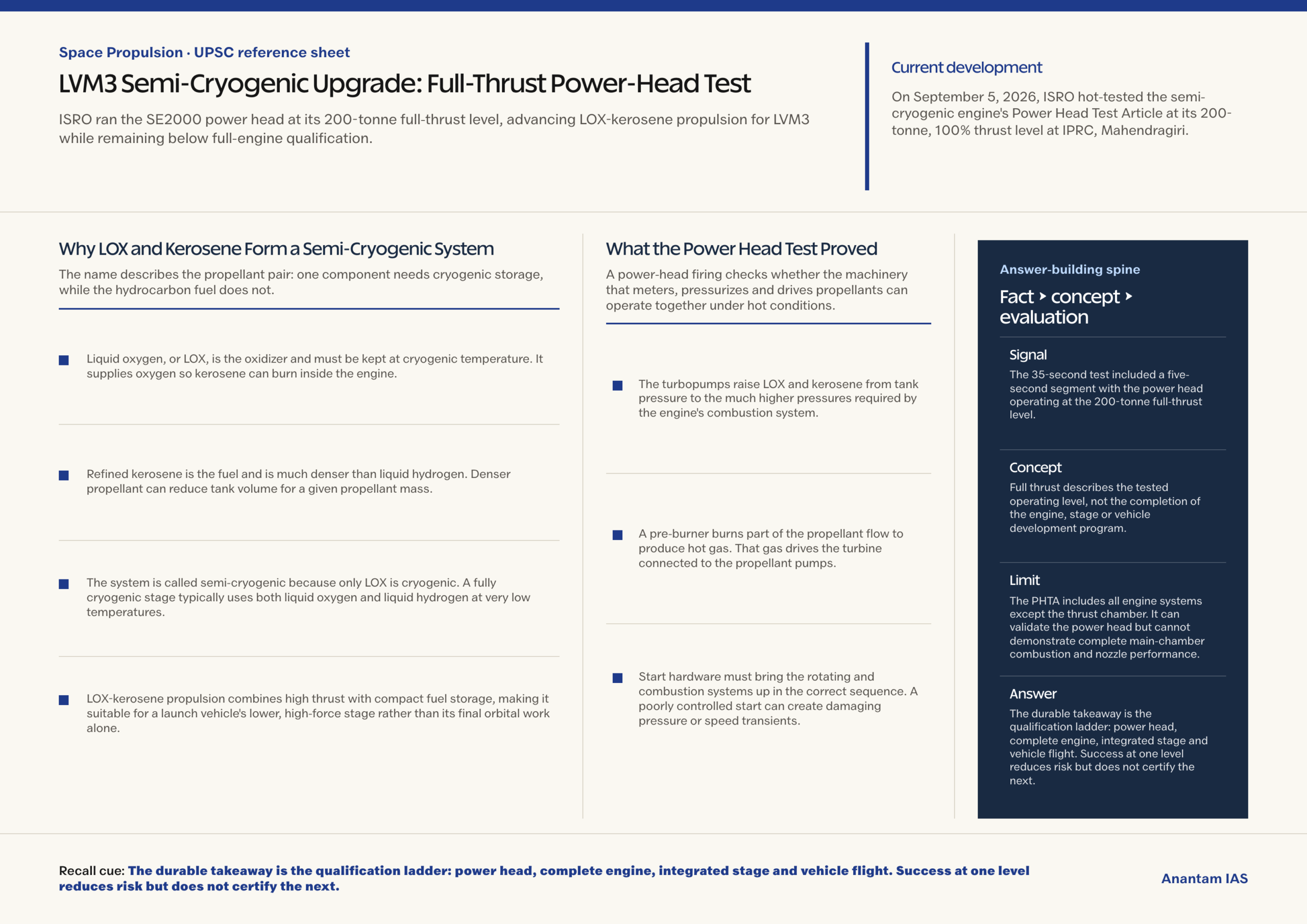
Background and Context
Why LOX and Kerosene Form a Semi-Cryogenic System
The name describes the propellant pair: one component needs cryogenic storage, while the hydrocarbon fuel does not.
- Liquid oxygen, or LOX, is the oxidizer and must be kept at cryogenic temperature. It supplies oxygen so kerosene can burn inside the engine.
- Refined kerosene is the fuel and is much denser than liquid hydrogen. Denser propellant can reduce tank volume for a given propellant mass.
- The system is called semi-cryogenic because only LOX is cryogenic. A fully cryogenic stage typically uses both liquid oxygen and liquid hydrogen at very low temperatures.
- LOX-kerosene propulsion combines high thrust with compact fuel storage, making it suitable for a launch vehicle’s lower, high-force stage rather than its final orbital work alone.
- The trade-off is demanding combustion hardware. Pumps, seals, valves and materials must handle large flows, high pressures and hot oxygen-rich gas without unstable operation.
What the Power Head Test Proved
A power-head firing checks whether the machinery that meters, pressurizes and drives propellants can operate together under hot conditions.
- The turbopumps raise LOX and kerosene from tank pressure to the much higher pressures required by the engine’s combustion system.
- A pre-burner burns part of the propellant flow to produce hot gas. That gas drives the turbine connected to the propellant pumps.
- Start hardware must bring the rotating and combustion systems up in the correct sequence. A poorly controlled start can create damaging pressure or speed transients.
- Control components regulate valves, flows and operating transitions. The September test showed expected parameters while the PHTA reached its rated 200-tonne operating level for five seconds.
- The tank switchover matters because a brief start supply cannot support a long firing. Moving to the run tank is a prerequisite for extended power-head tests.
Where the Test Sits in Qualification
Full thrust describes the tested operating level, not the completion of the engine, stage or vehicle development program.
- The PHTA includes all engine systems except the thrust chamber. It can validate the power head but cannot demonstrate complete main-chamber combustion and nozzle performance.
- A complete-engine test must integrate the power head with the thrust chamber and show that their pressures, flows, cooling and combustion remain compatible across the required operating envelope.
- Longer firings then build evidence on steady operation and durability. A five-second full-thrust segment is a milestone, but it does not establish mission-duration performance.
- Stage qualification adds tanks, feed lines, structures, controls and integrated operations around the engine. Vehicle-level work must later show that the stage functions within LVM3.
- The planned SC120, paired with an uprated C32 cryogenic upper stage, is intended to raise LVM3 payload capability. This test advances that path without completing it.
Way Forward
Move From Rated Power to Integrated Endurance
The next evidence must connect short power-head performance to longer, complete-engine and stage-level operation.
- ISRO should extend PHTA firing duration after validating the start-to-run tank transition and examine whether key pressures, temperatures and turbopump speeds remain stable.
- Complete-engine tests should integrate the thrust chamber and verify combustion stability, cooling and control across start-up, rated operation and shutdown.
- Stage testing should validate propellant tanks, feed systems, structures and controls under conditions representing the planned SC120 operating envelope.
- Payload gains should be treated as a vehicle-level outcome only after engine, stage and LVM3 integration are demonstrated through the required qualification sequence.
Conclusion
- The 200-tonne PHTA test shows that SE2000’s power-head systems can reach their rated design operating level, including a controlled transition to the run-tank supply.
- The durable takeaway is the qualification ladder: power head, complete engine, integrated stage and vehicle flight. Success at one level reduces risk but does not certify the next.
UPSC Practice Questions
Prelims MCQ 1
With reference to ISRO’s semi-cryogenic propulsion program, consider the following statements:
- The SE2000 uses liquid oxygen and refined kerosene as propellants.
- The Power Head Test Article includes the thrust chamber and nozzle.
- The SC120 stage is planned to replace LVM3’s L110 core stage.
How many of the above statements are correct?
(a) Only one (b) Only two (c) All three (d) None
Answer: (b) Only two
Explanation:
Statements 1 and 3 are correct. ISRO states that the PHTA encompasses the engine systems except the thrust chamber.
Prelims MCQ 2
What did ISRO’s September 5, 2026 SE2000 test directly demonstrate?
(a) A completed SC120 flight demonstration (b) Full qualification of the complete SE2000 engine (c) PHTA operation at the 200-tonne level for five seconds within a 35-second test (d) Replacement of the L110 stage on an operational LVM3 mission
Answer: (c) PHTA operation at the 200-tonne level for five seconds within a 35-second test
Explanation:
The test reached 100% power-head thrust level, but the article excluded the thrust chamber and was not a complete-engine, stage or flight qualification.
UPSC Mains Questions
- Explain why power-head testing is a distinct stage in the qualification of a high-thrust liquid rocket engine. What additional evidence is required before flight use?
- Discuss how LOX-kerosene semi-cryogenic propulsion can influence LVM3 payload capability, while distinguishing a subsystem milestone from engine, stage and vehicle qualification.
Sources: Indian Space Research Organisation and Indian Space Research Organisation, SE2000 development update.
Frequently Asked Questions
What is a Power Head Test Article?
It is an intermediate engine configuration used to test the propellant-feed and turbine-driving systems together. ISRO’s PHTA includes the engine systems except the thrust chamber.
Why is the engine called semi-cryogenic?
Its liquid-oxygen oxidizer requires cryogenic storage, while refined kerosene is a hydrocarbon fuel stored without the extreme cooling needed for liquid hydrogen.
Did the test qualify the complete SE2000 engine?
No. It operated the PHTA at the full-thrust level, but the article excluded the thrust chamber. Complete-engine integration, longer tests and later qualification stages remain separate steps.
What was achieved during the 35-second test?
The PHTA operated at the 200-tonne, 100% level for five seconds, and ISRO also validated switching propellant supply from the start tank to the run tank.
How could the SC120 stage affect LVM3?
ISRO plans SC120 as a replacement for the L110 core stage. Combined with an uprated C32 upper stage, it is intended to enhance LVM3’s payload capability.
Source: https://anantamias.com/current-affairs/lvm3-semicryogenic-full-thrust-test/
Equal-Area World Maps: UN Resolution and India’s Boundary Caveat
Why in News?
On September 4, 2026, the UN General Assembly adopted the non-binding “Correct the Map” resolution promoting equal-area projections, with India voting in favor while reserving its position on political boundaries.
- Draft resolution A/80/L.104 was adopted by 164 votes in favor, one against and six abstentions.
- The measure encourages equal-area methods where comparing landmass size matters; it does not compel states to use one projection for every map.
- India’s explanation supported the equal-area principle without endorsing Equal Earth or any other single projection.
- India later said depictions of Jammu and Kashmir and Ladakh must follow India’s official map, separating territorial claims from projection choice.
- The resolution also encourages teaching the characteristics, limitations and appropriate applications of projections, making critical map literacy part of its educational purpose.
- A projection decides how a curved Earth is flattened. The boundary lines and place names drawn on that surface come from a separate political dataset.
- This distinction prevents a common error: mathematical preservation of area does not authenticate the legal status, ownership or boundary of any territory.
UPSC Relevance
Prelims Relevance
- An equal-area projection preserves proportional area, but it must distort shape, angle, distance or direction in some way.
- The Mercator projection is conformal: it preserves local angles and supports navigation, while increasingly enlarging apparent area toward the poles.
- Equal Earth is an equal-area, pseudocylindrical world-map projection introduced by Bojan Šavrič, Tom Patterson and Bernhard Jenny.
- A UN General Assembly resolution is ordinarily recommendatory rather than legally binding on member states.
- A map’s projection and its boundary dataset are separate layers; changing one does not validate the other.
Mains Relevance
GS Paper 1
- Salient features of world physical geography: map projections, distortion and the use of equal-area maps for comparing regions.
- How cartographic choices shape geographic perception, especially the apparent size of equatorial and high-latitude landmasses.
GS Paper 2
- Important international institutions: the recommendatory character of General Assembly resolutions and member-state explanations of vote.
- India’s separation of support for a scientific mapping principle from its stated position on sovereignty and territorial depiction.
Essay
- Tools that represent reality also influence how societies perceive scale, importance and equality.
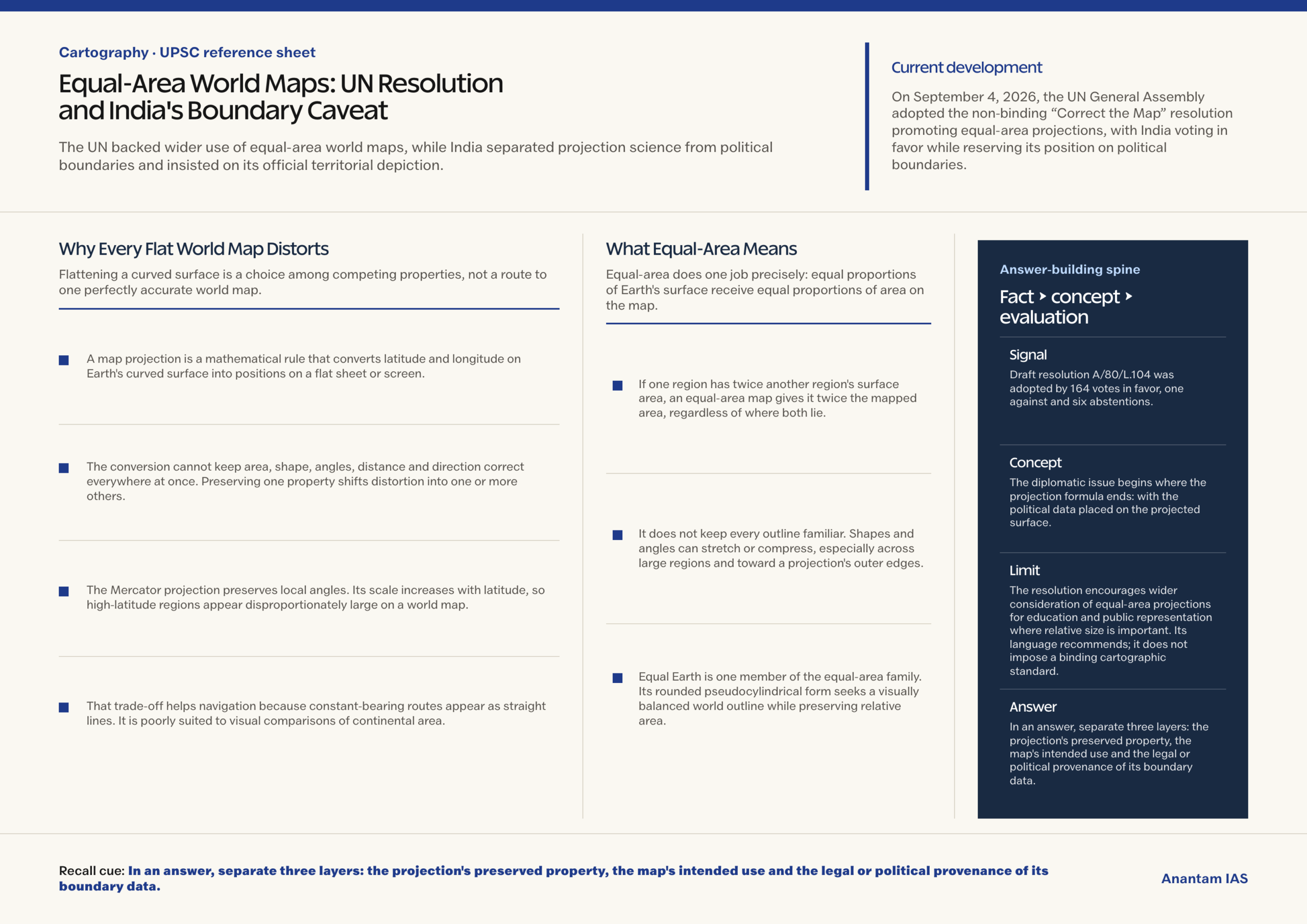
Background and Context
Why Every Flat World Map Distorts
Flattening a curved surface is a choice among competing properties, not a route to one perfectly accurate world map.
- A map projection is a mathematical rule that converts latitude and longitude on Earth’s curved surface into positions on a flat sheet or screen.
- The conversion cannot keep area, shape, angles, distance and direction correct everywhere at once. Preserving one property shifts distortion into one or more others.
- The Mercator projection preserves local angles. Its scale increases with latitude, so high-latitude regions appear disproportionately large on a world map.
- That trade-off helps navigation because constant-bearing routes appear as straight lines. It is poorly suited to visual comparisons of continental area.
- Projection choice should follow purpose: navigation needs differ from thematic mapping, geographic education and comparisons of landmass size. A classroom area comparison does not need a navigator’s straight bearing.
What Equal-Area Means
Equal-area does one job precisely: equal proportions of Earth’s surface receive equal proportions of area on the map.
- If one region has twice another region’s surface area, an equal-area map gives it twice the mapped area, regardless of where both lie.
- It does not keep every outline familiar. Shapes and angles can stretch or compress, especially across large regions and toward a projection’s outer edges.
- Equal Earth is one member of the equal-area family. Its rounded pseudocylindrical form seeks a visually balanced world outline while preserving relative area.
- Other equal-area projections also exist, including Mollweide and cylindrical equal-area forms. Equal-area is a property, not the name of one mandatory design.
- This is the exam-worthy distinction: “area-preserving” does not mean free of distortion. It identifies which quantity the projection protects while the remaining geometric properties carry the trade-off.
What the Resolution and India's Caveat Mean
The diplomatic issue begins where the projection formula ends: with the political data placed on the projected surface.
- The resolution encourages wider consideration of equal-area projections for education and public representation where relative size is important. Its language recommends; it does not impose a binding cartographic standard.
- The text and explanations recognized that different projections suit different uses. The measure did not ban Mercator or require one projection for navigation, regional maps or operational work.
- India voted in favor but said support was limited to the broader equal-area principle, not endorsement of Equal Earth, a website or one political map.
- A projection transforms coordinates. A separate dataset supplies borders, disputed-territory markings and place names, so projection science cannot settle territorial sovereignty.
- India’s boundary caveat applies to that political layer: it insisted that Jammu and Kashmir and Ladakh be depicted according to India’s official map.
Way Forward
Teach Purpose, Property and Provenance Together
Map literacy improves when users can see what a map preserves, what it distorts and where its political data came from.
- Schools and public institutions should label the projection and explain its intended use instead of presenting a flat world map as a neutral mirror of the globe.
- Area-comparison lessons should use an equal-area projection, while navigation and local mapping should retain projections suited to their own tasks.
- Publishers should identify the source and date of boundary data separately from the projection, especially where territorial depictions are contested.
- International bodies should keep technical guidance projection-neutral and avoid treating a projection’s mathematics as approval of any accompanying political map.
Conclusion
- The resolution promotes better comparison of landmass size through equal-area methods; it is non-binding and neither creates a universal map nor resolves political boundaries.
- In an answer, separate three layers: the projection’s preserved property, the map’s intended use and the legal or political provenance of its boundary data.
UPSC Practice Questions
Prelims MCQ 1
With reference to map projections, consider the following statements:
- An equal-area projection preserves proportional area between mapped regions.
- The Mercator projection preserves local angles but enlarges apparent area toward high latitudes.
- An equal-area projection can also preserve shape, distance and direction everywhere on a world map.
How many of the above statements are correct?
(a) Only one (b) Only two (c) All three (d) None
Answer: (b) Only two
Explanation:
Statements 1 and 2 are correct. Flattening Earth requires trade-offs, so preserving area does not preserve all other geometric properties everywhere.
Prelims MCQ 2
Which statement best describes the UN General Assembly’s September 2026 equal-area map resolution?
(a) It legally replaced every UN map with one Equal Earth political map (b) It authenticated the boundaries shown on the Equal Earth website (c) It encouraged equal-area approaches where relative landmass size matters without creating a binding universal map (d) It prohibited the Mercator projection for navigation
Answer: (c) It encouraged equal-area approaches where relative landmass size matters without creating a binding universal map
Explanation:
The resolution is non-binding and supports area-conscious projection choices. It neither mandates one map nor authenticates political boundaries or bans navigational use of Mercator.
UPSC Mains Questions
- No flat map can be accurate in every cartographic property. Explain the trade-offs among area, shape, direction and distance, and assess the educational value of equal-area projections.
- Projection science and political cartography are distinct layers of a map. Discuss this distinction in the context of the UN equal-area resolution and India’s explanation of vote.
Sources: United Nations General Assembly transcript and Indian Express.
Frequently Asked Questions
What is an equal-area map projection?
It is a projection that preserves proportional surface area. A region twice as large as another occupies twice the mapped area, though their shapes, angles or distances may be distorted.
Did the UN make Equal Earth the mandatory world map?
No. The General Assembly resolution is non-binding and encourages equal-area approaches where relative size matters. It does not impose one projection for every country, institution or use.
Why does the Mercator projection enlarge high-latitude regions?
Mercator’s scale increases away from the equator so that local angles and constant-bearing navigation are preserved. The same scaling makes high-latitude landmasses appear larger than their relative area.
Does an equal-area projection validate the boundaries shown on a map?
No. The projection controls geometric transformation, while a separate dataset supplies borders and labels. Area preservation cannot authenticate sovereignty, territorial status or a disputed boundary.
What was India’s position on the resolution?
India supported the equal-area principle without endorsing one projection or political map. It also insisted that Jammu and Kashmir and Ladakh be depicted according to India’s official map.
Source: https://anantamias.com/current-affairs/equal-area-world-maps-india-boundary-caveat/
ISRO Space-Sector Reforms: Research Leadership and Private-Sector Scale
Why in News?
On 6 September 2026, ISRO clarified that space-sector reforms are meant to expand an ISRO-led ecosystem, with the agency leading frontier work while industry scales mature capabilities.
- ISRO rejected reports that the reforms seek to privatize the agency or diminish its institutional role.
- It placed advanced research, national and strategic missions, space science, exploration and frontier capabilities within ISRO’s continuing core role.
- It assigned mature and routinely manufactured systems a different pathway: scaling through Indian industry or public-sector undertakings under appropriate competitive processes.
- The clarification describes an institutional direction. It isn’t a statute, a blanket guarantee against every organizational change or a detailed technology-transfer schedule.
- The key distinction is between creating the next capability and reproducing a proven capability at industrial scale; the two tasks need different institutions and incentives.
- For Mains, evaluate the reform by whether it increases aggregate national capability without weakening public control over strategic infrastructure, safety or long-horizon research.
- This is an ecosystem-expansion argument, not evidence that every transfer has occurred, every private participant can enter freely or implementation risks have disappeared.
UPSC Relevance
Prelims Relevance
- The Indian Space Policy 2023 provides the institutional policy framework cited by ISRO for the post-2020 reforms.
- The Department of Space provides overall policy direction within the stated architecture.
- IN-SPACe facilitates and authorizes participation by non-government entities; it is not the commercial operator for mature ISRO capabilities.
- NSIL undertakes commercialization and industry-led utilization of mature capabilities.
- ISRO remains the core organization for advanced R&D, technology development and national missions.
- Government control continues over critical national space infrastructure and strategic capabilities, according to the clarification.
Mains Relevance
GS Paper 3
- Achievements of Indians in science and technology; indigenization of technology and developing new technology.
- Assess how public research leadership and private manufacturing scale can complement each other in a strategic technology sector.
GS Paper 2
- Government policies and interventions for development in various sectors and issues arising out of their design and implementation.
- Examine role clarity, authorization, commercial functions and public accountability across the space-sector institutions.
Essay
- A capable state need not manufacture every mature system itself, but it must preserve the knowledge, authority and patient investment needed to create the next one.
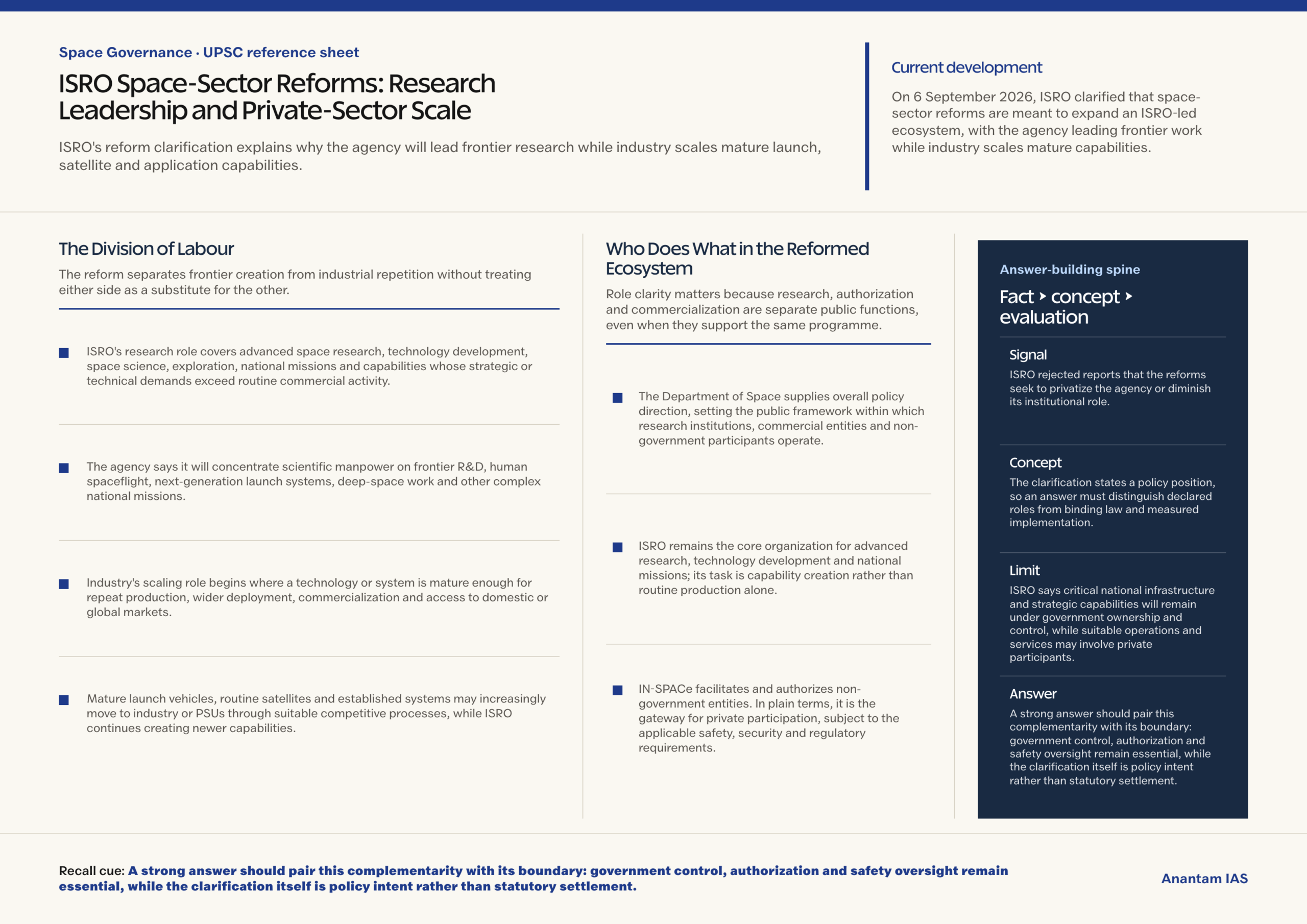
Background and Context
The Division of Labour
The reform separates frontier creation from industrial repetition without treating either side as a substitute for the other.
- ISRO’s research role covers advanced space research, technology development, space science, exploration, national missions and capabilities whose strategic or technical demands exceed routine commercial activity.
- The agency says it will concentrate scientific manpower on frontier R&D, human spaceflight, next-generation launch systems, deep-space work and other complex national missions.
- Industry’s scaling role begins where a technology or system is mature enough for repeat production, wider deployment, commercialization and access to domestic or global markets.
- Mature launch vehicles, routine satellites and established systems may increasingly move to industry or PSUs through suitable competitive processes, while ISRO continues creating newer capabilities.
- Technology transfer, in this model, changes who reproduces a proven capability at scale; it does not by itself prove that ISRO has abandoned the underlying domain.
Who Does What in the Reformed Ecosystem
Role clarity matters because research, authorization and commercialization are separate public functions, even when they support the same programme.
- The Department of Space supplies overall policy direction, setting the public framework within which research institutions, commercial entities and non-government participants operate.
- ISRO remains the core organization for advanced research, technology development and national missions; its task is capability creation rather than routine production alone.
- IN-SPACe facilitates and authorizes non-government entities. In plain terms, it is the gateway for private participation, subject to the applicable safety, security and regulatory requirements.
- NSIL handles commercialization and industry-led use of mature capabilities, connecting established public technologies with production, services and markets rather than replacing ISRO’s research mandate.
- Industry, start-ups and PSUs can supply investment, manufacturing capacity, innovation and market access, allowing a larger programme than public manpower and production lines could support alone.
The Boundary That Must Be Kept Clear
The clarification states a policy position, so an answer must distinguish declared roles from binding law and measured implementation.
- ISRO says critical national infrastructure and strategic capabilities will remain under government ownership and control, while suitable operations and services may involve private participants.
- Private participation remains subject to national-security, safety, quality and regulatory requirements; commercial opportunity does not remove the state’s authorization and oversight functions.
- The statement does not identify a binding transfer timetable, list every system to be scaled or settle how competitive processes will work in each case.
- It also does not convert role allocation into a statutory guarantee. Parliament, policy instruments, contracts, authorization decisions and future implementation will determine the enforceable details.
- The correct exam reading is narrow: public research leadership and private scale are complementary in the stated design, but outcomes must still be judged through evidence.
Way Forward
Make Complementarity Work in Practice
The division becomes credible only when institutions can transfer mature work without starving frontier research or weakening public oversight.
- Publish transparent selection criteria for mature capabilities, competitive processes and authorization decisions so participants understand the boundary between public research and commercial scaling.
- Protect ISRO’s scientific manpower and long-horizon funding while using industry capacity for repeat manufacturing, services, supply chains and market development.
- Build enforceable safety, security, quality and data-governance safeguards around private operations, especially where services depend on strategic infrastructure or sensitive technologies.
- Measure reform through reliable production, innovation, domestic capability and mission outcomes, not merely through the number of firms, transfers or policy announcements.
Conclusion
- The durable lesson is a division of labour: ISRO creates frontier and strategic capabilities, while industry supplies repeatable production, capital and market scale for mature systems.
- A strong answer should pair this complementarity with its boundary: government control, authorization and safety oversight remain essential, while the clarification itself is policy intent rather than statutory settlement.
UPSC Practice Questions
Prelims MCQ 1
With reference to the institutional architecture described in ISRO’s space-sector reform clarification, consider the following statements:
- ISRO remains the core organization for advanced research, technology development and national missions.
- IN-SPACe undertakes commercialization and industry-led utilization of mature space capabilities.
- NSIL undertakes commercialization and industry-led utilization of mature space capabilities.
How many of the above statements are correct?
(a) Only one (b) Only two (c) All three (d) None
Answer: (b) Only two
Explanation:
Statements 1 and 3 are correct. IN-SPACe facilitates and authorizes non-government participation, while NSIL performs the stated commercialization function.
Prelims MCQ 2
Which option best captures the division of labour stated by ISRO under the space-sector reforms?
(a) ISRO exits research while industry designs all strategic missions (b) IN-SPACe replaces ISRO as India’s principal research institution (c) ISRO leads frontier work while industry scales mature capabilities (d) All space infrastructure moves to private ownership
Answer: (c) ISRO leads frontier work while industry scales mature capabilities
Explanation:
ISRO presents private scale as complementary to its continuing leadership in advanced research, strategic capabilities, science, exploration and national missions.
UPSC Mains Questions
- Public research leadership and private industrial scale are complements, not substitutes, in strategic technology sectors. Discuss with reference to India’s space-sector reforms.
- Critically examine the institutional division of roles among ISRO, IN-SPACe, NSIL and industry. What safeguards are necessary to preserve national capability while expanding commercial participation?
Source: Indian Space Research Organisation.
Frequently Asked Questions
Is ISRO being privatized under the space-sector reforms?
ISRO’s official clarification says no. It states that ISRO will remain India’s principal institution for advanced research, national and strategic missions, space science, exploration and frontier capabilities.
What work does the clarification place with private industry?
Industry may increasingly scale mature technologies and routinely manufactured systems, including established launch vehicles and routine satellites, through appropriate competitive processes.
What is the difference between IN-SPACe and NSIL?
IN-SPACe facilitates and authorizes non-government participation. NSIL undertakes commercialization and industry-led utilization of mature space capabilities.
Does the clarification create a statutory guarantee for ISRO’s role?
No. It records ISRO’s official policy position and intended division of labour, but it is not legislation or a detailed, binding transfer schedule.
Why can technology transfer strengthen rather than shrink ISRO?
Repeat production can move to industry while ISRO’s scientific manpower focuses on advanced research and complex missions. The claim still requires implementation evidence, funding and clear safeguards.
Source: https://anantamias.com/current-affairs/isro-space-reforms-research-private-scale/
North Korea’s Kang Kon Destroyer: Naval Signalling and Freedom Edge
Why in News?
North Korea commissioned the Kang Kon at Wonsan on 6 September 2026, one day before the United States, Japan and South Korea began the five-day Freedom Edge 26 exercise.
- The Kang Kon became North Korea’s second new 5,000-ton-class destroyer, following the Choe Hyon, which entered service in June 2026.
- North Korean state media assigned it to the East Sea Fleet and presented the commissioning as part of a wider naval-modernisation drive.
- Claims about a nuclear deterrent role or nuclear-capable missile carriage come from state reporting and external assessments; they are not independently verified technical specifications.
- The official Japanese notice scheduled Freedom Edge 26 from 7 to 11 September and listed maritime, air, logistics and cyber activities.
- Japan described it as the fourth Freedom Edge iteration since the trilateral multidomain series began in 2024.
- The paired developments show an action-reaction cycle: North Korea seeks greater sea-based military options while the three partners improve detection, defence and coordinated response.
- For Mains, distinguish deterrence, which seeks to alter an adversary’s calculation, from war-fighting, arms-racing and diplomatic crisis management.
- The correct analytical frame is a security dilemma: measures one side calls defensive may appear threatening to the other and stimulate further military preparation.
UPSC Relevance
Prelims Relevance
- The Kang Kon was commissioned at Wonsan and assigned by North Korean state media to the East Sea Fleet.
- A ship’s commissioning marks formal entry into naval service; it is different from launch, fitting-out, trials or first public display.
- Freedom Edge is a trilateral exercise involving Japan, the Republic of Korea and the United States.
- The exercise is multidomain: Freedom Edge 26 officially included maritime, air, logistics and cyber activities.
- Freedom Edge was first conducted in 2024; the September 2026 edition was officially described as its fourth iteration.
- Japan and South Korea are separate United States treaty allies; Freedom Edge does not itself create a NATO-style trilateral collective-defence treaty.
Mains Relevance
GS Paper 2
- Effect of policies and politics of developed and developing countries on India’s interests; regional groupings and agreements involving India or affecting India’s interests.
- Assess the emerging Japan-South Korea-United States security coordination and its consequences for stability on the Korean Peninsula.
GS Paper 3
- Security challenges and their management in border areas; linkages of organized military capability, technology and strategic deterrence.
- Explain how multidomain interoperability links sensors, platforms, logistics and cyber resilience to deterrence by denial.
Essay
- Deterrence may prevent immediate conflict, but lasting security also requires communication, restraint and institutions that stop defensive preparations from becoming an uncontrolled arms race.
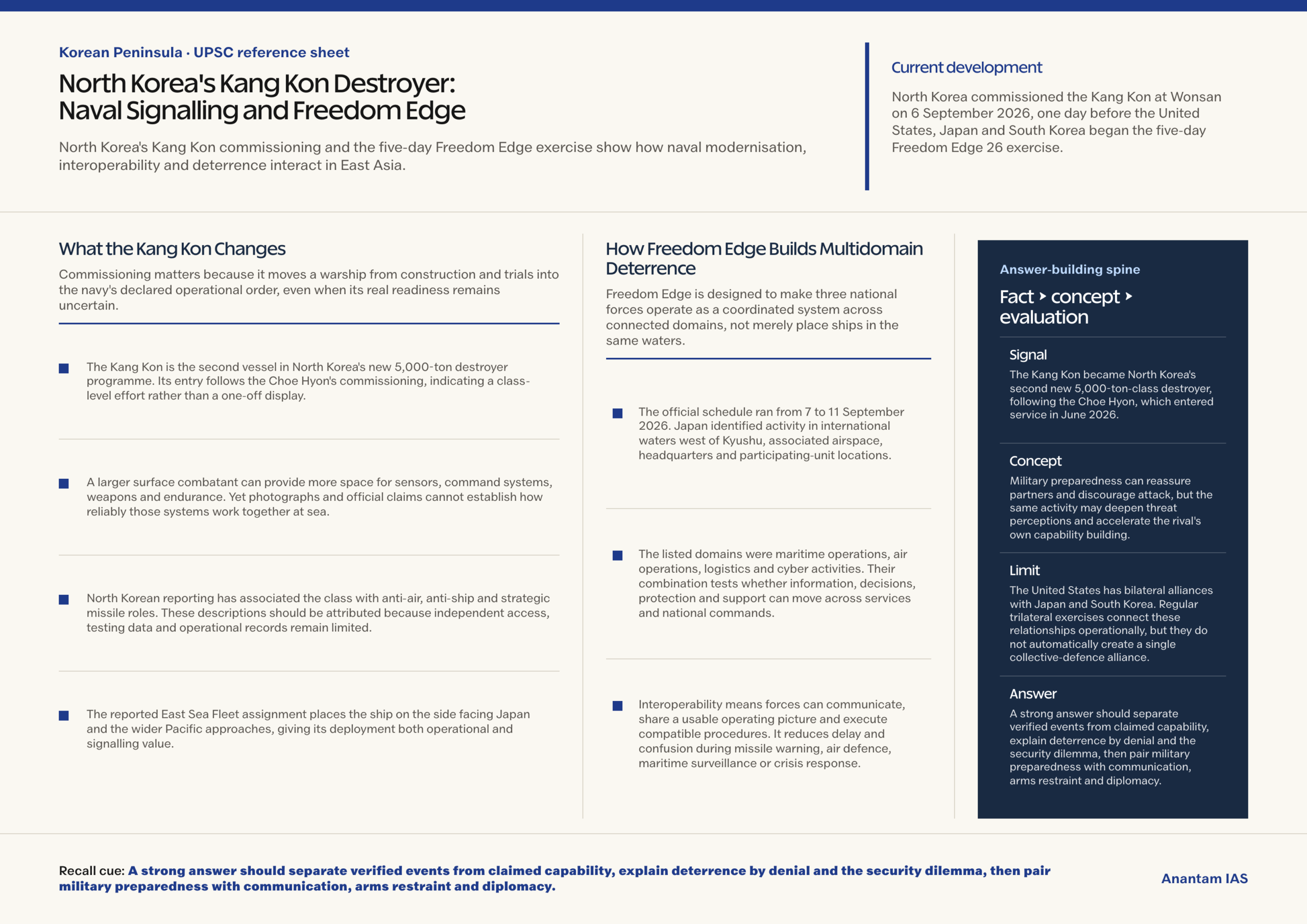
Background and Context
What the Kang Kon Changes
Commissioning matters because it moves a warship from construction and trials into the navy’s declared operational order, even when its real readiness remains uncertain.
- The Kang Kon is the second vessel in North Korea’s new 5,000-ton destroyer programme. Its entry follows the Choe Hyon’s commissioning, indicating a class-level effort rather than a one-off display.
- A larger surface combatant can provide more space for sensors, command systems, weapons and endurance. Yet photographs and official claims cannot establish how reliably those systems work together at sea.
- North Korean reporting has associated the class with anti-air, anti-ship and strategic missile roles. These descriptions should be attributed because independent access, testing data and operational records remain limited.
- The reported East Sea Fleet assignment places the ship on the side facing Japan and the wider Pacific approaches, giving its deployment both operational and signalling value.
- Naval modernisation broadens deterrence beyond land-based missiles by creating mobile maritime platforms. Mobility can complicate surveillance, but survivability depends on training, maintenance, escorts, sensors and secure communications.
How Freedom Edge Builds Multidomain Deterrence
Freedom Edge is designed to make three national forces operate as a coordinated system across connected domains, not merely place ships in the same waters.
- The official schedule ran from 7 to 11 September 2026. Japan identified activity in international waters west of Kyushu, associated airspace, headquarters and participating-unit locations.
- The listed domains were maritime operations, air operations, logistics and cyber activities. Their combination tests whether information, decisions, protection and support can move across services and national commands.
- Interoperability means forces can communicate, share a usable operating picture and execute compatible procedures. It reduces delay and confusion during missile warning, air defence, maritime surveillance or crisis response.
- This supports deterrence by denial: an adversary may reconsider an attack if detection, interception, force protection and recovery appear credible enough to prevent the expected military gain.
- Logistics and cyber elements are not decorative. Sustained operations require fuel, repair and supply, while resilient networks must continue carrying trusted data despite disruption, intrusion or electronic pressure.
The Security Dilemma and Its Limits
Military preparedness can reassure partners and discourage attack, but the same activity may deepen threat perceptions and accelerate the rival’s own capability building.
- The United States has bilateral alliances with Japan and South Korea. Regular trilateral exercises connect these relationships operationally, but they do not automatically create a single collective-defence alliance.
- For the three participants, Freedom Edge improves readiness and signalling. For North Korea, the exercise can be portrayed as encirclement, reinforcing domestic arguments for additional missiles, ships and nuclear forces.
- This action-reaction pattern is the security dilemma: defensive steps by one side can reduce the other’s sense of security even when neither side says it seeks immediate war.
- Deterrence also carries risks of misperception, compressed decision time and escalation. More platforms and faster data-sharing help defence, but a false warning or ambiguous manoeuvre can become harder to contain.
- For India, instability matters through Indo-Pacific sea lanes, non-proliferation norms and major-power relations. A balanced answer should support peace and denuclearisation without overstating India’s direct operational role.
Way Forward
Pair Readiness With Risk Reduction
Credible defence and diplomatic guardrails must develop together if deterrence is to prevent conflict rather than merely postpone a sharper crisis.
- Maintain military hotlines, exercise notifications and incident-at-sea procedures so commanders can clarify unexpected movements before political leaders face pressure to escalate.
- Use phased diplomacy to seek verifiable restraints on testing, deployment and fissile-material production, matched by reciprocal steps rather than unsupported declarations of final denuclearisation.
- Keep trilateral exercises defensive, transparent and proportionate, while preserving the readiness needed to respond to missile, air, maritime and cyber threats.
- Strengthen enforcement of United Nations sanctions alongside humanitarian safeguards, and judge every capability claim through attributed evidence instead of accepting propaganda or speculation as specification.
Conclusion
- The Kang Kon and Freedom Edge capture a regional capability-response cycle: maritime modernisation seeks new options, while multidomain interoperability seeks to detect, withstand and deny their effective use.
- A strong answer should separate verified events from claimed capability, explain deterrence by denial and the security dilemma, then pair military preparedness with communication, arms restraint and diplomacy.
UPSC Practice Questions
Prelims MCQ 1
With reference to the Kang Kon and Freedom Edge 26, consider the following statements:
- The Kang Kon was commissioned into North Korea’s East Sea Fleet according to North Korean state reporting.
- Freedom Edge 26 included maritime, air, logistics and cyber activities.
- Freedom Edge constitutes a NATO-style collective-defence treaty among Japan, South Korea and the United States.
How many of the above statements are correct?
(a) Only one (b) Only two (c) All three (d) None
Answer: (b) Only two
Explanation:
Statements 1 and 2 are correct. Freedom Edge is a trilateral exercise; it does not itself create a collective-defence treaty among the three participants.
Prelims MCQ 2
In strategic studies, ‘deterrence by denial’ is best understood as:
(a) Threatening punishment after every hostile statement (b) Preventing all diplomatic contact with an adversary (c) Convincing an adversary that an attack is unlikely to achieve its intended gains (d) Eliminating the need for surveillance and defensive systems
Answer: (c) Convincing an adversary that an attack is unlikely to achieve its intended gains
Explanation:
Deterrence by denial changes the attacker’s calculation by making successful detection, penetration or military gain appear unlikely, rather than relying only on threatened retaliation.
UPSC Mains Questions
- North Korea’s naval modernisation and the Freedom Edge exercise illustrate both deterrence by denial and the security dilemma. Discuss their implications for stability on the Korean Peninsula.
- Trilateral military interoperability can strengthen crisis response without creating a formal trilateral alliance. Critically examine with reference to Japan, South Korea and the United States.
Sources: The Hindu and Japan Joint Staff.
Frequently Asked Questions
What is the Kang Kon?
The Kang Kon is North Korea’s second new 5,000-ton-class destroyer. It was commissioned at Wonsan on 6 September 2026 and assigned to the East Sea Fleet according to state reporting.
What does nuclear-capable mean in reports about the Kang Kon?
It refers to attributed claims about the ship’s possible missile or deterrent role. It does not establish nuclear propulsion, and independent technical verification of the reported weapons remains limited.
What is Freedom Edge?
Freedom Edge is a Japan-South Korea-United States trilateral exercise first conducted in 2024. Its September 2026 iteration officially covered maritime, air, logistics and cyber activities.
What does multidomain interoperability mean?
It is the ability of different services and national forces to communicate, share usable information and coordinate operations across domains such as sea, air, logistics and cyber.
Why can deterrence create a security dilemma?
One side’s defensive preparation may look offensive to another. The rival then expands its forces, making both sides feel less secure despite their stated aim of preventing attack.
Source: https://anantamias.com/current-affairs/north-korea-kang-kon-freedom-edge/
India, China hold Military talks in Arunachal Pradesh
Why in News?
India and China have held their first Corps Commander-level meeting in the Eastern Sector at the Wacha-Damai Border Personnel Meeting Point in Arunachal Pradesh. The talks sought to address local issues along the Line of Actual Control (LAC) and maintain peace amid reports of tensions in the Taksing area of Upper Subansiri district.
The Indian delegation was led by the Commander of the Army’s III Corps, or Spear Corps, headquartered at Rangapahar near Dimapur. The Corps oversees parts of the LAC in Arunachal Pradesh.
| UPSC Relevance: GS-2: International Relations: India and its Neighbourhood; GS-3: Internal Security: Border security Mains: India and its Neighbourhood: India-China Relations |
Why is the Meeting Significant?
Until now, Corps Commander-level talks had largely been conducted at the Chushul-Moldo meeting point in eastern Ladakh, especially after the 2020 Galwan Valley clash.
Extension of the mechanism to Arunachal Pradesh:
- Creates a direct senior-level channel for the Eastern Sector
- Allows local incidents to be contained before they escalate
- Recognises that border management must cover the entire LAC rather than remain Ladakh-centric
- Supplements existing local commander meetings, Border Personnel Meetings and military hotlines; and
- Assumes diplomatic importance ahead of the India-hosted BRICS Summit, which Chinese President Xi Jinping is expected to attend.
However, dialogue is a confidence-building measure, not evidence that the boundary dispute has been resolved.
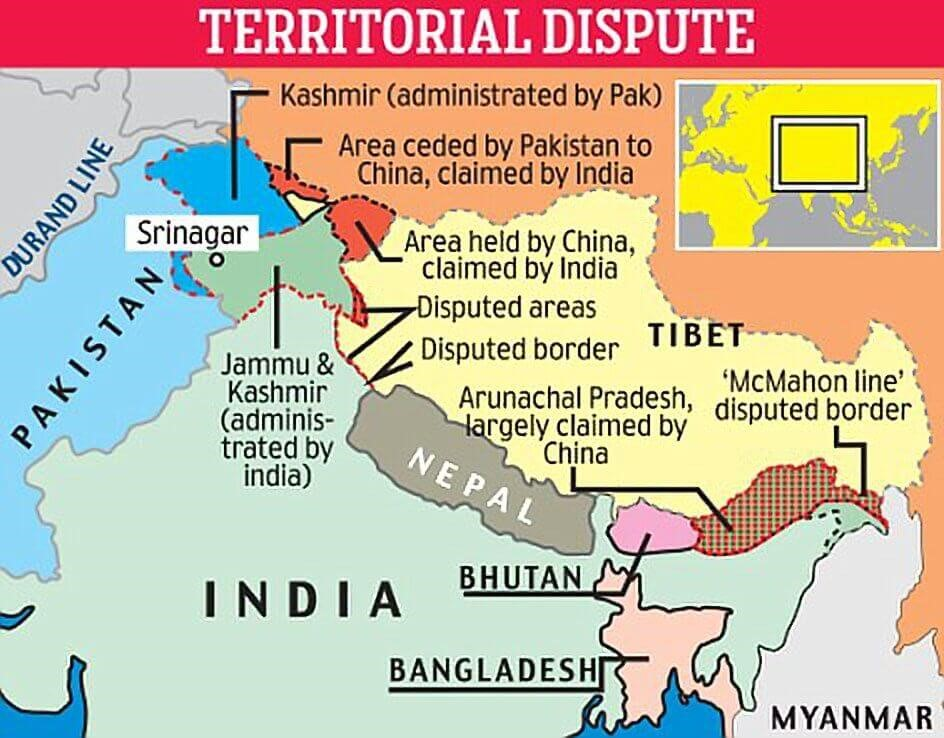
The Structural Problem: An Undelineated LAC
- The LAC is neither a mutually agreed international boundary nor fully clarified on maps. India and China often patrol up to their respective perceptions of the line, producing overlapping claims, patrol confrontations and accusations of transgression.
- The Eastern Sector is particularly sensitive because China claims much of Arunachal Pradesh as South Tibet, while India maintains that the State is an integral and inalienable part of India.
Multi-layered Border Dialogue:
India and China manage the boundary through three complementary channels:
- Special Representatives mechanism: Political negotiations on the boundary question, led by India’s National Security Adviser and China’s senior foreign-policy representative.
- Working Mechanism for Consultation and Coordination (WMCC): Diplomatic and military officials discuss border management and implementation of agreements.
- Military mechanisms: Corps Commander meetings, local commander talks, Border Personnel Meetings and hotlines deal with operational tensions on the ground.
The latest engagement follows the 25th round of Special Representatives’ talks, whose eight-point outcome included additional senior military meeting points and communication channels along the Eastern and Middle Sectors.
Significance of Stable Border Relations with China:
- Border stability and development: Regular military dialogue, hotlines and de-escalation can prevent patrol confrontations from turning into clashes. It would also reduce the cost of sustained high-altitude deployment and free resources for development, including in border villages.
- Economic and health security: China is one of India’s largest trading partners for goods and its largest source of imports. Bilateral merchandise trade reached about $151 billion in 2025-26, although India’s deficit exceeded $100 billion. China also supplied 73.7% of India’s imports of APIs, bulk drugs and drug intermediates in 2024-25. Stable ties can protect critical supply chains while India pursues domestic production and diversified sourcing.
- Clean-energy transition: China accounts for over 80% of several stages of global solar-panel manufacturing and nearly 90% of rare-earth refining. These inputs are crucial for renewable energy, electric vehicles, electronics and defence.
- Water security: China’s hydrological data on transboundary rivers such as the Brahmaputra is vital for flood forecasting, disaster management and hydropower planning.
- Strategic flexibility: Stable relations would reduce the risks posed by a possible China-Pakistan two-front challenge and allow India to devote greater attention to the Indian Ocean and the Indo-Pacific.
- Geopolitical support: China’s position is important for India’s membership of the consensus-based Nuclear Suppliers Group and as a permanent member of the United Nations Security Council (UNSC).
- Reforming Global Governance: India and China can cooperate within the BRICS, SCO, G20 and WTO to seek greater representation for developing countries and reforms in institutions such as the IMF, World Bank and United Nations. Joint action can strengthen the voice of the Global South on climate finance, development funding, technology access, food security and reform of multilateral institutions.
Continuing Challenges:
- Unclarified LAC: Differing perceptions of the undemarcated LAC repeatedly bring rival patrols into confrontation.
- Military build-up: Continued troop deployment and rapid border infrastructure development increase the risk of miscalculation and escalation.
- Trust deficit: The 2020 Galwan clash fundamentally weakened confidence in existing border agreements and China’s commitments.
- Arunachal Pradesh dispute: China’s claim over Arunachal Pradesh, particularly Tawang, remains a major obstacle to boundary settlement.
- Patrolling access: Restrictions and competing claims over traditional patrolling points continue to generate friction in sensitive areas.
- China-Pakistan nexus: Their expanding defence, economic and strategic cooperation intensifies India’s potential two-front security challenge.
- Fragile diplomatic thaw: Summit-level engagement may provide temporary stability without securing disengagement, de-escalation or boundary clarification.
Reports of fresh tensions in Taksing have also been contested by Indian defence authorities, illustrating the need to distinguish verified developments from uncorroborated claims.
Way Forward:
- India should pursue a sequential approach of disengagement, de-escalation and eventual demobilisation, backed by verification.
- Both sides must clarify the LAC in feasible sectors, strengthen hotlines and patrolling protocols, avoid unilateral alteration of the status quo, and faithfully implement the border agreements of 1993, 1996, 2005 and 2013.
- The 1993 and 1996 border agreements need updating for new realities such as drones, surveillance, rapid mobilisation and forward infrastructure.
- India should continue border infrastructure development along with livelihood support in border villages.
- China must ensure timely hydrological data sharing, prior notification of major river projects and emergency communication on transboundary rivers.
The Wacha-Damai meeting represents the geographical expansion of military dialogue and provides an important crisis-management mechanism for the Eastern Sector.
Nevertheless, durable stability requires more than periodic talks: it demands verifiable restraint, clarification of the LAC and sustained political commitment. For India, engagement with China must therefore combine dialogue with deterrence and diplomacy with preparedness.
Source: https://anantamias.com/current-affairs/india-china-hold-military-talks-in-arunachal-pradesh/
Judicial Integrity and Corruption
Why in News ?
Serious allegations against the former Acting Chief Justice of the Rajasthan High Court, Justice Sanjeev Prakash Sharma, have come to light following reports of letters written by Supreme Court of India judge Justice Sandeep Mehta to the Chief Justice of India (CJI), in which he has sought Justice Sharma’s immediate transfer.
UPSC Relevance
- GS Paper II: Structure, organization, and functioning of the Executive and the Judiciary; Issues arising out of systemic opacity, appointment mechanisms (Collegium), and judicial accountability mechanisms.
- Ethics (GS Paper IV): Probity in governance, conflict of interest, institutional integrity, leadership ethics, and public trust.
Judicial Corruption
”Judicial corruption is any acts or omissions that result in the misuse of entrusted power for private gain, which distorts the impartial and fair administration of justice.” (Transparency International’s Global Corruption Report: Corruption and Judicial Systems)
Judicial integrity is the bedrock of rule of law and constitutional democracy. However, recurring allegations of corruption, nepotism, and administrative maladministration in the higher judiciary threaten public trust.
Drivers of Judicial Corruption
- Institutional Opacity in Judicial Appointments and Transfers :Frequent transfers, repatriation and the absence of objective criteria and transparency in judicial appointments and postings leads to patronage, nepotism, and partisanship.
- Discretionary Misuse of Administrative powers : Allegations of improper case-shifting, administrative maladministration, and politicization of the “Master of the Roster” power erode internal checks and balances.
- Long-term reliance on Acting Chief Justices (e.g., 11 months in a High Court) impairs institutional stability and administrative firmness.
- Ineffective Accountability & In-House Mechanisms
- Procedural Bottlenecks: The K. Veeraswami v. Union of India (1991) judgment mandates prior CJI approval for registering an FIR against a higher judiciary judge, creating a catch-22 situation where police cannot gather evidence without an investigation, nor initiate an investigation without pre-existing clinching evidence.
- Redundant Statutes: The Judges (Inquiry) Act, 1968 and Article 124(4)/217(1)(b) impeachment processes are cumbersome and politically vulnerable, rendering formal removal mechanisms virtually defunct.
- Delay in In-House Action: Inaction or delayed response by the Chief Justice of India (CJI) to verifiable internal complaints allows institutional damage to increase, triggering public protests and lawyers’ strikes.
Consequences for Justice delivery (Violates Article 39A)
- Erosion of Public Trust & Judicial Legitimacy : Corruption allegations(bribery) and procedural delays erode the public’s perception of independence, aggravating the existing trust deficit in judicial institutions (as noted in global integrity surveys like Transparency International).
- Transparency International’s landmark report on South Asia highlighted this vulnerability by identifying the judiciary as the second-most corrupt public institution in the region, including India, driven by widespread demands for bribes and procedural delays.
- Compromised Rule of Law & Inequality: Bribes and influence favor wealthy litigants over marginalized individuals, violating the fundamental principle of equal protection under the law.
- Exacerbated Case Pendency: Corrupt practices—such as deliberate procedural delays (“speed money”) and arbitrary bench shifting—prolong trial times and inflate backlogs.
- Denial of Access to Justice : High litigation costs driven by administrative corruption and middlemen create financial barriers, effectively pricing vulnerable populations out of the court system.
- Violation of Human Rights: Arbitrary bail denials, prolonged undertrial detentions, and compromised judgments undermine fundamental freedoms and civil liberties.
Constitutional provisions and Judicial Case-Laws
- Article 217(1): Appointment and conditions of the office of a Judge of a High Court “Every Judge of a High Court shall be appointed by the President by warrant under his hand and seal after consultation with the Chief Justice of India, the Governor of the State, and, in the case of appointment of a Judge other than the Chief Justice, the Chief Justice of the High Court…”
- Article 223: Appointment of acting Chief Justice “When the office of Chief Justice of a High Court is vacant or when any such Chief Justice is, by reason of absence or otherwise, unable to perform the duties of his office, the duties of the office shall be performed by such one of the other Judges of the Court as the President may appoint for the purpose.”
- Article 222(1): Transfer of a Judge from one High Court to another (Relevant when a Chief Justice is transferred from another High Court) “The President may, after consultation with the Chief Justice of India, transfer a Judge from one High Court to any other High Court.”
- Article 124(4) & Article 217(1)(b): Procedure for the removal of Supreme Court and High Court judges on grounds of “proved misbehaviour or incapacity.”
- The Judicial Standards and Accountability Bill (2010/2012): Lapsed legislation that proposed statutory mechanisms to investigate complaints against judges and lay down enforceable judicial standards.
- K. Veeraswami v. Union of India (1991): Established immunity from routine police investigation without prior permission of the CJI to safeguard judicial independence, but created an accountability hurdle.
- CJI Precedents on Discretionary Authority: Historical precedents (e.g., CJI Sabyasachi Mukharji advising Justice V. Ramaswami to take leave while his removal procedure was ongoing ; CJI M.N. Venkatachaliah withholding judicial work allocations even after Justice Ramaswami’s removal failed ) illustrate that the CJI possesses inherent administrative power to divest erring judges of judicial work even without formal impeachment.
- When partly burnt currency notes were reportedly found in the outhouse of Justice Yashwant Varma at his Delhi residence, then CJI Sanjiv Khanna, quickly transferred him to the Allahabad High Court, where he was not allocated any judicial work, practically.
- In the reported decision in XXX vs Union of India (2025), the Supreme Court emphasised the responsibility of the CJI in matters relating to judicial integrity and allegations of corrupt practices.
- Subhash Sharma v. Union of India (1991): Emphasized that judicial independence is a basic feature of the Constitution and requires an objective, merit-based selection process.
Way Forward / Policy Recommendations
- Statutory Framework for Complaints: Reintroduce a comprehensive Judicial Standards and Accountability Bill to establish a statutory Judicial Oversight Committee to investigate complaints transparently without compromising judicial independence.
- Institutionalization of “Master of the Roster”: Draft objective, computerized, and transparent rules for case allocation to reduce arbitrary discretion by Chief Justices.
- Reforming the Collegium: Establish clear, published criteria for appointments, transfers, and repatriations, supported by a dedicated secretariat to conduct background and integrity checks.
- Strengthening In-House Mechanisms: Mandate time-bound action on internal complaints submitted by sitting judges or oversight bodies to preserve public faith.
- Bangalore principles (2002) : The Bangalore Principles of Judicial Conduct define global ethical standards for judges based on six core values:

- International Best Practices & Comparison
- United Kingdom: Uses an independent Judicial Appointments Commission (JAC) to ensure transparent, merit-based selection separate from political or judicial monopolies.
- Canada: Employs an application-based open process with Judicial Advisory Committees to vet candidate merit and integrity before appointment.
Ultimately, long-term legitimacy depends on answering a fundamental constitutional question: Who will judge the judges?
Restoring probity in the higher judiciary requires balancing judicial independence with institutional oversight. Swift internal administrative measures by the CJI—such as divesting erring judges of judicial work—are crucial interim steps.
Mains Practice Question :
“While judicial independence is a basic feature of the Indian Constitution, the lack of robust institutional mechanisms for internal accountability risks transforming judicial autonomy into opacity.” In light of recent concerns regarding administrative discretion and appointment processes in higher courts, critically analyze the challenges in enforcing judicial probity.
Prelims Practice MCQ :
Q. Consider the following statements regarding the Chief Justice of a High Court:
- The Chief Justice is appointed by the President after consulting the CJI and the Governor of the concerned state.
- An Acting Chief Justice can only be appointed from among the sitting judges of the same High Court.
Which of the statements given above is/are correct?
(a) 1 only
(b) 2 only
(c) Both 1 and 2
(d) Neither 1 nor 2
Answer: (a) 1 only
- Statement 1 is correct: Under Article 217, the President appoints the Chief Justice of a High Court after consulting the CJI and the State Governor.
- Statement 2 is incorrect: Under Article 223, the President can appoint any High Court judge as Acting Chief Justice; there is no constitutional bar against appointing a judge transferred from another High Court.
Source: https://anantamias.com/current-affairs/judicial-integrity-and-corruption/
Harnessing BRICS ‘POWER’ to empower the world
Why in News?
The 18th BRICS Summit will be held in New Delhi on September 12-13, 2026, under India’s presidency. China has expressed support for India and called for using the collective “POWER” of the expanded or Greater BRICS to promote peace, development and a more representative global order.
India’s presidency is guided by the theme “Building for Resilience, Innovation, Cooperation and Sustainability”.
| UPSC Relevance: GS-2 International Relations: International Organisations Mains: BRICS as a platform for South-South Cooperation, Challenges within BRICS. |
About BRICS:
- BRICS is an informal intergovernmental grouping of major emerging markets and developing countries. It seeks to strengthen economic cooperation, reform global governance and enhance the representation of the Global South.
- Members: BRICS presently has 11 members: Brazil, Russia, India, China, South Africa, Egypt, Ethiopia, Iran, the UAE, Saudi Arabia and Indonesia.
- BRICS is neither a treaty-based organisation nor a formal economic or military alliance. It has no permanent secretariat, charter or common market. Cooperation proceeds through consensus, an annually rotating chairship, leaders’ summits, ministerial meetings and specialised working groups.
- BRICS has no free-trade agreement, customs union or common economic policy, and much of intra-BRICS trade is centred on China.
- The New Development Bank (NDB) is a multilateral development bank established by BRICS. It aims to mobilise resources for infrastructure and sustainable development projects in emerging markets and developing countries.
Understanding BRICS ‘POWER’:
1. P- Principle:
- BRICS should uphold the UN Charter and principles such as sovereign equality, non-interference and peaceful settlement of disputes.
- Amid geopolitical conflicts and growing multipolarity, it can oppose unilateral coercion and prevent international relations from becoming purely power-driven.
- However, the credibility of these principles depends on their consistent application by members, including respect for territorial integrity and international law.
2. O- Openness:
- Against protectionism, tariff barriers and supply-chain fragmentation, BRICS should support an open global economy and the WTO-centred multilateral trading system.
- Cooperation can be expanded in energy, critical minerals, infrastructure and resilient industrial supply chains.
- For India, openness must be accompanied by fair market access, WTO-compatible trade and safeguards against excessive import dependence.
3. W- Win-Win Cooperation:
Development should remain central to the BRICS agenda through:
- Accelerated implementation of the Sustainable Development Goals
- Trade and investment facilitation
- Resilient agriculture and food systems
- Coordination of macroeconomic policies; and
- Local-currency trade and cross-border payment mechanisms.
Local-currency arrangements should reduce transaction costs and vulnerability to external financial shocks rather than be treated simply as an anti-dollar project.
4. E- Engine of Global Growth:
- Expanded BRICS represents nearly half (49.5%) of the world’s population, around 30% of global output and roughly one-fifth of world trade. Its major markets, manufacturers and natural resources give it the potential to become an important engine of global growth.
- Future cooperation should focus on AI, digital public infrastructure, health, agriculture, smart manufacturing and new industrialisation.
- The New Development Bank (NDB) has approved about $42.9 billion across 139 projects, including clean energy, transport, water and digital infrastructure.
5. R- Responsibility:
- BRICS must assume greater responsibility for global peace, climate action, food and energy security, and reform of the UN, IMF, World Bank and WTO. It can amplify the Global South’s demand for greater representation, development finance, technology access and climate justice.
- India and China, as successive BRICS chairs in 2026 and 2027, will have a particular responsibility to maintain policy continuity and institutional momentum.
Key Challenges within BRICS:
- India-China Geopolitical Rivalry: Ongoing border disputes and strategic competition between India and China create friction, often forcing other members to navigate these tensions. The bilateral rivalry limits cohesive action.
- China-Centric Influence: China’s GDP is significantly larger than all other BRICS members combined, leading to fears of economic dependency and domination, particularly among smaller or newer members.
- Divergent Geopolitical Interests: Members have differing relations with Western powers. Russia and China often adopt an anti-Western stance, while India, Brazil, and South Africa maintain more balanced or cooperative relations with the West, leading to inconsistent stances on global security and governance.
- Internal Differences: Enlargement has increased representativeness but also widened differences in political systems, regional priorities and development levels. Consensus among 11 members and ten partners is harder to achieve. E.g., Lack of a unified voice on major global crises, the Ukraine conflict and instability in West Asia
- Institutional and implementation deficit: BRICS declarations cover numerous sectors, but the absence of a permanent secretariat, common budget and enforcement mechanism weakens delivery.
- Limited financial alternatives: NDB remains much smaller than Bretton Woods institutions, while the CRA’s IMF linkage limits its autonomy. Sanctions and credit-rating considerations also constrain lending.
Importance of India-China Cooperation:
- Improved India-China relations can facilitate consensus within BRICS, expand connectivity and strengthen cooperation on trade, technology and global governance. The resumption of direct flights and border trade indicates gradual normalisation.
The “POWER” framework captures BRICS’ potential to defend international principles, preserve economic openness, promote shared development, drive growth and exercise global responsibility. However, its success will depend on internal cohesion, stronger institutions and concrete delivery.
Practice Mains Question:
Q. The expansion of BRICS has enhanced its global representativeness but also complicated internal cohesion and consensus-building. Discuss how India can use its 2026 BRICS Chairship to strengthen the grouping’s functional effectiveness.
Source: https://anantamias.com/current-affairs/harnessing-brics-power-to-empower-the-world/
EOS-05 : India’s First Eye That Does Not Blink
Why in news ?
India launched EOS-05 (GISAT-1A) aboard GSLV-F17 from Sriharikota on 4 September 2026. It is the successor to EOS-03/GISAT-1, which was lost in the GSLV-F10 failure in August 2021.
UPSC Relevance
Prelims
GS 3
Science and Technology- Developments and their Applications and Effects in Everyday Life.
Awareness in the fields of IT, Space, Computers, Robotics, Nano-technology, Bio-technology and issues relating to Intellectual Property Rights.
Mission Overview
- ISRO successfully launched the Earth Observation Satellite EOS-05 aboard the GSLV-F17 (19th flight of GSLV).
- Payload Capacity: At 2,367 kg, EOS-05 is the heaviest payload launched by the 3-stage, 51.7-meter GSLV Mk II rocket.
- Significance: This launch restores operational momentum after previous mission setbacks (including GSLV-F10/EOS-03 in 2021 and recent PSLV failures).
- EOS-05 is India’s 1st dedicated land-imaging satellite operating from geosynchronous altitude. India already had weather satellites in geostationary orbit and high-resolution land-imaging satellites such as Cartosat and Resourcesat in low Earth orbits.
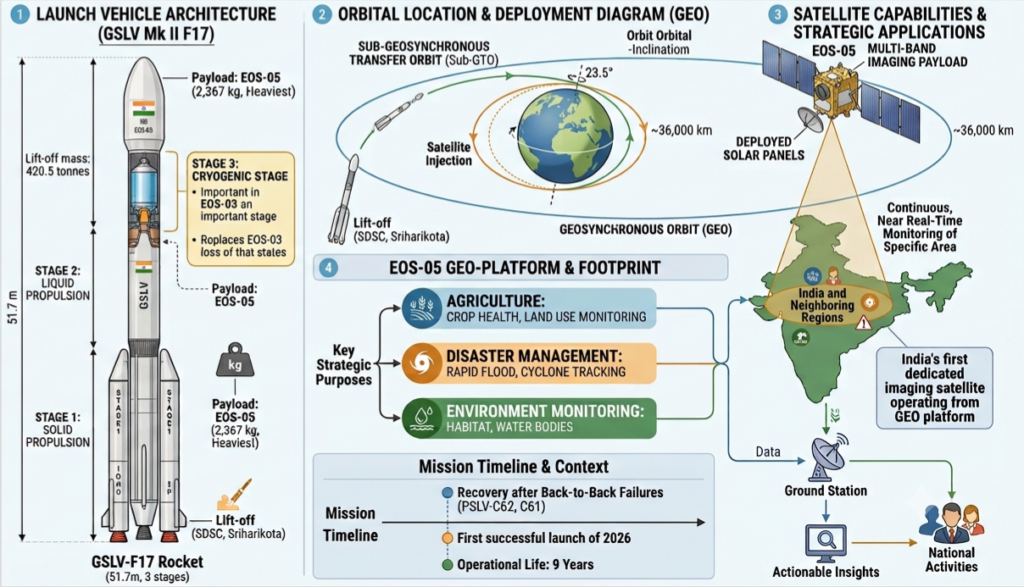
Orbit and Positioning Characteristics
- Geosynchronous Orbit (GEO): EOS-05 is India’s first dedicated imaging satellite designed for continuous observation from a geosynchronous altitude (~36,000 km).
- Orbit Injected: Placed initially into a Sub-Geosynchronous Transfer Orbit (Sub-GTO); on-board propulsion systems will raise it to its final operational geostationary/geosynchronous platform.
- Thus, launch success ≠ mission commissioning.
- Geo vs. LEO/Sun-Synchronous Remote Sensing:
- Low Earth Orbit (LEO) Imaging: Provides finer resolution detail, but constantly moves relative to Earth, taking days to return to the same location.
- Geosynchronous Imaging: Fixed relative to Earth’s rotation, enabling high temporal resolution (frequent revisit capability) over broad regions at the cost of ultra-fine spatial resolution.
A crucial Prelims distinction : types of orbits
- Geosynchronous: orbital period equals one sidereal day (23 hours, 56 minutes and 4 seconds) ; the orbit may be inclined or elliptical.
- Geostationary: a special GSO that is circular, equatorial and has near-zero inclination; therefore the satellite appears fixed over one longitude.
- Sun-synchronous: usually a near-polar low-Earth orbit whose plane precesses at roughly the rate of Earth’s revolution around the Sun, ensuring observations at similar local solar times.
- Polar: high inclination allowing successive passes over or near both poles.
Trap: Sun-synchronous and polar are not synonymous.
Technical Specifications
- Sensor Capabilities: EOS-05 carries a 700-mm Ritchey–Chrétien telescope and multispectral/hyperspectral sensors covering VNIR (visible and near-infrared) and SWIR (short-wave infrared) moving beyond simply producing photographs towards spectral intelligence about materials and their condition to distinguish land cover, vegetation, and thermal variations.
- Lifespan & Power: an operational life of 7 to 9 years and equipped with deployable solar panels.
- Launch Vehicle Architecture: GSLV uses a 3-stage structure (Solid primary stage, Liquid Vikas-based second stage, and an Indigenous Cryogenic Upper Stage – CUS).
The central trade-off: spatial vs temporal resolution
| LEO imagers | EOS-05 in GEO |
| ~500–800 km altitude | ~35,786 km |
| Much higher spatial resolution | Coarser: ~42 m to 318 m |
| Revisit generally measured in days | Selected areas potentially every ~5 min |
| Different ground tracks | Persistent view of the same broad region |
| What exactly is there? | What is changing, and when? |
- EOS-05 therefore complements rather than replaces LEO satellites.
- A mature Indian remote-sensing architecture can be understood as:
- Cartosat/Resourcesat: high spatial detail — What is it?
- RISAT/NISAR: radar, day-night and cloud-penetrating — What is happening despite clouds?
- EOS-05: persistent optical observation — When did the change occur?
- This is essentially a “tip-and-cue” architecture: GEO detects an unusual change, while higher-resolution LEO satellites investigate it.
Applications & Strategic Importance
- Disaster Risk Reduction (DRR): Real-time, continuous tracking of rapid natural hazard dynamics such as flash floods, glacial lake outburst floods (GLOFs), forest fires, and cyclone tracking.
- Agricultural & Environmental Governance: Continuous monitoring of crop growth cycles, stubble burning detection (identifying timing shifts), forest dynamics, and water resource management.
- Stubble burning — governance lesson – Polar satellites may miss fires that occur outside their predictable overpass windows. A GEO satellite can repeatedly observe north India and reduce this temporal blind spot.
- Hyperspectral and SWIR data can support crop classification, acreage estimation, moisture-stress detection and yield forecasting, complementing programmes such as PMFBY, FASAL and CHAMAN.
- Strategic & Security Applications: Near real-time “eye in the sky” surveillance capability along national borders and maritime zones to enhance national security infrastructure.
- Policy Data Integration: Acts as a persistent data source for evidence-based decision-making in climate adaptation, land-use planning, and regional development.
Challenges & Policy Imperatives
- Data Processing Pipeline: Translating massive feeds of raw satellite imagery into actionable, real-time insights requires robust ground station analytics and open-access data distribution frameworks.
- Launch Vehicle Reliability: Ensuring long-term consistency in the GSLV cryogenic stage and standardizing manufacturing protocols across PSLV/GSLV variants to maintain operational cadence.
- The recent GSLV success does not erase problems in the PSLV. The PSLV is India’s commercial workhorse, and repeated failures have implications for commercial credibility and the emerging private launch ecosystem.
- Coarse spatial resolution: ~42 m at best makes it unsuitable for detailed object identification.
- Atmospheric interference: At 36,000 km, the signal travels through a long atmospheric path, complicating atmospheric correction and reducing signal quality.
- Poorer high-latitude geometry: Himalayan regions are viewed at more oblique angles from an equatorial geostationary position.
- Clouds: Optical sensors cannot see through clouds. This is particularly significant because monsoon floods, cyclones and kharif agriculture coincide with heavy cloud cover.
- No reflective-band night imaging: Unlike radar, optical multispectral/hyperspectral observation is fundamentally constrained by illumination.
Hence NISAR and other radar capabilities remain crucial. India’s broader weakness is not the lack of a single satellite but the need for a balanced optical-radar constellation.
The Himalayan disaster lesson: detection is not warning
- The August 2026 Bhote Koshi disaster in Nepal provides a critical test case.
- An ice-and-rock avalanche from the Langtang Lirung region temporarily dammed a stream; the dam failed, producing a destructive debris-laden surge. Early descriptions called it a Glacial Lake Outburst Flood (GLOF), but this distinction matters: a strict GLOF requires drainage of a pre-existing glacial lake. Here, the immediate mechanism was an ice-and-rock avalanche followed by failure of a landslide dam.
- Nepal had satellite monitoring, glacial-lake inventories and early-warning capabilities. Yet the hazard originated from an uncatalogued unstable rock face, rather than a monitored glacial lake.
- EOS-05 could potentially help detect progressive slope movement, glacier change or lake expansion, but it could not necessarily prevent an instantaneous collapse. With the flood reportedly reaching downstream locations within minutes, there was insufficient warning time for satellite observation alone to save lives.
- Therefore, Satellites reduce the detection problem; they do not automatically solve the warning-to-action problem.
- Where lead time approaches zero, hazard zonation, land-use regulation and safer infrastructure siting become more important than faster imagery.
- This is especially relevant to the Himalayas, where India must also address transboundary data-sharing with Nepal, China and other downstream states.
The institutional layer
- The value of EOS-05 depends on institutions converting imagery into action. The National Geospatial Policy 2022 and Geospatial Data Guidelines have liberalised access to geospatial information.
- Platforms such as Bhuvan, NRSC’s data systems and the National Database for Emergency Management (NDEM) are important for dissemination and disaster response.
- The broader ecosystem must include government agencies, private firms, universities and analysts.
EOS-05 represents a shift from periodic observation to persistent observation. Its greatest contribution is not seeing smaller objects, but seeing change unfold in time.
Technology gives us sight; institutions decide whether we see.
EOS-05 can provide the eye. India still needs the analysts, data-sharing arrangements, hazard maps, regulatory institutions and last-mile warning systems that turn that eye into public safety.
Practice Question
In light of recent operational successes and launch vehicle setbacks, analyze how EOS-05 mission enhances India’s disaster management and strategic security, and discuss the critical reliability challenges facing ISRO’s launch vehicles. (15 marks)
UPSC Prelims Practice Question
Q. With reference to India’s space missions and Earth Observation Satellites (EOS), consider the following statements:
1. EOS-05 is India’s first dedicated Earth imaging satellite placed in a Geosynchronous Orbit.
2. Satellites placed in Low Earth Orbit (LEO) offer continuous, 24/7 observation of a fixed geographical location, unlike Geosynchronous imaging satellites.
3. The GSLV Mk II launch vehicle utilizes a three-stage propulsion system consisting of solid core with liquid strap-ons, a liquid second stage, and an indigenous cryogenic upper stage.
Which of the statements given above is/are correct?
(a) 1 and 2 only
(b) 1 and 3 only
(c) 2 and 3 only
(d) 1, 2, and 3
Answer: (b) 1 and 3 only
Source: https://anantamias.com/current-affairs/eos-05-indias-first-eye-that-does-not-blink/
The Political cost of Unconditional Cash Transfer (UCT) schemes
Context:
Since 2020, Unconditional Cash Transfers (UCTs) have become an important component of State welfare policy and electoral strategy, particularly for women. Examples include Tamil Nadu’s Kalaignar Magalir Urimai Thittam, West Bengal’s Lakshmir Bhandar and Karnataka’s Gruha Lakshmi.
However, subsequent elections have shown that UCTs do not guarantee electoral success and may impose their own political costs.
| UPSC Relevance: GS-2 Polity and Governance: Government Schemes; Social Justice: Vulnerable Sections; Welfare Mechanism Mains: Unconditional Cash Transfer: Merits and Challenges |
What are Unconditional Cash Transfer (UCT) schemes?
- UCTs provide money without requiring beneficiaries to undertake specified actions. They differ from:
- Conditional cash transfers, linked to school attendance, receiving vaccinations, or skill acquisition
- In-kind transfers, such as foodgrains, meals or medicines.
- UCT schemes remain targeted through eligibility conditions relating to income, age, landholding or household assets.
Why are UCTs Important?
- Immediate relief: They protect vulnerable households against poverty, inflation, income shocks and indebtedness.
- Women’s empowerment: Money deposited in women’s accounts can strengthen financial autonomy and household decision-making.
- Recognition of unpaid work: Women’s transfers partially advance SDG 5.4, which seeks recognition of unpaid domestic and care work.
- Freedom of choice: Unlike in-kind benefits, cash allows families to prioritise food, healthcare, education or other needs.
- Efficient delivery: DBT can reduce bureaucratic discretion and leakage by transferring money directly into verified accounts.
- Local multiplier: Additional consumption by poorer households can stimulate local demand and economic activity.
Issues associated with UCT Schemes:
- Fiscal and Developmental Concerns: The Economic Survey 2025-26 estimates State spending on UCT programmes, particularly for women, at approximately ₹1.7 lakh crore. Such transfers range from 0.19% to 1.25% of GSDP and may constitute as much as 8.26% of a State’s expenditure.
- Crowding out Productive Expenditure: Open-ended transfers may displace spending on infrastructure, health, education, skilling and employment. For perspective, Karnataka allocated ₹28,608 crore to Gruha Lakshmi in 2024-25, against the Union’s ₹ 12,467 crore budgetary allocation for PM-POSHAN.
- Short-term relief, not structural transformation: UCTs support consumption and short-term stability but cannot independently address unemployment, low female labour-force participation, poor healthcare, weak education or inadequate childcare. They cannot produce sustained exits from poverty without complementary public services.
- Fiscal rigidity and competitive welfarism: Once beneficiaries treat payments as entitlements, withdrawal becomes politically difficult, encouraging parties to compete through higher transfers and burdening future governments. It may encourage competitive bidding among political parties.
- Political Cost of Targeting: Since reliable income data are unavailable for much of the informal sector, governments use proxies such as land, ration cards, electricity consumption and household assets. This may lead to inclusion and exclusion errors, or even perceived errors. The resulting sense of relative deprivation can be politically damaging. Beneficiaries may quickly treat payments as entitlements, while excluded citizens may develop stronger resentment.
- Questionable electoral ethics: Launching or enhancing schemes immediately before elections can create an incumbency advantage and enable political self-branding through taxpayer-funded benefits. However, a legislatively approved welfare programme is not automatically electoral bribery; intent, public purpose, transparency and compliance with election law remain decisive.
- Rhetoric-delivery gap: Electoral announcements made without adequate financing may result in delayed instalments, reduced amounts or later tightening of eligibility, eroding citizens’ trust.
Judicial and Electoral Position:
- S. Subramaniam Balaji v. Government of Tamil Nadu (2013):
- The Supreme Court held that promises in party manifestos do not constitute “corrupt practice” under Section 123 of the Representation of the People Act, 1951, as the existing provision governs candidates and their agents, not political parties as such. It also held that courts have limited grounds to interfere where a scheme serves a public purpose, advances Directive Principles and is funded through an Appropriation Act.
- The Court observed that freebies can influence voters and disturb free and fair elections; it directed the Election Commission to frame manifesto guidelines and recommended legislative intervention.
- Ashwini Kumar Upadhyay v. Union of India (2022): The Supreme Court recognised the difficulty of distinguishing legitimate welfare from fiscally irresponsible freebies. Since the petitions sought reconsideration of Subramaniam Balaji, the matter was directed to be placed before a three-judge Bench.
- Election Commission Guidelines: The Model Code of Conduct requires manifestos to explain the rationale and broad financing mechanism for promises and avoid commitments that unduly influence voters. Manifestos cannot be released during the statutory 48-hour silence period preceding the close of polling.
Way Forward:
- Require manifestos to disclose scheme costs, funding sources, debt implications and opportunity costs.
- Introduce periodic reviews, outcome evaluation and sunset clauses according to fiscal capacity and outcomes.
- Strengthen CAG audits and legislative scrutiny of large welfare commitments.
- Use updated social registries, automatic enrolment and accessible grievance redressal.
- Consider broader categorical coverage where targeting errors are exceptionally high.
- Link cash with healthcare, childcare, education, skilling and employment, i.e., the “cash-plus-capabilities” approach.
- Empower voters through fiscal literacy and transparent publication of State finances.
UCTs can enhance women’s agency and consumption security, but poorly designed targeting creates fiscal as well as political costs. Sustainable welfare requires a balance between adequacy, inclusion, affordability and developmental impact.
Cash transfers should serve as a social-protection floor but not replace investments that enable citizens to permanently escape poverty.
Kaveripoompattinam- T.N. launches third phase of Underwater Archaeological Survey
Why in News?
The Tamil Nadu State Department of Archaeology has commenced the third phase of underwater archaeological exploration off Poompuhar in Mayiladuthurai district.
| UPSC Relevance: GS-1 History and Culture: Ancient History Prelims: Key facts related to Kaveripoompattinam |
Underwater archaeological exploration off Poompuhar:
- Objective: The nearly 20-day exercise seeks to locate submerged remains of Kaveripoompattinam, understand its maritime trade connections and reconstruct changes in the ancient coastline.
- The exploration covers areas nearly two kilometres offshore, using side-scan sonar and echo-sounders to identify seabed anomalies, followed by examination and excavation by trained divers.
Key facts related to Kaveripoompattinam:
- Location: At the mouth of the River Kaveri on the Coromandel Coast, facing the Bay of Bengal.
- Other names: Puhar, Poompuhar, Kaveripattinam and Kaveripoompattinam.
- Political importance: It was a flourishing port and an early capital of the Early Cholas during the Sangam period.
- Strategic advantage: Its location connected the fertile and craft-producing Kaveri hinterland with the wider Indian Ocean trading network.
The tentative chronology of some archaeological structures (remains) of the port extends from around the second century BCE to the fourth century CE, but their precise date and function require further investigation.
Literary Evidence:
Kaveripoompattinam occupies a prominent place in Tamil literary tradition:
- Pattinappalai, a Sangam poem, describes its harbour, customs administration, warehouses, bustling markets and movement of overseas merchandise.
- Silappadikaram begins in Puhar and portrays it as an affluent, cosmopolitan city inhabited by merchants, artisans, sailors and people from distant lands. The city was divided into two distinct districts:
- Maruvurpakkam: The busy harbour area home to foreign traders, merchants, craftsmen, and marketplaces.
- Pattinapakkam: The inland residential area housing the king, nobles, palace officials, and wealthy citizens.
- Manimekalai narrates the city’s destruction by the sea, providing an important literary memory of coastal submergence.
- The port is also associated with the Periplus of the Erythraean Sea, indicating its place in early Indian Ocean commercial geography.
Archaeological Evidence:
Onshore excavations conducted since the 1960s have revealed:
- Brick structures interpreted as wharves or port installations
- Terracotta ring wells and drainage structures
- Buddhist remains, suggesting a religiously diverse mercantile society
- Rouletted ware, amphora fragments, foreign pottery and coins, pointing to long-distance trade
- Local ceramics, beads and other artefacts reflecting an extensive urban settlement.
Earlier marine investigations identified submerged brick and stone structures, pottery, ring-well remains, a shipwreck and a large U-shaped stone formation.
Significance of the Present Exploration:
- Mapping the ancient city: It can determine how far Kaveripoompattinam extended beyond the present shoreline.
- Reconstructing maritime trade: Pottery, anchors, cargo remains, or shipwrecks may reveal connections with Sri Lanka, the Mediterranean world and Southeast Asia.
- Corroborating literature: Material evidence can test descriptions found in Pattinappalai, Silappadikaram and Manimekalai.
- Understanding ancient urbanisation: Port installations, warehouses and habitation remains can illuminate Chola administration, production and merchant networks.
- Studying coastal change: Sediments and submerged structures can help reconstruct shifts in the Kaveri’s course, shoreline erosion, sea-level change and extreme marine events.
Kaveripoompattinam demonstrates that Sangam-age Tamilakam was not an isolated agrarian region but an active participant in the early Indian Ocean economy. However, credible conclusions must rest on systematic excavation, scientific dating and careful separation of archaeological evidence from legend.
Bhutan leads Southeast Asia region in eliminating Rabies
Why in News?
The World Health Organisation (WHO) has validated Bhutan as the first country in its South-East Asia Region to eliminate dog-transmitted human rabies as a public health problem. Bhutan has recorded no human deaths from dog-mediated rabies since 2023.
| UPSC Relevance: GS-2 Social Justice: Health; GS-3 Science and Technology: One Health Approach Prelims: Rabies; WHO Rabies Target; India’s Response |
About Rabies:
- Rabies is a vaccine-preventable zoonotic disease caused by an RNA virus. It produces progressive and fatal inflammation of the brain and spinal cord.
- Transmission: Primarily through the saliva of an infected mammal, usually through a bite or scratch. Dogs cause up to 99% of human cases globally.
- Reservoirs: Dogs are the principal source in Asia and Africa, while cats, monkeys, bats and wild carnivores may also transmit it.
- Symptoms: Fever, pain or tingling at the bite site, hallucinations, hydrophobia, paralysis and coma.
- Fatality: Once clinical symptoms appear, rabies is virtually 100% fatal. However, timely post-exposure prophylaxis makes it almost entirely preventable.
- Vaccines: RABIVAX-S, VaxiRab N and VERORAB to immunise people both before and after potential exposures.
Rabies deaths are preventable. A two-pronged strategy is advocated globally: vaccinating dogs to curb the disease at source, and using post-exposure prophylaxis (PEP) after a bite.
Post-exposure prophylaxis consists of:
- Immediately washing and flushing the wound with soap and running water for at least 15 minutes
- receiving the complete course of anti-rabies vaccine; and
- administering rabies immunoglobulin in severe or Category III exposures.
WHO Rabies Target- Zero by 30:
- WHO aims to achieve zero human deaths from dog-mediated rabies worldwide by 2030. The target focuses on eliminating human deaths caused by dog-transmitted rabies, not eradicating the rabies virus from all animals.
- Its principal pillars are:
- mass dog vaccination, preferably maintaining at least 70% coverage
- universal and affordable access to post-exposure prophylaxis
- effective dog-population management
- integrated human-animal disease surveillance
- public awareness and prompt reporting of bites
- intersectoral cooperation through the One Health approach.
India has aligned its National Rabies Control Programme and National Action Plan for Dog-Mediated Rabies Elimination (NAPRE) with this 2030 target.
| Elimination does not mean that the rabies virus has disappeared from every animal. It means that dog-mediated human rabies deaths have remained absent for at least two years and the country possesses adequate systems to prevent their re-emergence. |
India’s Rabies Burden:
- Rabies remains endemic across most of India. Around 96% of rabies-associated mortality and morbidity in the country is linked to dog bites.
- Official parliamentary data recorded around 37.17 lakh dog-bite cases and 54 suspected human rabies deaths in 2024.
- Children are particularly vulnerable because they are more likely to play with animals, suffer bites on the head or upper body and fail to report minor scratches.
India’s Response:
- National Rabies Control Programme: Implemented by the Ministry of Health and Family Welfare, it seeks to:
- ensure availability of anti-rabies vaccines and immunoglobulins
- improve management of animal-bite cases
- train healthcare personnel
- strengthen laboratory diagnosis and surveillance; and
- progressively achieve zero human rabies deaths by 2030.
- National Action Plan for Dog-Mediated Rabies Elimination: The NAPRE, jointly launched in 2021 by the Health Ministry and the Department of Animal Husbandry and Dairying, provides a One Health framework for eliminating dog-mediated human rabies by 2030.
- Animal Birth Control Rules, 2023: These provide for humane capture, sterilisation, anti-rabies vaccination and release of community dogs. Urban local bodies are primarily responsible for implementing the Animal Birth Control programme.
Bhutan demonstrates that rabies elimination is achievable even in geographically difficult settings when mass dog vaccination, accessible human treatment, surveillance and community participation operate within a One Health framework.
For India, the principal challenge is not the absence of technology, but closing gaps in municipal implementation, vaccine access, surveillance and interdepartmental coordination.
Practice MCQ:
Q. Consider the following statements with reference to Rabies:
1. Rabies is a zoonotic disease that is caused by an RNA rabies virus.
2. The disease infects the central nervous system of humans and other mammals.
3. Hydrophobia is a prominent symptom associated with severe progression of the disease.
How many of the above statements are correct?
(a) Only one
(b) Only two
(c) All three
(d) None
Answer: (c)
Mains Practice Question: Case Study:
Q. You are the District Magistrate of a district where stray dog attacks have been increasing. Recently, a child died due to a stray dog bite, leading to public outrage. Animal rights activists are opposing culling and insist on sterilisation and vaccination drives as per law. Citizens are demanding immediate action to ensure safety.
What will be your course of action in this situation? Justify your decision considering ethical principles, legal provisions, and public interest.
Source: https://anantamias.com/current-affairs/bhutan-leads-southeast-asia-region-in-eliminating-rabies/
Roadmap ready to make India drug-free by 2029
Why in News?
The Union government has prepared a three-year road map (2026-2029) to make India drug-free by 2029, asserting that a drug-free youth population.
The objective is to dismantle the entire narcotics ecosystem: production, trafficking, financing and online distribution, while strengthening prevention, treatment, rehabilitation and livelihood support.
| UPSC Relevance: GS-3 Internal Security; GS-2 Social Justice; Health Mains: Drug Menace in India; Narco-terrorism |
Vision Document on Narcotics Control:
The Vision Document on Narcotics Control, 2026-2029, released in 2026, follows a whole-of-government and whole-of-society approach. It rests on four pillars:
- Enforcement, intelligence and operations: Strengthen intelligence-led investigations and coordinated operations to dismantle trafficking networks. Follow financial trails to identify organisers and financiers, while tackling cross-border and online trafficking.
- Control of precursor chemicals and synthetic drugs: Improve monitoring of chemicals that have legitimate industrial uses but can be diverted into illicit drug manufacturing. Detect clandestine laboratories and strengthen responses to emerging synthetic-drug threats.
- Demand reduction and harm reduction: Combine preventive education with accessible treatment, rehabilitation and social reintegration. Demand reduction seeks to prevent initiation and reduce problematic use; harm reduction addresses adverse health consequences associated with drug use.
- Capacity-building, coordination and monitoring: Strengthen personnel, training, technology and inter-agency information-sharing. Assign time-bound responsibilities and monitor implementation across Central, State and district institutions.
Magnitude of the Challenge:
- According to the government’s 2019 national survey, approximately 2.26 crore Indians used opioids, while around 77 lakh required help for opioid-related problems.
- About 3.1 crore people used cannabis products, while harmful or dependent alcohol use affected over 5.7 crore people.
These remain important national baseline estimates, though an updated nationwide survey is needed.
Drug abuse is simultaneously:
- a public-health issue, involving dependence, overdose, mental illness and transmission of HIV and hepatitis through injecting drug use
- a social issue, affecting families, education, employment and community safety
- an organised-crime problem, involving trafficking, money laundering and criminal networks
- a national-security challenge, where drug proceeds may finance insurgency, terrorism and other illicit activities.
Why is India Vulnerable?
- Strategic location: India lies between two major illicit drug-producing regions:
- Golden Crescent: Afghanistan, Pakistan and Iran, historically associated with opium and heroin.
- Golden Triangle: Myanmar, Laos and Thailand, increasingly associated with methamphetamine and other synthetic drugs.
- India’s long land borders, northeastern corridors, international airports, ports and extensive coastline create multiple trafficking routes.
- Changing drug markets: Synthetic drugs, pharmaceutical opioids, precursor-chemical diversion, darknet marketplaces, cryptocurrency payments, courier services and small maritime consignments have complicated conventional enforcement.
- Socio-psychological factors: Peer pressure, unemployment, academic stress, family conflict, trauma, isolation and untreated mental-health conditions can increase vulnerability. Substance dependence cuts across economic classes; it should not be portrayed solely as a problem of poorer groups.
- Enforcement and treatment gaps: Weak inter-agency coordination, inadequate forensic capacity, corruption, porous borders and delays in NDPS trials affect enforcement. Simultaneously, stigma, shortage of trained professionals and uneven access to de-addiction and rehabilitation services discourage treatment.
India’s Institutional Response:
Supply reduction:
- The Narcotic Drugs and Psychotropic Substances Act, 1985 regulates narcotic drugs and psychotropic substances, prescribes stringent penalties and provides for confiscation of illicitly acquired property.
- The Narcotics Control Bureau, under the Ministry of Home Affairs, is the principal coordinating and intelligence agency for drug law enforcement.
- The Narco-Coordination Centre (NCORD) ensures better coordination between Central & State Drug Law Enforcement Agencies and other stakeholders in controlling drug trafficking and drug abuse.
- Dedicated Anti-Narcotics Task Forces have been established in every State and Union Territory.
- A Joint Coordination Committee, chaired by the NCB Director-General, monitors investigations involving major seizures and organised networks.
- Digital systems include the NCORD Portal, Seizure Information Management System and NIDAAN, a national database of arrested narcotics offenders.
- The 2026-29 road map proposes dedicated darknet and cryptocurrency cells in State Anti-Narcotics Task Forces (ANTFs), AI-enabled analytics and stronger action against synthetic drugs and precursor diversion.
Demand reduction and rehabilitation:
- The National Action Plan for Drug Demand Reduction supports preventive education, counselling, treatment, rehabilitation and social reintegration.
- The Nasha Mukt Bharat Abhiyaan, launched in 2020, promotes community and educational institution participation in substance use prevention.
- Integrated Rehabilitation Centres for Addicts and District De-Addiction Centres provide treatment and rehabilitation services.
- The 24×7 MANAS helpline (1933) enables confidential reporting of trafficking and assists with counselling and rehabilitation.
International Commitments:
India is a party to the:
- Single Convention on Narcotic Drugs, 1961
- Convention on Psychotropic Substances, 1971
- UN Convention against Illicit Traffic in Narcotic Drugs and Psychotropic Substances, 1988
- UN Convention against Transnational Organised Crime, 2000.
India also cooperates through UNODC, INCB, SAARC, BIMSTEC, BRICS and bilateral mechanisms.
Way Forward:
- Define measurable outcomes: Drug-free India should be measured through reductions in initiation, dependence, overdose deaths, availability and organised trafficking, not merely seizures and arrests.
- Target criminal networks: Prioritise kingpins, financial trails, proceeds of crime, darknet markets and precursor diversion instead of treating users as hardened criminals.
- Adopt a public-health approach: Expand evidence-based treatment, opioid-substitution therapy, mental-health support and post-rehabilitation employment.
- Protect young people: Introduce age-appropriate prevention programmes in schools, universities and workplaces without fear-based messaging.
- Strengthen borders and ports: Improve container scanning, coastal surveillance, intelligence-sharing and cooperation with neighbouring countries.
- Improve data: Conduct periodic national surveys and integrate health, police, forensic and treatment databases while protecting individual privacy.
- Ensure balanced implementation of the NDPS Act: Maintain strict action against commercial traffickers while directing persons with substance-use disorders towards treatment and rehabilitation.
India cannot arrest its way out of the drug problem. The 2029 road map can succeed only by combining firm action against organised trafficking with compassionate, evidence-based treatment of addiction. Such a balanced approach reflects Article 47 and is essential for converting India’s demographic dividend into the human capital required for Viksit Bharat 2047.
UPSC PYQ 2019
Q. Consider the following statements:
1. The United Nations Convention against Corruption (UNCAC) has a ‘Protocol against the Smuggling of Migrants by Land, Sea and Air’.
2. The UNCAC is the ever first legally binding global anti-corruption instrument.
3. A highlight of the United Nations Convention against Transnational Organised Crime (UNTOC) is the inclusion of a specific chapter aimed at returning assets to their rightful owners from whom they had been taken illicitly.
4. The United Nations Office on Drugs and Crime (UNODC) is mandated by its member States to assist in the implementation of both UNCAC and UNTOC.
Which of the statements given above are correct?
(a) 1 and 3 only
(b) 2, 3 and 4 only
(c) 2 and 4 only
(d) 1, 2, 3 and 4
Answer: (c)
Source: https://anantamias.com/current-affairs/roadmap-ready-to-make-india-drug-free-by-2029/
Does inflation targeting work in India?
Why in news?
India has just completed a decade of inflation targeting (IT) as a formal policy framework of the Reserve Bank of India.
UPSC Relevance
Prelims
GS-III: Indian Economy and issues relating to Planning, Mobilization of Resources, Growth, Development and Employment.
Present Inflation Targeting Practices in India
- Flexible Inflation Targeting (FIT): India adopted FIT following the Urjit Patel Committee recommendations (formalized via an RBI Act amendment in 2016). The target is set at 4% headline CPI inflation with a tolerance band of +/- 2% (2 % to 6 %).
- Trap: Doesn’t target core CPI Inflation. Only headline CPI is targeted under FIT.
Statutory Provisions under the RBI Act, 1934
- Determination of Target : Mandates that the Central Government, in consultation with the RBI, determine the inflation target in terms of CPI once every five years.
- Institutional Decision-Making: Rate decisions are made by a 6-member Monetary Policy Committee (MPC) rather than solely by the RBI Governor.
- Constitution of MPC : Establishes the 6-member Monetary Policy Committee comprising:
- The RBI Governor (Ex-officio Chairperson)
- Deputy Governor in charge of monetary policy
- One RBI officer nominated by the Central Board
- Three external members appointed by the Central Government
- Failure Clause: Defines failure to meet the target as average CPI inflation remaining above 6% or below 2% for three consecutive quarters.
- Accountability Mechanism : In the event of failure, the RBI must submit a report to the Central Government explaining:
- The reasons for failing to achieve the target.
- Remedial actions proposed by the RBI.
- An estimated time period within which the target will be achieved.
- Transmission Channels of FIT: Both these routes work through a relationship called the New Keynesian Phillips curve (NKPC).
- Demand Management Channel: Increasing the Repo rate makes borrowing expensive for consumers and businesses, deferring consumption and investment, thereby suppressing aggregate demand to curb inflation.
- Expectations Anchoring Channel : If the public believes the central bank will keep inflation low, workers ask for lower wage hikes, and businesses set smaller price increases, preventing a wage-price spiral.
- The Inverse Relationship: As economic activity expands, employment rises and unemployment drops. Higher demand for workers gives labor greater bargaining power, driving up money wages and prices (higher inflation). Conversely, high unemployment depresses wages and lowers inflation.
- Thus, a Policy Trade-off: Policymakers face a dilemma—reducing inflation typically requires sacrificing short-term growth and accepting higher unemployment, whereas stimulating employment runs the risk of increasing inflation.
Key Economic Concepts
- Inflation is defined as a sustained, broad-based increase in the general price level of goods and services in an economy over a specific period of time.
- The Phillips Curve is an economic concept that describes the inverse relationship between inflation and unemployment in an economy as highlighted in the previous section.
- Flat Phillips Curve:
- Represents a scenario where output changes do not affect inflation rate movements significantly.
- Cause in India: Over 92% of India’s workforce operates in the informal sector with minimal to no collective bargaining power. They act as “price takers,” so higher employment does not automatically lead to higher nominal wage pressures or demand-driven inflation.
- This different scenario in India causes the failure of conventional monetary policy.

Does Inflation Targeting Work in India?
- Failure of the Demand Route: Since the empirical Phillips Curve for India is virtually flat, altering interest rates reduces GDP growth and employment without meaningfully reducing inflation.
- Failure of the Expectations Route: RBI’s Household Inflation Expectation Surveys reveal that household expectations remain consistently higher than actual inflation and RBI’s projections (by around 4 percentage points), failing to anchor expectations.
- Risk of Policy-Induced Stagflation: Raising interest rates when the NKPC is flat compresses economic output without bringing down inflation, creating artificially suppressed growth and job losses.
- Structural vs. Monetary Inflation: Inflation in India is heavily driven by supply-side shocks (food prices, fuel costs, climate disruptions) rather than demand-pull dynamics. Monetary policy toolkits are ill-suited to fix supply bottlenecks.
Way Forward
- Need for Flexible Policy Frameworks: Re-evaluate the rigid reliance on repo rate hikes when dealing with supply-side or cost-push inflation.
- Supply-Side Interventions: Utilize fiscal policy instruments, such as stock management, buffer stocks (e.g., buffer maintenance for pulses/grains), trade policy adjustments, and logistics infrastructure, rather than relying solely on monetary contraction.
- Formalization and Labor Reform: Addressing low worker bargaining power through structural labor welfare, formalization, and minimum wage enforcement is critical to aligning theoretical economic assumptions with ground realities.
Mains Practice Question:
Critically examine the efficacy of Flexible Inflation Targeting (FIT) in India, given the structural constraints Indian Economy. (10 Marks, 150 Words)
UPSC Prelims Practice MCQ :
Q. With reference to Flexible Inflation Targeting (FIT) in India, consider the following statements:
1. Under the RBI Act, 1934, the Central Government, in consultation with the RBI, sets the CPI inflation target every five years.
2. Monetary Policy Committee (MPC) failure occurs if headline CPI remains above 6% or below 2% for two consecutive quarters.
3. Core CPI inflation serves as the statutory operational target under FIT.
Which statements above are correct?
(a) 1 only
(b) 1 and 2 only
(c) 2 and 3 only
(d) 1, 2, and 3
Answer: (a) 1 only
Explanation:
Statement 1 is correct: Mandated under Section 45ZA of the RBI Act, 1934.
Statement 2 is incorrect: Failure is defined as missing the tolerance band (2\% \text{ to } 6\%) for three consecutive quarters, not two.
Statement 3 is incorrect: Headline CPI-Combined (not Core CPI) is the official statutory target.
Source: https://anantamias.com/current-affairs/does-inflation-targeting-work-in-india/
