Why in News?
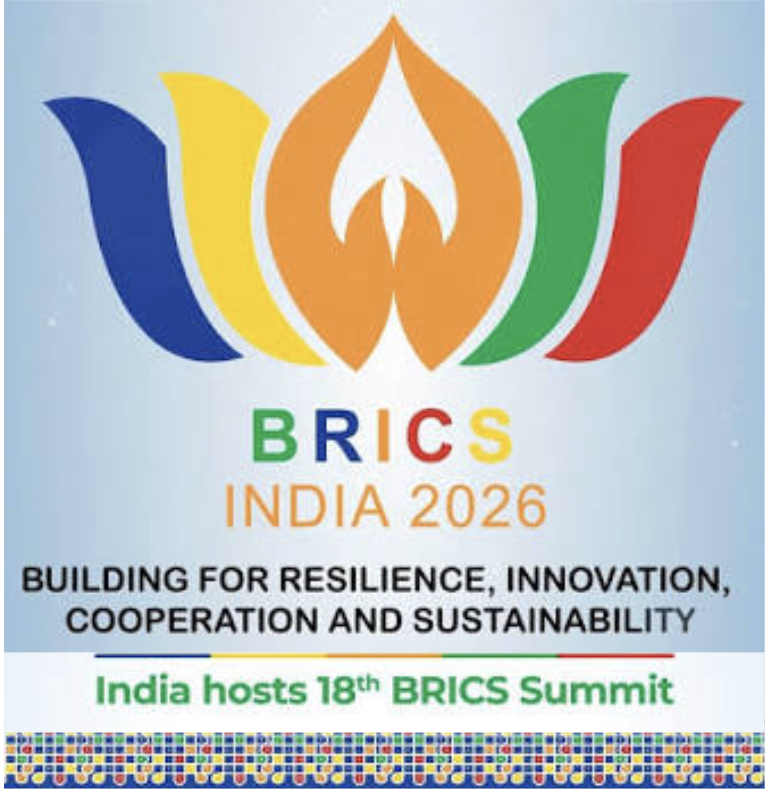
The 18th BRICS Summit will be held in New Delhi on September 12-13, 2026, under India’s presidency. China has expressed support for India and called for using the collective “POWER” of the expanded or Greater BRICS to promote peace, development and a more representative global order.
India’s presidency is guided by the theme “Building for Resilience, Innovation, Cooperation and Sustainability”.
| UPSC Relevance: GS-2 International Relations: International Organisations Mains: BRICS as a platform for South-South Cooperation, Challenges within BRICS. |
About BRICS:
- BRICS is an informal intergovernmental grouping of major emerging markets and developing countries. It seeks to strengthen economic cooperation, reform global governance and enhance the representation of the Global South.
- Members: BRICS presently has 11 members: Brazil, Russia, India, China, South Africa, Egypt, Ethiopia, Iran, the UAE, Saudi Arabia and Indonesia.
- BRICS is neither a treaty-based organisation nor a formal economic or military alliance. It has no permanent secretariat, charter or common market. Cooperation proceeds through consensus, an annually rotating chairship, leaders’ summits, ministerial meetings and specialised working groups.
- BRICS has no free-trade agreement, customs union or common economic policy, and much of intra-BRICS trade is centred on China.
- The New Development Bank (NDB) is a multilateral development bank established by BRICS. It aims to mobilise resources for infrastructure and sustainable development projects in emerging markets and developing countries.
Understanding BRICS ‘POWER’:
1. P- Principle:
- BRICS should uphold the UN Charter and principles such as sovereign equality, non-interference and peaceful settlement of disputes.
- Amid geopolitical conflicts and growing multipolarity, it can oppose unilateral coercion and prevent international relations from becoming purely power-driven.
- However, the credibility of these principles depends on their consistent application by members, including respect for territorial integrity and international law.
2. O- Openness:
- Against protectionism, tariff barriers and supply-chain fragmentation, BRICS should support an open global economy and the WTO-centred multilateral trading system.
- Cooperation can be expanded in energy, critical minerals, infrastructure and resilient industrial supply chains.
- For India, openness must be accompanied by fair market access, WTO-compatible trade and safeguards against excessive import dependence.
3. W- Win-Win Cooperation:
Development should remain central to the BRICS agenda through:
- Accelerated implementation of the Sustainable Development Goals
- Trade and investment facilitation
- Resilient agriculture and food systems
- Coordination of macroeconomic policies; and
- Local-currency trade and cross-border payment mechanisms.
Local-currency arrangements should reduce transaction costs and vulnerability to external financial shocks rather than be treated simply as an anti-dollar project.
4. E- Engine of Global Growth:
- Expanded BRICS represents nearly half (49.5%) of the world’s population, around 30% of global output and roughly one-fifth of world trade. Its major markets, manufacturers and natural resources give it the potential to become an important engine of global growth.
- Future cooperation should focus on AI, digital public infrastructure, health, agriculture, smart manufacturing and new industrialisation.
- The New Development Bank (NDB) has approved about $42.9 billion across 139 projects, including clean energy, transport, water and digital infrastructure.
5. R- Responsibility:
- BRICS must assume greater responsibility for global peace, climate action, food and energy security, and reform of the UN, IMF, World Bank and WTO. It can amplify the Global South’s demand for greater representation, development finance, technology access and climate justice.
- India and China, as successive BRICS chairs in 2026 and 2027, will have a particular responsibility to maintain policy continuity and institutional momentum.
Key Challenges within BRICS:
- India-China Geopolitical Rivalry: Ongoing border disputes and strategic competition between India and China create friction, often forcing other members to navigate these tensions. The bilateral rivalry limits cohesive action.
- China-Centric Influence: China’s GDP is significantly larger than all other BRICS members combined, leading to fears of economic dependency and domination, particularly among smaller or newer members.
- Divergent Geopolitical Interests: Members have differing relations with Western powers. Russia and China often adopt an anti-Western stance, while India, Brazil, and South Africa maintain more balanced or cooperative relations with the West, leading to inconsistent stances on global security and governance.
- Internal Differences: Enlargement has increased representativeness but also widened differences in political systems, regional priorities and development levels. Consensus among 11 members and ten partners is harder to achieve. E.g., Lack of a unified voice on major global crises, the Ukraine conflict and instability in West Asia
- Institutional and implementation deficit: BRICS declarations cover numerous sectors, but the absence of a permanent secretariat, common budget and enforcement mechanism weakens delivery.
- Limited financial alternatives: NDB remains much smaller than Bretton Woods institutions, while the CRA’s IMF linkage limits its autonomy. Sanctions and credit-rating considerations also constrain lending.
Importance of India-China Cooperation:
- Improved India-China relations can facilitate consensus within BRICS, expand connectivity and strengthen cooperation on trade, technology and global governance. The resumption of direct flights and border trade indicates gradual normalisation.
The “POWER” framework captures BRICS’ potential to defend international principles, preserve economic openness, promote shared development, drive growth and exercise global responsibility. However, its success will depend on internal cohesion, stronger institutions and concrete delivery.
Practice Mains Question:
Q. The expansion of BRICS has enhanced its global representativeness but also complicated internal cohesion and consensus-building. Discuss how India can use its 2026 BRICS Chairship to strengthen the grouping’s functional effectiveness.
Tell Google you want more of this.
Add Anantam IAS as a preferred sourceOne tap, and this site shows up more often in your own Top Stories, AI Overviews and AI Mode. Remove it any time.