Why in News?
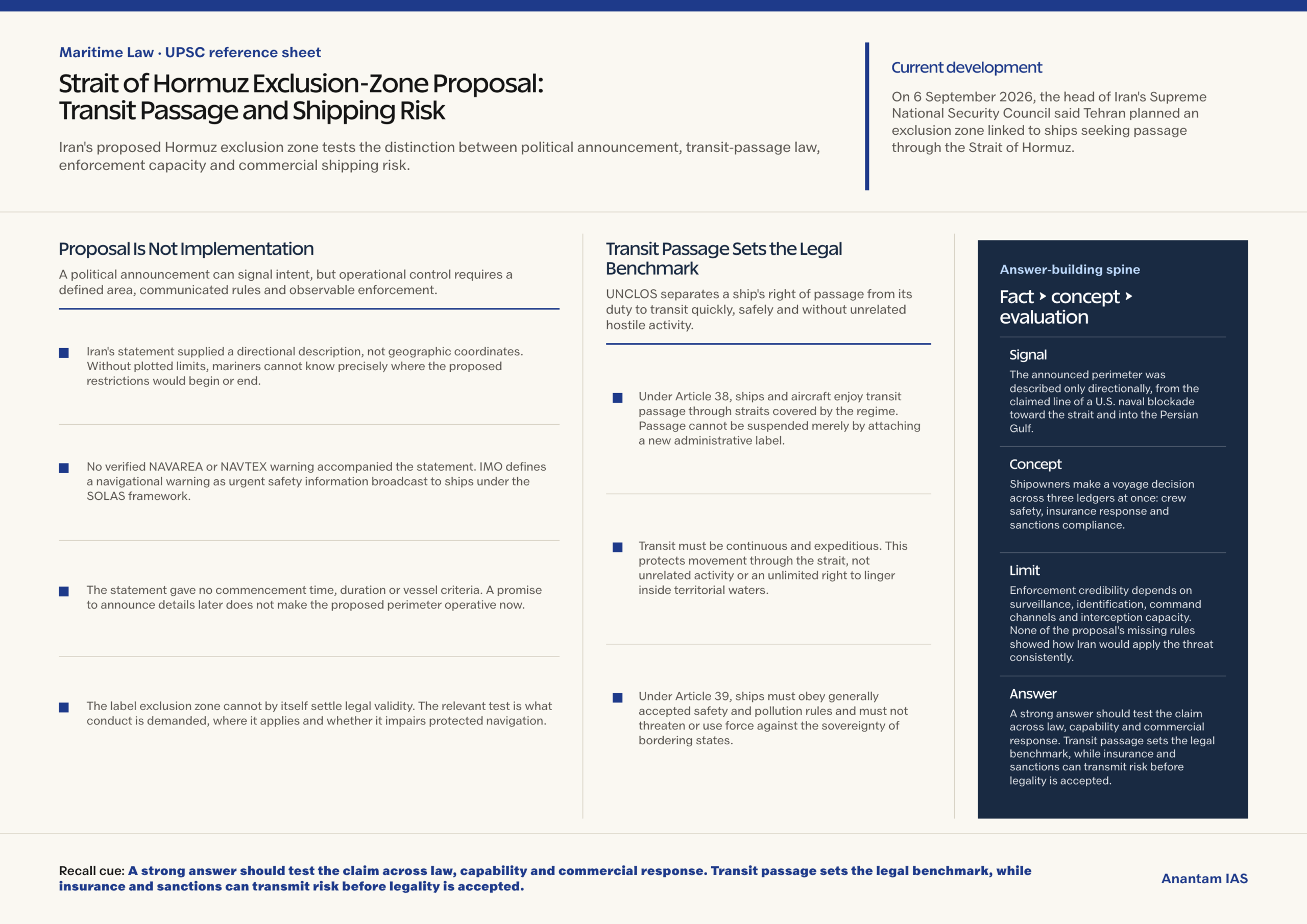
On 6 September 2026, the head of Iran’s Supreme National Security Council said Tehran planned an exclusion zone linked to ships seeking passage through the Strait of Hormuz.
- The announced perimeter was described only directionally, from the claimed line of a U.S. naval blockade toward the strait and into the Persian Gulf.
- Iran said the zone would be announced in the coming days or weeks and threatened identified ships entering it with placement on an Iranian sanctions list.
- At review time, Iran had published no coordinates, legal terms, commencement time or operative navigational warning defining the proposed zone.
- The development remained a proposal and coercive signal, not evidence of an operational, internationally accepted or consistently enforceable maritime regime.
- Three questions must stay separate: whether a zone has been formally specified, whether it is legally compatible with transit passage and whether Iran can enforce it in practice.
- Commercial effects may precede legal settlement because shipowners and insurers respond to threat probability, unclear operating rules and possible sanctions exposure, not only to an accepted legal claim.
- For India, the useful lens is energy-shipping resilience: maritime coercion can raise voyage costs and uncertainty even without producing a lawful closure.
UPSC Relevance
Prelims Relevance
- UNCLOS Part III governs straits used for international navigation; Article 38 states the right of transit passage for all ships and aircraft in covered straits.
- Transit passage means continuous and expeditious transit, while allowing entry, departure or return to a bordering state under that state’s conditions.
- Under Article 39, ships and aircraft must proceed without delay and refrain from threats or force unrelated to normal transit, except in distress or force majeure.
- Under Article 42, bordering states may regulate specified matters, but their laws cannot discriminate or have the practical effect of denying, hampering or impairing transit passage.
- Article 44 says bordering states shall not hamper transit passage and must appropriately publicize known dangers to navigation or overflight.
- Iran signed UNCLOS in 1982 but the UN Treaty Collection does not list a ratification; treaty status and customary-law arguments should not be collapsed into one claim.
Mains Relevance
GS Paper 2
- Effect of policies and politics of developed and developing countries on India’s interests; rules governing straits used for international navigation.
- Examine the gap between unilateral maritime-control claims, international legal standards and negotiated de-escalation.
GS Paper 3
- Indian economy and issues relating to mobilization of resources, growth and infrastructure, with emphasis on energy-shipping and insurance exposure.
- Assess how enforcement credibility, war-risk pricing and overlapping sanctions regimes transmit geopolitical risk into trade costs.
Essay
- Power at sea is exercised not only through recognized law, but also through uncertainty that changes the calculations of crews, insurers and trading firms.
Background and Context
Proposal Is Not Implementation
A political announcement can signal intent, but operational control requires a defined area, communicated rules and observable enforcement.
- Iran’s statement supplied a directional description, not geographic coordinates. Without plotted limits, mariners cannot know precisely where the proposed restrictions would begin or end.
- No verified NAVAREA or NAVTEX warning accompanied the statement. IMO defines a navigational warning as urgent safety information broadcast to ships under the SOLAS framework.
- The statement gave no commencement time, duration or vessel criteria. A promise to announce details later does not make the proposed perimeter operative now.
- The label exclusion zone cannot by itself settle legal validity. The relevant test is what conduct is demanded, where it applies and whether it impairs protected navigation.
- Iran’s threatened sanctions listing is also distinct from interdiction. Listing can deter commercial actors, while physical exclusion requires detection, communication and a credible capacity to compel compliance.
Transit Passage Sets the Legal Benchmark
UNCLOS separates a ship’s right of passage from its duty to transit quickly, safely and without unrelated hostile activity.
- Under Article 38, ships and aircraft enjoy transit passage through straits covered by the regime. Passage cannot be suspended merely by attaching a new administrative label.
- Transit must be continuous and expeditious. This protects movement through the strait, not unrelated activity or an unlimited right to linger inside territorial waters.
- Under Article 39, ships must obey generally accepted safety and pollution rules and must not threaten or use force against the sovereignty of bordering states.
- Under Article 42, bordering states can adopt non-discriminatory laws on navigation safety, traffic, pollution, fishing and customs-related matters within the Convention’s limits.
- The boundary is decisive: such laws cannot have the practical effect of denying, hampering or impairing transit passage, and Article 44 separately prohibits hampering it.
Coercive Effect Can Arrive Before Legal Acceptance
Shipowners make a voyage decision across three ledgers at once: crew safety, insurance response and sanctions compliance.
- Enforcement credibility depends on surveillance, identification, command channels and interception capacity. None of the proposal’s missing rules showed how Iran would apply the threat consistently.
- The Hindu reported earlier attacks on commercial shipping. That history makes the threat commercially relevant, but it does not prove a new zone exists or can be uniformly enforced.
- The Lloyd’s Market Association explains that war policies commonly contain cancellation-notice mechanisms, allowing insurers to renegotiate terms when the assessed risk to vessels rises.
- Insurance availability and safe passage are not identical. Cover may remain available while premium terms, route approval and owner or master decisions change because physical danger remains high.
- Sanctions create another filter. OFAC recommends sanctions-exclusion clauses and risk-based due diligence, so an Iranian listing threat may interact with separate contractual and regulatory screening obligations.
Way Forward
Replace Ambiguity With Verifiable Maritime Information
The immediate task is to reduce dangerous uncertainty without treating a unilateral proposal as lawful merely because it has been announced.
- Iran should disclose any claimed coordinates, duration, vessel rules, legal basis and safety procedures through recognized maritime-information channels before asserting that ships have entered a defined area.
- Relevant maritime authorities should circulate verified navigational warnings that distinguish observed hazards from contested political claims and give crews usable safety information.
- Shipowners should conduct separate safety, insurance and sanctions reviews; clearance under one ledger does not automatically satisfy the other two.
- Diplomatic deconfliction should preserve continuous and expeditious passage, protect crews and prevent ambiguous signalling from becoming an accidental interception or armed encounter.
Conclusion
- The durable distinction is proposal versus implementation: without coordinates, operative notice, defined rules and observable enforcement, Iran’s statement remained a threatened control measure rather than an established zone.
- A strong answer should test the claim across law, capability and commercial response. Transit passage sets the legal benchmark, while insurance and sanctions can transmit risk before legality is accepted.
UPSC Practice Questions
Prelims MCQ 1
With reference to transit passage under the United Nations Convention on the Law of the Sea, consider the following statements:
- All ships and aircraft enjoy the right of transit passage through straits covered by the regime.
- A bordering state may suspend transit passage whenever it announces an exclusion zone.
- Ships exercising transit passage must proceed without delay and refrain from threats or force unrelated to normal transit.
How many of the above statements are correct?
(a) Only one (b) Only two (c) All three (d) None
Answer: (b) Only two
Explanation:
Statements 1 and 3 are correct under Articles 38 and 39. UNCLOS does not permit a bordering state to suspend transit passage merely by announcing an exclusion zone.
Prelims MCQ 2
Which option best describes a navigational warning in the IMO’s World-Wide Navigational Warning Service?
(a) A treaty automatically changing a maritime boundary (b) An urgent safety message broadcast to ships under the SOLAS framework (c) A sanctions designation issued by a coastal state’s finance ministry (d) A private insurer’s final decision to withdraw all marine cover
Answer: (b) An urgent safety message broadcast to ships under the SOLAS framework
Explanation:
IMO defines a navigational warning as a message containing urgent information relevant to safe navigation and broadcast to ships under SOLAS arrangements.
UPSC Mains Questions
- A unilateral maritime exclusion-zone proposal may create commercial effects before acquiring legal acceptance or operational credibility. Critically examine with reference to transit passage through international straits.
- Discuss how navigational information, enforcement capacity, marine insurance and sanctions compliance shape shipping decisions during a geopolitical crisis.
Sources: The Hindu (Associated Press) and United Nations Convention on the Law of the Sea, Part III.
Frequently Asked Questions
Was Iran’s proposed exclusion zone operational on 7 September 2026?
No. Iran had announced an intention, but no coordinates, operative navigational warning, commencement time or complete rules had been published at review time.
What is transit passage under UNCLOS?
It is the continuous and expeditious passage of ships and aircraft through straits covered by UNCLOS, subject to duties concerning delay, safety, pollution and non-hostile conduct.
Can a state bordering a strait regulate passing ships?
Yes, within Article 42’s specified fields and without discrimination. Its laws cannot have the practical effect of denying, hampering or impairing transit passage.
Why do coordinates and navigational warnings matter?
Coordinates define the claimed area. Recognized warnings give mariners urgent, usable safety information; a vague political statement alone cannot provide the same operational certainty.
Why can shipping risk rise before a zone gains legal acceptance?
Owners, masters and insurers assess physical danger, coverage terms and sanctions exposure. Those commercial decisions can change immediately even while the legal status remains disputed.
Tell Google you want more of this.
Add Anantam IAS as a preferred sourceOne tap, and this site shows up more often in your own Top Stories, AI Overviews and AI Mode. Remove it any time.