Why in News?
A special NIA court in Jagdalpur convicted 10 accused on September 5, 2026 in the Jhiram Ghati Maoist attack case of 2013.
- The court fixed criminal liability at the trial stage, while the order on the quantum of punishment is scheduled for September 16.
- The defence said it would appeal. The convictions can still face appellate review on facts and law before the competent High Court.
- The NIA’s case record says the ambush killed 27 people, including 10 police personnel, injured 38 and involved the loss or looting of weapons.
- The verdict concerns the accused tried in this case. It does not by itself close every disputed question about the wider conspiracy or alleged security lapses.
- Jhiram Ghati became a political and operational turning point because Maoists struck a civilian political convoy while security forces were pushing deeper into core areas.
- The durable lesson is that prosecution, intelligence, force protection, roads, communications, public services and tribal rights must reinforce one another in an LWE-affected area.
UPSC Relevance
Prelims Relevance
- Police and public order are State List subjects, while the Union coordinates and supports states against Left Wing Extremism.
- The National Investigation Agency Act, 2008 provides for Special Courts to try scheduled offences investigated by the NIA.
- Under Section 21 of the NIA Act, an appeal from a Special Court’s judgment or sentence lies to the High Court on facts and law.
- The CPI (Maoist) and its formations are listed as a terrorist organization under the Unlawful Activities (Prevention) Act, 1967.
- The Union’s National Policy and Action Plan, 2015 combines security, development, rights and entitlements, governance and perception management.
Mains Relevance
GS Paper 3
- Linkages between development and spread of extremism; role of state and non-state actors in internal-security challenges.
- Operational lessons from Maoist ambushes, including intelligence, route security, medical evacuation and Centre-State coordination.
GS Paper 2
- Accountability through special courts, appellate safeguards and the distinction between criminal trials and wider institutional inquiries.
- Federal responsibilities in policing, development administration and protection of tribal rights in conflict-affected districts.
Essay
- Internal security becomes durable only when state capacity is matched by constitutional accountability and public trust.
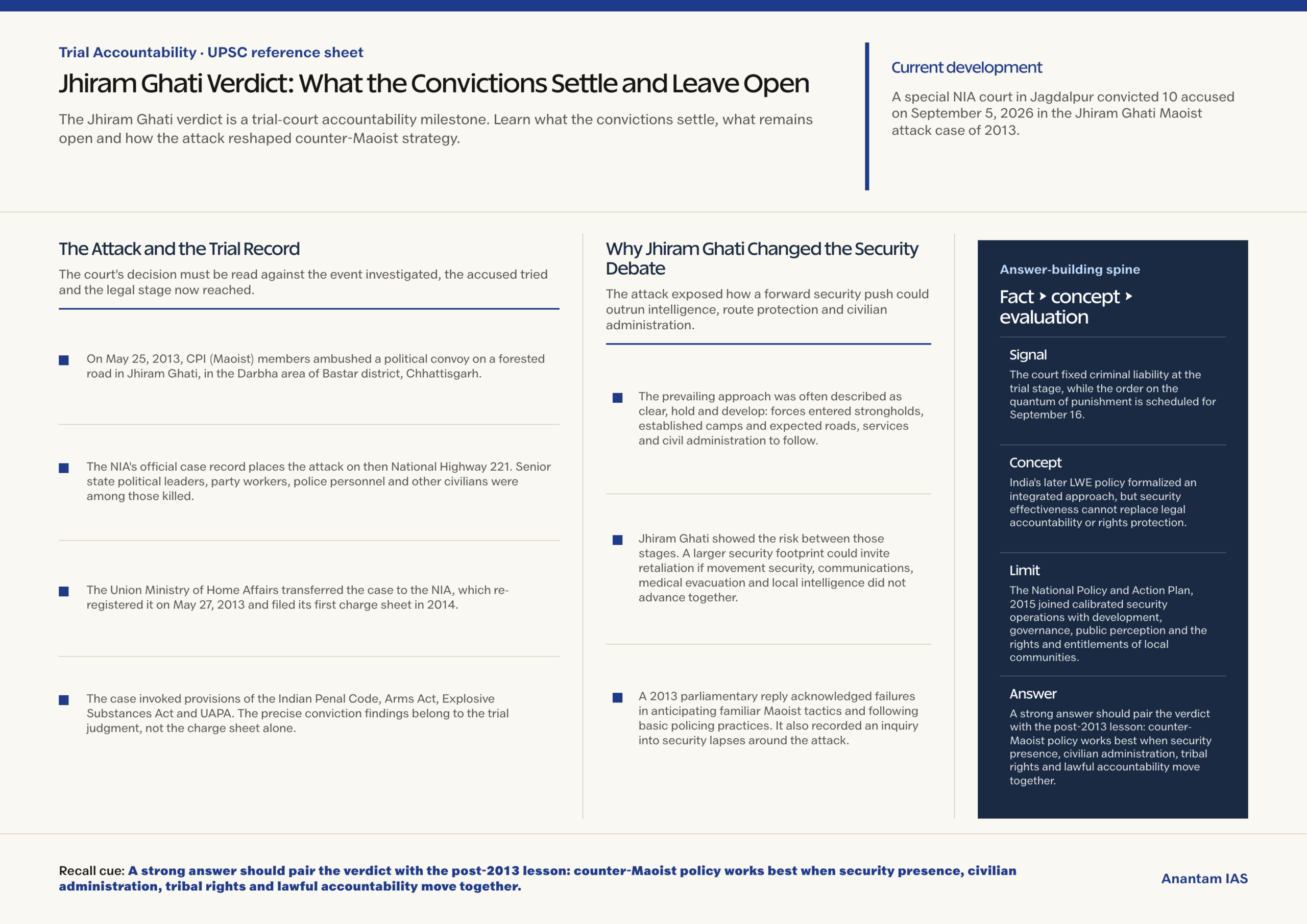
Background and Context
The Attack and the Trial Record
The court’s decision must be read against the event investigated, the accused tried and the legal stage now reached.
- On May 25, 2013, CPI (Maoist) members ambushed a political convoy on a forested road in Jhiram Ghati, in the Darbha area of Bastar district, Chhattisgarh.
- The NIA’s official case record places the attack on then National Highway 221. Senior state political leaders, party workers, police personnel and other civilians were among those killed.
- The Union Ministry of Home Affairs transferred the case to the NIA, which re-registered it on May 27, 2013 and filed its first charge sheet in 2014.
- The case invoked provisions of the Indian Penal Code, Arms Act, Explosive Substances Act and UAPA. The precise conviction findings belong to the trial judgment, not the charge sheet alone.
- Conviction means the trial court found guilt proved for the accused before it. Sentencing decides punishment, while an appeal tests the judgment before a higher court.
Why Jhiram Ghati Changed the Security Debate
The attack exposed how a forward security push could outrun intelligence, route protection and civilian administration.
- The prevailing approach was often described as clear, hold and develop: forces entered strongholds, established camps and expected roads, services and civil administration to follow.
- Jhiram Ghati showed the risk between those stages. A larger security footprint could invite retaliation if movement security, communications, medical evacuation and local intelligence did not advance together.
- A 2013 parliamentary reply acknowledged failures in anticipating familiar Maoist tactics and following basic policing practices. It also recorded an inquiry into security lapses around the attack.
- The immediate policy response included high-level Centre-State meetings on operational effectiveness and development delivery. The political convoy’s vulnerability made Maoist violence a direct governance concern, not only a policing file.
- The lesson was not to abandon area domination. It was to connect each security gain with administration, roads, communications and trusted local engagement so that a camp did not remain an isolated island.
The Post-2013 Strategy and Its Constitutional Limit
India’s later LWE policy formalized an integrated approach, but security effectiveness cannot replace legal accountability or rights protection.
- The National Policy and Action Plan, 2015 joined calibrated security operations with development, governance, public perception and the rights and entitlements of local communities.
- The Union supports states through central forces, intelligence sharing, police capacity, security expenditure and infrastructure. States retain primary responsibility because police and public order are State List subjects.
- Roads and mobile connectivity can improve access, evacuation and administration. These gains become durable only when schools, health services, welfare delivery and lawful grievance redress reach residents as well.
- Rights are not an optional soft component. The Supreme Court’s 2011 rejection of arming tribal youth as Special Police Officers showed that an anti-Maoist method can fail constitutional scrutiny despite security claims.
- A falling violence trend may indicate operational success, but it cannot answer who planned every past attack, whether every lapse was examined or whether each prosecution will survive appeal.
Way Forward
Make Security Gains Legally and Administratively Durable
The next step is to join case accountability with field lessons, rather than treating either as a substitute for the other.
- Prosecutors should preserve witness, forensic and chain-of-custody records in an appeal-ready case file, especially when a trial extends across many years.
- Governments should separately track criminal guilt, wider conspiracy leads and institutional lapses so that a conviction in one trial does not prematurely close other legitimate inquiries.
- Operational reviews should convert known ambush patterns into route planning, intelligence checks, communications redundancy and casualty evacuation protocols for every civilian or security movement in vulnerable terrain.
- Area security should carry a matching delivery plan for roads, health, education, forest rights and grievance redress, with independent checks against coercion and unlawful collective punishment.
Conclusion
- The Jhiram Ghati verdict is a major trial-court accountability milestone. It is not yet the final word because sentencing, appeal and questions beyond the tried accused remain open.
- A strong answer should pair the verdict with the post-2013 lesson: counter-Maoist policy works best when security presence, civilian administration, tribal rights and lawful accountability move together.
UPSC Practice Questions
Prelims MCQ 1
With reference to the institutional framework relevant to the Jhiram Ghati case, consider the following statements:
- The NIA re-registered the case after an order of the Union Ministry of Home Affairs.
- Section 21 of the NIA Act allows an appeal from a Special Court judgment to the High Court on facts and law.
- Police and public order are subjects in the Union List.
How many of the above statements are correct?
(a) Only one (b) Only two (c) All three (d) None
Answer: (b) Only two
Explanation:
Statements 1 and 2 are correct. Police and public order are State List subjects, although the Union supports and coordinates LWE responses.
Prelims MCQ 2
Which one of the following best describes the Union government’s National Policy and Action Plan, 2015 for Left Wing Extremism?
(a) A security-only doctrine centered on central armed police operations (b) A judicial scheme transferring all LWE cases to the Supreme Court (c) An integrated approach combining security, development, governance and rights and entitlements (d) A constitutional amendment moving police to the Concurrent List
Answer: (c) An integrated approach combining security, development, governance and rights and entitlements
Explanation:
The policy joins security measures with development, governance, public perception and protection of local communities’ rights and entitlements.
UPSC Mains Questions
- The Jhiram Ghati verdict is an accountability milestone, but a criminal conviction cannot by itself resolve every institutional question raised by an insurgent attack. Critically examine.
- India’s experience with Left Wing Extremism shows that area domination without responsive administration produces fragile gains. Discuss with reference to security, development, tribal rights and Centre-State coordination.
Sources: Indian Express Explained and National Investigation Agency.
Frequently Asked Questions
What did the special NIA court decide in the Jhiram Ghati case?
The Jagdalpur court convicted 10 accused in the 2013 Maoist attack case. The decision fixes guilt at the trial stage; it does not yet determine punishment or conclude appellate review.
When will the convicted accused be sentenced?
The court scheduled its order on the quantum of punishment for September 16, 2026. Sentencing is a separate stage after conviction and may itself become part of an appeal.
Why are the convictions not the final legal word?
Section 21 of the NIA Act permits appeals from a Special Court’s judgment or sentence to the High Court on both facts and law. The defence has said it will appeal.
Why was the Jhiram Ghati attack a turning point?
It struck a political convoy during a deeper security push into Maoist-held areas. The attack exposed gaps between camp expansion, route security, intelligence, communications, evacuation and civilian administration.
What is the main policy lesson from Jhiram Ghati?
Counter-Maoist operations need synchronized security, administration, infrastructure, justice and protection of tribal rights. A security camp can hold ground, but legitimate governance must make that gain durable.
Tell Google you want more of this.
Add Anantam IAS as a preferred sourceOne tap, and this site shows up more often in your own Top Stories, AI Overviews and AI Mode. Remove it any time.