Why in News?
India and China have held their first Corps Commander-level meeting in the Eastern Sector at the Wacha-Damai Border Personnel Meeting Point in Arunachal Pradesh. The talks sought to address local issues along the Line of Actual Control (LAC) and maintain peace amid reports of tensions in the Taksing area of Upper Subansiri district.
The Indian delegation was led by the Commander of the Army’s III Corps, or Spear Corps, headquartered at Rangapahar near Dimapur. The Corps oversees parts of the LAC in Arunachal Pradesh.
| UPSC Relevance: GS-2: International Relations: India and its Neighbourhood; GS-3: Internal Security: Border security Mains: India and its Neighbourhood: India-China Relations |
Why is the Meeting Significant?
Until now, Corps Commander-level talks had largely been conducted at the Chushul-Moldo meeting point in eastern Ladakh, especially after the 2020 Galwan Valley clash.
Extension of the mechanism to Arunachal Pradesh:
- Creates a direct senior-level channel for the Eastern Sector
- Allows local incidents to be contained before they escalate
- Recognises that border management must cover the entire LAC rather than remain Ladakh-centric
- Supplements existing local commander meetings, Border Personnel Meetings and military hotlines; and
- Assumes diplomatic importance ahead of the India-hosted BRICS Summit, which Chinese President Xi Jinping is expected to attend.
However, dialogue is a confidence-building measure, not evidence that the boundary dispute has been resolved.
The Structural Problem: An Undelineated LAC
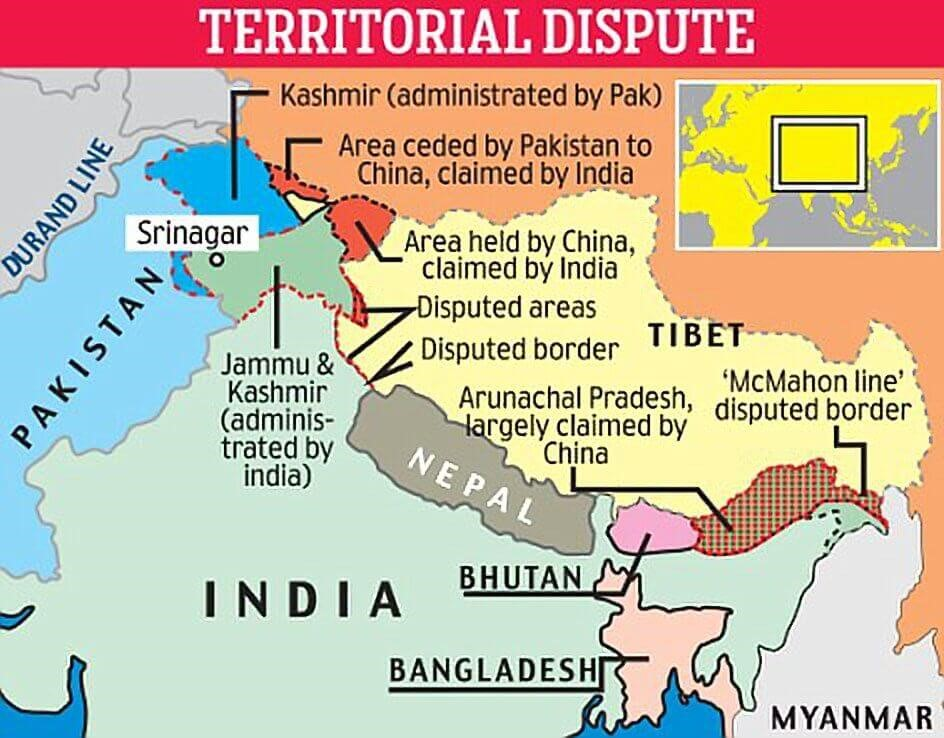
- The LAC is neither a mutually agreed international boundary nor fully clarified on maps. India and China often patrol up to their respective perceptions of the line, producing overlapping claims, patrol confrontations and accusations of transgression.
- The Eastern Sector is particularly sensitive because China claims much of Arunachal Pradesh as South Tibet, while India maintains that the State is an integral and inalienable part of India.
Multi-layered Border Dialogue:
India and China manage the boundary through three complementary channels:
- Special Representatives mechanism: Political negotiations on the boundary question, led by India’s National Security Adviser and China’s senior foreign-policy representative.
- Working Mechanism for Consultation and Coordination (WMCC): Diplomatic and military officials discuss border management and implementation of agreements.
- Military mechanisms: Corps Commander meetings, local commander talks, Border Personnel Meetings and hotlines deal with operational tensions on the ground.
The latest engagement follows the 25th round of Special Representatives’ talks, whose eight-point outcome included additional senior military meeting points and communication channels along the Eastern and Middle Sectors.
Significance of Stable Border Relations with China:
- Border stability and development: Regular military dialogue, hotlines and de-escalation can prevent patrol confrontations from turning into clashes. It would also reduce the cost of sustained high-altitude deployment and free resources for development, including in border villages.
- Economic and health security: China is one of India’s largest trading partners for goods and its largest source of imports. Bilateral merchandise trade reached about $151 billion in 2025-26, although India’s deficit exceeded $100 billion. China also supplied 73.7% of India’s imports of APIs, bulk drugs and drug intermediates in 2024-25. Stable ties can protect critical supply chains while India pursues domestic production and diversified sourcing.
- Clean-energy transition: China accounts for over 80% of several stages of global solar-panel manufacturing and nearly 90% of rare-earth refining. These inputs are crucial for renewable energy, electric vehicles, electronics and defence.
- Water security: China’s hydrological data on transboundary rivers such as the Brahmaputra is vital for flood forecasting, disaster management and hydropower planning.
- Strategic flexibility: Stable relations would reduce the risks posed by a possible China-Pakistan two-front challenge and allow India to devote greater attention to the Indian Ocean and the Indo-Pacific.
- Geopolitical support: China’s position is important for India’s membership of the consensus-based Nuclear Suppliers Group and as a permanent member of the United Nations Security Council (UNSC).
- Reforming Global Governance: India and China can cooperate within the BRICS, SCO, G20 and WTO to seek greater representation for developing countries and reforms in institutions such as the IMF, World Bank and United Nations. Joint action can strengthen the voice of the Global South on climate finance, development funding, technology access, food security and reform of multilateral institutions.
Continuing Challenges:
- Unclarified LAC: Differing perceptions of the undemarcated LAC repeatedly bring rival patrols into confrontation.
- Military build-up: Continued troop deployment and rapid border infrastructure development increase the risk of miscalculation and escalation.
- Trust deficit: The 2020 Galwan clash fundamentally weakened confidence in existing border agreements and China’s commitments.
- Arunachal Pradesh dispute: China’s claim over Arunachal Pradesh, particularly Tawang, remains a major obstacle to boundary settlement.
- Patrolling access: Restrictions and competing claims over traditional patrolling points continue to generate friction in sensitive areas.
- China-Pakistan nexus: Their expanding defence, economic and strategic cooperation intensifies India’s potential two-front security challenge.
- Fragile diplomatic thaw: Summit-level engagement may provide temporary stability without securing disengagement, de-escalation or boundary clarification.
Reports of fresh tensions in Taksing have also been contested by Indian defence authorities, illustrating the need to distinguish verified developments from uncorroborated claims.
Way Forward:
- India should pursue a sequential approach of disengagement, de-escalation and eventual demobilisation, backed by verification.
- Both sides must clarify the LAC in feasible sectors, strengthen hotlines and patrolling protocols, avoid unilateral alteration of the status quo, and faithfully implement the border agreements of 1993, 1996, 2005 and 2013.
- The 1993 and 1996 border agreements need updating for new realities such as drones, surveillance, rapid mobilisation and forward infrastructure.
- India should continue border infrastructure development along with livelihood support in border villages.
- China must ensure timely hydrological data sharing, prior notification of major river projects and emergency communication on transboundary rivers.
The Wacha-Damai meeting represents the geographical expansion of military dialogue and provides an important crisis-management mechanism for the Eastern Sector.
Nevertheless, durable stability requires more than periodic talks: it demands verifiable restraint, clarification of the LAC and sustained political commitment. For India, engagement with China must therefore combine dialogue with deterrence and diplomacy with preparedness.
Tell Google you want more of this.
Add Anantam IAS as a preferred sourceOne tap, and this site shows up more often in your own Top Stories, AI Overviews and AI Mode. Remove it any time.