Why in News?
India and China held their first Corps Commander-level meeting in the eastern sector on September 6, 2026 at the Wacha-Damai Border Personnel Meeting Point in Arunachal Pradesh.
- The meeting moved a senior military dialogue format, previously concentrated at Chushul-Moldo in eastern Ladakh, into the Arunachal Pradesh sector.
- The talks followed several meetings between local commanders amid reported tensions near Taksing in Upper Subansiri district.
- Wacha, in the Kibithoo sector, is India’s easternmost Border Personnel Meeting Point, according to the Indian Express report.
- The reports confirmed that talks occurred but announced no disengagement agreement, troop reduction or boundary settlement.
- The change matters because a higher command channel can examine sector-wide operational risks that may exceed the authority of local border commanders.
- The exam trap is simple: a meeting mechanism can manage incidents along the LAC, but it cannot by itself settle competing territorial claims.
UPSC Relevance
Prelims Relevance
- Wacha-Damai is a Border Personnel Meeting Point in the Kibithoo sector of Arunachal Pradesh.
- The Line of Actual Control is the line of military control, not a mutually delimited and demarcated international boundary.
- India’s 3 Corps is headquartered at Rangapahar in Nagaland and has operational responsibility along parts of the Arunachal Pradesh frontier.
- The 4 Corps, based at Tezpur, is the other Army corps formation responsible for the frontier in Arunachal Pradesh.
- Chushul-Moldo in eastern Ladakh has been the principal venue for earlier Corps Commander-level talks linked to the western sector standoff.
Mains Relevance
GS Paper 2
- India and its neighborhood: bilateral relations with China and management of an unsettled boundary.
- Effect of border-management mechanisms on bilateral stability without conflating dialogue with dispute resolution.
GS Paper 3
- Security challenges and their management in border areas, including escalation control, command communication and infrastructure-linked friction.
Essay
- Dialogue is most valuable when it prevents a manageable disagreement from becoming an uncontrollable crisis.
Background and Context
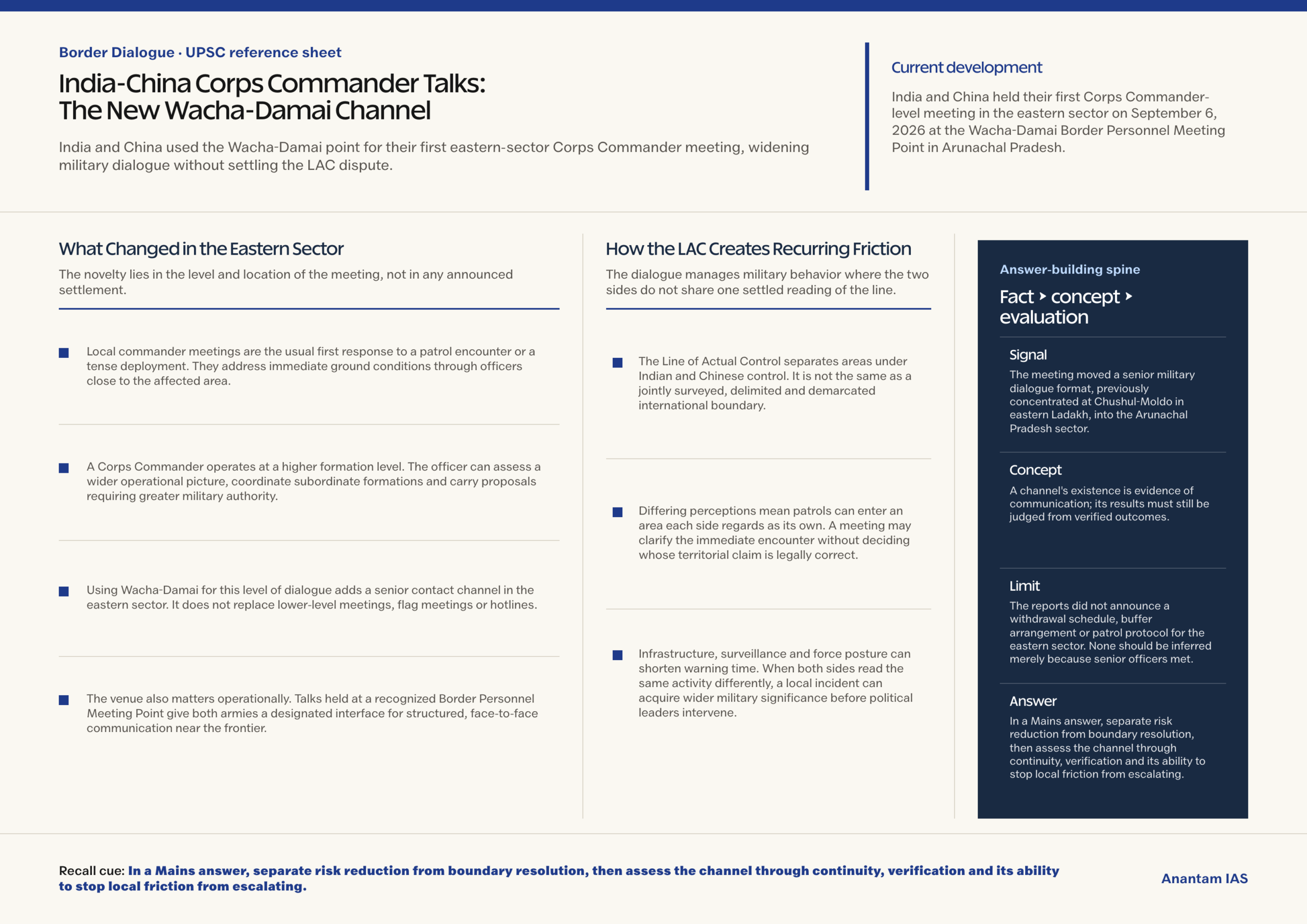
What Changed in the Eastern Sector
The novelty lies in the level and location of the meeting, not in any announced settlement.
- Local commander meetings are the usual first response to a patrol encounter or a tense deployment. They address immediate ground conditions through officers close to the affected area.
- A Corps Commander operates at a higher formation level. The officer can assess a wider operational picture, coordinate subordinate formations and carry proposals requiring greater military authority.
- Using Wacha-Damai for this level of dialogue adds a senior contact channel in the eastern sector. It does not replace lower-level meetings, flag meetings or hotlines.
- The venue also matters operationally. Talks held at a recognized Border Personnel Meeting Point give both armies a designated interface for structured, face-to-face communication near the frontier.
- This is best read as institutional layering: local channels handle immediate incidents, while higher commanders can review patterns, deployments and measures needed to prevent escalation across a broader sector.
How the LAC Creates Recurring Friction
The dialogue manages military behavior where the two sides do not share one settled reading of the line.
- The Line of Actual Control separates areas under Indian and Chinese control. It is not the same as a jointly surveyed, delimited and demarcated international boundary.
- Differing perceptions mean patrols can enter an area each side regards as its own. A meeting may clarify the immediate encounter without deciding whose territorial claim is legally correct.
- Infrastructure, surveillance and force posture can shorten warning time. When both sides read the same activity differently, a local incident can acquire wider military significance before political leaders intervene.
- Communication mechanisms reduce that danger by helping commanders establish what happened, convey concerns and discuss reciprocal steps. Their value lies in crisis control even when the political dispute remains open.
- This distinction should anchor a Mains answer: border management concerns stability and conduct along the line, while boundary settlement concerns the final territorial alignment between states.
What the Meeting Does Not Prove
A channel’s existence is evidence of communication; its results must still be judged from verified outcomes.
- The reports did not announce a withdrawal schedule, buffer arrangement or patrol protocol for the eastern sector. None should be inferred merely because senior officers met.
- There was also no verified troop reduction. Continued deployment may coexist with dialogue because forces can remain prepared while commanders work to prevent a specific friction from escalating.
- One meeting does not establish durable compliance. Confidence depends on repeated contact, accurate ground-level implementation and ways to verify whether agreed conduct is being followed by both sides.
- Military talks are designed to manage operational problems. They cannot alone resolve the legal, political and cartographic questions that make the India-China boundary dispute persistent.
- For analysis, treat this as a modest institutional gain: the eastern sector now has a senior dialogue pathway, but its effectiveness will depend on continuity, clarity and observable restraint.
Way Forward
Make the Channel Predictable and Verifiable
The new pathway will matter only if it produces reliable communication before and during friction.
- Both sides should establish regular contact intervals and rapid activation procedures so that a tense ground situation does not wait for an improvised diplomatic response.
- Meeting records should identify precise operational commitments, responsible command levels and review dates, while protecting information that cannot be made public for security reasons.
- Hotlines, local meetings and Corps-level talks should form one escalation ladder, with unresolved issues moving upward without cutting off communication at the ground level.
- Any reported improvement should be assessed through observable conduct, not the holding of talks alone. Verified implementation is the difference between a channel and an outcome.
Conclusion
- The Wacha-Damai meeting broadens military crisis-management architecture into the eastern sector. Its immediate significance is a higher-level communication route, not proof of disengagement or settlement.
- In a Mains answer, separate risk reduction from boundary resolution, then assess the channel through continuity, verification and its ability to stop local friction from escalating.
UPSC Practice Questions
Prelims MCQ 1
With reference to India-China border-management mechanisms, consider the following statements:
- Wacha-Damai is a Border Personnel Meeting Point in Arunachal Pradesh.
- A Corps Commander-level meeting automatically delimits the Line of Actual Control.
- Chushul-Moldo has hosted Corps Commander-level talks linked to the eastern Ladakh standoff.
How many of the above statements are correct?
(a) Only one (b) Only two (c) All three (d) None
Answer: (b) Only two
Explanation:
Statements 1 and 3 are correct. A military dialogue can manage operational tensions, but it does not automatically delimit or settle the LAC.
Prelims MCQ 2
What is the most accurate significance of the September 2026 Wacha-Damai meeting?
(a) It converted the LAC into an agreed international boundary (b) It completed troop withdrawal across Arunachal Pradesh (c) It extended Corps Commander-level dialogue into the eastern sector (d) It replaced every local commander meeting and military hotline
Answer: (c) It extended Corps Commander-level dialogue into the eastern sector
Explanation:
The verified development was the first eastern-sector use of the Corps Commander-level format. No boundary settlement, sector-wide withdrawal or replacement of other channels was announced.
UPSC Mains Questions
- Military dialogue can reduce border risks without resolving a boundary dispute. Discuss with reference to the India-China Corps Commander meeting at Wacha-Damai.
- Examine the role and limitations of layered military communication mechanisms in preventing local incidents along the Line of Actual Control from escalating into wider crises.
Sources: The Hindu and Indian Express.
Frequently Asked Questions
What happened at Wacha-Damai in September 2026?
India and China held their first Corps Commander-level meeting in the eastern sector there. The reports confirmed dialogue amid local tensions but announced no disengagement or boundary agreement.
Where is the Wacha-Damai Border Personnel Meeting Point?
It is in the Kibithoo sector of Arunachal Pradesh on the Indian side of the LAC. The Indian Express describes Wacha as India’s easternmost Border Personnel Meeting Point.
Why is a Corps Commander-level meeting different from a local commander meeting?
A Corps Commander has authority over a larger formation and can examine sector-wide operational issues. Local commanders remain essential for handling immediate encounters and implementing ground-level measures.
Did the Wacha-Damai talks settle the India-China boundary dispute?
No. The reports announced neither a settlement nor a troop-reduction agreement. Military talks can manage conduct and escalation risks along the LAC, while the underlying boundary remains unsettled.
Why is the LAC prone to recurring friction?
The two sides do not share a single settled perception of the line in all areas. Differing interpretations of patrol encounters, infrastructure and force posture can create escalation risks.
Tell Google you want more of this.
Add Anantam IAS as a preferred sourceOne tap, and this site shows up more often in your own Top Stories, AI Overviews and AI Mode. Remove it any time.