Why in News?
Justice Yashwant Varma, a former judge of the Allahabad High Court, who was facing a parliamentary motion for removal, has submitted his resignation to the President of India.
Under the Judges (Inquiry) Act, 1968, a panel constituted by the Lok Sabha Speaker was set to investigate allegations of burnt currency recovered from his official residence in Delhi. The Act contains no provision requiring an inquiry to continue after a judge vacates office.
| UPSC Relevance: GS-2 Polity and Governance: Judiciary Prelims: Removal & Impeachment process of Judges of High Court & Supreme Court. |
Resignation of a High Court Judge:
- A High Court judge may voluntarily resign by submitting a written resignation letter addressed to the President of India. This process is outlined under Article 217(1)(a) of the Indian Constitution. Resignation takes effect from the date specified in the letter. The judge is not required to give reasons.
Removal Process of a High Court Judge:
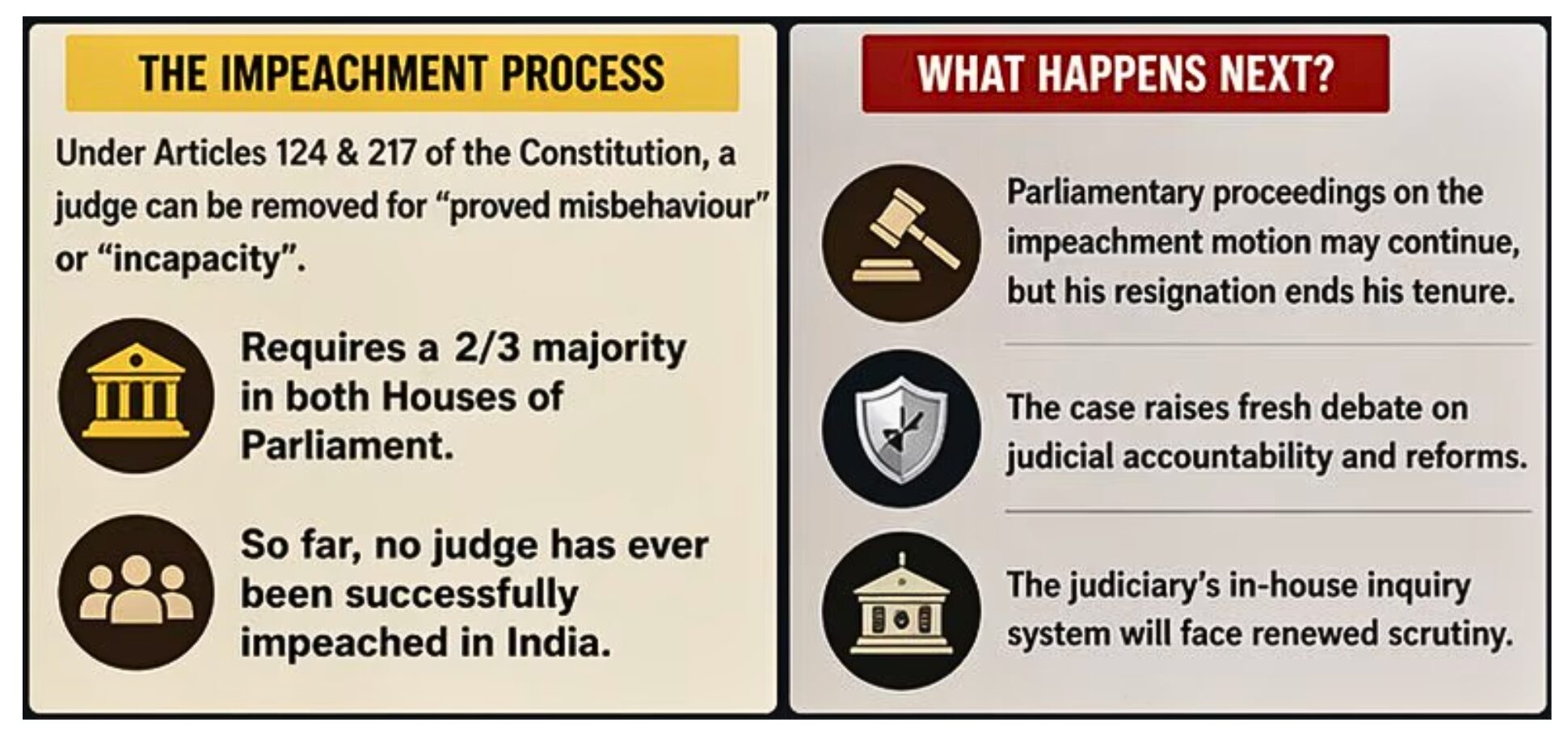
- A judge of a High Court can be removed only by the President of India, after an address is passed by both Houses of Parliament in the same session, supported by a special majority:
- A majority of not less than 2/3rd of members present and voting.
- A majority of the total membership of the House, and
- Grounds for Removal: Only two grounds are permitted: (i) Proved misbehaviour, (ii) Incapacity
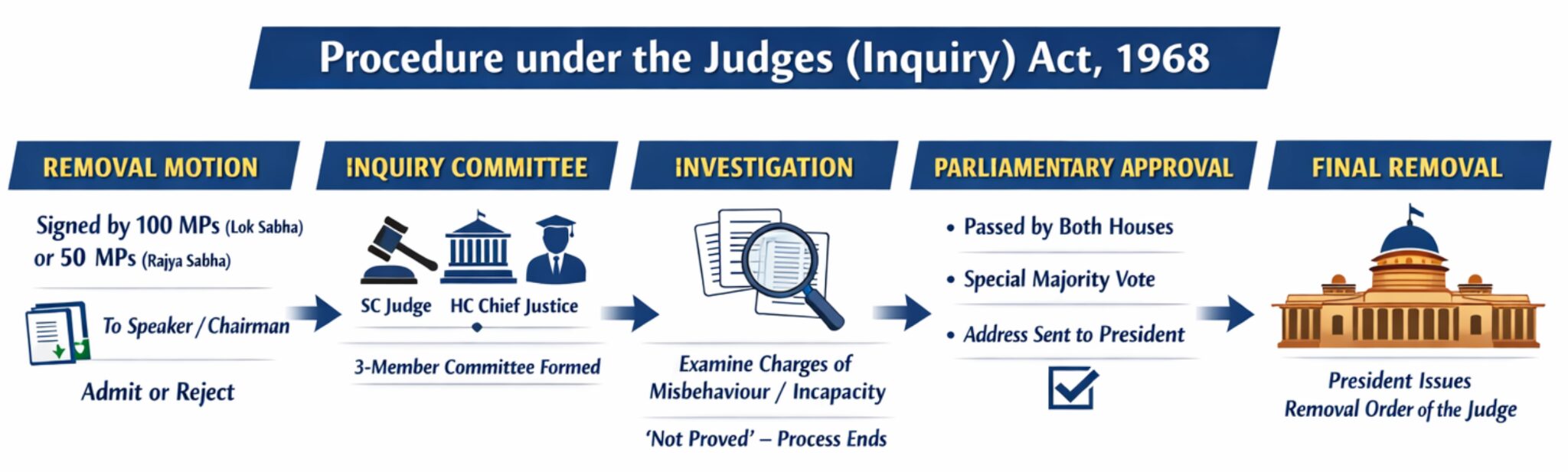
Procedure under the Judges (Inquiry) Act, 1968:
- Motion for Removal: A removal motion signed by 100 members (Lok Sabha) or 50 members (Rajya Sabha) is to be given to the Speaker/Chairman. The Presiding Officer may admit or reject the motion.
- Constitution of Inquiry Committee: If admitted, a 3-member committee is formed consisting of:
- A Judge of the Supreme Court
- A Chief Justice of a High Court
- A distinguished jurist
- Investigation: The committee examines charges of misbehaviour/incapacity. If charges are not proved, the process ends.
- Parliamentary Approval: If charges are proved, each House must pass the motion by a special majority. After the motion is passed, an address is presented to the President.
- Final Removal: The President issues the removal order of the judge.
The Judges (Inquiry) Act, 1968, contains no provision requiring an inquiry to continue after a judge vacates office.
Provisions related to Judicial Accountability:
- Constitutional Provisions:
- Article 124(4) provides for the removal of Supreme Court judges on the grounds of proved misbehaviour or incapacity, through a special majority in Parliament.
- Article 124(5) empowers Parliament to make laws regulating the procedure for investigation, which led to the enactment of the Judges (Inquiry) Act, 1968.
- Article 217 deals with the appointment and conditions of office of High Court judges. Removal provisions of Supreme Court judges under Article 124(4) are made applicable to High Court judges through Article 218.
- Statutory Provisions:
- The Judges (Inquiry) Act, 1968: Establishes a mechanism for investigating allegations of misbehaviour or incapacity against SC and HC judges.
- Contempt of Courts Act, 1971: Ensures authority, dignity, and independence of the judiciary by penalising acts that scandalise or obstruct the administration of justice. Indirectly contributes to judicial accountability by maintaining institutional integrity.
- In-house Procedure, 1999: (Non-statutory/Internal Mechanism):
- An internal mechanism evolved by the Supreme Court to examine complaints against judges of the higher judiciary for misconduct, corruption and ethical violations.
The removal procedure of High Court judges is the same as that of Supreme Court judges. The Constitution does not explicitly use the word “impeachment” for judges; it uses the term removal (impeachment is commonly used in practice).
UPSC PYQ 2019
Q. Consider the following statements:
1. The motion to impeach a Judge of the Supreme Court of India cannot be rejected by the Speaker of the Lok Sabha as per the Judges (Inquiry) Act, 1968.
2. The Constitution of India defines and gives details of what constitutes incapacity and proven misbehaviour of the Judges of the Supreme Court of India.
3. The details of the process of impeachment of the Judges of the Supreme Court of India are given in the Judges (Inquiry) Act, 1968.
4. If the motion for the impeachment of a Judge is taken up for voting, the law requires the motion to be backed by each House of the Parliament and supported by a majority of total membership of that House and by not less than two-thirds of total members of that House present and voting.
Which of the statements given above is/are correct?
(a) 1 and 2 only
(b) 3 only
(c) 3 and 4 only
(d) 1, 3 and 4
Answer: (c)
Tell Google you want more of this.
Add Anantam IAS as a preferred sourceOne tap, and this site shows up more often in your own Top Stories, AI Overviews and AI Mode. Remove it any time.