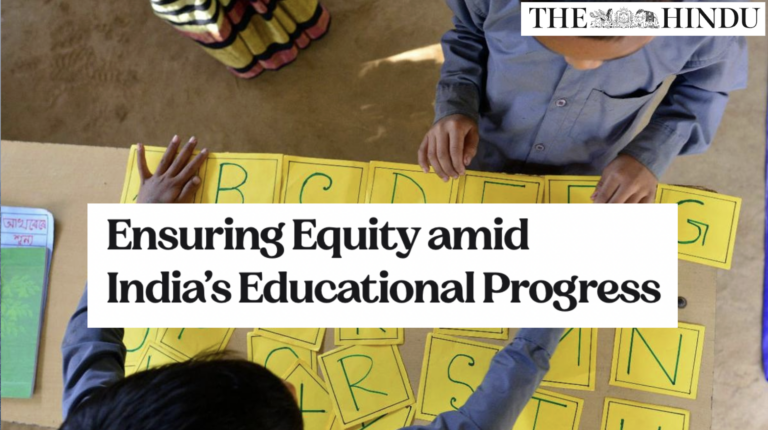
Why in News?
India continues to face a deep learning crisis, as evidenced by the Annual Status of Education Reports (ASER). Barring marginal improvements in recent years, the persistent failure to ensure Foundational Literacy and Numeracy (FLN) has failed to generate urgency at the policy implementation and grassroots levels.
| UPSC Relevance: GS-2 Social Justice: Education, Human Resources. Mains: Foundational Literacy and Numeracy: Associated challenges |
What is Foundational Literacy and Numeracy?
- FLN refers to the ability of children to read and understand a basic text and perform simple mathematical calculations, typically by the end of grade 3.
- Components of FLN:
- Literacy: Decoding, reading fluency, reading comprehension, and writing basic text.
- Numeracy: Identifying numbers, basic arithmetic operations (addition, subtraction, etc.), measurement, and shape recognition.
- Significance: FLN acts as the foundational “building block” for all future learning.
- National Education Policy (2020) has identified FLN as an “urgent and necessary prerequisite” for all future education.
- NIPUN Bharat mission (National Initiative for Proficiency in Reading with Understanding and Numeracy) was launched (2021) to ensure this goal is achieved by 2026-27.
| Findings of ASER 2024: Recent ASER findings underline the severity of the crisis: • 50% of Class 5 students are not able to read Class 2 text, whether they study in a government school or a private school. • Only around 30% of Class 5 students can solve basic division problems. • A large proportion of Grade 3 students lack basic reading fluency. This clearly indicates that schooling is not translating into learning, especially in the foundational years. As a result, children often start formal schooling without the skills they need. |
Challenges in achieving Foundational Literacy and Numeracy:
1. Lack of systemic Urgency & Accountability:
- Invisible Learning Deficit: Unlike infrastructure gaps such as the absence of classrooms, toilets, or teachers, learning deficits are intangible and not immediately visible to parents, administrators, or policymakers.
- Input-Outcome Mismatch: India’s education governance has traditionally measured success through enrollment rates, attendance, mid-day meal distribution, and infrastructure compliance, rather than learning outcomes.
- Weak Monitoring: Block and Cluster Resource Centres (BRC/CRC) function as administrative intermediaries, not pedagogic support hubs. Data collected rarely feed back into classroom planning; assessments are used for reporting rather than diagnosis. There are no direct consequences for persistent learning deficits at the school level.
- Socio-Economic Normalisation: Parents from disadvantaged backgrounds often lack awareness of grade-level learning benchmarks, have limited capacity to monitor progress, and may prioritise certification over actual competency. This reduces community pressure on schools to improve.
2. Grade Promotion Culture & RTE Misapplication:
- No-Detention Policy (Section 16, RTE 2009): Automatic promotion ensured that children moved to higher grades regardless of mastery of FLN. This allowed learning deficits to compound.
- Amendment but Weak Enforcement: Although the RTE Amendment (2019) allowed states to hold back students in Grades 5 and 8 after assessments, enforcement has been uneven.
- Cumulative Learning Deficit: Children in higher grades carry unresolved foundational gaps, making it progressively harder for teachers to address them. By Grade 5 or 6, the deficit becomes too large to bridge within regular instruction time.
3. Inadequate Early Childhood Care & Education (ECCE):
Over 85% of cumulative brain development occurs before age 6, the period before formal schooling. Failure at this stage creates a deficit that is difficult to reverse.
- Coverage Gap: Quality ECCE is not universally accessible, especially for children from marginalised sections.
- Undertrained Anganwadi Workers (AWW): Only 9% of pre-primary schools have a dedicated ECCE teacher. AWWs are expected to perform the roles of educator, health worker, and social service provider simultaneously. As a result, AWWs spend an average of only 38 minutes per day on preschool instruction against the scheduled 2 hours.
- Resource Asymmetry: The government spends only ₹1,263 per child annually on Early Childhood Education, compared with ₹37,000 per student on school education.
4. Teacher Shortages & Capacity Gaps:
- Single-Teacher Schools: As per UDISE+ 2023-24, India has 1,10,971 single-teacher schools (7.54% of all schools), where one teacher is responsible for all subjects and all grades simultaneously. Nearly 40 lakh students study in these schools.
- High Absenteeism: Teacher absenteeism (particularly in rural and tribal areas) remains a persistent structural problem. Some studies estimate 25% absence rates on any given day.
- Inadequate FLN Pedagogy Training: Most in-service training programmes are generic and top-down.
5. Language Barrier & Pedagogical Mismatch:
- Language Barrier: In many states, children whose mother tongue is a regional dialect or tribal language are taught in the state’s official language, or in English. This creates cognitive overload and poor FLN outcomes.
- Tribal and Migrant Children: Tribal children, and children of seasonal migrant workers who move between linguistic zones, face compounded disadvantage: linguistic discontinuity, school switching, and catch-up gaps that compound FLN deficits.
6. Nutritional Deficiencies among Children:
- As per GHI 2024, India has the highest child-wasting rate (18.7%) of all the countries, with a child stunting rate of 35.5%, reflecting chronic undernutrition. Malnutrition adversely affects children’s cognitive development, attention span and memory.
7. Inadequate Infrastructure & Digital Divide:
Physical and digital infrastructure deficits continue to undermine the learning environment in thousands of schools across India.
- Persistent Infrastructure Gaps: Despite RTE 2009 mandating basic infrastructure (separate toilets, safe drinking water, classrooms, playgrounds), UDISE+ 2023-24 shows that deficits persist, particularly in government schools across aspirational districts and tribal regions.
- Digital Divide: While computer availability has risen to 57.2% and internet connectivity to 53.9% in schools (UDISE+ 2023-24), over 40% of schools (disproportionately in rural and hilly areas) remain without these facilities.
India spends only 2.7% of its GDP on education, against the 6% recommended by the Kothari Commission (1968) and reaffirmed by NEP 2020.
Way Forward:
- Systematic remedial education: Targeted catch-up programs for children above Grade 3 who missed FLN milestones.
- Mother-tongue-based multilingual education: Begin instruction in the home language to improve comprehension and reduce language barriers.
- Strengthen Early Childhood Care and Education (ECCE): Universal, quality preschool education under trained Anganwadi workers to ensure school-readiness.
- Structured Pedagogy: Adopt the research-backed Teaching at the Right Level (TaRL) approach, pioneered by Pratham.
- Classroom-level formative assessment: Routine, low-stakes assessment tools for teachers to track progress daily.
- FLN-specific teacher training: Dedicated, subject-focused professional development, not generic training.
- Revise accountability frameworks: Link teacher performance assessment to FLN outcomes at the school level.
- Community mobilisation: Involve parents and local bodies (Gram Panchayats) in monitoring learning outcomes.
- Establish a National Assessment Centre with real-time, disaggregated learning data to enable rapid policy response.
- Strengthen block and cluster resource centres (BRCs/CRCs) as pedagogic support hubs, not just administrative units.
India’s FLN crisis is not a crisis of policy design — NEP 2020, NIPUN Bharat, and SAMAGRA SHIKSHA exist. It is a crisis of implementation, accountability, and the invisible nature of learning deficits.
UPSC PYQ 2022:
Q. The Right of Children to Free and Compulsory Education Act, 2009, remains inadequate in promoting incentive-based system for children’s education without generating awareness about the importance of schooling. Analyse.
Tell Google you want more of this.
Add Anantam IAS as a preferred sourceOne tap, and this site shows up more often in your own Top Stories, AI Overviews and AI Mode. Remove it any time.