Skill India Digital Hub: Features, Courses, Budget & UPSC Guide (2026)
Skill India Digital Hub (SIDH) explained — launch on 13 Sept 2023 by MSDE, integrated schemes (PMKVY 4.0, NAPS, DDU-GKY, PM Vishwakarma, PM-SETU), FY 2026–27 budget of ₹9,885.80 crore, course catalogue, NCVET, NCrF, criticisms, and UPSC Mains-ready takeaways.
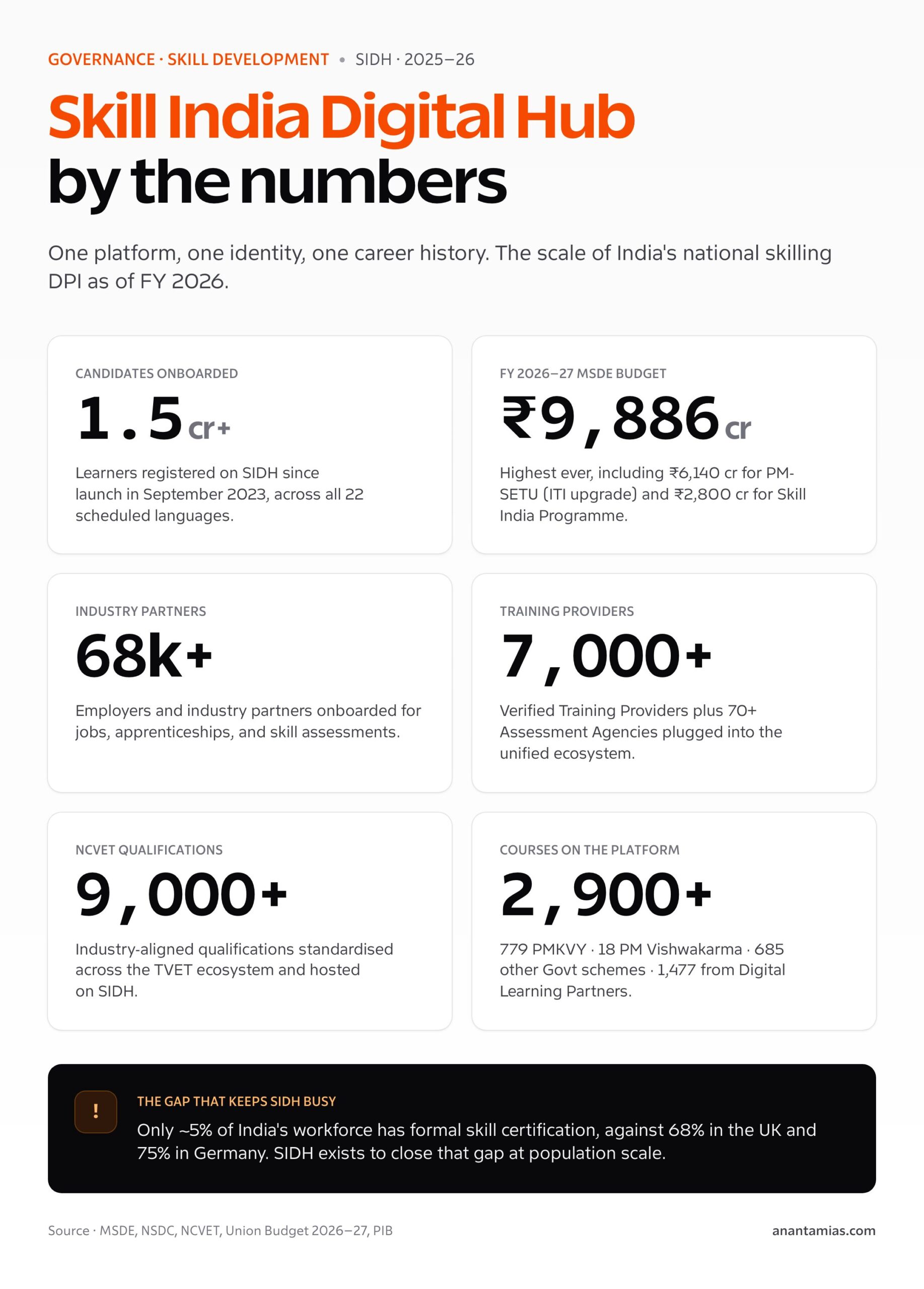
The Skill India Digital Hub (SIDH) is India’s national Digital Public Infrastructure (DPI) for skilling, education, employment, and entrepreneurship. Launched on 13 September 2023 by the Union Minister for Skill Development and Entrepreneurship Shri Dharmendra Pradhan, the Skill India Digital Hub stitches together what used to be a tangle of separate portals — PMKVY, NAPS, DDU-GKY, Jan Shikshan Sansthan, and more — into one Aadhaar-linked, mobile-first platform. By the close of FY 2026, more than 1.5 crore candidates, 7,000+ training providers, 70+ assessment agencies, and 68,000+ employers had been onboarded, against a backdrop where only about 5% of India’s workforce holds a formal skill certification.
For UPSC, the Skill India Digital Hub matters in GS-II (Governance, e-governance, welfare schemes), GS-III (employment, demographic dividend, inclusive growth), and Essay (future of work, youth empowerment). This guide walks you through the platform’s architecture, the schemes it integrates, the FY 2026–27 budget push, the global comparisons, the honest criticisms, and the Mains-ready takeaways.
UPSC relevance and quick syllabus map
- GS Paper II: Government policies and interventions; e-governance; welfare schemes for vulnerable sections; mechanisms, laws, institutions for development.
- GS Paper III: Employment, inclusive growth, demographic dividend, human resource as a factor in growth.
- Essay and Ethics: Future of work, youth empowerment, dignity of labour, fair access.
- Prelims hooks: SIDH launch (13 Sept 2023, by MSDE), PMKVY 4.0, NCVET, NCrF, NAPS, PM-SETU, Skill India Programme outlay (₹9,885.80 crore in 2026–27).
Background: from many portals to one Skill India Digital Hub
The Skill India Mission and its original promise
The Skill India Mission was launched on 15 July 2015 with four working goals: skill 400 million people by 2022, narrow the mismatch between industry needs and workforce supply, raise productivity, and create entrepreneurs. The vehicle was the National Skill Development Mission, anchored in the Ministry of Skill Development and Entrepreneurship (MSDE) set up the same year.
The intent was right. The plumbing was not. Within a few years, India had a long catalogue of separate skill schemes, each with its own portal, login, and data silo:
- PMKVY (Pradhan Mantri Kaushal Vikas Yojana) — the flagship short-term skilling and certification scheme.
- DDU-GKY (Deen Dayal Upadhyaya Grameen Kaushalya Yojana) — placement-linked rural skilling.
- Jan Shikshan Sansthan (JSS) — adult education and skilling for non-literate and neo-literate learners.
- NAPS (National Apprenticeship Promotion Scheme) — industry-led apprenticeships.
- Skill India International Centres (SIICs) — pre-departure skilling for overseas mobility.
- State-level schemes — each with their own onboarding flow.
For a 19-year-old in a Tier-3 town, the experience was brutal. Different forms, different IDs, different course catalogues, no portable record of what she had already learned. The Skill India Digital Hub was designed to fix exactly that.
Why “digital hub” and not just another portal
SIDH is built as Digital Public Infrastructure, in the same family as Aadhaar, UPI, DigiLocker, and ONDC. That is the key idea. It is not a website you log into for one course. It is a layered open API stack that:
- Holds one identity per learner (Aadhaar e-KYC, OTP based).
- Stores certifications and credit records that travel with the learner.
- Lets ministries, states, training providers, and employers plug in their courses, jobs, and assessments.
- Exposes its course and credential data through verifiable APIs, so it can connect to UPI for incentive payments, DigiLocker for storage, and the Academic Bank of Credits for credit transfers.
Skill India Digital Hub: launch and institutional framework
| Detail | Information |
|---|---|
| Launched on | 13 September 2023 |
| Launched by | Shri Dharmendra Pradhan, Union Minister for Skill Development and Entrepreneurship |
| Co-attended by | Shri Rajeev Chandrasekhar, MoS for Skill Development & Electronics and IT |
| Anchor ministry | Ministry of Skill Development and Entrepreneurship (MSDE) |
| Built and operated by | National Skill Development Corporation (NSDC) and NSDC International |
| Standards body | National Council for Vocational Education and Training (NCVET) |
| Domain | skillindiadigital.gov.in |
| Mobile app | Skill India Digital Hub app on Google Play and App Store |
The platform is positioned as the single front door for India’s skilling ecosystem and as a Digital Public Infrastructure showcased during India’s G20 Presidency. The DPI lens matters because it tells you what to expect: open standards, identity-first design, and continuous integration with new ministries and employer networks rather than a one-shot rollout.
Key features of the Skill India Digital Hub
One identity, one portable record
- Aadhaar-based eKYC and OTP login for trusted, low-friction registration.
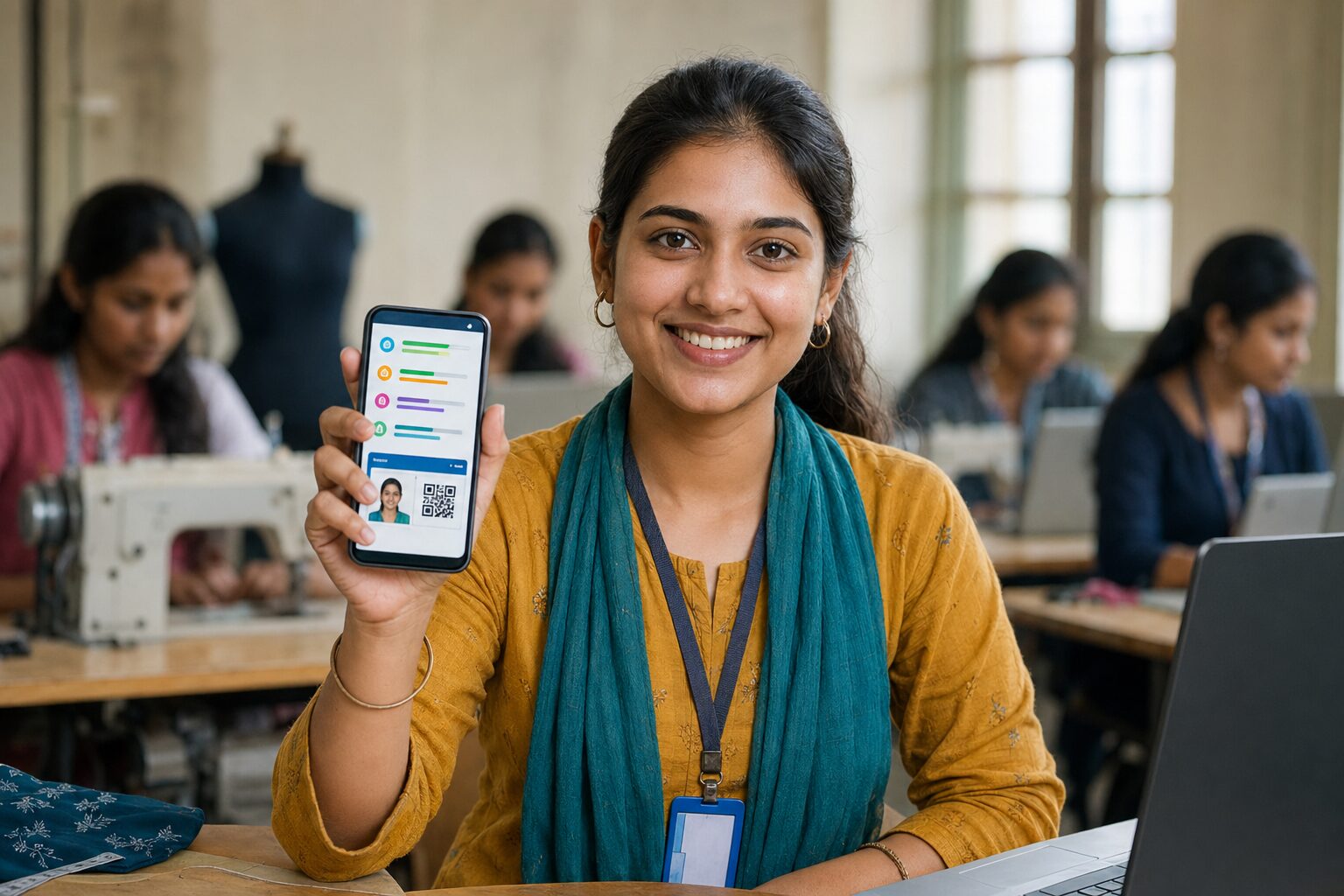
- QR-based digital and portable CV showing verified courses, certifications, internships, and apprenticeships.
- DigiLocker integration for issuing and storing certificates.
- Multilingual UI across major Indian languages, including a strong push to all 22 scheduled languages.
A unified Learning Management System
- Course enrolment, progress tracking, video and live classes via Big Blue Button, digital notes, discussion forums, and assessments inside one LMS.
- Recognition of Prior Learning (RPL) built in, so existing skilled workers can get certified without redoing what they already know.
- Offline-friendly design, including the mobile app, so learners with patchy data can still keep learning.
AI/ML matching and career pathways
- An AI and ML engine that reads a learner’s profile, prior credentials, and aspirations to suggest courses, jobs, and apprenticeships.
- Skill-gap analysis that tells a learner what is missing for a target job, not just what is available.
- Career-pathway recommendations that link short courses to longer diplomas to higher education.
Three audiences, three workflows
- Learners and trainees: Browse 2,900+ courses, enrol, learn, get certified, build a verified CV, apply for jobs and apprenticeships.
- Training providers: List courses against NCVET-aligned qualifications, manage enrolments, run assessments, track outcomes.
- Employers: Post jobs and apprenticeships, search verified candidates, request assessments, view skill analytics.
Course catalogue: what you can actually learn on SIDH
By the end of FY 2025–26, the Skill India Digital Hub hosts roughly 2,900+ courses, broken up as:
| Channel | Approximate count |
|---|---|
| PMKVY (incl. PMKVY 4.0) | 779 |
| PM Vishwakarma | 18 |
| Other Government schemes (DDU-GKY, JSS, sectoral) | 685 |
| Digital Learning Partners (DLPs) | 1,477 |
Sectors covered
Courses span more than 100 sectors. The biggest clusters today are:
- IT/ITeS: programming, data analytics, cloud, cybersecurity, and AI fundamentals.
- BFSI: banking ops, insurance distribution, customer service, RegTech basics.
- Manufacturing and automotive: production, quality control, EV components, semiconductors.
- Healthcare: general duty assistant, home health aide, lab technician, allied health.
- Construction: masonry, plumbing, electrical, surveying, finishing trades.
- Retail and hospitality: store ops, food and beverage, front-office.
- Agriculture and food: agritech, food processing, dairy, organic and natural farming.
- Green and sustainability: solar PV installer, energy auditor, EV technician, e-waste handler.
- Creative and media: animation, AVGC-XR, content production.
Course duration and stacking
- Short-duration (40–120 hours): entry-level certifications and reskilling modules.
- Medium-duration (150–400 hours): specialised skill courses with assessments.
- Long-duration (400–1,000+ hours): diploma-equivalent programs that map to academic credit.
Crucially, courses are not isolated. Under the National Credit Framework (NCrF) launched in 2023, credits earned on SIDH can be deposited in the Academic Bank of Credits (ABC) and combined with school and college credits. That is what makes SIDH a long-term lifelong learning platform rather than a short-course portal.
Schemes integrated with the Skill India Digital Hub
PMKVY 4.0 and the Skill India Programme
PMKVY is the flagship short-term skilling scheme. The 4.0 cycle rolled out from 2023–24 with three big shifts: shorter, employer-curated courses; deeper RPL coverage; and full integration into the Skill India Digital Hub for enrolment, attendance, assessment, and certificate issuance. PMKVY now sits inside the broader Skill India Programme (SIP), which the Union Budget for FY 2026–27 has resourced with ₹2,800 crore.
Apprenticeships and NAPS
Under the National Apprenticeship Promotion Scheme (NAPS), more than 25 lakh apprentices have been engaged so far. Apprentices earn a stipend, work on real industry shop floors, and get a portable certificate at the end. NITI Aayog has flagged in its 2025 paper on revitalising India’s apprenticeship ecosystem that scaling NAPS is one of the highest-return interventions for both employability and MSME productivity.
DDU-GKY for rural youth
Deen Dayal Upadhyaya Grameen Kaushalya Yojana targets rural poor youth in the 15–35 age group. It is residential, placement-linked (with a 75% minimum placement target), and explicitly oriented towards SCs, STs, women, minorities, and persons with disabilities. SIDH is the candidate-side onboarding for DDU-GKY today.
PM Vishwakarma and traditional artisans
PM Vishwakarma Yojana covers 18 traditional crafts, from carpenter and blacksmith to potter, weaver, and tailor. It bundles toolkit incentives, collateral-free credit, and skill upgradation. The 18 PM Vishwakarma trades are listed on SIDH so artisans can register, pick a trade, get assessed, and access credit and toolkit benefits in one place.
Jan Shikshan Sansthan and overseas skilling
- JSS — adult education plus skilling for non-literate and neo-literate learners, women, and rural youth, with emphasis on functional literacy plus a livelihood skill.
- Skill India International Centres (SIICs) — pre-departure orientation, language, and skill assessment for migrant workers, with mobility partnerships with the UAE, Saudi Arabia, Germany, Japan, Israel, and others.
PM-SETU: ITI upgrade in FY 2026–27
The Union Budget for FY 2026–27 has earmarked ₹6,140.50 crore for PM-SETU (Pradhan Mantri Skilling and Employability Transformation through Upgraded ITIs). The plan is to upgrade Industrial Training Institutes (ITIs) into modern, hub-and-spoke skilling centres aligned with NCVET qualifications, and to plug them directly into SIDH for admissions, attendance, and placements.
FY 2026–27 budget: ₹9,885.80 crore for MSDE
The Union Budget for 2026–27 gives the Ministry of Skill Development and Entrepreneurship its highest-ever allocation of ₹9,885.80 crore. The split tells you where the policy weight has shifted.
| Component | FY 2026–27 (₹ crore) | What it funds |
|---|---|---|
| PM-SETU | 6,140.50 | ITI upgrade, hub-and-spoke skilling network |
| Skill India Programme | 2,800.00 | PMKVY 4.0, JSS, NAPS, RPL |
| National Pool of Trainers and Assessors (PMKVY 4.0) | 200.00 | NCVET-driven SOPs, curricula, certification of trainers |
| Other components | ~745.30 | NSDC, autonomous bodies, international centres, IT and SIDH O&M |
The National Pool of Trainers and Assessors is the most quietly important line item. India’s skilling problem is not just learner-side. It is also a trainer-quality and assessor-quality problem. Codifying SOPs, curricula, and certification under NCVET, hosting them on SIDH, and training a national pool against a single quality benchmark is how the system is supposed to mature in the 2026–28 cycle.
Integration with education and the National Credit Framework
NEP 2020 and vocationalisation
The National Education Policy 2020 was explicit: vocational education should be mainstreamed from Class 6 onwards, and higher education should integrate skill credits. The Skill India Digital Hub is the operational layer that makes that integration practical, because credits earned on SIDH can be:
- Mapped to the National Skills Qualifications Framework (NSQF).
- Stored in the Academic Bank of Credits (ABC) via DigiLocker.
- Counted under the National Credit Framework (NCrF) for school, vocational, and higher education together.
School and college integration
- Samagra Shiksha integrates skill modules into school curriculum from Class 6 onwards.
- PM SHRI schools are pilots for skill-rich, future-of-work-ready education.
- Apprenticeship Embedded Degree Programmes (AEDPs) let undergraduate students stack a degree with paid apprenticeships, with both credentials sitting on SIDH.
- The push for AI in education has direct downstream effects on the SIDH course catalogue.
Why all this matters: India’s skilling gap and demographic window
India has one of the youngest workforces in the world. Reaping the demographic transition is not automatic, though. Three numbers explain why a high-quality SIDH matters for India’s growth story:
- ~5% of India’s workforce holds a formal skill certification, against around 68% in the UK and 75% in Germany. The gap is structural.
- 500 million+ youth and prospective workforce, with median age around 28.
- Mismatch: India produces graduates faster than the labour market can absorb them, while industry struggles to fill specialised roles in EV, semiconductors, healthcare, and logistics.
If India does not close the certification gap in the next decade, it risks the middle-income trap — exactly the scenario flagged by NITI Aayog and others. SIDH is the operational tool the State has chosen to attack that risk.
Comparison with other countries
| Country | Platform | Anchor design idea |
|---|---|---|
| India | Skill India Digital Hub | DPI: Aadhaar-linked, multilingual, multi-scheme aggregator |
| Germany | BIBB Bundes | Dual vocational training tightly coupled with apprenticeships |
| UK | National Career Service / Gov.uk | Career guidance plus apprenticeship levy |
| Singapore | MySkillsFuture | Lifelong learning credits per citizen |
| USA | CareerOneStop / MyFuturePathways | Career pathways with state-level training portals |
| Australia | myGov + USI | Unique Student Identifier across vocational and higher education |
India’s distinctive bet is scale plus DPI. Scale, because no other system targets 500 million-plus learners across 22 languages. DPI, because the system is designed as open APIs rather than a closed portal, which is what allowed UPI to outpace global peers.
Honest criticisms and limits of SIDH
A high-scoring Mains answer treats this section as table stakes, not a bonus.
- Digital divide: Skill India Digital Hub is mobile-first, but the bottom 30% of India still has uneven smartphone or data access. The offline app helps; it does not erase the gap.
- Quality variance across training providers: 7,000 TPs is impressive scale; it also means uneven quality. The National Pool of Trainers and PMKVY 4.0 standards are designed to fix this, but it will take cycles.
- Placement vs certification: Certificates do not automatically convert to jobs. PMKVY’s historical placement rate has hovered around 50%, which is decent at scale but signals a labour-market matching problem that no portal alone can solve. See our note on employment generation for youth for the wider debate.
- Informal-sector reach: Most Indian workers are in the informal urban workforce. RPL is the right tool here, but on-the-ground awareness and assessor capacity remain thin.
- Awareness and language: 22 languages on paper is not the same as 22 well-localised UI experiences. Course content quality in regional languages is still catching up.
- Industry alignment: NCVET has 9,000+ qualifications, but employers complain about skills lag in fast-moving fields like AI engineering, semiconductors, and EV battery engineering. The catalogue has to refresh faster than industry curricula change.
The critique is not “scrap SIDH.” The critique is: the platform succeeds only if the underlying ecosystem (trainers, assessors, employers, MSMEs, ITIs) keeps up. SIDH is the front-end. The back-end is the harder reform.
SIDH and the larger employment policy stack in 2026
Read the Skill India Digital Hub alongside three other 2025–26 levers and the picture sharpens:
- PM Viksit Bharat Rozgar Yojana (ELIS) — a wage-linked employment incentive scheme that pays formal employers and first-time formal employees, building on the EPFO base.
- Shram Shakti Niti 2025 — the new labour policy stance with stronger guardrails for vulnerable workers and gig and platform labour.
- NITI Aayog’s apprenticeship revitalisation paper — the case for scaling NAPS through SIDH integration.
SIDH provides the rails. ELIS provides the wage push. Shram Shakti Niti provides the floor. Together they describe how the State expects to convert demographic potential into actual employment.
Skill India Digital Hub inside the larger India Stack
One of the easiest ways to misread the Skill India Digital Hub is to treat it as a standalone portal. It is not. It sits as one layer inside India’s wider Digital Public Infrastructure stack, and that is precisely why it is supposed to scale faster than its predecessors.
| Layer | Role for SIDH |
|---|---|
| Aadhaar | One identity, e-KYC, OTP authentication for learners and trainers. |
| UPI | Stipend and incentive payments to apprentices and PMKVY trainees. |
| DigiLocker | Issuance and verification of digital certificates and IDs. |
| Academic Bank of Credits | Credit storage and transfer across school, vocational, and higher education. |
| eSHRAM | Informal worker database, used to extend RPL to unorganised sector workers. |
| ONDC | Standards inspiration for open commerce-style discovery and matching of training services. |
| India Enterprise Architecture (IndEA) | Reference architecture for ministries integrating their schemes into SIDH. |
This stack approach is what allows the Skill India Digital Hub to grow without rebuilding plumbing. When the Ministry of Rural Development brings a new DDU-GKY cohort online, when MeitY adds a green-skill course, or when an MSME network onboards as an employer, they reuse the same Aadhaar identity, the same DigiLocker layer, and the same NCVET qualifications.
Skill India 4.0 and the future-of-work agenda
The government has framed the next phase as Skill India 4.0 — explicitly oriented to the technologies that will reshape work between 2025 and 2035.
- AI, robotics, and semiconductors as priority sectors, with NCVET-aligned qualifications being added on a rolling basis.
- Green skilling across solar, EV, energy auditing, and waste management, in line with India’s net-zero 2070 commitment.
- AVGC-XR (Animation, Visual Effects, Gaming, Comics, Extended Reality) as a strategic creative-economy bet.
- Healthcare and care-economy roles, particularly nursing, geriatric care, mental health, and allied health.
- Digital and platform skills for the gig economy, with the Code on Social Security 2020 framework as the social-protection anchor.
Three operational levers underpin Skill India 4.0:
- AI-driven skill forecasting baked into SIDH, using employer demand signals and labour-market data to predict which roles will grow over 12–24 months.
- Virtual and augmented reality training for hands-on trades — welding, EV battery work, surgical assistance — where simulator hours can replace expensive equipment.
- International mobility with formal skill-passport recognition under bilateral agreements with the UAE, Saudi Arabia, Germany, Japan, and Israel.
A practical workflow: from RPL to job offer on SIDH
For an aspirant, it helps to picture how the platform actually behaves end-to-end for a real candidate. Take Asha, a 24-year-old who has been working as an unregistered tailor in a Tier-2 town for four years.
- Asha registers on the Skill India Digital Hub app with her mobile number and Aadhaar e-KYC. She is now assigned a single Skill India ID.
- She picks Recognition of Prior Learning (RPL) for “Sewing Machine Operator” under the Apparel Sector Skill Council. SIDH books her into the nearest assessment centre.
- She clears the assessment. An NCVET-aligned certificate is issued to her DigiLocker, and her QR-based portable CV updates automatically.
- SIDH’s AI engine sees a gap: she has no formal English communication credential. It recommends a 40-hour bridge course on the platform.
- She completes the course offline using the mobile app’s sync feature, and gets a second credential.
- An MSME garment exporter that has onboarded SIDH as an employer searches for “Sewing Machine Operator + basic English + NCVET certified” within 50 km of Asha’s pin code. She appears in the shortlist.
- She gets an interview, takes the job, and her career history is now portable across employers and across India.
That last point is the structural shift. Before SIDH, an Asha would have to start her CV from scratch every time she moved towns. After SIDH, her credentials travel with her, verified by the State, recognised by employers.
PMKVY by the numbers: cumulative impact
A short numbers anchor, useful for Mains and Prelims alike.
- 1.5 crore-plus enrolments under PMKVY since 2015 across 1.0, 2.0, 3.0, and 4.0 cycles.
- 40 lakh-plus certifications under PMKVY 3.0 alone.
- ~50% placement rate historically, with PMKVY 4.0 targeting better employer-curated outcomes through SIDH integration.
- 25 lakh-plus apprentices engaged under NAPS, with stipends paid via DBT to UPI/bank accounts.
- 9,000-plus NCVET qualifications standardising the catalogue, against fragmented sector council standards a decade ago.
How to use the Skill India Digital Hub today
- Visit skillindiadigital.gov.in or download the Skill India Digital Hub mobile app from Google Play or the App Store.
- Register with your mobile number and complete Aadhaar e-KYC.
- Build your profile: education, prior work, languages, location.
- Browse courses by sector or use the AI-powered recommendation panel.
- Enrol in a course; learn through the LMS; complete the assessment.
- Receive a NCVET-aligned digital certificate in DigiLocker and an entry on your QR-based portable CV.
- Apply for jobs and apprenticeships directly through the employer module.
- For artisans, register under a PM Vishwakarma trade and access toolkit incentives and credit linkage.
Mains-ready takeaways and answer scaffold
If you get a 10-mark question on the Skill India Digital Hub or skilling-led growth, this scaffold has consistently worked in our classroom evaluations.
- Definition (1–2 lines): SIDH is India’s national DPI for skilling, education, employment, and entrepreneurship, launched on 13 September 2023 by MSDE.
- Architecture (1 line): Aadhaar-based identity, NCVET-aligned credentials, DigiLocker storage, AI/ML matching, multilingual mobile-first design.
- Schemes integrated: PMKVY 4.0, NAPS, DDU-GKY, JSS, PM Vishwakarma, SIICs, PM-SETU.
- FY 2026–27 push: ₹9,885.80 crore MSDE outlay; ₹6,140.50 crore for PM-SETU; ₹2,800 crore for SIP; ₹200 crore for the National Pool of Trainers and Assessors.
- Why it matters: ~5% formal certification rate vs 68–75% in advanced economies; demographic dividend window; middle-income-trap risk.
- Critique (1 line): Digital divide, quality variance, placement gap, informal-sector reach, language localisation.
- Conclusion (1 line): SIDH is necessary but not sufficient; its success depends on parallel reform of trainers, assessors, ITIs, and employer engagement.
Key takeaways
- The Skill India Digital Hub was launched on 13 September 2023 by MSDE as India’s national DPI for skilling, education, employment, and entrepreneurship.
- It integrates PMKVY, NAPS, DDU-GKY, JSS, PM Vishwakarma, SIICs, and PM-SETU into one Aadhaar-linked, multilingual, mobile-first platform.
- By FY 2025–26: 1.5 crore+ candidates, 7,000+ training providers, 70+ assessment agencies, 68,000+ employers, 2,900+ courses, 9,000+ NCVET qualifications.
- FY 2026–27 budget: ₹9,885.80 crore for MSDE, with PM-SETU and the Skill India Programme as the two largest line items.
- SIDH is most powerful when paired with parallel reforms: trainer quality, NAPS expansion, ITI upgrade, and labour-market matching with the formal sector.
Frequently asked questions
What is the Skill India Digital Hub (SIDH)?
The Skill India Digital Hub is India’s national Digital Public Infrastructure for skilling, education, employment, and entrepreneurship. It is an Aadhaar-linked, multilingual, mobile-first platform run by the Ministry of Skill Development and Entrepreneurship (MSDE) and built by NSDC, with NCVET as the standards body.
When was the Skill India Digital Hub launched and by whom?
The Skill India Digital Hub was launched on 13 September 2023 by Shri Dharmendra Pradhan, Union Minister for Skill Development and Entrepreneurship, in New Delhi, with MoS Shri Rajeev Chandrasekhar in attendance. It was showcased as a Digital Public Infrastructure during India’s G20 Presidency.
How is SIDH different from older skill portals?
Older portals were scheme-specific and disconnected. SIDH is built as DPI: one Aadhaar-linked identity, NCVET-aligned credentials, DigiLocker-stored certificates, AI/ML matching, and open APIs that let multiple ministries, states, training providers, and employers plug in. It is designed as the single front door for all Skill India schemes.
How many users and partners are on SIDH?
By the close of FY 2025–26, more than 1.5 crore candidates, 7,000+ training providers, 70+ assessment agencies, and 68,000+ employers and industry partners had been onboarded. The platform also hosts more than 2,900 courses, including 779 PMKVY courses, 18 PM Vishwakarma trades, 685 other Government scheme courses, and 1,477 from Digital Learning Partners.
What is the FY 2026–27 budget for skilling, and how is it split?
The Union Budget for FY 2026–27 has allocated ₹9,885.80 crore to MSDE — its highest-ever outlay. ₹6,140.50 crore goes to PM-SETU (ITI upgrade), ₹2,800 crore to the Skill India Programme (PMKVY 4.0, JSS, NAPS, RPL), and ₹200 crore to a National Pool of Trainers and Assessors under PMKVY 4.0.
What schemes are integrated with the Skill India Digital Hub?
PMKVY 4.0, the National Apprenticeship Promotion Scheme (NAPS), Deen Dayal Upadhyaya Grameen Kaushalya Yojana (DDU-GKY), Jan Shikshan Sansthan (JSS), PM Vishwakarma (18 trades), Skill India International Centres (SIICs), and PM-SETU. State skill schemes also plug in via APIs.
How does SIDH connect to school and higher education?
Through the National Credit Framework (NCrF) launched in 2023, credits earned on SIDH map to the National Skills Qualifications Framework (NSQF) and can be deposited in the Academic Bank of Credits (ABC) via DigiLocker. This makes SIDH a lifelong learning platform that interoperates with NEP 2020’s vocationalisation push.
What is the digital divide criticism of SIDH?
SIDH is mobile-first and supports offline sync, but the bottom 30% of Indians still face uneven smartphone or data access, and trainer and language localisation quality is uneven. RPL and Jan Shikshan Sansthan integration help, but on-the-ground awareness, assessor capacity, and last-mile training quality remain the harder problems.
How can I register on the Skill India Digital Hub today?
Visit skillindiadigital.gov.in or download the Skill India Digital Hub app from Google Play or the App Store. Register with your mobile number and complete Aadhaar e-KYC, build your profile, browse or accept AI-recommended courses, complete the assessment, and receive an NCVET-aligned digital certificate stored in DigiLocker plus a QR-based portable CV.
Why does SIDH matter for India’s demographic dividend?
Only about 5% of India’s workforce holds formal skill certification, against around 68% in the UK and 75% in Germany. With 500 million-plus youth and a narrow demographic window, scaling certified, employable skills is essential to avoid the middle-income trap. SIDH is the operational rail that the Indian State has chosen to attack that gap.