Why in News?
In April 2026, the Ministry of Labour and Employment (MoLE), in consultation with the Employees’ Provident Fund Organisation (EPFO), notified the operational guidelines of the Prime Minister Viksit Bharat Rozgar Yojana, popularly styled the Employment-Linked Incentive Scheme (ELIS). The scheme was first announced in the Union Budget 2025-26 as the government’s flagship instrument to boost formal hiring, deepen social security coverage and arrest the jobless-growth critique that has dogged the post-pandemic recovery.
The newly notified rules lay down eligibility thresholds, disbursement timelines through the EPFO architecture, and employer verification protocols. With a total outlay of Rs 1.07 lakh crore over two financial years and a stated target of 4.1 crore additional jobs, ELIS is being presented as the labour-market counterpart to the Production Linked Incentive (PLI) scheme that transformed manufacturing investment after 2020.
For UPSC aspirants, the scheme sits at the intersection of multiple debates: jobless growth, informality of India’s workforce, the slow operationalisation of the four Labour Codes, and the policy pivot from skilling to direct wage subsidy. It is also the first major test of whether India can convert cyclical formalisation gains into structural ones.
UPSC Relevance at a Glance
| Dimension | Mapping |
|---|---|
| GS Paper | GS3 — Indian Economy, Employment, Inclusive Growth |
| Prelims | ELIS outlay, EPFO wage ceiling, PLFS vs CMIE, Labour Codes count |
| Mains | Employment generation, formalisation, fiscal efficacy of wage subsidies |
| Syllabus Tags | Human Resources, Mobilisation of Resources, Growth and Development |
| Essay Angle | Jobless growth, demographic dividend, welfare state design |
Background and Context
India’s employment puzzle has always been statistical and structural in equal measure. The Periodic Labour Force Survey (PLFS) from the National Statistical Office records an unemployment rate of around 3.2 per cent in 2024-25, while private tracker CMIE reports figures closer to 7-8 per cent for comparable months. The gap is not noise. It reflects definitional choices around who counts as employed, how unpaid family labour is treated, and whether discouraged workers are included in the labour force.
Beneath both numbers sits a deeper reality. Roughly 90 per cent of India’s 56-crore workforce is informal, lacking written contracts, social security or predictable wages. The organised sector, proxied by EPFO subscribers, covers barely 7.5 crore active members. Formalisation has climbed since the pandemic, but much of the gain is attributed to statutory enforcement rather than genuine job creation.
The policy backdrop is equally layered. The earlier Aatmanirbhar Bharat Rozgar Yojana (ABRY), operational from October 2020 to March 2022, subsidised both employee and employer EPFO contributions for new hires earning up to Rs 15,000 a month. ABRY added about 60 lakh formal jobs on paper but suffered from low employer uptake, leakage and tepid post-scheme retention. Separately, the Pradhan Mantri Rojgar Protsahan Yojana (PMRPY) of 2016 reimbursed employer EPS contributions for new hires.
Supply-side interventions also proliferated. The Pradhan Mantri Kaushal Vikas Yojana (PMKVY), SANKALP, STRIVE, Deen Dayal Upadhyaya Grameen Kaushalya Yojana (DDU-GKY) and the apprenticeship-linked NAPS collectively trained over 2.5 crore youth. Yet placement rates hovered around 20-25 per cent, and wage outcomes rarely crossed Rs 12,000 per month. The diagnosis was simple: skilling without demand-side absorption is a sunk cost. ELIS is the government’s attempt to fix that missing demand.
Key Features
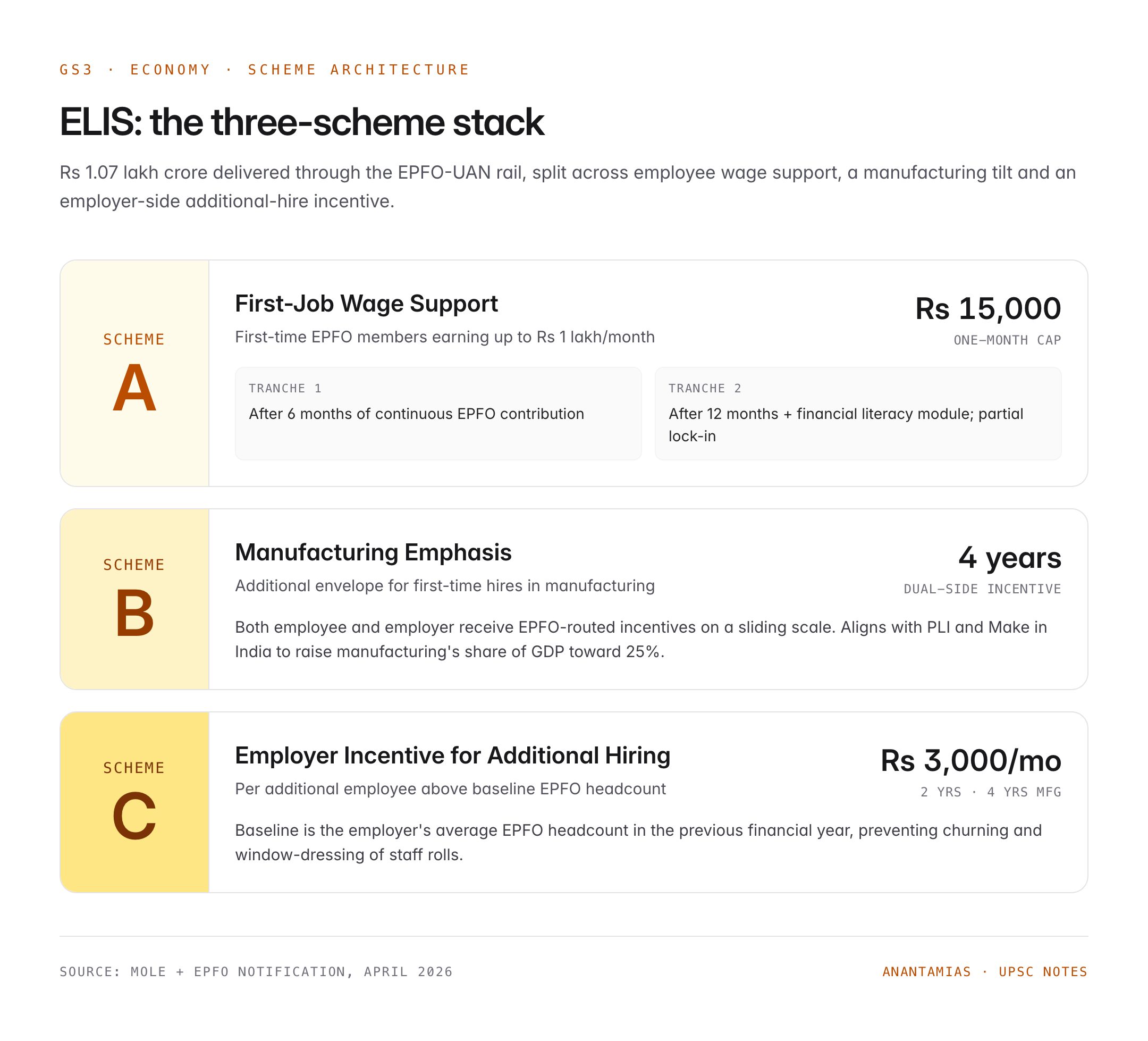
ELIS is a three-scheme architecture delivered entirely through the EPFO’s Universal Account Number (UAN) pipeline, making the scheme portable, auditable and Aadhaar-seeded by design.
Scheme A — First-Job Wage Support
The flagship component targets first-time formal entrants to the EPFO. An eligible employee, defined as someone registering their first UAN on or after 1 August 2025 and earning up to Rs 1 lakh per month, receives a one-time wage support equivalent to one month of EPF wages, capped at Rs 15,000. The payment is disbursed in two tranches. The first tranche arrives after six months of continuous EPFO contribution. The second follows completion of twelve months, contingent on attending a short financial literacy module delivered through the EPFO’s digital portal.
A portion of the second tranche is mandatorily parked in a savings instrument for a fixed lock-in, echoing the behavioural design nudges of Jan Dhan-Aadhaar-Mobile (JAM). The scheme targets around 1.92 crore first-time workers over two years.
Scheme B — Manufacturing Emphasis
Scheme B layers an additional incentive for first-time employees hired in the manufacturing sector. Both the employee and the employer receive a substantial EPFO-routed incentive during the first four years of employment, calibrated on a sliding scale tied to EPF wages. The objective is unambiguous: shift the compositional balance of job creation toward manufacturing, whose share in total employment has stagnated at around 11-12 per cent for a decade. This aligns with the broader Make in India 2.0 and PLI ambition of raising manufacturing to 25 per cent of GDP.
Scheme C — Employer Incentive for Additional Hiring
The employer-facing leg is structurally closest to ABRY but more generous. Any employer registered under EPFO and hiring additional employees beyond a baseline reference workforce receives Rs 3,000 per month per additional employee for two years. For manufacturing employers, the benefit extends to the third and fourth years as well. The wage ceiling for the additional employee is Rs 1 lakh per month. The baseline threshold is calculated from the employer’s average EPFO headcount in the previous financial year, preventing churning and window-dressing.
Implementation and Governance
| Parameter | Specification |
|---|---|
| Total Outlay | Rs 1.07 lakh crore |
| Duration | FY 2025-26 to FY 2026-27 (two years) |
| Target Beneficiaries | 4.1 crore jobs; 1.92 crore first-time workers |
| Wage Ceiling | Rs 1 lakh per month |
| Administering Agency | Ministry of Labour and Employment + EPFO |
| Delivery Rail | UAN, Aadhaar-seeded EPFO account, DBT |
| Verification | Employer EPFO ECR filings, biometric auth |
Payments are Direct Benefit Transfer (DBT) based, with anti-fraud triangulation against the e-Shram unorganised workers database and Income Tax TDS records.
Significance
- Demand-side pivot. ELIS breaks with two decades of supply-heavy skilling orthodoxy. By paying the employer and the worker at the point of hiring, it attacks the absorption gap directly rather than assuming it will clear itself.
- Formalisation push. Every ELIS beneficiary is by construction an EPFO member, which means access to provident fund, pension under EPS-95, and the Employees’ Deposit Linked Insurance (EDLI) scheme. This is a structural upgrade for workers who otherwise would have remained on the informal fringe.
- Manufacturing tilt. The extra four-year envelope for manufacturing hires complements PLI’s capital-side incentives. Together they create a coherent industrial policy stack where PLI rewards output and ELIS rewards payroll.
- Fiscal design. At Rs 1.07 lakh crore spread over two years, the outlay is roughly 0.15 per cent of GDP per year. If the 4.1 crore jobs target is even half-met, the cost per formal job created would fall below Rs 55,000, cheaper than MGNRGA-equivalent person-days and with multi-year social security spillovers.
- Behavioural architecture. The lock-in on part of the second tranche, the financial literacy requirement, and the two-tranche disbursement structure all incorporate lessons from behavioural economics. They hedge against consumption leakage and promote savings habit formation.
- Data infrastructure. ELIS forces tighter reconciliation between EPFO, e-Shram, PAN and Aadhaar. The data substrate it leaves behind will outlast the scheme itself.
Concerns and Challenges
The most serious concern is deadweight loss. If employers were going to hire anyway, paying them Rs 3,000 per month per additional employee simply transfers public money to private balance sheets without generating net new employment. International evidence on wage-subsidy schemes, including OECD evaluations of similar ELIS-type instruments in Europe and Latin America, finds deadweight ranging from 40 to 70 per cent. The Indian scheme’s baseline-comparison design reduces but does not eliminate this risk.
A second concern is displacement and substitution. Employers may retrench workers earning above the Rs 1 lakh ceiling or outside the baseline window to replace them with subsidised first-time hires. The two-year incentive window for Scheme C creates a cliff at month 25 that could trigger mass attrition.
Targeting and exclusion form the third worry. First-time EPFO entrants skew urban, male, and educated. Rural women, gig workers registered on e-Shram, and platform economy participants fall outside the scheme’s perimeter. Unless ELIS is complemented with a parallel track for informal workers, it could widen intra-labour inequality.
Administrative capacity is a further bottleneck. EPFO still struggles with claim turnaround times, KYC reconciliation and grievance redress. Layering a complex two-tranche, multi-scheme disbursal on top of existing workloads without proportional expansion of compliance capacity invites implementation failure.
Finally, ELIS operates in a policy vacuum on the four Labour Codes — Code on Wages 2019, Industrial Relations Code 2020, Occupational Safety, Health and Working Conditions Code 2020, and the Social Security Code 2020. Parliament has passed all four, but most states have not notified the rules. Without Code implementation, the definitional scaffolding of “employee”, “wages” and “establishment” that ELIS assumes remains legally unsettled.
Comparative / Historical Perspective
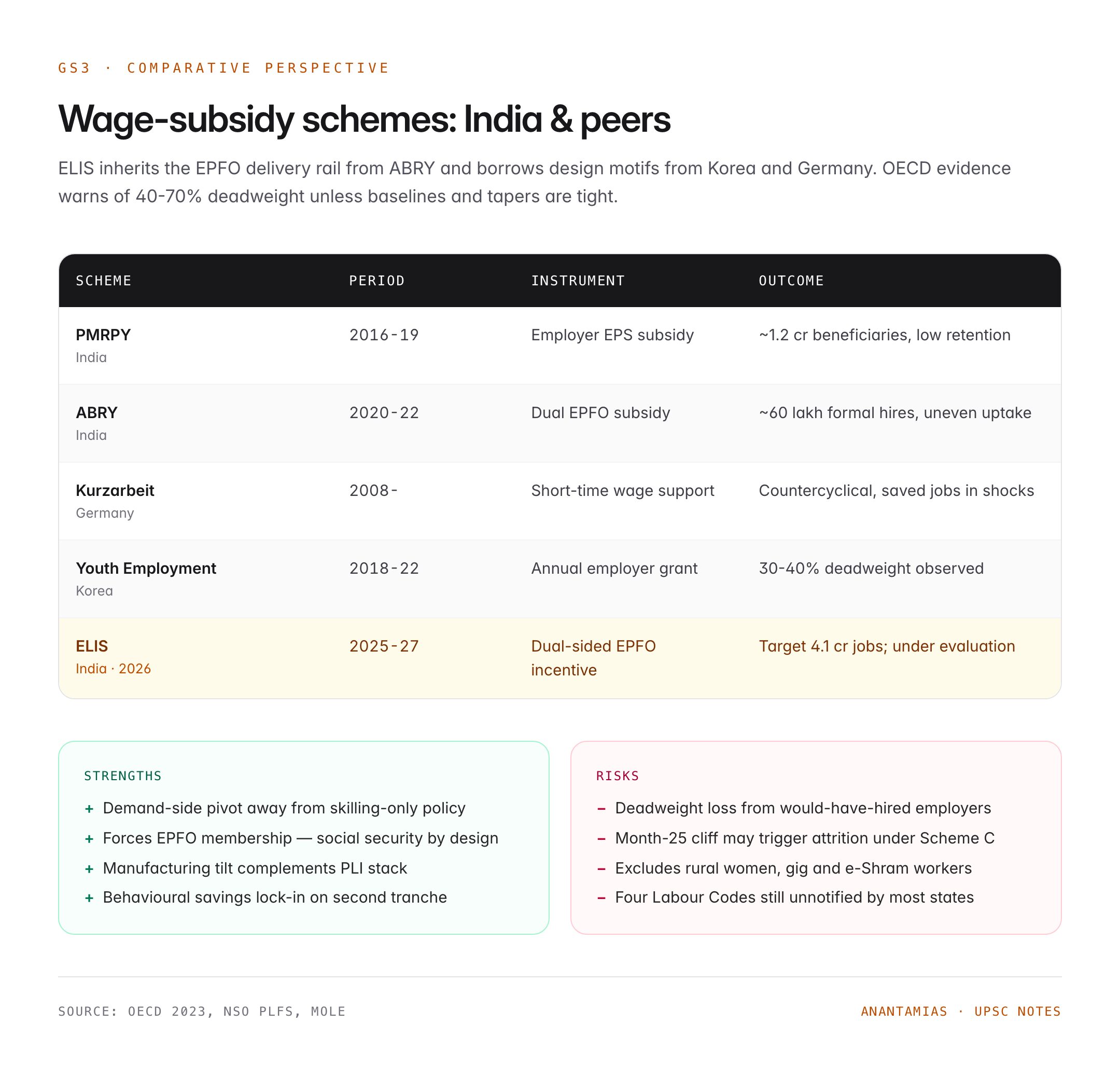
Wage-subsidy and employment-linked incentive schemes have a mixed global record. Germany’s Kurzarbeit short-time work model famously saved jobs in 2008-09 and 2020. South Korea’s Youth Employment Incentive paid employers KRW 9 lakh per year per young hire. Brazil’s Bolsa Empregador supplemented payroll during COVID. The OECD’s 2023 review of employment-linked incentive schemes concludes that such instruments work best when (a) tightly targeted, (b) time-bound, and (c) embedded in broader active labour market policies.
India’s ELIS can be read against its own domestic predecessors and international peers.
| Scheme | Period | Target | Instrument | Outcome |
|---|---|---|---|---|
| PMRPY (India) | 2016-2019 | Employers hiring new EPFO members | Employer EPS subsidy | ~1.2 crore beneficiaries; low retention |
| ABRY (India) | 2020-2022 | Pandemic-hit formal hiring | Dual EPFO subsidy | ~60 lakh jobs; uneven uptake |
| Kurzarbeit (Germany) | 2008- | Job retention in shocks | Short-time wage support | Highly effective; countercyclical |
| Youth Employment Incentive (Korea) | 2018-2022 | Youth first-job hiring | Annual employer grant | 30-40% deadweight observed |
| ELIS (India) | 2025-2027 | Formalisation + manufacturing | Dual-sided EPFO incentive | To be evaluated |
The ELIS design borrows ABRY’s EPFO delivery rail but layers manufacturing preference and a behavioural savings nudge that neither predecessor contained.
Way Forward
- Tighten baselines. MoLE and EPFO should publish quarterly employer-level baseline data to allow third-party verification of “additionality” claims.
- Integrate e-Shram. The Ministry of Labour should build a bridge pathway for unorganised workers registered on e-Shram to transition into EPFO-covered roles under ELIS Scheme A.
- Notify the Labour Codes. The Centre, in concert with states, must expedite notification of the four Labour Codes so that ELIS’s statutory scaffolding is clear.
- Independent evaluation. NITI Aayog, in partnership with the Development Monitoring and Evaluation Office (DMEO), should commission a randomised evaluation at the 12-month mark.
- Gender and rural tilt. The scheme should consider a topped-up component for female first-time hires and for hiring in Aspirational Districts, analogous to the differential incentives in PMAY-G.
- Convergence with PMKVY 4.0. MSDE should align ELIS with Pradhan Mantri Kaushal Vikas Yojana 4.0 so that subsidised first-job hires are drawn from skilled pipelines, improving employer match quality.
- Sunset clause and taper. The scheme must have a pre-announced taper so that employer expectations are anchored and no fiscal cliff forms at the end of FY 2026-27.
Conclusion
PM Viksit Bharat Rozgar Yojana is the most ambitious attempt by the Indian state in two decades to use the fiscal lever to directly change the composition of hiring. Its architecture reflects hard-learned lessons from PMRPY and ABRY, its delivery rides on the maturing EPFO-UAN-Aadhaar stack, and its manufacturing bias sits coherently alongside the PLI regime. Whether it succeeds will depend less on the size of the outlay and more on how cleanly the baseline rules are enforced and how rigorously the post-scheme retention is monitored.
For a country adding nearly a crore youth to the labour force every year, and still carrying a 90 per cent informal workforce, ELIS is necessary but not sufficient. It must be read alongside the four Labour Codes, PMKVY, DDU-GKY and the gig worker social security framework under the Social Security Code. India’s demographic dividend has an expiry date. ELIS is one instrument on the table; the question is whether the state will build the complementary scaffolding fast enough for the instrument to bite.
Prelims Pointers
- ELIS announced in Union Budget 2025-26; operational rules notified April 2026 by MoLE.
- Total outlay: Rs 1.07 lakh crore over two years (FY 2025-26 and FY 2026-27).
- Target: 4.1 crore additional jobs; 1.92 crore first-time formal workers.
- Income ceiling for beneficiary: Rs 1 lakh per month EPF wages.
- Scheme A one-time wage support capped at Rs 15,000, disbursed in two tranches.
- Scheme C employer incentive: Rs 3,000 per month per additional employee for two years; four years for manufacturing.
- Delivery rail: Universal Account Number (UAN) under EPFO, Aadhaar-seeded, DBT-based.
- Predecessor schemes: PMRPY (2016-2019), ABRY (2020-2022).
- India’s informal workforce share: around 90 per cent of 56-crore workforce.
- EPFO active members: approximately 7.5 crore.
- Four Labour Codes: Wages 2019, Industrial Relations 2020, OSH 2020, Social Security 2020.
- PLFS is released by NSO, MoSPI; CMIE is a private think-tank.
Mains Practice Question
Q. “The Prime Minister Viksit Bharat Rozgar Yojana attempts to fix India’s jobless-growth problem by targeting demand rather than supply.” Critically examine the design of ELIS and its likely impact on formalisation of India’s labour force. (15 marks, 250 words)
Answer skeleton:
- Frame the jobless-growth and formalisation problem, citing PLFS-CMIE gap and 90 per cent informality; introduce ELIS as a demand-side pivot from skilling-era supply policies.
- Examine Schemes A, B and C; highlight EPFO delivery, manufacturing tilt, and behavioural design; contrast with PMRPY and ABRY and OECD evidence on deadweight loss.
- Conclude with structural conditions for success: Labour Codes notification, e-Shram integration, gender targeting, independent evaluation, and convergence with PMKVY and PLI.
Frequently Asked Questions
What is the PM Viksit Bharat Rozgar Yojana (ELIS)?
PM Viksit Bharat Rozgar Yojana is India’s Employment-Linked Incentive Scheme, announced in Union Budget 2025-26 and operationalised in April 2026. It offers up to Rs 15,000 first-month wage support to first-time EPFO members and Rs 3,000 per month employer incentives for additional hires, with a total outlay of Rs 1.07 lakh crore to create 4.1 crore jobs in two years.
Why is the ELIS scheme in news in April 2026?
The Ministry of Labour and Employment along with EPFO notified the detailed operational rules of ELIS in April 2026, activating its three-scheme architecture. The notification clarified eligibility thresholds, two-tranche disbursement timelines and employer verification protocols, paving the way for actual claim processing through the Universal Account Number pipeline.
How do Scheme A, B and C of ELIS differ?
Scheme A offers one-time wage support up to Rs 15,000 to first-time EPFO members in two tranches. Scheme B adds extra incentives for manufacturing sector first-time hires across four years. Scheme C gives employers Rs 3,000 per month per additional employee beyond a baseline workforce for two years, extended to four for manufacturing.
Who is eligible under ELIS?
Employees earning up to Rs 1 lakh per month EPF wages and registering their first Universal Account Number on or after 1 August 2025 are eligible for Scheme A. Employers registered under EPFO hiring workers above a computed baseline headcount qualify for Scheme C. Manufacturing sector employers and workers unlock additional years of incentives under Scheme B.
How does ELIS differ from ABRY and PMRPY?
PMRPY reimbursed only employer EPS contributions for new hires. ABRY during the pandemic subsidised both employee and employer EPFO contributions for 24 months. ELIS goes further by paying direct wage support to first-time workers, adding a dedicated manufacturing leg, introducing behavioural savings lock-ins, and extending employer incentives up to four years for manufacturing.
What are the main criticisms of ELIS?
Critics cite deadweight loss since employers may have hired anyway, displacement of existing workers above the Rs 1 lakh ceiling, and exclusion of rural women, gig workers and e-Shram registrants. EPFO’s administrative capacity is stretched, and the unresolved status of the four Labour Codes creates legal ambiguity around definitions of employee and wages.
How does ELIS help UPSC preparation?
ELIS sits at the crossroads of GS3 Economy, Employment and Inclusive Growth topics. It offers concrete data points for Prelims, a policy-evaluation angle for Mains, and an essay-worthy frame of jobless growth and demographic dividend. Aspirants can link it with PLI, Labour Codes, PLFS-CMIE debates and formalisation, giving a high-leverage single story for multiple answer structures.
Why is formalisation of the Indian labour force important?
Around 90 per cent of India’s 56-crore workforce is informal, lacking contracts, provident fund, pension or insurance. Formalisation through EPFO membership under ELIS delivers statutory social security via EPS-95 and EDLI, strengthens the tax base, improves data visibility for policy, and lifts worker bargaining power, making growth more inclusive and shock-resilient.
Tell Google you want more of this.
Add Anantam IAS as a preferred sourceOne tap, and this site shows up more often in your own Top Stories, AI Overviews and AI Mode. Remove it any time.