Synthetic Biology Explained: DBTL Cycle, Applications, and India’s Regulatory Framework
A complete UPSC GS-III explainer on synthetic biology. Covers what synbio is, the design-build-test-learn cycle, core tools like CRISPR and DNA synthesis, applications in fuels and medicine, biosafety risks, and India's regulatory and policy framework.
Synthetic biology is what happens when you treat living cells like engineering platforms. Instead of studying organisms as nature built them, synbio designers take DNA sequences from a library, rewrite them, paste them into a host cell, and program the cell to do something it would never do on its own. The host might produce a malaria drug, secrete a biofuel, or sense a toxin in groundwater. The shift from descriptive biology to engineering biology is what separates synthetic biology from older recombinant DNA work.
The field is now the centrepiece of the global bioeconomy push. The OECD estimates the bioeconomy could reach 30 trillion US dollars by 2030, and synthetic biology is the most disruptive engine inside it. India launched the BioE3 Policy in 2024 to position the country as a major synbio manufacturing hub, building on a regulatory architecture that has handled genetically modified organisms since the 1980s. The infrastructure of biotechnology regulation in India was built for an earlier generation of techniques. Synthetic biology stretches it in ways the policy framework is still catching up with.
For UPSC GS-III, synbio sits at the intersection of biotechnology, environmental safety, public health, intellectual property, and trade. This article walks through what synthetic biology is, the design-build-test-learn cycle that defines its workflow, the core tools used, the major applications, the biosafety concerns, and India’s regulatory framework.
Quick Facts on Synthetic Biology
Synthetic biology, often shortened to synbio, is the field of designing and constructing new biological parts, devices, and systems for useful purposes, or redesigning natural biological systems. The defining principle is that biological systems can be engineered like machines, by assembling DNA parts to create functions not normally found in nature.
The term came into use in the early 2000s, distinguishing the new wave of work from older genetic engineering. The launch of the iGEM competition at MIT in 2004 created a generation of practitioners. Craig Venter’s group built the first synthetic bacterial genome in 2010, and George Church’s lab at Harvard demonstrated the first recoded organism in 2013. India’s first major synbio research push came through the DBT-funded Biotech Centres of Excellence in the mid-2010s, with the Indian Institute of Science Education and Research, the Institute of Genomics and Integrative Biology, and the National Centre for Biological Sciences as anchor institutions.
The four core capabilities that define synbio are artificial design and chemical synthesis of DNA, programmable genome editing, construction of new biological pathways and gene circuits, and use of standardised host cells called chassis organisms.
How Synthetic Biology Differs from Traditional Genetic Engineering
Traditional recombinant DNA work, the technology that produced human insulin in E. coli in 1978, takes a single gene from one organism and inserts it into another. The result is a host that now makes one new protein. The metaphor is cut and paste, with one piece of code at a time.
Synthetic biology operates at scale and at the systems level. Instead of moving one gene, synbio designers assemble entire metabolic pathways from dozens of genes, sometimes from multiple source organisms, all engineered to work together. They use computer-aided design software to lay out gene circuits, automated DNA synthesis to build the parts, and high-throughput screening to test thousands of variants. The metaphor is no longer cut and paste. It is software engineering, with version control, modular components, and iteration.
The other shift is from extraction to fabrication. Traditional biotech extracts what nature provides, then improves it. Synthetic biology designs what nature does not provide. Artemisinic acid, the precursor to the antimalarial artemisinin, is naturally extracted from the sweet wormwood plant. Sanofi and Amyris built a yeast strain that produces the same precursor at industrial scale. The synthetic route is independent of harvest cycles, weather, and land.
The Design-Build-Test-Learn Cycle
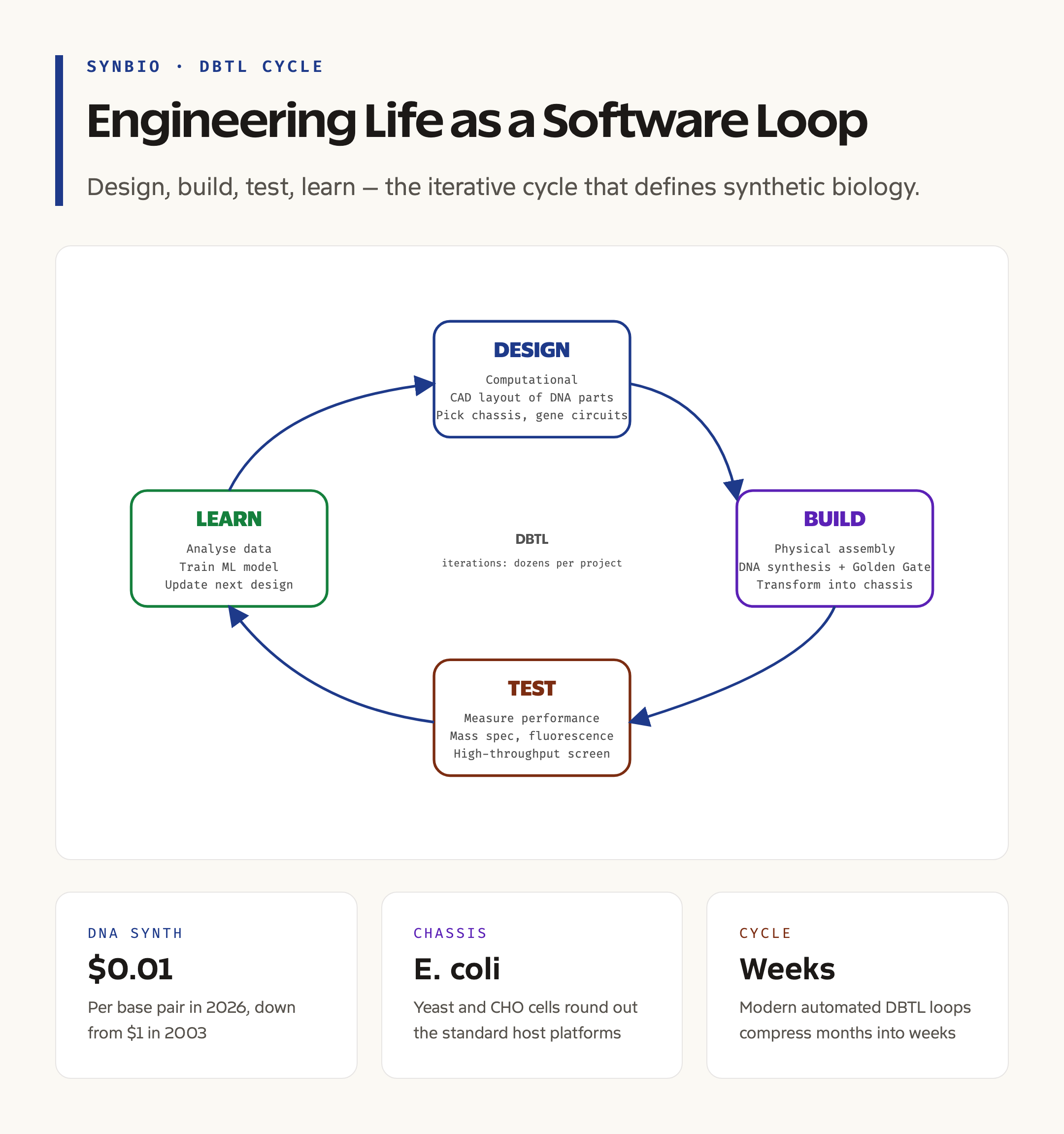
Every synbio project follows the same four-stage iterative loop, abbreviated DBTL.
Design is computational. The team specifies what the cell should do, breaks the function into modules, selects DNA parts from public registries like the BioBricks repository or the iGEM Parts Registry, and uses CAD tools to lay out the circuit. The output is a digital DNA sequence, often tens of thousands of base pairs long.
Build is physical. The DNA is ordered from a synthesis vendor or assembled in-house using methods like Golden Gate assembly or Gibson assembly. The synthesised DNA is transformed into the chassis organism, typically Escherichia coli, Saccharomyces cerevisiae yeast, or a mammalian cell line. Successful transformants are isolated.
Test is measurement. The engineered strain is grown under controlled conditions and the function is measured. If the goal is to produce a chemical, mass spectrometry quantifies output. If the goal is a sensor, fluorescence or growth response is measured. High-throughput screening allows thousands of variants to be tested in parallel.
Learn is analytical. The data feeds back into the design step. Machine learning models increasingly predict which design changes will improve performance, accelerating the cycle. A typical industrial synbio project goes through dozens of DBTL iterations before achieving target performance.
This loop is why synthetic biology is converging with computer science and machine learning. Foundation models for biology, trained on vast genomic and proteomic datasets, can now suggest design variants without exhaustive screening, compressing each cycle from months to weeks.
Core Tools of Synthetic Biology
DNA synthesis is the foundation. Companies like Twist Bioscience and IDT can synthesise custom DNA sequences of tens of thousands of base pairs at falling cost. The price of synthesising one base pair has fallen from around 1 US dollar in 2003 to under 0.01 US dollar in 2026. Whole genome-scale synthesis is now feasible for bacteria and yeast.
CRISPR-Cas, profiled in detail in our CRISPR explainer, provides programmable genome editing. CRISPR allows the synbio designer to insert, delete, or rewrite specific genome locations in the chassis organism without disrupting the rest of the genome. CRISPR base editors and prime editors extend this to single-letter changes.
Gene circuits arrange genes to act as logic gates. A simple toggle switch holds a cell in one of two stable states. An oscillator makes a gene turn on and off in regular cycles. More elaborate circuits implement AND, OR, and NOT logic, allowing a cell to integrate multiple inputs before producing an output. The first synthetic gene circuits, the toggle switch and the repressilator, were published in Nature in 2000.
Chassis organisms are the standardised hosts. E. coli is fast, well-characterised, and easy to transform. Yeast handles eukaryotic protein folding and is the workhorse for fermentation. CHO cells make complex therapeutics like monoclonal antibodies. Streptomyces species are used for antibiotic production. The trend is toward minimal chassis, organisms with most non-essential genes deleted, leaving a clean platform for engineered functions.
Major Applications of Synthetic Biology
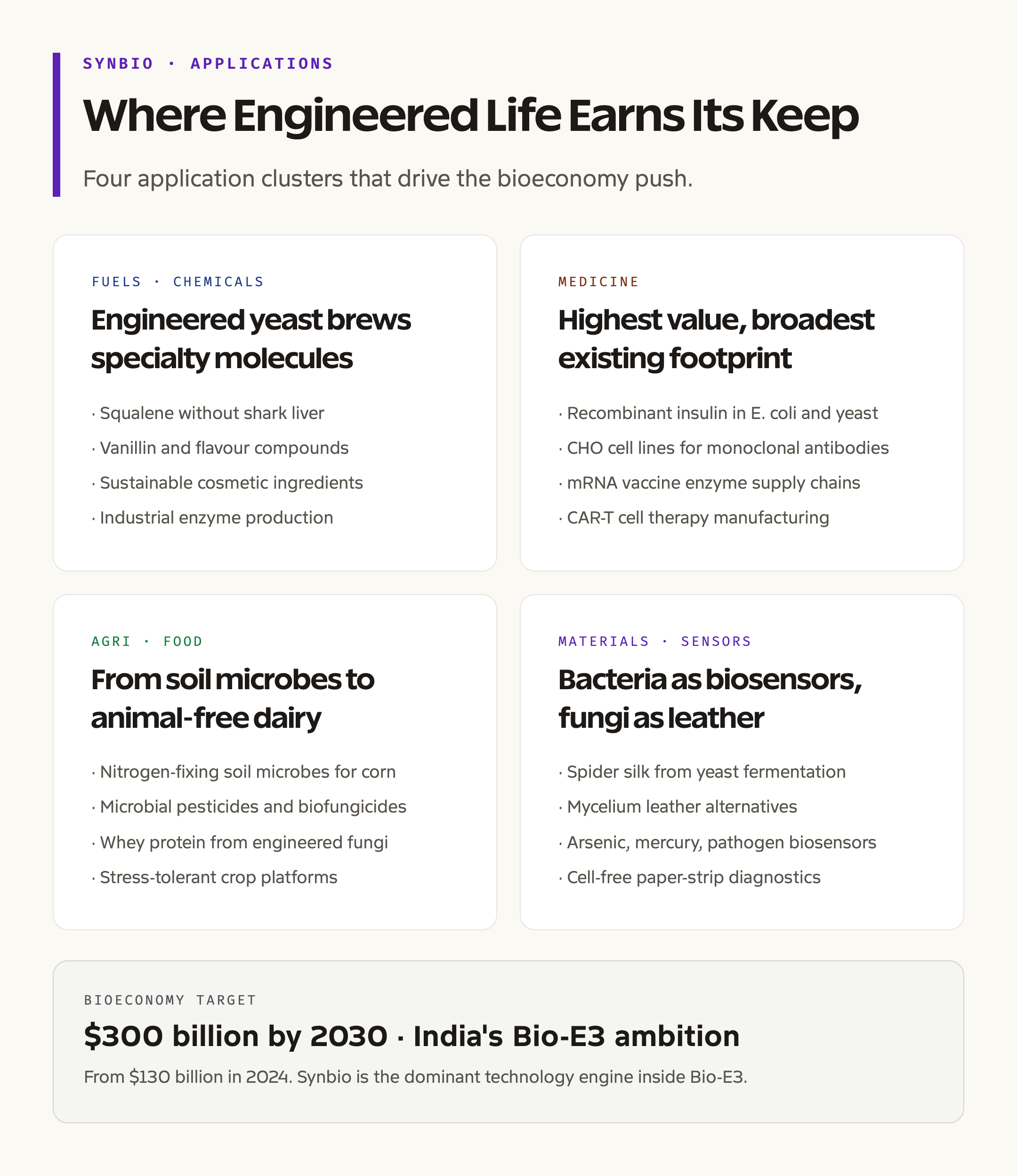
Industrial fuels and chemicals were the first major synbio market. Companies like Amyris built yeast strains producing biofuels and specialty chemicals. While early biofuel ventures struggled commercially, the platform shifted to higher-margin specialty molecules, fragrances, flavours, and cosmetic ingredients. Squalene, a moisturiser ingredient traditionally extracted from shark liver, is now produced sustainably by engineered yeast.
Medicine is the highest-value application. Engineered yeast and E. coli produce human insulin, growth hormone, and erythropoietin. Synthetic biology builds the cell lines used to manufacture mAbs and CAR-T cell therapies. Most mRNA vaccine manufacturing depends on synbio-derived enzymes and cell-free expression systems. Ginkgo Bioworks and Twist Bioscience are public synbio companies with significant pharma supply contracts.
Agriculture uses synbio for nitrogen-fixing microbes that reduce fertiliser need, microbial pesticides, and engineered seeds with stacked traits. Pivot Bio in the US sells nitrogen-fixing soil microbes for corn. India’s research is mostly upstream, with NBRC and ICGEB working on stress-tolerant crops, and IISER labs working on synthetic auxotrophy in nitrogen fixation pathways.
Materials and food include lab-grown leather alternatives produced by engineered fungi, spider silk made by yeast, and animal-free dairy proteins like whey produced by engineered microbes. Perfect Day produces dairy whey protein at industrial scale through fermentation.
Environmental sensors are an emerging area. Engineered bacteria can detect arsenic in drinking water, mercury in soil, or specific pathogens in waste streams. Cell-free biosensors deposit synbio components on paper strips for low-cost field detection.
India’s Synthetic Biology Programme and Bio-E3 Policy
India’s institutional infrastructure for synbio sits within the Department of Biotechnology, abbreviated DBT, of the Ministry of Science and Technology. DBT funds research grants, supports the Biotechnology Industry Research Assistance Council, abbreviated BIRAC, and runs autonomous institutes including the Institute of Genomics and Integrative Biology in Delhi, the Translational Health Science and Technology Institute in Faridabad, and the National Institute of Immunology.
The National Biotechnology Development Strategy 2020-2025 set out the policy direction for the bioeconomy. The Bio-E3 Policy, approved by the Union Cabinet in August 2024, expanded the scope. The three Es are economy, employment, and environment. The policy targets six thematic areas including high-value bio-based chemicals, smart proteins, precision biotherapeutics, climate-resilient agriculture, carbon capture and utilisation, and marine and space biotechnology. Synthetic biology is the technology backbone for most of these.
Bio-E3 also mandates the establishment of biomanufacturing hubs, a Biofoundry network, and Bio-AI hubs that combine synbio with machine learning. The Biotechnology Centres of Excellence at IISERs, IITs, and IISc anchor the research push. BIRAC’s Biotech Ignition Grant and SEED schemes fund early-stage synbio start-ups.
For UPSC, the Bio-E3 Policy is the most significant recent move and a likely answer-bank citation. The policy targets a 300 billion US dollar bioeconomy by 2030, up from around 130 billion in 2024.
Biosafety and Biosecurity Concerns
Synthetic biology raises three distinct categories of risk. Biosafety covers accidental release of engineered organisms and unintended ecological harm. Biosecurity covers deliberate misuse, including the synthesis of dangerous pathogens. Bioethics covers concerns about playing god, dual-use research, and equitable access.
The dual-use concern is sharpest. The synthetic genome of the 1918 influenza virus was reconstructed in 2005, and the horsepox genome was synthesised by a Canadian group in 2017 using commercial DNA orders. Modern DNA synthesis vendors screen orders against pathogen sequence databases under voluntary guidelines coordinated by the International Gene Synthesis Consortium, but no global treaty mandates such screening. Foundation AI models trained on biology data could lower the barrier further, a concern flagged repeatedly by the WHO and the Biological Weapons Convention review meetings.
Environmental release is the second area. Gene drives, a synbio technique that biases inheritance so a gene spreads through a wild population in a few generations, could in theory eliminate disease-vector mosquitoes. Released gene drives cannot easily be recalled, which raises serious ecological concerns and treaty implications under the Cartagena Protocol on Biosafety.
Regulatory Framework in India
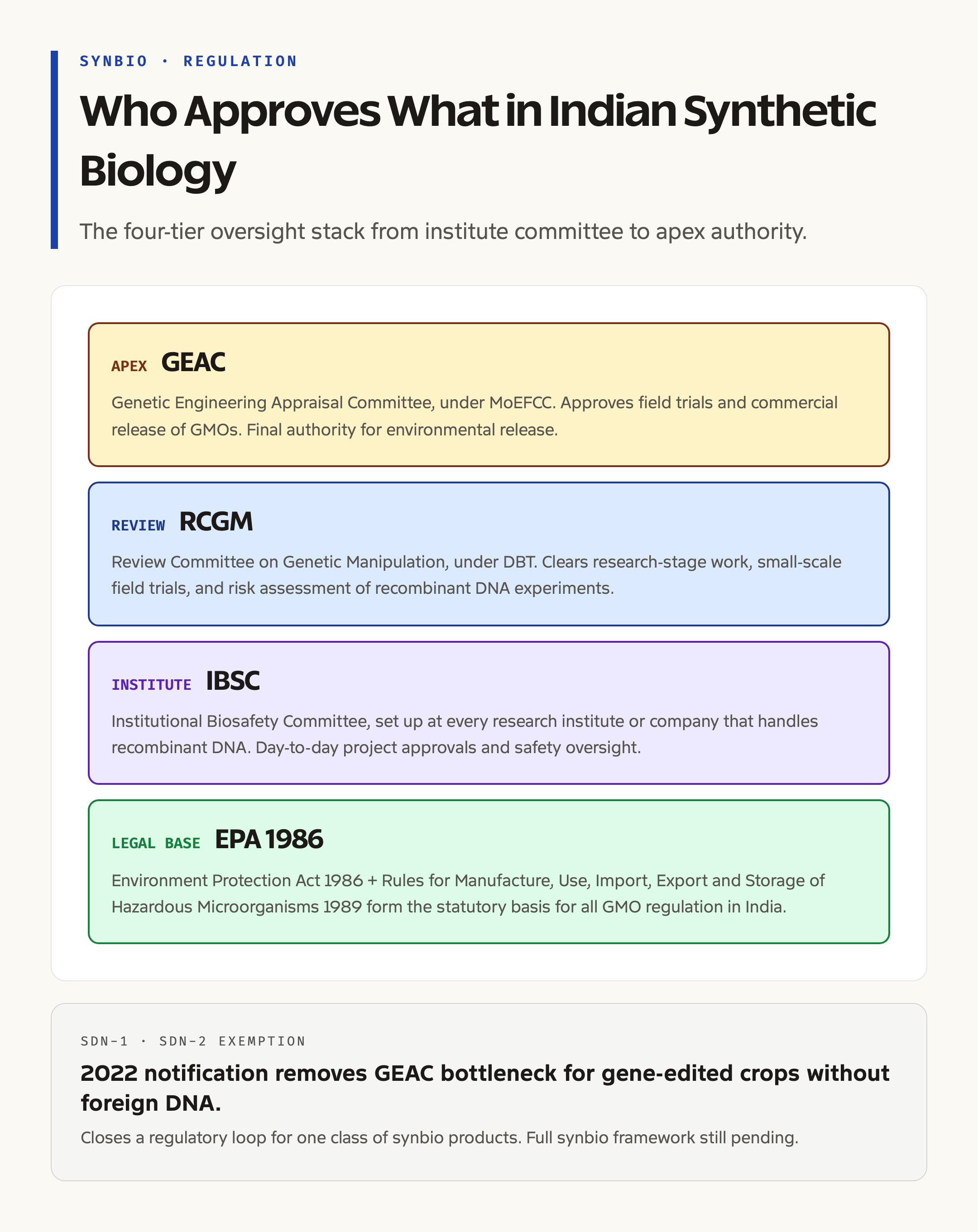
India’s regulation of engineered organisms is layered. The Environment Protection Act 1986 and the Rules for Manufacture, Use, Import, Export and Storage of Hazardous Microorganisms 1989 provide the legal basis. The Genetic Engineering Appraisal Committee, abbreviated GEAC, sits at the apex under the Ministry of Environment, Forest and Climate Change and approves field trials and commercial release of GMOs.
The Review Committee on Genetic Manipulation, abbreviated RCGM, sits under the DBT and clears research and small-scale field trials. Institutional Biosafety Committees, abbreviated IBSC, operate at every research institute or company handling recombinant DNA. The Recombinant DNA Safety Guidelines and the Biosafety Rules 1989 set procedural requirements.
For synthetic biology, the existing framework covers most use cases because synbio products are typically GMOs in legal terms. Where the framework strains is in cell-free systems, gene-edited products without foreign DNA, and AI-designed sequences. The 2022 SDN-1 and SDN-2 exemption notification for site-directed nucleases, profiled in our SDN explainer, partially addresses the gene-editing question by exempting SDN-1 and SDN-2 edits without foreign DNA from the GEAC pathway. A comprehensive synbio-specific framework has not yet been notified.
What to Watch Going Forward
Three trends will shape Indian synbio through the next five years. The first is integration with AI. Foundation models trained on biological data are now producing novel protein designs that work on the first attempt, and Indian labs at IISc and TIFR are starting to publish in this area. The second is the commercial scale-up of biomanufacturing hubs under Bio-E3, with the first hubs expected to be sanctioned in late 2025 and operational by 2027. The third is the regulatory rewrite. India’s Genetic Engineering Appraisal Committee is under pressure to update guidelines for SDN-3 and synbio-specific risk classes.
The strategic prize for India is moving from being a buyer of synbio products to being a global manufacturer. The cost structure of biomanufacturing favours countries with skilled biology talent, lower labour costs, and strong fermentation infrastructure, all of which India has at scale. Whether the policy execution matches the ambition is the question UPSC GS-III answers will have to address through the rest of the decade.
Frequently Asked Questions
What is the difference between synthetic biology and genetic engineering?
Genetic engineering moves single genes between organisms. Synthetic biology designs entire pathways and circuits at the systems level, using standardised parts, automated DNA synthesis, and iterative engineering cycles. Synbio is closer to software engineering than to traditional cut-and-paste recombinant DNA work.
What is a chassis organism?
A chassis is a host cell engineered to be a clean, predictable platform for synthetic biology designs. E. coli, baker’s yeast, and CHO cells are the most common chassis. Minimal chassis have most non-essential genes deleted to leave only the core machinery needed to host engineered functions.
Is synthetic biology the same as gene editing?
Gene editing, especially with CRISPR-Cas, is one tool used inside synthetic biology. Synbio is the broader engineering discipline that designs and builds new biological systems, often using gene editing alongside DNA synthesis, gene circuits, and chassis engineering.
What is the Bio-E3 Policy?
The Bio-E3 Policy was approved by the Union Cabinet in August 2024 to drive India’s bioeconomy through synthetic biology and biomanufacturing. The three Es stand for economy, employment, and environment. The policy targets a 300 billion US dollar bioeconomy by 2030 and supports biomanufacturing hubs, biofoundries, and Bio-AI integration.
Who regulates synthetic biology in India?
The Genetic Engineering Appraisal Committee under the Ministry of Environment is the apex regulator. The Review Committee on Genetic Manipulation under the DBT clears research-stage work, and Institutional Biosafety Committees handle institutional oversight. The legal framework comes from the Environment Protection Act 1986 and the Rules for Hazardous Microorganisms 1989.