A monoclonal antibody is one of the most precise weapons modern medicine has built. It is a lab-made protein engineered to recognise a single target on a cell, and only that target. The immune system already produces antibodies in vast variety to fight pathogens, but a monoclonal antibody, abbreviated mAb, is the opposite of variety. Every molecule in a vial of trastuzumab or rituximab is a clone of one parent cell, identical down to the atom, programmed to bind to one receptor or one antigen.
This precision is why mAbs have transformed cancer therapy, autoimmune disease, and emergency response to viruses like Ebola and SARS-CoV-2. They cost more than small-molecule drugs because they are grown by living cells in bioreactors, not synthesised in chemical plants. India has been one of the more active emerging markets for mAb development, with both originator approvals and a growing pipeline of biosimilars regulated by the Central Drugs Standard Control Organisation, abbreviated CDSCO.
For UPSC GS-III, mAbs sit at the meeting point of biotechnology, public health, intellectual property, and pharma manufacturing strategy. This article walks through what mAbs are, how they are produced, the three mechanisms by which they act, the major therapy classes, and India’s regulatory and approval picture.
Quick Facts on Monoclonal Antibodies
Antibodies are Y-shaped proteins of the immunoglobulin family produced by B-cells. The body makes a polyclonal mix in response to any infection, which means many slightly different antibodies attack many parts of the pathogen. A monoclonal antibody is the opposite. It is the single best-binding antibody isolated, then mass-produced from one parent cell line so every copy is identical.
The term monoclonal was coined in 1975 when Cesar Milstein and Georges Kohler at the Medical Research Council in Cambridge fused a mouse B-cell with a myeloma tumour cell to create a hybridoma. The hybridoma kept the antibody specificity of the B-cell and the immortality of the cancer cell. They received the Nobel Prize in Physiology or Medicine in 1984. The first FDA-approved therapeutic mAb, muromonab, came in 1986. As of 2026, more than 160 mAbs are approved globally, and the class is the single largest revenue category in the biopharmaceutical market.
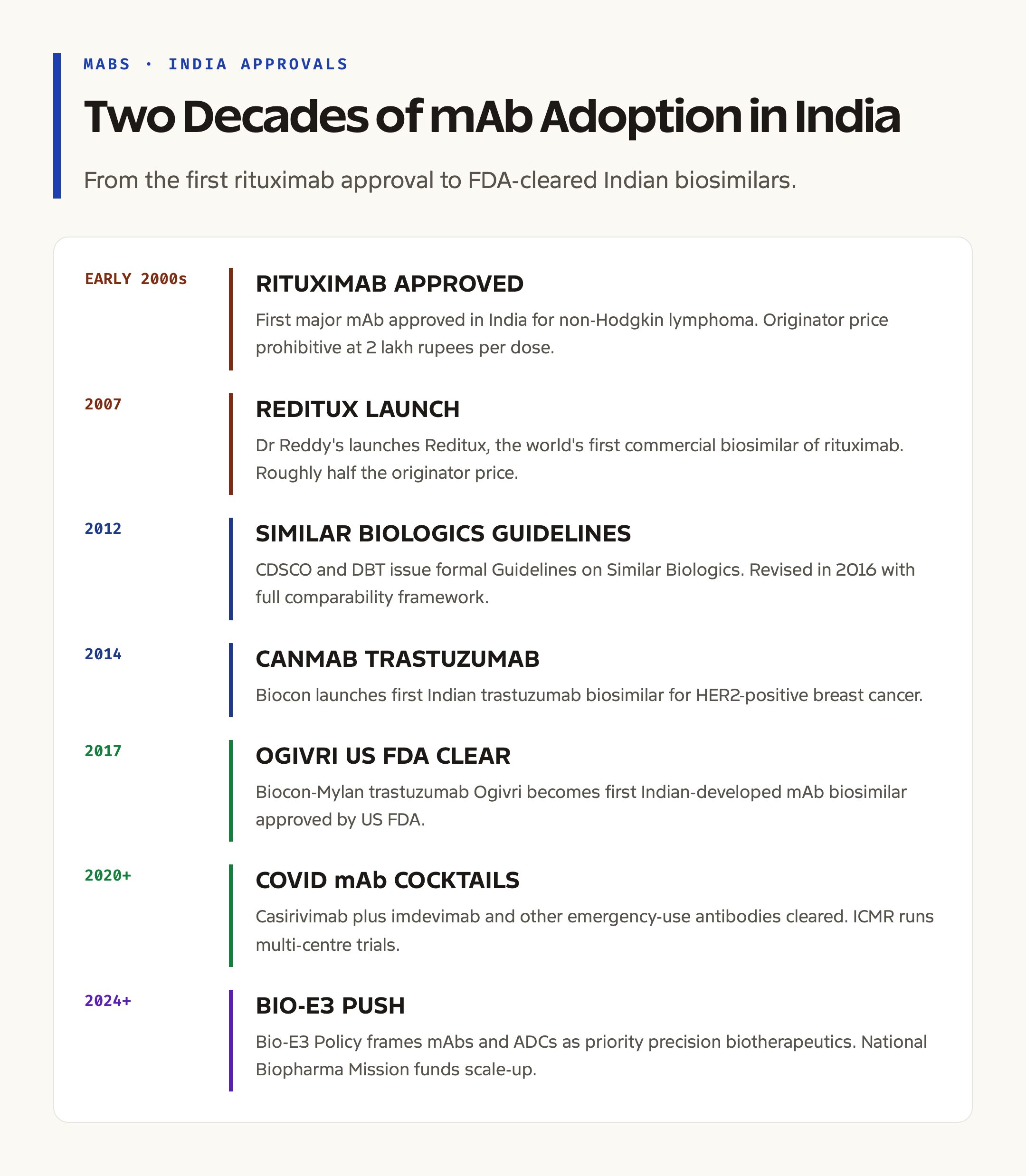
In India, the regulator for biologics including mAbs is CDSCO, working with the Department of Biotechnology, abbreviated DBT. The first major mAb approved for the Indian market was rituximab in the early 2000s. Reditux, the world’s first biosimilar of rituximab, was launched by Dr Reddy’s Laboratories in 2007.
How Monoclonal Antibodies Are Different from Polyclonal Antibodies
Polyclonal antibodies are the natural mix made by the immune system. If you contract influenza, dozens of B-cell lineages each make a slightly different antibody recognising different parts of the virus. The mix is diverse, and that diversity is useful for fighting an unknown pathogen because at least some antibodies will hit the right spot.
Monoclonal antibodies are uniform. Every molecule recognises the same epitope, the same precise patch on the target. The advantage is consistency. Every dose acts the same way. The disadvantage is fragility. If the target mutates, as SARS-CoV-2 spike protein did across variants, the mAb can lose effectiveness overnight. This is why mAb cocktails, mixtures of two or three different mAbs targeting different epitopes, are now common in antiviral use.
A useful analogy. Polyclonal antibodies are a militia, lots of soldiers attacking different parts of an invader. Monoclonal antibodies are a sniper team, every shooter aiming at the exact same weak spot.
How Monoclonal Antibodies Are Produced
There are two main routes for producing therapeutic mAbs.
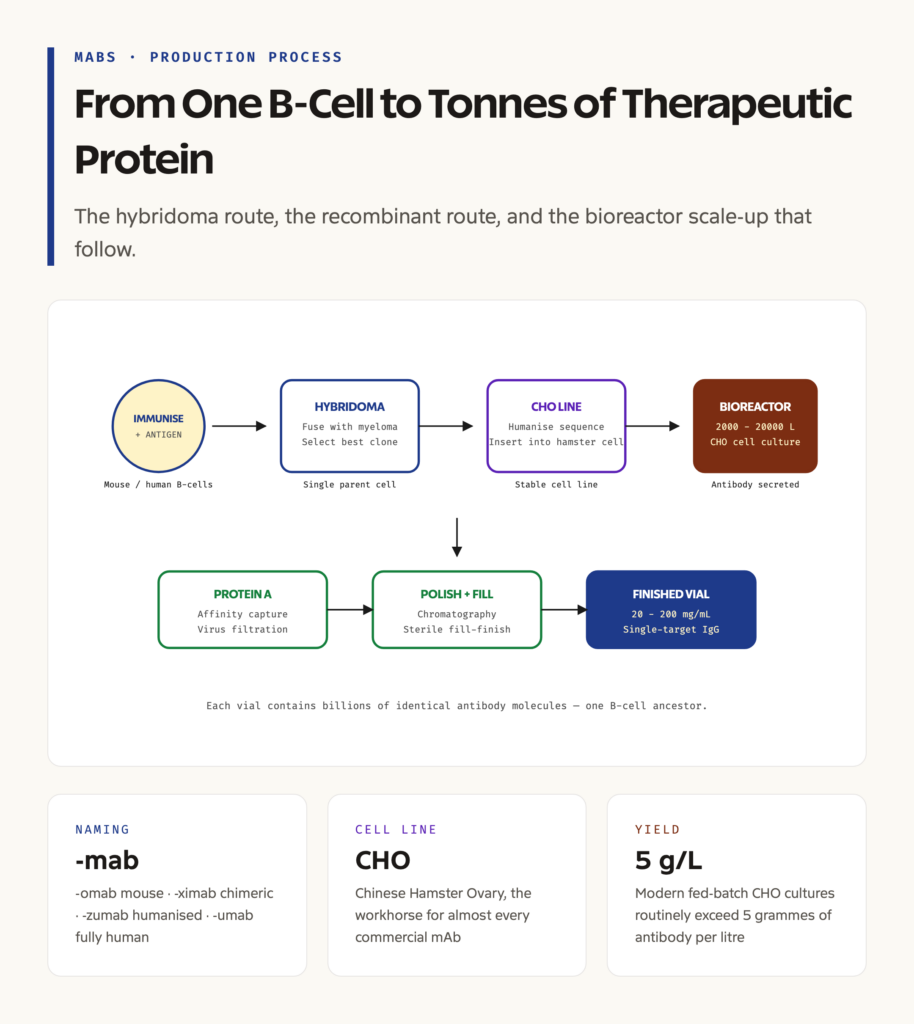
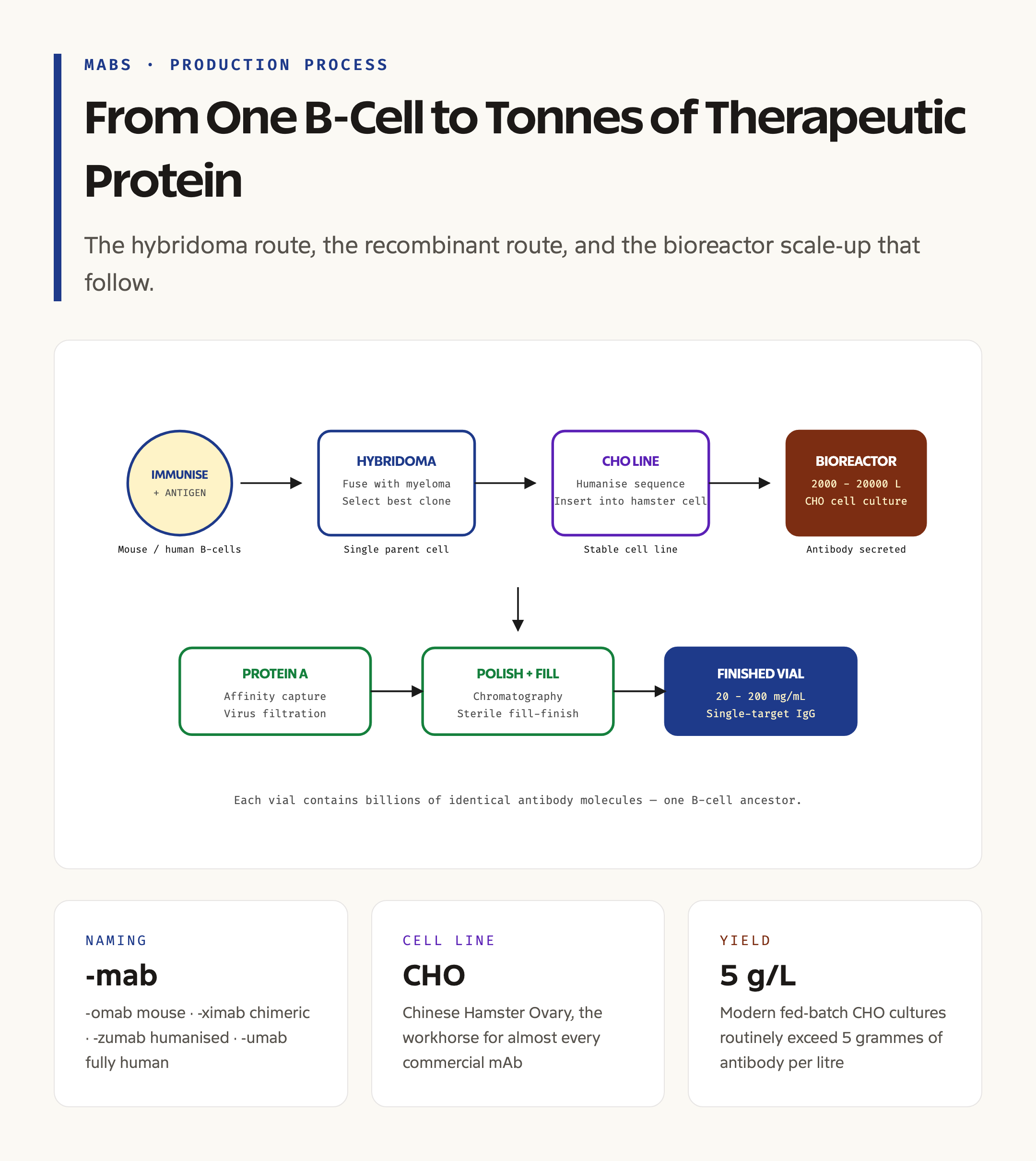
The classical hybridoma method involves immunising a mouse with the target antigen, harvesting B-cells from the mouse spleen, fusing them with myeloma cells using polyethylene glycol, and screening the resulting hybridomas for the one that produces the best antibody. That hybridoma is then cloned and grown in bioreactors. The problem with pure mouse mAbs is that humans treat them as foreign and produce anti-mouse antibodies, which can cause severe reactions. This led to the development of chimeric antibodies, which combine a mouse variable region with a human constant region, and humanised antibodies, which are almost entirely human with only the antigen-binding loops kept from the mouse parent.
The fully human route uses transgenic mice carrying human immunoglobulin genes, or phage display libraries that screen billions of human antibody fragments without using animals at all. Almost all new mAbs approved since 2020 are fully human or humanised.
The naming convention encodes the source. A drug ending in -omab is mouse, -ximab is chimeric, -zumab is humanised, and -umab is fully human. Trastuzumab is humanised. Adalimumab is fully human. Rituximab is chimeric.
Once the antibody is selected, the gene encoding it is inserted into a mammalian cell line, typically Chinese Hamster Ovary cells, abbreviated CHO. The cells are grown in steel bioreactors of 2,000 to 20,000 litres, fed with glucose and amino acids, and the antibody is harvested from the culture broth. Downstream purification uses protein A affinity columns followed by virus filtration and polishing chromatography. The final drug substance is filled into vials at concentrations of 20 to 200 milligrammes per millilitre.
The Three Mechanisms of Monoclonal Antibody Action
Therapeutic mAbs work by one or a combination of three mechanisms.
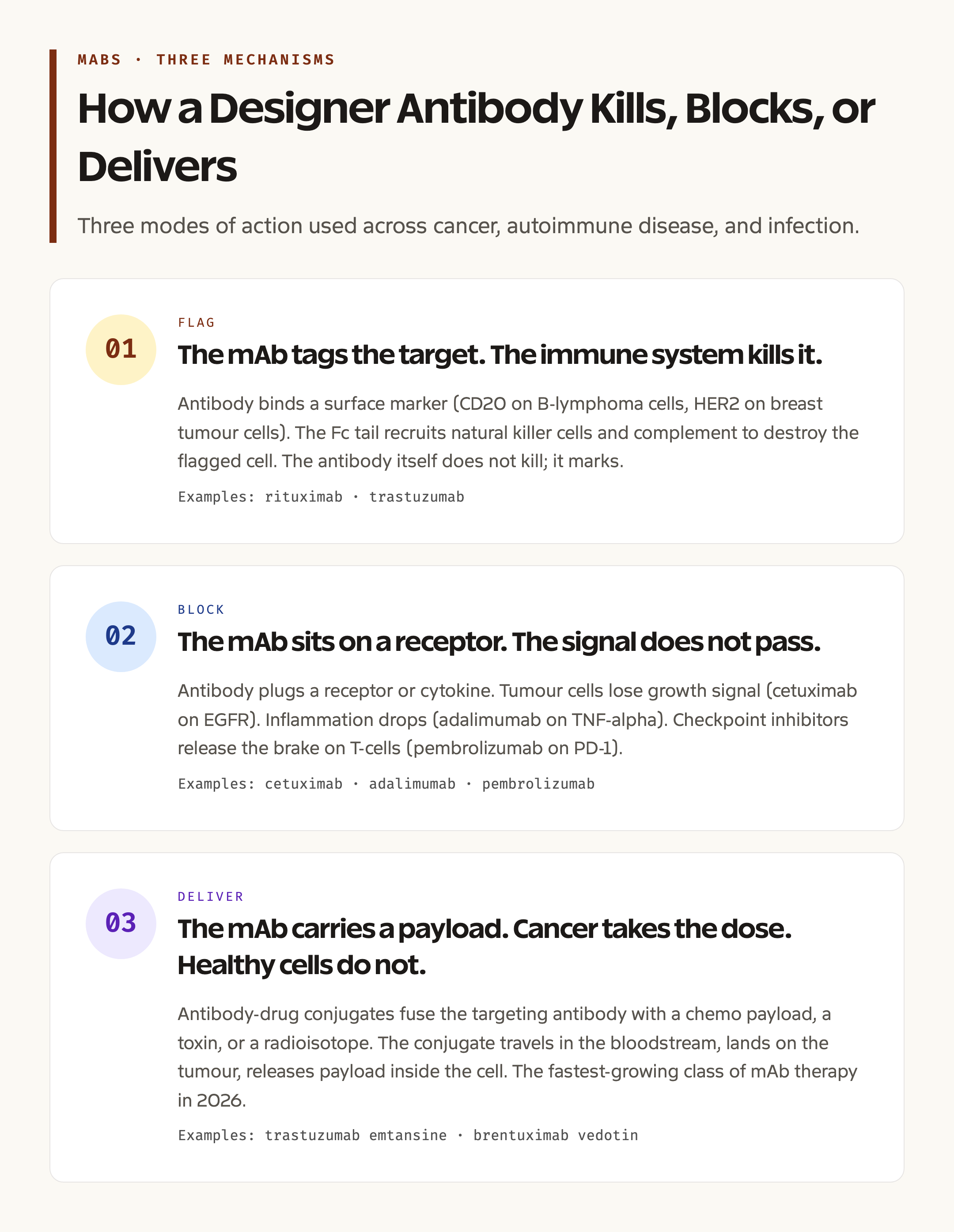
The first is flagging. The mAb binds to a target on a cancer cell or pathogen and the constant region of the antibody is recognised by immune cells. Natural killer cells, macrophages, and the complement system are recruited to destroy the flagged cell. Rituximab works this way against CD20 on B-cell lymphomas. The cancer cell does not die because of the antibody. It dies because the antibody marks it for the immune system.
The second is blocking. The mAb binds to a receptor and stops a signal from being sent or received. Cetuximab blocks the epidermal growth factor receptor on tumour cells, cutting off a growth signal. Adalimumab binds to tumour necrosis factor alpha and stops it from triggering inflammation, which is why it is used in rheumatoid arthritis, Crohn’s disease, and psoriasis. Checkpoint inhibitors like pembrolizumab block the PD-1 receptor on T-cells, releasing the brakes on the immune system so it can attack the tumour again.
The third is delivery. The mAb is conjugated to a payload, either a chemotherapy drug, a radioactive isotope, or a toxin. The antibody guides the payload to the cancer cell, sparing healthy tissue. These are called antibody drug conjugates, abbreviated ADCs. Trastuzumab emtansine combines the HER2-binding antibody trastuzumab with a microtubule poison, delivering chemotherapy directly to HER2-positive breast cancer cells. ADC development is the fastest-growing subclass within mAb therapy as of 2026.
Major Therapy Classes Built on mAbs
Cancer therapy is the largest application area. HER2-targeted antibodies for breast cancer, CD20-targeted antibodies for lymphoma, EGFR-targeted antibodies for colorectal cancer, and VEGF-targeted antibodies that starve tumours of blood supply are all multi-billion-dollar drug classes. Checkpoint inhibitors against PD-1, PD-L1, and CTLA-4 have become the backbone of immunotherapy in lung cancer, melanoma, and bladder cancer.
Autoimmune and inflammatory disease is the second-largest area. Anti-TNF drugs like adalimumab, infliximab, and etanercept treat rheumatoid arthritis, psoriasis, and inflammatory bowel disease. Anti-IL-17 and anti-IL-23 drugs treat severe psoriasis and ankylosing spondylitis. Omalizumab, an anti-IgE antibody, treats severe allergic asthma.
Infectious disease grew quickly during the COVID-19 pandemic. Casirivimab plus imdevimab, sotrovimab, and tixagevimab plus cilgavimab were emergency-use mAb cocktails against SARS-CoV-2. Most lost effectiveness as new variants emerged, which highlighted the limit of single-target therapy against a fast-mutating virus. Palivizumab, an older mAb, is still used to prevent respiratory syncytial virus in high-risk infants.
Cardiovascular and metabolic disease entered the mAb era with PCSK9 inhibitors. Evolocumab and alirocumab block the PCSK9 protein that controls LDL receptor recycling, lowering bad cholesterol dramatically in patients who do not respond to statins. The migraine class, anti-CGRP antibodies like erenumab, has changed prevention for chronic migraine sufferers.
Monoclonal Antibodies in India
India approved its first mAb, rituximab, for non-Hodgkin lymphoma in the early 2000s. The price was prohibitive, around two lakh rupees per dose at launch. The breakthrough came in 2007 when Dr Reddy’s Laboratories launched Reditux, a biosimilar of rituximab, at roughly half the originator price. Reditux is widely cited as the world’s first commercially launched biosimilar mAb.
Since then, the Indian biosimilar market for mAbs has grown to include trastuzumab from Biocon and Mylan, marketed globally as Ogivri, adalimumab biosimilars from Cadila Healthcare and Torrent, and bevacizumab biosimilars from multiple manufacturers. Biocon’s trastuzumab was approved by the US FDA in 2017, the first Indian-developed mAb biosimilar to clear that regulator.
Indian-originator mAb development has been slower because the discovery and clinical-trial cost of a novel mAb is high, often 1,500 to 2,500 crore rupees from preclinical to launch. The DBT-funded National Biopharma Mission and BIRAC support translational mAb research, and ICMR has run multi-centre clinical studies on mAb cocktails for COVID-19 and dengue. The Translational Health Science and Technology Institute in Faridabad, an autonomous DBT institute, runs the only national mAb scale-up facility in the public sector.
For UPSC, the policy story is the tension between affordable access and innovation incentives. Biosimilar mAbs have brought cancer therapy within reach of many patients in India, but originator mAbs remain expensive, and patent monopolies keep them so until the patent cliff. This is the same debate that surrounds compulsory licensing, patent thickets, and the price-control framework under the Drug Price Control Order.
Regulatory Pathway in India
CDSCO regulates mAbs as biologics, with mandatory clinical trial review, GMP-compliant manufacturing inspection, and post-marketing surveillance. The Drugs and Cosmetics Act 1940, the Drugs and Cosmetics Rules 1945, and the New Drugs and Clinical Trials Rules 2019 form the legal backbone. The Guidelines on Similar Biologics, first issued in 2012 and revised in 2016, govern biosimilar mAb approvals jointly with DBT and the Review Committee on Genetic Manipulation, abbreviated RCGM.
A new mAb application requires Phase I, II, and III clinical trials, the same as a small-molecule drug, but with additional comparability studies if the molecule is a biosimilar. Manufacturing facilities are inspected for compliance with WHO GMP standards. Biosimilar applications must include comparability data with the reference biologic at the analytical, functional, and clinical levels.
Cost Structure and Affordability
A vial of originator trastuzumab cost around 70,000 rupees in India a decade ago. Biosimilar trastuzumab is now available at 15,000 to 20,000 rupees per vial. A full course of HER2-positive breast cancer therapy still runs into six to eight lakh rupees, even with biosimilars. The National List of Essential Medicines includes selected mAbs, and the Ayushman Bharat Pradhan Mantri Jan Arogya Yojana covers mAb-based cancer therapy in empanelled hospitals up to a limit.
The cost driver is not raw materials. CHO cell culture media, single-use bioreactor bags, and protein A resin together account for a small fraction of selling price. The dominant costs are facility depreciation, clinical-trial recovery, and licensing royalties on patents that cover the antibody, the cell line, the formulation, and the indication. Each of these is a separate intellectual-property layer, which is why patent thickets are so common in mAbs and why generics-style cost compression is harder than for chemical drugs.
What to Watch Going Forward
Three trends are shaping mAb development through the rest of the decade. Bispecific antibodies are the first. Unlike a standard mAb that binds one target, a bispecific binds two, often dragging an immune cell into contact with a tumour cell. Blinatumomab, a CD3-CD19 bispecific, is the prototype, used in acute lymphoblastic leukaemia. The second is antibody drug conjugate refinement, with new linkers and payloads that release the toxin only inside the target cell. The third is subcutaneous delivery. Most mAbs require intravenous infusion in a hospital. New formulations and devices are shifting routine dosing to subcutaneous self-injection at home.
For India, the strategic prize is not just biosimilar manufacturing for export. It is moving up the value chain to novel mAb discovery, ADC development, and bispecific platforms, areas where Korean, Chinese, and US biotech firms are spending heavily. The Bio-E3 policy and the National Biopharma Mission both flag this transition. Whether Indian companies can convert manufacturing scale into discovery output is the question UPSC GS-III answers will need to grapple with through the second half of the 2020s.
Frequently Asked Questions
What is the difference between a monoclonal antibody and a vaccine?
A vaccine teaches the body to make its own antibodies through active immunity. A monoclonal antibody is the antibody itself, given as passive immunity. Protection from a vaccine builds over weeks and lasts years. Protection from a mAb is immediate but lasts only as long as the antibody remains in circulation, typically a few weeks.
Why are mAbs so expensive compared to generic drugs?
mAbs are grown in living cells, not synthesised chemically. Bioreactor production, complex purification, and stringent quality testing all add cost. Patent layers covering the antibody, cell line, and formulation also delay competition. Biosimilars reduce price by 30 to 60 per cent but cannot match small-molecule generic economics.
What is the difference between a chimeric and a humanised antibody?
A chimeric antibody mixes mouse and human protein sequences, with a mouse variable region grafted onto a human constant region. A humanised antibody is mostly human, with only the antigen-binding loops kept from the mouse parent. Both reduce immune reactions compared to pure mouse antibodies, with humanised being closer to fully human.
Are biosimilar mAbs as effective as the originator?
Regulatory standards require biosimilar mAbs to demonstrate no clinically meaningful difference in safety, purity, or potency. They are not identical molecules, because no two batches of any biologic are perfectly identical, but they are highly similar at the structural, functional, and clinical levels. Indian biosimilars approved by CDSCO and global regulators meet this standard.
Which Indian companies make monoclonal antibodies?
Biocon, Dr Reddy’s, Cadila Healthcare, Torrent Pharma, Intas, and Lupin all manufacture mAb products. Biocon Biologics is the largest by revenue and the most active in international markets, with US FDA and European Medicines Agency approvals for trastuzumab and adalimumab biosimilars.
Tell Google you want more of this.
Add Anantam IAS as a preferred sourceOne tap, and this site shows up more often in your own Top Stories, AI Overviews and AI Mode. Remove it any time.