When Indian regulators sat down in 2021 to decide how to handle the new wave of genome-edited crops coming out of academic and corporate laboratories, they faced a simple but consequential question. Was a CRISPR-edited rice plant, with no foreign DNA inserted into its genome but with a few base pairs deliberately changed, the same thing as a Bt cotton plant carrying a bacterial gene? The answer mattered for everything from approval timelines to consumer labelling to export markets. After eighteen months of consultation, the Indian government issued a notification in March 2022 that adopted the international Site-Directed Nuclease classification and exempted two of its three categories from the strict GM regulatory regime.
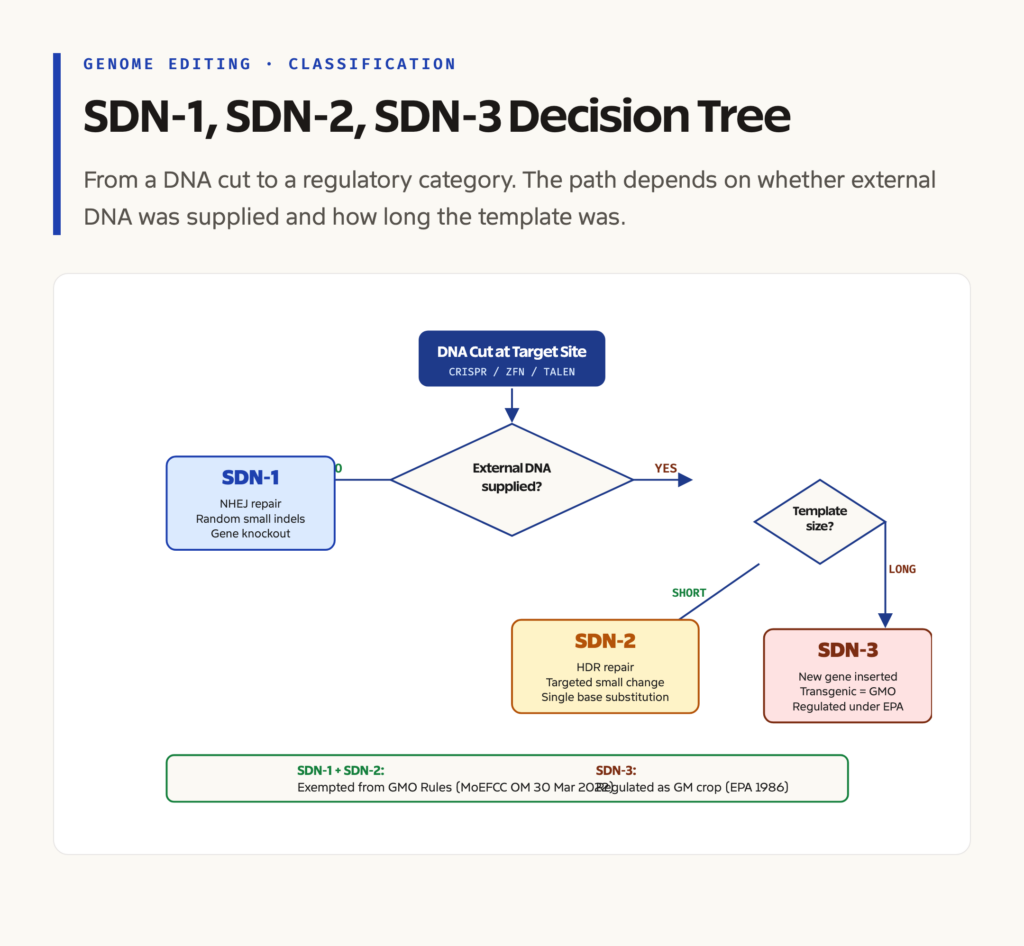
Site-Directed Nuclease, abbreviated SDN, is the umbrella term for a family of genome-editing techniques that cut DNA at a specific, chosen location. The cutting tools include CRISPR-Cas9, zinc finger nucleases, and TALENs. After the cut is made, the cell repairs the break in different ways. The category of edit, SDN-1, SDN-2, or SDN-3, depends on what kind of repair occurs and whether any external DNA is supplied during the process.
For UPSC purposes, the SDN classification has become essential. It anchors the Indian regulatory regime, distinguishes new-generation crop improvement from older genetic modification, and frames the debate about whether genome-edited crops should count as GM crops or not. This article walks through the science of SDN-1, SDN-2, and SDN-3, the global regulatory landscape, India’s specific framework, and the implications for Indian agriculture.
Quick Facts on SDN
SDN, or Site-Directed Nuclease, refers to genome-editing tools that introduce a precise double-strand break in DNA at a specific target location. The cell’s natural repair pathways then act on that break. The classification into SDN-1, SDN-2, and SDN-3 was first formalised by the European Food Safety Authority in 2012 and has since been adopted by regulatory agencies worldwide.
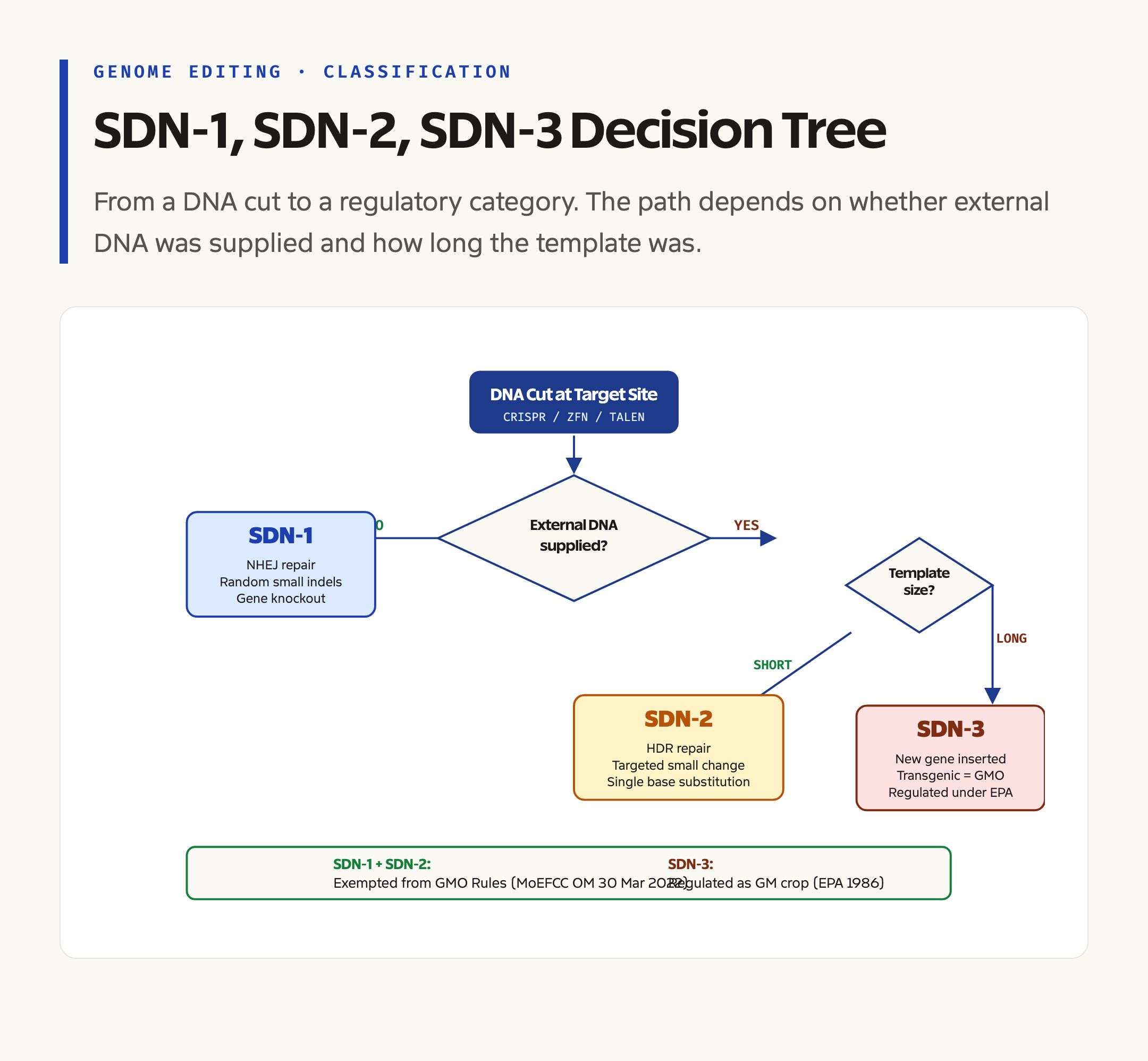
In SDN-1, the break is repaired without any external DNA template. The repair is error-prone and produces small insertions or deletions, abbreviated indels, that typically disable the gene. The result is a knockout: a gene that no longer works.
In SDN-2, a short DNA template is supplied at the time of the break. The cell uses this template to introduce a small, precise change at the cut site, such as a single base substitution or a small insertion or deletion. No new gene is added. The result is a tweaked version of the original gene.
In SDN-3, a long DNA sequence carrying a new gene is supplied with the break. The cell incorporates this new gene at the cut site. The result is the addition of a foreign or new gene to the genome, which is functionally equivalent to traditional transgenic modification.
In India, the Ministry of Environment, Forest and Climate Change, abbreviated MoEFCC, issued an Office Memorandum in March 2022 exempting SDN-1 and SDN-2 plants from the strict GMO regulatory regime under the Environment Protection Act. SDN-3 plants continue to be regulated as GM crops.
What an SDN Tool Actually Does
An SDN technology is a programmable molecular instrument that makes a cut at a chosen location in the genome. The instrument is a protein, sometimes guided by an RNA molecule, that recognizes a specific DNA sequence and then cleaves the DNA. After the cut, the cell takes over.
Background and Historical Context
The first programmable nuclease for plant genome editing was the zinc finger nuclease, developed in the late 1990s. ZFN-mediated edits in plants were demonstrated in tobacco and Arabidopsis through the 2000s. The technology was accurate but each new target required a new, slow protein design.
The second generation, TALENs, came in the early 2010s. They were easier to design than ZFNs and entered active use in plant breeding programmes. The third generation, CRISPR-Cas9, came from the 2012 work of Jennifer Doudna and Emmanuelle Charpentier and was rapidly adapted for plants. By 2014, CRISPR-edited plants had been demonstrated in rice, maize, wheat, and several other crops. By 2018, the technology was in routine use in academic and industrial plant-breeding programmes worldwide.
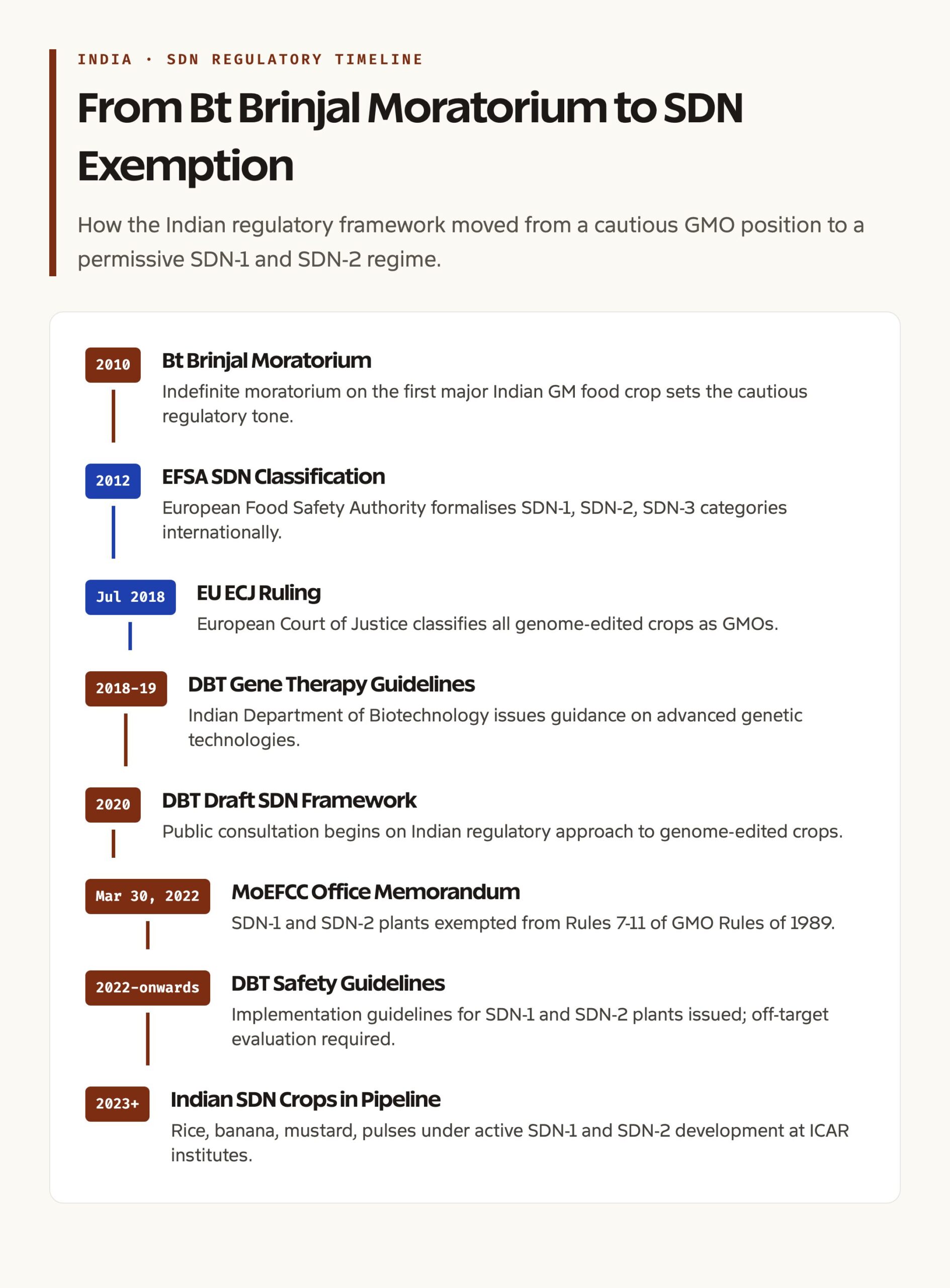
The classification into SDN-1, SDN-2, and SDN-3 was first developed by the European Food Safety Authority in 2012 to handle the regulatory question raised by these new techniques. The European Court of Justice ruled in July 2018 that genome-edited crops would be treated as GMOs under European law, regardless of the SDN category. This restrictive ruling slowed European adoption of genome editing in agriculture, although a 2023 European Commission proposal sought to liberalise the regime for SDN-1 and SDN-2.
The United States moved earlier in a different direction. The US Department of Agriculture decided in 2018 that genome-edited plants without foreign DNA would not be regulated under the existing biotechnology framework. Several non-GM-classified genome-edited crops, including high-oleic soybean and CRISPR mushroom, have since reached the US market.
India’s SDN Notification
The Indian regulatory journey began with a Department of Biotechnology guidance document in 2020 that set out a draft framework for SDN classification. After public consultation, the Ministry of Environment, Forest and Climate Change issued the Office Memorandum dated March 30, 2022, which exempted SDN-1 and SDN-2 plants from Rules 7-11 of the Manufacture, Use, Import, Export and Storage of Hazardous Microorganisms, Genetically Engineered Organisms or Cells Rules, 1989, framed under the Environment Protection Act, 1986.
The exemption applies only to plants and only to SDN-1 and SDN-2. SDN-3 plants, which contain a newly introduced gene, continue to be regulated as GM crops under the existing framework administered by the Genetic Engineering Appraisal Committee, abbreviated GEAC.
The exemption is conditional. The plant must not contain any exogenous introduced DNA, the edit must be confined to the chosen target site, and the developer must submit a confirmation declaration to a designated regulatory body. The Department of Biotechnology has separately issued guidelines for the safety assessment and regulatory pathway for SDN-1 and SDN-2 plants, which require comparative analysis of the edited plant with the parent variety, evaluation of off-target effects, and documentation of the edit at the molecular level.
Detailed Analysis: The Three Categories Compared
The three SDN categories differ in the nature of the change and in the regulatory treatment they receive.
| Feature | SDN-1 | SDN-2 | SDN-3 |
|---|---|---|---|
| External DNA used | None | Short repair template | Long gene-carrying sequence |
| Type of change | Random small mutations (indels) | Targeted small substitutions | Insertion of a new gene |
| Equivalent to | Natural mutation | Precision breeding | Genetic modification |
| Indian regulatory status | Exempted from GMO rules (2022) | Exempted from GMO rules (2022) | Regulated as GM under EPA |
| Typical use case | Knock out a disease-susceptibility gene | Confer drought tolerance via single base change | Add a herbicide-tolerance gene |
| EU regulatory status | Treated as GMO (2018 ECJ ruling) | Treated as GMO | Treated as GMO |
| US regulatory status | Generally not regulated as GMO | Generally not regulated as GMO | Regulated under biotechnology framework |
The distinction between SDN-1 and SDN-2 is technical but important. In SDN-1, no external DNA is supplied, so the repair is left to the cell’s natural error-prone mechanism, abbreviated NHEJ for non-homologous end joining. The resulting indels typically disrupt a gene, achieving a knockout. In SDN-2, a short template is supplied, and the cell uses a precision repair mechanism, abbreviated HDR for homology-directed repair, to introduce a controlled small change at the target site. SDN-1 is simpler but cruder. SDN-2 is more precise but technically harder.
SDN-3, by contrast, introduces a complete new gene at the cut site. The molecular mechanics are the same as SDN-2, but the size of the inserted sequence and the introduction of a new genetic function place SDN-3 firmly in the transgenic category.
Why the Classification Matters
The first reason is regulatory speed. A GMO approval in India can take a decade and several hundred crores of investment, with no guarantee of final clearance. The SDN-1 and SDN-2 exemption shortens the timeline dramatically, bringing the development cost closer to that of conventional plant breeding.
The second is research access. Indian universities and public-sector research institutions have struggled to navigate the GMO regulatory regime. The SDN exemption opens the door for routine use of genome editing in publicly funded crop improvement, with implications for staple crops including rice, wheat, mustard, and pulses.
The third is the scientific argument that SDN-1 and SDN-2 outcomes are indistinguishable, at the genetic level, from changes that could occur through natural mutation or conventional breeding. The Indian regulatory position aligns with this scientific argument, while the European position treats process, not product, as the basis for regulation.
The fourth is the trade dimension. India’s exports of agricultural produce go to markets with different regulatory regimes. Aligning the Indian framework with the more permissive US position helps US-bound exports but creates friction with the EU. The medium-term political question is whether India can negotiate a workable mutual recognition with major export markets.
Comparative Snapshot: Global SDN Regulation
The world is divided into three rough camps. The first, including the United States, Brazil, Argentina, Canada, and Australia, treats SDN-1 and SDN-2 plants as conventional, not as GMOs. India’s 2022 notification places it in this camp.
The second, including the European Union, treats all genome-edited crops as GMOs, following the 2018 European Court of Justice ruling. The European Commission’s 2023 proposal would liberalise this for SDN-1 and SDN-2, and as of writing the EU position is in transition.
The third camp includes China, which has issued its own genome-editing rules that allow SDN-1 and SDN-2 to proceed under a streamlined pathway, though with mandatory government registration. Russia and Japan have also moved towards permissive frameworks.
The Indian framework is closer to the US-Brazil model than to the EU model. The implications for crop research, export trade, and consumer labelling have not yet fully played out.
Crop Applications in India
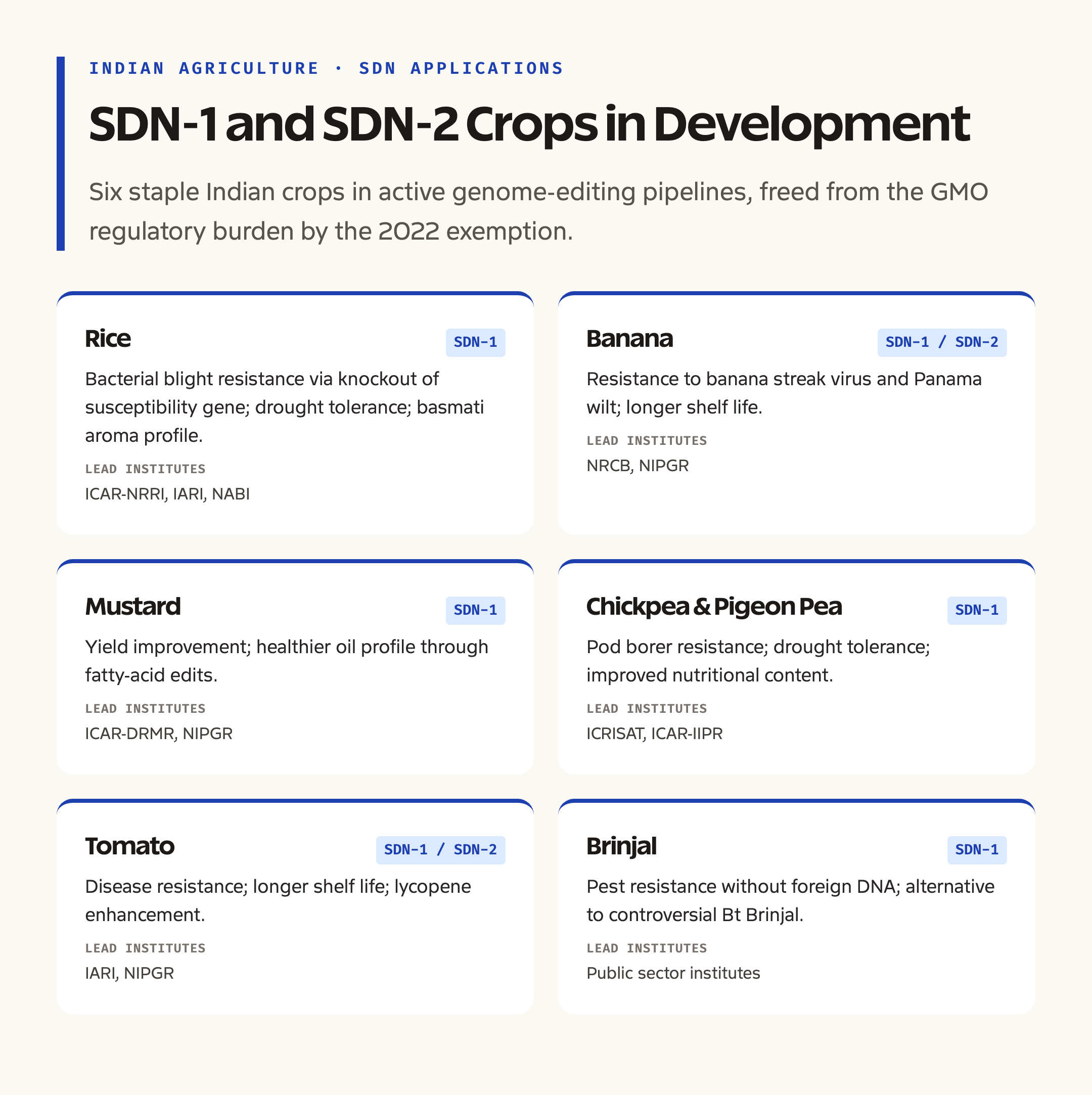
A growing list of Indian SDN-1 and SDN-2 projects is now in development. Rice is the most active crop. Indian institutes have used CRISPR-Cas9 to knock out genes that confer susceptibility to bacterial blight, a major rice pathogen. Other rice projects target drought tolerance, low-glycaemic varieties, and improved aroma profiles in basmati lines.
In banana, the Indian Council of Agricultural Research and partner institutions are using genome editing to address banana streak virus and Panama wilt, two major threats to Indian banana production. In mustard, work is underway on yield-related traits and on lipid profile modification for healthier oils.
Pulses, the highest-priority crop category for Indian self-sufficiency, have been a particular focus. Genome-edited chickpea and pigeon pea projects target pod borer resistance, drought tolerance, and improved nutritional content. The exemption of SDN-1 and SDN-2 from GMO rules has accelerated this work substantially.
A separate set of projects targets fruits and vegetables, including tomato, brinjal, and okra. The brinjal case is particularly interesting, given the long-running controversy over the GM Bt brinjal that was placed under indefinite moratorium in 2010. SDN-edited brinjal varieties, with no foreign DNA, would not face the same regulatory hurdles.
Challenges and Open Questions
The first challenge is the off-target detection requirement. Even SDN-1 edits can produce unintended changes elsewhere in the genome. Detection requires whole-genome sequencing of edited plants and comparison with the parent line. Indian research institutions have built up this capacity, but the cost remains significant.
The second is the verification problem. The Indian framework requires the developer to certify that the edit is confined to the target site and that no exogenous DNA persists in the final plant. Independent verification by regulatory agencies will require investment in molecular detection capacity that does not yet exist at scale.
The third is the consumer labelling question. The Indian notification does not require labelling of SDN-1 or SDN-2 products. Consumer rights groups have argued that consumers should still have the right to know whether a product has been genome-edited. This question has not been settled.
The fourth is the equity dimension. Genome editing tools are protected by patents, many held by Western biotechnology companies. Indian public-sector institutions have negotiated some access, but the long-term commercial dynamics will depend on how the patent landscape evolves.
Prelims Pointers
- SDN stands for Site-Directed Nuclease, a class of genome-editing tools that cut DNA at a specific target.
- SDN tools include CRISPR-Cas9, zinc finger nucleases, and TALENs.
- SDN-1 produces small random changes through error-prone repair after the cut.
- SDN-2 produces small targeted changes using a short repair template.
- SDN-3 introduces a new gene through a long DNA template, equivalent to transgenic modification.
- The SDN classification was first formalised by the European Food Safety Authority in 2012.
- The MoEFCC Office Memorandum of March 30, 2022, exempted SDN-1 and SDN-2 plants from Rules 7-11 of the GMO Rules of 1989.
- SDN-3 plants continue to be regulated as GM crops under the Environment Protection Act, 1986.
- The Genetic Engineering Appraisal Committee, abbreviated GEAC, is the apex regulator for GM crops in India.
- The European Court of Justice ruled in 2018 that genome-edited crops are GMOs under EU law, although a 2023 EC proposal seeks to liberalise the regime for SDN-1 and SDN-2.
Mains Practice Questions
- Examine the SDN-1, SDN-2, SDN-3 classification of genome-editing techniques. Discuss the scientific and regulatory rationale for India’s exemption of SDN-1 and SDN-2 plants from the GMO regulatory regime.
- Compare the regulatory approach to genome-edited crops in India, the European Union, and the United States. What are the implications of the Indian position for crop research, agricultural trade, and consumer protection?
- The exemption of SDN-1 and SDN-2 plants from GMO rules has accelerated genome-editing research in Indian agriculture. Discuss the opportunities and the unresolved challenges of this regulatory shift.
Way Forward
India’s SDN regime is now three years old, and the next steps are visible. First, a robust independent verification regime, with national-level capacity for whole-genome sequencing and off-target detection, so that the regulatory exemption is matched by credible monitoring. Second, a clear policy on consumer information for SDN-1 and SDN-2 products, balancing the consumer right to know against the regulatory finding that these products are equivalent to conventionally bred crops. Third, a strategic push to negotiate mutual recognition with the European Union and other restrictive markets, so that India’s genome-edited exports do not face additional barriers. Fourth, sustained investment in publicly funded SDN research, including in pulses, oilseeds, and horticultural crops, where the gains for Indian agriculture are largest. The SDN classification is an enabling framework. The harvest of that enabling depends on what India does with it over the next decade. The work is well begun, but it is not finished.
Frequently Asked Questions
What is SDN?
SDN stands for Site-Directed Nuclease. It is the umbrella term for genome-editing tools that make a precise double-strand break in DNA at a chosen target location. The major SDN tools are CRISPR-Cas9, zinc finger nucleases, and TALENs. After the cut, the cell’s repair machinery acts on the break, producing different categories of edit depending on whether external DNA is supplied.
What is the difference between SDN-1, SDN-2, and SDN-3?
SDN-1 produces small, random insertions or deletions through error-prone repair, with no external DNA supplied. SDN-2 produces small, targeted changes using a short DNA repair template. SDN-3 introduces a new gene at the cut site using a long DNA template. SDN-1 and SDN-2 do not add foreign genes to the genome; SDN-3 does.
Are SDN-1 and SDN-2 plants treated as GM crops in India?
No. The Ministry of Environment, Forest and Climate Change issued an Office Memorandum on March 30, 2022, exempting SDN-1 and SDN-2 plants from Rules 7-11 of the GMO Rules of 1989, framed under the Environment Protection Act, 1986. SDN-3 plants, which contain a newly introduced gene, continue to be regulated as GM crops.
Why has India exempted SDN-1 and SDN-2 plants?
The scientific case is that SDN-1 and SDN-2 outcomes are indistinguishable, at the genetic level, from changes that could occur through natural mutation or conventional breeding. The regulatory case is that the existing GMO regulatory regime is too slow and expensive to handle the volume of new genome-editing applications. The exemption brings the regulatory pathway closer to conventional breeding while keeping safety oversight in place through Department of Biotechnology guidelines.
What is the role of the Genetic Engineering Appraisal Committee?
The Genetic Engineering Appraisal Committee, abbreviated GEAC, is the apex regulator for GM crops in India. It functions under the Ministry of Environment, Forest and Climate Change. After the 2022 notification, GEAC continues to regulate SDN-3 plants as GM crops but does not regulate SDN-1 or SDN-2 plants, which are handled through a separate Department of Biotechnology pathway.
What is CRISPR-Cas9?
CRISPR-Cas9 is the most widely used SDN tool. It uses a short guide RNA to direct the Cas9 protein to a chosen DNA sequence, where Cas9 cuts both strands of the DNA. The cell then repairs the cut, with the outcome depending on whether external DNA is supplied. CRISPR-Cas9 is cheap, fast, and flexible, and it has revolutionised genome-editing research worldwide.
How does the European Union treat genome-edited crops?
The European Court of Justice ruled in July 2018 that genome-edited crops are GMOs under European law and must be regulated as such, regardless of whether they contain foreign DNA. A 2023 European Commission proposal seeks to liberalise the regime for SDN-1 and SDN-2 plants, but as of writing the European framework remains restrictive.
What is the regulatory approach in the United States?
The United States Department of Agriculture decided in 2018 that genome-edited plants without foreign DNA would not be regulated under the existing biotechnology framework. The US position is broadly aligned with India’s 2022 exemption: SDN-1 and SDN-2 plants are treated as conventional, while SDN-3 plants are regulated as transgenic.
Are SDN-1 and SDN-2 products labelled as genome-edited in India?
The current Indian framework does not require labelling of SDN-1 or SDN-2 products. Consumer rights groups have argued for labelling, but the regulatory position to date has been that, since these products are equivalent to conventionally bred crops, special labelling is not required. The labelling question is likely to be revisited as the volume of genome-edited products in the Indian market grows.
What kinds of crops are being edited in India under the SDN-1 and SDN-2 framework?
Active research projects include genome-edited rice for bacterial blight resistance and drought tolerance, banana for resistance to streak virus and Panama wilt, mustard for yield and oil-quality improvement, and pulses including chickpea and pigeon pea for pod borer resistance and drought tolerance. Fruits and vegetables, including tomato, brinjal, and okra, are also under development.
Tell Google you want more of this.
Add Anantam IAS as a preferred sourceOne tap, and this site shows up more often in your own Top Stories, AI Overviews and AI Mode. Remove it any time.