
Why in News?
Recently, concerns have been raised regarding allegations of misconduct and lack of transparency in judicial appointments and functioning of the higher judiciary.
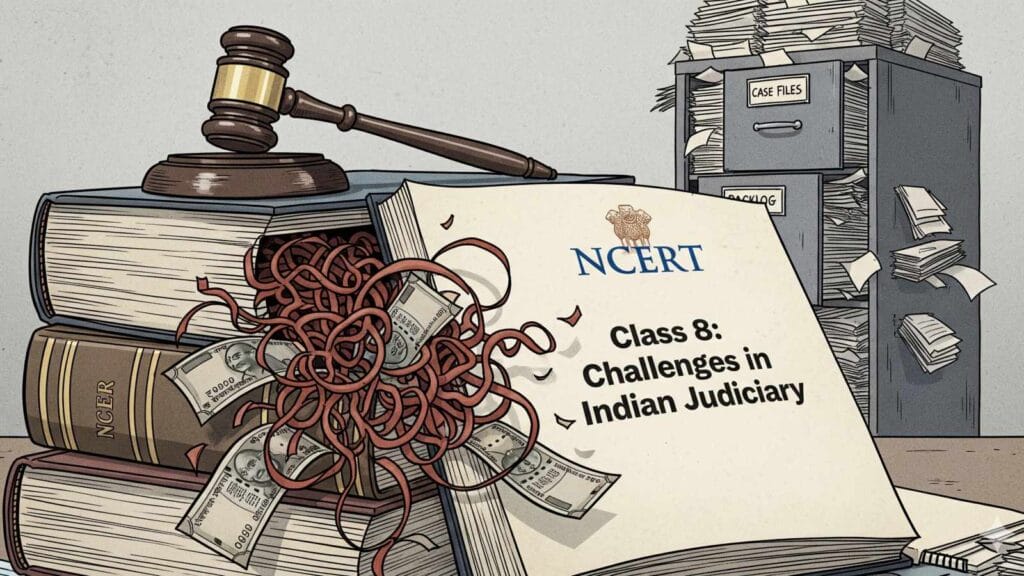
Also the recent controversy surrounding the Class 8 NCERT Social Science textbook, which included an explicit chapter on judicial corruption and case pendency.
- The NCERT textbook cited ~81,000 pending cases in the Supreme Court, 62.40 lakh in High Courts, and 4.70 crore in district courts. It also quoted former CJI B R Gavai (July 2025): ‘Instances of corruption and misconduct within the judiciary had a negative impact on public confidence.’
- CJI Surya Kant took suo motu cognizance, stating the textbook content was an attempt to ‘defame and scandalize the judiciary’
- NCERT issued a public apology and withdrew the book from its website before formal hearing
- Government indicated content should have covered all three organs — not singled out the judiciary.
UPSC Relevance:
GS-II: Judiciary, Judicial Reforms, Governance.
The Justice Yashwant Varma Case (2025)
Earlier in 2025, the Supreme Court Collegium unanimously decided to transfer Delhi High Court Judge Justice Yashwant Varma back to the Allahabad High Court — the court from which he was elevated — following allegations that a large sum of cash was recovered from his residence after a fire.
- This was a rare instance of the Collegium acting swiftly on perceived misconduct
- No formal impeachment was initiated; the matter was handled through administrative transfer — highlighting limitations of the existing accountability framework
The Justice Swaminathan Motion (2025)
- 107 MPs signed a removal motion against Justice Swaminathan in 2025
- The Speaker refused admission, meaning charges were never formally investigated — exposing the arbitrary power of the Presiding Officer at the threshold stage
What is Judicial Corruption?
Judicial corruption refers to misuse of judicial office for private gain. It may include:
- Accepting bribes to influence judgments
- Nepotism or favoritism in appointments
- Conflict of interest in cases
- Undue post-retirement benefits influencing conduct
- Manipulation of case listing or allocation
It undermines public trust in the judiciary — the final guardian of the Constitution.
Types of Judicial Corruption
1. Adjudicatory Corruption
- Judges improperly deciding cases under influence of bribes, political pressure, or personal interest
- Bench hunting — litigants or lawyers engineering which judge hears their case
- Selective grant of stay orders or bail for extraneous considerations
2. Administrative Corruption
- Registry corruption: Court clerks and middlemen accepting bribes for case listings, adjournments
- Manipulation of records: Tampering with court orders, dates, or documentation
- Late 2025: A High Court in North India suspended several registry staff after a money-for-listing expose
3. Nepotism & Structural Bias
- Uncle Judge Syndrome: Lawyers related to judges appearing before their relatives
- Judges presiding over cases where they have direct or indirect conflict of interest
- Favouring known individuals in court appointments and administrative positions
4. Post-Retirement Sinecures
- Retired judges accepting Rajya Sabha seats, Governorships, Tribunal chairmanships shortly after retirement
- This creates an incentive to deliver favourable verdicts to the government before retirement
- Violates the spirit of judicial independence even if not technically corrupt
5. Contempt as a Shield
- The threat of contempt of court discourages honest criticism, whistleblowing, or accountability reporting
- The NCERT textbook controversy itself illustrates how educational content on judicial challenges can be treated as ‘scandalizing the court’
Why is Judicial Integrity Crucial in India?
India follows the principle of separation of powers under the Constitution. The judiciary acts as:
- Guardian of Fundamental Rights
- Interpreter of the Constitution
- Arbiter between Centre and States
- Check on Executive and Legislature
Judgments such as Kesavananda Bharati v. State of Kerala established the Basic Structure Doctrine, placing the judiciary at the core of constitutional protection.
If judicial integrity weakens, the entire constitutional structure is threatened.
Causes of Judicial Corruption
| Category | Specific Cause |
| Structural | Absence of transparent complaint and investigation mechanism |
| Institutional | Opaque Collegium system — no external oversight of judge appointments |
| Workload-driven | 5.2 crore pending cases create pressure and incentive for ‘speed money’ |
| Legal vacuum | No enacted Judicial Accountability law; the Judicial Standards and Accountability Bill lapsed |
| Contempt shield | Fear of contempt deters public from reporting corruption |
| Post-retirement lure | Government patronage post-retirement compromises independence |
| Registry opacity | Court administration not subject to RTI in most states |
Constitutional Provisions Related to Judicial Accountability
Constitutional Provisions
- Article 124(4): Removal of SC judges only through impeachment by Parliament — requires special majority and Presidential order
- Article 217(1)(b): Removal of HC judges by Presidential order on address by Parliament — same procedure
- Article 121: Judges’ conduct cannot be discussed in Parliament except on a substantive motion for removal
- Article 129 & 215: SC and HCs are courts of record — powers of contempt
- The Judges (Inquiry) Act, 1968 governs the impeachment investigation process
What are the flaws in the Impeachment Process
| Stage | Issue |
| Signing: 100 MPs (LS) / 50 MPs (RS) | High threshold keeps most complaints from even initiating |
| Admission by Speaker/Chairman | Presiding officer has absolute discretion — no reasons required for rejection (Justice Swaminathan case, 2025) |
| 3-member inquiry committee | Composition: SC judge, HC CJ, eminent jurist — no independent external body |
| Special majority vote | Political considerations often override judicial misconduct evidence |
| Presidential order | Final stage subject to political dynamics |
Major Issues in Judicial Accountability
1. Opaque Appointment Process
The Collegium System, evolved through the Supreme Court Advocates-on-Record Association v. Union of India, gives primacy to judiciary in appointments.
While it protects independence, criticisms include:
- Lack of transparency
- No recorded reasons for selection/rejection
- Allegations of “judicial nepotism”
The attempt to replace it through the National Judicial Appointments Commission Act was struck down in Supreme Court Advocates-on-Record Association v. Union of India, citing violation of Basic Structure.
This revived debate: How to balance independence with accountability?
2. Weak Internal Disciplinary Mechanisms
The “in-house procedure” for dealing with judicial misconduct lacks:
- Statutory backing
- Transparency
- Public reporting
Outcomes are rarely disclosed.
3. Difficulty of Impeachment
Impeachment is highly political and requires:
- Special majority in both Houses of Parliament
Historically, impeachment attempts (e.g., Justice V. Ramaswami case) have failed due to political considerations.
Thus, accountability becomes practically impossible unless there is overwhelming consensus.
4. Post-Retirement Appointments
Frequent appointments of retired judges to:
- Tribunals
- Commissions
- Governorships
Raise concerns about possible “future rewards” influencing present decisions.
Impact of Judicial Corruption
Judicial corruption affects:
- Rule of Law – Equality before law becomes compromised.
- Economic Growth – Investors lose confidence in contract enforcement.
- Democratic Legitimacy – Judiciary is last resort for citizens.
- Human Rights – Vulnerable groups suffer when justice is biased.
For a country like India, where pendency already exceeds crores of cases, trust deficit can be disastrous.
Comparative Perspective
Countries like:
- United Kingdom – Judicial Appointments Commission (independent body)
- United States – Senate confirmation process
Though not perfect, they institutionalize transparency to a greater extent.
India’s challenge is designing a model that protects independence while ensuring accountability.
What Reforms Are Needed?
A. Institutional Reforms
- Enact Judicial Standards and Accountability Law: Create a permanent, statutory National Judicial Oversight Committee with external members
- Amend Judges (Inquiry) Act: Define ‘misbehaviour’ clearly; impose timelines on the Presiding Officer’s admission decision; make rejection of motion judicially reviewable
- Redefine Contempt: Narrow the definition of ‘scandalizing the court’ — bona fide public interest criticism should be excluded
- Independent Judicial Secretariat: A dedicated body to handle grievances, separate from the CJI’s office
B. Transparency Reforms
- Mandatory asset disclosure by all judges — publicly accessible
- Live-streaming of court proceedings (being expanded since 2021) — increases transparency and reduces scope for behind-the-scenes manipulation
- RTI applicability to court registries — currently resisted
- Publish outcomes of In-House Procedure investigations — even in anonymized form — to rebuild public trust
C. Structural Reforms
- Fast-track case resolution: Reduce the backlog that creates incentive for ‘speed money’ — fill 5,300+ judicial vacancies
- Technology deployment: AI-based case listing (removing human discretion in bench/date assignment), digital record-keeping
- Cooling-off period: Mandatory 2-year bar on post-retirement government appointments for judges
- Financial independence: Judges’ salaries should be charged to Consolidated Fund (SC judges already are) — all judges including district judiciary should have complete financial security
D. Civic Education
- Ironically, the NCERT controversy itself shows the need for civic education — citizens unaware of accountability mechanisms cannot demand them
- Judicial literacy programs explaining how to file complaints through CPGRAMS and In-House Procedure
- Balance transparency with institutional respect — content should be factual, comparative (covering all organs), and constructive
Conclusion: Balancing Judicial Independence and Accountability
Judicial independence is part of Basic Structure (Kesavananda case). However, independence does not mean absence of accountability.
The real constitutional question is:
“How to ensure accountability without compromising independence?”
Judicial corruption strikes at the heart of constitutional democracy. In a country where courts are the ultimate protector of rights, even a perception of corruption can erode public faith.
Reforms must aim at:
- Transparency
- Institutional accountability
- Ethical standards
- Protection of independence
Strengthening judicial credibility is not weakening the judiciary — it is reinforcing the foundations of the Republic.
Key terms
| Term | Meaning |
| Uncle Judge Syndrome | Lawyers related to judges appearing in their relatives’ courts — structural conflict of interest |
| Bench Hunting | Engineering which judge hears a case through registry manipulation |
| In-House Procedure (1999) | Internal complaint mechanism with no statutory backing or public disclosure |
| Judges (Inquiry) Act, 1968 | Governs impeachment process; widely considered outdated |
| NJAC (2014) | National Judicial Appointments Commission — struck down in 2015 as threat to independence |
| Restatement of Values of Judicial Life (1997) | SC’s self-adopted ethical code — not legally enforceable |
| CPGRAMS | Centralised Public Grievance Redress and Monitoring System — official complaint channel for judicial grievances |
| WJP Rule of Law Index | India ranks ~77-79/142 (2025); below median on ‘Absence of Corruption in Judiciary’ |
Tell Google you want more of this.
Add Anantam IAS as a preferred sourceOne tap, and this site shows up more often in your own Top Stories, AI Overviews and AI Mode. Remove it any time.