Daily Digest
UPSC · Civil Services Examination
Current Affairs · Tuesday, 1 September 2026
Current affairs curated and edited by Anantam IAS faculty — pulled from The Hindu, PIB, IDSA, Foreign Affairs and the ministries. Read, annotate, revise.
Old Rajinder Nagar · Delhi 110005 · anantamias.com
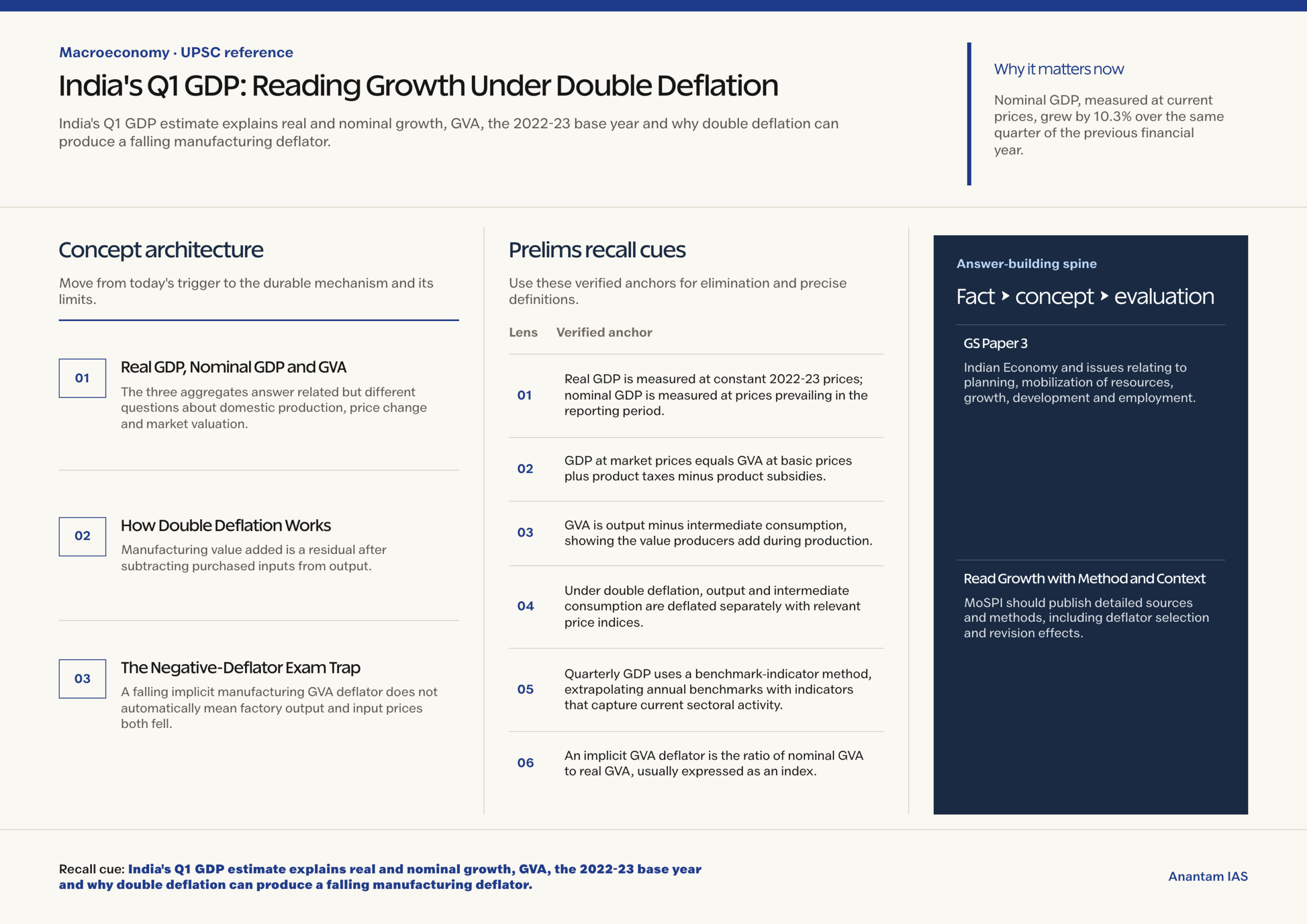
India’s Q1 GDP: Reading Growth Under Double Deflation
Why in News?
On 31 August, MoSPI’s provisional quarterly estimate placed India’s real GDP growth at 7.8% for April-June 2026-27 under the national-accounts series with base year 2022-23.
- Nominal GDP, measured at current prices, grew by 10.3% over the same quarter of the previous financial year.
- Real GVA, which tracks value added by producers before net product taxes, grew by 8.2%.
- The new series applies double deflation to manufacturing by removing price effects from output and intermediate inputs separately.
- MoSPI cautioned that better source coverage and revisions by data-supplying agencies can change these quarterly estimates later.
- The growth print is an estimate of economy-wide production, not a complete measure of jobs, household welfare, distribution or environmental costs.
- A single quarter shows near-term momentum, but durable assessment requires later revisions, sectoral evidence and comparison across several quarters.
- The methodological change matters because relative movements in factory output and input prices can materially affect measured real manufacturing GVA.
UPSC Relevance
Prelims Relevance
- Real GDP is measured at constant 2022-23 prices; nominal GDP is measured at prices prevailing in the reporting period.
- GDP at market prices equals GVA at basic prices plus product taxes minus product subsidies.
- GVA is output minus intermediate consumption, showing the value producers add during production.
- Under double deflation, output and intermediate consumption are deflated separately with relevant price indices.
- Quarterly GDP uses a benchmark-indicator method, extrapolating annual benchmarks with indicators that capture current sectoral activity.
- An implicit GVA deflator is the ratio of nominal GVA to real GVA, usually expressed as an index.
Mains Relevance
GS Paper 3
- Indian Economy and issues relating to planning, mobilization of resources, growth, development and employment.
- Interpret GDP growth through measurement methods, sectoral value addition and the limits of a quarterly aggregate.
Essay
- What a country measures shapes how it understands growth, but measurement must remain separate from judgment about welfare.
Background and Context
Real GDP, Nominal GDP and GVA
The three aggregates answer related but different questions about domestic production, price change and market valuation, so they should not be used interchangeably in analysis.
- Nominal GDP values final domestically produced goods and services at current prices. It can rise because quantities increased, prices increased or both, so it cannot isolate production-volume growth by itself.
- Real GDP values the same broad output at constant base-year prices. Removing estimated price change makes its growth rate closer to a volume comparison across periods with different price levels.
- GVA measures sectoral output minus goods and services consumed during production. A bakery’s flour is intermediate consumption; subtracting it prevents counting the same embedded value twice across production stages.
- GDP connects producer value to final market valuation by adding taxes on products and subtracting subsidies on products from aggregate GVA, because purchasers pay prices shaped by both.
- A faster GVA print than GDP can reflect movements in net product taxes rather than weaker economy-wide production. The aggregates reconcile within one national-accounting framework, not two independently measured economies.
How Double Deflation Works
Manufacturing value added is a residual after subtracting purchased inputs from output, making separate price treatment especially useful when their prices move at different speeds.
- Start with nominal output, the current-price value of manufactured goods, and nominal intermediate consumption, the current-price value of energy, materials and purchased services used to produce those goods.
- Deflate output with relevant producer price indices to estimate output volume at base-year prices. Deflate intermediate consumption separately with indices representing prices across its distinct basket of industrial inputs.
- Subtract real intermediate consumption from real output. The remainder is real manufacturing GVA, showing how much production volume manufacturers added after separately removing estimated output-price and input-price effects.
- The earlier single-deflator approach applied the same price movement to output and inputs. That can obscure a widening or narrowing wedge between factory selling prices and costs such as energy or materials.
- The 2022-23 series uses improved Producer Price Index data, allowing the output and input sides of manufacturing to receive more specific, product-linked price treatment than one common deflator provided.
The Negative-Deflator Exam Trap
A falling implicit manufacturing GVA deflator does not automatically mean factory output and input prices both fell; the subtraction at the heart of GVA changes its interpretation.
- The implicit GVA deflator compares nominal GVA with real GVA. Unlike a directly observed price index for one product basket, it is derived from value added after intermediate inputs are subtracted.
- If input prices rise faster than output prices, the current-price value-added margin can be squeezed even though factories pay more for inputs and also receive higher selling prices.
- Because output and inputs are deflated separately, changing relative prices can make the nominal-to-real GVA ratio fall. Its measured growth rate may then turn negative without either underlying price index falling.
- This is a relative-price and margin effect, not proof of economy-wide deflation, falling factory-gate prices or a statistical mistake. The underlying output and input price indices still need separate inspection.
- The estimates remain provisional in practice: quarterly benchmarks, indicators and source data are updated. MoSPI says improved data coverage and source-agency revisions can alter the initially published figures later.
Way Forward
Read Growth with Method and Context
Sound interpretation needs transparency about both the estimate and the evidence around it.
- MoSPI should publish detailed sources and methods, including deflator selection and revision effects, in forms that researchers can reproduce and scrutinize.
- Policy analysis should pair GDP with employment, consumption, investment, sectoral productivity and distributional indicators rather than treating one growth rate as a welfare verdict.
- Answers should state the price basis, distinguish GDP from GVA and flag provisional status before drawing conclusions from a quarterly estimate.
- Users should compare revised data across several quarters and avoid attributing a methodological effect to policy performance without supporting evidence.
Conclusion
- The Q1 estimate shows strong measured volume growth, but its durable lesson is methodological: real GDP, nominal GDP and GVA describe different layers of national accounts and cannot substitute for one another in an answer.
- A strong Mains answer should explain double deflation step by step, identify the negative-deflator trap and close by placing provisional quarterly GDP beside jobs, welfare, distribution and revised sectoral evidence.
UPSC Practice Questions
Prelims MCQ 1
With reference to India’s national accounts, consider the following statements:
- Nominal GDP values final domestic output at current prices.
- GDP at market prices equals GVA at basic prices plus net taxes on products.
- Double deflation applies the same deflator to manufacturing output and intermediate consumption.
How many of the above statements are correct?
(a) Only one (b) Only two (c) All three (d) None
Answer: (b) Only two
Explanation:
Statements 1 and 2 are correct. Double deflation uses separate relevant price indices for output and intermediate consumption, so statement 3 is incorrect.
Prelims MCQ 2
Under double deflation, which situation can produce a falling implicit manufacturing GVA deflator even when output and input prices both rise?
(a) Output prices rise faster than input prices in every industry (b) Nominal and real GVA are always identical (c) Input prices rise faster than output prices and squeeze the value-added margin (d) Product taxes are excluded from both GDP and GVA
Answer: (c) Input prices rise faster than output prices and squeeze the value-added margin
Explanation:
GVA is a residual after subtracting inputs. Faster input-price growth can lower the nominal-to-real GVA ratio even when neither input nor output prices fall.
UPSC Mains Questions
- Distinguish real GDP, nominal GDP and Gross Value Added. Explain why each aggregate answers a different question about economic growth.
- How does double deflation improve the estimation of real manufacturing GVA? Discuss its interpretation challenges with reference to changing input and output prices.
Sources: PIB, Ministry of Statistics and Programme Implementation and MoSPI Sub-Committee for Constant Price Estimates.
Frequently Asked Questions
What was India’s real GDP growth in Q1 of 2026-27?
MoSPI estimated real GDP growth at 7.8% for April-June 2026-27 over the corresponding quarter. The estimate uses constant 2022-23 prices and may be revised as source data improve.
How is real GDP different from nominal GDP?
Nominal GDP values final output at current prices, mixing quantity and price changes. Real GDP uses constant base-year prices to make growth closer to a comparison of production volumes.
What is the difference between GDP and GVA?
GVA measures output minus intermediate consumption at the producer level. GDP at market prices adds product taxes and subtracts product subsidies, connecting producer value added to final market valuation.
What does double deflation mean?
Double deflation removes price effects from output and intermediate consumption separately, using relevant indices for each, before subtracting real inputs from real output to estimate real value added.
Does a negative manufacturing GVA deflator mean all factory prices fell?
No. Input and output prices may both rise, but faster input-price growth can squeeze current-price value added and lower the implicit nominal-to-real GVA ratio.
Source: https://anantamias.com/current-affairs/india-q1-gdp-double-deflation-2026/
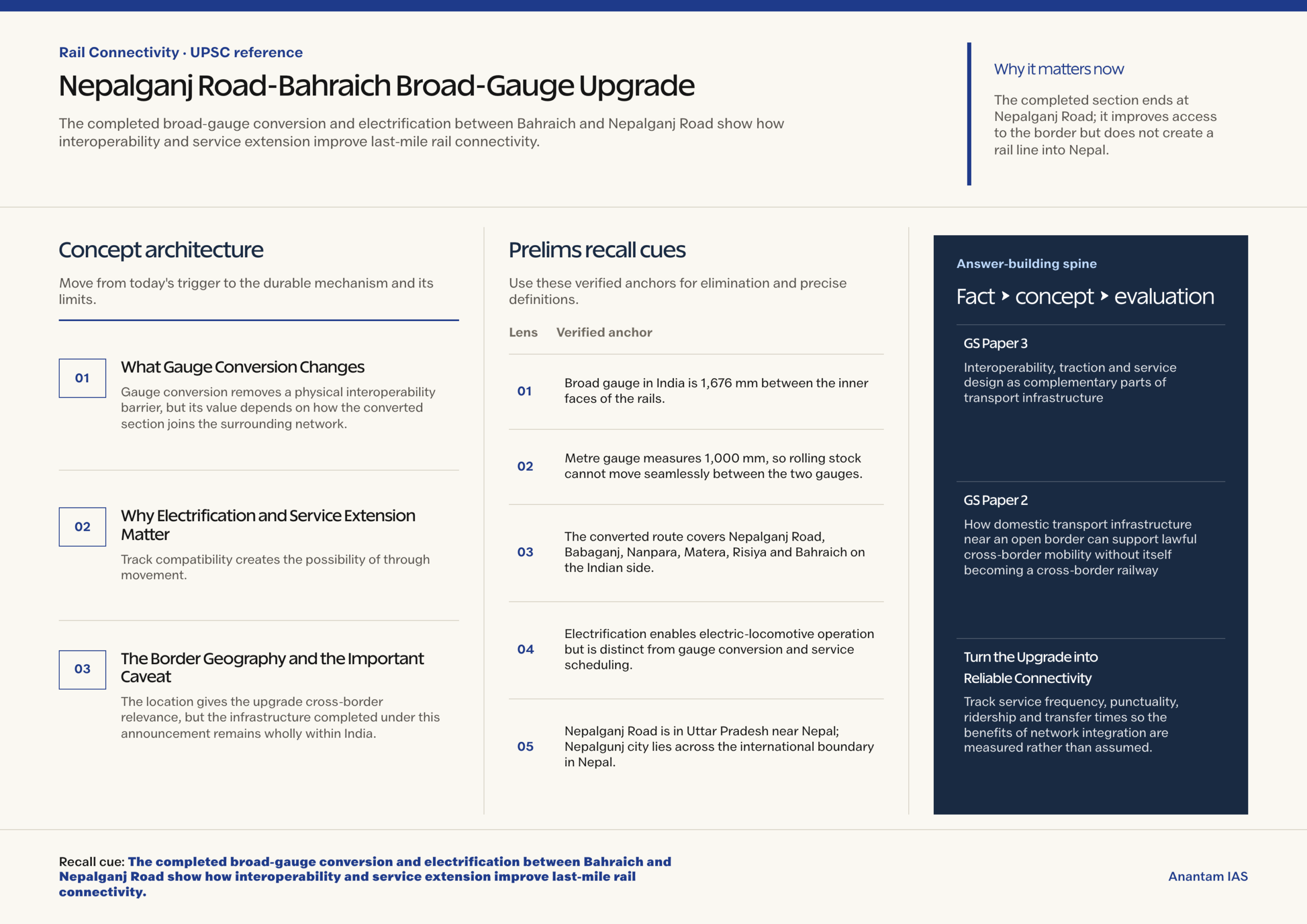
Nepalganj Road-Bahraich Broad-Gauge Upgrade
Why in News?
On 31 August 2026, Indian Railways inaugurated the completed broad-gauge conversion and electrification of the Nepalganj Road-Nanpara-Bahraich section and extended four existing train services to Nepalganj Road.
- The completed Indian section is 56.15 km long and runs through Bahraich district in Uttar Pradesh.
- The former metre-gauge section, originally built in 1886, has been integrated with India’s wider broad-gauge network.
- The upgrade combines three linked changes: gauge conversion, route electrification and extension of existing services.
- The extended services connect Nepalganj Road directly with Gonda, Gorakhpur and Varanasi through the Indian railway network.
- Gauge compatibility matters because trains can continue over connected routes without the operational break created by different track gauges.
- Nepalganj Road is an Indian railhead near the Nepal border; the completed project does not extend railway track into Nepal.
- Electrification changes the available traction system, while service extension determines whether upgraded infrastructure produces direct passenger connectivity.
UPSC Relevance
Prelims Relevance
- Broad gauge in India is 1,676 mm between the inner faces of the rails.
- Metre gauge measures 1,000 mm, so rolling stock cannot move seamlessly between the two gauges.
- The converted route covers Nepalganj Road, Babaganj, Nanpara, Matera, Risiya and Bahraich on the Indian side.
- Electrification enables electric-locomotive operation but is distinct from gauge conversion and service scheduling.
- Nepalganj Road is in Uttar Pradesh near Nepal; Nepalgunj city lies across the international boundary in Nepal.
Mains Relevance
GS Paper 3
- Interoperability, traction and service design as complementary parts of transport infrastructure
- Last-mile rail connectivity and access to larger urban and economic centres
GS Paper 2
- How domestic transport infrastructure near an open border can support lawful cross-border mobility without itself becoming a cross-border railway
Essay
- Infrastructure becomes useful when physical compatibility, operating systems and actual services are designed together.
Background and Context
What Gauge Conversion Changes
Gauge conversion removes a physical interoperability barrier, but its value depends on how the converted section joins the surrounding network.
- A railway gauge is the distance between the inner faces of the rails; wheelsets and vehicles are engineered for a specific gauge and cannot ordinarily switch gauges in service.
- The Bahraich-Nanpara-Nepalganj Road section previously used metre gauge, while India’s trunk network largely uses 1,676-mm broad gauge, leaving the section incompatible with mainstream rolling stock.
- Conversion replaces or repositions track and requires compatible points, platforms, bridges, signalling and structure clearances; it is a coordinated system upgrade, not merely the widening of rails.
- After conversion, compatible broad-gauge rolling stock can operate between the section and connected routes, avoiding a forced terminal point created solely by gauge mismatch rather than passenger demand.
- The operational benefit is network integration: a peripheral section becomes usable by trains designed for the wider system, although actual operations still depend on capacity, timetables and safety clearances.
Why Electrification and Service Extension Matter
Track compatibility creates the possibility of through movement; electrification and scheduled services determine how that possibility is used.
- Electrification equips the route with overhead traction infrastructure so electric locomotives or electric multiple units can operate, subject to compatible rolling stock, substations, power availability and operating clearances.
- Electric traction can reduce direct diesel use on the section, but its wider emissions effect depends on the electricity mix, train loading and the services actually operated.
- Indian Railways extended the Varanasi-Bahraich and Varanasi City-Gorakhpur services, plus two Gonda-Bahraich service pairs, to Nepalganj Road, turning completed works into a scheduled passenger offer.
- A service extension differs from building a new train corridor: it changes the terminal point of existing services over upgraded Indian track and connects additional stations to established routes.
- Direct services can reduce forced transfers and waiting time for passengers, but frequency, reliability, timetable coordination, station access and affordability remain essential measures of usable connectivity after inauguration.
The Border Geography and the Important Caveat
The location gives the upgrade cross-border relevance, but the infrastructure completed under this announcement remains wholly within India.
- The section links Bahraich through Nanpara to Nepalganj Road, an Indian station near the Rupaidiha-Nepalgunj border interface in the Terai region, where road movement continues beyond the railhead.
- Nepalgunj is a city in Nepal, while Nepalganj Road is the nearby Indian railhead; confusing the similar names produces the false claim that Indian trains now run into Nepal.
- People crossing the land border can use the Indian railhead for onward journeys, but border crossing, road access and passenger transfers remain separate from the rail operation itself.
- The official release expects wider movement and market access, yet these are prospective effects; passenger volumes, freight data, travel-time changes and local access must be measured before claiming outcomes.
- For analysis, separate three layers: completed physical works, approved and extended train services, and longer-term regional effects that require later evidence rather than ceremonial claims.
Way Forward
Turn the Upgrade into Reliable Connectivity
- Track service frequency, punctuality, ridership and transfer times so the benefits of network integration are measured rather than assumed.
- Coordinate timetables with onward trains at Gonda, Gorakhpur and Varanasi, while keeping safe turnaround capacity at Nepalganj Road.
- Improve station access, passenger information and multimodal links between the Indian railhead and nearby settlements without misrepresenting the route as a cross-border railway.
- Maintain overhead equipment, signalling and track to protect reliability; an electrified broad-gauge route delivers little if asset maintenance or service continuity weakens.
Conclusion
- The Nepalganj Road-Bahraich project shows that gauge compatibility, electrification and actual service extension are distinct but complementary steps in turning an isolated section into an integrated rail link with usable onward connections.
- Its immediate achievement is the completion of upgraded Indian railway infrastructure and direct services to the border railhead, not the creation of a railway line into Nepal or proof of wider economic outcomes.
- A sound infrastructure answer should distinguish completed assets from anticipated development effects and judge success through reliability, access and measured use after services have operated long enough to generate evidence.
UPSC Practice Questions
Prelims MCQ 1
With reference to the Nepalganj Road-Nanpara-Bahraich rail upgrade, consider the following statements:
- The completed section is entirely on the Indian side of the international boundary.
- Gauge conversion and electrification refer to the same engineering process.
- Existing train services have been extended to Nepalganj Road.
How many of the above statements are correct?
(a) Only one (b) Only two (c) All three (d) None
Answer: (b) Only two
Explanation:
Statements 1 and 3 are correct. The completed section lies in India, and four existing services were extended. Gauge conversion changes track compatibility; electrification provides electric traction infrastructure.
Prelims MCQ 2
What is the most direct operational purpose of converting a metre-gauge section to the broad gauge used by the surrounding network?
(a) To eliminate the need for railway signalling (b) To permit compatible rolling stock to move across the connected network (c) To convert a domestic railway automatically into an international railway (d) To guarantee that every train on the section is electric
Answer: (b) To permit compatible rolling stock to move across the connected network
Explanation:
Gauge conversion removes a physical compatibility barrier. It does not replace signalling, create an international route or by itself determine the traction used by every service.
UPSC Mains Questions
- Explain how gauge conversion, electrification and service extension perform different but complementary roles in railway network integration. Use the Nepalganj Road-Bahraich section as an example.
- Domestic transport infrastructure near an international border can have cross-border relevance without being cross-border infrastructure. Discuss with reference to the Nepalganj Road rail upgrade.
Source: PIB, Ministry of Railways.
Frequently Asked Questions
What was completed on the Nepalganj Road-Bahraich rail section?
Indian Railways completed broad-gauge conversion and electrification of the 56.15-km Nepalganj Road-Nanpara-Bahraich section and extended four existing train services to Nepalganj Road.
Does the upgraded railway line enter Nepal?
No. The completed railway work is on the Indian side up to Nepalganj Road station. Nepalgunj city is across the international boundary in Nepal.
Why does railway gauge compatibility matter?
Rolling stock is built for a particular gauge. A compatible broad-gauge section can connect operationally with the wider network without journeys ending solely because the track gauges differ.
What does electrification add after gauge conversion?
Electrification supplies overhead traction infrastructure for electric train operation. It is separate from widening the gauge and from deciding which services will run on the route.
Which direct connections were extended to Nepalganj Road?
The extensions cover services linked with Varanasi, Gorakhpur and Gonda, improving the Indian railhead’s direct connection to major cities and interchange points.
Source: https://anantamias.com/current-affairs/nepalganj-road-bahraich-broad-gauge/
Machine-Learning Materials Screening: New Candidates for CO2 Conversion
Why in News?
On 31 August 2026, PIB reported that IIT Gandhinagar researchers computationally identified three high-entropy MBenes as promising candidates for electrochemical CO2-to-CO conversion.
- The study screened 56 equiatomic five-metal compositions, narrowed them to 18 viable candidates and identified three with favourable computed reaction profiles.
- The three candidates are CrNbZrMoTiB5, MoZrHfNbCrB5 and MoZrHfTaCrB5, all ultrathin two-dimensional transition-metal borides.
- Under the computational hydrogen electrode model, their CO2-to-CO steps were downhill at zero applied potential, meaning no additional electrical bias appeared necessary in the calculation.
- This is a computational prediction, not a deployed catalyst: synthesis, electrochemical testing, durability, selectivity and scale-up have not yet been demonstrated.
- Catalyst discovery involves a vast composition space; machine learning can prioritise combinations for costly high-fidelity calculations and experiments without proving real-world performance by itself.
- Converting captured CO2 into carbon monoxide could supply an industrial intermediate, but climate value depends on clean electricity, conversion efficiency and the full system’s emissions.
UPSC Relevance
Prelims Relevance
- MBenes are two-dimensional transition-metal borides; their exposed surfaces and electronic structure make them candidates for electrocatalytic reactions.
- High-entropy materials combine five or more principal elements, creating chemically diverse local sites rather than one uniform metal surface.
- Electrochemical CO2 reduction uses electrical energy and a catalyst to convert carbon dioxide into products such as carbon monoxide.
- Carbon monoxide is an industrial feedstock and a component of syngas; it is not the same substance as carbon dioxide.
- Machine-learning interatomic potentials estimate energies across many atomic arrangements, helping researchers screen material candidates before experimental synthesis.
Mains Relevance
GS Paper 3
- Indigenisation of advanced materials research through machine learning and high-performance computing
- Carbon-utilisation technologies, renewable electricity and the evidence needed before claiming climate benefits
GS Paper 2
- Public research institutions, computing infrastructure and responsible communication of early-stage scientific findings
Essay
- Scientific prediction creates options; public value begins only when those options survive testing, scaling and lifecycle scrutiny.

Background and Context
How the screening funnel worked
The study used a multi-fidelity funnel: fast screening reduced the search space before demanding calculations examined reaction energetics, with each stage answering a different scientific question.
- Researchers began with 56 equiatomic quinary HE-MBenes drawn from titanium, vanadium, chromium, molybdenum, niobium, tantalum, zirconium and hafnium around boron. The pool covered every five-metal combination from those eight metals.
- First-principles density functional theory relaxed atomic structures, while formation-energy filters removed combinations that did not meet computed viability criteria. This tested structural plausibility before catalytic performance.
- A MACE machine-learning interatomic potential accelerated evaluation across 1,375 surface environments, estimating atomic energies so expensive calculations could concentrate on stronger candidates instead of treating every arrangement with the costliest method.
- Projected density-of-states analysis then helped identify electronically plausible active sites, meaning surface atoms likely to bind reaction intermediates and orbitals capable of exchanging charge with adsorbates.
- The final computational hydrogen electrode profiles compared free-energy changes step by step. They rank calculated pathways, not measured production rates, and remain conditional on the modelled structures and approximations.
Why the three candidates stood out
Their calculated advantage comes from chemically different metals sharing separate tasks on one two-dimensional catalytic surface. This mechanistic claim still awaits experimental verification.
- The selected compositions were CrNbZrMoTiB5, MoZrHfNbCrB5 and MoZrHfTaCrB5; each combines five metals with boron. Their differing metal sets let researchers compare related local chemical environments.
- This mixed surface creates a cocktail effect: neighbouring elements provide different adsorption and charge-transfer environments instead of forcing every reaction stage, from activation to product release, onto identical sites.
- The calculations indicate chromium-centred sites preferentially adsorb CO2, positioning the stable molecule where electron transfer and bond rearrangement may begin rather than merely approaching a chemically inert surface.
- Nearby zirconium and hafnium donate charge that stabilises the COOH* intermediate, the computed rate-determining stage towards carbon monoxide. Lowering that stage reshapes the overall calculated energy pathway.
- That division of labour may relax linear scaling relationships, where improving the binding of one intermediate shifts another in an unhelpful linked direction. Breaking the link can ease a catalyst-design trade-off.
The evidence ladder to deployment
A promising calculated energy profile is the first filter, not final proof of a useful carbon-conversion catalyst. Each rung answers a different source of uncertainty.
- The next step is experimental synthesis: researchers must create each predicted HE-MBene with the intended composition, phase purity, atomic arrangement and accessible sites. A formula is insufficient if its phase cannot be made reproducibly.
- Structural and spectroscopic characterisation must verify that the real material resembles the modelled surface. Defects, oxidation or element segregation can change catalytic behaviour, making characterisation a gate rather than a formality.
- Electrochemical tests must measure selectivity, Faradaic efficiency, current density and overpotential, showing whether electricity produces carbon monoxide rather than competing products under relevant electrolyte, temperature and pressure conditions.
- Long-duration operation must test durability, including surface reconstruction, catalyst poisoning and hydrogen evolution, because a strong initial reading may fade while repeated cycling reveals whether the active surface survives.
- Deployment also needs scalable manufacture, responsible metal sourcing, reactor integration and lifecycle assessment. Renewable electricity and captured-CO2 supply determine whether the complete system reduces emissions instead of moving them elsewhere.
Way Forward
Validate prediction before climate claims
- Synthesize the three candidates and publish open comparisons between predicted structures, measured structures and electrochemical performance.
- Benchmark them against established CO2-to-CO catalysts under matched conditions, including energy efficiency, product selectivity, stability and material cost.
- Use failed experiments to retrain the screening model, so the prediction-experiment loop improves rather than merely generating longer candidate lists.
- Assess supply chains and lifecycle emissions before scale-up, especially where five-metal compositions depend on energy-intensive or geographically concentrated inputs.
Conclusion
- The durable lesson is the screening funnel: machine learning can narrow an enormous materials space, while high-fidelity calculations explain why a few candidates deserve laboratory attention. That establishes a research priority, not deployment evidence.
- A strong Mains answer should keep the evidence ladder visible: computational promise must pass synthesis, validation, durability, selectivity, scale-up and lifecycle tests before becoming climate technology. The caveat belongs in the argument, not a footnote.
UPSC Practice Questions
Prelims MCQ 1
With reference to the IIT Gandhinagar study on high-entropy MBenes, consider the following statements:
- MBenes are two-dimensional transition-metal borides.
- The three leading candidates were identified through computational screening.
- Their long-term industrial durability has already been demonstrated.
How many of the above statements are correct?
(a) Only one (b) Only two (c) All three (d) None
Answer: (b) Only two
Explanation:
Statements 1 and 2 are correct. The study is computational; experimental synthesis, electrochemical validation and durability testing remain necessary.
Prelims MCQ 2
Which step would provide the strongest direct evidence that a computationally predicted catalyst selectively converts CO2 into carbon monoxide under working conditions?
(a) Counting the number of possible metal combinations (b) Measuring Faradaic efficiency and product distribution in an electrochemical cell (c) Comparing only the atomic masses of its constituent metals (d) Repeating the machine-learning prediction with the same training data
Answer: (b) Measuring Faradaic efficiency and product distribution in an electrochemical cell
Explanation:
Faradaic efficiency and product analysis directly test how much electrical charge forms carbon monoxide rather than hydrogen or other competing products.
UPSC Mains Questions
- Machine learning can accelerate materials discovery, but prediction is not deployment. Discuss with reference to the evidence ladder for electrochemical CO2-conversion catalysts.
- Explain how high-entropy MBenes may improve CO2-to-CO catalysis. What scientific and lifecycle tests are required before claiming climate benefits?
Source: PIB Ahmedabad, Ministry of Education.
Frequently Asked Questions
What is an MBene?
An MBene is an ultrathin two-dimensional transition-metal boride. Its exposed surface and tunable electronic structure can provide sites for adsorption and charge transfer during catalytic reactions.
What does high entropy mean in these materials?
It means the metal sublattice contains five or more principal elements. Their varied local environments can let different metals support different steps of one catalytic reaction.
What did machine learning do in this study?
A machine-learning interatomic potential accelerated energy estimates across many surface arrangements, helping the researchers narrow candidates before applying more demanding electronic-structure and reaction-path calculations.
Did the study prove that the candidates work in industry?
No. It identified promising candidates computationally. Researchers still need to synthesise them, verify their structures and test selectivity, efficiency, durability and scalability under realistic conditions.
Why convert carbon dioxide into carbon monoxide?
Carbon monoxide is an industrial intermediate used in syngas and chemical production. Conversion can support carbon utilisation, but climate value depends on clean electricity and lifecycle emissions.
Source: https://anantamias.com/current-affairs/ml-screening-carbon-dioxide-conversion-materials/
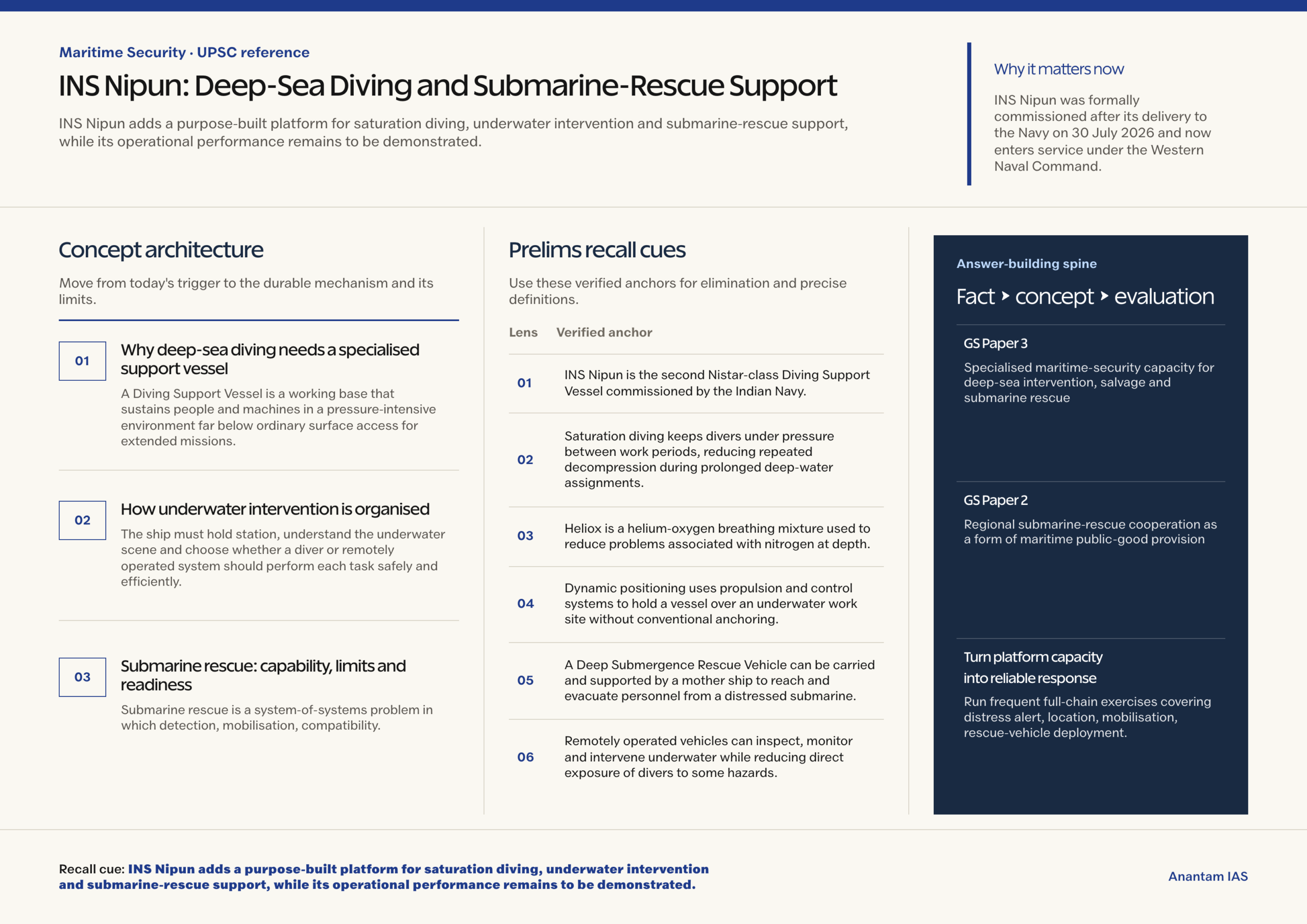
INS Nipun: Deep-Sea Diving and Submarine-Rescue Support
Why in News?
The Indian Navy commissioned INS Nipun, the second Nistar-class Diving Support Vessel, at Mumbai on 31 August 2026 for deep-sea diving, underwater intervention and submarine-rescue support.
- INS Nipun was formally commissioned after its delivery to the Navy on 30 July 2026 and now enters service under the Western Naval Command.
- The vessel was designed and constructed by Hindustan Shipyard Limited, Visakhapatnam, under Indian Register of Shipping classification rules.
- Its official role set covers saturation, air and heliox diving, remotely operated underwater inspection, intervention, salvage and support to submarine rescue.
- Commissioning confirms induction, while descriptions of readiness and response capacity remain official capability claims, not evidence from a real rescue operation.
- Underwater casualties compress response time: divers, life-support teams, rescue vehicles and a precisely positioned mother ship must function as one integrated system.
- A second Nistar-class vessel can broaden geographic availability, but actual readiness depends on trained crews, maintenance, exercises and interoperability, not hull numbers alone.
- The UPSC-relevant issue is specialist maritime readiness: how diving technology, remotely operated systems and submarine-rescue cooperation convert a ship into usable public capability.
UPSC Relevance
Prelims Relevance
- INS Nipun is the second Nistar-class Diving Support Vessel commissioned by the Indian Navy.
- Saturation diving keeps divers under pressure between work periods, reducing repeated decompression during prolonged deep-water assignments.
- Heliox is a helium-oxygen breathing mixture used to reduce problems associated with nitrogen at depth.
- Dynamic positioning uses propulsion and control systems to hold a vessel over an underwater work site without conventional anchoring.
- A Deep Submergence Rescue Vehicle can be carried and supported by a mother ship to reach and evacuate personnel from a distressed submarine.
- Remotely operated vehicles can inspect, monitor and intervene underwater while reducing direct exposure of divers to some hazards.
Mains Relevance
GS Paper 3
- Specialised maritime-security capacity for deep-sea intervention, salvage and submarine rescue
- Technology, training and maintenance requirements behind credible underwater readiness
GS Paper 2
- Regional submarine-rescue cooperation as a form of maritime public-good provision
- Interoperability and assistance to partner navies during underwater emergencies
Essay
- Technology becomes strategic capability only when platforms, people, procedures and international cooperation remain ready before an emergency begins.
Background and Context
Why deep-sea diving needs a specialised support vessel
A Diving Support Vessel is a working base that sustains people and machines in a pressure-intensive environment far below ordinary surface access for extended missions.
- In air diving, compressed air supports comparatively shallower work; depth and exposure remain limited because pressure increases breathing-gas risk and decompression burden.
- Heliox diving replaces nitrogen with helium in the breathing mixture, reducing nitrogen narcosis and breathing resistance during deeper operations, though specialised thermal and communication management is still needed.
- In saturation diving, divers live in a pressurised chamber and travel to the work depth in a closed bell, avoiding a full decompression after every shift.
- One carefully managed decompression at the end can support prolonged assignments, but chamber integrity, gas control, medical supervision and emergency procedures become mission-critical parts of the entire support system.
- INS Nipun’s diving complex, life-support and medical facilities are designed to combine these functions at sea; the official release does not report performance from an operational casualty.
How underwater intervention is organised
The ship must hold station, understand the underwater scene and choose whether a diver or remotely operated system should perform each task safely and efficiently.
- Dynamic positioning continuously adjusts propulsion to keep the vessel over a work site, limiting drift that could endanger diving bells, umbilicals, rescue vehicles or underwater equipment.
- A remotely operated vehicle carries cameras, sensors or tools while operators control it from the ship, enabling inspection and intervention before exposing divers to uncertain conditions.
- Divers remain important for complex manual work, close assessment and repairs, while remotely operated systems extend observation, monitor divers and handle tasks where endurance or immediate human exposure is problematic.
- The same platform can support salvage, which concerns locating, stabilising or recovering underwater material, but salvage and rescue have different priorities, timelines, acceptable risks and life-safety requirements.
- Effective intervention depends on a common operating picture, reliable communications and disciplined task sequencing; advanced equipment cannot compensate for weak coordination between bridge, diving, medical and engineering teams.
Submarine rescue: capability, limits and readiness
Submarine rescue is a system-of-systems problem in which detection, mobilisation, compatibility, access and safe decompression must align under severe time pressure after an accident.
- The delivery release describes INS Nipun as a mother ship for a Deep Submergence Rescue Vehicle, which can descend, mate with a distressed submarine and evacuate survivors in repeated sorties.
- The support vessel supplies launch and recovery, navigation, control, maintenance, medical care and decompression support; the rescue vehicle is only one component of the overall emergency response chain.
- A rescue attempt also requires the submarine’s location, a reachable escape or rescue interface, tolerable sea conditions and compatible procedures; no single ship can remove every physical constraint.
- Regular exercises and interoperability checks matter because India may need to assist partner navies, while foreign systems may need to operate with Indian submarines or support infrastructure.
- INS Nipun’s commissioning expands designed capacity alongside INS Nistar, but credible readiness should be judged through availability, trained teams, mobilisation time and verified exercise outcomes, not ceremonial induction alone.
Way Forward
Turn platform capacity into reliable response
- Run frequent full-chain exercises covering distress alert, location, mobilisation, rescue-vehicle deployment, medical reception and decompression rather than testing each subsystem only in isolation.
- Publish appropriate readiness lessons without exposing sensitive details, allowing doctrine, maintenance schedules and crew training to improve from measurable exercise evidence.
- Build interoperability through bilateral and multilateral submarine-rescue drills, common interface data and advance arrangements for customs, airlift, port access and technical support.
- Maintain spare parts, breathing gases, medical teams and specialised technicians at readiness levels matched to the narrow response window of an underwater casualty.
Conclusion
- INS Nipun matters because underwater intervention demands a stable, pressurised and medically supported work base, not merely divers or a rescue vehicle deployed independently from shore or another ship.
- In a Mains answer, present submarine rescue as a chain: locate the casualty, mobilise the mother ship, deploy a compatible rescue vehicle, evacuate survivors and manage pressure-related medical risks throughout recovery.
- Treat commissioning as a verified institutional milestone, while assessing operational capability through crew proficiency, system availability, mobilisation time, exercise results and partner interoperability under demanding sea conditions.
UPSC Practice Questions
Prelims MCQ 1
With reference to deep-sea diving support, consider the following statements:
- Saturation diving can reduce repeated decompression during prolonged work at depth.
- Heliox replaces oxygen entirely with helium.
- Dynamic positioning can help a support vessel hold station over an underwater work site.
How many of the above statements are correct?
(a) Only one (b) Only two (c) All three (d) None
Answer: (b) Only two
Explanation:
Statements 1 and 3 are correct. Heliox is a helium-oxygen mixture; it does not remove oxygen.
Prelims MCQ 2
What is the most accurate description of a Diving Support Vessel’s role in submarine rescue?
(a) It replaces every rescue vehicle with saturation divers (b) It detects all distressed submarines through satellite communication alone (c) It provides the mother-ship functions needed to deploy and support a rescue system (d) It guarantees rescue regardless of depth, damage and sea conditions
Answer: (c) It provides the mother-ship functions needed to deploy and support a rescue system
Explanation:
The support vessel integrates launch, recovery, navigation, control, medical and decompression functions. Physical conditions, location and compatibility still constrain any rescue.
UPSC Mains Questions
- Explain how a Diving Support Vessel integrates saturation diving, remotely operated systems and dynamic positioning for underwater intervention. Why is this integration strategically important?
- Submarine rescue is a system-of-systems capability rather than a single-platform function. Discuss with reference to readiness, medical support and international interoperability.
Sources: PIB, Ministry of Defence and PIB, Ministry of Defence delivery release.
Frequently Asked Questions
What is INS Nipun?
INS Nipun is the Indian Navy’s second Nistar-class Diving Support Vessel, commissioned for deep-sea diving, underwater intervention, salvage and support to submarine-rescue operations.
What is saturation diving?
Saturation diving keeps divers pressurised between work periods and uses a diving bell for transfer, allowing prolonged deep-water work with one managed decompression at the end.
Why does a diving support vessel need dynamic positioning?
Dynamic positioning counters drift and holds the vessel over a work site, protecting bells, umbilicals, rescue systems and divers from hazardous relative movement.
How does INS Nipun support submarine rescue?
It is designed to act as a mother ship for a Deep Submergence Rescue Vehicle and provide launch, recovery, control, medical and decompression support.
Does commissioning prove INS Nipun’s operational performance?
No. Commissioning verifies formal induction. Official releases describe designed capabilities and completed trials, but real readiness must be assessed through availability, exercises, trained crews and demonstrated response performance.
Source: https://anantamias.com/current-affairs/ins-nipun-diving-support-vessel/
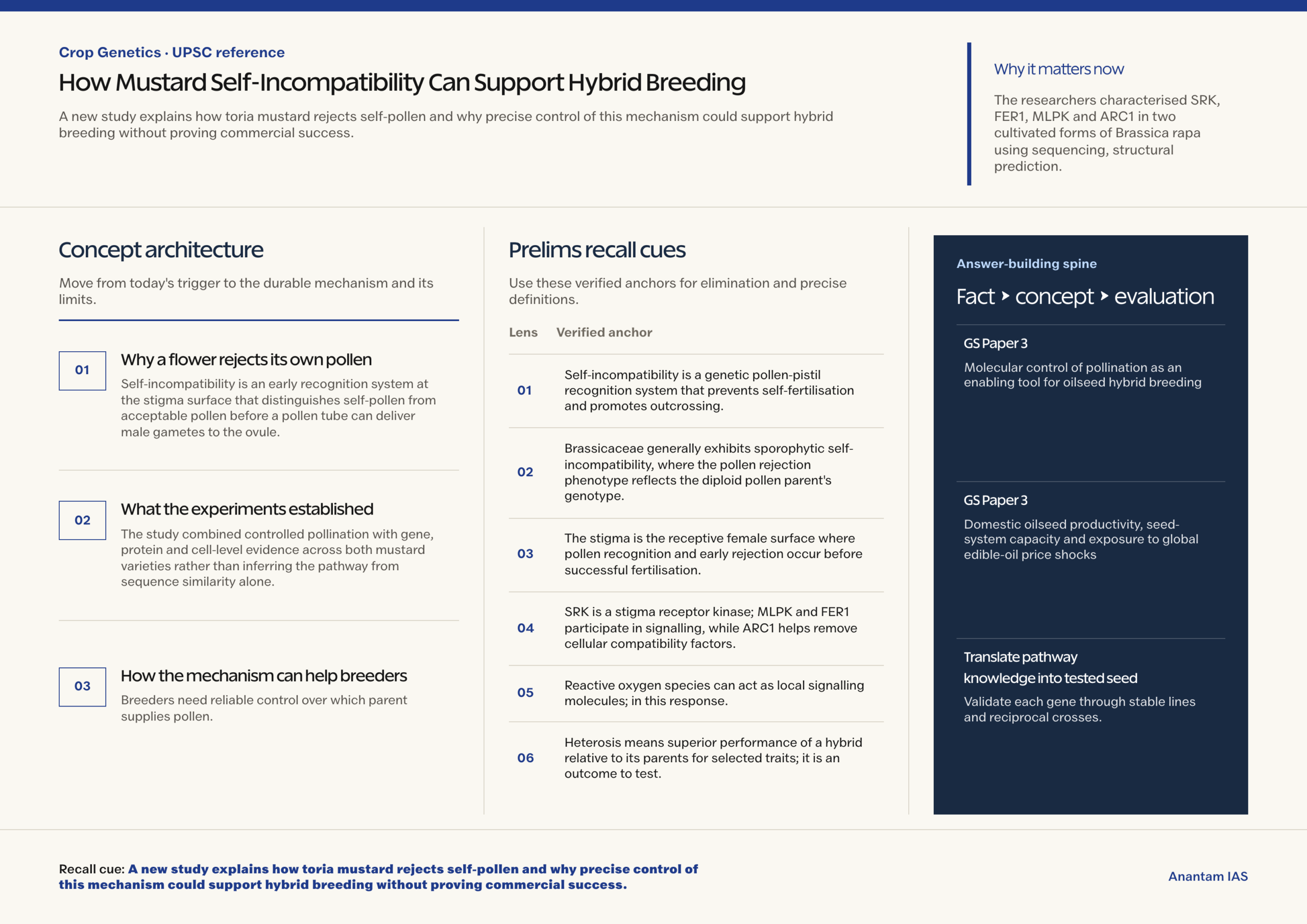
How Mustard Self-Incompatibility Can Support Hybrid Breeding
Why in News?
An IIT Gandhinagar and ICAR-DRMR study reported on 31 August 2026 that four genes help regulate self-pollen rejection in toria and yellow sarson mustard.
- The researchers characterised SRK, FER1, MLPK and ARC1 in two cultivated forms of Brassica rapa using sequencing, structural prediction, pollination tests and temporary gene suppression.
- Toria behaved as self-incompatible, largely blocking its own pollen, while yellow sarson was self-compatible; crosses between the varieties could still produce germinating seed.
- Temporarily suppressing SRK, FER1 or ARC1 allowed strong self-pollen tube growth in toria; suppressing MLPK weakened rejection only partly, suggesting a secondary or redundant role.
- The finding supplies a molecular breeding foundation. It does not establish that a commercial high-yield hybrid has been released or that India’s edible-oil import dependence has been solved.
- Hybrid seed production requires the maternal line to receive pollen from the selected parent without fertilising itself first; self-incompatibility can enforce that crossing step biologically.
- Crossing genetically different parents can express heterosis, but yield, oil quality, stress tolerance and seed-production reliability must still be tested across environments and generations.
- India imports more than half of its edible-oil requirement, yet laboratory insight becomes economic resilience only after breeding, field evaluation, seed multiplication and farmer adoption.
UPSC Relevance
Prelims Relevance
- Self-incompatibility is a genetic pollen-pistil recognition system that prevents self-fertilisation and promotes outcrossing.
- Brassicaceae generally exhibits sporophytic self-incompatibility, where the pollen rejection phenotype reflects the diploid pollen parent’s genotype.
- The stigma is the receptive female surface where pollen recognition and early rejection occur before successful fertilisation.
- SRK is a stigma receptor kinase; MLPK and FER1 participate in signalling, while ARC1 helps remove cellular compatibility factors.
- Reactive oxygen species can act as local signalling molecules; in this response, their accumulation helps arrest incompatible pollen germination.
- Heterosis means superior performance of a hybrid relative to its parents for selected traits; it is an outcome to test, not an automatic result of every cross.
Mains Relevance
GS Paper 3
- Molecular control of pollination as an enabling tool for oilseed hybrid breeding
- Translation gap between gene characterisation, stable breeding lines and field-validated cultivars
GS Paper 3
- Domestic oilseed productivity, seed-system capacity and exposure to global edible-oil price shocks
- Need to combine biotechnology with agronomy, biosafety, public breeding and farmer access
Essay
- Scientific self-reliance is built through patient translation from molecular understanding to dependable seed, field performance and affordable access.
Background and Context
Why a flower rejects its own pollen
Self-incompatibility is an early recognition system at the stigma surface that distinguishes self-pollen from acceptable pollen before a pollen tube can deliver male gametes to the ovule.
- A pollen grain first lands on the stigma, where hydration, germination and entry are regulated; only after these early checks can a pollen tube grow toward the ovule.
- In Brassica, a matching self-pollen signal activates the stigma’s S-locus receptor kinase, or SRK, at the papilla-cell membrane, like a receptor recognising a molecular identity tag.
- Activated receptors recruit downstream signalling components, including FER1 and MLPK, converting recognition at the surface into a rapid intracellular rejection response within minutes of pollination.
- One branch produces a local reactive oxygen species burst; these reactive molecules function here as signals that make the stigma hostile before incompatible pollen can establish a tube.
- A parallel ARC1 pathway, involving an E3 ubiquitin ligase, targets cellular compatibility factors for degradation and helps prevent hydration, tube penetration and eventual self-fertilisation.
What the experiments established
The study combined controlled pollination with gene, protein and cell-level evidence across both mustard varieties rather than inferring the pathway from sequence similarity alone.
- Pollination assays tracked pollen attachment, pollen-tube growth and seed formation, confirming strong rejection after toria self-pollination and compatibility in reciprocal crosses involving toria and yellow sarson.
- The team cloned and sequenced SRK, FER1, MLPK and ARC1, compared them across related plants, and used AlphaFold3 to test whether predicted proteins retained expected functional domains.
- Short antisense oligonucleotides temporarily reduced each gene’s instructions on the stigma; this transient suppression tested function directly without creating or evaluating a permanent edited plant.
- Suppressing SRK, FER1 or ARC1 broke the self-incompatibility barrier strongly, while MLPK suppression increased attachment but did not significantly restore pollen-tube penetration, marking an important pathway difference.
- ROS fell after suppressing SRK, FER1 or MLPK but not ARC1, supporting two interacting rejection branches: a FER-linked ROS response and an ARC1-linked protein-degradation pathway.
How the mechanism can help breeders
Breeders need reliable control over which parent supplies pollen, because accidental selfing contaminates hybrid seed while indiscriminate rejection can also block the intended cross at scale.
- A stable self-incompatible maternal line can reduce manual emasculation, the labour-intensive removal of pollen-producing anthers before controlled crossing across thousands of flowers in a seed-production plot.
- Crossing distinct parents may capture hybrid vigour for yield, oil traits or resilience, but each combination must be selected, replicated and tested rather than assumed superior.
- Knowing pathway genes can support molecular markers, parent-line selection and future editing strategies that switch compatibility on for line maintenance and off during controlled hybrid seed production.
- The toria-yellow sarson crosses show biological compatibility, yet a usable hybrid also needs stable trait inheritance, seed purity, multi-location performance, regulatory clearance where applicable and economical multiplication.
- The study narrows a breeding bottleneck; it does not by itself raise national production, release a cultivar or replace imports without coordinated progress across genetics, agronomy, regulation and seed systems.
Way Forward
Translate pathway knowledge into tested seed
- Validate each gene through stable lines and reciprocal crosses, distinguishing temporary laboratory suppression from heritable control of pollen acceptance under field conditions.
- Develop molecular markers for dependable self-incompatible and maintainer lines, then measure hybrid seed purity, restoration, fertility and multiplication efficiency before scale-up.
- Test candidate hybrids across agro-climatic zones for yield stability, oil quality, disease resistance, heat tolerance and farmer-relevant input requirements rather than relying on controlled-environment results.
- Link public research with transparent biosafety assessment, breeder-seed capacity and affordable distribution so any successful hybrid becomes an accessible production technology, not only a laboratory achievement.
Conclusion
- Mustard self-incompatibility is a pollen-recognition and signalling system: SRK detects self identity, FER1 and MLPK shape signalling, and ROS and ARC1-linked pathways stop pollen acceptance before fertilisation through partly separable cellular routes.
- For Mains, connect this mechanism to hybrid breeding through a chain: control pollination, preserve parent identity, test heterosis, validate performance, multiply pure seed and deliver it affordably to farmers.
- Present the 2026 study as foundational evidence, not a commercial breakthrough: permanent validation, stable breeding lines, multi-location trials and seed-system execution still separate gene knowledge from sustained import reduction across the wider oilseed economy.
UPSC Practice Questions
Prelims MCQ 1
With reference to self-incompatibility in Brassica crops, consider the following statements:
- It can prevent self-fertilisation by rejecting pollen at the stigma.
- Reactive oxygen species may participate in the rejection response.
- Every cross between self-incompatible and self-compatible parents necessarily produces a superior hybrid.
How many of the above statements are correct?
(a) Only one (b) Only two (c) All three (d) None
Answer: (b) Only two
Explanation:
Statements 1 and 2 are correct. Self-incompatibility can block self-pollen and involves signalling that includes ROS. Heterosis must be demonstrated for a particular cross; it is not guaranteed.
Prelims MCQ 2
What is the most accurate breeding relevance of a self-incompatible maternal line?
(a) It guarantees that all offspring outperform both parents (b) It can reduce accidental selfing while enabling controlled cross-pollination (c) It permanently edits the genome of every pollen donor (d) It removes the need for field testing and seed-purity checks
Answer: (b) It can reduce accidental selfing while enabling controlled cross-pollination
Explanation:
A self-incompatible line can help enforce crossing with the selected pollen parent. Hybrid performance, genetic stability and seed purity still require breeding and field validation.
UPSC Mains Questions
- Explain the molecular basis of self-pollen rejection in mustard. How can controlled self-incompatibility support hybrid seed production?
- Gene characterisation is only the first step from agricultural biotechnology to economic self-reliance. Discuss with reference to oilseed breeding and India’s edible-oil challenge.
Sources: PIB Ahmedabad, Ministry of Education and Frontiers in Plant Science.
Frequently Asked Questions
What is self-incompatibility in mustard?
It is a genetic recognition system in which the stigma identifies related self-pollen and blocks its acceptance, promoting cross-pollination and helping maintain genetic diversity.
Why is toria useful for studying self-incompatibility?
Toria is a cultivated Brassica rapa form that strongly rejects its own pollen, allowing researchers to test the genes and cellular signals controlling that barrier.
What roles do SRK, FER1, MLPK and ARC1 play?
SRK detects self-pollen identity; FER1 and MLPK contribute to signalling; ARC1 supports a parallel degradation pathway that removes factors required for compatible pollen growth.
How can self-incompatibility aid hybrid breeding?
It can reduce accidental self-fertilisation in the maternal parent, helping breeders enforce crossing with a selected pollen donor and maintain hybrid-seed purity.
Has this study produced a commercial mustard hybrid?
No. It characterised and temporarily suppressed pathway genes. Stable breeding lines, field trials, seed multiplication and formal release would still be needed for a commercial hybrid.
Source: https://anantamias.com/current-affairs/mustard-self-incompatibility-hybrid-breeding/
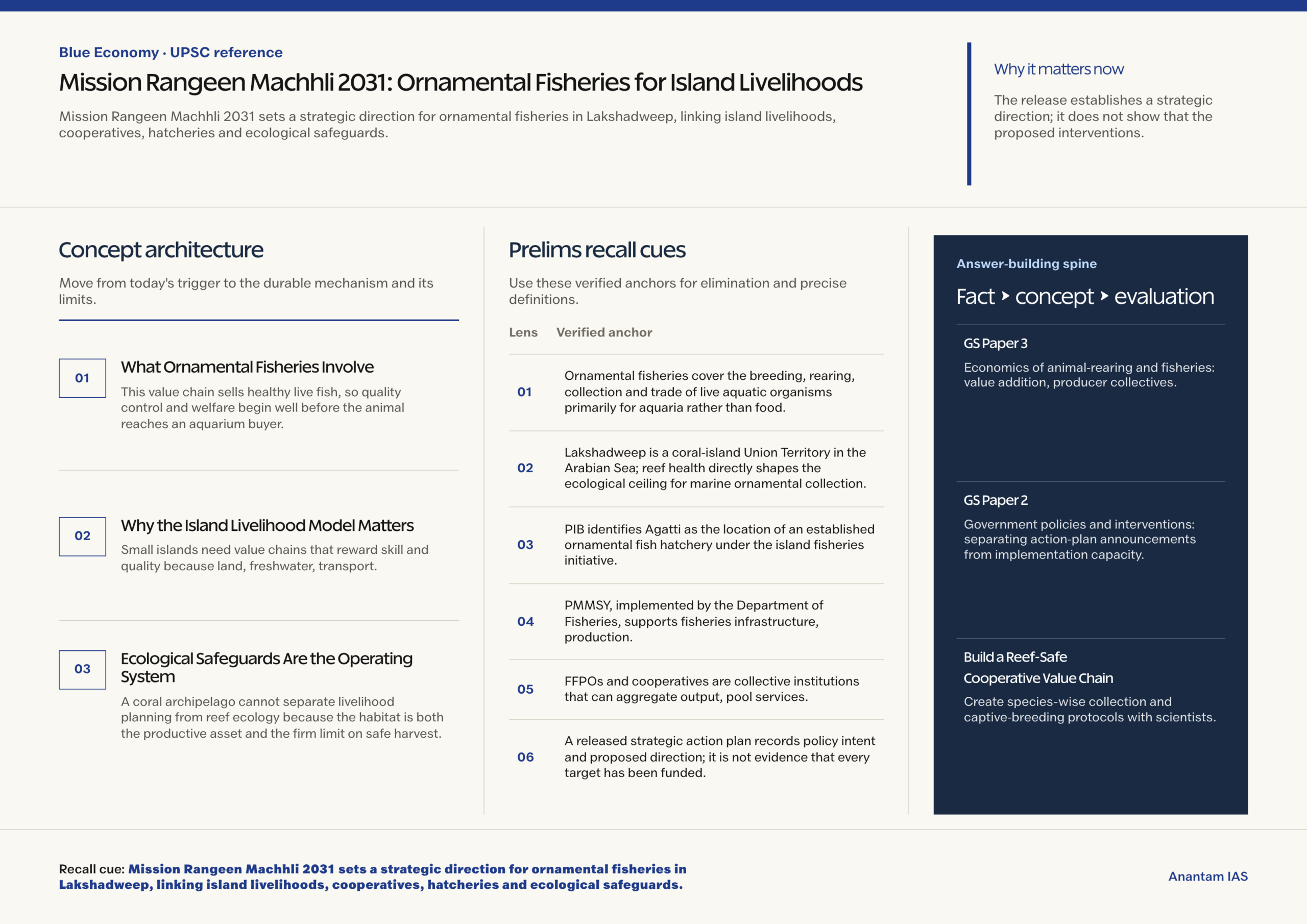
Mission Rangeen Machhli 2031: Ornamental Fisheries for Island Livelihoods
Why in News?
The Department of Fisheries released the Mission Rangeen Machhli 2031 Strategic Action Plan for Ornamental Fisheries Development at Agatti, Lakshadweep, on 31 August 2026, marking a policy release rather than completed implementation.
- The release establishes a strategic direction; it does not show that the proposed interventions, livelihood gains or conservation outcomes have already been completed.
- PIB reports that Lakshadweep has more than 300 ornamental fish species, giving the islands a distinctive base for a carefully regulated aquarium-fish value chain.
- An ornamental fish hatchery has been established at Agatti, while 3 rearing units have been approved under the Pradhan Mantri Matsya Sampada Yojana.
- The wider policy frame emphasizes Fish Farmer Producer Organisations and fisheries cooperatives for aggregation, technical support, value addition and market access.
- The central policy test is whether income from colorful live fish can grow without transferring ecological costs to fragile coral-reef habitats.
- Ornamental fisheries trade live aquatic organisms for aquaria, so survival, appearance, traceability and animal health matter more than bulk harvest volume.
- For small islands, local breeding and cooperative marketing can retain more value locally, but wild collection needs science-based limits and non-destructive methods.
- The initiative joins livelihood policy with marine conservation: a depleted reef cannot support either biodiversity or a durable ornamental-fish enterprise.
UPSC Relevance
Prelims Relevance
- Ornamental fisheries cover the breeding, rearing, collection and trade of live aquatic organisms primarily for aquaria rather than food.
- Lakshadweep is a coral-island Union Territory in the Arabian Sea; reef health directly shapes the ecological ceiling for marine ornamental collection.
- PIB identifies Agatti as the location of an established ornamental fish hatchery under the island fisheries initiative.
- PMMSY, implemented by the Department of Fisheries, supports fisheries infrastructure, production, value chains and fisher welfare across marine and inland sectors.
- FFPOs and cooperatives are collective institutions that can aggregate output, pool services, improve bargaining power and organize compliance among small producers.
- A released strategic action plan records policy intent and proposed direction; it is not evidence that every target has been funded, executed or achieved.
Mains Relevance
GS Paper 3
- Economics of animal-rearing and fisheries: value addition, producer collectives, market access and livelihood diversification in island territories.
- Conservation, environmental pollution and degradation: reef-safe collection, captive breeding, biosecurity, traceability and science-based harvest limits.
GS Paper 2
- Government policies and interventions: separating action-plan announcements from implementation capacity, monitoring and verifiable outcomes.
Essay
- The blue economy succeeds when coastal prosperity is treated as a return on healthy marine ecosystems, not as a substitute for conservation.
Background and Context
What Ornamental Fisheries Involve
This value chain sells healthy live fish, so quality control and welfare begin well before the animal reaches an aquarium buyer.
- The chain can include broodstock management, hatchery breeding, nursery rearing, feed, grading, quarantine, packing, air transport and specialized retail, with welfare checks and survival records at each transfer.
- Unlike food fisheries, value depends heavily on survival and condition; poor handling raises mortality, weakens producer returns, creates an animal-welfare concern and increases pressure for replacement collection.
- Captive breeding can create repeatable supply, retain breeding knowledge locally and reduce dependence on wild capture, while hatchery records help producers track survival and improve husbandry.
- Wild collection may remain part of the sector, but it requires species identification, selective gear, habitat-safe methods and science-based limits, supported by collector logs that reveal changing catch effort.
- This is the exam trap: small harvest volume does not guarantee sustainability when collection concentrates on rare or slow-recovering species. Ecological sensitivity, not tonnage alone, determines risk.
Why the Island Livelihood Model Matters
Small islands need value chains that reward skill and quality because land, freshwater, transport, storage and access to distant buyers are tightly constrained by geography.
- Ornamental fish can offer a high-value, low-volume livelihood route, but distance from markets makes reliable packing and air connectivity critical because delays, cancellations or temperature shocks can erase value.
- A local hatchery and rearing network can move earnings from raw collection toward breeding, husbandry and quality assurance, keeping higher-value work and specialized technical jobs within island communities.
- Women and youth enterprises can participate in nurseries, feed preparation, maintenance, packing and digital marketing when training, finance and facilities match local conditions, without forcing participation in capture.
- FFPOs and fisheries cooperatives can pool batches, negotiate transport, buy inputs and maintain standards. That converts scattered, price-taking households into a market-facing institution with better information about buyers.
- But cooperative labels do not guarantee participation. Durable gains require transparent membership, audited accounts, fair benefit sharing, local decisions and accessible grievances, so customary fishers don’t bear hidden costs.
Ecological Safeguards Are the Operating System
A coral archipelago cannot separate livelihood planning from reef ecology because the habitat is both the productive asset and the firm limit on safe harvest.
- Collection rules should begin with species-level identification and stock assessment, then set seasonal, area or quantity limits that respond to monitoring, with no-take treatment where recovery is uncertain.
- Non-destructive capture must exclude practices that damage corals or indiscriminately stun fish. Selective methods, collector training and field inspection protect habitat, non-target species and future recruitment.
- Hatcheries need biosecurity, meaning quarantine, disease screening and controlled water management, so pathogens, untreated effluent or escaped non-native organisms do not enter island waters or move between units.
- A traceability record should connect each specimen to its source, collector or hatchery and movement chain. Interoperable records support enforcement, credible buyer claims and recalls when problems appear.
- Independent ecological monitoring should publish what is measured and what changes when thresholds are crossed, including predefined pause or reduction triggers. Until then, plan targets remain proposals.
Way Forward
Build a Reef-Safe Cooperative Value Chain
- Create species-wise collection and captive-breeding protocols with scientists, island administrations and fishers before scaling market access.
- Link hatcheries, rearing units and cooperatives through common quarantine, animal-welfare, traceability and mortality-reporting standards.
- Measure household income, local value retention, women’s participation, wild collection pressure and reef indicators rather than reporting infrastructure alone.
- Use staged expansion: scale only when survival, compliance and ecological monitoring show that the previous stage stayed within agreed limits.
Conclusion
- Mission Rangeen Machhli 2031 is best read as an island livelihood strategy whose economic promise depends on cooperative capacity, captive breeding and enforceable ecological safeguards.
- In a Mains answer, connect value addition with the ecological ceiling: reefs support the enterprise, so monitoring and local stewardship are productive infrastructure, not optional restrictions.
- The present evidence confirms the release of a plan and some enabling facilities. Implementation quality and measurable outcomes still need to be demonstrated.
UPSC Practice Questions
Prelims MCQ 1
With reference to Mission Rangeen Machhli 2031, consider the following statements:
- It is a strategic action plan for ornamental fisheries development.
- PIB identifies Agatti as the site of an established ornamental fish hatchery.
- Its release proves that all proposed livelihood and conservation targets have been achieved.
How many of the above statements are correct?
(a) Only one (b) Only two (c) All three (d) None
Answer: (b) Only two
Explanation:
Statements 1 and 2 are correct. The release records policy direction; it does not establish completed implementation or achieved outcomes.
Prelims MCQ 2
Which measure most directly reduces ecological pressure while maintaining a supply of ornamental fish?
(a) Expanding indiscriminate wild collection (b) Replacing species identification with volume targets (c) Scaling captive breeding with biosecurity and traceability (d) Removing quarantine requirements for live-fish trade
Answer: (c) Scaling captive breeding with biosecurity and traceability
Explanation:
Captive breeding can reduce repeated wild collection, while biosecurity and traceability address disease, escape and sourcing risks.
UPSC Mains Questions
- Ornamental fisheries can diversify island livelihoods, but their viability depends on ecological discipline. Discuss with reference to Lakshadweep.
- Fish Farmer Producer Organisations and fisheries cooperatives can connect conservation with local value addition. Critically examine the institutional conditions needed for this model to work.
Source: PIB, Department of Fisheries.
Frequently Asked Questions
What is Mission Rangeen Machhli 2031?
It is a strategic action plan released by the Department of Fisheries for ornamental fisheries development. The announcement sets policy direction, but it does not by itself prove completed implementation or outcomes.
Why is Lakshadweep suitable for ornamental fisheries?
Lakshadweep has diverse reef-associated fish, including more than 300 ornamental species reported by PIB. Its ecological sensitivity also means collection and breeding must operate under strict safeguards.
How can cooperatives support island fishers?
Cooperatives and FFPOs can aggregate small batches, share technical services, standardize quality, negotiate transport and improve bargaining power. Their success still depends on transparent governance and fair benefit sharing.
Can ornamental fisheries harm coral reefs?
Yes. Unsustainable collection, destructive capture and poor species identification can damage habitats or deplete sensitive populations. Captive breeding, selective methods, monitoring and traceability can reduce these risks.
What should be monitored during implementation?
Monitoring should cover specimen survival, disease, wild collection pressure, reef condition, compliance, household income, local value retention and participation by women and small producers, not infrastructure counts alone.
Source: https://anantamias.com/current-affairs/mission-rangeen-machhli-ornamental-fisheries/
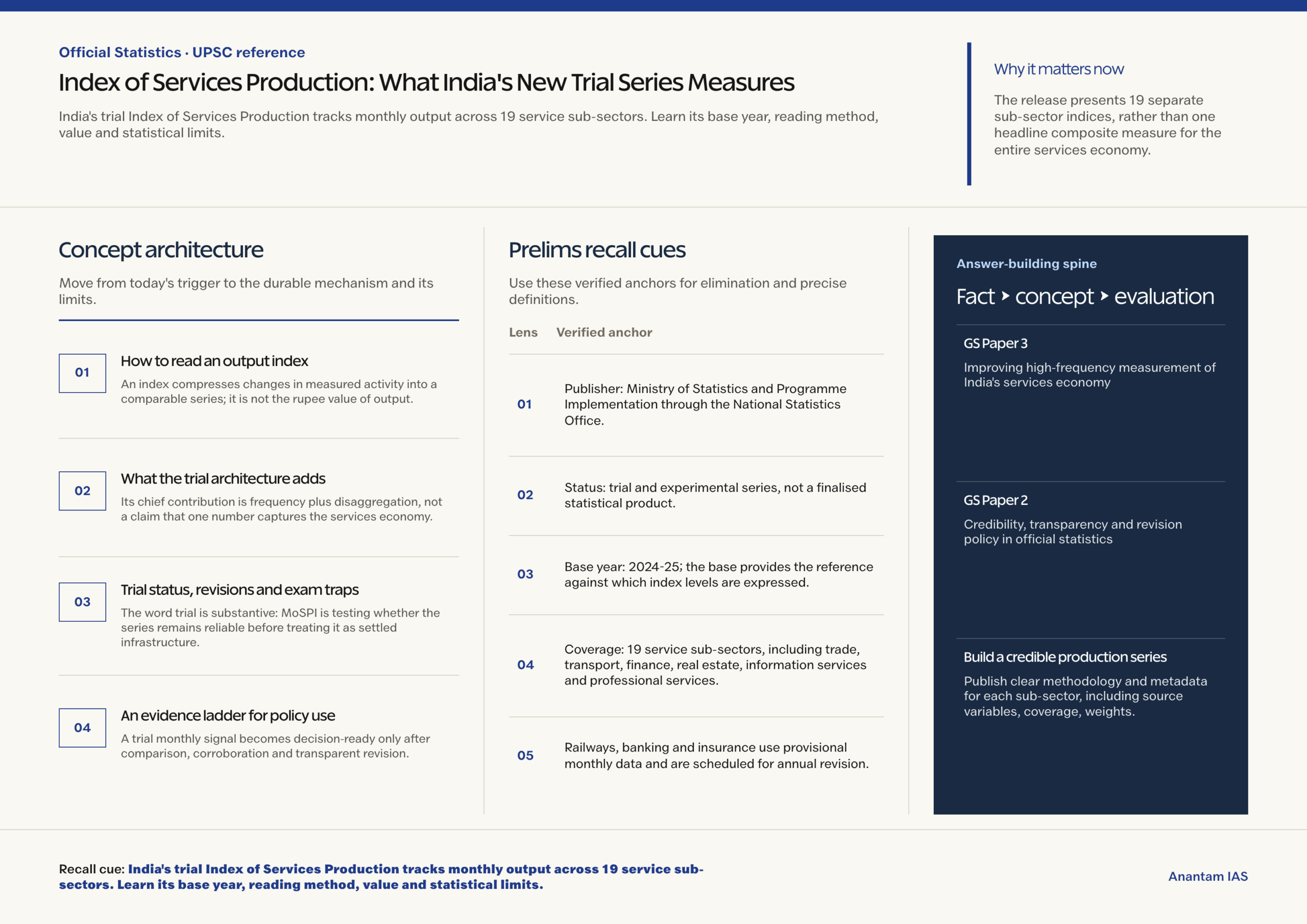
Index of Services Production: What India’s New Trial Series Measures
Why in News?
On 31 August 2026, MoSPI released the trial Index of Services Production for June 2026, covering 19 service sub-sectors on a 2024-25 base.
- The release presents 19 separate sub-sector indices, rather than one headline composite measure for the entire services economy.
- Compared with June 2025, 18 sub-sectors recorded positive growth and 8 posted double-digit growth; air transport was the only sub-sector showing contraction.
- Real estate showed the strongest reported year-on-year increase at 24.7%, followed by retail trade at 18.0%; these are one-month readings, not established trends.
- MoSPI describes publication as experimental, intended to test data quality and resilience while gathering feedback from users and stakeholders.
- Services dominate India’s economic structure, yet many detailed output estimates arrive less frequently than comparable production indicators for industry.
- A monthly sub-sector lens can reveal turning points and divergence earlier, but policy interpretation depends on stable source data, revisions and longer sequences.
UPSC Relevance
Prelims Relevance
- Publisher: Ministry of Statistics and Programme Implementation through the National Statistics Office.
- Status: trial and experimental series, not a finalised statistical product.
- Base year: 2024-25; the base provides the reference against which index levels are expressed.
- Coverage: 19 service sub-sectors, including trade, transport, finance, real estate, information services and professional services.
- Railways, banking and insurance use provisional monthly data and are scheduled for annual revision.
Mains Relevance
GS Paper 3
- Improving high-frequency measurement of India’s services economy
- Using disaggregated indicators without confusing volatility with structural change
GS Paper 2
- Credibility, transparency and revision policy in official statistics
Essay
- Better public decisions require faster statistics, but speed must remain subordinate to transparent methods and credible revision.
Background and Context
How to read an output index
An index compresses changes in measured activity into a comparable series; it is not the rupee value of output.
- The base year 2024-25 supplies the reference point. An index above 100 indicates measured output above its base-period reference, subject to the published series method and later revisions.
- An index level such as 122.8 should not be read as 122.8 rupees, a percentage share of GDP, a growth rate, or a measure of employment.
- A year-on-year comparison matches June 2026 with June 2025, reducing seasonal distortion that may affect a comparison with the immediately preceding month.
- Year-on-year growth still describes only the change between two observations; it cannot by itself separate seasonal, cyclical, policy or data-source effects or explain the causal mechanism.
- The release provides sub-sector-specific readings. Divergence between air transport, real estate and trade is analytical information, not a contradiction requiring averaging away into a false common story.
What the trial architecture adds
Its chief contribution is frequency plus disaggregation, not a claim that one number captures the services economy.
- The 19 sub-sectors span market services such as wholesale and retail trade, accommodation, logistics, telecommunications, finance, real estate, professional services and entertainment.
- Monthly readings can support nowcasting, help analysts locate sector-specific stress and provide an earlier check against narratives built only from quarterly aggregates or anecdotal business reports.
- Separate indices preserve different operating rhythms: passenger transport, insurance, property activity and digital services need not move together during the same month or respond equally to a shock.
- The published release does not offer one overall ISP headline. Aspirants should not construct an unweighted average because sub-sectors differ greatly in economic size.
- ISP complements national accounts rather than replacing them. GDP and GVA measure broader value added within an accounting framework; this trial series tracks higher-frequency production movement.
Trial status, revisions and exam traps
The word trial is substantive: MoSPI is testing whether the series remains reliable before treating it as settled infrastructure.
- MoSPI says experimentation will examine data quality, test resilience and collect feedback, so coverage, sources or methods may be refined after evaluation rather than assumed final.
- Railways, banking and insurance currently rely on provisional monthly inputs; their published values may change during the stated annual revision process.
- A revision is not automatically evidence of manipulation. Statistical systems revise estimates when more complete source data replace early or provisional information, provided changes remain transparent and documented.
- The June breadth reading is notable, but one month cannot establish a trend. Trend claims need several comparable observations and attention to revisions, seasonality and base effects.
- The 24.7% real-estate increase is a headline observation, not proof that service-sector productivity, employment quality, household welfare or the entire services economy improved by the same proportion.
An evidence ladder for policy use
A trial monthly signal becomes decision-ready only after comparison, corroboration and transparent revision.
- First, read the direction and breadth: identify which sub-sectors rose or fell and whether movement is concentrated, without converting one release into a structural verdict.
- Second, compare several months and corresponding year-earlier observations, then check whether provisional values changed. Persistence matters more than an isolated high or low reading.
- Third, corroborate the signal with national accounts, employment, prices and sector-specific administrative evidence. Agreement strengthens diagnosis; disagreement identifies where measurement or transmission needs investigation.
- Policy should respond to the diagnosed mechanism, not the index alone. A transport decline caused by temporary disruption requires a different response from weak demand or capacity constraints.
Way Forward
Build a credible production series
- Publish clear methodology and metadata for each sub-sector, including source variables, coverage, weights, treatment of missing observations and revision schedules.
- Release vintage data so users can compare first estimates with revisions and judge whether early signals remain directionally reliable.
- Test seasonal adjustment only after sufficient observations accumulate, while retaining unadjusted data and explaining breaks in series.
- Use stakeholder feedback to improve coverage without sacrificing comparability across time or obscuring changes in methods.
Conclusion
- The trial ISP addresses a real information gap by making varied service activities visible at monthly frequency, but its strongest use is diagnostic, not definitive.
- A sound Mains answer should pair faster measurement with caveats on trial status, revisions and one-month volatility, then demand transparent methods before major policy reliance.
UPSC Practice Questions
Prelims MCQ 1
With reference to India’s trial Index of Services Production, consider the following statements:
- It uses 2024-25 as its base year.
- The June 2026 release presents separate indices for 19 service sub-sectors.
- Railways, banking and insurance are based on final monthly data that cannot be revised.
How many of the above statements are correct?
(a) Only one (b) Only two (c) All three (d) None
Answer: (b) Only two
Explanation:
Statements 1 and 2 are correct. MoSPI says the railways, banking and insurance indices use provisional monthly data and will undergo annual revision.
Prelims MCQ 2
Which interpretation of an Index of Services Production reading is most appropriate?
(a) It directly states the sub-sector’s share in GDP (b) It reports the rupee value of monthly service output (c) It tracks measured production relative to a base-period reference (d) It measures only employment generated by services
Answer: (c) It tracks measured production relative to a base-period reference
Explanation:
An output index expresses relative movement against its base reference. It is not a GDP share, rupee-value total or employment measure.
UPSC Mains Questions
- How can a monthly Index of Services Production improve economic policymaking in India? Discuss its value and the safeguards needed during a trial series.
- A high-frequency indicator can be timely without being conclusive. Explain with reference to sub-sectoral service indices, revisions and one-month volatility.
Source: PIB, Ministry of Statistics and Programme Implementation.
Frequently Asked Questions
What is the Index of Services Production?
It is a set of monthly indices tracking measured production movement across 19 service sub-sectors relative to a 2024-25 base-period reference.
Is India’s ISP a final official series?
No. MoSPI explicitly labels it a trial, experimental publication designed to test data quality and resilience and receive feedback before the system matures.
Does an index value of 122.8 mean 22.8% annual growth?
No. The index level is relative to its base reference. Annual growth must be calculated by comparing the index with the corresponding month a year earlier.
Why should one month not be called a trend?
A single comparison may reflect seasonality, base effects, temporary shocks or provisional inputs. A trend needs multiple comparable observations and scrutiny of later revisions.
How is ISP different from GDP or GVA?
ISP offers high-frequency movement for selected service sub-sectors. GDP and GVA are broader national-account aggregates measuring value added across the economy.
Source: https://anantamias.com/current-affairs/services-production-index-trial-series/
Article 124(3): The Unused Distinguished-Jurist Route to the Supreme Court
Why in News?
On 30 August, Supreme Court judge Justice Ujjal Bhuyan highlighted Article 124(3), which permits a distinguished jurist to be appointed to the Court, although that route has never been used.
- Article 124(3) establishes three alternative eligibility routes: High Court judicial service, High Court advocacy, or recognition by the President as a distinguished jurist.
- The jurist clause carries no specified minimum period of practice or academic service; the constitutional text instead uses the President’s opinion as its express qualifier.
- No Supreme Court judge has been appointed through clause (c), making it a valid but unused constitutional route, not a newly created category.
- The speech reopened a question about judicial diversity and legal scholarship; it did not announce a candidate, recommendation, vacancy decision or pending nomination.
- The exam trap is to confuse constitutional eligibility with selection: satisfying Article 124(3) permits consideration but does not itself create a claim to appointment.
- The route could bring academic or juristic expertise to constitutional adjudication, but undefined criteria also raise questions of transparency, comparability and institutional legitimacy.
- Its non-use reflects appointment practice rather than repeal; clause (c) remains part of the Constitution even though judges have come from the Bench or Bar.
UPSC Relevance
Prelims Relevance
- A Supreme Court judge must be a citizen of India under Article 124(3).
- One route requires at least five years as a High Court judge, including service across two or more High Courts in succession.
- A second route requires at least ten years as a High Court advocate, including qualifying successive practice.
- Clause (c) covers a person who is, in the opinion of the President, a distinguished jurist.
- Article 124(3) states qualifications; Supreme Court appointment proposals operate through the current Memorandum of Procedure and collegium practice.
- A Supreme Court judge holds office until 65 years of age, subject to resignation or constitutional removal.
Mains Relevance
GS Paper 2
- Constitutional qualifications for Supreme Court judges and the difference between eligibility, recommendation and formal appointment
- Potential contribution of academic and juristic expertise to judicial diversity, balanced against transparent and defensible selection criteria
Essay
- Institutions gain from diverse expertise only when inclusion is joined by clear standards, independence and public legitimacy.
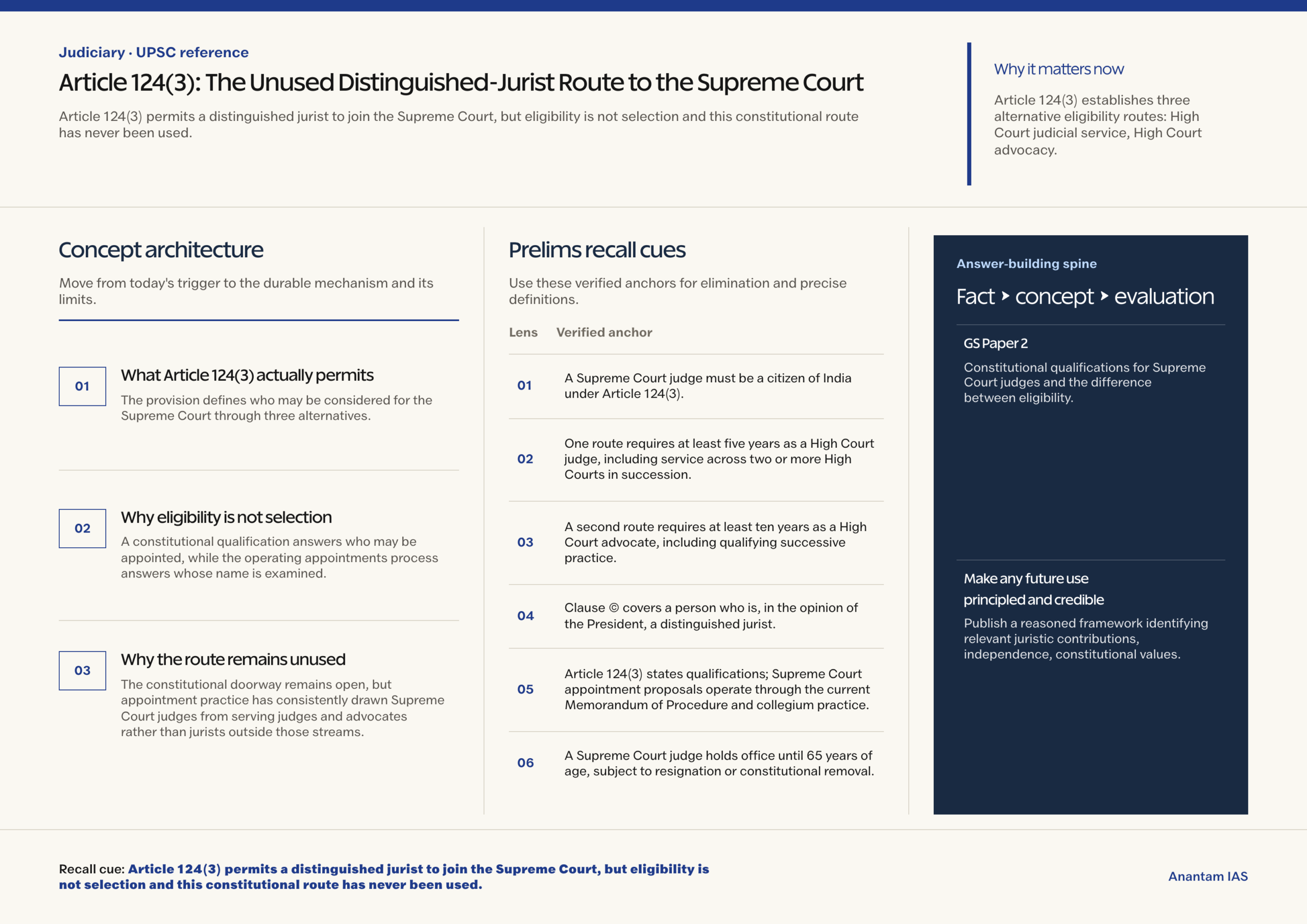
Background and Context
What Article 124(3) actually permits
The provision defines who may be considered for the Supreme Court through three alternatives, all subject to Indian citizenship and a separate appointment decision.
- The first route covers a person who has served for at least five years as a judge of one High Court or successive High Courts; the required period is cumulative across qualifying courts.
- The second covers a person who has practised for at least ten years as an advocate of one High Court or successive High Courts, allowing qualifying successive practice to count.
- The third covers someone who is, in the President’s opinion, a distinguished jurist; the clause provides no fixed academic title, publication threshold, judicial experience or service period.
- These are alternative qualifications, not cumulative requirements. A distinguished jurist need not first satisfy the five-year judicial or ten-year advocacy route, though citizenship remains common.
- The clause creates eligibility for consideration. It grants no enforceable entitlement to a seat, and a vacancy, institutional recommendation and formal appointment remain separately necessary.
Why eligibility is not selection
A constitutional qualification answers who may be appointed, while the operating appointments process answers whose name is examined, recommended and formally appointed in the real institutional sequence.
- Under the current Memorandum of Procedure, responsibility for initiating a Supreme Court appointment proposal rests with the Chief Justice of India; clause (c) does not itself start a search.
- The Chief Justice’s opinion is formed with the four senior-most Supreme Court judges; this collegium convention governs recommendations and gives the judiciary institutional primacy in candidate selection.
- The recommendation moves through the Union Law Minister and Prime Minister before the President formally appoints the judge, as constitutional appointing authority, by warrant under hand and seal.
- The phrase in the opinion of the President in clause (c) cannot be read as a stand-alone recruitment channel detached from executive advice, judicial consultation and the operating process.
- A jurist would still need institutional assessment and recommendation. The distinction prevents an exam answer from treating eligibility wording, or presidential opinion, as unilateral presidential selection.
Why the route remains unused
The constitutional doorway remains open, but appointment practice has consistently drawn Supreme Court judges from serving judges and advocates rather than jurists outside those streams.
- The Constitution does not define distinguished jurist through measurable criteria or an exhaustive test, leaving difficult comparisons among scholars, teachers, researchers, law-reform experts and other legal thinkers.
- Selection bodies may prefer candidates with demonstrated courtroom and adjudicatory experience, while a jurist route asks them to evaluate different evidence of legal judgment, institutional temperament and capacity across disputes.
- Clear criteria could improve predictability, but a rigid checklist might undervalue unconventional scholarship or reproduce existing networks under a new label unless reasons and evidence remain open to scrutiny.
- Using the route could broaden expertise in public law and legal research; it would not create a narrower class of judge, because every appointee performs the full judicial role.
- The present debate asks whether the route deserves serious exploration. A judicial speech neither places a person under consideration nor creates a binding definition or official appointment proposal.
Way Forward
Make any future use principled and credible
- Publish a reasoned framework identifying relevant juristic contributions, independence, constitutional values, professional integrity and ability to perform the full judicial role.
- Assess scholarship and public-law contribution alongside temperament, conflicts of interest, fairness and capacity to decide fact-intensive disputes beyond an academic specialisation.
- Record enough reasons to distinguish a jurist recommendation from patronage while protecting legitimate confidentiality around consultations and personal information.
- Treat the clause as one route to institutional diversity, not as a shortcut around judicial independence, scrutiny or the regular recommendation process.
Conclusion
- Article 124(3)(c) is an unused eligibility route, not an unused presidential power to appoint anyone independently; constitutional qualification and institutional selection must remain separate under Article 74 and current appointment practice.
- A strong Mains answer should pair the diversity case for juristic expertise with safeguards: clear criteria, reasoned evaluation, independence and equal judicial responsibility after appointment, without mistaking diversity for relaxed scrutiny.
UPSC Practice Questions
Prelims MCQ 1
With reference to Article 124(3) of the Constitution, consider the following statements:
- Every person appointed as a Supreme Court judge must be a citizen of India.
- Ten years as an advocate of a High Court is one qualification route.
- The Constitution prescribes a minimum number of years in legal academia for a distinguished jurist.
How many of the above statements are correct?
(a) Only one (b) Only two (c) All three (d) None
Answer: (b) Only two
Explanation:
Statements 1 and 2 are correct. Clause (c) uses the President’s opinion but sets no minimum academic-service period or other express definition of distinguished jurist.
Prelims MCQ 2
Which statement best describes the distinguished-jurist clause in Article 124(3)?
(a) It permits Parliament to elect a law professor directly to the Supreme Court (b) It applies only to advocates with at least ten years of High Court practice (c) It is an alternative constitutional qualification whose use still requires the regular appointment process (d) It creates a temporary advisory membership of the Supreme Court
Answer: (c) It is an alternative constitutional qualification whose use still requires the regular appointment process
Explanation:
Clause (c) is an alternative to the High Court judge and advocate qualifications. It makes a jurist eligible for consideration but does not itself select or appoint that person.
UPSC Mains Questions
- Article 124(3)(c) broadens eligibility for appointment to the Supreme Court, but its non-use exposes a gap between constitutional design and selection convention. Discuss.
- How can India explore the distinguished-jurist route to the Supreme Court while protecting judicial independence, transparency and confidence in the appointments process?
Sources: Indian Express Explained and Legislative Department, Constitution of India.
Frequently Asked Questions
Who is a distinguished jurist under Article 124(3)?
The Constitution supplies no fixed definition or minimum academic tenure. It covers a person who is, in the President’s opinion, a distinguished jurist, subject to the regular appointments process.
Has India appointed any Supreme Court judge through this route?
No. Supreme Court judges have been drawn from the Bench or directly from the Bar; Article 124(3)(c) remains constitutionally available but has not been used.
Can the President independently choose a distinguished jurist?
No stand-alone recruitment route follows from that phrase. Under current practice, the Chief Justice of India initiates Supreme Court proposals through collegium consultation before executive processing and formal presidential appointment.
Does eligibility guarantee appointment to the Supreme Court?
No. Article 124(3) sets threshold qualifications. Recommendation, executive processing and formal appointment are separate stages, so an eligible person has no automatic claim to a Supreme Court seat.
Why might a distinguished jurist be considered for the Court?
A jurist could add deep scholarship, comparative insight and public-law expertise. Any benefit depends on transparent assessment of independence, judgment, integrity and capacity to perform the Court’s complete judicial role.
Source: https://anantamias.com/current-affairs/article-124-distinguished-jurist-supreme-court/
Indian Standard Time becomes Mandatory National Time Reference
Why in News?
The Union government has notified the Legal Metrology (Indian Standard Time) Rules, 2026, making Indian Standard Time (IST) the common reference for all legal, administrative, commercial and official purposes across India.
The rules will come into force 180 days after their publication in the Official Gazette, allowing government departments, businesses and institutions to align their systems.
| UPSC Relevance: GS-1 Geography; GS-2: Government Policies and e-governance Prelims: IST, UTC, GMT, Indian Standard Meridian |
About Indian Standard Time:
- IST corresponds to UTC+5:30.
- It is historically based on India’s Standard Meridian of 82°30′ East longitude, passing near Mirzapur in Uttar Pradesh.
- CSIR-National Physical Laboratory (NPL), New Delhi, is India’s official timekeeper. It maintains IST through atomic clocks and links it with Coordinated Universal Time.
Why is a Common Time Reference Necessary?
Modern digital systems depend on precise and synchronised timestamps. Even small discrepancies can disrupt the correct sequence, authentication and audit of transactions.
Uniform IST will support:
- Accurate time-stamping of banking and digital-payment transactions
- Coordination among railways, airports and other transport systems
- Synchronisation of telecommunications, Internet and computer networks
- Stable operation of power grids and energy-management systems
- Authenticity of government, judicial and commercial records
- Coordination of defence, emergency and disaster-response services; and
- Investigation of cyberattacks by correlating digital logs across different networks.
Wider Significance:
- Digital and technological sovereignty: Many Indian systems obtain time from foreign satellite-navigation networks or overseas Internet servers. Indigenous dissemination of accurate IST will reduce external dependence and strengthen the resilience of critical infrastructure.
- Cybersecurity and digital evidence: A trusted national time reference helps reconstruct cyber incidents, identify the sequence of unauthorised activities and establish the evidentiary value of electronic records.
- Financial integrity: Stock exchanges, banks, payment platforms and high-frequency trading systems require accurate timestamps to settle disputes, prevent manipulation and maintain reliable audit trails.
Implementation Challenges:
- Upgrading legacy equipment and software may impose costs on smaller institutions.
- Remote areas may lack reliable connectivity for continuous synchronisation.
- Different sectors require different levels of precision: from seconds in administrative records to microseconds or nanoseconds in telecommunications and power systems.
- Systems operating internationally often store time in UTC. Implementation guidelines must preserve global interoperability while ensuring that official records are traceable to IST.
- Strong authentication is necessary to prevent spoofing or manipulation of national time-distribution services.
Two-Time-Zone Debate:
- The rules standardise the reference and dissemination of time; they do not settle the separate demand for a second time zone in northeastern India.
- Advocates argue that earlier daylight hours could improve productivity and energy efficiency, while opponents cite administrative, railway and coordination difficulties.
Way Forward:
- India should establish secure and redundant time-distribution infrastructure through CSIR-NPL and legal metrology laboratories.
- Sector-specific accuracy standards, regular audits, domestic atomic-clock capability and backup terrestrial networks should complement satellite-based dissemination.
Mandatory IST is more than an administrative reform. It creates a trusted national time architecture essential for digital governance, cybersecurity, financial stability and strategic autonomy.
Back to Basics:
| Basics of GMT: Greenwich Mean Time (GMT) is the mean solar time calculated at the Prime Meridian (0° longitude), which passes through the Royal Observatory at Greenwich, London. The Royal Observatory was established in 1675 to improve astronomical observations and help sailors determine longitude at sea. Since Earth rotates 360° in 24 hours, every 15° of longitude corresponds approximately to a one-hour time difference. Thus, places east of Greenwich are ahead of GMT, while places west of it are behind GMT. |
| Why was Greenwich Chosen? The International Meridian Conference of 1884, held in Washington, D.C., selected the Greenwich Meridian as the world’s Prime Meridian because: British maritime charts were already extensively used by international shipping. The Greenwich-based Nautical Almanac was widely employed for navigation. Britain was the dominant maritime and commercial power of the period. Many railways, telegraph networks and mapmakers already used Greenwich as their reference. Adopting an already widespread meridian reduced the economic and administrative cost of transition. Its opposite meridian (near 180° longitude) passed largely through the Pacific Ocean, making it suitable for locating the International Date Line with relatively limited disruption to populated areas. |
| GMT, UTC and IST: GMT is based traditionally on Earth’s rotation and mean solar time at Greenwich. Coordinated Universal Time (UTC) is the modern international time standard maintained through atomic clocks, with adjustments to remain close to Earth’s rotation. GMT and UTC generally show the same clock time, but UTC is the scientifically precise global standard. India’s Standard Meridian is 82°30′ E. Since it lies 82.5° east of Greenwich. |
What are Hanging Glaciers?
Why in News?
The recent devastating floods in Nepal have renewed attention on hanging glaciers and cascading Himalayan hazards. Scientists warn that rising temperatures, permafrost thaw and changing precipitation are destabilising steep ice-covered slopes.
A 2026 study identified 219 hanging glaciers in Uttarakhand’s Alaknanda basin, with simulations showing that their collapse could generate avalanche flows exceeding 50 metres in the Badrinath-Mana sector, threatening settlements and critical infrastructure.
| UPSC Relevance: GS-1 Geography: Physical Geography; GS-3: Climate Change and Disaster Management Prelims: Hanging glaciers, GLOF Mains: India’s vulnerability to climate events; Transboundary disaster management |
What are Hanging Glaciers?
- Hanging glaciers are masses of ice situated on steep mountain slopes, cliffs or elevated tributary valleys, often above a larger glacier, river valley or settlement.
- Unlike relatively stable valley glaciers, they are vulnerable to sudden break-off under gravity due to their steep gradient and partly unsupported position.
- As a trunk glacier retreats, its tributary glacier may become detached and remain “hanging” above the deepened main valley.
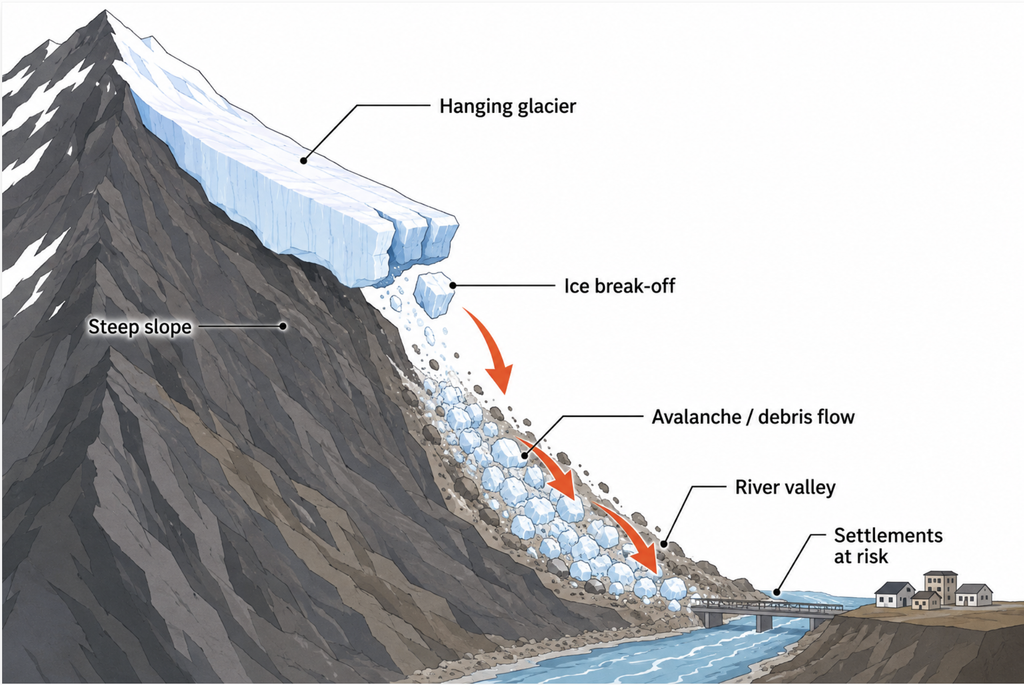
Why are they becoming unstable?
A combination of influences their stability:
- Rising temperatures and accelerated ice loss
- Thawing permafrost, which weakens the frozen ground anchoring ice and rocks
- Meltwater entering crevasses and lubricating the glacier bed
- Extreme or erratic precipitation and heavy snowfall
- Steep, fractured Himalayan geology; and
- Earthquakes, rockfalls and changes in glacier geometry.
Climate change is thus an important destabilising factor, but individual collapses may involve several interacting triggers.
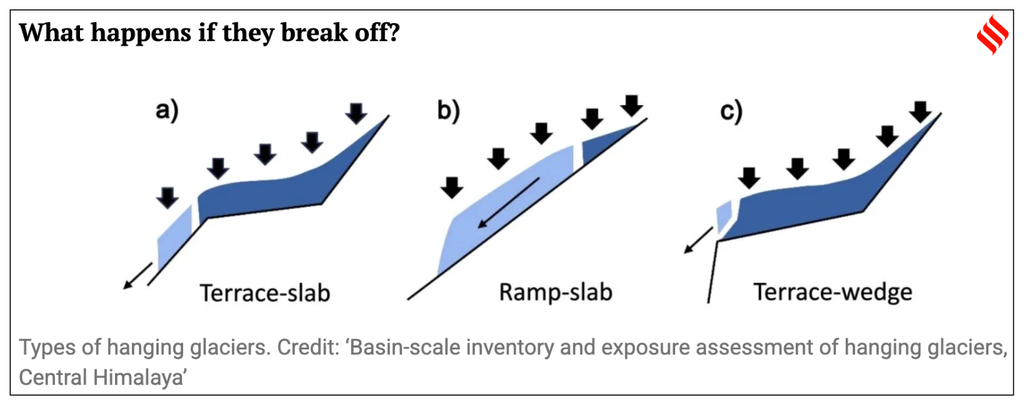
What happens when they break off?
A hanging-glacier failure can release enormous quantities of ice and rock within seconds. The falling mass may:
- Produce a high-speed ice-rock avalanche
- Entrap water, boulders and sediments
- Transform into a destructive debris flow
- Temporarily block a river, creating an unstable lake
- Breach the blockage and generate a flash flood; or
- Fall into a glacial lake and trigger a Glacial Lake Outburst Flood (GLOF).
Thus, it is a cascading hazard, rather than merely an avalanche. The 2021 Chamoli disaster, in which a rock-ice avalanche entered the Rishiganga valley and killed over 200 people, illustrates this process. It was initially misidentified as a GLOF.
Alaknanda Basin: Key Findings
A 2026 basin-scale study identified:
- 219 hanging glaciers in the Alaknanda basin
- Total area of approximately 71.7 sq km
- Total ice volume of 2.39 cubic km
- Around 0.74 cubic km classified as hanging ice
- Nearly 30% of hanging-ice volume concentrated in the Upper Alaknanda basin.
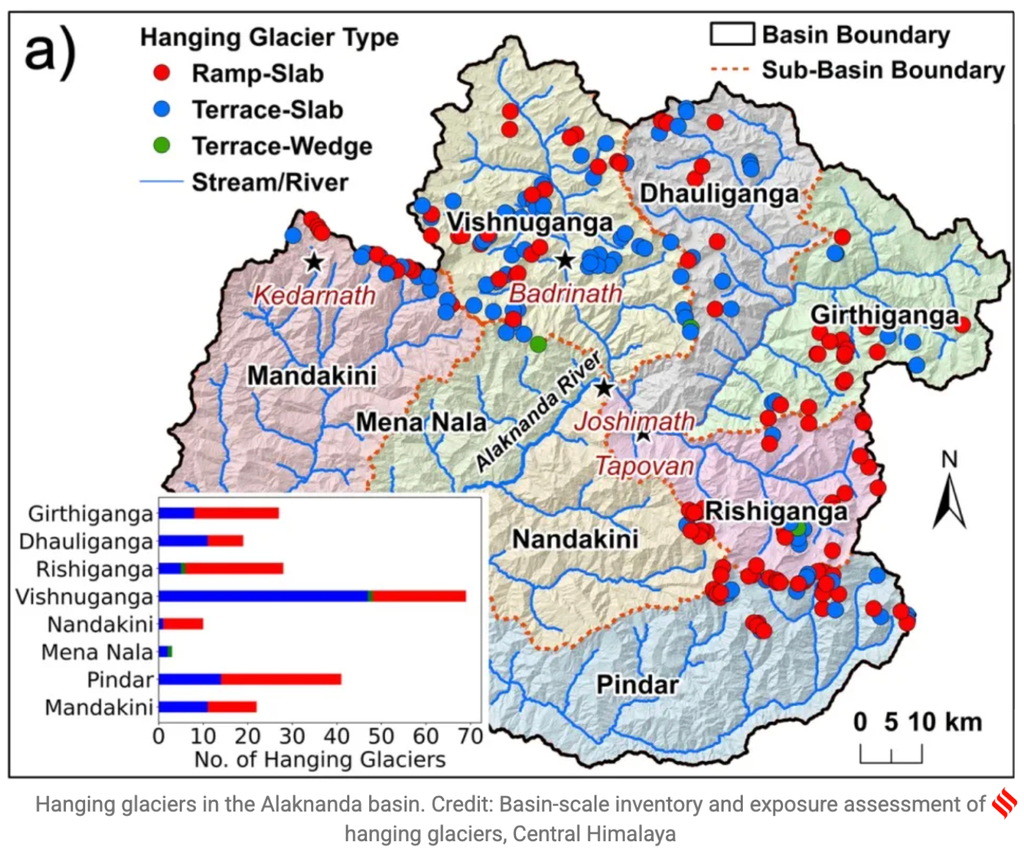
Worst-case simulations for selected glaciers indicated avalanche-flow heights exceeding 50 metres in the Badrinath-Mana sector, potentially affecting settlements, highways, pilgrimage routes and other infrastructure. These simulations indicate potential exposure, not that a collapse is certain.
Why is India particularly vulnerable?
- High exposure: Settlements, hydropower projects, roads and pilgrimage centres occupy narrow river valleys.
- Rapid infrastructure expansion: Construction is increasingly entering potential avalanche-runout zones.
- Cascading impacts: Avalanches can damage dams, block rivers and generate floods far downstream.
- Difficult monitoring: Many unstable slopes lie in remote, inaccessible areas.
- Short warning time: Once collapse begins, flood-like flows may travel rapidly through steep valleys.
- Transboundary character: Hazards originating in Nepal, Bhutan, Tibet or India can affect downstream countries.
- Ecological fragility: Debris flows damage forests, river habitats, farmland and geomorphological stability.
Way Forward:
- Prepare a comprehensive inventory of hanging glaciers across the Indian Himalayas.
- Combine satellite monitoring with drones, ground sensors, seismic instruments and automatic weather stations.
- Identify precursors such as accelerating ice movement, widening crevasses, slope deformation and temperature changes.
- Establish basin-level, multi-hazard early-warning systems.
- Integrate cryospheric risks into environmental impact assessments of dams, roads and tourism projects.
- Restrict construction in avalanche-runout and river-blockage zones.
- Develop last-mile alerts, evacuation routes and community-based disaster drills.
- Strengthen data-sharing among Himalayan countries.
- Reduce long-term risk through climate mitigation and ecosystem-sensitive development.
Hanging glaciers exemplify how climate change converts gradual cryospheric change into sudden, high-impact disasters. India must move from responding to “unexpected” Himalayan calamities towards anticipatory monitoring, risk-sensitive development and cascading-hazard preparedness.
Source: https://anantamias.com/current-affairs/what-are-hanging-glaciers/
India rejects Hague Court’s Indus Waters Treaty Ruling
Why in News?
On August 31, 2026, an ad hoc Court of Arbitration, administered by the Permanent Court of Arbitration (PCA) at The Hague, ruled that the Indus Waters Treaty (IWT), 1960, remains fully in force despite India’s decision to hold it in abeyance. The tribunal also imposed temporary restrictions on parts of the Ratle Hydroelectric Project in Jammu and Kashmir.
India rejected the award, maintaining that the arbitral body was illegally constituted and had no jurisdiction over India’s sovereign decisions.
| UPSC Relevance: GS-1 Indian Geography; GS-2 International Relations: Bilateral Relations Prelims: Indus Water Treaty, Dispute-Settlement Mechanism, Ratle Hydroelectric Project Mains: Indus Water Treaty: India’s stance & implications |
Key Provisions of Indus Waters Treaty:
- Signed in 1960 after World Bank-assisted negotiations, the Treaty divided the Indus river system broadly as follows:
- Eastern Rivers: Ravi, Beas and Sutlej- Allocated for India’s unrestricted use.
- Western Rivers: Indus, Jhelum and Chenab- Allocated principally to Pakistan. India can use the Western Rivers for domestic and non-consumptive purposes, limited irrigation, specified storage and run-of-the-river hydropower, subject to design restrictions.
- The Treaty also established:
- Regular exchange of hydrological data
- The bilateral Permanent Indus Commission
- Prior notification of projects affecting the other country; and
- A graded dispute-settlement mechanism.
The World Bank’s role is primarily procedural, including making specified appointments; it is neither the Treaty’s guarantor nor its enforcement authority.
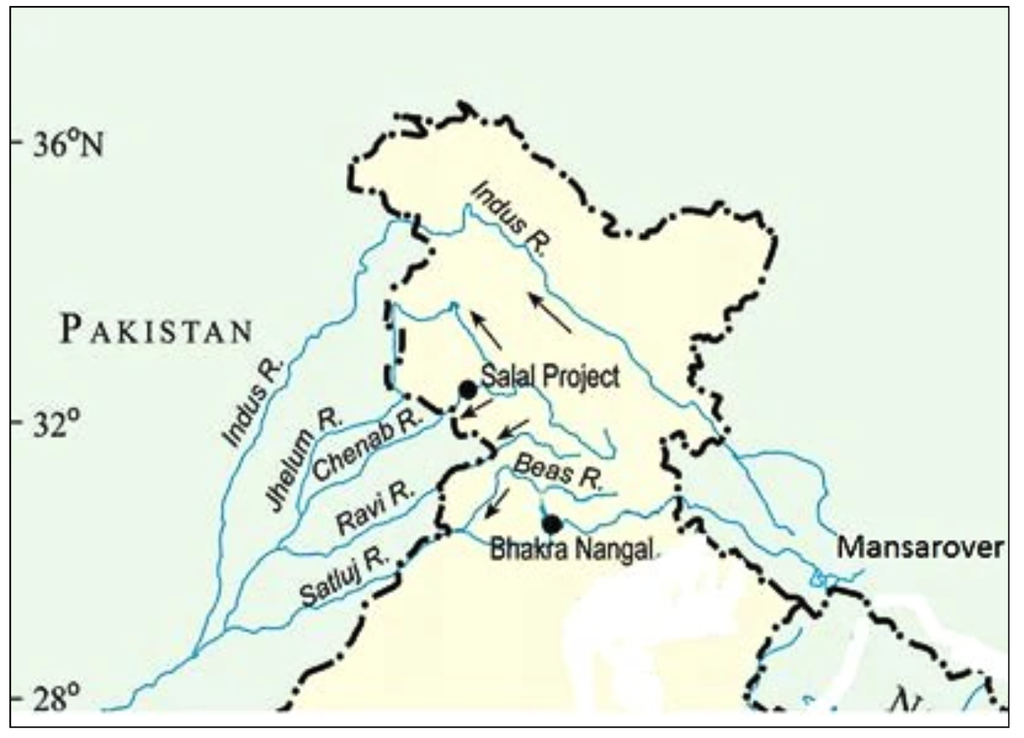
Dispute-Settlement Mechanism:
- Article IX provides three stages:
- A question is first examined by the Permanent Indus Commission.
- A technical difference may be referred to a Neutral Expert.
- A legal dispute may be placed before a seven-member Court of Arbitration under Annexure G.
- The present controversy arose because Pakistan sought a Court of Arbitration, while India requested a Neutral Expert to examine overlapping technical objections concerning the Kishenganga and Ratle projects.
- India argues that the Treaty does not permit parallel adjudication (i.e., a Neutral Expert and a Court of Arbitration to examine the same issue simultaneously). Article IX(6) supports this position by stating that arbitration cannot proceed while a “difference” is being considered by a Neutral Expert.
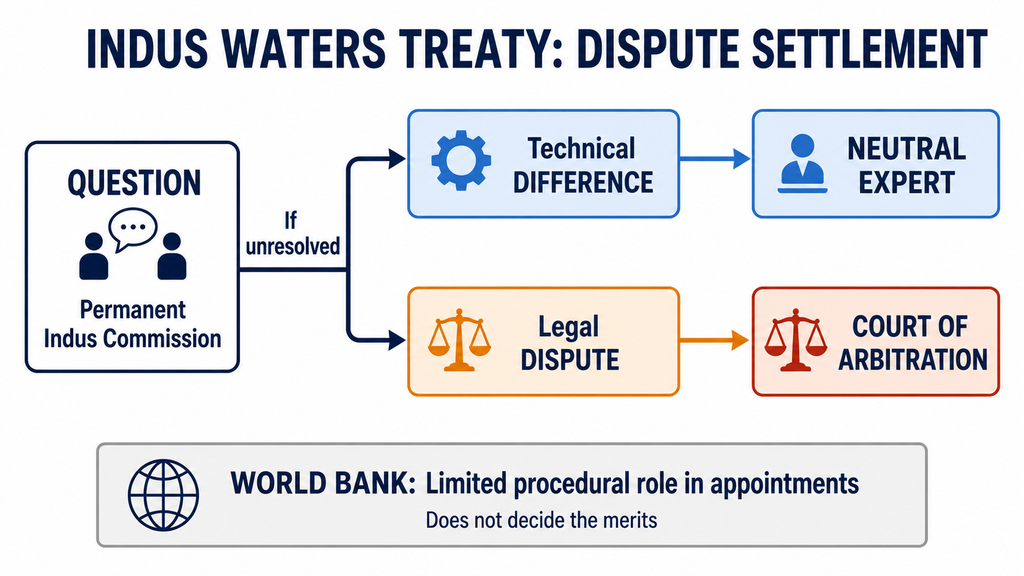
Why did India place the Treaty in abeyance?
Following the Pahalgam terrorist attack in April 2025, India announced that the IWT would be held in abeyance until Pakistan credibly and irrevocably ended its support for cross-border terrorism.
India’s broader concerns include:
- Continued cross-border terrorism
- Pakistan’s repeated objections to Indian hydropower projects
- Prolonged and duplicative dispute proceedings
- Population growth and rising energy requirements
- Advances in dam and hydropower technology
- Climate change and altered river hydrology; and
- Pakistan’s alleged reluctance to renegotiate an agreement framed in the 1950s.
Importantly, India has not formally terminated or “scrapped” the Treaty; it has declared its obligations to be in abeyance.
What did the Court rule?
The tribunal interpreted “abeyance” as an attempted suspension or termination, because the term has no technical meaning under international treaty law. It unanimously concluded that:
- The IWT contains no provision allowing unilateral suspension or termination.
- Under Article XII(4), it continues until India and Pakistan terminate it through another duly ratified treaty.
- Sovereignty by itself cannot release a State from treaty obligations.
- Pakistan’s alleged support for terrorism, even if assumed, would not constitute a “material breach” of the IWT because the Treaty specifically governs river-water rights and obligations.
- Demographic, technological and climatic changes did not meet the strict threshold of a “fundamental change of circumstances”.
- The Treaty is of a character that would continue operating even during armed conflict.
- Suspension could not be justified as a countermeasure.
The tribunal consequently held that India must continue observing the Treaty, including its hydropower-design and dispute-settlement obligations.
India did not participate in the proceedings; the tribunal considered India’s position through official statements and communications.
Ratle Hydroelectric Project:
- The Ratle Hydroelectric Project is an 850 MW run-of-the-river project currently under construction on the Chenab River. It is located in the Kishtwar district of Jammu and Kashmir.
- Pakistan has challenged features such as its spillways, power intakes, freeboard and operating pool, arguing that these could provide India excessive control over river flows.
- Pending the Neutral Expert’s decision, expected around July 2027, the Court ordered India:
- Not to concrete the dam wall and power-intake structure above specified levels
- To report changes in the construction schedule; and
- To maintain these restrictions until 90 days after the Neutral Expert’s final decision.
This is a limited interim order, not a direction to stop the entire Ratle project.
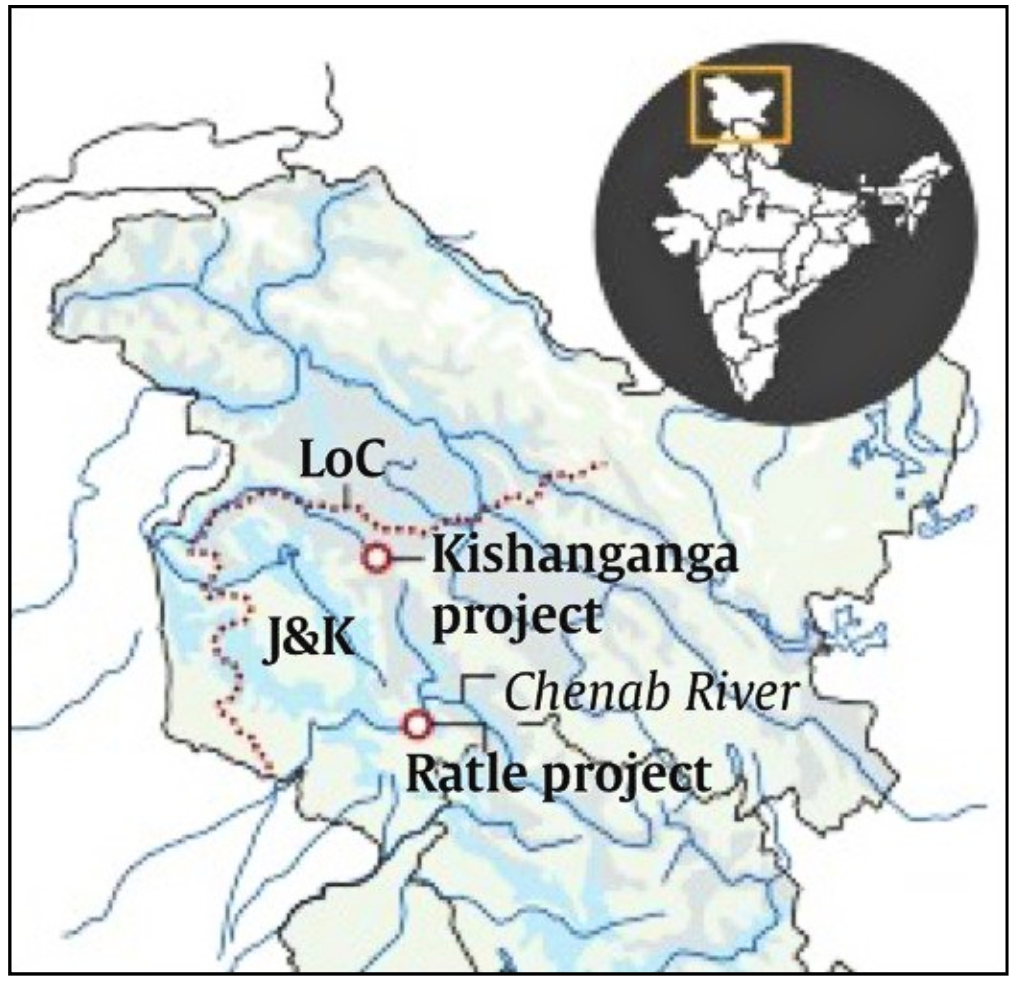
Why has India rejected the award?
India maintains that:
- The arbitral body was constituted in violation of the Treaty
- Parallel proceedings on the same issues undermine Article IX
- The Neutral Expert is the appropriate forum for technical design questions
- India never recognised or participated in the arbitration
- The tribunal cannot adjudicate India’s sovereign decision to hold the Treaty in abeyance; and
- Its awards are therefore “null and void” and will not affect Indian projects.
The Ministry of External Affairs reiterated that India’s decision to hold the Treaty in abeyance remains in force.
What happens now?
The dispute has produced a gap between legal pronouncement and political implementation:
- The tribunal regards the Treaty and its awards as binding.
- India rejects the tribunal’s jurisdiction and continues to treat the Treaty as being in abeyance.
- The Neutral Expert process is continuing, with a final decision expected in July 2027.
- Pakistan may invoke the award diplomatically and before international forums.
- The PCA has no independent executive machinery to physically enforce the order; implementation ultimately depends on State conduct, diplomacy and international pressure.
- India’s limited storage and diversion infrastructure means that abeyance does not immediately enable it to stop or divert the entire flow of the Western Rivers.
Way Forward:
- Pursue formal modernisation under Article XII(3), which permits modification through a mutually ratified treaty.
- Clarify the sequencing of Neutral Expert and arbitration proceedings to prevent duplication.
- Update the Treaty for climate change, glacier loss, environmental flows, sedimentation and groundwater.
- Establish real-time flood, drought and hydrological data-sharing systems.
- Preserve humanitarian and disaster-warning communication even during political crises.
- Ensure transparent, Treaty-compliant design of Indian hydropower projects while firmly protecting India’s legitimate developmental rights.
- Combine technical engagement with demands for verifiable action against cross-border terrorism.
- Use limited bilateral or back-channel negotiations to prevent a water dispute from becoming an uncontrollable security crisis.
The Hague award does not by itself end the dispute: it reinforces the Treaty’s legal continuity, while India’s rejection creates an operational and diplomatic stalemate.
The durable solution lies neither in an unchanged 1960 framework nor in uncontrolled water coercion, but in a modernised, climate-resilient and enforceable arrangement that protects India’s developmental and security interests while ensuring responsible transboundary water governance.
UPSC PYQ 2016
Q. Present an account of the Indus Water Treaty and examine its ecological, economic and political implications in the context of changing bilateral relations.
Source: https://anantamias.com/current-affairs/india-rejects-hague-courts-indus-waters-treaty-ruling/
Government notifies Semicon 2.0 Scheme
Why in News?
The Ministry of Electronics and Information Technology (MeitY) has notified Semicon India 2.0, with a multi-year outlay of ₹1,27,500 crore.
Announced in the Union Budget 2026-27, the scheme expands government support from individual fabrication and packaging projects to the entire semiconductor value chain.
| UPSC Relevance: GS-3 Economy: Manufacturing, Industrial Policy; Science and Technology: Frontier Technology Prelims: India Semiconductor Mission, ISM 2.0 Mains: Semiconductors: Role in economic growth & challenges associated |
India Semiconductor Mission 2.0:
- Objective: To develop the complete semiconductor value chain: from indigenous chip design and specialised materials to fabrication, packaging, research and workforce development.
- Outlay: ₹1,27,500 crore
- Nodal Agency: India Semiconductor Mission (ISM). It will invite applications, undertake technical and financial appraisal, recommend applicants and oversee implementation.
- MeitY will make budgetary provisions for fiscal support, with disbursements undertaken by the nodal agency in accordance with approved conditions.
- Projects supported under Semicon 2.0 will generally have a duration of up to six years, while the scheme will initially remain open for applications for three years.
A mid-term assessment will be conducted after three years of implementation (or as required) to evaluate the scheme’s impact and consider modifications or continuation.
Six Pillars of India Semiconductor Mission 2.0:
- Pillar 1 Design: It follows a three-track approach:
- Strategic technologies: C-DAC will invite bids for Indian development of IP, chips, SoCs and modules for compute, memory, radio frequency, power, networking and sensors. The resulting IP will be jointly owned by C-DAC and the selected company.
- Commercial fabless companies: Start-ups and MSMEs can receive milestone-linked seed funding of up to ₹15 crore or 50% of project cost (whichever is lower), and access to EDA tools, multi-project wafer services and post-silicon validation.
- Deployment-linked incentive: Newly developed chips can receive reimbursement equal to 9% of net sales for five years, capped at ₹30 crore per application and ₹120 crore per company group.
- Pillar 2 Machines and Materials: Semiconductor manufacturing ecosystem.
- Pillar 3 Setting up more Fabs: Silicon Semiconductor Wafer Fabs; Compound Semiconductors/Photonics/Sensors (including MEMS) Fab/Discrete Semiconductors Fab; and Display Fabs.
- Pillar 4 Strengthening the ATMP/OSAT industry: Semiconductor Assembly, Testing, Marking and Packaging (ATMP) / Outsourced Semiconductor Assembly and Test (OSAT) Facility.
- Pillar 5 Research and Development: R&D for advanced semiconductor technologies.
- Pillar 6 Talent Development: Semicon 2.0 seeks to train one lakh additional semiconductor engineers.
Incentive Structure:
- Equipment and materials: 30% capital support for equipment, wafers, photomasks, substrates, photoresists, chemicals, gases and testing facilities. Equipment manufacturers can additionally receive a production-linked incentive declining from 10% to 2% over five years.
- Silicon wafer fabs: 40% of eligible capital expenditure.
- Other fabs: Compound-semiconductor, photonics, sensor, discrete-semiconductor and display fabs can receive up to 35%.
- Advanced packaging: 35% capital support, compared with 25% for conventional packaging.
- R&D and talent development: Support of up to 75% of project cost, including State incentives.
From ISM 1.0 to ISM 2.0:
- Launched in 2021 with an outlay of ₹76,000 crore, ISM 1.0 concentrated on attracting fabs, display units, packaging facilities and chip-design companies.
- Its progress includes:
- 12 manufacturing projects involving investment exceeding ₹1.64 lakh crore:
- one silicon fab, one silicon-carbide fab, an integrated gallium-nitride micro-LED display fab and nine packaging units
- commercial production by Micron, Kaynes and CG Semi
- financial support for 24 chip-design projects
- access to advanced design tools for 105 start-ups and MSMEs; and
- semiconductor-design training for around 70,000 students across 332 universities.
ISM 2.0 marks a shift from attracting isolated factories to creating an integrated ecosystem of design → equipment and materials → fabrication → packaging and testing → end-use manufacturing.
Significance of India Semiconductor Mission 2.0:
- Complete ecosystem: It links chip design, equipment, materials, fabrication, packaging, R&D and skilling, moving beyond support for isolated factories.
- Technological sovereignty: Full-stack Indian intellectual property can reduce dependence on foreign chip architectures and enable customised chips for telecom, automobiles, space and defence.
- Supply-chain resilience: Domestic capacity can reduce exposure to geopolitical conflicts, export controls and semiconductor shortages.
- National security: Trusted indigenous chips are essential for defence systems, satellites, power grids, telecommunications and other critical infrastructure.
- Industrial deepening: Demand for precision machinery, speciality chemicals, gases and advanced materials can generate spillovers across aerospace, medical equipment and high-end capital goods.
- Higher domestic value addition: India can progress from electronics assembly to higher-value chip design, fabrication and advanced packaging.
- Commercialisation and employment: Support for risk capital, prototyping and training can bridge the “lab-to-fab” gap while creating specialised jobs in design and manufacturing.
- Strategic-sector growth: Domestic chips can accelerate EVs, AI, renewable energy, 6G, industrial automation, drones and medical devices.
- Global positioning: India can leverage its large market and engineering base to emerge as a trusted partner in diversified global semiconductor supply chains.
Semicon 2.0 aims to strengthen India’s economic growth and national security by improving semiconductor supply-chain resilience and establishing technological leadership in critical sectors. Thus, it represents a shift from subsidising isolated chip factories to building an integrated semiconductor ecosystem.
Source: https://anantamias.com/current-affairs/government-notifies-semicon-2-0-scheme/
