Why in News?
The Indian Navy commissioned INS Nipun, the second Nistar-class Diving Support Vessel, at Mumbai on 31 August 2026 for deep-sea diving, underwater intervention and submarine-rescue support.
- INS Nipun was formally commissioned after its delivery to the Navy on 30 July 2026 and now enters service under the Western Naval Command.
- The vessel was designed and constructed by Hindustan Shipyard Limited, Visakhapatnam, under Indian Register of Shipping classification rules.
- Its official role set covers saturation, air and heliox diving, remotely operated underwater inspection, intervention, salvage and support to submarine rescue.
- Commissioning confirms induction, while descriptions of readiness and response capacity remain official capability claims, not evidence from a real rescue operation.
- Underwater casualties compress response time: divers, life-support teams, rescue vehicles and a precisely positioned mother ship must function as one integrated system.
- A second Nistar-class vessel can broaden geographic availability, but actual readiness depends on trained crews, maintenance, exercises and interoperability, not hull numbers alone.
- The UPSC-relevant issue is specialist maritime readiness: how diving technology, remotely operated systems and submarine-rescue cooperation convert a ship into usable public capability.
UPSC Relevance
Prelims Relevance
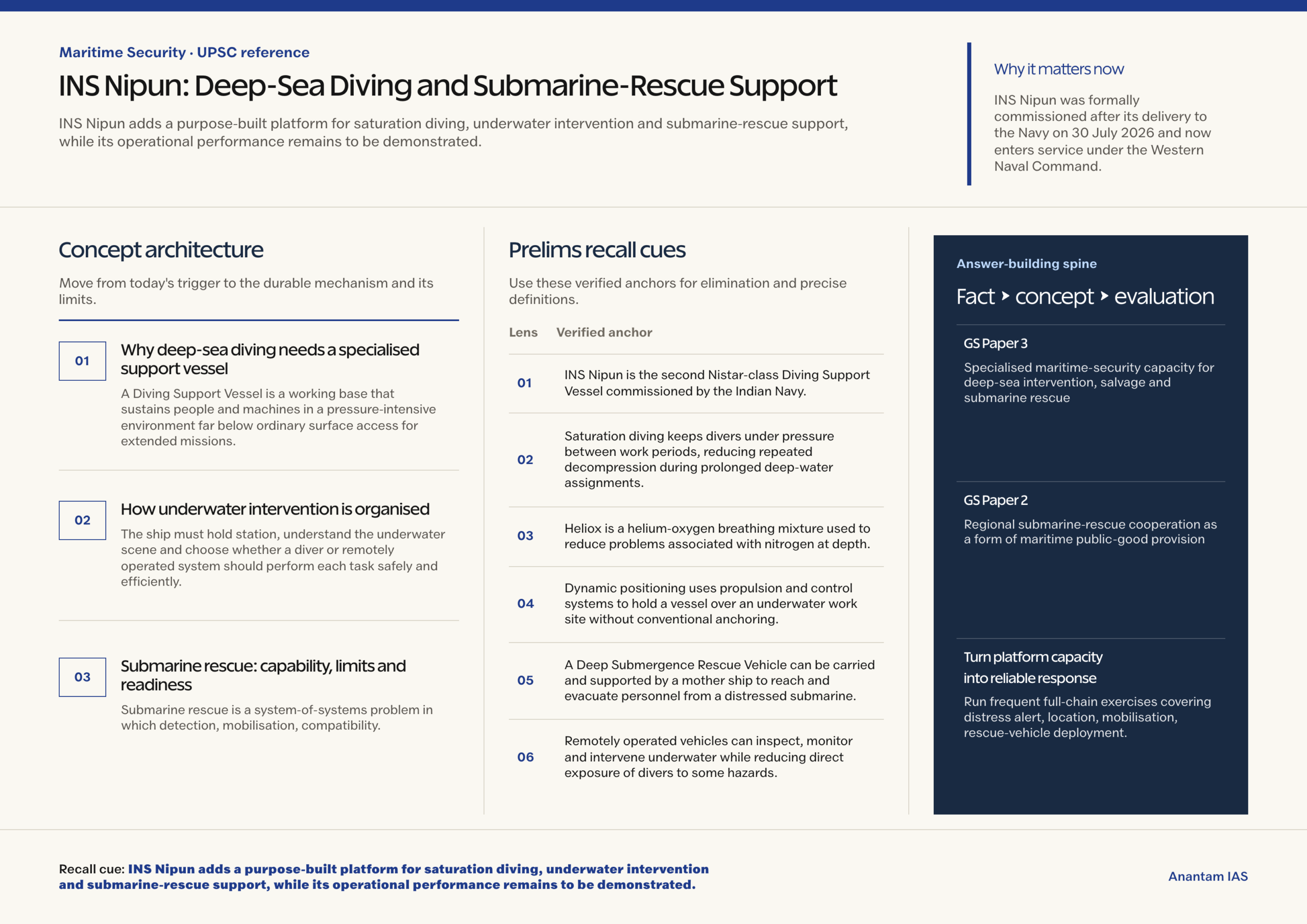
- INS Nipun is the second Nistar-class Diving Support Vessel commissioned by the Indian Navy.
- Saturation diving keeps divers under pressure between work periods, reducing repeated decompression during prolonged deep-water assignments.
- Heliox is a helium-oxygen breathing mixture used to reduce problems associated with nitrogen at depth.
- Dynamic positioning uses propulsion and control systems to hold a vessel over an underwater work site without conventional anchoring.
- A Deep Submergence Rescue Vehicle can be carried and supported by a mother ship to reach and evacuate personnel from a distressed submarine.
- Remotely operated vehicles can inspect, monitor and intervene underwater while reducing direct exposure of divers to some hazards.
Mains Relevance
GS Paper 3
- Specialised maritime-security capacity for deep-sea intervention, salvage and submarine rescue
- Technology, training and maintenance requirements behind credible underwater readiness
GS Paper 2
- Regional submarine-rescue cooperation as a form of maritime public-good provision
- Interoperability and assistance to partner navies during underwater emergencies
Essay
- Technology becomes strategic capability only when platforms, people, procedures and international cooperation remain ready before an emergency begins.
Background and Context
Why deep-sea diving needs a specialised support vessel
A Diving Support Vessel is a working base that sustains people and machines in a pressure-intensive environment far below ordinary surface access for extended missions.
- In air diving, compressed air supports comparatively shallower work; depth and exposure remain limited because pressure increases breathing-gas risk and decompression burden.
- Heliox diving replaces nitrogen with helium in the breathing mixture, reducing nitrogen narcosis and breathing resistance during deeper operations, though specialised thermal and communication management is still needed.
- In saturation diving, divers live in a pressurised chamber and travel to the work depth in a closed bell, avoiding a full decompression after every shift.
- One carefully managed decompression at the end can support prolonged assignments, but chamber integrity, gas control, medical supervision and emergency procedures become mission-critical parts of the entire support system.
- INS Nipun’s diving complex, life-support and medical facilities are designed to combine these functions at sea; the official release does not report performance from an operational casualty.
How underwater intervention is organised
The ship must hold station, understand the underwater scene and choose whether a diver or remotely operated system should perform each task safely and efficiently.
- Dynamic positioning continuously adjusts propulsion to keep the vessel over a work site, limiting drift that could endanger diving bells, umbilicals, rescue vehicles or underwater equipment.
- A remotely operated vehicle carries cameras, sensors or tools while operators control it from the ship, enabling inspection and intervention before exposing divers to uncertain conditions.
- Divers remain important for complex manual work, close assessment and repairs, while remotely operated systems extend observation, monitor divers and handle tasks where endurance or immediate human exposure is problematic.
- The same platform can support salvage, which concerns locating, stabilising or recovering underwater material, but salvage and rescue have different priorities, timelines, acceptable risks and life-safety requirements.
- Effective intervention depends on a common operating picture, reliable communications and disciplined task sequencing; advanced equipment cannot compensate for weak coordination between bridge, diving, medical and engineering teams.
Submarine rescue: capability, limits and readiness
Submarine rescue is a system-of-systems problem in which detection, mobilisation, compatibility, access and safe decompression must align under severe time pressure after an accident.
- The delivery release describes INS Nipun as a mother ship for a Deep Submergence Rescue Vehicle, which can descend, mate with a distressed submarine and evacuate survivors in repeated sorties.
- The support vessel supplies launch and recovery, navigation, control, maintenance, medical care and decompression support; the rescue vehicle is only one component of the overall emergency response chain.
- A rescue attempt also requires the submarine’s location, a reachable escape or rescue interface, tolerable sea conditions and compatible procedures; no single ship can remove every physical constraint.
- Regular exercises and interoperability checks matter because India may need to assist partner navies, while foreign systems may need to operate with Indian submarines or support infrastructure.
- INS Nipun’s commissioning expands designed capacity alongside INS Nistar, but credible readiness should be judged through availability, trained teams, mobilisation time and verified exercise outcomes, not ceremonial induction alone.
Way Forward
Turn platform capacity into reliable response
- Run frequent full-chain exercises covering distress alert, location, mobilisation, rescue-vehicle deployment, medical reception and decompression rather than testing each subsystem only in isolation.
- Publish appropriate readiness lessons without exposing sensitive details, allowing doctrine, maintenance schedules and crew training to improve from measurable exercise evidence.
- Build interoperability through bilateral and multilateral submarine-rescue drills, common interface data and advance arrangements for customs, airlift, port access and technical support.
- Maintain spare parts, breathing gases, medical teams and specialised technicians at readiness levels matched to the narrow response window of an underwater casualty.
Conclusion
- INS Nipun matters because underwater intervention demands a stable, pressurised and medically supported work base, not merely divers or a rescue vehicle deployed independently from shore or another ship.
- In a Mains answer, present submarine rescue as a chain: locate the casualty, mobilise the mother ship, deploy a compatible rescue vehicle, evacuate survivors and manage pressure-related medical risks throughout recovery.
- Treat commissioning as a verified institutional milestone, while assessing operational capability through crew proficiency, system availability, mobilisation time, exercise results and partner interoperability under demanding sea conditions.
UPSC Practice Questions
Prelims MCQ 1
With reference to deep-sea diving support, consider the following statements:
- Saturation diving can reduce repeated decompression during prolonged work at depth.
- Heliox replaces oxygen entirely with helium.
- Dynamic positioning can help a support vessel hold station over an underwater work site.
How many of the above statements are correct?
(a) Only one (b) Only two (c) All three (d) None
Answer: (b) Only two
Explanation:
Statements 1 and 3 are correct. Heliox is a helium-oxygen mixture; it does not remove oxygen.
Prelims MCQ 2
What is the most accurate description of a Diving Support Vessel’s role in submarine rescue?
(a) It replaces every rescue vehicle with saturation divers (b) It detects all distressed submarines through satellite communication alone (c) It provides the mother-ship functions needed to deploy and support a rescue system (d) It guarantees rescue regardless of depth, damage and sea conditions
Answer: (c) It provides the mother-ship functions needed to deploy and support a rescue system
Explanation:
The support vessel integrates launch, recovery, navigation, control, medical and decompression functions. Physical conditions, location and compatibility still constrain any rescue.
UPSC Mains Questions
- Explain how a Diving Support Vessel integrates saturation diving, remotely operated systems and dynamic positioning for underwater intervention. Why is this integration strategically important?
- Submarine rescue is a system-of-systems capability rather than a single-platform function. Discuss with reference to readiness, medical support and international interoperability.
Sources: PIB, Ministry of Defence and PIB, Ministry of Defence delivery release.
Frequently Asked Questions
What is INS Nipun?
INS Nipun is the Indian Navy’s second Nistar-class Diving Support Vessel, commissioned for deep-sea diving, underwater intervention, salvage and support to submarine-rescue operations.
What is saturation diving?
Saturation diving keeps divers pressurised between work periods and uses a diving bell for transfer, allowing prolonged deep-water work with one managed decompression at the end.
Why does a diving support vessel need dynamic positioning?
Dynamic positioning counters drift and holds the vessel over a work site, protecting bells, umbilicals, rescue systems and divers from hazardous relative movement.
How does INS Nipun support submarine rescue?
It is designed to act as a mother ship for a Deep Submergence Rescue Vehicle and provide launch, recovery, control, medical and decompression support.
Does commissioning prove INS Nipun’s operational performance?
No. Commissioning verifies formal induction. Official releases describe designed capabilities and completed trials, but real readiness must be assessed through availability, exercises, trained crews and demonstrated response performance.
Tell Google you want more of this.
Add Anantam IAS as a preferred sourceOne tap, and this site shows up more often in your own Top Stories, AI Overviews and AI Mode. Remove it any time.