Why in News?
On 31 August 2026, Indian Railways inaugurated the completed broad-gauge conversion and electrification of the Nepalganj Road-Nanpara-Bahraich section and extended four existing train services to Nepalganj Road.
- The completed Indian section is 56.15 km long and runs through Bahraich district in Uttar Pradesh.
- The former metre-gauge section, originally built in 1886, has been integrated with India’s wider broad-gauge network.
- The upgrade combines three linked changes: gauge conversion, route electrification and extension of existing services.
- The extended services connect Nepalganj Road directly with Gonda, Gorakhpur and Varanasi through the Indian railway network.
- Gauge compatibility matters because trains can continue over connected routes without the operational break created by different track gauges.
- Nepalganj Road is an Indian railhead near the Nepal border; the completed project does not extend railway track into Nepal.
- Electrification changes the available traction system, while service extension determines whether upgraded infrastructure produces direct passenger connectivity.
UPSC Relevance
Prelims Relevance
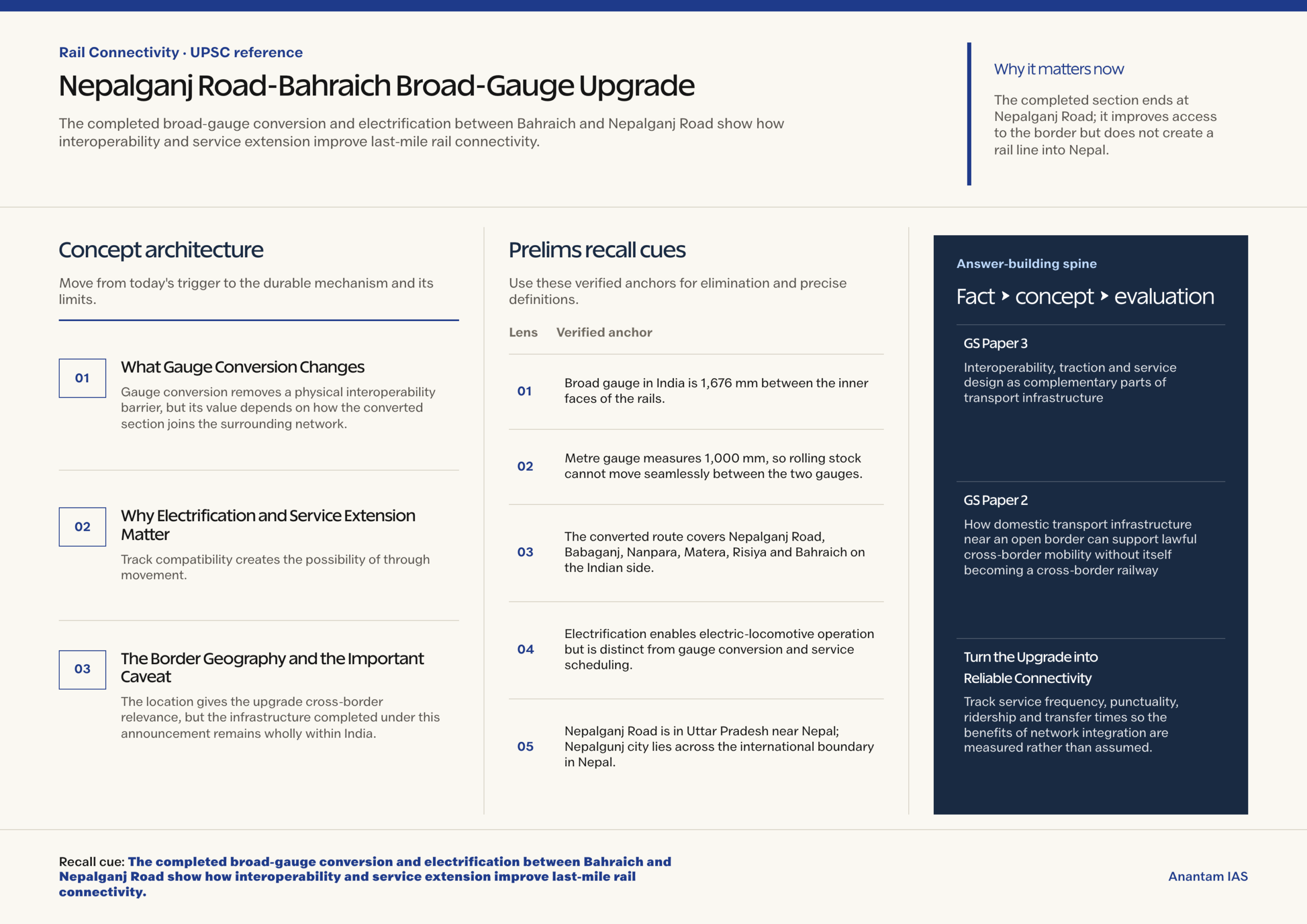
- Broad gauge in India is 1,676 mm between the inner faces of the rails.
- Metre gauge measures 1,000 mm, so rolling stock cannot move seamlessly between the two gauges.
- The converted route covers Nepalganj Road, Babaganj, Nanpara, Matera, Risiya and Bahraich on the Indian side.
- Electrification enables electric-locomotive operation but is distinct from gauge conversion and service scheduling.
- Nepalganj Road is in Uttar Pradesh near Nepal; Nepalgunj city lies across the international boundary in Nepal.
Mains Relevance
GS Paper 3
- Interoperability, traction and service design as complementary parts of transport infrastructure
- Last-mile rail connectivity and access to larger urban and economic centres
GS Paper 2
- How domestic transport infrastructure near an open border can support lawful cross-border mobility without itself becoming a cross-border railway
Essay
- Infrastructure becomes useful when physical compatibility, operating systems and actual services are designed together.
Background and Context
What Gauge Conversion Changes
Gauge conversion removes a physical interoperability barrier, but its value depends on how the converted section joins the surrounding network.
- A railway gauge is the distance between the inner faces of the rails; wheelsets and vehicles are engineered for a specific gauge and cannot ordinarily switch gauges in service.
- The Bahraich-Nanpara-Nepalganj Road section previously used metre gauge, while India’s trunk network largely uses 1,676-mm broad gauge, leaving the section incompatible with mainstream rolling stock.
- Conversion replaces or repositions track and requires compatible points, platforms, bridges, signalling and structure clearances; it is a coordinated system upgrade, not merely the widening of rails.
- After conversion, compatible broad-gauge rolling stock can operate between the section and connected routes, avoiding a forced terminal point created solely by gauge mismatch rather than passenger demand.
- The operational benefit is network integration: a peripheral section becomes usable by trains designed for the wider system, although actual operations still depend on capacity, timetables and safety clearances.
Why Electrification and Service Extension Matter
Track compatibility creates the possibility of through movement; electrification and scheduled services determine how that possibility is used.
- Electrification equips the route with overhead traction infrastructure so electric locomotives or electric multiple units can operate, subject to compatible rolling stock, substations, power availability and operating clearances.
- Electric traction can reduce direct diesel use on the section, but its wider emissions effect depends on the electricity mix, train loading and the services actually operated.
- Indian Railways extended the Varanasi-Bahraich and Varanasi City-Gorakhpur services, plus two Gonda-Bahraich service pairs, to Nepalganj Road, turning completed works into a scheduled passenger offer.
- A service extension differs from building a new train corridor: it changes the terminal point of existing services over upgraded Indian track and connects additional stations to established routes.
- Direct services can reduce forced transfers and waiting time for passengers, but frequency, reliability, timetable coordination, station access and affordability remain essential measures of usable connectivity after inauguration.
The Border Geography and the Important Caveat
The location gives the upgrade cross-border relevance, but the infrastructure completed under this announcement remains wholly within India.
- The section links Bahraich through Nanpara to Nepalganj Road, an Indian station near the Rupaidiha-Nepalgunj border interface in the Terai region, where road movement continues beyond the railhead.
- Nepalgunj is a city in Nepal, while Nepalganj Road is the nearby Indian railhead; confusing the similar names produces the false claim that Indian trains now run into Nepal.
- People crossing the land border can use the Indian railhead for onward journeys, but border crossing, road access and passenger transfers remain separate from the rail operation itself.
- The official release expects wider movement and market access, yet these are prospective effects; passenger volumes, freight data, travel-time changes and local access must be measured before claiming outcomes.
- For analysis, separate three layers: completed physical works, approved and extended train services, and longer-term regional effects that require later evidence rather than ceremonial claims.
Way Forward
Turn the Upgrade into Reliable Connectivity
- Track service frequency, punctuality, ridership and transfer times so the benefits of network integration are measured rather than assumed.
- Coordinate timetables with onward trains at Gonda, Gorakhpur and Varanasi, while keeping safe turnaround capacity at Nepalganj Road.
- Improve station access, passenger information and multimodal links between the Indian railhead and nearby settlements without misrepresenting the route as a cross-border railway.
- Maintain overhead equipment, signalling and track to protect reliability; an electrified broad-gauge route delivers little if asset maintenance or service continuity weakens.
Conclusion
- The Nepalganj Road-Bahraich project shows that gauge compatibility, electrification and actual service extension are distinct but complementary steps in turning an isolated section into an integrated rail link with usable onward connections.
- Its immediate achievement is the completion of upgraded Indian railway infrastructure and direct services to the border railhead, not the creation of a railway line into Nepal or proof of wider economic outcomes.
- A sound infrastructure answer should distinguish completed assets from anticipated development effects and judge success through reliability, access and measured use after services have operated long enough to generate evidence.
UPSC Practice Questions
Prelims MCQ 1
With reference to the Nepalganj Road-Nanpara-Bahraich rail upgrade, consider the following statements:
- The completed section is entirely on the Indian side of the international boundary.
- Gauge conversion and electrification refer to the same engineering process.
- Existing train services have been extended to Nepalganj Road.
How many of the above statements are correct?
(a) Only one (b) Only two (c) All three (d) None
Answer: (b) Only two
Explanation:
Statements 1 and 3 are correct. The completed section lies in India, and four existing services were extended. Gauge conversion changes track compatibility; electrification provides electric traction infrastructure.
Prelims MCQ 2
What is the most direct operational purpose of converting a metre-gauge section to the broad gauge used by the surrounding network?
(a) To eliminate the need for railway signalling (b) To permit compatible rolling stock to move across the connected network (c) To convert a domestic railway automatically into an international railway (d) To guarantee that every train on the section is electric
Answer: (b) To permit compatible rolling stock to move across the connected network
Explanation:
Gauge conversion removes a physical compatibility barrier. It does not replace signalling, create an international route or by itself determine the traction used by every service.
UPSC Mains Questions
- Explain how gauge conversion, electrification and service extension perform different but complementary roles in railway network integration. Use the Nepalganj Road-Bahraich section as an example.
- Domestic transport infrastructure near an international border can have cross-border relevance without being cross-border infrastructure. Discuss with reference to the Nepalganj Road rail upgrade.
Source: PIB, Ministry of Railways.
Frequently Asked Questions
What was completed on the Nepalganj Road-Bahraich rail section?
Indian Railways completed broad-gauge conversion and electrification of the 56.15-km Nepalganj Road-Nanpara-Bahraich section and extended four existing train services to Nepalganj Road.
Does the upgraded railway line enter Nepal?
No. The completed railway work is on the Indian side up to Nepalganj Road station. Nepalgunj city is across the international boundary in Nepal.
Why does railway gauge compatibility matter?
Rolling stock is built for a particular gauge. A compatible broad-gauge section can connect operationally with the wider network without journeys ending solely because the track gauges differ.
What does electrification add after gauge conversion?
Electrification supplies overhead traction infrastructure for electric train operation. It is separate from widening the gauge and from deciding which services will run on the route.
Which direct connections were extended to Nepalganj Road?
The extensions cover services linked with Varanasi, Gorakhpur and Gonda, improving the Indian railhead’s direct connection to major cities and interchange points.
Tell Google you want more of this.
Add Anantam IAS as a preferred sourceOne tap, and this site shows up more often in your own Top Stories, AI Overviews and AI Mode. Remove it any time.