Why in News?
The Department of Fisheries released the Mission Rangeen Machhli 2031 Strategic Action Plan for Ornamental Fisheries Development at Agatti, Lakshadweep, on 31 August 2026, marking a policy release rather than completed implementation.
- The release establishes a strategic direction; it does not show that the proposed interventions, livelihood gains or conservation outcomes have already been completed.
- PIB reports that Lakshadweep has more than 300 ornamental fish species, giving the islands a distinctive base for a carefully regulated aquarium-fish value chain.
- An ornamental fish hatchery has been established at Agatti, while 3 rearing units have been approved under the Pradhan Mantri Matsya Sampada Yojana.
- The wider policy frame emphasizes Fish Farmer Producer Organisations and fisheries cooperatives for aggregation, technical support, value addition and market access.
- The central policy test is whether income from colorful live fish can grow without transferring ecological costs to fragile coral-reef habitats.
- Ornamental fisheries trade live aquatic organisms for aquaria, so survival, appearance, traceability and animal health matter more than bulk harvest volume.
- For small islands, local breeding and cooperative marketing can retain more value locally, but wild collection needs science-based limits and non-destructive methods.
- The initiative joins livelihood policy with marine conservation: a depleted reef cannot support either biodiversity or a durable ornamental-fish enterprise.
UPSC Relevance
Prelims Relevance
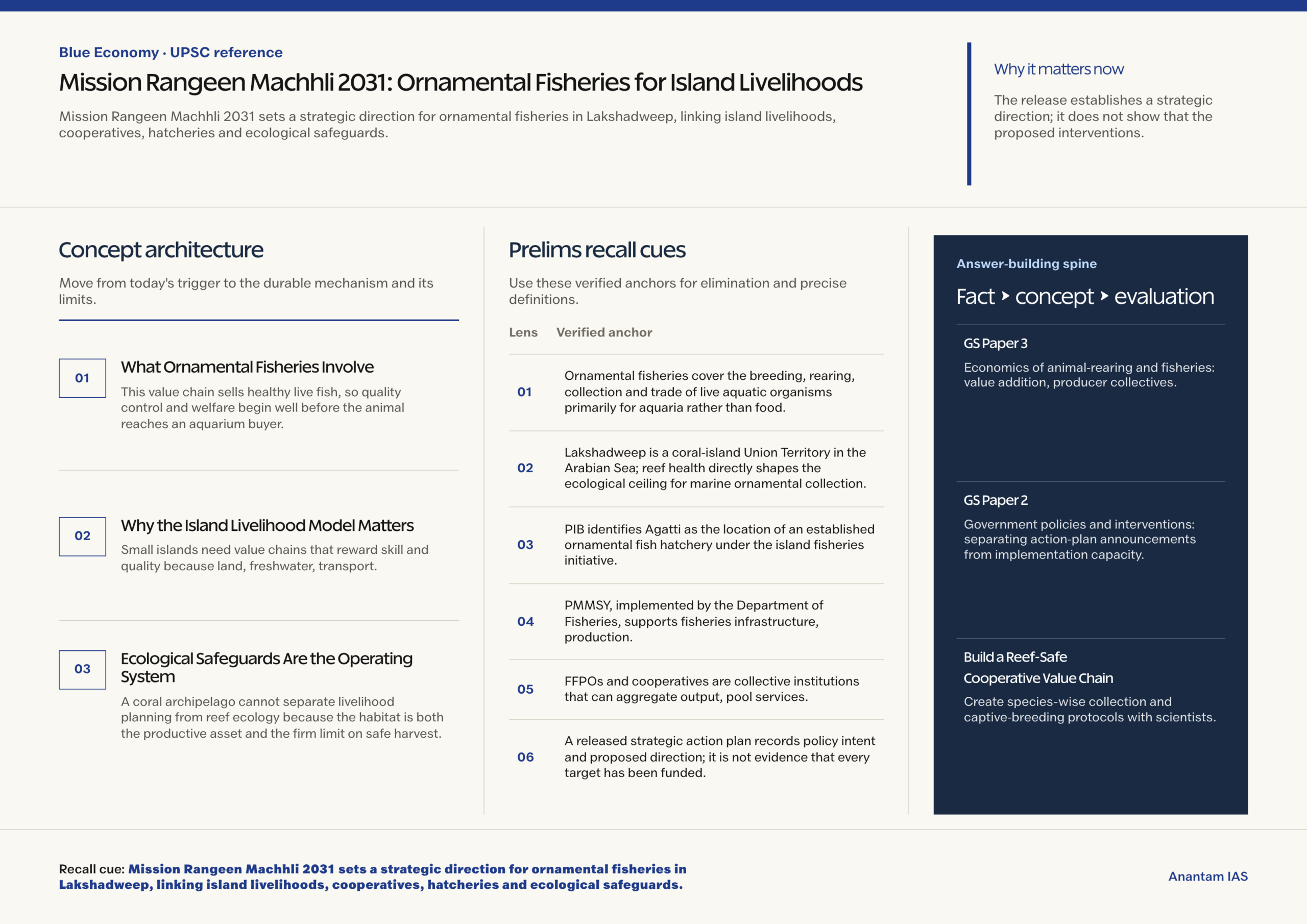
- Ornamental fisheries cover the breeding, rearing, collection and trade of live aquatic organisms primarily for aquaria rather than food.
- Lakshadweep is a coral-island Union Territory in the Arabian Sea; reef health directly shapes the ecological ceiling for marine ornamental collection.
- PIB identifies Agatti as the location of an established ornamental fish hatchery under the island fisheries initiative.
- PMMSY, implemented by the Department of Fisheries, supports fisheries infrastructure, production, value chains and fisher welfare across marine and inland sectors.
- FFPOs and cooperatives are collective institutions that can aggregate output, pool services, improve bargaining power and organize compliance among small producers.
- A released strategic action plan records policy intent and proposed direction; it is not evidence that every target has been funded, executed or achieved.
Mains Relevance
GS Paper 3
- Economics of animal-rearing and fisheries: value addition, producer collectives, market access and livelihood diversification in island territories.
- Conservation, environmental pollution and degradation: reef-safe collection, captive breeding, biosecurity, traceability and science-based harvest limits.
GS Paper 2
- Government policies and interventions: separating action-plan announcements from implementation capacity, monitoring and verifiable outcomes.
Essay
- The blue economy succeeds when coastal prosperity is treated as a return on healthy marine ecosystems, not as a substitute for conservation.
Background and Context
What Ornamental Fisheries Involve
This value chain sells healthy live fish, so quality control and welfare begin well before the animal reaches an aquarium buyer.
- The chain can include broodstock management, hatchery breeding, nursery rearing, feed, grading, quarantine, packing, air transport and specialized retail, with welfare checks and survival records at each transfer.
- Unlike food fisheries, value depends heavily on survival and condition; poor handling raises mortality, weakens producer returns, creates an animal-welfare concern and increases pressure for replacement collection.
- Captive breeding can create repeatable supply, retain breeding knowledge locally and reduce dependence on wild capture, while hatchery records help producers track survival and improve husbandry.
- Wild collection may remain part of the sector, but it requires species identification, selective gear, habitat-safe methods and science-based limits, supported by collector logs that reveal changing catch effort.
- This is the exam trap: small harvest volume does not guarantee sustainability when collection concentrates on rare or slow-recovering species. Ecological sensitivity, not tonnage alone, determines risk.
Why the Island Livelihood Model Matters
Small islands need value chains that reward skill and quality because land, freshwater, transport, storage and access to distant buyers are tightly constrained by geography.
- Ornamental fish can offer a high-value, low-volume livelihood route, but distance from markets makes reliable packing and air connectivity critical because delays, cancellations or temperature shocks can erase value.
- A local hatchery and rearing network can move earnings from raw collection toward breeding, husbandry and quality assurance, keeping higher-value work and specialized technical jobs within island communities.
- Women and youth enterprises can participate in nurseries, feed preparation, maintenance, packing and digital marketing when training, finance and facilities match local conditions, without forcing participation in capture.
- FFPOs and fisheries cooperatives can pool batches, negotiate transport, buy inputs and maintain standards. That converts scattered, price-taking households into a market-facing institution with better information about buyers.
- But cooperative labels do not guarantee participation. Durable gains require transparent membership, audited accounts, fair benefit sharing, local decisions and accessible grievances, so customary fishers don’t bear hidden costs.
Ecological Safeguards Are the Operating System
A coral archipelago cannot separate livelihood planning from reef ecology because the habitat is both the productive asset and the firm limit on safe harvest.
- Collection rules should begin with species-level identification and stock assessment, then set seasonal, area or quantity limits that respond to monitoring, with no-take treatment where recovery is uncertain.
- Non-destructive capture must exclude practices that damage corals or indiscriminately stun fish. Selective methods, collector training and field inspection protect habitat, non-target species and future recruitment.
- Hatcheries need biosecurity, meaning quarantine, disease screening and controlled water management, so pathogens, untreated effluent or escaped non-native organisms do not enter island waters or move between units.
- A traceability record should connect each specimen to its source, collector or hatchery and movement chain. Interoperable records support enforcement, credible buyer claims and recalls when problems appear.
- Independent ecological monitoring should publish what is measured and what changes when thresholds are crossed, including predefined pause or reduction triggers. Until then, plan targets remain proposals.
Way Forward
Build a Reef-Safe Cooperative Value Chain
- Create species-wise collection and captive-breeding protocols with scientists, island administrations and fishers before scaling market access.
- Link hatcheries, rearing units and cooperatives through common quarantine, animal-welfare, traceability and mortality-reporting standards.
- Measure household income, local value retention, women’s participation, wild collection pressure and reef indicators rather than reporting infrastructure alone.
- Use staged expansion: scale only when survival, compliance and ecological monitoring show that the previous stage stayed within agreed limits.
Conclusion
- Mission Rangeen Machhli 2031 is best read as an island livelihood strategy whose economic promise depends on cooperative capacity, captive breeding and enforceable ecological safeguards.
- In a Mains answer, connect value addition with the ecological ceiling: reefs support the enterprise, so monitoring and local stewardship are productive infrastructure, not optional restrictions.
- The present evidence confirms the release of a plan and some enabling facilities. Implementation quality and measurable outcomes still need to be demonstrated.
UPSC Practice Questions
Prelims MCQ 1
With reference to Mission Rangeen Machhli 2031, consider the following statements:
- It is a strategic action plan for ornamental fisheries development.
- PIB identifies Agatti as the site of an established ornamental fish hatchery.
- Its release proves that all proposed livelihood and conservation targets have been achieved.
How many of the above statements are correct?
(a) Only one (b) Only two (c) All three (d) None
Answer: (b) Only two
Explanation:
Statements 1 and 2 are correct. The release records policy direction; it does not establish completed implementation or achieved outcomes.
Prelims MCQ 2
Which measure most directly reduces ecological pressure while maintaining a supply of ornamental fish?
(a) Expanding indiscriminate wild collection (b) Replacing species identification with volume targets (c) Scaling captive breeding with biosecurity and traceability (d) Removing quarantine requirements for live-fish trade
Answer: (c) Scaling captive breeding with biosecurity and traceability
Explanation:
Captive breeding can reduce repeated wild collection, while biosecurity and traceability address disease, escape and sourcing risks.
UPSC Mains Questions
- Ornamental fisheries can diversify island livelihoods, but their viability depends on ecological discipline. Discuss with reference to Lakshadweep.
- Fish Farmer Producer Organisations and fisheries cooperatives can connect conservation with local value addition. Critically examine the institutional conditions needed for this model to work.
Source: PIB, Department of Fisheries.
Frequently Asked Questions
What is Mission Rangeen Machhli 2031?
It is a strategic action plan released by the Department of Fisheries for ornamental fisheries development. The announcement sets policy direction, but it does not by itself prove completed implementation or outcomes.
Why is Lakshadweep suitable for ornamental fisheries?
Lakshadweep has diverse reef-associated fish, including more than 300 ornamental species reported by PIB. Its ecological sensitivity also means collection and breeding must operate under strict safeguards.
How can cooperatives support island fishers?
Cooperatives and FFPOs can aggregate small batches, share technical services, standardize quality, negotiate transport and improve bargaining power. Their success still depends on transparent governance and fair benefit sharing.
Can ornamental fisheries harm coral reefs?
Yes. Unsustainable collection, destructive capture and poor species identification can damage habitats or deplete sensitive populations. Captive breeding, selective methods, monitoring and traceability can reduce these risks.
What should be monitored during implementation?
Monitoring should cover specimen survival, disease, wild collection pressure, reef condition, compliance, household income, local value retention and participation by women and small producers, not infrastructure counts alone.
Tell Google you want more of this.
Add Anantam IAS as a preferred sourceOne tap, and this site shows up more often in your own Top Stories, AI Overviews and AI Mode. Remove it any time.