Why in News?
On 31 August 2026, PIB reported that IIT Gandhinagar researchers computationally identified three high-entropy MBenes as promising candidates for electrochemical CO2-to-CO conversion.
- The study screened 56 equiatomic five-metal compositions, narrowed them to 18 viable candidates and identified three with favourable computed reaction profiles.
- The three candidates are CrNbZrMoTiB5, MoZrHfNbCrB5 and MoZrHfTaCrB5, all ultrathin two-dimensional transition-metal borides.
- Under the computational hydrogen electrode model, their CO2-to-CO steps were downhill at zero applied potential, meaning no additional electrical bias appeared necessary in the calculation.
- This is a computational prediction, not a deployed catalyst: synthesis, electrochemical testing, durability, selectivity and scale-up have not yet been demonstrated.
- Catalyst discovery involves a vast composition space; machine learning can prioritise combinations for costly high-fidelity calculations and experiments without proving real-world performance by itself.
- Converting captured CO2 into carbon monoxide could supply an industrial intermediate, but climate value depends on clean electricity, conversion efficiency and the full system’s emissions.
UPSC Relevance
Prelims Relevance
- MBenes are two-dimensional transition-metal borides; their exposed surfaces and electronic structure make them candidates for electrocatalytic reactions.
- High-entropy materials combine five or more principal elements, creating chemically diverse local sites rather than one uniform metal surface.
- Electrochemical CO2 reduction uses electrical energy and a catalyst to convert carbon dioxide into products such as carbon monoxide.
- Carbon monoxide is an industrial feedstock and a component of syngas; it is not the same substance as carbon dioxide.
- Machine-learning interatomic potentials estimate energies across many atomic arrangements, helping researchers screen material candidates before experimental synthesis.
Mains Relevance
GS Paper 3
- Indigenisation of advanced materials research through machine learning and high-performance computing
- Carbon-utilisation technologies, renewable electricity and the evidence needed before claiming climate benefits
GS Paper 2
- Public research institutions, computing infrastructure and responsible communication of early-stage scientific findings
Essay
- Scientific prediction creates options; public value begins only when those options survive testing, scaling and lifecycle scrutiny.
Background and Context
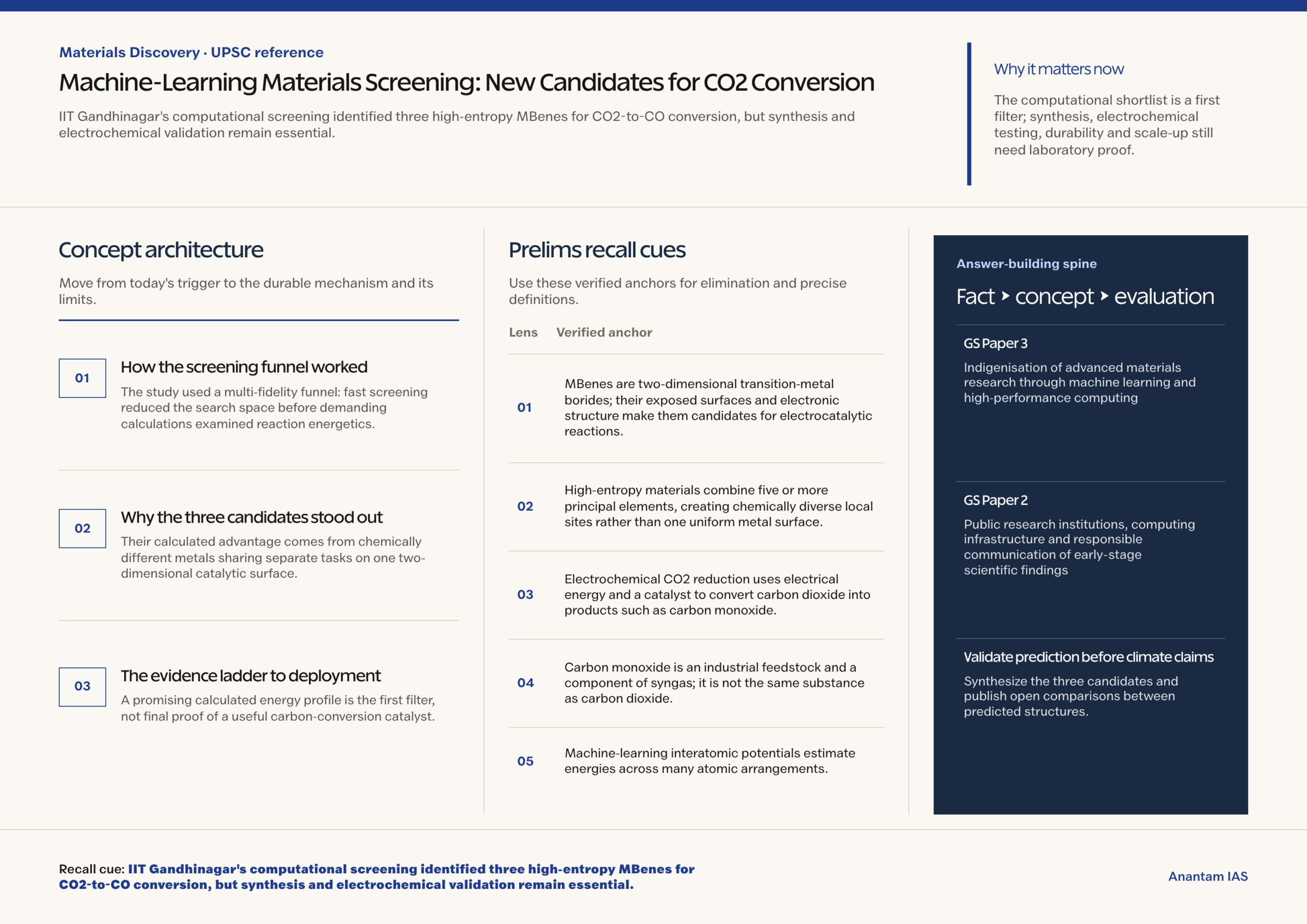
How the screening funnel worked
The study used a multi-fidelity funnel: fast screening reduced the search space before demanding calculations examined reaction energetics, with each stage answering a different scientific question.
- Researchers began with 56 equiatomic quinary HE-MBenes drawn from titanium, vanadium, chromium, molybdenum, niobium, tantalum, zirconium and hafnium around boron. The pool covered every five-metal combination from those eight metals.
- First-principles density functional theory relaxed atomic structures, while formation-energy filters removed combinations that did not meet computed viability criteria. This tested structural plausibility before catalytic performance.
- A MACE machine-learning interatomic potential accelerated evaluation across 1,375 surface environments, estimating atomic energies so expensive calculations could concentrate on stronger candidates instead of treating every arrangement with the costliest method.
- Projected density-of-states analysis then helped identify electronically plausible active sites, meaning surface atoms likely to bind reaction intermediates and orbitals capable of exchanging charge with adsorbates.
- The final computational hydrogen electrode profiles compared free-energy changes step by step. They rank calculated pathways, not measured production rates, and remain conditional on the modelled structures and approximations.
Why the three candidates stood out
Their calculated advantage comes from chemically different metals sharing separate tasks on one two-dimensional catalytic surface. This mechanistic claim still awaits experimental verification.
- The selected compositions were CrNbZrMoTiB5, MoZrHfNbCrB5 and MoZrHfTaCrB5; each combines five metals with boron. Their differing metal sets let researchers compare related local chemical environments.
- This mixed surface creates a cocktail effect: neighbouring elements provide different adsorption and charge-transfer environments instead of forcing every reaction stage, from activation to product release, onto identical sites.
- The calculations indicate chromium-centred sites preferentially adsorb CO2, positioning the stable molecule where electron transfer and bond rearrangement may begin rather than merely approaching a chemically inert surface.
- Nearby zirconium and hafnium donate charge that stabilises the COOH* intermediate, the computed rate-determining stage towards carbon monoxide. Lowering that stage reshapes the overall calculated energy pathway.
- That division of labour may relax linear scaling relationships, where improving the binding of one intermediate shifts another in an unhelpful linked direction. Breaking the link can ease a catalyst-design trade-off.
The evidence ladder to deployment
A promising calculated energy profile is the first filter, not final proof of a useful carbon-conversion catalyst. Each rung answers a different source of uncertainty.
- The next step is experimental synthesis: researchers must create each predicted HE-MBene with the intended composition, phase purity, atomic arrangement and accessible sites. A formula is insufficient if its phase cannot be made reproducibly.
- Structural and spectroscopic characterisation must verify that the real material resembles the modelled surface. Defects, oxidation or element segregation can change catalytic behaviour, making characterisation a gate rather than a formality.
- Electrochemical tests must measure selectivity, Faradaic efficiency, current density and overpotential, showing whether electricity produces carbon monoxide rather than competing products under relevant electrolyte, temperature and pressure conditions.
- Long-duration operation must test durability, including surface reconstruction, catalyst poisoning and hydrogen evolution, because a strong initial reading may fade while repeated cycling reveals whether the active surface survives.
- Deployment also needs scalable manufacture, responsible metal sourcing, reactor integration and lifecycle assessment. Renewable electricity and captured-CO2 supply determine whether the complete system reduces emissions instead of moving them elsewhere.
Way Forward
Validate prediction before climate claims
- Synthesize the three candidates and publish open comparisons between predicted structures, measured structures and electrochemical performance.
- Benchmark them against established CO2-to-CO catalysts under matched conditions, including energy efficiency, product selectivity, stability and material cost.
- Use failed experiments to retrain the screening model, so the prediction-experiment loop improves rather than merely generating longer candidate lists.
- Assess supply chains and lifecycle emissions before scale-up, especially where five-metal compositions depend on energy-intensive or geographically concentrated inputs.
Conclusion
- The durable lesson is the screening funnel: machine learning can narrow an enormous materials space, while high-fidelity calculations explain why a few candidates deserve laboratory attention. That establishes a research priority, not deployment evidence.
- A strong Mains answer should keep the evidence ladder visible: computational promise must pass synthesis, validation, durability, selectivity, scale-up and lifecycle tests before becoming climate technology. The caveat belongs in the argument, not a footnote.
UPSC Practice Questions
Prelims MCQ 1
With reference to the IIT Gandhinagar study on high-entropy MBenes, consider the following statements:
- MBenes are two-dimensional transition-metal borides.
- The three leading candidates were identified through computational screening.
- Their long-term industrial durability has already been demonstrated.
How many of the above statements are correct?
(a) Only one (b) Only two (c) All three (d) None
Answer: (b) Only two
Explanation:
Statements 1 and 2 are correct. The study is computational; experimental synthesis, electrochemical validation and durability testing remain necessary.
Prelims MCQ 2
Which step would provide the strongest direct evidence that a computationally predicted catalyst selectively converts CO2 into carbon monoxide under working conditions?
(a) Counting the number of possible metal combinations (b) Measuring Faradaic efficiency and product distribution in an electrochemical cell (c) Comparing only the atomic masses of its constituent metals (d) Repeating the machine-learning prediction with the same training data
Answer: (b) Measuring Faradaic efficiency and product distribution in an electrochemical cell
Explanation:
Faradaic efficiency and product analysis directly test how much electrical charge forms carbon monoxide rather than hydrogen or other competing products.
UPSC Mains Questions
- Machine learning can accelerate materials discovery, but prediction is not deployment. Discuss with reference to the evidence ladder for electrochemical CO2-conversion catalysts.
- Explain how high-entropy MBenes may improve CO2-to-CO catalysis. What scientific and lifecycle tests are required before claiming climate benefits?
Source: PIB Ahmedabad, Ministry of Education.
Frequently Asked Questions
What is an MBene?
An MBene is an ultrathin two-dimensional transition-metal boride. Its exposed surface and tunable electronic structure can provide sites for adsorption and charge transfer during catalytic reactions.
What does high entropy mean in these materials?
It means the metal sublattice contains five or more principal elements. Their varied local environments can let different metals support different steps of one catalytic reaction.
What did machine learning do in this study?
A machine-learning interatomic potential accelerated energy estimates across many surface arrangements, helping the researchers narrow candidates before applying more demanding electronic-structure and reaction-path calculations.
Did the study prove that the candidates work in industry?
No. It identified promising candidates computationally. Researchers still need to synthesise them, verify their structures and test selectivity, efficiency, durability and scalability under realistic conditions.
Why convert carbon dioxide into carbon monoxide?
Carbon monoxide is an industrial intermediate used in syngas and chemical production. Conversion can support carbon utilisation, but climate value depends on clean electricity and lifecycle emissions.
Tell Google you want more of this.
Add Anantam IAS as a preferred sourceOne tap, and this site shows up more often in your own Top Stories, AI Overviews and AI Mode. Remove it any time.