Daily Digest
UPSC · Civil Services Examination
Current Affairs · Saturday, 22 August 2026
Current affairs curated and edited by Anantam IAS faculty — pulled from The Hindu, PIB, IDSA, Foreign Affairs and the ministries. Read, annotate, revise.
Old Rajinder Nagar · Delhi 110005 · anantamias.com
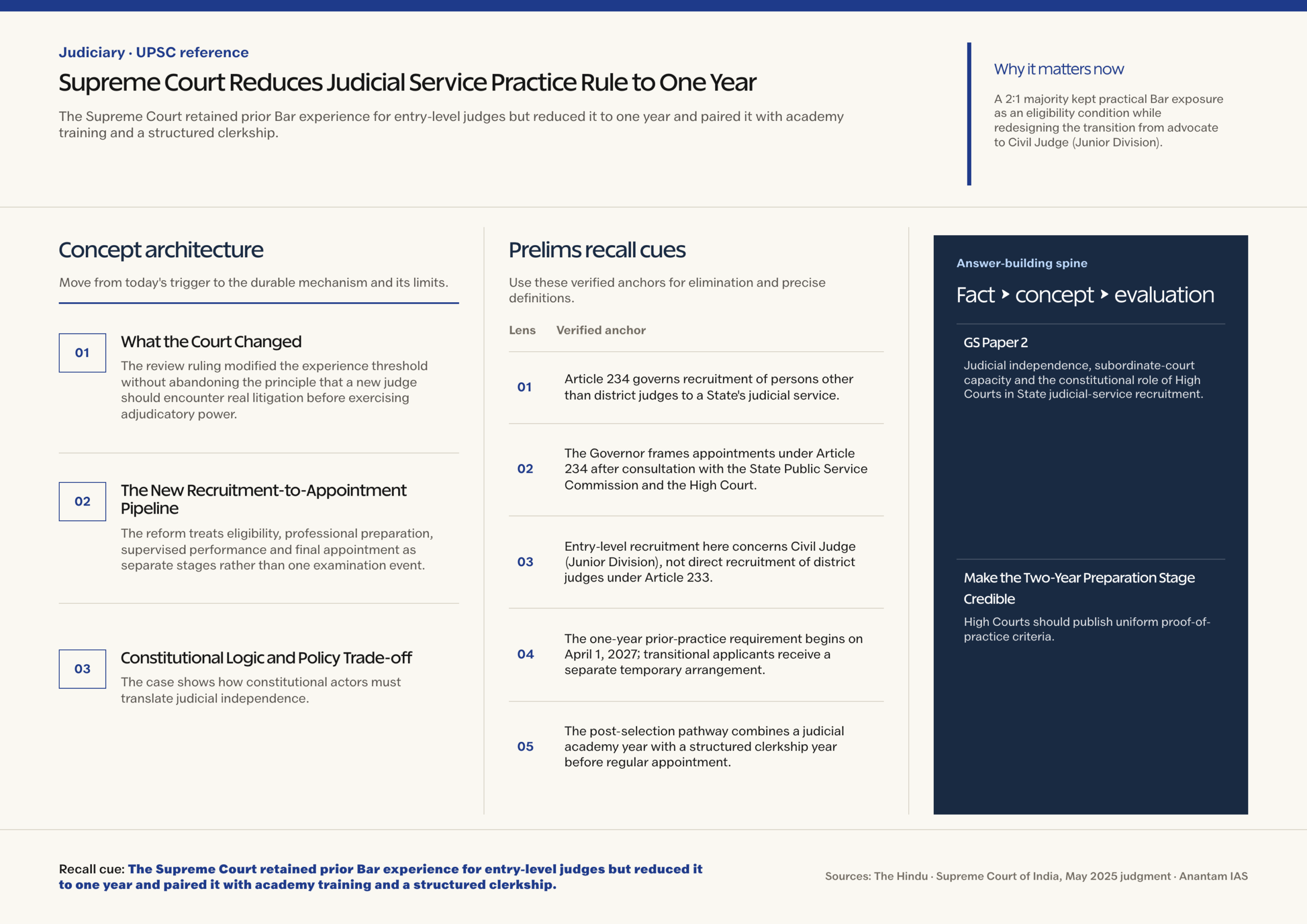
Supreme Court Reduces Judicial Service Practice Rule to One Year
Why in News?
On August 21, 2026, the Supreme Court retained prior legal practice for entry-level judicial service but reduced the May 2025 requirement from three years to one.
- A 2:1 majority kept practical Bar exposure as an eligibility condition while redesigning the transition from advocate to Civil Judge (Junior Division).
- The new one-year practice rule will operate prospectively from April 1, 2027, giving recruiting authorities time to align rules and certification.
- Selected candidates will complete one year at a State judicial academy, followed by a structured year of law clerkship before regular appointment.
- The clerkship divides six months with a District and Sessions Judge and six months with a sitting High Court judge, followed by a reasoned evaluation.
- The ruling balances two concerns: courtroom readiness at entry and fair access for young graduates who may struggle to sustain prolonged low-paid practice.
- It shifts recruitment from a single experience threshold toward a practice-training-assessment pipeline, making institutional training and supervision central to judicial capacity.
UPSC Relevance
Prelims Relevance
- Article 234 governs recruitment of persons other than district judges to a State’s judicial service.
- The Governor frames appointments under Article 234 after consultation with the State Public Service Commission and the High Court.
- Entry-level recruitment here concerns Civil Judge (Junior Division), not direct recruitment of district judges under Article 233.
- The one-year prior-practice requirement begins on April 1, 2027; transitional applicants receive a separate temporary arrangement.
- The post-selection pathway combines a judicial academy year with a structured clerkship year before regular appointment.
Mains Relevance
GS Paper 2
- Judicial independence, subordinate-court capacity and the constitutional role of High Courts in State judicial-service recruitment.
- Designing merit-based recruitment that combines access, practical competence, training and accountable evaluation.
Essay
- Institutions earn trust when entry standards measure practical judgment without turning social or economic disadvantage into an invisible barrier.
Background and Context
What the Court Changed
The review ruling modified the experience threshold without abandoning the principle that a new judge should encounter real litigation before exercising adjudicatory power.
- The May 2025 judgment had restored three years of practice before eligibility for entry-level judicial service; the majority has reduced that period to one year while preserving experiential learning and reducing exclusionary delay.
- The changed rule applies prospectively from April 1, 2027, avoiding immediate disruption while High Courts and States align recruitment rules without cancelling ongoing selection cycles.
- Candidates applying during the review period are deemed to have completed the required year and need not submit a proof-of-practice certificate, protecting existing recruitment notices and candidate expectations.
- This relief lasts until March 31, 2027; it does not erase certification once the permanent rule begins or create a continuing exemption for applicants after the cut-off date.
- The majority designed the arrangement for a five-year course, after which its effectiveness is to be reviewed using actual experience as evidence accumulates rather than treating the design as final.
The New Recruitment-to-Appointment Pipeline
The reform treats eligibility, professional preparation, supervised performance and final appointment as separate stages rather than one examination event.
- From April 2027, an applicant must show active legal practice through records of presence and participation in effective judicial proceedings, making courtroom engagement more important than nominal enrolment under the new standard.
- Proof may include work alongside a senior Bar member with at least ten years’ practice, connecting certification to observed participation while requiring authorities to verify meaningful exposure across differing practice settings.
- A successful applicant becomes a trainee judicial officer and undertakes one year of intensive instruction at the relevant State judicial academy before supervised and evaluated practical work.
- The next year is a law clerkship: six months under a Principal District or District and Sessions Judge, then six months with a sitting High Court judge across two judicial levels.
- The supervising High Court judge submits a reasoned evaluation; a favourable assessment enables regular appointment with full pay and service benefits, making assessment the final quality checkpoint before confirmation in service.
Constitutional Logic and Policy Trade-off
The case shows how constitutional actors must translate judicial independence, professional competence and equal opportunity into a workable entry system.
- Under Article 234, recruitment below the district-judge level requires consultation among the Governor, State Public Service Commission and High Court, distributing responsibility across executive, recruitment and judicial institutions within a federal structure.
- High Court participation protects judicial standards, while the Public Service Commission contributes an open recruitment process within the State framework; neither role should collapse into unchecked discretion or opaque gatekeeping.
- Prior practice exposes candidates to evidence, procedure, client hardship and courtroom ethics, but a long compulsory period may favour those able to absorb unstable early-career earnings and weak mentorship in poorly regulated chambers.
- Academy training supplies common doctrine and procedure; clerkship adds supervised observation of trial management, judgment craft, institutional ethics and High Court scrutiny before independent adjudication begins in a controlled environment.
- The dissent preferred retaining the May 2025 approach, showing that the disagreement concerned how much pre-entry experience protects competence, not whether practical exposure has value for judging at the judicial threshold.
Way Forward
Make the Two-Year Preparation Stage Credible
- High Courts should publish uniform proof-of-practice criteria, acceptable records and review procedures so certification does not become arbitrary or patronage-driven.
- Judicial academies need assessed modules on evidence, procedure, ethics, court management, legal aid, digital courts and clear judgment writing.
- Clerkship evaluations should use disclosed competency rubrics, multiple observations and a fair opportunity to address an adverse assessment.
- The five-year review should examine recruitment diversity, training outcomes, appointment delays and early-career judicial performance before changing the threshold again.
Conclusion
- The ruling replaces a blunt three-year filter with a one-year practice plus two-year supervised preparation model, preserving courtroom exposure while reducing the entry barrier and embedding performance review before authority is conferred.
- In a Mains answer, evaluate the reform through four tests: constitutional consultation, access to the profession, practical competence and transparent assessment before regular appointment, rather than debating experience duration in isolation.
UPSC Practice Questions
Prelims MCQ 1
With reference to recruitment to the State judicial service, consider the following statements:
- Article 234 concerns recruitment of persons other than district judges to a State’s judicial service.
- Such appointments are made by the Governor after consulting the State Public Service Commission and the High Court.
- Article 233 governs the same entry-level Civil Judge recruitment process.
How many of the above statements are correct?
(a) Only one (b) Only two (c) All three (d) None
Answer: (b) Only two
Explanation:
Statements 1 and 2 correctly describe Article 234. Article 233 deals with appointment, posting and promotion of district judges, not this entry-level recruitment category.
Prelims MCQ 2
Under the Supreme Court’s August 2026 arrangement, which sequence correctly describes preparation after selection for entry-level judicial service?
(a) Two years of independent practice followed by direct appointment (b) One academy year followed by one structured clerkship year (c) One High Court clerkship year followed by a competitive examination (d) District-court practice alone, without academy training
Answer: (b) One academy year followed by one structured clerkship year
Explanation:
Selected candidates first undergo one year of intensive State judicial-academy training and then a structured year of clerkship before consideration for regular appointment.
UPSC Mains Questions
- The Supreme Court’s revised judicial-service entry model combines prior Bar practice with academy training and supervised clerkship. Examine how this design balances competence with equal access.
- Discuss the constitutional roles of the Governor, State Public Service Commission and High Court in recruitment to the subordinate judiciary. Why does process design matter for judicial independence?
Sources: The Hindu and Supreme Court of India, May 2025 judgment.
Frequently Asked Questions
What did the Supreme Court change in August 2026?
A 2:1 majority retained prior Bar experience for entry-level judicial service but reduced the May 2025 requirement from three years to one, effective prospectively from April 1, 2027.
Does one year of practice lead directly to appointment as a Civil Judge?
No. Selection is followed by one year at a State judicial academy and one year of structured clerkship. Regular appointment depends on a favourable reasoned evaluation.
How will active legal practice be proved?
The certificate must rest on records showing presence and participation in effective judicial proceedings, including work with a senior Bar member having at least ten years’ practice.
What happens to candidates caught in the transition?
Applicants covered by the interim arrangement are deemed to have completed one year of practice and need not furnish proof certificates. This temporary protection operates through March 31, 2027.
Which constitutional provision is most relevant for entry-level judicial-service recruitment?
Article 234 covers recruitment below the district-judge level. The Governor acts according to rules made after consulting the State Public Service Commission and the High Court.
Source: https://anantamias.com/current-affairs/judicial-service-one-year-practice-rule/
Agro-Input Dealer Cartel: How CCI Applies Competition Law to Associations
Why in News?
On August 21, 2026, the Competition Commission of India imposed monetary and non-monetary sanctions for cartel conduct involving agro-input dealer associations and responsible individuals.
- CCI found a contravention of Section 3(3)(b), which covers agreements or association decisions that limit or control production, supply, markets, technical development, investment or services.
- The provision was applied with Section 3(1), the general prohibition on agreements causing or likely to cause an appreciable adverse effect on competition in India.
- The order combined penalties with a cease-and-desist direction and required the associations to conduct competition-compliance training.
- Officials found responsible were also proceeded against under Section 48, showing that an association cannot always absorb liability for the individuals directing its conduct.
- Dealer associations may legitimately represent members, but collective directions affecting independent commercial decisions can replace rivalry with coordinated restriction.
- In an agro-input market, restricted supply or market access can weaken availability, choice and competitive pressure for dealers and farmers, even without a formally signed cartel contract.
- The order is exam-relevant because it links substantive prohibition, institutional responsibility, individual accountability and corrective compliance within one enforcement action.
UPSC Relevance
Prelims Relevance
- The Competition Commission of India enforces the Competition Act, 2002 against anti-competitive agreements, abuse of dominance and regulated combinations.
- Section 3(1) prohibits agreements that cause or are likely to cause an appreciable adverse effect on competition within India.
- Section 3(3)(b) covers horizontal arrangements that limit or control production, supply, markets, technical development, investment or services.
- Section 3(3) expressly includes a practice carried on or decision taken by an association; the arrangement need not resemble a conventional signed contract.
- Section 27 empowers CCI to order discontinuance, impose penalties, modify agreements and issue other appropriate directions after finding a contravention.
- Section 48 can attach liability to responsible persons when the contravention is committed by a company, a term that includes an association of individuals.
Mains Relevance
GS Paper 3
- Competition policy as part of market regulation, consumer welfare and efficient distribution of essential production inputs.
- How output restriction by horizontal competitors can reduce independent decision-making, availability and competitive pressure across a supply chain.
GS Paper 2
- Regulatory governance through proportionate sanctions, reasoned enforcement, officer accountability and preventive compliance obligations.
Essay
- Collective organisation serves the public interest only when representation does not become a mechanism for suppressing independent economic choice.

Background and Context
When Association Conduct Becomes an Agreement
Competition law looks at coordinated commercial conduct and its likely effect, not merely the label or legal form of the coordinating body.
- Section 3 reaches agreements between enterprises or persons, while Section 3(3) also covers a practice or decision of an association operating in identical or similar trade.
- This prevents members from avoiding scrutiny by presenting coordinated restrictions as advice, resolutions or welfare activity when they actually influence independent market conduct.
- The Act defines agreement broadly to include an arrangement, understanding or action in concert, whether or not it is formal, written or legally enforceable between the participants.
- An association may share compliance information, train members or advocate policy; legal risk begins when collective action directs prices, quantities, customers, territories or other variables on which members should compete.
- For UPSC answers, distinguish lawful representation from commercial coordination: common identity is not illegal, but using collective authority to suppress independent rivalry can be.
Section 3 Cartel Logic and Market Effect
The Act connects a specific horizontal restriction to the wider rule protecting competitive market outcomes in India.
- Section 3(1) supplies the core test: an agreement concerning goods or services is prohibited when it causes or is likely to cause an appreciable adverse effect on competition within India.
- Section 3(3)(b) identifies limitation or control of production, supply, markets, technical development, investment or services as a serious form of horizontal coordination among market participants.
- A Section 3(3) arrangement is presumed to have an appreciable adverse effect, reflecting the high competitive risk of rivals jointly controlling market variables instead of deciding independently.
- Output restriction can reduce quantity or availability, delay distribution and weaken rivalry among sellers; downstream users may then face poorer choice, access or bargaining conditions.
- The exam trap is to equate every trade-association decision with a cartel. Ask whether competitors coordinated a listed market variable and displaced rivalry, not merely whether an association exists.
Section 27 Remedies
Section 27 lets CCI combine punishment, restoration of independent conduct and preventive directions after it finds a contravention.
- Under Section 27(a), CCI may direct parties to discontinue and not re-enter an anti-competitive agreement, making cease-and-desist relief central to restoring independent commercial decisions.
- Section 27 also permits monetary penalties, modification of agreements and other suitable orders or directions, allowing the remedy to address both the breach and its organisational setting.
- In this case, competition-compliance training accompanied the sanctions, treating weak understanding and internal practice as risks requiring correction rather than relying on punishment alone.
- Training becomes meaningful when it changes association rules, meeting agendas, information exchange, communications and escalation procedures that could otherwise reproduce coordination after the formal order.
Section 48 Individual Accountability
Organisational liability does not automatically shield those who control, consent to or negligently enable the contravening conduct.
- Section 48 treats a body corporate, firm or other association of individuals as a company for this liability framework, making it relevant beyond conventional corporations.
- Section 48(1) covers persons who were in charge of and responsible for the organisation’s business when the contravention occurred, alongside liability of the organisation itself.
- A responsible person may avoid liability by proving the contravention occurred without knowledge or that all due diligence was exercised to prevent it.
- Section 48(2) separately reaches an officer when consent, connivance or neglect is proved, connecting personal accountability to active involvement or a demonstrated oversight failure.
Way Forward
Build Competition-Safe Associations
- Associations should adopt written antitrust rules barring discussion or coordination of prices, output, territories, customers, bids and collective refusals to deal.
- Meeting agendas, minutes and communications should document legitimate advocacy while preserving each member’s independent commercial decisions.
- Periodic training should be paired with confidential reporting, legal review of risky resolutions and clear officer responsibility rather than treated as a one-time formality.
- CCI enforcement should explain market harm and remedy design clearly, helping smaller associations distinguish lawful cooperation from cartel-facilitating conduct.
Conclusion
- The order shows that an association decision can become cartel conduct when it coordinates an output or market restriction that displaces independent rivalry among members.
- A strong Mains answer should connect Section 3 prohibition, Section 27 institutional remedies and Section 48 individual liability, then assess how compliance systems can prevent recurrence.
UPSC Practice Questions
Prelims MCQ 1
With reference to anti-competitive agreements under the Competition Act, 2002, consider the following statements:
- Section 3(3) can cover a practice carried on or decision taken by an association of enterprises or persons.
- An arrangement limiting or controlling production or supply is among the horizontal arrangements listed in Section 3(3).
- Section 3 applies only when the parties have executed a formally signed contract.
How many of the above statements are correct?
(a) Only one (b) Only two (c) All three (d) None
Answer: (b) Only two
Explanation:
Statements 1 and 2 are correct. Competition law can examine an association practice or decision; a formally signed contract is not essential to the statutory concept of coordinated conduct.
Prelims MCQ 2
Which provision of the Competition Act primarily enables liability of persons responsible for a contravening company or association?
(a) Section 3 (b) Section 19 (c) Section 27 (d) Section 48
Answer: (d) Section 48
Explanation:
Section 48 addresses contravention by companies and responsible officers. Its definition of company includes a firm or other association of individuals.
UPSC Mains Questions
- How can a trade association’s decision become an anti-competitive agreement under Section 3 of the Competition Act, 2002? Explain with reference to output restrictions and market effects.
- Competition-law enforcement must correct organisational conduct as well as assign individual responsibility. Discuss the relationship between remedies under Section 27 and liability under Section 48.
Sources: PIB, Competition Commission of India and Competition Commission of India, Competition Act 2002.
Frequently Asked Questions
What conduct did CCI find anti-competitive in the agro-input matter?
CCI found cartel conduct involving an output-restricting arrangement under Section 3(3)(b) read with Section 3(1), involving dealer associations and responsible individuals.
Why can a trade-association decision attract Section 3?
Section 3(3) expressly covers a practice or decision of an association in identical or similar trade when it coordinates listed restrictions such as price, output, market sharing or bids.
What is an output restriction under Section 3(3)(b)?
It is coordination that limits or controls production, supply, markets, technical development, investment or services, replacing independent competitive choices with a collective constraint.
What remedies can CCI use under Section 27?
After finding a contravention, CCI may order discontinuance, impose penalties, modify agreements and issue other appropriate directions. The agro-input order also required competition-compliance training.
How does Section 48 create individual liability?
It can cover persons responsible for organisational business and officers whose consent, connivance or neglect caused the contravention, while recognising statutory knowledge and due-diligence defences.
Source: https://anantamias.com/current-affairs/cci-agro-input-dealer-cartel-order/
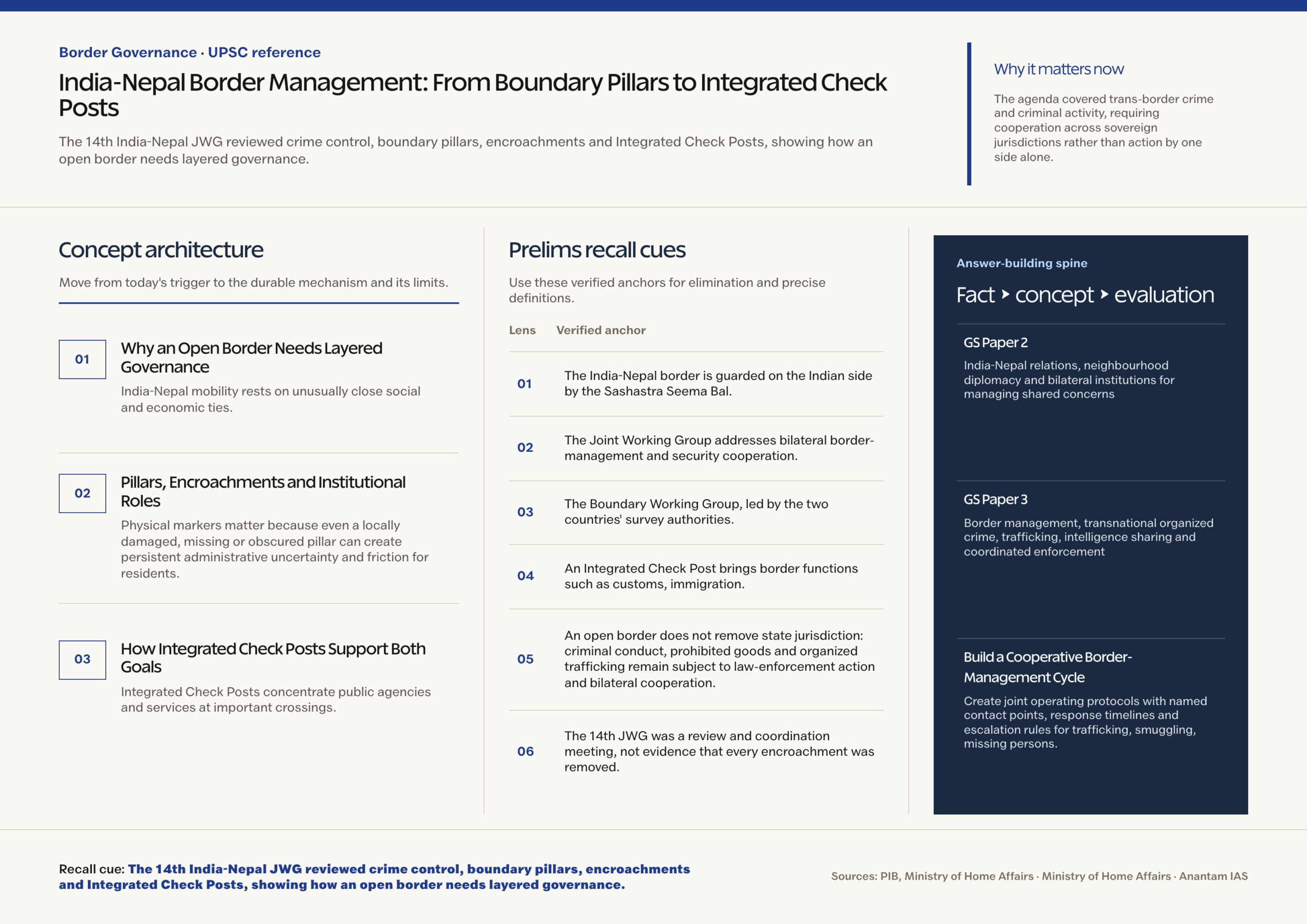
India-Nepal Border Management: From Boundary Pillars to Integrated Check Posts
Why in News?
The 14th India-Nepal Joint Working Group met in Dehradun on 20–21 August 2026 and, through recurring institutional dialogue, reviewed bilateral cooperation on border management, security, infrastructure and capacity.
- The agenda covered trans-border crime and criminal activity, requiring cooperation across sovereign jurisdictions rather than action by one side alone.
- Both sides reviewed the strengthening and effective use of Integrated Check Posts, roads and railway networks serving legitimate cross-border movement.
- They discussed removal of encroachments and maintenance of boundary pillars, which connect local fieldwork with bilateral boundary-management mechanisms.
- The meeting ended with an agreement to sustain engagement; it did not announce a new treaty, a settled boundary dispute or completed infrastructure.
- An open and heavily used border supports livelihoods, kinship and trade, but also creates opportunities for trafficking, smuggling and other criminal networks.
- Effective management must combine facilitation and security: lawful movement should remain convenient while risk-based checks target prohibited activity.
- Boundary upkeep, crime control and trade facilitation require different agencies and technical mechanisms, making institutional coordination as important as physical infrastructure.
UPSC Relevance
Prelims Relevance
- The India-Nepal border is guarded on the Indian side by the Sashastra Seema Bal, a Central Armed Police Force under the Ministry of Home Affairs.
- The Joint Working Group addresses bilateral border-management and security cooperation; it should not be confused with a treaty-making or boundary-adjudication body.
- The Boundary Working Group, led by the two countries’ survey authorities, handles technical boundary work such as maintenance or construction of damaged and missing pillars.
- An Integrated Check Post brings border functions such as customs, immigration, security and cargo or passenger facilitation into a coordinated facility at a designated crossing.
- An open border does not remove state jurisdiction: criminal conduct, prohibited goods and organized trafficking remain subject to law-enforcement action and bilateral cooperation.
- The 14th JWG was a review and coordination meeting, not evidence that every encroachment was removed, every pillar repaired or every proposed transport link completed.
Mains Relevance
GS Paper 2
- India-Nepal relations, neighbourhood diplomacy and bilateral institutions for managing shared concerns
- Cooperative federal and local implementation where border decisions affect communities, commerce and routine mobility
GS Paper 3
- Border management, transnational organized crime, trafficking, intelligence sharing and coordinated enforcement
- Integrated Check Posts as infrastructure that combines security controls with faster legitimate trade and travel
Essay
- Good borders are governed through trust and institutions: openness and security are complementary when cooperation is precise, accountable and humane.
Background and Context
Why an Open Border Needs Layered Governance
India-Nepal mobility rests on unusually close social and economic ties, so a conventional sealed-border model would misunderstand both the bilateral relationship and its governance challenge.
- People cross for family, work, education, pilgrimage and local trade, making the border a lived social space rather than only a distant security line to be policed.
- High legitimate mobility can be exploited by networks engaged in human trafficking, narcotics, arms, counterfeit currency, vehicle theft or other smuggling, especially when agencies hold fragmented information across jurisdictions.
- The policy task is risk-based facilitation: preserve ordinary lawful movement while focusing checks, intelligence and investigations on suspicious routes, consignments, facilitators and repeat offenders.
- India’s Sashastra Seema Bal performs border-guarding functions, but policing, customs, immigration, railways, land-port authorities and local administrations retain distinct legal responsibilities and operational chains.
- Because an offence may begin in one country and produce evidence, victims or proceeds in the other, timely information exchange and compatible procedures are indispensable for prosecution.
Pillars, Encroachments and Institutional Roles
Physical markers matter because even a locally damaged, missing or obscured pillar can create persistent administrative uncertainty and friction for residents, landholders and field officials.
- Boundary pillars make an agreed alignment visible on the ground; their maintenance requires joint technical verification and consistent records, not unilateral relocation based on local perception or convenience.
- Encroachment may involve cultivation, structures or altered land use near the boundary, so response should begin with survey records, joint inspection and documented facts rather than inflammatory public claims.
- The JWG supplies a broad security and border-management forum, allowing officials to review crime, infrastructure, coordination, capacity building, encroachments and pillar maintenance within one recurring dialogue.
- Technical boundary work is associated with the bilateral Boundary Working Group and survey authorities; distinguishing this role prevents confusion between field maintenance, political dialogue, territorial claims and legal settlement.
- Routine coordination should include shared incident records, escalation contacts and periodic pillar inspection so a small field problem is documented and resolved before it becomes a diplomatic dispute.
How Integrated Check Posts Support Both Goals
Integrated Check Posts concentrate public agencies and services at important crossings, reducing fragmented procedures while giving legitimate passenger and freight movement a clearer, more accountable route.
- An ICP can coordinate customs, immigration, security, quarantine, cargo handling and passenger services, reducing repeated stops and improving the traceability and predictability of formal cross-border flows.
- Better layouts separate passenger and freight movement, create inspection space and support digital documentation, enabling targeted checks without treating every traveller or consignment as equally risky by default.
- Road and railway connectivity can increase an ICP’s usefulness, but the governance objective is effective utilisation and reliable service, not simply announcing or constructing an isolated facility.
- Infrastructure cannot replace intelligence, trained personnel, interoperable data, grievance channels and maintenance; an impressive building with weak inter-agency coordination merely centralizes delay and confusion.
- The exam trap is to equate an open border with no regulation or an ICP with closure. In practice, facilitation and enforcement coexist through differentiated, lawful and proportionate controls.
Way Forward
Build a Cooperative Border-Management Cycle
- Create joint operating protocols with named contact points, response timelines and escalation rules for trafficking, smuggling, missing persons, forged documents and pillar damage.
- Schedule survey-led pillar inspections and record encroachment cases through shared evidence, geospatial records and joint field verification, while avoiding unilateral changes on the ground.
- Measure ICP performance through clearance time, reliability, seizures based on risk and user grievances, not only construction milestones or raw checking volumes.
- Train agencies together on victim-sensitive anti-trafficking work, evidence preservation, cyber-enabled crime and lawful data exchange with privacy, accountability and review safeguards.
Conclusion
- The meeting shows that India-Nepal border governance is a continuing institutional process linking bilateral security cooperation, field-level boundary maintenance, effective infrastructure use and durable administrative capacity.
- Its central lesson is that an open border becomes safer through selective enforcement and reliable facilitation, not indiscriminate restriction that burdens lawful social, cultural and economic exchange.
- In a Mains answer, clearly separate the roles of the JWG, survey-led boundary mechanisms, SSB and ICPs, then recommend joint verification, intelligence-led policing and accountable facilitation.
UPSC Practice Questions
Prelims MCQ 1
With reference to India-Nepal border management, consider the following statements:
- The Sashastra Seema Bal guards the India-Nepal border on the Indian side.
- Integrated Check Posts coordinate multiple border functions at designated crossings.
- The 14th Joint Working Group meeting created a new bilateral boundary treaty.
How many of the above statements are correct?
(a) Only one (b) Only two (c) All three (d) None
Answer: (b) Only two
Explanation:
Statements 1 and 2 are correct. The 14th JWG reviewed border-management cooperation and agreed to continued engagement; the official release did not announce a new boundary treaty.
Prelims MCQ 2
Which institution is most directly associated with technical work on damaged or missing India-Nepal boundary pillars?
(a) Finance Commission (b) Boundary Working Group led by the survey authorities (c) Inter-State Council (d) GST Council
Answer: (b) Boundary Working Group led by the survey authorities
Explanation:
The bilateral Boundary Working Group, led by the respective survey authorities, undertakes technical boundary work, including maintenance or construction of damaged and missing pillars.
UPSC Mains Questions
- An open border requires more governance, not less. Examine this statement in the context of India-Nepal border management and security cooperation.
- Explain how Integrated Check Posts, boundary-pillar maintenance and bilateral institutional coordination can jointly facilitate legitimate mobility while controlling trans-border crime.
Sources: PIB, Ministry of Home Affairs and Ministry of Home Affairs.
Frequently Asked Questions
What was decided at the 14th India-Nepal JWG meeting?
The two sides reviewed border security, crime, infrastructure, encroachments, pillars and capacity building, and agreed to sustain engagement. The release announced no new treaty or completed project.
Why is the India-Nepal border called open?
Indian and Nepali citizens have long enjoyed extensive cross-border movement under the bilateral relationship, supporting family ties, employment, trade, education and other routine activities.
What does an Integrated Check Post do?
It coordinates functions such as customs, immigration, security, cargo handling and passenger facilitation at a designated crossing, supporting faster lawful movement and more organized enforcement.
Who guards the India-Nepal border on the Indian side?
The Sashastra Seema Bal is the designated border-guarding force on the Indian side, while customs, immigration, police and other agencies perform their separate statutory functions.
Are the JWG and Boundary Working Group the same?
No. The JWG reviews broad security and border-management cooperation, while the survey-led Boundary Working Group handles technical boundary work, including maintenance of damaged or missing pillars.
Source: https://anantamias.com/current-affairs/india-nepal-border-management-jwg/
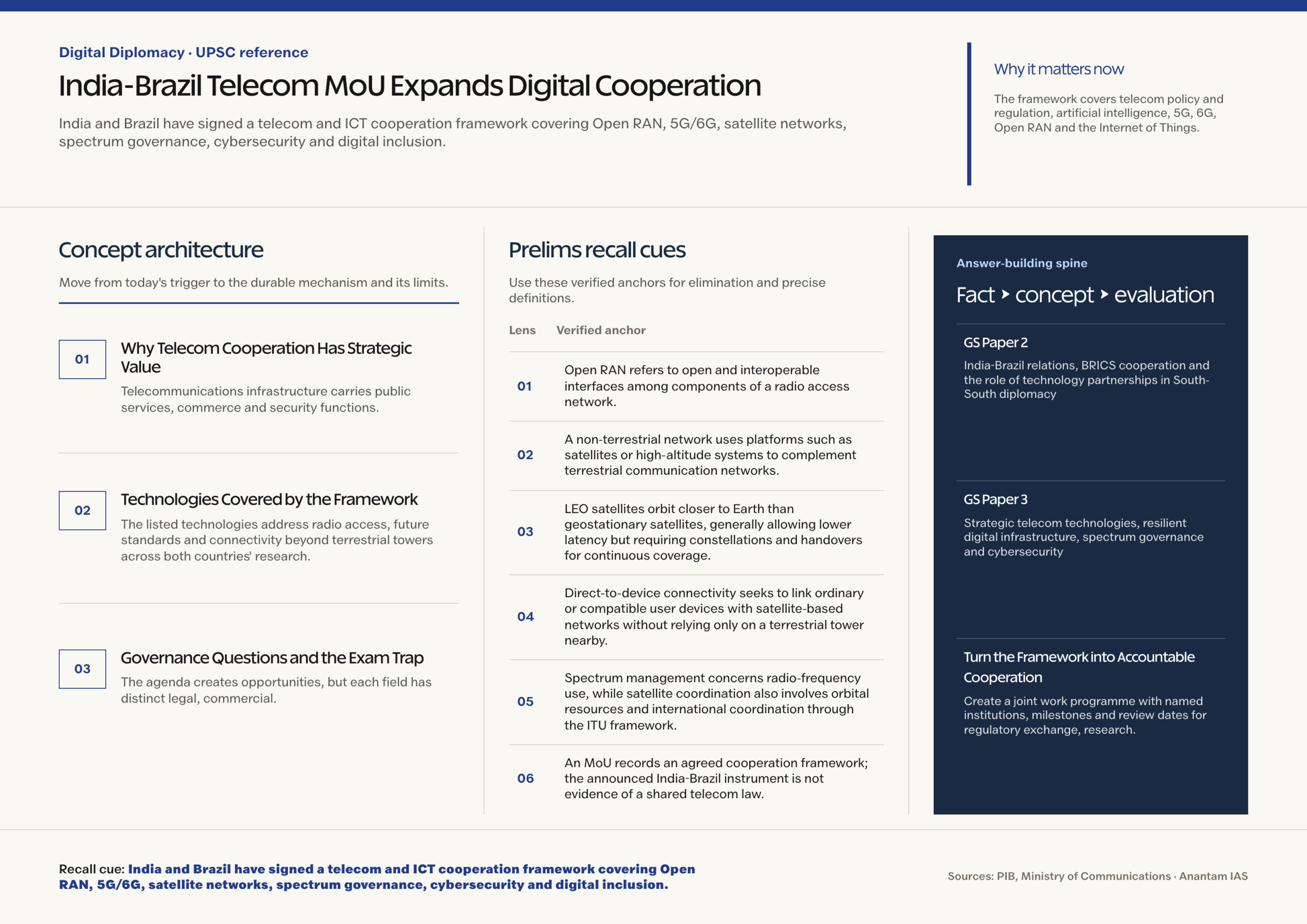
India-Brazil Telecom MoU Expands Digital Cooperation
Why in News?
India and Brazil signed a telecommunications and ICT cooperation MoU on 21 August 2026 during the BRICS ICT Track Meeting in Pune, following discussions on emerging networks, spectrum governance and digital inclusion.
- The framework covers telecom policy and regulation, artificial intelligence, 5G, 6G, Open RAN and the Internet of Things.
- It also includes direct-to-device connectivity, Low Earth Orbit satellites, non-terrestrial networks, optical fibre and submarine cables.
- Cooperation may extend to spectrum and orbit management, cybersecurity, consumer protection, private networks, digital inclusion and greener ICT systems.
- The MoU provides for exchanges of information, experience and best practices; it does not itself establish a common standard or complete a technology project.
- Telecom systems now link foreign policy, industrial capability and strategic resilience, making standards and trusted infrastructure important fields of bilateral cooperation.
- India and Brazil can use South-South cooperation to compare regulatory approaches and improve connectivity across large territories with difficult last-mile conditions.
- The value of the MoU will depend on specific follow-up projects, responsible institutions, timelines and measurable public benefits.
UPSC Relevance
Prelims Relevance
- Open RAN refers to open and interoperable interfaces among components of a radio access network; it does not mean the entire telecom network is open-source.
- A non-terrestrial network uses platforms such as satellites or high-altitude systems to complement terrestrial communication networks.
- LEO satellites orbit closer to Earth than geostationary satellites, generally allowing lower latency but requiring constellations and handovers for continuous coverage.
- Direct-to-device connectivity seeks to link ordinary or compatible user devices with satellite-based networks without relying only on a terrestrial tower nearby.
- Spectrum management concerns radio-frequency use, while satellite coordination also involves orbital resources and international coordination through the ITU framework.
- An MoU records an agreed cooperation framework; the announced India-Brazil instrument is not evidence of a shared telecom law, operating network or completed deployment.
Mains Relevance
GS Paper 2
- India-Brazil relations, BRICS cooperation and the role of technology partnerships in South-South diplomacy
- Balancing bilateral cooperation with transparent institutions, consumer protection and implementation accountability
GS Paper 3
- Strategic telecom technologies, resilient digital infrastructure, spectrum governance and cybersecurity
- Open interfaces, satellite connectivity and digital inclusion as tools for reducing geographic access gaps
Essay
- Digital sovereignty grows through capable institutions and interoperable cooperation, not technological isolation.
Background and Context
Why Telecom Cooperation Has Strategic Value
Telecommunications infrastructure carries public services, commerce and security functions, so bilateral learning can support development and resilience across essential public systems rather than remain sectoral.
- India and Brazil are large federal democracies with extensive rural and remote areas, making universal and meaningful connectivity across dispersed, high-cost and environmentally difficult regions a shared challenge because geographic scale raises deployment and maintenance costs.
- Cooperation can compare how regulators allocate spectrum, protect consumers, encourage competition and maintain service quality under different but sovereign legal systems, including how licence obligations can reach underserved populations.
- Exchange on cybersecurity can help institutions study network resilience, incident response and supply-chain risk, including trusted-vendor assessment, while each country retains responsibility for its security choices.
- Optical fibre, submarine cables and satellite links provide different connectivity layers; resilient systems avoid dependence on a single route or technology and preserve redundancy during disruptions.
- The framework places digital inclusion alongside innovation, reminding policymakers that networks matter only when access is affordable, usable and reliable across income, language, disability and location.
Technologies Covered by the Framework
The listed technologies address radio access, future standards and connectivity beyond terrestrial towers across both countries’ research, regulatory and future commercial deployment ecosystems.
- A radio access network connects user devices to the mobile core; Open RAN promotes specified interfaces between disaggregated functions so different suppliers can interoperate where standards and testing permit.
- Open interfaces may widen vendor choice and innovation, but interoperability, performance, security assurance and lifecycle support remain engineering and regulatory tasks requiring certification and operational accountability.
- 5G and 6G cooperation can include research, standards discussions, trials and policy exchange across public and private institutions; it does not declare a joint network or common standard.
- Non-terrestrial networks use satellites or aerial platforms, while direct-to-device links aim to reach compatible handsets beyond ground infrastructure, including during disasters or in sparsely served areas.
- LEO systems can reduce signal travel time compared with distant geostationary systems, but require multiple moving satellites, complex handovers, ground systems, constellation control and coordinated spectrum use.
Governance Questions and the Exam Trap
The agenda creates opportunities, but each field has distinct legal, commercial, technical and public-interest constraints that diplomatic language cannot settle without detailed implementing arrangements.
- Radio frequencies cross borders and satellite systems can cause harmful interference, making spectrum and orbit coordination through domestic regulators and appropriate international processes essential alongside national authorization.
- Cybersecurity cooperation must coexist with privacy, lawful access, data governance and consumer remedies; stronger security cannot justify opaque surveillance without independent oversight and clear legal safeguards.
- Private networks and IoT can improve industrial operations, yet connected devices expand the attack surface and require secure design, updates and clear accountability throughout their operational life cycles.
- Submarine cables face accidental, environmental and security risks, so route diversity, repair capacity and international coordination must complement resilient domestic landing stations and terrestrial backhaul.
- Treat the agreement as an enabling diplomatic framework. Do not infer a treaty, harmonized regulation, shared spectrum or completed infrastructure, which require later rules, contracts, investment and implementation.
Way Forward
Turn the Framework into Accountable Cooperation
- Create a joint work programme with named institutions, milestones and review dates for regulatory exchange, research, skills and pilot cooperation.
- Use transparent testbeds to assess interoperability, security and performance before scaling Open RAN, IoT or satellite-linked services.
- Build consumer protection, accessibility, privacy and affordability indicators into projects so digital inclusion is measured by meaningful use, not coverage claims alone.
- Coordinate positions in appropriate international forums while preserving evidence-based domestic regulation and avoiding premature technological lock-in.
Conclusion
- The India-Brazil MoU expands bilateral relations from conventional diplomacy into telecom regulation, emerging networks, cybersecurity and inclusion within BRICS and a more plural digital order.
- Its significance lies in enabling concrete joint work; success must be judged by secure interoperability, accountable follow-up and wider meaningful connectivity for underserved communities, not the signing ceremony.
- In a Mains answer, connect the framework to South-South cooperation and digital sovereignty, distinguish collaboration from implementation, and assess regulatory capacity, cybersecurity and consumer rights before recommending scale-up.
UPSC Practice Questions
Prelims MCQ 1
With reference to emerging telecommunications systems, consider the following statements:
- Open RAN seeks interoperable interfaces among components of the radio access network.
- Non-terrestrial networks may use satellite or high-altitude platforms.
- Low Earth Orbit satellites remain stationary relative to one point on Earth.
How many of the above statements are correct?
(a) Only one (b) Only two (c) All three (d) None
Answer: (b) Only two
Explanation:
Statements 1 and 2 are correct. LEO satellites move relative to Earth’s surface; remaining fixed over one point is a feature associated with geostationary orbit.
Prelims MCQ 2
The India-Brazil telecommunications and ICT MoU announced in August 2026 is best understood as:
(a) A common telecom law immediately applicable in both countries (b) A completed bilateral satellite constellation (c) A framework for cooperation, exchange and exploration across telecom and ICT fields (d) A treaty allocating radio spectrum between the two countries
Answer: (c) A framework for cooperation, exchange and exploration across telecom and ICT fields
Explanation:
The official release describes a bilateral framework for information, experience and best-practice exchange across listed fields. It does not announce common law, spectrum allocation or a completed network.
UPSC Mains Questions
- India-Brazil digital cooperation illustrates the growing strategic role of telecommunications in South-South relations. Discuss the opportunities and implementation challenges.
- Explain how Open RAN and non-terrestrial networks may support connectivity while creating new regulatory, cybersecurity and consumer-protection questions.
Source: PIB, Ministry of Communications.
Frequently Asked Questions
What did India and Brazil sign in August 2026?
They signed an MoU creating a cooperation framework for telecommunications and ICT, including policy exchange, emerging networks, digital infrastructure, cybersecurity, inclusion and capacity building.
What is Open RAN?
Open RAN promotes specified, interoperable interfaces among radio access network components, potentially allowing greater supplier flexibility while still requiring rigorous integration, security and performance testing.
What are non-terrestrial networks?
They are communication networks that use platforms beyond conventional ground towers, including satellites or high-altitude systems, to complement terrestrial coverage and improve reach.
Does the MoU create a common India-Brazil telecom standard?
No. The announcement establishes cooperation and exchange across listed areas; it does not by itself create harmonized regulation, allocate shared spectrum or establish a common technical standard.
Why is spectrum management part of international cooperation?
Radio signals and satellite operations can affect users across borders, so interference avoidance, compatible use and orbit-related coordination require domestic regulation plus international engagement.
Source: https://anantamias.com/current-affairs/india-brazil-telecom-ict-mou/
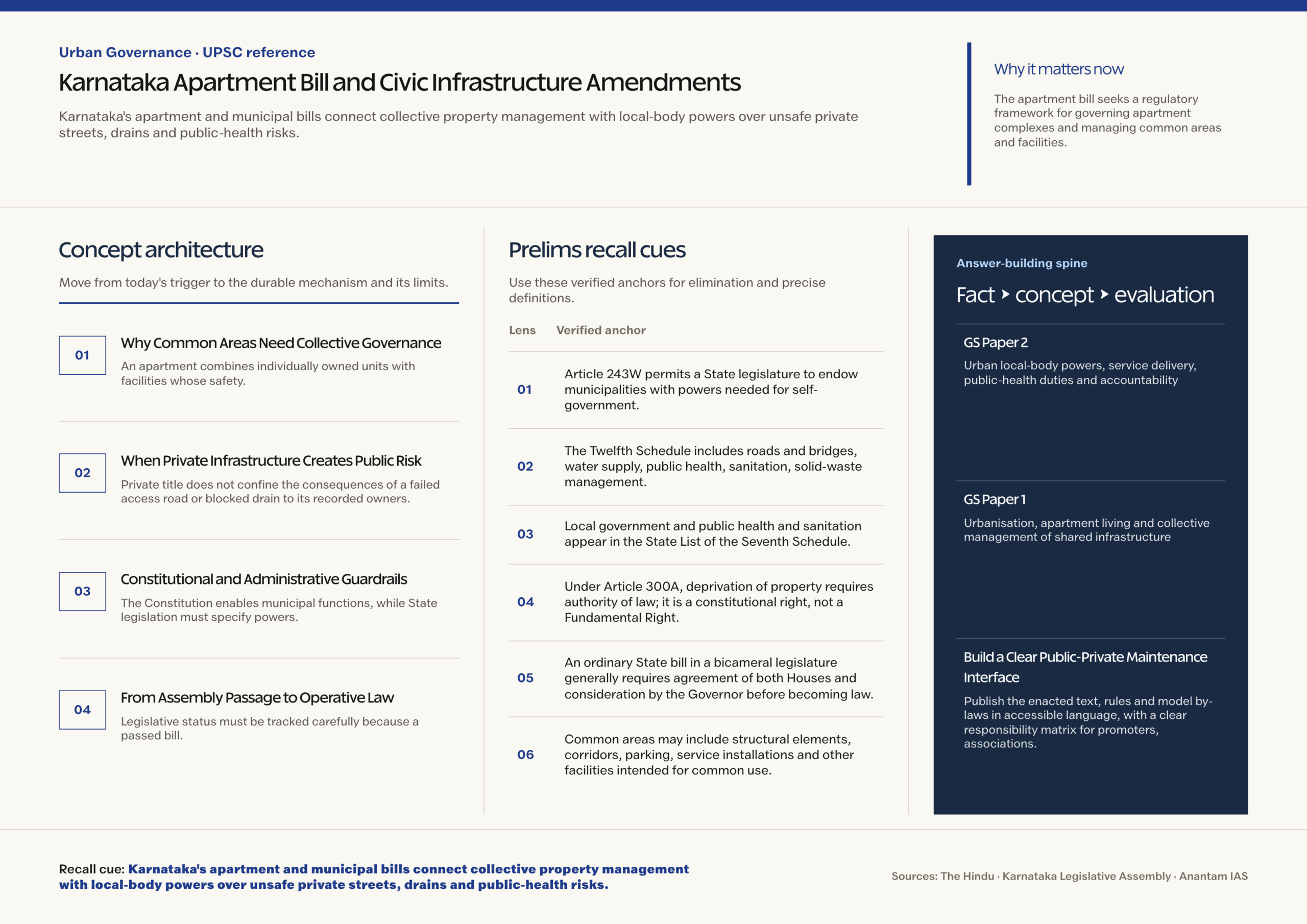
Karnataka Apartment Bill and Civic Infrastructure Amendments
Why in News?
The Karnataka Legislative Assembly passed an apartment-governance bill and two municipal amendments on 21 August 2026, addressing common facilities and unsafe private streets and drains.
- The apartment bill seeks a regulatory framework for governing apartment complexes and managing common areas and facilities.
- The municipal amendments would empower designated officials to intervene when private streets or drains threaten public health and safety.
- The measures seek to prevent private ownership disputes from obstructing the maintenance of essential civic infrastructure.
- Assembly passage is not final enactment; the bills must complete the applicable legislative and assent stages before their provisions operate.
- Apartment governance requires clear ownership records, representative decision-making and accountable maintenance because several facilities are used collectively but cannot be managed effectively by isolated owners.
- A privately owned road or drain can create public consequences when neglect disrupts access, sanitation, drainage, emergency response or disease prevention beyond the property’s boundary.
- The bills illustrate how property rights and municipal responsibility must be reconciled through clear statutory authority, fair procedure and defined maintenance obligations.
UPSC Relevance
Prelims Relevance
- Article 243W permits a State legislature to endow municipalities with powers needed for self-government; it does not itself transfer every listed function automatically.
- The Twelfth Schedule includes roads and bridges, water supply, public health, sanitation, solid-waste management, fire services and urban planning.
- Local government and public health and sanitation appear in the State List of the Seventh Schedule.
- Under Article 300A, deprivation of property requires authority of law; it is a constitutional right, not a Fundamental Right.
- An ordinary State bill in a bicameral legislature generally requires agreement of both Houses and consideration by the Governor before becoming law.
- Common areas may include structural elements, corridors, parking, service installations and other facilities intended for common use.
Mains Relevance
GS Paper 2
- Urban local-body powers, service delivery, public-health duties and accountability
- Balancing property interests with statutory intervention and procedural safeguards
GS Paper 1
- Urbanisation, apartment living and collective management of shared infrastructure
- Institutional gaps created when private layouts perform public-facing civic functions
Essay
- Urban governance succeeds when legal ownership, collective responsibility and public-service obligations meet at the same institutional boundary.
Background and Context
Why Common Areas Need Collective Governance
An apartment combines individually owned units with facilities whose safety, value and daily operation depend on collective decisions.
- The existing Karnataka framework treats an apartment with its undivided interest in common areas as transferable immovable property, linking the unit and its shared-property interest.
- Common areas can include land, structural components, corridors, parking, central-service installations, lifts, tanks and equipment intended for common use.
- Because these interests remain undivided, an individual owner cannot manage a roof, lift, fire exit or water system as though it were an isolated asset.
- A functioning association needs transparent by-laws, voting, accounts, maintenance contributions, reserve planning and accessible records to turn shared ownership into responsible management.
- Regulation must also distinguish the responsibilities of promoters, associations and owners, especially during handover, defect repair, fund transfer and long-term maintenance.
When Private Infrastructure Creates Public Risk
Private title does not confine the consequences of a failed access road or blocked drain to its recorded owners.
- A deteriorated private street can impede ambulances, fire services, waste collection and pedestrian access, turning maintenance failure into a wider urban-service problem.
- A damaged or blocked drain can increase waterlogging, sewage exposure and vector risk, so delay may impose health costs on neighbouring properties and public networks.
- The municipal amendments reportedly empower commissioners or chief officers to act when poor conditions create a threat to public health and safety.
- This power addresses a coordination failure: numerous owners may benefit from repair, yet fragmented title, absent developers or disputes can prevent timely collective action.
- Taking over infrastructure is different from routine regulation; the administration must identify the statutory trigger, responsible land, maintenance scope and consequences for existing rights.
Constitutional and Administrative Guardrails
The Constitution enables municipal functions, while State legislation must specify powers, procedures and accountability for their actual exercise.
- Article 243W allows State legislatures to endow municipalities with authority for functions in the Twelfth Schedule, including roads, sanitation, water supply and public health.
- The provision is enabling: operational authority comes from State municipal law, rules, delegated powers and budgets rather than from the Schedule alone.
- Article 300A requires authority of law for deprivation of property, but it does not create an automatic rule that every regulatory intervention must receive identical compensation.
- A fair takeover process should establish notice, inspection, recorded reasons, an opportunity to respond, appeal or review, accurate land records and a defined maintenance handover.
From Assembly Passage to Operative Law
Legislative status must be tracked carefully because a passed bill, an assented Act and an operative provision are not interchangeable.
- Karnataka has a bicameral legislature; an ordinary bill must complete the constitutionally required process involving the Legislative Assembly and Legislative Council.
- After legislative passage, Article 200 governs the Governor’s consideration, including assent, withholding assent, reserving a bill or returning a non-Money Bill for reconsideration.
- Even after assent, an Act may commence immediately, on a date written into it, or through a later government notification, depending on its commencement clause.
- Rules can supply forms, procedures and administrative detail, but delegated legislation must remain within the authority and purposes of the parent Act.
- A UPSC answer should separate the proposal, enacted provision, notified rule and actual administrative outcome instead of treating announcement as implementation.
Way Forward
Build a Clear Public-Private Maintenance Interface
- Publish the enacted text, rules and model by-laws in accessible language, with a clear responsibility matrix for promoters, associations, owners and municipalities.
- Require audited handover records covering common assets, maintenance funds, warranties, approved plans, fire-safety systems and pending defects.
- Use risk-based inspections and time-bound notices before municipal takeover, while preserving emergency powers where delay presents an immediate health or safety threat.
- Create a review mechanism that resolves title, cost-recovery and maintenance disputes without forcing residents or civic bodies into prolonged litigation.
Conclusion
- Apartment governance is not merely a housing-society issue; it is the institutional link between shared property, resident accountability and reliable urban services.
- A strong answer should connect Article 243W and the Twelfth Schedule with Article 300A, due process and the practical problem of fragmented responsibility.
- Karnataka’s bills should be assessed by their final enacted text and implementation, not by treating Assembly passage as proof that new powers are already operational.
UPSC Practice Questions
Prelims MCQ 1
With reference to urban local governance in India, consider the following statements:
- Article 243W itself directly transfers every Twelfth Schedule function to every municipality.
- The Twelfth Schedule includes roads and bridges as well as public health and sanitation.
- Property protected by Article 300A is a Fundamental Right.
How many of the above statements are correct?
(a) Only one (b) Only two (c) All three (d) None
Answer: (a) Only one
Explanation:
Only statement 2 is correct. Article 243W enables State legislatures to endow municipalities with powers. Article 300A protects a constitutional legal right to property, not a Fundamental Right.
Prelims MCQ 2
Which one of the following best explains an undivided interest in apartment common areas?
(a) Every owner receives a physically partitioned part of each common facility (b) The promoter permanently owns every common facility after unit sales (c) Each apartment carries a proportionate shared interest that is not ordinarily separated from the unit (d) Municipal ownership arises automatically when an apartment is registered
Answer: (c) Each apartment carries a proportionate shared interest that is not ordinarily separated from the unit
Explanation:
Apartment ownership combines exclusive possession of the unit with a proportionate, undivided interest in common areas and facilities; registration does not automatically transfer them to a municipality.
UPSC Mains Questions
- Apartment governance lies at the intersection of private property and public service delivery. Discuss with reference to common areas, civic infrastructure and urban local-body accountability.
- How should State law balance municipal intervention in unsafe private streets and drains with property rights and procedural fairness?
Sources: The Hindu and Karnataka Legislative Assembly.
Frequently Asked Questions
What did the Karnataka Legislative Assembly pass?
It passed an apartment ownership and management bill plus amendments concerning municipalities and municipal corporations, with the latter addressing unsafe private streets and drains.
Has the apartment bill already become operative law?
No conclusion should be drawn from Assembly passage alone. The bill must complete the applicable bicameral, gubernatorial and commencement stages before its provisions operate.
What are apartment common areas?
They are shared parts and systems such as land, structural elements, corridors, parking, lifts, tanks and central services in which apartment owners may hold undivided interests.
Why can a municipality intervene in private civic infrastructure?
State law may authorise intervention when neglected private streets or drains create wider health, safety or service-delivery risks, subject to statutory conditions and fair procedure.
Which constitutional provisions are most relevant?
Article 243W and the Twelfth Schedule frame municipal functions, while Article 300A requires authority of law for deprivation of property. State List entries support State legislation.
Source: https://anantamias.com/current-affairs/karnataka-apartment-governance-bill/
Prison Technology: AI Surveillance, Signal Jammers and Proportionality
Why in News?
Karnataka’s Cabinet approved AI-based surveillance cameras, portable signal jammers and regulated inmate calling for prisons on 21 August 2026, while nearby residents reported that existing jammers disrupt lawful mobile and internet services.
- The decision followed reported instances of unauthorised mobile-phone use inside Bengaluru’s Parappana Agrahara Central Prison.
- The proposed package combines AI-assisted camera surveillance, portable signal jammers and regulated calling facilities for inmates.
- Residents around the prison reported disruption to calls, OTP-based transactions, Wi-Fi and internet-dependent services, including difficulty making emergency calls.
- Cabinet approval marks a policy and procurement stage; it does not establish that the new equipment is installed, technically contained or proven effective.
- Illicit phones can enable intimidation, fraud, coordination of crime or circulation of prohibited content, making communication control a legitimate prison-security objective.
- A jammer that extends beyond the prison can burden neighbours, workers, visitors and emergency communication, shifting the cost of security onto lawful users.
- AI may help screen camera feeds, but accountability remains human: agencies must define alerts, verify them and document decisions before taking coercive action.
UPSC Relevance
Prelims Relevance
- Prisons and persons detained therein fall under Entry 4 of the State List in the Seventh Schedule, so prison administration is primarily a State responsibility.
- The Union Ministry of Home Affairs issues guidance and supports prison modernisation, but its Model Prison Manual, 2016 is a model for adoption by States and Union Territories.
- A signal jammer transmits radio-frequency energy to prevent or degrade communication within a designed area; it is different from lawful interception, which accesses communication under legal authority.
- AI-assisted video analytics can flag selected patterns or anomalies, but an alert is a probabilistic output, not automatic proof of misconduct.
- The constitutional idea of proportionality tests legitimate aim, rational connection, necessity or less-restrictive alternatives, and the balance between benefit and rights impact.
- The Karnataka announcement concerned a proposed deployment; approval should not be confused with installation, successful testing or measured reduction in illicit communication.
Mains Relevance
GS Paper 2
- State responsibility for prisons, accountable procurement, grievance redress and rights-compatible prison administration
- Application of legality, necessity, proportionality and procedural safeguards to technology-led restrictions
GS Paper 3
- Technology for internal security, including detection of illicit communications and risk-based surveillance
- Cyber-physical spillovers, false positives, system audits, human oversight and resilient emergency communication
Essay
- Security technology earns legitimacy when it narrows harm, preserves lawful activity and remains answerable to evidence rather than technological claims.
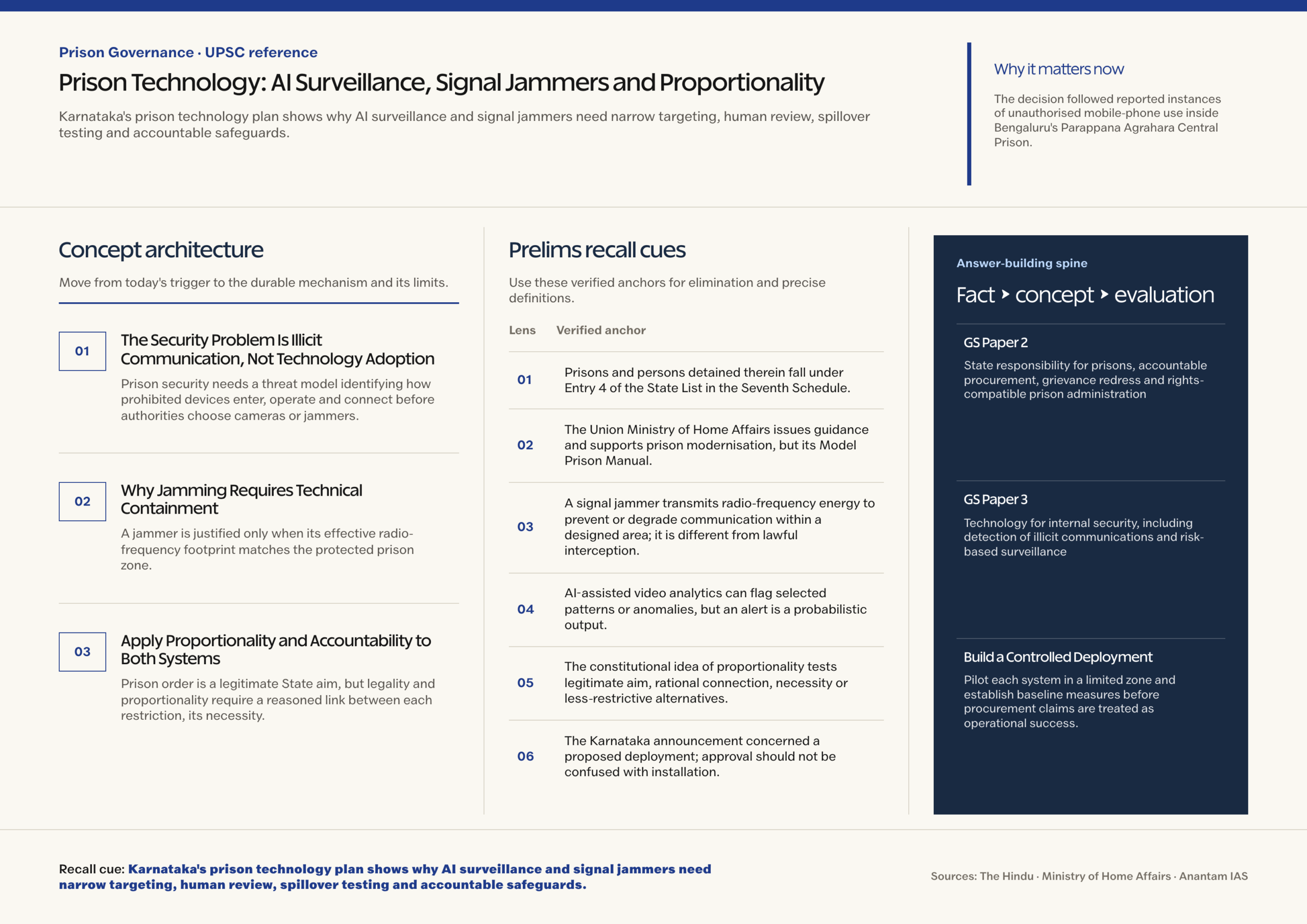
Background and Context
The Security Problem Is Illicit Communication, Not Technology Adoption
Prison security needs a threat model identifying how prohibited devices enter, operate and connect before authorities choose cameras or jammers, because procurement without diagnosis can displace risk.
- An illicit phone can connect inmates to external criminal networks, enable threats or fraud, compromise witnesses and move operational information beyond prison walls.
- Technology addresses only part of that chain. Searches, staff integrity, visitor controls, inventory records and investigation of supply routes remain essential to prevent device entry and identify organized facilitation.
- AI-assisted cameras may prioritize footage or flag configured events, reducing monitoring burden, but performance depends on camera placement, lighting, training data, thresholds and maintenance.
- False positives can trigger unnecessary searches or disciplinary attention, while false negatives create false confidence; both require human verification and recorded outcomes.
- Procurement should begin with measurable objectives such as reduced device recovery, faster incident detection or fewer verified breaches, not a vague promise that AI itself creates security.
Why Jamming Requires Technical Containment
A jammer is justified only when its effective radio-frequency footprint matches the protected prison zone, measurably suppresses prohibited connections and avoids unnecessary interference outside it.
- Radio coverage does not respect a prison wall automatically; terrain, building materials, antenna placement, power and network bands influence where interference actually reaches.
- Portable equipment may allow targeted use, but portability alone does not guarantee precision. Authorities need site surveys, calibrated power, directional design and boundary testing before routine operation.
- Reported spillovers around Parappana Agrahara affect calls, OTP delivery and internet access, showing how a security measure can impair lawful communication, livelihoods, payments and ordinary services.
- Emergency risk deserves a separate protocol: administrators should test access at surrounding homes, roads and institutions and provide a rapid shutdown and escalation channel when harmful interference appears.
- Regulated inmate calling facilities complement enforcement by providing an authorised, logged and time-bound channel, reducing incentives to seek covert alternatives while supporting family contact.
Apply Proportionality and Accountability to Both Systems
Prison order is a legitimate State aim, but legality and proportionality require a reasoned link between each restriction, its necessity, its available alternatives and its wider effects.
- The authority, purpose and operating limits of surveillance and jamming should be written clearly, with designated responsibility for activation, access, review, maintenance, complaints and incident response.
- Necessity asks whether an equally effective, less restrictive mix exists, such as better perimeter detection, managed calling, targeted searches or narrower jamming zones.
- Camera analytics should collect only what the defined security purpose requires, with controlled access, retention limits and deletion schedules that reduce function creep and insider misuse.
- A human reviewer should confirm consequential alerts, record the evidence used and permit challenge through prison procedures; an algorithmic score must not become self-validating proof.
- Independent technical audits should test accuracy, outages, cybersecurity, interference boundaries and complaint patterns, converting procurement claims into verifiable public accountability without exposing security-sensitive details.
Way Forward
Build a Controlled Deployment
- Pilot each system in a limited zone and establish baseline measures before procurement claims are treated as operational success.
- Map the jammer footprint across bands and times, publish a complaint channel, protect emergency access and require immediate corrective action for confirmed spillover.
- Adopt written rules for camera purposes, alert review, retention, access logs, disciplinary use, vendor access and periodic privacy and cybersecurity audits.
- Combine technology with searches, staff vetting, anti-corruption controls, regulated inmate calls and investigation of device-supply routes through a layered security model.
Conclusion
- Karnataka’s decision should be assessed as an approved modernisation proposal, not proof that AI surveillance or portable jammers are installed, accurate, contained or effective across different prison conditions and sustained operating loads.
- A sound policy targets illicit communication while minimizing harm to lawful users through technical containment, human review, controlled data, emergency safeguards and independent audits backed by published performance criteria and transparent complaint data.
- In a Mains answer, organize the solution around a layered sequence: prevent devices, detect risks, restrict narrowly, preserve regulated contact, audit outcomes, correct failures and provide accessible redress to prisoners and affected neighbours during implementation and review.
UPSC Practice Questions
Prelims MCQ 1
With reference to prison administration and security technology in India, consider the following statements:
- Prisons and persons detained therein are included in the State List.
- The Model Prison Manual, 2016 automatically operates as binding law in every State.
- A signal jammer and lawful interception perform the same technical function.
How many of the above statements are correct?
(a) Only one (b) Only two (c) All three (d) None
Answer: (a) Only one
Explanation:
Only Statement 1 is correct. The Manual is a model for adoption by States and Union Territories. Jamming disrupts communication, whereas lawful interception accesses communication under legal authority.
Prelims MCQ 2
Which option best expresses the necessity limb of the proportionality test?
(a) The restriction must be announced by the executive (b) The restriction must use the newest available technology (c) No equally effective but less restrictive alternative should be available (d) The restriction must apply uniformly across all locations
Answer: (c) No equally effective but less restrictive alternative should be available
Explanation:
Necessity asks whether the legitimate objective can be achieved through an equally effective measure that restricts rights less. It is distinct from suitability and final balancing.
UPSC Mains Questions
- Prison modernisation must strengthen security without making technological surveillance self-justifying. Discuss with reference to AI-assisted cameras, human oversight and prisoners’ rights.
- How should public authorities apply proportionality when prison signal jammers disrupt lawful communications in surrounding communities? Suggest technical and institutional safeguards.
Sources: The Hindu and Ministry of Home Affairs.
Frequently Asked Questions
What did the Karnataka Cabinet approve for prisons?
It approved AI-based surveillance cameras and portable signal jammers, alongside regulated calling facilities. The announcement concerns proposed deployment, not verified installation or proven effectiveness.
Why are mobile phones a prison-security concern?
Unauthorised phones can support threats, fraud, witness intimidation or coordination with outside networks. Technology must accompany searches, staff controls and investigation of device-supply routes.
Why can prison signal jammers affect nearby residents?
Radio interference may extend beyond prison walls depending on power, antennas, bands, terrain and building materials. Site surveys and boundary testing are needed to contain the footprint.
Does an AI camera alert prove misconduct?
No. An alert is a system output shaped by data, thresholds and conditions. A trained human must verify relevant evidence before any consequential or disciplinary action.
What does proportionality require in this case?
Authorities should establish legality and a legitimate security aim, show a rational connection, consider equally effective less-restrictive options, balance wider harm and maintain safeguards against misuse.
Source: https://anantamias.com/current-affairs/karnataka-prison-ai-surveillance-jammers/
Chennai Water Security Project: Ring Mains and Climate-Resilient Utilities
Why in News?
India and the Asian Development Bank signed a $230 million loan on 21 August 2026 for planned water-supply, sewerage and utility-management improvements under the Chennai Climate-Resilient Water Security and Sewerage Project.
- The project plans a comprehensive ring-main solution, described as a closed-loop system intended to balance pressure and distribute water more reliably across service areas.
- Planned physical works include over 170 km of water and sewer pipes, with upgrades to seven water-pumping stations and 38 sewer-pumping stations.
- Utility reform includes performance-based operations contracts, real-time monitoring, data-led decisions and improved customer responsiveness.
- Advanced inspection technologies are intended to replace hazardous manual sewer inspection and improve blockage detection and worker safety.
- The signing finances planned works; it is not evidence that the ring main, pumping upgrades or service outcomes are already complete.
- A water system is resilient when it can maintain essential service through drought, flooding, equipment failure and uneven demand, then recover without prolonged disruption.
- Urban water security depends on network design, operations, sanitation and public accountability together; adding supply alone cannot correct pressure imbalance, leakage or unsafe maintenance.
- Chennai offers a governance case study in connecting capital investment with measurable utility performance and occupational safety.
UPSC Relevance
Prelims Relevance
- A ring main forms a closed loop, allowing water to reach parts of a network through more than one route and helping maintain balanced pressure.
- A performance-based contract links payment or continuation to defined service outcomes rather than rewarding expenditure or activity alone.
- Real-time monitoring can track pressure, flow, equipment condition and faults, supporting quicker operational decisions when sensors and data quality are reliable.
- The Asian Development Bank is a multilateral development bank; project approval and loan signing do not mean construction or service outcomes are complete.
- The Prohibition of Employment as Manual Scavengers and their Rehabilitation Act, 2013 prohibits employment for hazardous cleaning of sewers and septic tanks.
- Climate-resilient urban water planning must address both water supply and wastewater, because flooding, sewage leakage and treatment failure can convert a service disruption into a public-health crisis.
Mains Relevance
GS Paper 2
- Urban governance, accountable public utilities, service standards and grievance redress
- Occupational dignity and the State’s duty to prevent hazardous sewer work
GS Paper 3
- Climate-resilient infrastructure, urban water security and disaster-risk reduction
- Digital monitoring, network redundancy and outcome-based asset management
Essay
- Infrastructure becomes resilient when engineering redundancy, capable institutions and human dignity are designed as one public service.
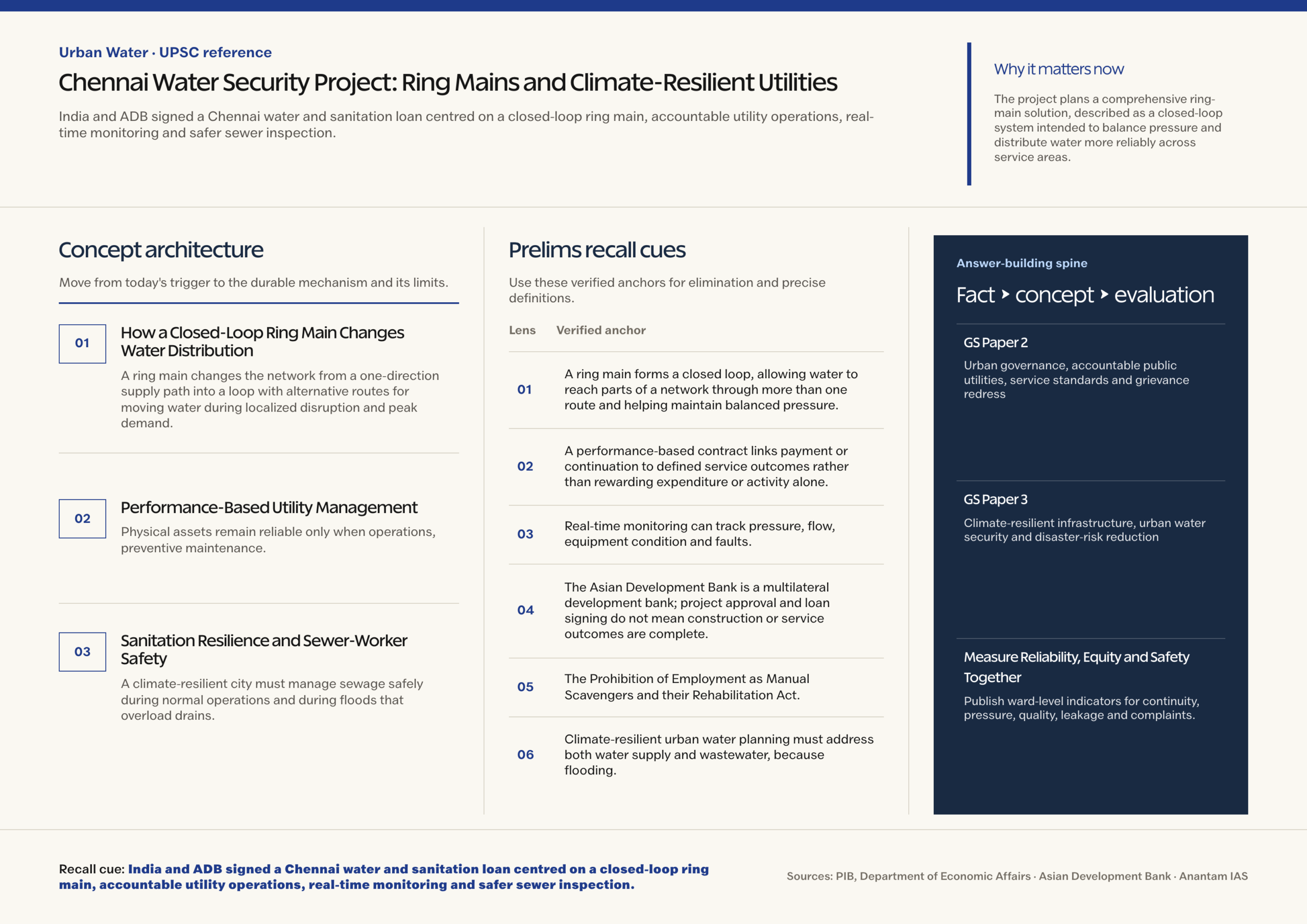
Background and Context
How a Closed-Loop Ring Main Changes Water Distribution
A ring main changes the network from a one-direction supply path into a loop with alternative routes for moving water during localized disruption and peak demand.
- In a branched network, a break or pumping failure can isolate everything downstream; a closed loop can reroute supply from another direction when valves, pumps and spare network capacity permit.
- Feeding an area from multiple directions can reduce extreme pressure differences, supporting more equitable distribution between locations near the source and those at network edges during variable demand.
- Balanced pressure can reduce intermittent stress, bursts and contamination risk, but benefits depend on hydraulic modelling, sound pipes, valve control and connections that actually reach households.
- Redundancy strengthens climate resilience because drought, flooding or localized damage need not disable a single linear route, yet a ring main cannot create water when source availability collapses.
- The Chennai design should be assessed through continuity, pressure, water quality, leakage, repair time and underserved-area coverage, not kilometres built or money disbursed alone.
Performance-Based Utility Management
Physical assets remain reliable only when operations, preventive maintenance, financial stewardship and customer service are managed against transparent outcomes over their full life cycle.
- Performance-based contracts can define indicators such as service continuity, pressure stability, breakdown response, energy efficiency and complaint resolution, shifting attention from spending and activity to verifiable results.
- Real-time sensors can reveal pressure drops, abnormal flow and pump faults earlier, helping operators locate problems, prioritize repairs and reduce the time between failure and response.
- Digital systems do not guarantee accountability: sensor calibration, interoperable records, cybersecurity, audit trails and trained staff determine whether data becomes credible operational evidence for timely decisions.
- Contracts need baselines, independent verification and penalties for distorted reporting; otherwise providers may meet narrow indicators while neglecting water quality, low-income areas or long-term maintenance.
- Public dashboards and grievance systems can connect utility data with lived service, allowing residents and regulators to compare reported performance with actual continuity, quality, affordability and responsiveness.
Sanitation Resilience and Sewer-Worker Safety
A climate-resilient city must manage sewage safely during normal operations and during floods that overload drains, pumps and treatment systems while increasing human exposure.
- Upgraded sewer pumping and blockage detection can reduce overflow risk, but the full chain includes collection, pumping, treatment, safe discharge, preventive maintenance and emergency bypass planning.
- Floodwater entering sewers can overwhelm capacity, while failed pumps can expose communities to contaminated water; backup power, protected equipment and tested emergency protocols are core public-health safeguards.
- Remote cameras, robotic crawlers and mechanical tools can inspect or clear hazardous spaces without sending workers inside, converting safety from personal bravery and informal practice into engineered risk elimination.
- Technology must not become a licence for unsafe entry. Procurement requires usable equipment, worker consultation, training, maintenance, rescue arrangements and enforceable responsibility across utilities and contractors.
- The exam trap is to treat proposed technology as proof that hazardous work has ended; outcomes require deployment, compliance audits, worker reporting and zero tolerance for coercive exposure.
Way Forward
Measure Reliability, Equity and Safety Together
- Publish ward-level indicators for continuity, pressure, quality, leakage and complaints, with independent checks and clear baselines before works begin.
- Stress-test the ring main and pumping system against drought, flooding, power failure and equipment outages, then maintain alternative routes and backup capacity.
- Tie contractor payments to verified service and safety outcomes while protecting affordability and preventing neglect of difficult or low-income service areas.
- Mechanize sewer inspection, train crews, maintain equipment and create confidential reporting so no worker is pushed into hazardous manual entry.
Conclusion
- Chennai’s project is important because it joins network redundancy, operational accountability, sanitation and worker safety instead of treating urban water security as a pipe-construction exercise measured mainly through physical outputs.
- Its promise remains conditional: a signed loan and planned technology become resilience only when the utility demonstrates reliable, equitable and safe service during ordinary demand, climate shocks and prolonged infrastructure stress.
- In a Mains answer, explain the ring-main mechanism, connect performance contracts to measurable outcomes, and place sewer-worker dignity within infrastructure governance rather than as an afterthought.
UPSC Practice Questions
Prelims MCQ 1
With reference to urban water and sanitation systems, consider the following statements:
- A ring-main network can provide alternative supply routes within a closed loop.
- Performance-based contracts link utility management to defined outcomes.
- Approval of a development-bank loan proves that the planned infrastructure has been completed.
How many of the above statements are correct?
(a) Only one (b) Only two (c) All three (d) None
Answer: (b) Only two
Explanation:
Statements 1 and 2 are correct. Loan approval or signing finances a planned project; completion and service outcomes require subsequent implementation and verification.
Prelims MCQ 2
Which one of the following best explains why a closed-loop ring main can improve urban water resilience?
(a) It creates a new raw-water source during drought (b) It removes the need for pumping and valves (c) It allows alternative flow paths and can support balanced pressure (d) It automatically treats wastewater within supply pipes
Answer: (c) It allows alternative flow paths and can support balanced pressure
Explanation:
A ring main provides network redundancy and can improve pressure distribution. It does not create water, eliminate operational controls or treat wastewater.
UPSC Mains Questions
- Urban water security is as much a governance challenge as an engineering challenge. Discuss with reference to closed-loop networks, utility performance and climate resilience.
- Modern sewerage infrastructure must place worker safety at the centre of service delivery. Examine the role and limits of technology in eliminating hazardous manual sewer work.
Sources: PIB, Department of Economic Affairs and Asian Development Bank.
Frequently Asked Questions
What did India and ADB sign for Chennai?
They signed a $230 million loan for planned water-supply, sewerage and utility reforms, including a ring main, pumping upgrades, digital monitoring and safer sewer-inspection technology.
What is a water-supply ring main?
It is a closed-loop distribution arrangement that can feed service areas from alternative directions, helping balance pressure and maintain supply when one segment is isolated.
Why are performance-based contracts relevant to water utilities?
They connect payment or continuation to measurable outcomes such as continuity, pressure, fault response and customer service, provided baselines and independent verification are credible.
How can technology improve sewer-worker safety?
Remote cameras, robotic inspection and mechanical cleaning can keep workers out of hazardous spaces, but equipment, training, maintenance, rescue systems and legal enforcement remain essential.
Are Chennai’s proposed project outcomes already achieved?
No. The announcement concerns loan signing and planned components. Reliability, equity, climate resilience and safer working conditions must be demonstrated through implementation and verified results.
Source: https://anantamias.com/current-affairs/chennai-climate-resilient-water-adb-loan/
India-UK Defence Industrial Roadmap and Maritime Security Cooperation
Why in News?
The Indian Express reported that India and the United Kingdom reviewed defence-industrial cooperation at the 25th Defence Consultative Group meeting in New Delhi on 21 August 2026.
- The review emphasised research and development under the India-UK Vision 2035 and its ten-year Defence Industrial Roadmap.
- Both sides agreed to expand joint exercises, training and capacity-building exchanges between their armed forces.
- They acknowledged maritime-security cooperation, including the planned Regional Maritime Security Centre of Excellence under the Indo-Pacific Oceans Initiative.
- The meeting reaffirmed mutual security and strategic autonomy, but announced no completed industrial project or operational maritime centre.
- The review connects diplomatic intent with institutions that can monitor industrial, technological and military cooperation over several years.
- Its significance depends on whether roadmaps produce tested capabilities, reliable supply chains and interoperable forces without weakening India’s decision-making autonomy.
- The maritime component addresses non-traditional threats in the Indian Ocean, where surveillance, information-sharing and capacity-building require sustained regional trust.
UPSC Relevance
Prelims Relevance
- The Defence Consultative Group is a bilateral India-UK defence dialogue mechanism; it is not a treaty organisation.
- India and the UK adopted a ten-year Defence Industrial Roadmap within the India-UK Vision 2035 framework.
- The Indo-Pacific Oceans Initiative was launched by India and works through thematic pillars and partnerships.
- The proposed Regional Maritime Security Centre of Excellence is linked to capacity-building on non-traditional maritime threats.
- Military exercises, professional training and industrial co-development are distinct but complementary forms of defence cooperation.
Mains Relevance
GS Paper 2
- India-UK relations, strategic partnerships and India’s approach to the Indo-Pacific
- Strategic autonomy while deepening defence cooperation with major powers
GS Paper 3
- Defence technology, research partnerships, co-development and resilient supply chains
- Maritime security responses to piracy, trafficking, disasters and threats to critical sea lanes
Essay
- Strategic partnerships become credible when shared declarations are converted into accountable institutions and usable public capabilities.
Background and Context
What the Defence Industrial Roadmap Is Designed to Do
The roadmap converts a broad strategic partnership into a monitored programme for industrial and technological cooperation.
- Vision 2035 calls for a joint senior-official mechanism to monitor the roadmap’s implementation and progress, creating accountability beyond occasional summit declarations.
- Its industrial logic favours co-design, co-development and co-production, which can distribute research risk and connect Indian manufacturing with specialised British technology.
- Official priority areas include advanced technologies and complex weapons, where long testing cycles, protected knowledge and dependable certification make institutional continuity essential.
- The Electric Propulsion Capability Partnership concerns maritime propulsion, while Jet Engine Advanced Core Technologies provides another pathway for collaboration in difficult defence-engineering domains.
- A roadmap is not a procurement contract: projects still need agreed requirements, intellectual-property terms, funding, export permissions, production partners and acceptance by the armed forces.
How Military Cooperation Complements Industrial Cooperation
Industrial collaboration gains operational value only when forces can train, communicate and evaluate capabilities together.
- The two sides agreed to expand joint exercises, training and capacity-building, creating opportunities to compare doctrine, logistics and equipment performance under realistic conditions.
- Exercises strengthen interoperability: the ability of forces to coordinate procedures, communications and support without surrendering their separate national command structures.
- Training exchanges can expose capability gaps and user requirements, allowing research programmes to respond to operational problems rather than technology demonstrations alone.
- Regular service-to-service contact supports crisis communication and mutual familiarity, but participation in exercises does not create an automatic obligation to join another country’s conflict.
- For India, the central test is whether cooperation adds capability and resilience while preserving strategic autonomy, diversified partnerships and independent procurement choices.
Maritime Security and the Indo-Pacific Oceans Initiative
The maritime strand focuses on capacity against shared risks rather than a formal alliance or territorial arrangement.
- Vision 2035 proposes a Regional Maritime Security Centre of Excellence under the Indo-Pacific Oceans Initiative to build Indian Ocean capacity and resilience.
- Its stated field is non-traditional maritime security, which includes piracy, trafficking, disaster response, marine pollution and threats to commercial shipping and critical infrastructure.
- A centre of excellence can support doctrine, training, research and shared practices; it should not be confused with a naval base or combined operational command.
- The proposal fits the IPOI’s cooperative approach, which encourages countries to contribute expertise to practical maritime pillars while keeping the initiative open and non-treaty-based.
- Its value will depend on regional participation, credible governance, information-protection rules and programmes that help smaller littoral states without creating dependence or strategic suspicion.
From Framework to Measurable Outcomes
The meeting reviewed direction and expanded intent; it did not establish that promised capabilities are already fielded.
- Implementation should be judged through milestones: approved project definitions, funded research, prototypes, trials, technology absorption, production arrangements and sustained maintenance capacity.
- Co-development fails when technology transfer remains shallow, intellectual-property ownership is unclear, or export-control decisions arrive after firms have committed capital and engineering teams.
- Procurement rules and security vetting must protect sensitive technology while giving firms predictable timelines, fair competition and workable access to testing and certification facilities.
- Supply-chain resilience requires more than assembly: Indian firms need design knowledge, quality systems, skilled suppliers and lifecycle support that can survive political or commercial disruption.
- Parliamentary and public scrutiny should distinguish announcements from delivery, assess costs and opportunity trade-offs, and test whether cooperation strengthens indigenous capability rather than substituting imports.
Way Forward
Convert Commitments into Accountable Delivery
- Publish non-sensitive milestones and periodic progress summaries so roadmap monitoring measures prototypes, trials, production and skills created rather than meetings held.
- Agree project-specific rules for intellectual property, export approvals, cybersecurity, data access and dispute resolution before major research spending begins.
- Link exercises and training feedback to capability development while retaining sovereign operational control and compatibility with India’s diversified defence partnerships.
- Design the maritime centre with regional partners, transparent governance and demand-led training for practical non-traditional threats.
Conclusion
- The Defence Consultative Group matters because it can connect strategy, industry, military learning and maritime capacity through a regular bilateral mechanism rather than isolated announcements.
- In a Mains answer, evaluate success through delivered technology, resilient production and useful regional capacity, while clearly separating a reviewed framework from an operational capability.
UPSC Practice Questions
Prelims MCQ 1
With reference to India-UK defence cooperation, consider the following statements:
- The Defence Consultative Group is a bilateral dialogue mechanism.
- The ten-year Defence Industrial Roadmap forms part of the India-UK Vision 2035 framework.
- The proposed Regional Maritime Security Centre of Excellence is a combined naval command.
How many of the above statements are correct?
(a) Only one (b) Only two (c) All three (d) None
Answer: (b) Only two
Explanation:
Statements 1 and 2 are correct. The proposed centre is intended for capacity-building on non-traditional maritime threats; official documents do not describe it as a combined naval command.
Prelims MCQ 2
Which one of the following best describes interoperability in bilateral military cooperation?
(a) Transfer of national command to a permanent allied headquarters (b) Replacement of domestic procurement by imports from the partner (c) Ability of separate forces to coordinate procedures, communications and support (d) Automatic military assistance whenever either country enters a conflict
Answer: (c) Ability of separate forces to coordinate procedures, communications and support
Explanation:
Interoperability improves coordinated action between separate forces. It does not itself merge command structures or create an automatic alliance obligation.
UPSC Mains Questions
- Defence-industrial cooperation can strengthen strategic autonomy only when it builds domestic design and lifecycle capabilities. Discuss with reference to the India-UK Defence Industrial Roadmap.
- How can India use minilateral and bilateral maritime partnerships to address non-traditional threats in the Indian Ocean without creating rigid alliance structures?
Sources: The Indian Express and UK Government, India-UK Vision 2035.
Frequently Asked Questions
What happened at the 25th India-UK Defence Consultative Group meeting?
India and the UK reviewed defence-industrial cooperation, emphasised research under Vision 2035 and the ten-year roadmap, and agreed to expand exercises, training and maritime-security capacity-building.
What is the ten-year India-UK Defence Industrial Roadmap?
It is a bilateral framework for monitored defence-industry cooperation, including research, advanced technology and potential co-development. It does not by itself constitute a procurement contract or completed project.
What is the proposed Regional Maritime Security Centre of Excellence?
Vision 2035 proposes it under the Indo-Pacific Oceans Initiative to build capacity and resilience against non-traditional maritime threats. It should not be treated as already operational.
Does deeper India-UK defence cooperation create a military alliance?
No automatic alliance obligation was announced. The cooperation covers industry, research, exercises and training, while the meeting explicitly reaffirmed mutual security and strategic autonomy.
How should UPSC aspirants evaluate this roadmap?
Assess whether it delivers co-developed technology, production skills, supply-chain resilience and useful maritime capacity, while managing intellectual property, export controls, costs and strategic dependence.
Source: https://anantamias.com/current-affairs/india-uk-defence-industrial-roadmap-review/
IPMDA: Securing Unimpeded Trade in the Indo-Pacific
Why in News?
Amid growing threats to maritime trade, the Quad is strengthening the Indo-Pacific Partnership for Maritime Domain Awareness (IPMDA) and has launched the Indo-Pacific Maritime Surveillance Collaboration (IPMSC) to improve coordinated surveillance across the region.
| UPSC Relevance: GS-2 International Relations: Major groupings; GS-3 Intenal Security: Maritime Security Prelims: Indo-Pacific Partnership for Maritime Domain Awareness Mains: Quad (Initiatives), India’s role in the Indo-Pacific, Maritime Security |
Why is Maritime Domain Awareness Important?
The Indo-Pacific contains critical sea lanes and chokepoints such as the Straits of Malacca, Hormuz, Bab-el-Mandeb, Sunda and Lombok. Disruption in these waterways can affect global energy supplies, container traffic and commodity prices.
However, maritime trade faces multiple threats:
- Dark shipping: Vessels switch off or manipulate their Automatic Identification System (AIS) to conceal their identity or movement.
- Illegal, unreported and unregulated fishing: It depletes marine resources and threatens the food security of littoral states.
- Grey-zone activities: State-backed actors employ coercive tactics below the threshold of conventional warfare.
- Transnational crimes: Smuggling, piracy, trafficking and unauthorised ship-to-ship transfers.
- Environmental risks: Oil spills and unsafe shipping practices may go undetected.
What is IPMDA?
- Indo-Pacific Partnership for Maritime Domain Awareness (IPMDA) was launched by the Quad: India, Australia, Japan and the US in 2022.
- IPMDA seeks to provide partner countries with a shared, near-real-time picture of maritime activity.
- It integrates information from:
- AIS and coastal-radar networks
- Commercial satellites and radio-frequency detection
- Synthetic Aperture Radar and satellite imagery; and
- National and regional maritime information-fusion centres.
Thus, IPMDA enables countries to identify anomalous vessel behaviour even beyond the effective reach of their national surveillance systems.
IPMSC: Operationalising Maritime Cooperation:
- At the Quad Foreign Ministers’ Meeting in New Delhi in 2026, the members launched the Indo-Pacific Maritime Surveillance Collaboration (IPMSC).
- It will complement IPMDA by coordinating Quad surveillance capabilities, initially in the Indian Ocean, and developing an enhanced common picture of vessel movements.
India’s Information Fusion Centre-Indian Ocean Region (IFC-IOR) at Gurugram can serve as an important regional hub.
In 2025, the US approved a possible $131-million Foreign Military Sale of SeaVision software and associated support to India (presently an approval, no confirmation of a completed purchase).
Significance for India:
- Protects India’s trade and energy lifelines.
- Enhances monitoring of the Indian Ocean Region.
- Strengthens capacity against illegal fishing and maritime terrorism.
- Assists smaller partners such as the Maldives, Sri Lanka, Seychelles and Bangladesh.
- Reinforces India’s role as a net security provider without creating a formal military alliance.
Challenges and Way Forward:
- IPMDA must address concerns over data sovereignty, cybersecurity, uneven surveillance capacity and the reluctance of some countries to share sensitive information.
- Quad countries should establish interoperable protocols, expand capacity-building for ASEAN and island states, and ensure that information leads to timely enforcement.
In an era of contested sea lanes, freedom of navigation cannot be preserved by naval power alone. By converting maritime transparency into deterrence, IPMDA and IPMSC can provide a cooperative and rules-based foundation for secure and unimpeded trade.
Source: https://anantamias.com/current-affairs/ipmda-securing-unimpeded-trade-in-the-indo-pacific/
Ensuring Equity amid India’s Educational Progress
Why in News?
The Unified District Information System for Education Plus (UDISE+) 2025-26 records improvements in enrolment, retention, teacher availability and school infrastructure. However, wide regional and social disparities show that expansion of schooling has not yet ensured equal access to quality education.
| UPSC Relevance: GS-2 Social Justice: Education, Human Resource Development Prelims: UDISE+, Key trends (Gross Enrolment Ratio, Pupil-Teacher Ratio) Mains: Educational equity, implementation of NEP 2020, inclusive development. |
What is UDISE+?
- UDISE+ is the Ministry of Education’s annual school-level information system.
- It collects data on enrolment, teachers, infrastructure and student progression from recognised schools and supports evidence-based planning under schemes such as Samagra Shiksha.
- The 2025-26 report covers approximately 14.7 lakh schools, 24 crore students and 1.02 crore teachers. The report shows that educational inequality persists across accessibility, infrastructure, teacher availability, digital resources, and social inclusion.
Major Improvements:
- The number of teachers crossed 1.02 crore for the first time.
- Secondary-level Gross Enrolment Ratio (GER) increased from 68.5% in 2024-25 to 71.7% in 2025-26.
- Secondary dropout declined from 8.2% to 7%.
- Retention at the secondary stage improved from 47.2% to 51.9%.
- Access to basic facilities such as electricity, drinking water and toilets has expanded.
Persistent Dimensions of Inequality:
- Regional divide: Bihar has low enrolment and high dropout at several stages, while remote, tribal, hilly and border regions continue to face inadequate schools and transport.
- Unequal teacher deployment: High secondary-level PTR in States such as Jharkhand and Uttar Pradesh coexists with very low ratios in smaller States and Union Territories. Thus, the national increase in teachers does not necessarily ensure their equitable distribution.
- Social disadvantage: SCs, STs, minorities, migrant children and economically weaker families face overlapping barriers involving poverty, discrimination, language and geographical isolation.
- Secondary-stage bottleneck: While access at the elementary level has expanded, transition and retention weaken considerably at the secondary stage, particularly among girls and disadvantaged groups.
- Disability exclusion: Many schools still lack ramps, accessible toilets, learning aids, special educators and inclusive pedagogy.
- Digital divide: Unequal access to devices, electricity, internet connectivity and digital literacy produces unequal learning opportunities.
- Access-quality gap: UDISE+ primarily measures administrative inputs and participation; it does not directly measure whether children acquire foundational literacy, numeracy and higher-order skills.
- Data exclusion: Aadhaar seeding can improve record accuracy, but it should not become a condition for admission or educational entitlements.
Way Forward:
- Use district-level indicators to provide need-based rather than uniform funding.
- Rationalise teacher deployment while providing incentives, housing and training for service in remote areas.
- Strengthen scholarships, transport, hostels, school meals and conditional support for vulnerable students.
- Implement the Gender Inclusion Fund and Special Education Zones envisaged under NEP 2020.
- Ensure universal disability-friendly and digitally accessible infrastructure.
- Integrate UDISE+ data with independent assessments of learning outcomes while protecting children’s privacy.
- Improve coordination between the Union, States and local governments, consistent with education’s position in the Concurrent List.
Article 21A, Article 46, NEP 2020 and SDG-4 require more than universal enrolment. India must shift from counting children in schools to ensuring that every child, irrespective of identity or location, can attend, learn and complete quality schooling.
Source: https://anantamias.com/current-affairs/ensuring-equity-amid-indias-educational-progress/
Noise Pollution: Patna High Court Order
Why in News?
In Surendra Prasad v. State of Bihar, the Patna High Court issued State-wide directions to control noise from DJs, loudspeakers and pressure horns. It ordered proactive enforcement, registration of sound-system operators and cessation of amplified sound by 9:55 p.m., ahead of the statutory 10 p.m. limit.
| UPSC Relevance: GS-2 Polity and Governance: Fundamental rights; GS-3 Environment: Pollution and urbanisation Prelims: Noise Pollution Rules, Decibel limits Mains: Environmental governance and public health |
Noise Pollution and its Impact:
- Noise pollution refers to unwanted or excessive sound that adversely affects human health and environmental quality.
- Under the Air (Prevention and Control of Pollution) Act, 1981, noise is recognised as an air pollutant.
- The World Health Organisation (WHO) links prolonged exposure to excessive noise with:
Legal Framework:
- The Noise Pollution (Regulation and Control) Rules, 2000, framed under the Environment (Protection) Act, 1986, prescribe the following ambient noise limits:
- Industrial areas: 75 dB during the day and 70 dB at night
- Commercial areas: 65 dB during the day and 55 dB at night
- Residential areas: 55 dB during the day and 45 dB at night
- Silence zones: 50 dB during the day and 40 dB at night
- Written permission is required for using loudspeakers or public-address systems.
- Their use is generally prohibited between 10 p.m. and 6 a.m.
- States may permit their use until midnight on cultural or religious occasions for a maximum of 15 days in a calendar year.
- An area of at least 100 metres around hospitals, courts and educational institutions may be declared a silence zone.
Constitutional Dimension:
- The Supreme Court of India in the landmark judgment (In Re: Noise Pollution 2005), held that nobody has a fundamental right to create amplified noise. Freedom of expression under Article 19(1)(a) and religious freedom under Article 25 cannot override another person’s right to health, sleep and a peaceful environment under Article 21.
- Noise control also advances Article 47 (improvement of public health) and the environmental duties under Articles 48A and 51A(g).
Why does Enforcement Remain Weak?
- Complaint-driven policing: Authorities often act only after citizens file complaints, thereby exposing complainants to social pressure.
- Institutional fragmentation: Responsibility is divided among pollution-control boards, police, district administrations and local bodies.
- Political and cultural pressures: Governments hesitate to regulate weddings, festivals, religious events and election campaigns.
- Monitoring deficit: Many cities lack adequate calibrated sound meters, continuous monitoring stations and noise maps.
- Selective enforcement: Sporadic action creates perceptions of discrimination against particular groups or events.
- Urbanisation: Traffic, construction, generators and mixed land use create continuous background noise beyond occasional loudspeakers.
Way Forward:
- Shift from complaint-based action to routine, suo motu enforcement.
- Create unified digital permits and mandatory registration for DJs, event venues and loudspeaker operators.
- Install real-time noise monitors and public display boards in identified hotspots.
- Introduce graded penalties, equipment seizure and liability of event organisers for repeated violations.
- Prepare city-level noise maps and integrate them with transport, zoning and building regulations.
- Protect complainants’ identities and provide time-bound response through emergency helplines.
- Publish ward-wise violation and enforcement data to prevent selective action.
- Apply restrictions uniformly across religious, political, commercial and private events.
Judicial intervention may temporarily compensate for administrative failure, but courts cannot remain permanent noise regulators. India needs predictable, technologically enabled and non-discriminatory enforcement that balances cultural expression with every citizen’s right to a peaceful and healthy life.
Source: https://anantamias.com/current-affairs/noise-pollution-patna-high-court-order/
Facial Recognition at Protests: Security versus Civil Liberties
Why in News?
The Delhi Police informed the Supreme Court that facial-recognition systems, AI-enabled cameras, surveillance vehicles, drones and smart spectacles were deployed during the Cockroach Janta Party protest at Jantar Mantar. The incident has renewed concerns over biometric mass surveillance in the absence of a dedicated regulatory framework.
| UPSC Relevance: GS-2 Polity and Governance: Fundamental rights; GS-3: Internal Security: AI and Internal Security Prelims: Facial Recognition Technology, AFRS, DPDP Act, Proportionality test Mains: Technology-mediated surveillance versus privacy and democratic freedoms |
What is Facial Recognition Technology?
- Facial Recognition Technology (FRT) uses algorithms to extract biometric features from an image and compare them against faces stored in a database.
- It can assist law-enforcement agencies in:
- Identifying wanted persons and repeat offenders;
- Tracing missing persons and unidentified bodies;
- Securing sensitive installations and large gatherings; and
- Accelerating investigation and verification.
- The proposed Automated Facial Recognition System (AFRS) of the National Crime Records Bureau seeks to provide police agencies with a searchable facial image database.
Constitutional and Democratic Concerns:
- Right to Privacy: Biometric identification affects informational privacy protected under Article 21, as recognised in K.S. Puttaswamy v. Union of India.
- Chilling effect: Fear of being identified, profiled or subsequently targeted may discourage citizens from exercising freedom of speech and peaceful assembly under Articles 19(1)(a) and 19(1)(b).
- Indiscriminate capture: Unlike targeted surveillance, real-time FRT initially scans everyone within a camera’s range, including persons unconnected with any offence.
- Equality concerns: Unequal error rates across gender, age and demographic groups may produce false positives, arbitrary questioning and discrimination under Article 14.
- Function creep: Data collected for crowd security could later be used for political profiling or unrelated investigations.
- Private-contractor access: Vendor-managed systems raise questions regarding data ownership, storage, sharing, cybersecurity and accountability.
- Opacity: Citizens may not know the source of watchlists, accuracy thresholds, retention periods or mechanisms for challenging an incorrect match.
Gaps in the Legal Framework:
India has no dedicated legislation regulating police use of FRT.
- The Criminal Procedure (Identification) Act, 2022 permits collection of specified measurements from particular categories of persons, but does not clearly authorise indiscriminate scanning of peaceful assemblies.
- The Digital Personal Data Protection Act, 2023 provides general data-protection principles but permits exemptions for certain state and law-enforcement purposes and does not specifically regulate biometric profiling or automated decision-making.
Under the Puttaswamy doctrine, state surveillance must satisfy:
- Legality: existence of a valid law
- Legitimate state objective
- Necessity: absence of an equally effective, less intrusive alternative
- Proportionality between the objective and rights restricted; and
- Procedural safeguards against abuse.
Way Forward:
- Enact a comprehensive surveillance law covering biometric identification.
- Require prior judicial or independent authorisation for real-time mass identification.
- Restrict watchlists to clearly defined categories and verified databases.
- Mandate human verification before coercive action based on an algorithmic match.
- Conduct independent accuracy, bias and cybersecurity audits.
- Prescribe purpose limitation, minimal collection and time-bound deletion.
- Disclose government-vendor data-processing agreements and fix accountability for breaches.
- Establish notice, grievance-redress and compensation mechanisms.
- Prohibit indiscriminate FRT deployment at peaceful political gatherings until adequate safeguards exist.
FRT may strengthen targeted law enforcement, but converting every protest site into a biometric checkpoint threatens democratic participation. India needs a rights-based framework that permits narrowly tailored surveillance while ensuring that technological efficiency does not displace constitutional liberty.
Centre notifies Mobile Phone Manufacturing Scheme
Why in News?
The Ministry of Electronics and Information Technology has notified the Mobile Phone Manufacturing Scheme (MPMS) with an outlay of ₹62,500 crore. It succeeds the Production Linked Incentive Scheme for Large-Scale Electronics Manufacturing, which operated from 2020 to March 2026.
| UPSC Relevance: GS-3 Economy: Industrial policy, electronics manufacturing Prelims: Mobile Phone Manufacturing Scheme, PLI Scheme Mains: Manufacturing-led growth, global value chains and technological self-reliance |
India has emerged as the world’s second-largest mobile phone manufacturer by volume, with 99.2% of phones used domestically now manufactured in India. Smartphones also became India’s largest exported product category in 2025.
However, India’s participation remains concentrated in assembly, while high-value components, product design, operating technologies and intellectual property are often controlled overseas. The MPMS seeks to move India from “Make in India” towards “Design and Innovate in India.”
Key Features:
- The scheme will operate for five years, from 2026-27 to 2030-31, under two segments:
- Large-scale manufacturing: Mobile manufacturers and Electronics Manufacturing Services companies will receive differentiated incentives ranging from 2.25% to 5% on eligible incremental sales. Applicants require a minimum turnover of ₹10,000 crore in 2025-26.
- Indian mobile brands: Eligible Indian brands will receive a uniform 5% incentive and may be allowed a one-year gestation period. They require a minimum turnover of ₹1,000 crore but face no minimum annual sales threshold.
- To qualify as an Indian brand, the company must be incorporated in India, have over 51% Indian citizen ownership, Indian management control, a locally held trademark and intellectual property, and in-house design and R&D capabilities.
- Indian brands can receive an additional 3% incentive for domestic design and R&D. Both segments are eligible for an additional incentive of up to 1.5% for sourcing key components domestically, provided localisation covers at least 25% of the phones manufactured during the year.
- The scheme targets approximately ₹39 lakh crore in cumulative production, ₹15 lakh crore in exports and 60,000 direct jobs.
Significance:
- Deeper value addition: It seeks to increase domestic value addition from the present 18-23% to around 35-40%.
- Technological sovereignty: Indian ownership of product designs, patents and brands can help retain a greater share of profits within the country.
- Export competitiveness: It strengthens India’s position as an alternative manufacturing base under the “China-plus-one” strategy.
- Employment and skills: Electronics manufacturing can generate large-scale jobs, including for women, while developing engineering and design capabilities.
- Spillover benefits: Mobile-phone capabilities can support laptops, drones, medical devices, automobiles, wearables and other electronics industries.
- Supply-chain resilience: Domestic components can reduce vulnerability to geopolitical disruptions and import concentration.
Associated Challenges:
- Assembly trap: Incentives may expand output without creating capabilities in semiconductors, displays, sensors, production equipment and core technologies.
- High entry thresholds: Turnover requirements may favour large companies and exclude innovative start-ups and MSME suppliers.
- Foreign-brand dominance: Since the scheme’s corpus is fungible and not separately earmarked for Indian brands, established global firms may capture a large share.
- Verification problem: Authorities must prevent overseas-designed or rebranded products from claiming Indian design and IP incentives.
- Subsidy dependence: Firms must remain globally competitive after the five-year incentive period.
- Fiscal and WTO concerns: Local sourcing incentives must be transparently administered and designed consistently with India’s international trade commitments.
- Environmental costs: Rising production and consumption may aggravate e-waste, resource extraction and carbon emissions.
Way Forward:
- India should complement MPMS with semiconductor manufacturing, component clusters, testing facilities, affordable finance and industry-academia R&D.
- MSMEs should be integrated through vendor-development programmes, while incentives must be linked to measurable domestic value addition, patents, skilled employment and exports.
- Mandatory repairability, recycling and extended producer responsibility should make the ecosystem circular.
MPMS represents a necessary shift from production scale to indigenous value creation. Its success should be measured not merely by the number of phones assembled, but by whether India develops globally competitive brands, owns critical technologies and captures a larger share of the electronics value chain.
Source: https://anantamias.com/current-affairs/centre-notifies-mobile-phone-manufacturing-scheme/
NGT seeks Centre’s response on change in Floodplain Rules
Why in News?
The National Green Tribunal (NGT) has sought the Centre’s response to a petition challenging the River Ganga (Rejuvenation, Protection and Management) Authorities (Second Amendment) Order, 2026.
The amendment removes the general description of the Ganga’s floodplains as a “construction-free zone” and introduces risk-based floodplain categories. The NGT has not stayed the amendment.
| UPSC Relevance: GS-3 Environment and Disaster Management: River conservation, floods and urban planning Mains: Floodplain regulation, climate resilience and sustainable river-basin management |
What is a Floodplain?
A floodplain is the low-lying area adjoining a river that becomes inundated when water exceeds the channel’s carrying capacity. Floodplains:
- Temporarily store excess floodwater
- Recharge groundwater and maintain base flows
- Trap sediment and pollutants
- Sustain wetlands, fisheries and biodiversity; and
- Reduce downstream flood peaks.
Consequently, construction on floodplains converts a natural “sponge” into an impermeable surface, increasing flood damage and transferring risk downstream.
What has Changed?
The 2016 Order broadly defined the Ganga floodplain with reference to the one-in-100-year flood and described riverbanks and floodplains as construction-free zones.
The 2026 amendment introduces three categories:
- Active Floodplain: Area inundated by a flood corresponding to a one-in-five-year return period.
- Regulatory Zone: Area inundated by floods with return periods ranging from five to 25 years.
- Warning Zone: Area inundated by floods with return periods ranging from 25 to 100 years.
A “one-in-100-year flood” does not mean that it occurs only once every century; it signifies an approximately 1% probability of occurrence in any given year.
The specific prohibition on structures in the river, its banks, tributaries and active floodplain remains. However, the amended notification does not clearly specify the nature of construction restrictions in the newly created regulatory and warning zones, producing legal ambiguity.
Arguments Supporting Graded Zoning:
- Provides scientifically differentiated regulation according to the intensity and frequency of flood risk.
- Clarifies the previously undefined concept of an “active floodplain”.
- May be more enforceable than a blanket prohibition across a densely settled river basin.
- Enables essential infrastructure and existing settlements to be managed through flood-proofing and conditional permissions.
- Broadly follows the risk zonation approach used in flood management planning.
Major Concerns:
- Dilution of protection: Restricting the active floodplain to the five-year flood line may expose the wider 100-year belt to construction pressures.
- Climate non-stationarity: Climate change and extreme rainfall are making historical flood-return periods less reliable.
- Discretionary approvals: Replacing a clear prohibition with conditional regulation can encourage regulatory capture and piecemeal encroachment.
- Cumulative impacts: Individual projects may appear safe while collectively reducing flood storage and groundwater recharge capacity.
- Conflict with precedent: In 2017, the NGT declared a 100-metre belt along the Ganga between Haridwar and Unnao a no-development zone.
- Disaster-risk transfer: Construction creates long-term public liabilities through recurrent relief, compensation and protective infrastructure.
- Social justice: Floodplain residents, informal settlements and downstream communities often bear the consequences of development permitted elsewhere.
Legal and Governance Dimensions:
- Floodplain protection is supported by Article 21, Articles 48A and 51A(g), the public-trust doctrine, precautionary principle and intergenerational equity. Under Section 20 of the NGT Act, the Tribunal must apply sustainable development, precaution and polluter pays principles.
- Governance remains fragmented because river conservation involves the NMCG and the Union government, while land use, local planning and floodplain zoning substantially depend on States and urban local bodies. The limited adoption of the Model Flood Plain Zoning Bill, 1975 illustrates this federal implementation gap.
Way Forward:
- Publish scientific justification and invite public consultation before altering ecological safeguards.
- Use updated climate projections, satellite imagery and basin-wide hydrological modelling.
- Explicitly list prohibited, conditional and permissible activities in each zone.
- Prohibit housing, industries and permanent critical infrastructure in high-risk areas.
- Subject projects to cumulative-impact and disaster-risk assessments.
- Make floodplain maps legally binding and publicly accessible.
- Restore wetlands and compensate landowners through conservation easements or transferable development rights.
- Establish an independent, basin-level authority to coordinate Union, State and local agencies.
Graded floodplain zoning can improve risk-sensitive planning, but only if it strengthens rather than weakens the river’s right to space. Development must adapt to the Ganga’s natural hydrology instead of compelling the river to conform to construction boundaries.
Source: https://anantamias.com/current-affairs/ngt-seeks-centres-response-on-change-in-floodplain-rules/
Centre may add subsidy scheme to make Polysilicon
Why in News?
The Ministry of New and Renewable Energy (MNRE) is considering a subsidy scheme to establish at least 30 GW of domestic polysilicon manufacturing capacity by 2030.
An integrated polysilicon and metallurgical-grade silicon facility is estimated to require approximately ₹850 crore per GW, implying an investment of around ₹25,500 crore.
| UPSC Relevance: GS-3 Economy: Industrial policy, Manufacturing sector Prelims: Polysilicon, solar-PV value chain, ALMM and PLI Scheme Mains: Renewable-energy self-reliance, green industrialisation and supply-chain resilience |
What is Polysilicon?
- Polysilicon is an ultra-pure form of silicon, and a critical raw material for most crystalline-silicon solar panels.
- The solar-manufacturing chain involves: Quartz → metallurgical-grade silicon → polysilicon → ingots → wafers → solar cells → modules
- India has rapidly expanded module-assembly capacity but remains substantially import-dependent for upstream materials such as polysilicon, ingots and wafers. This creates a paradox in which a module may be “made in India” while much of its technological and material value is imported.
Existing Policy Support:
- The government is already implementing the ₹24,000-crore PLI Scheme for High-Efficiency Solar PV Modules, under which around 48 GW of fully or partially integrated manufacturing capacity has been awarded.
- Other measures include:
- Basic customs duty on imported solar cells and modules
- Domestic Content Requirements in government-supported projects
- The Approved List of Models and Manufacturers (ALMM); and
- Extension of ALMM to ingots and wafers from June 2028.
As of March 2026, ALMM-listed capacity had reached around 172 GW for modules and 27 GW for cells. However, listed capacity does not necessarily represent operational production, and the upstream value chain remains comparatively weak.
Significance of Domestic Polysilicon Production:
- Energy security: Reduces dependence on geographically concentrated overseas supply chains.
- Manufacturing resilience: Protects solar deployment from trade restrictions, geopolitical tensions and shipping disruptions.
- Higher value addition: Moves India beyond low-value module assembly towards integrated solar manufacturing.
- Strategic autonomy: Solar equipment is becoming as critical to the energy economy as hydrocarbons were to the fossil-fuel economy.
- Employment and technology: Creates capabilities in high-purity chemicals, precision manufacturing, materials science and industrial automation.
- Export potential: An integrated ecosystem can position India as an alternative solar-manufacturing hub.
- Climate targets: Reliable equipment supply is essential for India’s target of 500 GW non-fossil-fuel capacity by 2030.
Major Challenges:
- Capital intensity: Large upfront investment and long gestation periods may deter private manufacturers.
- Global price competition: Chinese producers possess economies of scale and can supply polysilicon at prices difficult for new Indian plants to match.
- Energy and carbon intensity: Polysilicon purification requires large quantities of reliable electricity. Coal-based production could increase the embedded carbon in Indian solar modules.
- Environmental risks: Manufacturing involves substantial energy, water and hazardous chemicals, requiring strict recycling and pollution-control standards.
- Technology risk: Rapid shifts towards thinner wafers, heterojunction cells, tandem cells and perovskites may change future polysilicon demand.
- Higher solar tariffs: Excessive protection or expensive domestic inputs may increase module prices and slow renewable-energy deployment.
- Demand-offtake mismatch: Around 42 GW of planned renewable capacity reportedly lacks power-sale agreements. Distribution companies increasingly prefer hybrid, storage-backed and round-the-clock power over standalone solar projects.
- Risk of overcapacity: Manufacturing subsidies without corresponding demand, transmission and storage expansion may create underutilised plants.
Way Forward:
- Provide time-bound, declining support linked to actual production, efficiency and domestic value addition.
- Use competitive bidding instead of open-ended capital subsidies.
- Locate plants near renewable-energy hubs and incentivise the use of green electricity.
- Secure long-term offtake without imposing sudden costs on solar developers.
- Develop indigenous manufacturing equipment, skilled personnel and R&D in next-generation cell technologies.
- Enforce water recycling, chemical recovery and carbon-accounting standards.
- Coordinate manufacturing policy with storage, transmission expansion and financially viable DISCOM procurement.
- Promote export diversification so capacity is not dependent solely on domestic demand.
Domestic polysilicon manufacturing can close the weakest link in India’s solar supply chain. However, genuine self-reliance requires competitive and environmentally sustainable production—not merely subsidised capacity on paper.
Source: https://anantamias.com/current-affairs/centre-may-add-subsidy-scheme-to-make-polysilicon/
FDI push: ₹4,896 cr across 29 projects
Why in News?
India has reported 29 proposed FDI investments worth ₹4,895.65 crore under the revised framework permitting limited, non-controlling ownership from countries sharing a land border with India through the automatic route. Among India’s neighbouring countries, China is the largest source of investment.
The proposals cover IT, artificial intelligence, manufacturing, pharmaceuticals, data centres and transport services. Importantly, these are reported investment proposals—not necessarily FDI already received or operationalised.
| UPSC Relevance: GS-3 Economy: Foreign investment, liberalisation Prelims: FDI routes, Press Note 3 |
Background: Press Note 3 of 2020:
- In April 2020, amid concerns that depressed company valuations during the COVID-19 crisis could facilitate opportunistic takeovers, India introduced Press Note 3.
- It required prior government approval for FDI where:
- The investing entity was situated in a country sharing a land border with India; or
- The beneficial owner of the investment was situated in, or was a citizen of, such a country.
- The land-border countries are China, Pakistan, Bangladesh, Nepal, Bhutan, Myanmar and Afghanistan. Though country-neutral in wording, the measure primarily affected Chinese-linked investment because of China’s much larger economic presence.
What has Changed?
Through Press Note 2 of 2026 and the amendment to the Foreign Exchange Management (Non-debt Instruments) Rules, 2019, notified on May 1, 2026:
- An investor entity with up to 10% non-controlling beneficial ownership from land-border countries may invest through the automatic route.
- The investment remains subject to applicable sectoral caps, entry conditions and reporting requirements.
- Prior approval continues to be required where the land-border investor exercises control, even if its numerical ownership is small.
- The beneficial-ownership test is applied at the level of the investor entity.
Thus, the reform does not remove security screening; it distinguishes small portfolio-like exposure from ownership involving effective control.
Significance:
- Regulatory certainty: Earlier, even negligible indirect ownership could trigger government approval and delay transactions.
- Ease of doing business: The automatic route reduces approval time and transaction costs.
- Access to global capital: International funds often have diversified investors, including small Chinese or other land-border-country holdings.
- Technology and manufacturing: Investment can support AI, electronics, pharmaceuticals and other capital- and technology-intensive sectors.
- Supply-chain integration: Indian manufacturing remains linked with Chinese components, machinery and technical expertise.
- Calibrated liberalisation: It replaces a blanket restriction with a risk-based approach while retaining controls over effective ownership.
Associated Concerns:
- Strategic sectors: AI, data centres, telecommunications, fintech and pharmaceuticals involve sensitive data, critical infrastructure and supply security.
- Post-investment changes: Subsequent stake increases or transfer of control may evade scrutiny without continuous monitoring.
- Round-tripping: Complex offshore structures may disguise the origin of domestic or restricted capital.
The reform represents pragmatic de-risking rather than indiscriminate decoupling. India must remain open to productive foreign capital while ensuring that opaque ownership structures do not compromise technological, data or national security.
Source: https://anantamias.com/current-affairs/fdi-push-%e2%82%b94896-cr-across-29-projects/