

Why in News?
India and Brazil signed a telecommunications and ICT cooperation MoU on 21 August 2026 during the BRICS ICT Track Meeting in Pune, following discussions on emerging networks, spectrum governance and digital inclusion.
- The framework covers telecom policy and regulation, artificial intelligence, 5G, 6G, Open RAN and the Internet of Things.
- It also includes direct-to-device connectivity, Low Earth Orbit satellites, non-terrestrial networks, optical fibre and submarine cables.
- Cooperation may extend to spectrum and orbit management, cybersecurity, consumer protection, private networks, digital inclusion and greener ICT systems.
- The MoU provides for exchanges of information, experience and best practices; it does not itself establish a common standard or complete a technology project.
- Telecom systems now link foreign policy, industrial capability and strategic resilience, making standards and trusted infrastructure important fields of bilateral cooperation.
- India and Brazil can use South-South cooperation to compare regulatory approaches and improve connectivity across large territories with difficult last-mile conditions.
- The value of the MoU will depend on specific follow-up projects, responsible institutions, timelines and measurable public benefits.
UPSC Relevance
Prelims Relevance
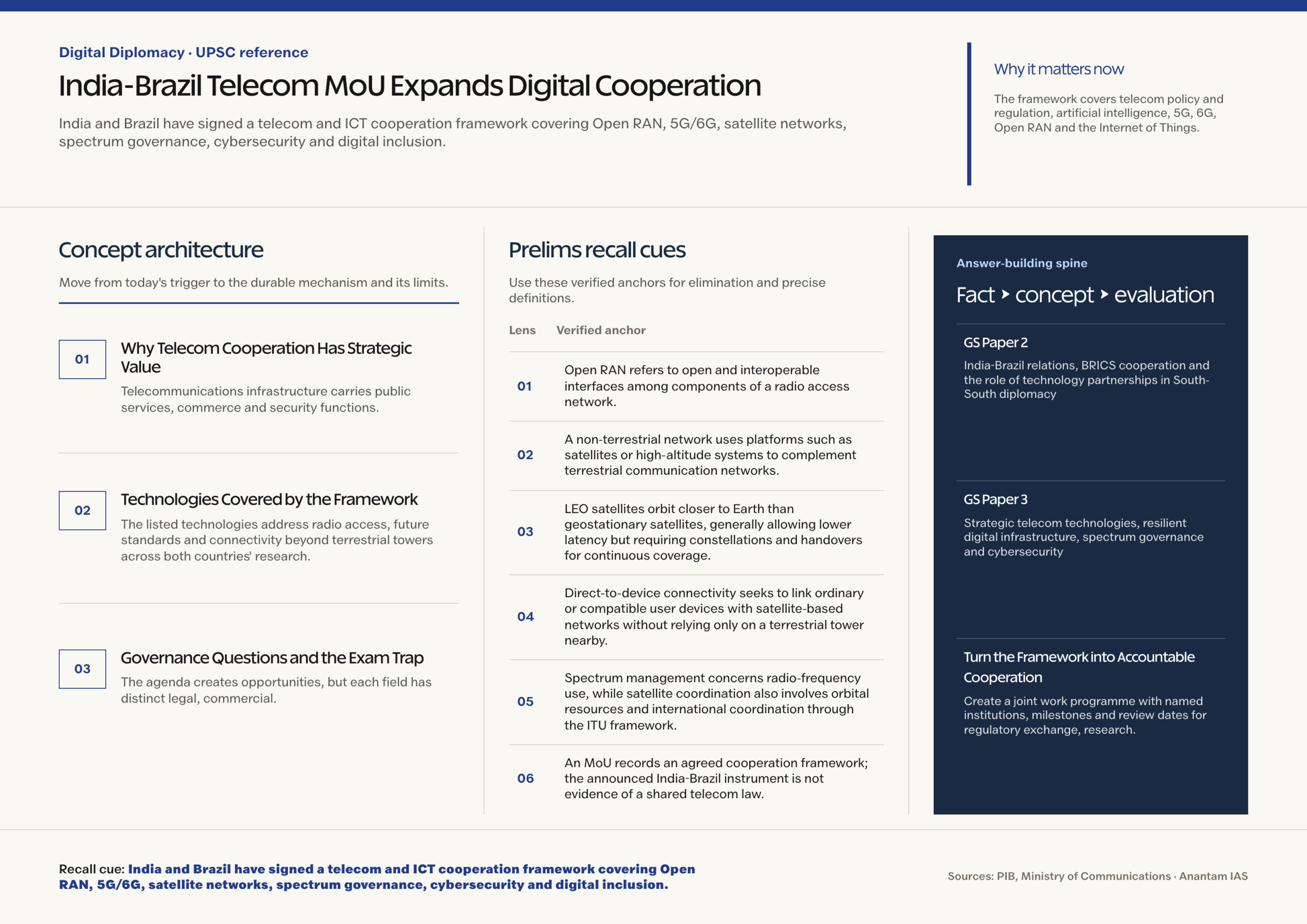
- Open RAN refers to open and interoperable interfaces among components of a radio access network; it does not mean the entire telecom network is open-source.
- A non-terrestrial network uses platforms such as satellites or high-altitude systems to complement terrestrial communication networks.
- LEO satellites orbit closer to Earth than geostationary satellites, generally allowing lower latency but requiring constellations and handovers for continuous coverage.
- Direct-to-device connectivity seeks to link ordinary or compatible user devices with satellite-based networks without relying only on a terrestrial tower nearby.
- Spectrum management concerns radio-frequency use, while satellite coordination also involves orbital resources and international coordination through the ITU framework.
- An MoU records an agreed cooperation framework; the announced India-Brazil instrument is not evidence of a shared telecom law, operating network or completed deployment.
Mains Relevance
GS Paper 2
- India-Brazil relations, BRICS cooperation and the role of technology partnerships in South-South diplomacy
- Balancing bilateral cooperation with transparent institutions, consumer protection and implementation accountability
GS Paper 3
- Strategic telecom technologies, resilient digital infrastructure, spectrum governance and cybersecurity
- Open interfaces, satellite connectivity and digital inclusion as tools for reducing geographic access gaps
Essay
- Digital sovereignty grows through capable institutions and interoperable cooperation, not technological isolation.
Background and Context
Why Telecom Cooperation Has Strategic Value
Telecommunications infrastructure carries public services, commerce and security functions, so bilateral learning can support development and resilience across essential public systems rather than remain sectoral.
- India and Brazil are large federal democracies with extensive rural and remote areas, making universal and meaningful connectivity across dispersed, high-cost and environmentally difficult regions a shared challenge because geographic scale raises deployment and maintenance costs.
- Cooperation can compare how regulators allocate spectrum, protect consumers, encourage competition and maintain service quality under different but sovereign legal systems, including how licence obligations can reach underserved populations.
- Exchange on cybersecurity can help institutions study network resilience, incident response and supply-chain risk, including trusted-vendor assessment, while each country retains responsibility for its security choices.
- Optical fibre, submarine cables and satellite links provide different connectivity layers; resilient systems avoid dependence on a single route or technology and preserve redundancy during disruptions.
- The framework places digital inclusion alongside innovation, reminding policymakers that networks matter only when access is affordable, usable and reliable across income, language, disability and location.
Technologies Covered by the Framework
The listed technologies address radio access, future standards and connectivity beyond terrestrial towers across both countries’ research, regulatory and future commercial deployment ecosystems.
- A radio access network connects user devices to the mobile core; Open RAN promotes specified interfaces between disaggregated functions so different suppliers can interoperate where standards and testing permit.
- Open interfaces may widen vendor choice and innovation, but interoperability, performance, security assurance and lifecycle support remain engineering and regulatory tasks requiring certification and operational accountability.
- 5G and 6G cooperation can include research, standards discussions, trials and policy exchange across public and private institutions; it does not declare a joint network or common standard.
- Non-terrestrial networks use satellites or aerial platforms, while direct-to-device links aim to reach compatible handsets beyond ground infrastructure, including during disasters or in sparsely served areas.
- LEO systems can reduce signal travel time compared with distant geostationary systems, but require multiple moving satellites, complex handovers, ground systems, constellation control and coordinated spectrum use.
Governance Questions and the Exam Trap
The agenda creates opportunities, but each field has distinct legal, commercial, technical and public-interest constraints that diplomatic language cannot settle without detailed implementing arrangements.
- Radio frequencies cross borders and satellite systems can cause harmful interference, making spectrum and orbit coordination through domestic regulators and appropriate international processes essential alongside national authorization.
- Cybersecurity cooperation must coexist with privacy, lawful access, data governance and consumer remedies; stronger security cannot justify opaque surveillance without independent oversight and clear legal safeguards.
- Private networks and IoT can improve industrial operations, yet connected devices expand the attack surface and require secure design, updates and clear accountability throughout their operational life cycles.
- Submarine cables face accidental, environmental and security risks, so route diversity, repair capacity and international coordination must complement resilient domestic landing stations and terrestrial backhaul.
- Treat the agreement as an enabling diplomatic framework. Do not infer a treaty, harmonized regulation, shared spectrum or completed infrastructure, which require later rules, contracts, investment and implementation.
Way Forward
Turn the Framework into Accountable Cooperation
- Create a joint work programme with named institutions, milestones and review dates for regulatory exchange, research, skills and pilot cooperation.
- Use transparent testbeds to assess interoperability, security and performance before scaling Open RAN, IoT or satellite-linked services.
- Build consumer protection, accessibility, privacy and affordability indicators into projects so digital inclusion is measured by meaningful use, not coverage claims alone.
- Coordinate positions in appropriate international forums while preserving evidence-based domestic regulation and avoiding premature technological lock-in.
Conclusion
- The India-Brazil MoU expands bilateral relations from conventional diplomacy into telecom regulation, emerging networks, cybersecurity and inclusion within BRICS and a more plural digital order.
- Its significance lies in enabling concrete joint work; success must be judged by secure interoperability, accountable follow-up and wider meaningful connectivity for underserved communities, not the signing ceremony.
- In a Mains answer, connect the framework to South-South cooperation and digital sovereignty, distinguish collaboration from implementation, and assess regulatory capacity, cybersecurity and consumer rights before recommending scale-up.
UPSC Practice Questions
Prelims MCQ 1
With reference to emerging telecommunications systems, consider the following statements:
- Open RAN seeks interoperable interfaces among components of the radio access network.
- Non-terrestrial networks may use satellite or high-altitude platforms.
- Low Earth Orbit satellites remain stationary relative to one point on Earth.
How many of the above statements are correct?
(a) Only one (b) Only two (c) All three (d) None
Answer: (b) Only two
Explanation:
Statements 1 and 2 are correct. LEO satellites move relative to Earth’s surface; remaining fixed over one point is a feature associated with geostationary orbit.
Prelims MCQ 2
The India-Brazil telecommunications and ICT MoU announced in August 2026 is best understood as:
(a) A common telecom law immediately applicable in both countries (b) A completed bilateral satellite constellation (c) A framework for cooperation, exchange and exploration across telecom and ICT fields (d) A treaty allocating radio spectrum between the two countries
Answer: (c) A framework for cooperation, exchange and exploration across telecom and ICT fields
Explanation:
The official release describes a bilateral framework for information, experience and best-practice exchange across listed fields. It does not announce common law, spectrum allocation or a completed network.
UPSC Mains Questions
- India-Brazil digital cooperation illustrates the growing strategic role of telecommunications in South-South relations. Discuss the opportunities and implementation challenges.
- Explain how Open RAN and non-terrestrial networks may support connectivity while creating new regulatory, cybersecurity and consumer-protection questions.
Source: PIB, Ministry of Communications.
Frequently Asked Questions
What did India and Brazil sign in August 2026?
They signed an MoU creating a cooperation framework for telecommunications and ICT, including policy exchange, emerging networks, digital infrastructure, cybersecurity, inclusion and capacity building.
What is Open RAN?
Open RAN promotes specified, interoperable interfaces among radio access network components, potentially allowing greater supplier flexibility while still requiring rigorous integration, security and performance testing.
What are non-terrestrial networks?
They are communication networks that use platforms beyond conventional ground towers, including satellites or high-altitude systems, to complement terrestrial coverage and improve reach.
Does the MoU create a common India-Brazil telecom standard?
No. The announcement establishes cooperation and exchange across listed areas; it does not by itself create harmonized regulation, allocate shared spectrum or establish a common technical standard.
Why is spectrum management part of international cooperation?
Radio signals and satellite operations can affect users across borders, so interference avoidance, compatible use and orbit-related coordination require domestic regulation plus international engagement.
Tell Google you want more of this.
Add Anantam IAS as a preferred sourceOne tap, and this site shows up more often in your own Top Stories, AI Overviews and AI Mode. Remove it any time.






