

Why in News?
On August 21, 2026, the Supreme Court retained prior legal practice for entry-level judicial service but reduced the May 2025 requirement from three years to one.
- A 2:1 majority kept practical Bar exposure as an eligibility condition while redesigning the transition from advocate to Civil Judge (Junior Division).
- The new one-year practice rule will operate prospectively from April 1, 2027, giving recruiting authorities time to align rules and certification.
- Selected candidates will complete one year at a State judicial academy, followed by a structured year of law clerkship before regular appointment.
- The clerkship divides six months with a District and Sessions Judge and six months with a sitting High Court judge, followed by a reasoned evaluation.
- The ruling balances two concerns: courtroom readiness at entry and fair access for young graduates who may struggle to sustain prolonged low-paid practice.
- It shifts recruitment from a single experience threshold toward a practice-training-assessment pipeline, making institutional training and supervision central to judicial capacity.
UPSC Relevance
Prelims Relevance
- Article 234 governs recruitment of persons other than district judges to a State’s judicial service.
- The Governor frames appointments under Article 234 after consultation with the State Public Service Commission and the High Court.
- Entry-level recruitment here concerns Civil Judge (Junior Division), not direct recruitment of district judges under Article 233.
- The one-year prior-practice requirement begins on April 1, 2027; transitional applicants receive a separate temporary arrangement.
- The post-selection pathway combines a judicial academy year with a structured clerkship year before regular appointment.
Mains Relevance
GS Paper 2
- Judicial independence, subordinate-court capacity and the constitutional role of High Courts in State judicial-service recruitment.
- Designing merit-based recruitment that combines access, practical competence, training and accountable evaluation.
Essay
- Institutions earn trust when entry standards measure practical judgment without turning social or economic disadvantage into an invisible barrier.
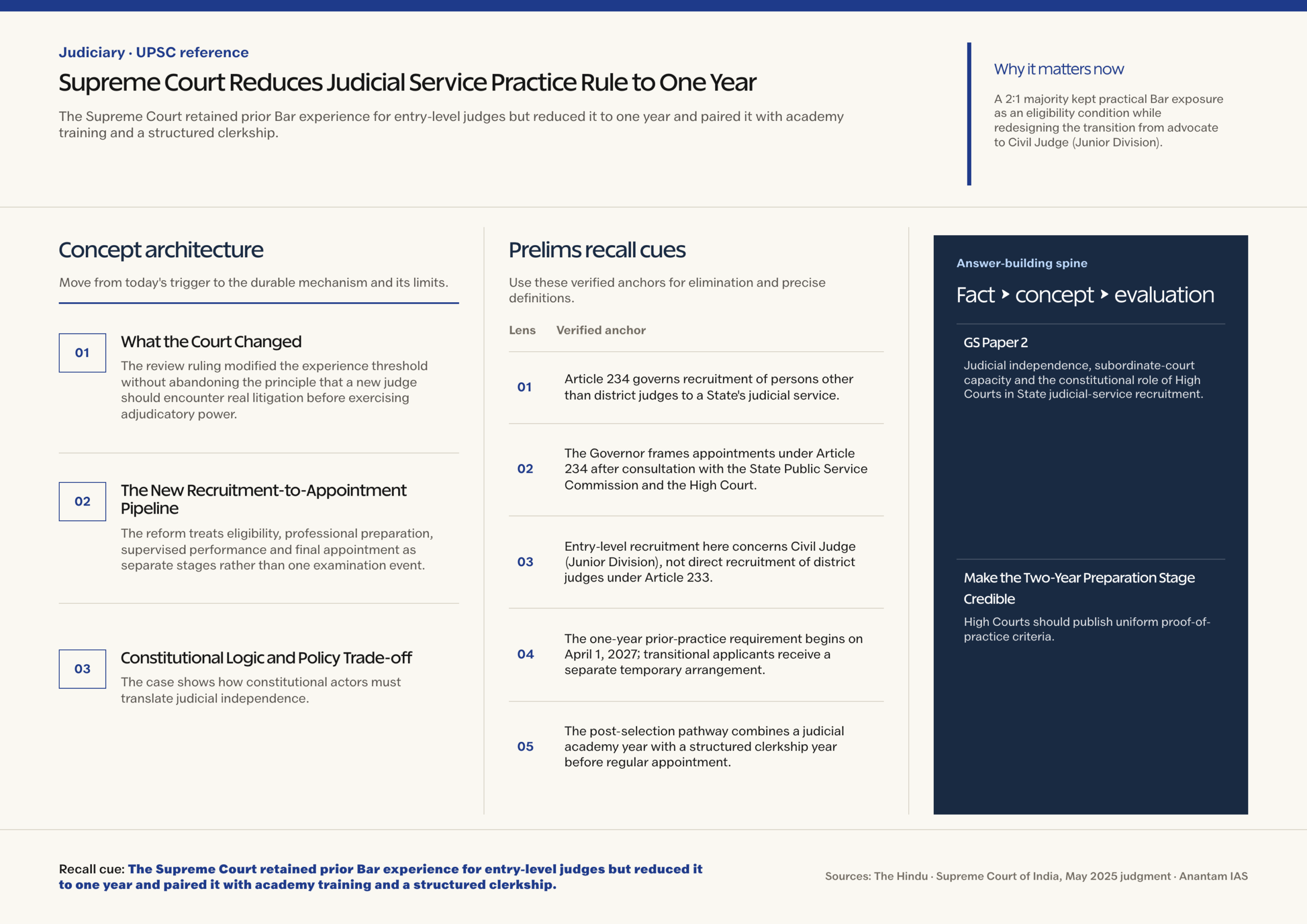
Background and Context
What the Court Changed
The review ruling modified the experience threshold without abandoning the principle that a new judge should encounter real litigation before exercising adjudicatory power.
- The May 2025 judgment had restored three years of practice before eligibility for entry-level judicial service; the majority has reduced that period to one year while preserving experiential learning and reducing exclusionary delay.
- The changed rule applies prospectively from April 1, 2027, avoiding immediate disruption while High Courts and States align recruitment rules without cancelling ongoing selection cycles.
- Candidates applying during the review period are deemed to have completed the required year and need not submit a proof-of-practice certificate, protecting existing recruitment notices and candidate expectations.
- This relief lasts until March 31, 2027; it does not erase certification once the permanent rule begins or create a continuing exemption for applicants after the cut-off date.
- The majority designed the arrangement for a five-year course, after which its effectiveness is to be reviewed using actual experience as evidence accumulates rather than treating the design as final.
The New Recruitment-to-Appointment Pipeline
The reform treats eligibility, professional preparation, supervised performance and final appointment as separate stages rather than one examination event.
- From April 2027, an applicant must show active legal practice through records of presence and participation in effective judicial proceedings, making courtroom engagement more important than nominal enrolment under the new standard.
- Proof may include work alongside a senior Bar member with at least ten years’ practice, connecting certification to observed participation while requiring authorities to verify meaningful exposure across differing practice settings.
- A successful applicant becomes a trainee judicial officer and undertakes one year of intensive instruction at the relevant State judicial academy before supervised and evaluated practical work.
- The next year is a law clerkship: six months under a Principal District or District and Sessions Judge, then six months with a sitting High Court judge across two judicial levels.
- The supervising High Court judge submits a reasoned evaluation; a favourable assessment enables regular appointment with full pay and service benefits, making assessment the final quality checkpoint before confirmation in service.
Constitutional Logic and Policy Trade-off
The case shows how constitutional actors must translate judicial independence, professional competence and equal opportunity into a workable entry system.
- Under Article 234, recruitment below the district-judge level requires consultation among the Governor, State Public Service Commission and High Court, distributing responsibility across executive, recruitment and judicial institutions within a federal structure.
- High Court participation protects judicial standards, while the Public Service Commission contributes an open recruitment process within the State framework; neither role should collapse into unchecked discretion or opaque gatekeeping.
- Prior practice exposes candidates to evidence, procedure, client hardship and courtroom ethics, but a long compulsory period may favour those able to absorb unstable early-career earnings and weak mentorship in poorly regulated chambers.
- Academy training supplies common doctrine and procedure; clerkship adds supervised observation of trial management, judgment craft, institutional ethics and High Court scrutiny before independent adjudication begins in a controlled environment.
- The dissent preferred retaining the May 2025 approach, showing that the disagreement concerned how much pre-entry experience protects competence, not whether practical exposure has value for judging at the judicial threshold.
Way Forward
Make the Two-Year Preparation Stage Credible
- High Courts should publish uniform proof-of-practice criteria, acceptable records and review procedures so certification does not become arbitrary or patronage-driven.
- Judicial academies need assessed modules on evidence, procedure, ethics, court management, legal aid, digital courts and clear judgment writing.
- Clerkship evaluations should use disclosed competency rubrics, multiple observations and a fair opportunity to address an adverse assessment.
- The five-year review should examine recruitment diversity, training outcomes, appointment delays and early-career judicial performance before changing the threshold again.
Conclusion
- The ruling replaces a blunt three-year filter with a one-year practice plus two-year supervised preparation model, preserving courtroom exposure while reducing the entry barrier and embedding performance review before authority is conferred.
- In a Mains answer, evaluate the reform through four tests: constitutional consultation, access to the profession, practical competence and transparent assessment before regular appointment, rather than debating experience duration in isolation.
UPSC Practice Questions
Prelims MCQ 1
With reference to recruitment to the State judicial service, consider the following statements:
- Article 234 concerns recruitment of persons other than district judges to a State’s judicial service.
- Such appointments are made by the Governor after consulting the State Public Service Commission and the High Court.
- Article 233 governs the same entry-level Civil Judge recruitment process.
How many of the above statements are correct?
(a) Only one (b) Only two (c) All three (d) None
Answer: (b) Only two
Explanation:
Statements 1 and 2 correctly describe Article 234. Article 233 deals with appointment, posting and promotion of district judges, not this entry-level recruitment category.
Prelims MCQ 2
Under the Supreme Court’s August 2026 arrangement, which sequence correctly describes preparation after selection for entry-level judicial service?
(a) Two years of independent practice followed by direct appointment (b) One academy year followed by one structured clerkship year (c) One High Court clerkship year followed by a competitive examination (d) District-court practice alone, without academy training
Answer: (b) One academy year followed by one structured clerkship year
Explanation:
Selected candidates first undergo one year of intensive State judicial-academy training and then a structured year of clerkship before consideration for regular appointment.
UPSC Mains Questions
- The Supreme Court’s revised judicial-service entry model combines prior Bar practice with academy training and supervised clerkship. Examine how this design balances competence with equal access.
- Discuss the constitutional roles of the Governor, State Public Service Commission and High Court in recruitment to the subordinate judiciary. Why does process design matter for judicial independence?
Sources: The Hindu and Supreme Court of India, May 2025 judgment.
Frequently Asked Questions
What did the Supreme Court change in August 2026?
A 2:1 majority retained prior Bar experience for entry-level judicial service but reduced the May 2025 requirement from three years to one, effective prospectively from April 1, 2027.
Does one year of practice lead directly to appointment as a Civil Judge?
No. Selection is followed by one year at a State judicial academy and one year of structured clerkship. Regular appointment depends on a favourable reasoned evaluation.
How will active legal practice be proved?
The certificate must rest on records showing presence and participation in effective judicial proceedings, including work with a senior Bar member having at least ten years’ practice.
What happens to candidates caught in the transition?
Applicants covered by the interim arrangement are deemed to have completed one year of practice and need not furnish proof certificates. This temporary protection operates through March 31, 2027.
Which constitutional provision is most relevant for entry-level judicial-service recruitment?
Article 234 covers recruitment below the district-judge level. The Governor acts according to rules made after consulting the State Public Service Commission and the High Court.
Tell Google you want more of this.
Add Anantam IAS as a preferred sourceOne tap, and this site shows up more often in your own Top Stories, AI Overviews and AI Mode. Remove it any time.






