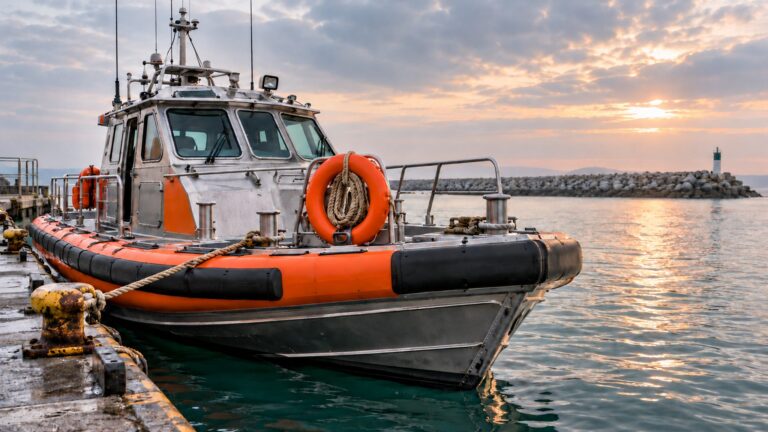
Why in News?
The Indian Express reported that India and the United Kingdom reviewed defence-industrial cooperation at the 25th Defence Consultative Group meeting in New Delhi on 21 August 2026.
- The review emphasised research and development under the India-UK Vision 2035 and its ten-year Defence Industrial Roadmap.
- Both sides agreed to expand joint exercises, training and capacity-building exchanges between their armed forces.
- They acknowledged maritime-security cooperation, including the planned Regional Maritime Security Centre of Excellence under the Indo-Pacific Oceans Initiative.
- The meeting reaffirmed mutual security and strategic autonomy, but announced no completed industrial project or operational maritime centre.
- The review connects diplomatic intent with institutions that can monitor industrial, technological and military cooperation over several years.
- Its significance depends on whether roadmaps produce tested capabilities, reliable supply chains and interoperable forces without weakening India’s decision-making autonomy.
- The maritime component addresses non-traditional threats in the Indian Ocean, where surveillance, information-sharing and capacity-building require sustained regional trust.
UPSC Relevance
Prelims Relevance
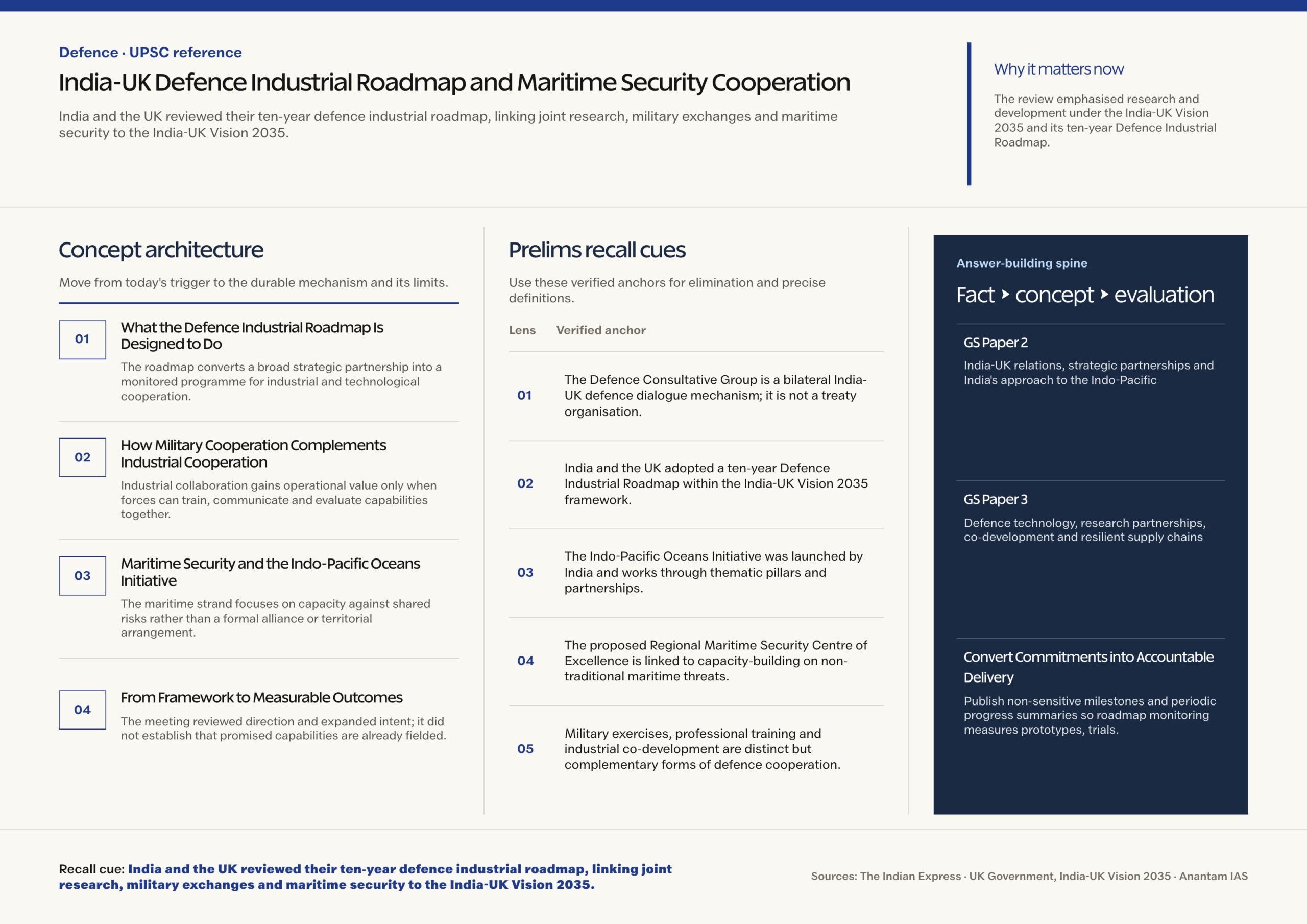
- The Defence Consultative Group is a bilateral India-UK defence dialogue mechanism; it is not a treaty organisation.
- India and the UK adopted a ten-year Defence Industrial Roadmap within the India-UK Vision 2035 framework.
- The Indo-Pacific Oceans Initiative was launched by India and works through thematic pillars and partnerships.
- The proposed Regional Maritime Security Centre of Excellence is linked to capacity-building on non-traditional maritime threats.
- Military exercises, professional training and industrial co-development are distinct but complementary forms of defence cooperation.
Mains Relevance
GS Paper 2
- India-UK relations, strategic partnerships and India’s approach to the Indo-Pacific
- Strategic autonomy while deepening defence cooperation with major powers
GS Paper 3
- Defence technology, research partnerships, co-development and resilient supply chains
- Maritime security responses to piracy, trafficking, disasters and threats to critical sea lanes
Essay
- Strategic partnerships become credible when shared declarations are converted into accountable institutions and usable public capabilities.
Background and Context
What the Defence Industrial Roadmap Is Designed to Do
The roadmap converts a broad strategic partnership into a monitored programme for industrial and technological cooperation.
- Vision 2035 calls for a joint senior-official mechanism to monitor the roadmap’s implementation and progress, creating accountability beyond occasional summit declarations.
- Its industrial logic favours co-design, co-development and co-production, which can distribute research risk and connect Indian manufacturing with specialised British technology.
- Official priority areas include advanced technologies and complex weapons, where long testing cycles, protected knowledge and dependable certification make institutional continuity essential.
- The Electric Propulsion Capability Partnership concerns maritime propulsion, while Jet Engine Advanced Core Technologies provides another pathway for collaboration in difficult defence-engineering domains.
- A roadmap is not a procurement contract: projects still need agreed requirements, intellectual-property terms, funding, export permissions, production partners and acceptance by the armed forces.
How Military Cooperation Complements Industrial Cooperation
Industrial collaboration gains operational value only when forces can train, communicate and evaluate capabilities together.
- The two sides agreed to expand joint exercises, training and capacity-building, creating opportunities to compare doctrine, logistics and equipment performance under realistic conditions.
- Exercises strengthen interoperability: the ability of forces to coordinate procedures, communications and support without surrendering their separate national command structures.
- Training exchanges can expose capability gaps and user requirements, allowing research programmes to respond to operational problems rather than technology demonstrations alone.
- Regular service-to-service contact supports crisis communication and mutual familiarity, but participation in exercises does not create an automatic obligation to join another country’s conflict.
- For India, the central test is whether cooperation adds capability and resilience while preserving strategic autonomy, diversified partnerships and independent procurement choices.
Maritime Security and the Indo-Pacific Oceans Initiative
The maritime strand focuses on capacity against shared risks rather than a formal alliance or territorial arrangement.
- Vision 2035 proposes a Regional Maritime Security Centre of Excellence under the Indo-Pacific Oceans Initiative to build Indian Ocean capacity and resilience.
- Its stated field is non-traditional maritime security, which includes piracy, trafficking, disaster response, marine pollution and threats to commercial shipping and critical infrastructure.
- A centre of excellence can support doctrine, training, research and shared practices; it should not be confused with a naval base or combined operational command.
- The proposal fits the IPOI’s cooperative approach, which encourages countries to contribute expertise to practical maritime pillars while keeping the initiative open and non-treaty-based.
- Its value will depend on regional participation, credible governance, information-protection rules and programmes that help smaller littoral states without creating dependence or strategic suspicion.
From Framework to Measurable Outcomes
The meeting reviewed direction and expanded intent; it did not establish that promised capabilities are already fielded.
- Implementation should be judged through milestones: approved project definitions, funded research, prototypes, trials, technology absorption, production arrangements and sustained maintenance capacity.
- Co-development fails when technology transfer remains shallow, intellectual-property ownership is unclear, or export-control decisions arrive after firms have committed capital and engineering teams.
- Procurement rules and security vetting must protect sensitive technology while giving firms predictable timelines, fair competition and workable access to testing and certification facilities.
- Supply-chain resilience requires more than assembly: Indian firms need design knowledge, quality systems, skilled suppliers and lifecycle support that can survive political or commercial disruption.
- Parliamentary and public scrutiny should distinguish announcements from delivery, assess costs and opportunity trade-offs, and test whether cooperation strengthens indigenous capability rather than substituting imports.
Way Forward
Convert Commitments into Accountable Delivery
- Publish non-sensitive milestones and periodic progress summaries so roadmap monitoring measures prototypes, trials, production and skills created rather than meetings held.
- Agree project-specific rules for intellectual property, export approvals, cybersecurity, data access and dispute resolution before major research spending begins.
- Link exercises and training feedback to capability development while retaining sovereign operational control and compatibility with India’s diversified defence partnerships.
- Design the maritime centre with regional partners, transparent governance and demand-led training for practical non-traditional threats.
Conclusion
- The Defence Consultative Group matters because it can connect strategy, industry, military learning and maritime capacity through a regular bilateral mechanism rather than isolated announcements.
- In a Mains answer, evaluate success through delivered technology, resilient production and useful regional capacity, while clearly separating a reviewed framework from an operational capability.
UPSC Practice Questions
Prelims MCQ 1
With reference to India-UK defence cooperation, consider the following statements:
- The Defence Consultative Group is a bilateral dialogue mechanism.
- The ten-year Defence Industrial Roadmap forms part of the India-UK Vision 2035 framework.
- The proposed Regional Maritime Security Centre of Excellence is a combined naval command.
How many of the above statements are correct?
(a) Only one (b) Only two (c) All three (d) None
Answer: (b) Only two
Explanation:
Statements 1 and 2 are correct. The proposed centre is intended for capacity-building on non-traditional maritime threats; official documents do not describe it as a combined naval command.
Prelims MCQ 2
Which one of the following best describes interoperability in bilateral military cooperation?
(a) Transfer of national command to a permanent allied headquarters (b) Replacement of domestic procurement by imports from the partner (c) Ability of separate forces to coordinate procedures, communications and support (d) Automatic military assistance whenever either country enters a conflict
Answer: (c) Ability of separate forces to coordinate procedures, communications and support
Explanation:
Interoperability improves coordinated action between separate forces. It does not itself merge command structures or create an automatic alliance obligation.
UPSC Mains Questions
- Defence-industrial cooperation can strengthen strategic autonomy only when it builds domestic design and lifecycle capabilities. Discuss with reference to the India-UK Defence Industrial Roadmap.
- How can India use minilateral and bilateral maritime partnerships to address non-traditional threats in the Indian Ocean without creating rigid alliance structures?
Sources: The Indian Express and UK Government, India-UK Vision 2035.
Frequently Asked Questions
What happened at the 25th India-UK Defence Consultative Group meeting?
India and the UK reviewed defence-industrial cooperation, emphasised research under Vision 2035 and the ten-year roadmap, and agreed to expand exercises, training and maritime-security capacity-building.
What is the ten-year India-UK Defence Industrial Roadmap?
It is a bilateral framework for monitored defence-industry cooperation, including research, advanced technology and potential co-development. It does not by itself constitute a procurement contract or completed project.
What is the proposed Regional Maritime Security Centre of Excellence?
Vision 2035 proposes it under the Indo-Pacific Oceans Initiative to build capacity and resilience against non-traditional maritime threats. It should not be treated as already operational.
Does deeper India-UK defence cooperation create a military alliance?
No automatic alliance obligation was announced. The cooperation covers industry, research, exercises and training, while the meeting explicitly reaffirmed mutual security and strategic autonomy.
How should UPSC aspirants evaluate this roadmap?
Assess whether it delivers co-developed technology, production skills, supply-chain resilience and useful maritime capacity, while managing intellectual property, export controls, costs and strategic dependence.
Tell Google you want more of this.
Add Anantam IAS as a preferred sourceOne tap, and this site shows up more often in your own Top Stories, AI Overviews and AI Mode. Remove it any time.