Why in News?
India and the Asian Development Bank signed a $230 million loan on 21 August 2026 for planned water-supply, sewerage and utility-management improvements under the Chennai Climate-Resilient Water Security and Sewerage Project.
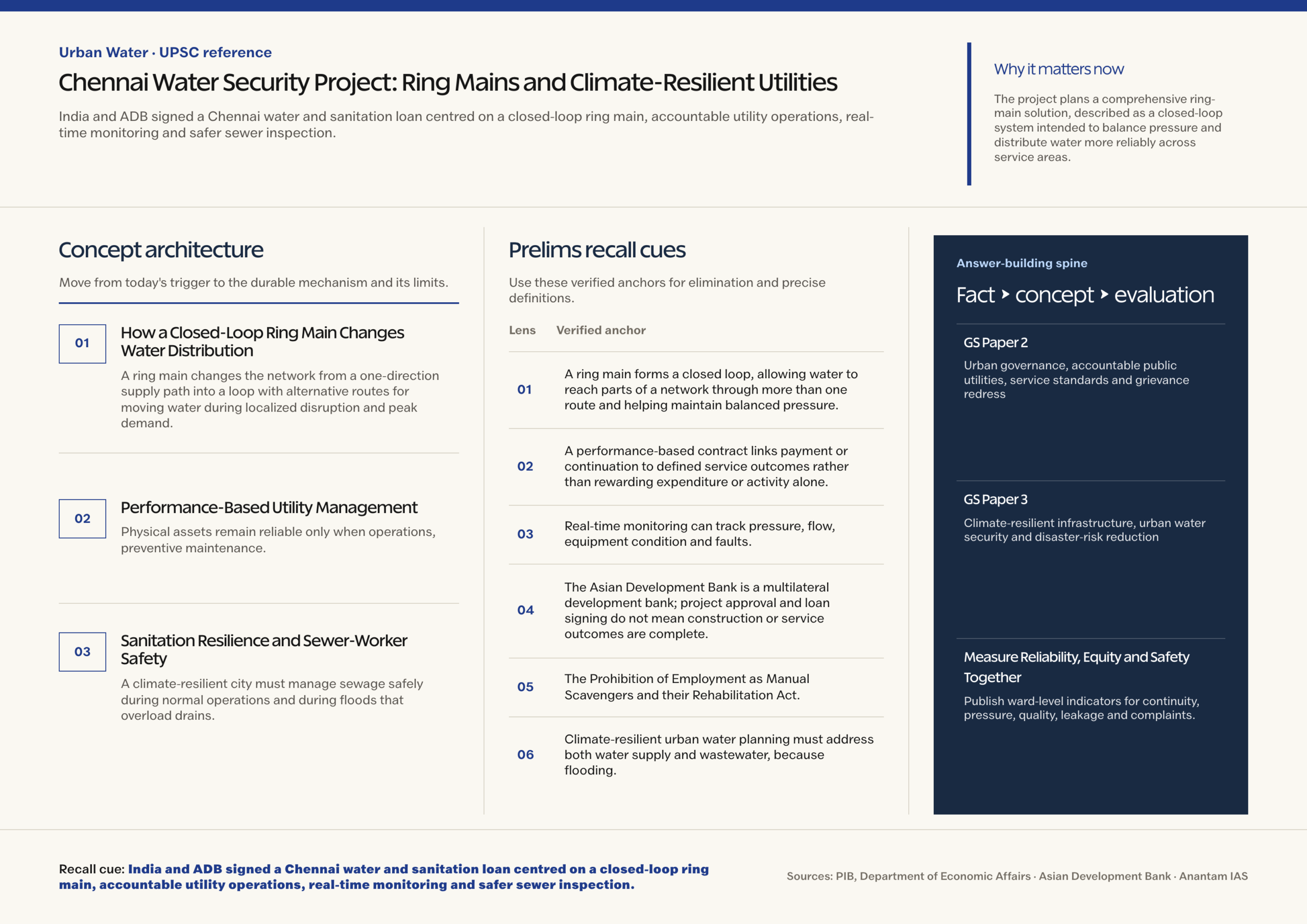
- The project plans a comprehensive ring-main solution, described as a closed-loop system intended to balance pressure and distribute water more reliably across service areas.
- Planned physical works include over 170 km of water and sewer pipes, with upgrades to seven water-pumping stations and 38 sewer-pumping stations.
- Utility reform includes performance-based operations contracts, real-time monitoring, data-led decisions and improved customer responsiveness.
- Advanced inspection technologies are intended to replace hazardous manual sewer inspection and improve blockage detection and worker safety.
- The signing finances planned works; it is not evidence that the ring main, pumping upgrades or service outcomes are already complete.
- A water system is resilient when it can maintain essential service through drought, flooding, equipment failure and uneven demand, then recover without prolonged disruption.
- Urban water security depends on network design, operations, sanitation and public accountability together; adding supply alone cannot correct pressure imbalance, leakage or unsafe maintenance.
- Chennai offers a governance case study in connecting capital investment with measurable utility performance and occupational safety.
UPSC Relevance
Prelims Relevance
- A ring main forms a closed loop, allowing water to reach parts of a network through more than one route and helping maintain balanced pressure.
- A performance-based contract links payment or continuation to defined service outcomes rather than rewarding expenditure or activity alone.
- Real-time monitoring can track pressure, flow, equipment condition and faults, supporting quicker operational decisions when sensors and data quality are reliable.
- The Asian Development Bank is a multilateral development bank; project approval and loan signing do not mean construction or service outcomes are complete.
- The Prohibition of Employment as Manual Scavengers and their Rehabilitation Act, 2013 prohibits employment for hazardous cleaning of sewers and septic tanks.
- Climate-resilient urban water planning must address both water supply and wastewater, because flooding, sewage leakage and treatment failure can convert a service disruption into a public-health crisis.
Mains Relevance
GS Paper 2
- Urban governance, accountable public utilities, service standards and grievance redress
- Occupational dignity and the State’s duty to prevent hazardous sewer work
GS Paper 3
- Climate-resilient infrastructure, urban water security and disaster-risk reduction
- Digital monitoring, network redundancy and outcome-based asset management
Essay
- Infrastructure becomes resilient when engineering redundancy, capable institutions and human dignity are designed as one public service.
Background and Context
How a Closed-Loop Ring Main Changes Water Distribution
A ring main changes the network from a one-direction supply path into a loop with alternative routes for moving water during localized disruption and peak demand.
- In a branched network, a break or pumping failure can isolate everything downstream; a closed loop can reroute supply from another direction when valves, pumps and spare network capacity permit.
- Feeding an area from multiple directions can reduce extreme pressure differences, supporting more equitable distribution between locations near the source and those at network edges during variable demand.
- Balanced pressure can reduce intermittent stress, bursts and contamination risk, but benefits depend on hydraulic modelling, sound pipes, valve control and connections that actually reach households.
- Redundancy strengthens climate resilience because drought, flooding or localized damage need not disable a single linear route, yet a ring main cannot create water when source availability collapses.
- The Chennai design should be assessed through continuity, pressure, water quality, leakage, repair time and underserved-area coverage, not kilometres built or money disbursed alone.
Performance-Based Utility Management
Physical assets remain reliable only when operations, preventive maintenance, financial stewardship and customer service are managed against transparent outcomes over their full life cycle.
- Performance-based contracts can define indicators such as service continuity, pressure stability, breakdown response, energy efficiency and complaint resolution, shifting attention from spending and activity to verifiable results.
- Real-time sensors can reveal pressure drops, abnormal flow and pump faults earlier, helping operators locate problems, prioritize repairs and reduce the time between failure and response.
- Digital systems do not guarantee accountability: sensor calibration, interoperable records, cybersecurity, audit trails and trained staff determine whether data becomes credible operational evidence for timely decisions.
- Contracts need baselines, independent verification and penalties for distorted reporting; otherwise providers may meet narrow indicators while neglecting water quality, low-income areas or long-term maintenance.
- Public dashboards and grievance systems can connect utility data with lived service, allowing residents and regulators to compare reported performance with actual continuity, quality, affordability and responsiveness.
Sanitation Resilience and Sewer-Worker Safety
A climate-resilient city must manage sewage safely during normal operations and during floods that overload drains, pumps and treatment systems while increasing human exposure.
- Upgraded sewer pumping and blockage detection can reduce overflow risk, but the full chain includes collection, pumping, treatment, safe discharge, preventive maintenance and emergency bypass planning.
- Floodwater entering sewers can overwhelm capacity, while failed pumps can expose communities to contaminated water; backup power, protected equipment and tested emergency protocols are core public-health safeguards.
- Remote cameras, robotic crawlers and mechanical tools can inspect or clear hazardous spaces without sending workers inside, converting safety from personal bravery and informal practice into engineered risk elimination.
- Technology must not become a licence for unsafe entry. Procurement requires usable equipment, worker consultation, training, maintenance, rescue arrangements and enforceable responsibility across utilities and contractors.
- The exam trap is to treat proposed technology as proof that hazardous work has ended; outcomes require deployment, compliance audits, worker reporting and zero tolerance for coercive exposure.
Way Forward
Measure Reliability, Equity and Safety Together
- Publish ward-level indicators for continuity, pressure, quality, leakage and complaints, with independent checks and clear baselines before works begin.
- Stress-test the ring main and pumping system against drought, flooding, power failure and equipment outages, then maintain alternative routes and backup capacity.
- Tie contractor payments to verified service and safety outcomes while protecting affordability and preventing neglect of difficult or low-income service areas.
- Mechanize sewer inspection, train crews, maintain equipment and create confidential reporting so no worker is pushed into hazardous manual entry.
Conclusion
- Chennai’s project is important because it joins network redundancy, operational accountability, sanitation and worker safety instead of treating urban water security as a pipe-construction exercise measured mainly through physical outputs.
- Its promise remains conditional: a signed loan and planned technology become resilience only when the utility demonstrates reliable, equitable and safe service during ordinary demand, climate shocks and prolonged infrastructure stress.
- In a Mains answer, explain the ring-main mechanism, connect performance contracts to measurable outcomes, and place sewer-worker dignity within infrastructure governance rather than as an afterthought.
UPSC Practice Questions
Prelims MCQ 1
With reference to urban water and sanitation systems, consider the following statements:
- A ring-main network can provide alternative supply routes within a closed loop.
- Performance-based contracts link utility management to defined outcomes.
- Approval of a development-bank loan proves that the planned infrastructure has been completed.
How many of the above statements are correct?
(a) Only one (b) Only two (c) All three (d) None
Answer: (b) Only two
Explanation:
Statements 1 and 2 are correct. Loan approval or signing finances a planned project; completion and service outcomes require subsequent implementation and verification.
Prelims MCQ 2
Which one of the following best explains why a closed-loop ring main can improve urban water resilience?
(a) It creates a new raw-water source during drought (b) It removes the need for pumping and valves (c) It allows alternative flow paths and can support balanced pressure (d) It automatically treats wastewater within supply pipes
Answer: (c) It allows alternative flow paths and can support balanced pressure
Explanation:
A ring main provides network redundancy and can improve pressure distribution. It does not create water, eliminate operational controls or treat wastewater.
UPSC Mains Questions
- Urban water security is as much a governance challenge as an engineering challenge. Discuss with reference to closed-loop networks, utility performance and climate resilience.
- Modern sewerage infrastructure must place worker safety at the centre of service delivery. Examine the role and limits of technology in eliminating hazardous manual sewer work.
Sources: PIB, Department of Economic Affairs and Asian Development Bank.
Frequently Asked Questions
What did India and ADB sign for Chennai?
They signed a $230 million loan for planned water-supply, sewerage and utility reforms, including a ring main, pumping upgrades, digital monitoring and safer sewer-inspection technology.
What is a water-supply ring main?
It is a closed-loop distribution arrangement that can feed service areas from alternative directions, helping balance pressure and maintain supply when one segment is isolated.
Why are performance-based contracts relevant to water utilities?
They connect payment or continuation to measurable outcomes such as continuity, pressure, fault response and customer service, provided baselines and independent verification are credible.
How can technology improve sewer-worker safety?
Remote cameras, robotic inspection and mechanical cleaning can keep workers out of hazardous spaces, but equipment, training, maintenance, rescue systems and legal enforcement remain essential.
Are Chennai’s proposed project outcomes already achieved?
No. The announcement concerns loan signing and planned components. Reliability, equity, climate resilience and safer working conditions must be demonstrated through implementation and verified results.
Tell Google you want more of this.
Add Anantam IAS as a preferred sourceOne tap, and this site shows up more often in your own Top Stories, AI Overviews and AI Mode. Remove it any time.