Why in News?
The 14th India-Nepal Joint Working Group met in Dehradun on 20–21 August 2026 and, through recurring institutional dialogue, reviewed bilateral cooperation on border management, security, infrastructure and capacity.
- The agenda covered trans-border crime and criminal activity, requiring cooperation across sovereign jurisdictions rather than action by one side alone.
- Both sides reviewed the strengthening and effective use of Integrated Check Posts, roads and railway networks serving legitimate cross-border movement.
- They discussed removal of encroachments and maintenance of boundary pillars, which connect local fieldwork with bilateral boundary-management mechanisms.
- The meeting ended with an agreement to sustain engagement; it did not announce a new treaty, a settled boundary dispute or completed infrastructure.
- An open and heavily used border supports livelihoods, kinship and trade, but also creates opportunities for trafficking, smuggling and other criminal networks.
- Effective management must combine facilitation and security: lawful movement should remain convenient while risk-based checks target prohibited activity.
- Boundary upkeep, crime control and trade facilitation require different agencies and technical mechanisms, making institutional coordination as important as physical infrastructure.
UPSC Relevance
Prelims Relevance
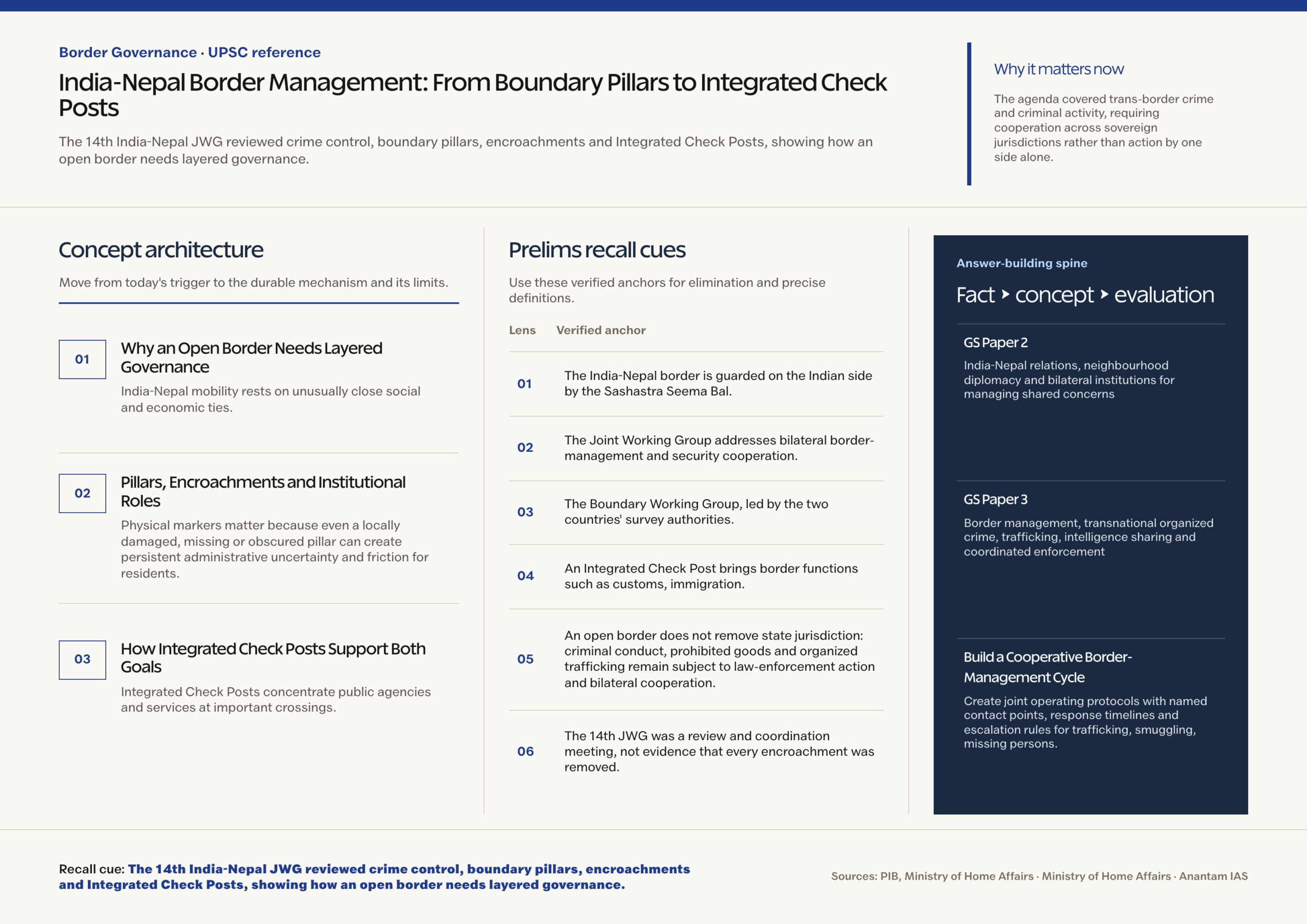
- The India-Nepal border is guarded on the Indian side by the Sashastra Seema Bal, a Central Armed Police Force under the Ministry of Home Affairs.
- The Joint Working Group addresses bilateral border-management and security cooperation; it should not be confused with a treaty-making or boundary-adjudication body.
- The Boundary Working Group, led by the two countries’ survey authorities, handles technical boundary work such as maintenance or construction of damaged and missing pillars.
- An Integrated Check Post brings border functions such as customs, immigration, security and cargo or passenger facilitation into a coordinated facility at a designated crossing.
- An open border does not remove state jurisdiction: criminal conduct, prohibited goods and organized trafficking remain subject to law-enforcement action and bilateral cooperation.
- The 14th JWG was a review and coordination meeting, not evidence that every encroachment was removed, every pillar repaired or every proposed transport link completed.
Mains Relevance
GS Paper 2
- India-Nepal relations, neighbourhood diplomacy and bilateral institutions for managing shared concerns
- Cooperative federal and local implementation where border decisions affect communities, commerce and routine mobility
GS Paper 3
- Border management, transnational organized crime, trafficking, intelligence sharing and coordinated enforcement
- Integrated Check Posts as infrastructure that combines security controls with faster legitimate trade and travel
Essay
- Good borders are governed through trust and institutions: openness and security are complementary when cooperation is precise, accountable and humane.
Background and Context
Why an Open Border Needs Layered Governance
India-Nepal mobility rests on unusually close social and economic ties, so a conventional sealed-border model would misunderstand both the bilateral relationship and its governance challenge.
- People cross for family, work, education, pilgrimage and local trade, making the border a lived social space rather than only a distant security line to be policed.
- High legitimate mobility can be exploited by networks engaged in human trafficking, narcotics, arms, counterfeit currency, vehicle theft or other smuggling, especially when agencies hold fragmented information across jurisdictions.
- The policy task is risk-based facilitation: preserve ordinary lawful movement while focusing checks, intelligence and investigations on suspicious routes, consignments, facilitators and repeat offenders.
- India’s Sashastra Seema Bal performs border-guarding functions, but policing, customs, immigration, railways, land-port authorities and local administrations retain distinct legal responsibilities and operational chains.
- Because an offence may begin in one country and produce evidence, victims or proceeds in the other, timely information exchange and compatible procedures are indispensable for prosecution.
Pillars, Encroachments and Institutional Roles
Physical markers matter because even a locally damaged, missing or obscured pillar can create persistent administrative uncertainty and friction for residents, landholders and field officials.
- Boundary pillars make an agreed alignment visible on the ground; their maintenance requires joint technical verification and consistent records, not unilateral relocation based on local perception or convenience.
- Encroachment may involve cultivation, structures or altered land use near the boundary, so response should begin with survey records, joint inspection and documented facts rather than inflammatory public claims.
- The JWG supplies a broad security and border-management forum, allowing officials to review crime, infrastructure, coordination, capacity building, encroachments and pillar maintenance within one recurring dialogue.
- Technical boundary work is associated with the bilateral Boundary Working Group and survey authorities; distinguishing this role prevents confusion between field maintenance, political dialogue, territorial claims and legal settlement.
- Routine coordination should include shared incident records, escalation contacts and periodic pillar inspection so a small field problem is documented and resolved before it becomes a diplomatic dispute.
How Integrated Check Posts Support Both Goals
Integrated Check Posts concentrate public agencies and services at important crossings, reducing fragmented procedures while giving legitimate passenger and freight movement a clearer, more accountable route.
- An ICP can coordinate customs, immigration, security, quarantine, cargo handling and passenger services, reducing repeated stops and improving the traceability and predictability of formal cross-border flows.
- Better layouts separate passenger and freight movement, create inspection space and support digital documentation, enabling targeted checks without treating every traveller or consignment as equally risky by default.
- Road and railway connectivity can increase an ICP’s usefulness, but the governance objective is effective utilisation and reliable service, not simply announcing or constructing an isolated facility.
- Infrastructure cannot replace intelligence, trained personnel, interoperable data, grievance channels and maintenance; an impressive building with weak inter-agency coordination merely centralizes delay and confusion.
- The exam trap is to equate an open border with no regulation or an ICP with closure. In practice, facilitation and enforcement coexist through differentiated, lawful and proportionate controls.
Way Forward
Build a Cooperative Border-Management Cycle
- Create joint operating protocols with named contact points, response timelines and escalation rules for trafficking, smuggling, missing persons, forged documents and pillar damage.
- Schedule survey-led pillar inspections and record encroachment cases through shared evidence, geospatial records and joint field verification, while avoiding unilateral changes on the ground.
- Measure ICP performance through clearance time, reliability, seizures based on risk and user grievances, not only construction milestones or raw checking volumes.
- Train agencies together on victim-sensitive anti-trafficking work, evidence preservation, cyber-enabled crime and lawful data exchange with privacy, accountability and review safeguards.
Conclusion
- The meeting shows that India-Nepal border governance is a continuing institutional process linking bilateral security cooperation, field-level boundary maintenance, effective infrastructure use and durable administrative capacity.
- Its central lesson is that an open border becomes safer through selective enforcement and reliable facilitation, not indiscriminate restriction that burdens lawful social, cultural and economic exchange.
- In a Mains answer, clearly separate the roles of the JWG, survey-led boundary mechanisms, SSB and ICPs, then recommend joint verification, intelligence-led policing and accountable facilitation.
UPSC Practice Questions
Prelims MCQ 1
With reference to India-Nepal border management, consider the following statements:
- The Sashastra Seema Bal guards the India-Nepal border on the Indian side.
- Integrated Check Posts coordinate multiple border functions at designated crossings.
- The 14th Joint Working Group meeting created a new bilateral boundary treaty.
How many of the above statements are correct?
(a) Only one (b) Only two (c) All three (d) None
Answer: (b) Only two
Explanation:
Statements 1 and 2 are correct. The 14th JWG reviewed border-management cooperation and agreed to continued engagement; the official release did not announce a new boundary treaty.
Prelims MCQ 2
Which institution is most directly associated with technical work on damaged or missing India-Nepal boundary pillars?
(a) Finance Commission (b) Boundary Working Group led by the survey authorities (c) Inter-State Council (d) GST Council
Answer: (b) Boundary Working Group led by the survey authorities
Explanation:
The bilateral Boundary Working Group, led by the respective survey authorities, undertakes technical boundary work, including maintenance or construction of damaged and missing pillars.
UPSC Mains Questions
- An open border requires more governance, not less. Examine this statement in the context of India-Nepal border management and security cooperation.
- Explain how Integrated Check Posts, boundary-pillar maintenance and bilateral institutional coordination can jointly facilitate legitimate mobility while controlling trans-border crime.
Sources: PIB, Ministry of Home Affairs and Ministry of Home Affairs.
Frequently Asked Questions
What was decided at the 14th India-Nepal JWG meeting?
The two sides reviewed border security, crime, infrastructure, encroachments, pillars and capacity building, and agreed to sustain engagement. The release announced no new treaty or completed project.
Why is the India-Nepal border called open?
Indian and Nepali citizens have long enjoyed extensive cross-border movement under the bilateral relationship, supporting family ties, employment, trade, education and other routine activities.
What does an Integrated Check Post do?
It coordinates functions such as customs, immigration, security, cargo handling and passenger facilitation at a designated crossing, supporting faster lawful movement and more organized enforcement.
Who guards the India-Nepal border on the Indian side?
The Sashastra Seema Bal is the designated border-guarding force on the Indian side, while customs, immigration, police and other agencies perform their separate statutory functions.
Are the JWG and Boundary Working Group the same?
No. The JWG reviews broad security and border-management cooperation, while the survey-led Boundary Working Group handles technical boundary work, including maintenance of damaged or missing pillars.
Tell Google you want more of this.
Add Anantam IAS as a preferred sourceOne tap, and this site shows up more often in your own Top Stories, AI Overviews and AI Mode. Remove it any time.