

Why in News?
The Karnataka Legislative Assembly passed an apartment-governance bill and two municipal amendments on 21 August 2026, addressing common facilities and unsafe private streets and drains.
- The apartment bill seeks a regulatory framework for governing apartment complexes and managing common areas and facilities.
- The municipal amendments would empower designated officials to intervene when private streets or drains threaten public health and safety.
- The measures seek to prevent private ownership disputes from obstructing the maintenance of essential civic infrastructure.
- Assembly passage is not final enactment; the bills must complete the applicable legislative and assent stages before their provisions operate.
- Apartment governance requires clear ownership records, representative decision-making and accountable maintenance because several facilities are used collectively but cannot be managed effectively by isolated owners.
- A privately owned road or drain can create public consequences when neglect disrupts access, sanitation, drainage, emergency response or disease prevention beyond the property’s boundary.
- The bills illustrate how property rights and municipal responsibility must be reconciled through clear statutory authority, fair procedure and defined maintenance obligations.
UPSC Relevance
Prelims Relevance
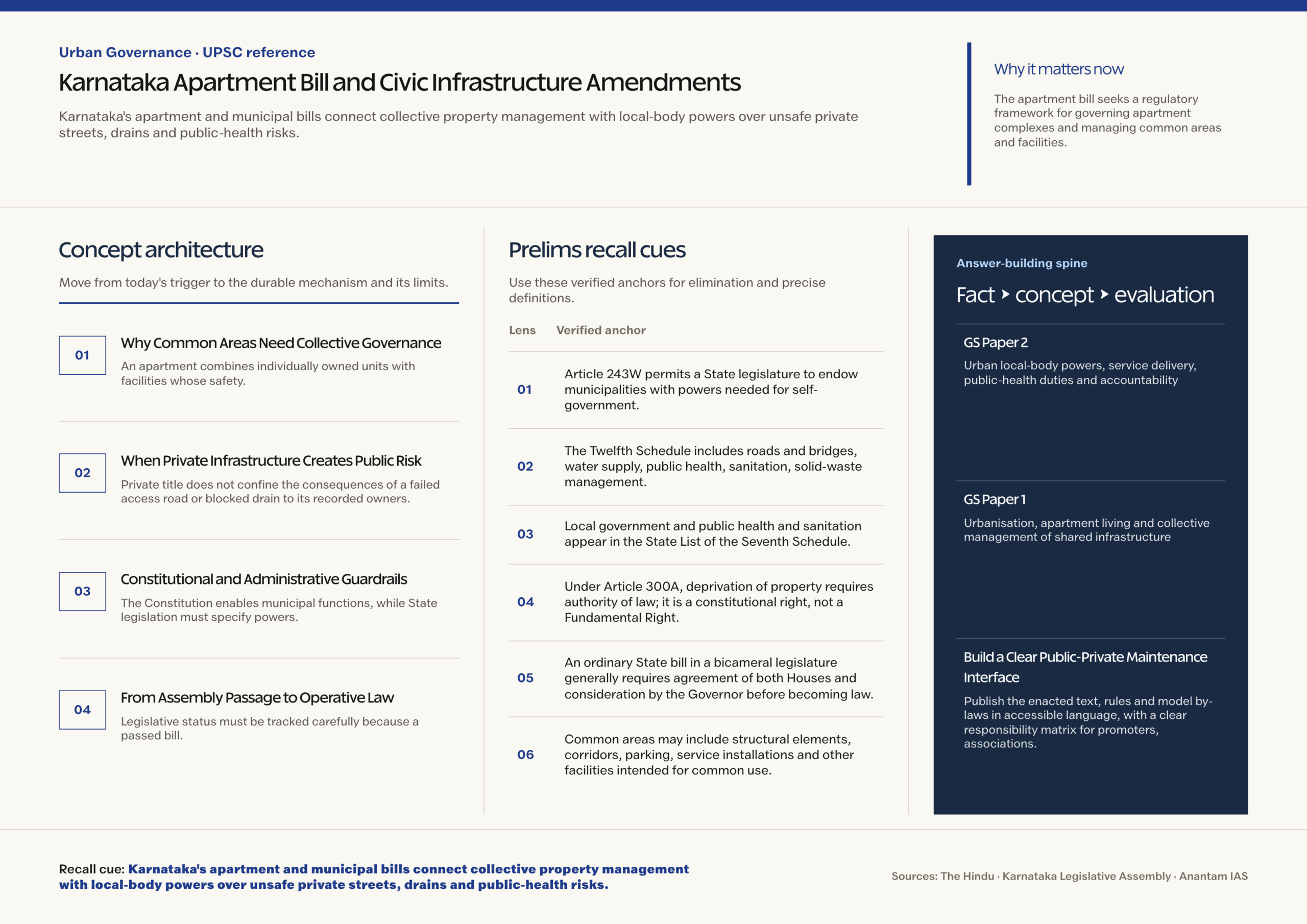
- Article 243W permits a State legislature to endow municipalities with powers needed for self-government; it does not itself transfer every listed function automatically.
- The Twelfth Schedule includes roads and bridges, water supply, public health, sanitation, solid-waste management, fire services and urban planning.
- Local government and public health and sanitation appear in the State List of the Seventh Schedule.
- Under Article 300A, deprivation of property requires authority of law; it is a constitutional right, not a Fundamental Right.
- An ordinary State bill in a bicameral legislature generally requires agreement of both Houses and consideration by the Governor before becoming law.
- Common areas may include structural elements, corridors, parking, service installations and other facilities intended for common use.
Mains Relevance
GS Paper 2
- Urban local-body powers, service delivery, public-health duties and accountability
- Balancing property interests with statutory intervention and procedural safeguards
GS Paper 1
- Urbanisation, apartment living and collective management of shared infrastructure
- Institutional gaps created when private layouts perform public-facing civic functions
Essay
- Urban governance succeeds when legal ownership, collective responsibility and public-service obligations meet at the same institutional boundary.
Background and Context
Why Common Areas Need Collective Governance
An apartment combines individually owned units with facilities whose safety, value and daily operation depend on collective decisions.
- The existing Karnataka framework treats an apartment with its undivided interest in common areas as transferable immovable property, linking the unit and its shared-property interest.
- Common areas can include land, structural components, corridors, parking, central-service installations, lifts, tanks and equipment intended for common use.
- Because these interests remain undivided, an individual owner cannot manage a roof, lift, fire exit or water system as though it were an isolated asset.
- A functioning association needs transparent by-laws, voting, accounts, maintenance contributions, reserve planning and accessible records to turn shared ownership into responsible management.
- Regulation must also distinguish the responsibilities of promoters, associations and owners, especially during handover, defect repair, fund transfer and long-term maintenance.
When Private Infrastructure Creates Public Risk
Private title does not confine the consequences of a failed access road or blocked drain to its recorded owners.
- A deteriorated private street can impede ambulances, fire services, waste collection and pedestrian access, turning maintenance failure into a wider urban-service problem.
- A damaged or blocked drain can increase waterlogging, sewage exposure and vector risk, so delay may impose health costs on neighbouring properties and public networks.
- The municipal amendments reportedly empower commissioners or chief officers to act when poor conditions create a threat to public health and safety.
- This power addresses a coordination failure: numerous owners may benefit from repair, yet fragmented title, absent developers or disputes can prevent timely collective action.
- Taking over infrastructure is different from routine regulation; the administration must identify the statutory trigger, responsible land, maintenance scope and consequences for existing rights.
Constitutional and Administrative Guardrails
The Constitution enables municipal functions, while State legislation must specify powers, procedures and accountability for their actual exercise.
- Article 243W allows State legislatures to endow municipalities with authority for functions in the Twelfth Schedule, including roads, sanitation, water supply and public health.
- The provision is enabling: operational authority comes from State municipal law, rules, delegated powers and budgets rather than from the Schedule alone.
- Article 300A requires authority of law for deprivation of property, but it does not create an automatic rule that every regulatory intervention must receive identical compensation.
- A fair takeover process should establish notice, inspection, recorded reasons, an opportunity to respond, appeal or review, accurate land records and a defined maintenance handover.
From Assembly Passage to Operative Law
Legislative status must be tracked carefully because a passed bill, an assented Act and an operative provision are not interchangeable.
- Karnataka has a bicameral legislature; an ordinary bill must complete the constitutionally required process involving the Legislative Assembly and Legislative Council.
- After legislative passage, Article 200 governs the Governor’s consideration, including assent, withholding assent, reserving a bill or returning a non-Money Bill for reconsideration.
- Even after assent, an Act may commence immediately, on a date written into it, or through a later government notification, depending on its commencement clause.
- Rules can supply forms, procedures and administrative detail, but delegated legislation must remain within the authority and purposes of the parent Act.
- A UPSC answer should separate the proposal, enacted provision, notified rule and actual administrative outcome instead of treating announcement as implementation.
Way Forward
Build a Clear Public-Private Maintenance Interface
- Publish the enacted text, rules and model by-laws in accessible language, with a clear responsibility matrix for promoters, associations, owners and municipalities.
- Require audited handover records covering common assets, maintenance funds, warranties, approved plans, fire-safety systems and pending defects.
- Use risk-based inspections and time-bound notices before municipal takeover, while preserving emergency powers where delay presents an immediate health or safety threat.
- Create a review mechanism that resolves title, cost-recovery and maintenance disputes without forcing residents or civic bodies into prolonged litigation.
Conclusion
- Apartment governance is not merely a housing-society issue; it is the institutional link between shared property, resident accountability and reliable urban services.
- A strong answer should connect Article 243W and the Twelfth Schedule with Article 300A, due process and the practical problem of fragmented responsibility.
- Karnataka’s bills should be assessed by their final enacted text and implementation, not by treating Assembly passage as proof that new powers are already operational.
UPSC Practice Questions
Prelims MCQ 1
With reference to urban local governance in India, consider the following statements:
- Article 243W itself directly transfers every Twelfth Schedule function to every municipality.
- The Twelfth Schedule includes roads and bridges as well as public health and sanitation.
- Property protected by Article 300A is a Fundamental Right.
How many of the above statements are correct?
(a) Only one (b) Only two (c) All three (d) None
Answer: (a) Only one
Explanation:
Only statement 2 is correct. Article 243W enables State legislatures to endow municipalities with powers. Article 300A protects a constitutional legal right to property, not a Fundamental Right.
Prelims MCQ 2
Which one of the following best explains an undivided interest in apartment common areas?
(a) Every owner receives a physically partitioned part of each common facility (b) The promoter permanently owns every common facility after unit sales (c) Each apartment carries a proportionate shared interest that is not ordinarily separated from the unit (d) Municipal ownership arises automatically when an apartment is registered
Answer: (c) Each apartment carries a proportionate shared interest that is not ordinarily separated from the unit
Explanation:
Apartment ownership combines exclusive possession of the unit with a proportionate, undivided interest in common areas and facilities; registration does not automatically transfer them to a municipality.
UPSC Mains Questions
- Apartment governance lies at the intersection of private property and public service delivery. Discuss with reference to common areas, civic infrastructure and urban local-body accountability.
- How should State law balance municipal intervention in unsafe private streets and drains with property rights and procedural fairness?
Sources: The Hindu and Karnataka Legislative Assembly.
Frequently Asked Questions
What did the Karnataka Legislative Assembly pass?
It passed an apartment ownership and management bill plus amendments concerning municipalities and municipal corporations, with the latter addressing unsafe private streets and drains.
Has the apartment bill already become operative law?
No conclusion should be drawn from Assembly passage alone. The bill must complete the applicable bicameral, gubernatorial and commencement stages before its provisions operate.
What are apartment common areas?
They are shared parts and systems such as land, structural elements, corridors, parking, lifts, tanks and central services in which apartment owners may hold undivided interests.
Why can a municipality intervene in private civic infrastructure?
State law may authorise intervention when neglected private streets or drains create wider health, safety or service-delivery risks, subject to statutory conditions and fair procedure.
Which constitutional provisions are most relevant?
Article 243W and the Twelfth Schedule frame municipal functions, while Article 300A requires authority of law for deprivation of property. State List entries support State legislation.
Tell Google you want more of this.
Add Anantam IAS as a preferred sourceOne tap, and this site shows up more often in your own Top Stories, AI Overviews and AI Mode. Remove it any time.






