Why in News?
On August 21, 2026, the Competition Commission of India imposed monetary and non-monetary sanctions for cartel conduct involving agro-input dealer associations and responsible individuals.
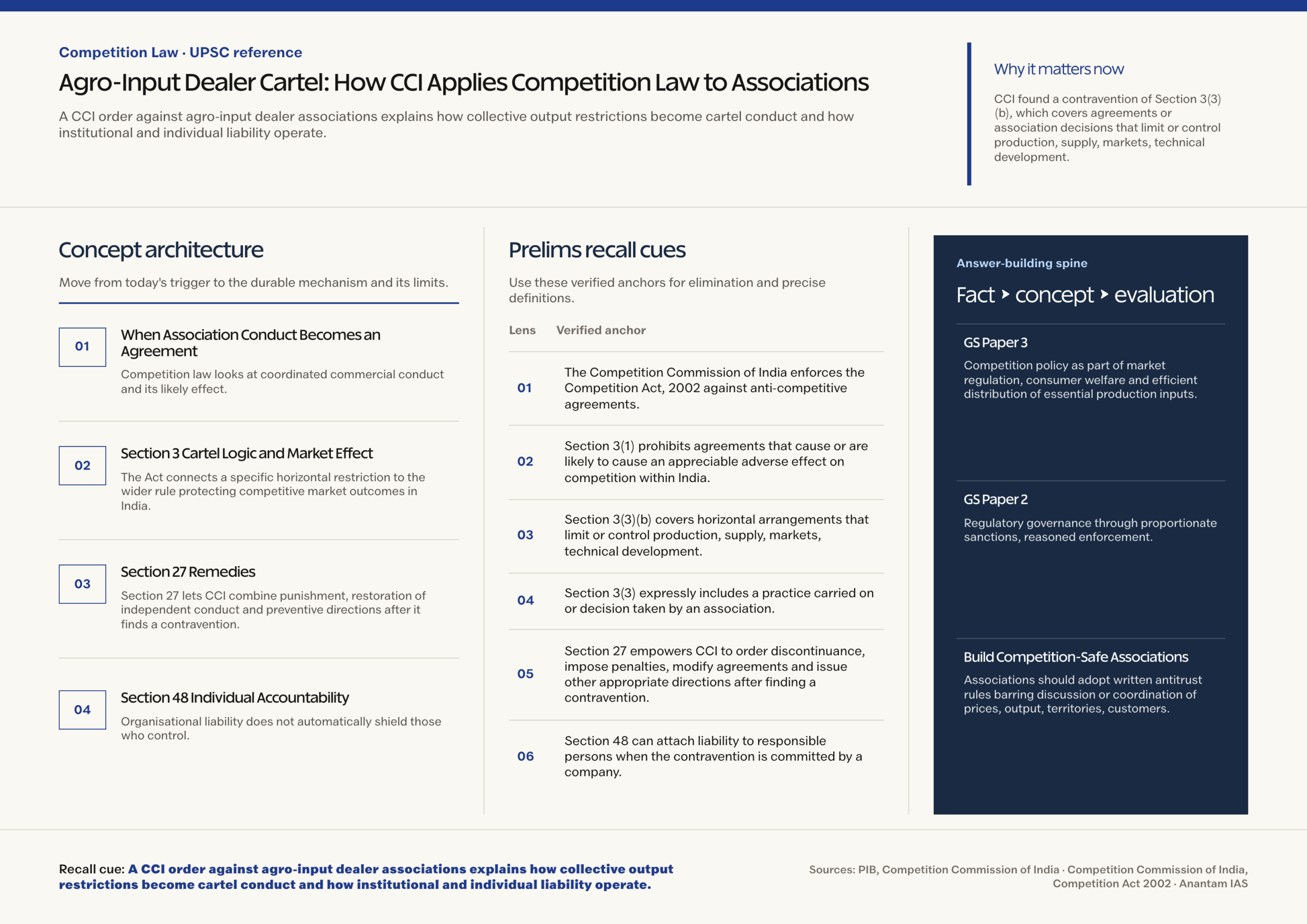
- CCI found a contravention of Section 3(3)(b), which covers agreements or association decisions that limit or control production, supply, markets, technical development, investment or services.
- The provision was applied with Section 3(1), the general prohibition on agreements causing or likely to cause an appreciable adverse effect on competition in India.
- The order combined penalties with a cease-and-desist direction and required the associations to conduct competition-compliance training.
- Officials found responsible were also proceeded against under Section 48, showing that an association cannot always absorb liability for the individuals directing its conduct.
- Dealer associations may legitimately represent members, but collective directions affecting independent commercial decisions can replace rivalry with coordinated restriction.
- In an agro-input market, restricted supply or market access can weaken availability, choice and competitive pressure for dealers and farmers, even without a formally signed cartel contract.
- The order is exam-relevant because it links substantive prohibition, institutional responsibility, individual accountability and corrective compliance within one enforcement action.
UPSC Relevance
Prelims Relevance
- The Competition Commission of India enforces the Competition Act, 2002 against anti-competitive agreements, abuse of dominance and regulated combinations.
- Section 3(1) prohibits agreements that cause or are likely to cause an appreciable adverse effect on competition within India.
- Section 3(3)(b) covers horizontal arrangements that limit or control production, supply, markets, technical development, investment or services.
- Section 3(3) expressly includes a practice carried on or decision taken by an association; the arrangement need not resemble a conventional signed contract.
- Section 27 empowers CCI to order discontinuance, impose penalties, modify agreements and issue other appropriate directions after finding a contravention.
- Section 48 can attach liability to responsible persons when the contravention is committed by a company, a term that includes an association of individuals.
Mains Relevance
GS Paper 3
- Competition policy as part of market regulation, consumer welfare and efficient distribution of essential production inputs.
- How output restriction by horizontal competitors can reduce independent decision-making, availability and competitive pressure across a supply chain.
GS Paper 2
- Regulatory governance through proportionate sanctions, reasoned enforcement, officer accountability and preventive compliance obligations.
Essay
- Collective organisation serves the public interest only when representation does not become a mechanism for suppressing independent economic choice.
Background and Context
When Association Conduct Becomes an Agreement
Competition law looks at coordinated commercial conduct and its likely effect, not merely the label or legal form of the coordinating body.
- Section 3 reaches agreements between enterprises or persons, while Section 3(3) also covers a practice or decision of an association operating in identical or similar trade.
- This prevents members from avoiding scrutiny by presenting coordinated restrictions as advice, resolutions or welfare activity when they actually influence independent market conduct.
- The Act defines agreement broadly to include an arrangement, understanding or action in concert, whether or not it is formal, written or legally enforceable between the participants.
- An association may share compliance information, train members or advocate policy; legal risk begins when collective action directs prices, quantities, customers, territories or other variables on which members should compete.
- For UPSC answers, distinguish lawful representation from commercial coordination: common identity is not illegal, but using collective authority to suppress independent rivalry can be.
Section 3 Cartel Logic and Market Effect
The Act connects a specific horizontal restriction to the wider rule protecting competitive market outcomes in India.
- Section 3(1) supplies the core test: an agreement concerning goods or services is prohibited when it causes or is likely to cause an appreciable adverse effect on competition within India.
- Section 3(3)(b) identifies limitation or control of production, supply, markets, technical development, investment or services as a serious form of horizontal coordination among market participants.
- A Section 3(3) arrangement is presumed to have an appreciable adverse effect, reflecting the high competitive risk of rivals jointly controlling market variables instead of deciding independently.
- Output restriction can reduce quantity or availability, delay distribution and weaken rivalry among sellers; downstream users may then face poorer choice, access or bargaining conditions.
- The exam trap is to equate every trade-association decision with a cartel. Ask whether competitors coordinated a listed market variable and displaced rivalry, not merely whether an association exists.
Section 27 Remedies
Section 27 lets CCI combine punishment, restoration of independent conduct and preventive directions after it finds a contravention.
- Under Section 27(a), CCI may direct parties to discontinue and not re-enter an anti-competitive agreement, making cease-and-desist relief central to restoring independent commercial decisions.
- Section 27 also permits monetary penalties, modification of agreements and other suitable orders or directions, allowing the remedy to address both the breach and its organisational setting.
- In this case, competition-compliance training accompanied the sanctions, treating weak understanding and internal practice as risks requiring correction rather than relying on punishment alone.
- Training becomes meaningful when it changes association rules, meeting agendas, information exchange, communications and escalation procedures that could otherwise reproduce coordination after the formal order.
Section 48 Individual Accountability
Organisational liability does not automatically shield those who control, consent to or negligently enable the contravening conduct.
- Section 48 treats a body corporate, firm or other association of individuals as a company for this liability framework, making it relevant beyond conventional corporations.
- Section 48(1) covers persons who were in charge of and responsible for the organisation’s business when the contravention occurred, alongside liability of the organisation itself.
- A responsible person may avoid liability by proving the contravention occurred without knowledge or that all due diligence was exercised to prevent it.
- Section 48(2) separately reaches an officer when consent, connivance or neglect is proved, connecting personal accountability to active involvement or a demonstrated oversight failure.
Way Forward
Build Competition-Safe Associations
- Associations should adopt written antitrust rules barring discussion or coordination of prices, output, territories, customers, bids and collective refusals to deal.
- Meeting agendas, minutes and communications should document legitimate advocacy while preserving each member’s independent commercial decisions.
- Periodic training should be paired with confidential reporting, legal review of risky resolutions and clear officer responsibility rather than treated as a one-time formality.
- CCI enforcement should explain market harm and remedy design clearly, helping smaller associations distinguish lawful cooperation from cartel-facilitating conduct.
Conclusion
- The order shows that an association decision can become cartel conduct when it coordinates an output or market restriction that displaces independent rivalry among members.
- A strong Mains answer should connect Section 3 prohibition, Section 27 institutional remedies and Section 48 individual liability, then assess how compliance systems can prevent recurrence.
UPSC Practice Questions
Prelims MCQ 1
With reference to anti-competitive agreements under the Competition Act, 2002, consider the following statements:
- Section 3(3) can cover a practice carried on or decision taken by an association of enterprises or persons.
- An arrangement limiting or controlling production or supply is among the horizontal arrangements listed in Section 3(3).
- Section 3 applies only when the parties have executed a formally signed contract.
How many of the above statements are correct?
(a) Only one (b) Only two (c) All three (d) None
Answer: (b) Only two
Explanation:
Statements 1 and 2 are correct. Competition law can examine an association practice or decision; a formally signed contract is not essential to the statutory concept of coordinated conduct.
Prelims MCQ 2
Which provision of the Competition Act primarily enables liability of persons responsible for a contravening company or association?
(a) Section 3 (b) Section 19 (c) Section 27 (d) Section 48
Answer: (d) Section 48
Explanation:
Section 48 addresses contravention by companies and responsible officers. Its definition of company includes a firm or other association of individuals.
UPSC Mains Questions
- How can a trade association’s decision become an anti-competitive agreement under Section 3 of the Competition Act, 2002? Explain with reference to output restrictions and market effects.
- Competition-law enforcement must correct organisational conduct as well as assign individual responsibility. Discuss the relationship between remedies under Section 27 and liability under Section 48.
Sources: PIB, Competition Commission of India and Competition Commission of India, Competition Act 2002.
Frequently Asked Questions
What conduct did CCI find anti-competitive in the agro-input matter?
CCI found cartel conduct involving an output-restricting arrangement under Section 3(3)(b) read with Section 3(1), involving dealer associations and responsible individuals.
Why can a trade-association decision attract Section 3?
Section 3(3) expressly covers a practice or decision of an association in identical or similar trade when it coordinates listed restrictions such as price, output, market sharing or bids.
What is an output restriction under Section 3(3)(b)?
It is coordination that limits or controls production, supply, markets, technical development, investment or services, replacing independent competitive choices with a collective constraint.
What remedies can CCI use under Section 27?
After finding a contravention, CCI may order discontinuance, impose penalties, modify agreements and issue other appropriate directions. The agro-input order also required competition-compliance training.
How does Section 48 create individual liability?
It can cover persons responsible for organisational business and officers whose consent, connivance or neglect caused the contravention, while recognising statutory knowledge and due-diligence defences.
Tell Google you want more of this.
Add Anantam IAS as a preferred sourceOne tap, and this site shows up more often in your own Top Stories, AI Overviews and AI Mode. Remove it any time.