Daily Digest
UPSC · Civil Services Examination
Current Affairs · Friday, 25 September 2026
Current affairs curated and edited by Anantam IAS faculty — pulled from The Hindu, PIB, IDSA, Foreign Affairs and the ministries. Read, annotate, revise.
Old Rajinder Nagar · Delhi 110005 · anantamias.com
Dilution Refrigerators: Ultra-Cold Infrastructure for Quantum Systems
Why in News?
On 24 September 2026, DRDO announced an agreement with Zero mK India Private Limited to develop an indigenous 20 mK dilution refrigerator for quantum applications.
- The development agreement falls under the Technology Development Fund; it is not an announcement of a completed refrigerator.
- The target of 20 millikelvin means 0.020 kelvin above absolute zero, not a temperature below absolute zero.
- The Solid State Physics Laboratory will monitor, mentor and support the project.
- PIB links indigenous cryogenic capability with the National Quantum Mission and reduced dependence on imported infrastructure.
- The practical bottleneck is experimental infrastructure: a quantum device must be tested in a sufficiently stable physical environment.
- Evaluate demonstrated performance separately from announced capability; equipment development, integration and reliable operation are different milestones.
UPSC Relevance
Prelims Relevance
- Cryogenics: production and study of extremely low temperatures.
- Millikelvin: one thousandth of a kelvin.
- Helium-3 and helium-4: isotopes used in dilution refrigeration.
- Mixing chamber: the low-temperature region where dilution provides cooling.
- Superconducting quantum circuits: one application requiring an ultra-cold environment.
Mains Relevance
GS Paper 3
- Enabling infrastructure in domestic deep-technology development.
- Scientific validation, skilled maintenance and quantum technology capability.
Essay
- Scientific independence depends on the instruments that make discoveries reproducible.
Background and Context
Why a quantum device needs a controlled thermal environment
A quantum processor is not just its chip: the surrounding apparatus helps establish conditions in which the chip can be prepared, controlled and measured.
- Thermal energy can produce unwanted excitations in sensitive quantum devices. Cooling reduces this disturbance, helping researchers distinguish deliberately prepared behaviour from changes caused by the surrounding environment during an experiment.
- Superconducting microwave circuits are an important example. NIST describes using a dilution refrigerator to provide their millikelvin environment and reduce thermal occupation in mechanical components of quantum transducers.
- Cooling is necessary but insufficient for such experiments. NIST also identifies vibration isolation and low-noise electrical measurements as relevant, illustrating why temperature control cannot replace careful engineering of the complete experimental system.
- Platform specificity matters: the defence release says several quantum computing platforms require this environment, not every quantum technology. Avoid treating a dilution refrigerator as a universal requirement for all devices carrying the quantum label.
- Lowest temperature and usable operation are different questions. A research instrument must sustain suitable conditions while connected to the experiment; reaching a temperature once does not establish reliable performance during repeated measurements.
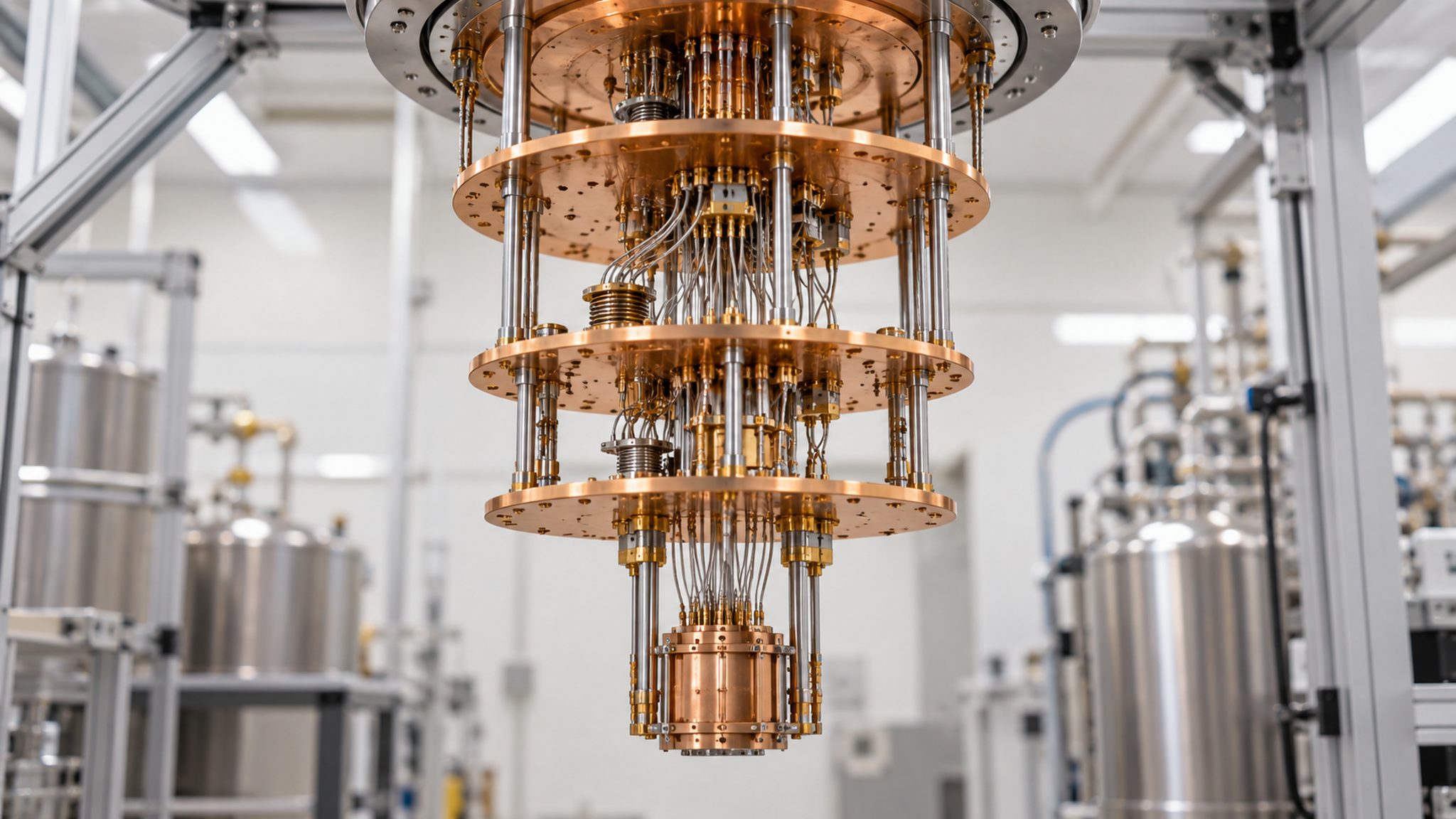
How helium dilution removes heat
Dilution refrigeration uses the behaviour of helium isotopes at low temperatures; it does not obtain cooling by mixing ordinary gases at room temperature.
- Helium-3 and helium-4 have different atomic masses but belong to the same element. The refrigerator exploits their low-temperature mixture, rather than a chemical reaction that permanently consumes them as fuel.
- At sufficiently low temperatures, the mixture separates into a helium-3-rich phase and a dilute phase containing helium-3 in helium-4. This phase behaviour supplies the physical basis for the refrigerator’s coldest stage.
- When helium-3 passes into the dilute phase, it absorbs heat. The mixing chamber couples this cooling process to the experimental load, removing thermal energy from the region that must be kept cold.
- A circulation system removes helium-3 from the dilute side and returns it through the cooling circuit. Heat exchangers help precool returning helium, enabling continuing refrigeration rather than only a single cooling event.
- The NBS thermodynamic treatment explains this mechanism. NIST’s operational account also shows why mixture monitoring matters: incorrect gas composition can disrupt temperature control and waste valuable experimental time.
What an indigenous refrigerator would establish
The policy significance lies in mastering an enabling instrument, while the actual achievement must be established through testing rather than inferred from the agreement.
- Domestic capability could make laboratories less dependent on imported cryogenic infrastructure, the objective identified by PIB. It would complement work on quantum devices by strengthening the equipment base needed to test them.
- Integration skills matter alongside fabrication: laboratories need staff able to operate, diagnose and maintain the apparatus. NIST’s mixture-diagnosis example shows how instrument knowledge can determine whether an experiment continues or loses usable time.
- Acceptance testing should examine temperature stability with a representative experimental load, repeatability and recovery after interruptions. These are proposed evaluation criteria, not performance results already reported for the Indian development project.
- Capability claims should identify what was actually tested, under which conditions and for how long. A working refrigerator would establish cryogenic capability; it would not by itself demonstrate a useful quantum computer.
- Supply resilience requires examining critical components and servicing as well as final assembly. Policymakers should distinguish domestic manufacture of a system from complete domestic sourcing, which this announcement does not establish.
Way Forward
Test the enabling capability
- Require measured acceptance criteria for stable operation under realistic experimental heat loads.
- Build maintenance and diagnostic expertise with laboratories that will use the refrigerator.
- Report development milestones separately from validated quantum-device performance.
Conclusion
- Dilution refrigeration illustrates how advanced computing depends on physical infrastructure: a stable experimental environment is part of the capability, not merely an accessory purchased after the device is developed.
- The DRDO agreement is a development step toward indigenous ultra-cold equipment. Its scientific significance should be assessed through demonstrated operation, while keeping the requirements of different quantum platforms distinct.
UPSC Practice Questions
Prelims MCQ 1
With reference to dilution refrigeration, consider the following statements:
- It uses a mixture of helium isotopes.
- A temperature of 20 mK is below absolute zero.
- Every quantum computing platform necessarily requires a dilution refrigerator.
How many of the above statements are correct?
(a) Only one (b) Only two (c) All three (d) None
Answer: (a) Only one
Explanation:
Only the first statement is correct. Twenty millikelvin is 0.020 K above absolute zero; refrigeration requirements depend on the quantum platform.
Prelims MCQ 2
Which process provides cooling at the mixing chamber of a helium dilution refrigerator?
(a) Combustion of helium with oxygen (b) Dilution of helium-3 into the helium-4-rich phase (c) Nuclear fission of helium atoms (d) Heating the quantum device above room temperature
Answer: (b) Dilution of helium-3 into the helium-4-rich phase
Explanation:
Helium-3 absorbs heat as it enters the dilute phase. Circulation sustains the process.
UPSC Mains Questions
- Explain why indigenous enabling infrastructure is important for quantum technology development. Illustrate with dilution refrigeration.
- Distinguish a technology-development agreement from demonstrated scientific capability. Suggest evaluation criteria for an indigenous cryogenic system.
Sources: PIB, Ministry of Defence and NIST, cryogenic systems and helium dilution thermodynamics.
Frequently Asked Questions
What is a dilution refrigerator?
It is a cryogenic instrument that uses helium-3 and helium-4 to achieve extremely low temperatures. Heat absorption during helium-3 dilution cools the experimental region, while circulation sustains the process.
Does 20 mK mean below absolute zero?
No. Twenty millikelvin equals 0.020 kelvin above absolute zero. The prefix milli means one thousandth; it does not indicate a negative temperature or a temperature below the physical zero point.
Has India completed this refrigerator?
The announcement concerns a development agreement between DRDO and Zero mK India Private Limited. It does not report a completed instrument, demonstrated 20 mK performance or operational deployment of the proposed refrigerator.
Do all quantum computers require this equipment?
No. Cooling requirements depend on the physical platform. Dilution refrigerators support several quantum technologies, including superconducting circuits, but the defence release does not describe them as mandatory for every quantum computing approach.
Source: https://anantamias.com/current-affairs/dilution-refrigerator-millikelvin-quantum-infrastructure/
Edible Oil Duty Cut: Landed Costs, Retail Prices and Refining
Why in News?
On 24 September 2026, the government announced an implemented edible oil duty cut to moderate consumer prices while preserving the import-duty differential supporting domestic refining.
- Basic Customs Duty on crude sunflower oil fell from 10% to nil; crude soybean and palm oil duty fell from 10% to 5%.
- The government also reduced duties on refined oils, maintaining the stated 19.25% import-duty differential between crude and refined edible oils.
- Industry associations were advised to revise Price to Distributors and Maximum Retail Price in line with lower landed costs.
- International price increases can raise domestic cooking-oil costs even when the physical supply chain continues functioning.
- The policy balances consumer affordability, domestic refining and farmers; these interests need separate assessment rather than a single retail-price headline.
UPSC Relevance
Prelims Relevance
- Basic Customs Duty versus total effective import duty
- Landed cost and exchange-rate exposure
- Crude versus refined edible oil
- Tariff differential and domestic value addition
- Price to Distributors versus Maximum Retail Price
Mains Relevance
GS Paper 3
- Transmission of trade-policy changes into food prices
- Consumer relief, domestic processing and agricultural incentives
GS Paper 2
- Monitoring implementation of industry price-revision advisories
Essay
- Affordable essentials and the distribution of economic adjustment costs
Background and Context
What the duty reduction changes
The immediate intervention operates at the import stage; understanding that starting point prevents confusing a tax change with a guaranteed supermarket price.
- Crude edible oil is an input requiring processing before sale for consumption. Importing crude oil and refining it domestically retains processing activity in India, unlike importing an already refined product.
- Basic Customs Duty is a named component of import taxation. A nil basic rate does not, by itself, establish that every applicable charge has disappeared or that the total import-tax burden is zero.
- Landed cost describes the cost of bringing imported oil into the domestic market. The import price, transport-related expenses and applicable duties contribute; a tariff reduction lowers one component rather than every component together.
- The PIB release attributes the intervention to rising international edible-oil prices. This matters because tariff policy is being used to cushion an external cost shock, rather than demonstrate that global prices have fallen.
- The release reports a reduction already made in applicable duties. However, it does not supply a complete refined-oil tariff schedule, so deriving exact final refined rates from the headline would overstate the evidence.

How lower landed costs can reach consumers
Price transmission follows a chain of commercial decisions; the tax saving at entry must survive later costs and margins to reach the household.
- Pass-through means the extent to which lower upstream costs reduce downstream prices. A smaller import bill creates room for cheaper oil, but it does not mechanically determine the price charged by every seller.
- World prices can move after a duty change, while exchange-rate movements alter the domestic-currency cost of an overseas purchase. These changes may reinforce or offset part of the relief from lower duties.
- Existing inventories complicate timing because oil already purchased may carry earlier costs. Comparing prices immediately before and after an announcement cannot alone show whether all subsequent tariff savings were retained or passed through.
- Price to Distributors concerns an upstream selling price; Maximum Retail Price is the marked retail ceiling. Revising both addresses different stages, while actual shop prices remain the relevant evidence of consumer benefit.
- The government has issued an industry advisory seeking prompt revisions consistent with lower landed costs. Its announcement establishes the requested action, not proof that all associations, distributors and retailers have already implemented it.
Why preserve the crude-refined duty gap?
The comparison is between importing a processing input and importing the finished oil; that distinction explains the industrial-policy element inside a consumer-relief measure.
- A higher duty burden on refined imports relative to crude imports makes domestic refining comparatively more attractive. The intended effect is to support utilisation of Indian refining capacity and preserve local value addition.
- The stated import-duty differential should be read as the government describes it, not relabelled as a difference in basic duty alone. Distinguishing tax components avoids an incorrect calculation of protection for domestic refiners.
- Refining capacity and domestic oilseed production are different parts of the supply chain. Support for processors does not automatically guarantee remunerative prices for farmers, so consumer, processor and producer outcomes need separate examination.
- Cheaper imports can ease consumer costs while creating competitive pressure within the domestic chain. The release explicitly recognises farmers alongside industry and consumers; it does not establish that every group benefits equally.
- This measure changes border costs; stock-control powers under the Essential Commodities Act concern a different policy lever. Do not confuse an import-duty revision with a new stock limit or domestic price ceiling.
Way Forward
Measure the transmission, not just the announcement
- Compare landed costs, distributor prices and observed retail prices over time, accounting for changing global prices and exchange rates.
- Check whether price revisions actually reach consumers instead of treating an industry advisory as evidence of completed compliance.
- Assess domestic refining utilisation and oilseed-producer outcomes separately before concluding that the policy balance has succeeded.
Conclusion
- The edible oil duty cut is a cost-side intervention with a domestic-processing objective. Its effectiveness depends on both price transmission and the incentives created by the crude-refined duty gap.
- For policy analysis, distinguish the announced tax change, its expected economic mechanism and its observed outcome. Consumer relief must be demonstrated through prices, not inferred solely from a lower basic customs rate.
UPSC Practice Questions
Prelims MCQ 1
With reference to edible-oil import duties, consider the following statements:
- A nil Basic Customs Duty necessarily means that all applicable import charges are zero.
- Lower duties on crude oil relative to refined oil can encourage domestic refining.
- A duty reduction guarantees an identical percentage decline in retail prices.
How many of the above statements are correct?
(a) Only one (b) Only two (c) All three (d) None
Answer: (a) Only one
Explanation:
Only the second statement is correct. Basic duty is not necessarily the whole import burden, and retail pass-through depends on other costs and commercial decisions.
Prelims MCQ 2
Which observation most directly supports the conclusion that consumers benefited from an edible-oil duty reduction?
(a) The publication of an industry advisory (b) Lower observed retail prices after accounting for other cost movements (c) A change in the wording of import documents (d) The continued existence of domestic refineries
Answer: (b) Lower observed retail prices after accounting for other cost movements
Explanation:
Actual retail outcomes, interpreted alongside other cost changes, provide evidence of consumer benefit. An advisory alone cannot establish completed pass-through.
UPSC Mains Questions
- Explain how a reduction in edible-oil import duties can affect consumer prices. Why may retail pass-through be incomplete?
- Assess the rationale for maintaining a crude-refined edible-oil duty differential while providing consumer relief.
Source: PIB, Ministry of Consumer Affairs, Food and Public Distribution.
Frequently Asked Questions
What changed in edible-oil import duties?
The government reduced Basic Customs Duty on major crude edible oils and also reduced applicable duties on refined oils, while preserving the stated crude-refined import-duty differential to support domestic processing.
Does nil basic duty mean completely duty-free imports?
Not necessarily. Basic Customs Duty is one component of the applicable import burden. A nil basic rate alone cannot establish that every other charge has been removed.
Why might retail oil prices not fall immediately?
Retail prices reflect more than customs duty. International prices, exchange rates, inventories and supply-chain decisions can affect the timing and extent of transmission from lower landed costs to shops.
Why does the crude-refined duty gap matter?
A relatively lower import burden on crude oil can encourage processing within India instead of importing finished refined oil. This supports refining activity, but does not automatically resolve every producer or consumer concern.
Source: https://anantamias.com/current-affairs/edible-oil-duty-cut-landed-cost-refining/
Nidhi Companies: Member Deposits and the Insurance Gap
Why in News?
On 24 September 2026, the Ministry of Corporate Affairs cautioned the public against unusually high-return promises by non-compliant Nidhi companies and reiterated that their deposits lack DICGC insurance.
- The MCA advisory reports non-compliance found during examination of applications and failures to submit required applications within prescribed timelines.
- Companies seeking Nidhi status must submit Form NDH-4 for declaration or updating their status; members should independently verify government declaration.
- The warning reiterates existing requirements; it does not announce a new deposit-insurance scheme or guarantee repayment to members.
- A company’s legal status, compliance with applicable requirements and ability to repay are separate questions; a familiar name cannot answer all three.
- Member-based finance creates a consumer-protection challenge when personal trust and promised returns substitute for checking institutional status and deposit conditions.
UPSC Relevance
Prelims Relevance
- Nidhi: a mutual-benefit company accepting deposits and lending only to members.
- Regulatory authority: Ministry of Corporate Affairs under company law and Nidhi Rules.
- Section 406: the Companies Act framework relevant to Nidhis.
- NDH-4: the application for declaration or updating Nidhi status.
- DICGC: deposit insurance does not cover deposits accepted by Nidhi companies.
Mains Relevance
GS Paper 3
- Financial inclusion and the limits of member-based savings institutions.
- Distinguishing regulatory permission from financial safety nets.
GS Paper 2
- Consumer protection through verifiable disclosures and enforcement.
Essay
- Public trust requires both clear information and accountable institutions.
Background and Context
What makes a Nidhi a member-based institution?
A Nidhi pools savings and provides loans within its membership; that restricted relationship defines its mutual-benefit model and the limits of its customer base.
- A Nidhi company accepts deposits from members and lends to members only. It is not authorised by this model to treat every person approaching its office as an ordinary banking customer.
- The Ministry of Corporate Affairs regulates Nidhis under company law and the Nidhi Rules. This regulatory setting matters because financial institutions do not all operate under an identical permission or protection framework.
- Mutual benefit describes who participates in the institution; it does not establish that every loan will be repaid. Members’ savings remain exposed to the company’s ability to honour its deposit obligations.
- A deposit claim and a loan are different sides of the institution’s finances. If funds cannot be recovered or managed properly, promised payments to members can become difficult despite the mutual-benefit label.
- The advisory targets non-compliance and misleading assurances, not the proposition that every Nidhi is fraudulent. An answer should distinguish the permitted institutional model from failures by particular companies operating within or outside its requirements.
Incorporation, declaration and repayment are separate questions
An official company identity is a starting point for checking status, not a substitute for the specific declaration required to function as a Nidhi.
- Incorporation establishes a company’s legal existence. The MCA advisory asks the public to check whether the Central Government has declared it a Nidhi; these checks answer different institutional questions.
- Section 406 supplies the company-law framework. The advisory reiterates the requirement to seek declaration or update through NDH-4, rather than presenting its warning as a newly enacted restriction on member deposits.
- Filing an application is not the same as obtaining the declaration being sought. An agent’s statement that papers have been submitted should not be treated as evidence that the government has granted Nidhi status.
- A government declaration concerns institutional status; it does not promise compensation for losses. Even where declaration is confirmed, members must separately consider deposit terms and the company’s capacity to repay their money.
- Independent verification means comparing the company’s identity and claimed status with official information rather than accepting a brochure or oral assurance. The advisory links an MCA list, whose stated publication date should also be checked.
Why the deposit-insurance distinction matters
The central comparison is between deposits with an insured bank and deposits with a Nidhi, even when both are marketed as familiar savings arrangements.
- DICGC insurance covers eligible deposits with insured banks under its statutory scheme. The MCA explicitly states that Nidhi deposits are not insured; being a member does not create coverage that the institution lacks.
- An insured-bank deposit and a Nidhi deposit should not be compared solely by the advertised interest return. Their protection arrangements differ, so an apparently attractive return does not establish an equivalent level of safety.
- High promised returns are a reason to examine the proposition carefully, not proof by themselves of fraud. The advisory warns against relying exclusively on such promises or informal assurances when making financial decisions.
- Absence of insurance does not mean that depositors have no claim against the company. It means they cannot assume a DICGC payout; actual recovery after failure or fraud may be difficult or incomplete.
- The policy issue is information asymmetry: a depositor may recognise the word company but misunderstand its protections. Clear disclosure must explain the missing insurance alongside the institution’s legal identity and member-only operating restrictions.
Way Forward
Make institutional status and protection verifiable
- Require customer-facing disclosures to separate incorporation, declaration and insurance, so one official-looking document is not presented as evidence of all three.
- Prioritise scrutiny of misleading return claims and non-compliance identified through applications, with accessible official status information for members.
- Explain repayment conditions and risks in plain language before accepting deposits; do not let informal agent assurances replace written terms.
Conclusion
- Nidhi status identifies a regulated member-based institution, not an insured deposit product. Declaration and membership cannot be used to infer a public guarantee against loss.
- The durable lesson is to separate permission, compliance and protection: financial inclusion needs useful institutions, but also disclosures that accurately explain what happens when repayment fails.
UPSC Practice Questions
Prelims MCQ 1
With reference to Nidhi companies, consider the following statements:
- They accept deposits and provide loans only to members.
- Their deposits are insured by DICGC once they receive government declaration.
- The Ministry of Corporate Affairs regulates them under the company-law framework.
How many of the above statements are correct?
(a) Only one (b) Only two (c) All three (d) None
Answer: (b) Only two
Explanation:
Statements 1 and 3 are correct. Government declaration does not make Nidhi deposits eligible for DICGC insurance.
Prelims MCQ 2
Which statement best explains the significance of a government declaration of Nidhi status?
(a) It guarantees repayment of every member deposit. (b) It converts the company into an insured bank. (c) It confirms the relevant institutional status without guaranteeing deposits. (d) It permits unrestricted deposit-taking from non-members.
Answer: (c) It confirms the relevant institutional status without guaranteeing deposits.
Explanation:
Declaration concerns Nidhi status. It does not create deposit insurance, a repayment guarantee or permission to accept deposits from non-members.
UPSC Mains Questions
- Distinguish regulatory recognition from deposit protection, using Nidhi companies as an example. How can misleading assurances weaken consumer protection?
- Discuss how member-based financial institutions can support savings while creating risks for depositors. Suggest specific disclosure and enforcement measures.
Sources: PIB, Ministry of Corporate Affairs and DICGC.
Frequently Asked Questions
What is a Nidhi company?
A Nidhi is a mutual-benefit company that accepts deposits and provides loans only to its members. It operates under the company-law framework and Nidhi Rules, with regulation by the Ministry of Corporate Affairs.
Are Nidhi deposits insured by DICGC?
No. The MCA advisory explicitly states that deposits accepted by Nidhi companies are not insured by DICGC. Members should not confuse government declaration of Nidhi status with insurance or a repayment guarantee.
Does filing NDH-4 prove that a company has been declared a Nidhi?
No. Filing is an application step, whereas declaration is the status sought. The advisory asks members to independently verify whether the Central Government has declared the company a Nidhi.
Did the September advisory introduce a new law?
The advisory reiterated existing requirements and warned about observed non-compliance and unusually high-return promises. It did not introduce deposit insurance for Nidhis or announce that government declaration guarantees repayment.
Source: https://anantamias.com/current-affairs/nidhi-companies-member-deposits-insurance-gap/
OptoSAR Satellites: Combining Radar and Optical Views
Why in News?
On 24 September 2026, the Technology Development Board announced an agreement supporting GalaxEye’s proposed OptoSAR satellite, which would combine synthetic aperture radar and electro-optical observations.
- The proposed multisensor satellite aims to combine radar and optical data rather than rely on either sensing method alone.
- The announced design targets sub-0.5-metre imaging; this is a development objective, not evidence of an operational capability already deployed.
- The release identifies surveillance and target classification among intended applications, with further development, testing and validation still required.
- Cloud cover and illumination can interrupt optical Earth observation precisely when users need fresh information.
- Complementary measurements can improve interpretation, but combining sensors does not eliminate the physical limits of each instrument.
UPSC Relevance
Prelims Relevance
- Synthetic Aperture Radar as active remote sensing
- Electro-optical imaging and illumination
- Microwave backscatter versus reflected light
- Synthetic aperture and platform movement
- Data fusion versus an optical view through clouds
Mains Relevance
GS Paper 3
- Indigenous Earth-observation capability and applications
- Evidence standards for emerging space technologies
Essay
- Better decisions require complementary evidence, not simply more images
Background and Context
Two instruments observe different properties
An optical image and a radar image are different measurements of the same landscape, not interchangeable photographs with different colour settings.
- Optical imaging in this comparison uses light received from the scene, including reflected sunlight. Surface colours and spatial patterns can help interpretation, but clouds can obscure the ground and illumination affects the available view.
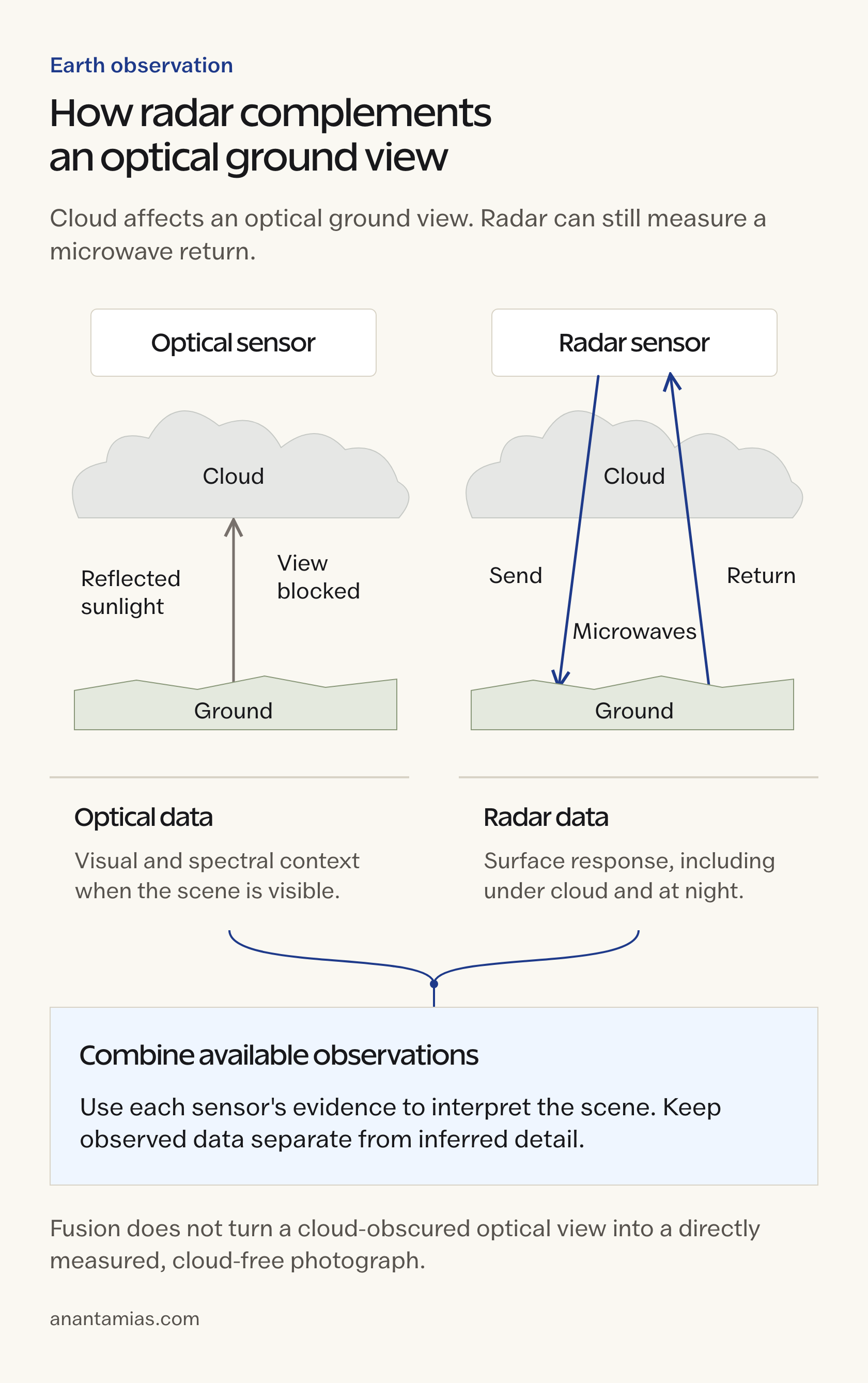
- SAR sends microwave pulses and records returning energy. Because the instrument supplies its own illumination, it does not require daylight; suitable radar wavelengths can also pass through cloud cover that blocks optical ground views.
- Radar backscatter depends on how the transmitted signal interacts with the surface. Structure, moisture and viewing geometry matter, so a bright radar patch should not automatically be read as a bright-coloured object.
- The synthetic aperture is created by combining observations made as the instrument moves. NASA’s SAR explanation describes how this simulates a longer antenna, improving resolution without requiring an impractically large physical antenna.
- The central comparison is complementarity: optical sensing supplies visual or spectral information, while radar supplies a different response to physical conditions. Neither measurement is universally superior for every question about the ground.
What fusion adds, and what it cannot add
Fusion means combining information from the two observations; it does not change the wavelength or cloud sensitivity of the optical instrument.
- The proposed OptoSAR approach brings SAR and electro-optical data together to create a richer picture of Earth. Its value rests on the different information each sensor contributes, not on renaming two separate pictures.
- When clouds obscure the ground, radar observations can still contribute evidence about the surface. That does not mean the accompanying optical sensor suddenly records an unobstructed visual image through the same cloud layer.
- Shared interpretation can use one observation to help make sense of the other. For example, an available optical view may provide context for a radar feature; this is an explanatory example, not a demonstrated project result.
- A useful evaluation should ask whether combined data improve the intended task compared with either input alone. A visually striking fused product is insufficient proof if its object classifications cannot be independently checked.
- Missing observations must remain distinguishable from inferred information. If processing estimates what lies beneath a cloud, the result should not be presented as a direct optical measurement captured at that time and location.
Read proposed capability separately from proven performance
The announcement supports development of a system; it does not establish that its intended surveillance performance has been demonstrated under operational conditions.
- High-resolution imaging is a project objective in the release. The announced agreement is not a launch confirmation, a declaration of routine service or independent validation of the satellite’s planned ground-observation performance.
- Detection and classification ask different questions: whether something is present, and what it is. A system should be evaluated against the specific task claimed rather than treating all image-based decisions as equivalent.
- For surveillance applications, assess false detections and missed targets alongside useful detections. This is an evaluation requirement: the PIB announcement names intended applications but provides no published performance results establishing their accuracy.
- Day-and-night capability describes a radar advantage over sunlight-dependent optical viewing. It should not be expanded into a claim of uninterrupted global coverage, which the announcement neither specifies nor demonstrates for this proposed system.
- Domestic technology development can strengthen the capacity to build and interpret specialised observations. The immediate teaching point is sensor integration; financing details do not establish that the sensing challenge has already been solved.

Way Forward
Validate the information, not merely the image
- Test fused products against radar-only and optical-only results for clearly defined tasks and conditions.
- Report observation gaps and uncertainty so users can distinguish direct measurements from inferred features.
- Publish evidence of operational performance before treating design objectives as demonstrated capabilities.
Conclusion
- OptoSAR seeks to combine different kinds of evidence: optical detail and radar observations less constrained by daylight and clouds. Fusion is useful because the inputs differ, not because their limitations disappear.
- Distinguish instrument capability, processing claims and operational validation. The September agreement supports a proposed multisensor satellite; it does not prove that all intended imaging and classification outcomes are already available.
UPSC Practice Questions
Prelims MCQ 1
With reference to Synthetic Aperture Radar, consider the following statements:
- SAR transmits energy and measures the returning signal.
- SAR requires sunlight to illuminate the observed ground.
- A synthetic aperture combines observations to simulate a longer antenna.
How many of the above statements are correct?
(a) Only one (b) Only two (c) All three (d) None
Answer: (b) Only two
Explanation:
The first and third statements are correct. SAR is active sensing: its own transmitted energy allows operation without sunlight.
Prelims MCQ 2
Which statement best explains SAR-optical data fusion?
(a) Radar makes the optical sensor transmit microwaves (b) Optical cameras become able to see through every cloud (c) Complementary observations are combined while individual sensor limits remain (d) Fusion removes the need to validate classifications
Answer: (c) Complementary observations are combined while individual sensor limits remain
Explanation:
Fusion combines information from different sensors. It does not change the physical sensing properties of either instrument or establish accuracy without validation.
UPSC Mains Questions
- Explain why combining SAR and optical observations can improve Earth observation. What limitations remain after data fusion?
- Distinguish a proposed satellite’s design objectives from demonstrated operational capability. Suggest an evidence-based framework for evaluating multisensor surveillance systems.
Sources: PIB, Ministry of Science and Technology and NASA Earthdata, Synthetic Aperture Radar.
Frequently Asked Questions
What is OptoSAR?
In the announced project, OptoSAR is an approach combining synthetic aperture radar and electro-optical imaging. It seeks to fuse complementary observations into a richer picture of Earth, subject to development and validation.
Why can radar operate at night?
SAR is an active instrument that sends its own microwave signal and measures returning energy. Unlike sunlight-dependent optical observations, it does not need the Sun to illuminate the ground.
Does fusion let an optical camera see through clouds?
No. Radar may provide surface information through cloud cover, but the optical instrument retains its physical limitations. Combining those observations does not turn the radar measurement into an unobstructed optical photograph.
Is the announced satellite already operational?
The release describes a proposed satellite and a development agreement requiring engineering, testing and validation. Its imaging and classification objectives should not be reported as capabilities already demonstrated in routine service.
Source: https://anantamias.com/current-affairs/optosar-satellite-radar-optical-data-fusion/
Paneer Draft Rules: Product Names and Informed Food Choices
Why in News?
On September 24, 2026, the Health Ministry announced FSSAI’s draft amendment restricting the use of the name paneer for products made with constituents not derived from milk.
- The proposal would amend the Prohibition and Restrictions on Sales Regulations, rather than announce a completed change in the law.
- Products licensed or registered as Analogue in Dairy Context would have to stop using paneer in their names, labels or marketing under the proposal.
- The 60-day consultation period runs from public availability of the relevant Gazette copies, not automatically from the ministry’s announcement.
- A familiar food name can influence purchasing before a consumer reads the ingredient list. Product identity is part of informed choice.
- The regulatory question concerns truthful representation; the announcement does not establish that every analogue product is unsafe.
UPSC Relevance
Prelims Relevance
- FSSAI: Food Safety and Standards Authority of India.
- Draft regulation: a proposed legal change subject to consultation.
- Dairy analogue: the category expressly identified in the proposal.
- Food identity and food safety: distinct questions requiring different evidence.
Mains Relevance
GS Paper 2
- Public consultation and delegated regulation.
- Consumer protection through accurate food descriptions.
GS Paper 3
- Information asymmetry and fair competition in food markets.
Essay
- Trust in markets depends on what product names allow consumers to infer.
Background and Context
What the proposed naming restriction means
The proposal addresses the identity conveyed by a familiar food name, covering how the product is presented as well as what it contains.
- The draft notification proposes adding paneer made of constituents not derived from milk to the sales restrictions. Its stated purpose is preventing misleading descriptions of a product’s nature and composition.
- Existing registration under the analogue category would not preserve the right to use the paneer name under the proposed amendment. Registration and the permitted description of a food answer different regulatory questions.
- The announcement expressly covers nomenclature, labelling and marketing. The concern is broader than one ingredient panel: a prominent product name or sales claim can create an expectation that smaller disclosures do not remove.
- A useful comparison is between accurately identified milk-derived paneer and an analogue represented as paneer. The issue is whether the description matches composition, rather than whether two products look similar on a plate.
- The draft should not be paraphrased as a universal prohibition on analogue foods. Its stated target is manufacturing and selling analogue products as paneer; wider claims about every substitute exceed the announced proposal.

How a draft becomes a regulatory decision
The Gazette is the primary legal source; the ministry’s release explains the proposal but does not turn consultation into an operative final rule.
- FSSAI issued the proposal with the Central Government’s previous approval under the Food Safety and Standards Act. The notification invokes its regulation-making authority; it is not a separate new Act passed by Parliament.
- Public consultation allows people likely to be affected to submit objections or suggestions. Manufacturers, consumers and other stakeholders can challenge ambiguous language, explain implementation problems or support a clearer restriction with reasons.
- The stated 60-day period begins when copies of the Gazette containing the notification become publicly available. A news report’s publication date is not a substitute for that specified legal trigger when calculating deadlines.
- The notification says timely objections and suggestions will be considered by FSSAI. Consideration does not mean every suggestion must be accepted, or that the proposal necessarily takes effect unchanged once consultation time expires.
- For examination answers, preserve the distinction between proposed and final regulation. A draft shows the direction of policy, but claims about enforceable new duties require checking the subsequent final notification and applicable commencement terms.
Why accurate names protect consumer choice
Naming rules respond to unequal information between sellers and buyers, while safety claims still require evidence about the actual food and its handling.
- Information asymmetry arises when a seller knows composition that a buyer cannot readily verify. A familiar name reduces search effort, but a misleading name can make that shortcut unreliable during an ordinary purchase.
- Informed choice requires understanding what is being bought before comparing price or suitability. Consumers may accept a substitute when clearly identified; their willingness to buy it does not justify concealing its distinct composition.
- Safety and identity must be assessed separately. Calling an analogue unsafe without evidence confuses a naming dispute with a hazard finding; a milk-derived product also needs safe production, storage and handling.
- Fair competition is another policy rationale: accurate descriptions help buyers compare products on relevant terms. Regulatory analysis should examine whether compliance guidance prevents misleading claims without needlessly excluding honestly described alternatives from the market.
- Practical enforcement clarity would require explanations that businesses and inspectors interpret consistently. For this proposal, useful consultation asks which descriptions create confusion and how compliant names can communicate a product’s actual identity to buyers.
Way Forward
Make the final rule clear and proportionate
- Publish clear naming examples with any final rule so businesses can distinguish compliant descriptions from misleading uses.
- Assess consultation evidence on ambiguity and implementation before fixing the final wording and applicable transition arrangements.
- Keep safety enforcement evidence-based while addressing identity claims; do not encourage unsupported claims that all alternatives are hazardous.
Conclusion
- The paneer proposal illustrates how product identity supports consumer protection: a name should communicate composition reliably, allowing buyers to judge alternatives without being misled by familiar terminology.
- Use this example to connect information asymmetry with consultative regulation. Keep its draft status explicit, and separate the proposed naming restriction from unsupported claims of a blanket analogue ban or automatic safety risk.
UPSC Practice Questions
Prelims MCQ 1
With reference to FSSAI’s paneer draft amendment, consider the following statements:
- The proposal addresses use of the paneer name in marketing as well as labelling.
- The proposal establishes that every dairy analogue is unsafe.
- The consultation period is linked to public availability of the relevant Gazette copies.
How many of the above statements are correct?
(a) Only one (b) Only two (c) All three (d) None
Answer: (b) Only two
Explanation:
Statements 1 and 3 are correct. The proposal concerns misleading product identity; it does not establish that all analogue products are unsafe.
Prelims MCQ 2
Which best explains the consumer-protection rationale for accurate food names?
(a) Every cheaper substitute is unsafe. (b) Registration makes all marketing claims permissible. (c) Buyers need reliable information about product identity. (d) Consultation automatically creates an enforceable final rule.
Answer: (c) Buyers need reliable information about product identity.
Explanation:
Accurate names reduce information asymmetry and help buyers make informed choices about composition and suitability.
UPSC Mains Questions
- Explain how truthful food labelling can address information asymmetry. Discuss with reference to FSSAI’s proposed paneer naming restriction.
- Why must consumer-protection regulation distinguish product identity from product safety? Examine the role of public consultation in designing proportionate rules.
Sources: PIB, Ministry of Health and Family Welfare and Gazette of India, FSSAI draft notification.
Frequently Asked Questions
Has the paneer naming restriction already become a final rule?
No. The September announcement concerns a draft amendment inviting objections and suggestions. It should not be described as an implemented new restriction without checking a subsequent final notification and its terms.
Does the proposal ban every dairy analogue?
The stated proposal targets manufacturing and selling analogue products as paneer, including use of that name in labels and marketing. It does not justify claiming that all analogue foods are universally prohibited.
Are analogue products automatically unsafe?
No such conclusion follows from this proposal. Product identity and safety are distinct questions: a misleading name concerns representation, while a safety finding requires evidence about hazards in the actual food.
When does the consultation period begin?
The notification specifies sixty days from public availability of the Gazette copies containing it. The ministry’s announcement date should not automatically be treated as the start date for calculating a deadline.
Source: https://anantamias.com/current-affairs/paneer-draft-dairy-analogue-naming-consumer-choice/
PLA Bioplastics: Renewable Feedstock and End-of-Life Conditions
Why in News?
On 24 September 2026, the Department of Biotechnology announced the commercial-use launch of PLA-based bioplastics and support for a planned pilot facility at Balrampur Chini Mills.
- The initiative uses renewable sugar-based feedstock to create a materials value chain beyond conventional sugar products.
- The pilot-scale R&D facility will be established at Kumbhi, Uttar Pradesh; the announcement does not establish that it is already operating.
- The proposed work covers specialised PLA grades and co-polymers, process development and customer validation.
- A change in feedstock can reduce reliance on fossil inputs without automatically solving waste collection or disposal.
- The policy question is whether biomanufacturing can deliver useful materials alongside credible, locally available end-of-life arrangements.
UPSC Relevance
Prelims Relevance
- PLA: polylactic acid, a polymer derived from lactic acid.
- Bio-based: describes the biological origin of the feedstock.
- Biodegradation: biological breakdown depends on material and environmental conditions.
- Industrial composting: a managed treatment process, distinct from home composting.
- Pilot facility: tests and develops processes before wider scale-up.
Mains Relevance
GS Paper 3
- Biotechnology-led industrial diversification and indigenous process development.
- Waste-management infrastructure, environmental claims and material substitution.
Essay
- An environmentally promising material still needs an effective disposal system.
Background and Context
What the launch establishes
The announcement combines a commercial-use launch with a separate research facility that is still planned, so their implementation status must remain distinct.
- Balrampur Chini Mills is taking forward the PLA initiative under the BioE3 framework. The official release identifies renewable sugar feedstock as the industrial starting point, connecting an agricultural resource with a manufactured material.
- The planned pilot is intended to develop specialised grades and co-polymers. This is a research and validation role; its announcement should not be presented as proof of an already commissioned production line.
- Process know-how concerns how production can be repeated reliably, not simply whether a material can be made once. The pilot is expected to generate technical and economic evidence needed for subsequent commercial translation.
- Customer validation checks whether a developed material suits its intended application. A successful laboratory result does not by itself demonstrate that the material will meet a manufacturer’s processing needs or a buyer’s performance requirements.
- Industrial diversification is the central policy significance: biological resources can supply material production as well as established uses. The release describes a potential value chain; it does not establish every claimed economic or environmental outcome.
From sugar feedstock to a polymer
PLA manufacture connects biological feedstock with chemical conversion; the finished material is a polymer, not unprocessed plant matter or sugar pressed into a mould.
- Sugar-based feedstock supplies the starting resource, while lactic acid is the intermediate identified in the release. Keeping these stages separate explains how agricultural inputs become materials with properties different from the original crop.
- Lactic acid is a small molecular building block, whereas PLA consists of linked units forming polymer chains. Calling the resulting product bio-based identifies its origin; it does not mean the product remains biologically unchanged.
- Polymer manufacture adds a conversion stage between the renewable resource and the finished product. An assessment must examine that stage as well as the feedstock, rather than treating agricultural origin as a complete environmental verdict.
- Specialised grades are relevant because different applications demand different material properties. The pilot’s research mandate includes these grades and co-polymers, rather than assuming that one standard formulation will serve every possible use equally well.
- Resource recovery and renewable sourcing ask different questions: one concerns using discarded material, the other concerns where inputs originate. The leather protein-recovery example illustrates why these descriptions should not be treated as interchangeable environmental claims.

Why disposal conditions matter
The useful distinction is between a material’s origin and its fate after use: one label cannot answer both questions for a consumer or waste operator.
- Bio-based describes feedstock origin; biodegradable describes breakdown under specified conditions. UNEP’s material comparison treats managed facilities and natural environments separately, rather than assigning one universal breakdown outcome to every environment.
- Industrial compostability is not permission to discard PLA in soil, rivers or the sea. A managed treatment claim cannot be converted into an assurance of home compostability or harmless litter under uncontrolled environmental conditions.
- Hydrolysis can break PLA down towards lactic acid before further microbial processing. A DOE-hosted research presentation examines pretreatment and anaerobic degradation; it does not establish that untreated litter follows the same pathway in nature.
- Collection and acceptance must connect the used product with a suitable facility. A compostability claim has limited practical value if the local operator cannot identify, segregate or accept that product into its actual treatment process.
- Environmental evaluation should compare the complete route from input to treatment. The urban waste LCA note explains system boundaries; here, the immediate distinction is renewable origin versus the specific conditions needed after disposal.
Way Forward
Match the product with a real treatment route
- Require specific claims about the tested product and disposal conditions, rather than an unqualified biodegradable label.
- Link procurement to collection arrangements and confirmation that the receiving facility accepts the material.
- Use the pilot to publish performance and process evidence supporting scale-up, with separate reporting of planned and operational capabilities.
Conclusion
- PLA offers a route from renewable sugar resources to manufactured materials, but feedstock origin does not settle the disposal question. The proposed pilot should be judged on evidence supporting usable grades and repeatable processes.
- For an answer, connect industrial innovation with verified end-of-life conditions: distinguish the commercial-use launch from the planned pilot, and distinguish a managed treatment pathway from claims that a product will disappear wherever it is discarded.
UPSC Practice Questions
Prelims MCQ 1
With reference to PLA-based materials, consider the following statements:
- Bio-based describes the origin of a material’s feedstock.
- Industrial compostability automatically establishes marine biodegradability.
- PLA is a polymer associated with lactic acid.
How many of the above statements are correct?
(a) Only one (b) Only two (c) All three (d) None
Answer: (b) Only two
Explanation:
Statements 1 and 3 are correct. Performance in a managed composting system does not establish biodegradability in the sea.
Prelims MCQ 2
What is the principal role of the planned PLA pilot-scale R&D facility described in the announcement?
(a) Certifying that all bio-based plastics degrade in seawater (b) Replacing municipal waste segregation (c) Developing grades and process evidence for commercial translation (d) Eliminating the need for customer validation
Answer: (c) Developing grades and process evidence for commercial translation
Explanation:
The announced pilot is intended to develop specialised PLA grades, process know-how and validation evidence. It is still planned.
UPSC Mains Questions
- Explain why a bio-based plastic cannot be assessed solely by the renewable origin of its feedstock.
- Discuss how pilot-scale research and waste-management infrastructure can support responsible commercialisation of PLA-based materials.
Sources: PIB, Ministry of Science and Technology and UNEP.
Frequently Asked Questions
What is PLA?
PLA means polylactic acid. It is a polymer associated with lactic acid and can be produced using renewable sugar-based feedstock. Its biological input does not determine how it behaves in every disposal environment.
Is the announced pilot already operational?
The official release says the pilot-scale R&D facility will be established at Kumbhi. The commercial-use launch and the planned research facility are separate developments and should not be described as the same operational milestone.
Can PLA be put in a home compost bin?
An industrial compostability claim alone is insufficient. Home composting involves different conditions, so consumers should follow the specific product’s verified instructions and the requirements of the local treatment provider.
Does bio-based mean harmless if littered?
No. Bio-based identifies feedstock origin, while breakdown depends on the material and its surroundings. It does not establish rapid disappearance in soil or water, or justify releasing a product into the environment.
Source: https://anantamias.com/current-affairs/pla-bioplastics-feedstock-production-disposal-conditions/
Quantum Measure: Why Interference Can Produce a Value Above One
Why in News?
On 24 September 2026, the Department of Science and Technology reported an RRI experiment measuring a quantum measure of about 1.17, while photon-detection probability remained within its ordinary bounds.
- The Raman Research Institute experiment used an optical event filter to select a collection of possible photon routes and determine their quantum measure.
- The measured quantum measure was about 1.17, consistent within uncertainty with an apparatus-adjusted prediction of about 1.18.
- The reported result was published in Quantum; it concerns a generalized measure incorporating interference, not a probability greater than one.
- A measurement claim is meaningful only after identifying the quantity being measured: a generalized quantum measure and a detector probability are different quantities.
- The work links foundational theory to a laboratory measurement, while proposed computing applications still require further development.
UPSC Relevance
Prelims Relevance
- Quantum history: a possible evolution or route between preparation and detection.
- Event: a selected set of histories in this framework.
- Interference: wave-like contributions from different routes combine.
- Polarisation: orientation of light-wave oscillation, used here to distinguish routes.
- Detection probability: remains between zero and one.
Mains Relevance
GS Paper 3
- Indigenous research in quantum measurement and enabling science.
- Separating an experimental result from proposed technological applications.
Essay
- Scientific progress requires both new questions and precise limits on claims.
Background and Context
Histories, events and interference
Instead of asking only about a system at one instant, the histories viewpoint considers possible routes through its evolution between preparation and detection.
- A history is one possible way a quantum system evolves. For the optical experiment, the relevant examples are photon routes between source and detector, rather than a list of independently observed particle journeys.
- An event is a selected collection of these histories. Quantum Measure Theory assigns it a generalized weight that includes interference between routes, so the weight cannot automatically be interpreted as an ordinary frequency.
- Interference means contributions from different possible routes combine like waves. The combined effect depends on their relationship, rather than simply adding probabilities as though the alternatives were separately observed and independent of interference.
- Constructive interference can reinforce contributions, analogous to overlapping wave crests. This helps explain the unusual measure, but does not mean the apparatus creates extra photons or records more than certainty at its detector.
- The main comparison is quantum measure versus probability. An ordinary probability lies between zero and one; a measure assigned to a selected history collection can exceed one because it incorporates interference differently.
How the optical experiment accessed the measure
The experiment connected a question about selected routes to observable optical powers through a calibrated event filter, making an abstract quantity experimentally accessible.
- The researchers allowed laser light to traverse different routes in an optical setup. Their event filter was designed to select a particular collection of routes, giving the measurement a clearly specified event to examine.
- Polarisation, the orientation of light-wave oscillation, distinguished routes within the arrangement. It supplied a controllable marker for selecting the intended collection, rather than requiring the researchers to observe each possible history separately.
- The team then erased the distinguishing information so the selected routes could interfere. Both selection and interference mattered: retaining information that separates routes would change the relationship the filter was intended to probe.
- Measurements of input and output laser power were used to infer photon-detection probability. The filter’s calibration then connected that probability to quantum measure; the reported measure was not simply the detector probability renamed.
- The calibrated result was compared with a prediction accounting for apparatus imperfections. Agreement within experimental uncertainty supports the measurement method; it does not imply that every possible history collection was tested by this experiment.

What the result establishes and what remains open
The finding expands experimentally accessible questions about quantum processes; it must not be promoted into claims about gravity, certainty or finished computing hardware.
- The official research account reports an experimentally measured quantum measure above one. The achievement is giving operational access to this generalized quantity, while preserving the distinction between measured optical response and calibrated interpretation.
- The inferred detector probability remains between zero and one. Calling the result a chance greater than certainty would confuse two mathematical quantities and misrepresent both the experiment and the probability rule it respects.
- A future event filter might select photon histories while leaving photons available for subsequent quantum operations. That potential application is different from the reported power-based measurement and should not be described as already demonstrated.
- Quantum Measure Theory has links to foundational work motivated partly by quantum gravity. This optical experiment does not test a theory of quantum gravity merely because the framework has that intellectual origin.
- The researchers explicitly say the work does not resolve the quantum measurement problem. For policy analysis, its value is an additional experimental capability, with further engineering and scientific questions separating foundational research from practical deployment.
Way Forward
Build on a precisely defined result
- Evaluate calibration and apparatus uncertainty alongside the reported value so subsequent measurements can be compared meaningfully.
- Treat non-destructive filtering as a further development objective, requiring evidence that selected photons remain available for later operations.
- Keep public explanations clear about measure, probability and application status; avoid presenting foundational optics as completed quantum-computing hardware.
Conclusion
- A quantum measure above one is compatible with ordinary detection probabilities because the two quantities answer different questions. Interference and calibration are the essential links in understanding the result.
- The achievement is experimental access to a history-based quantity. Its scientific significance can be recognised without claiming impossible probabilities, a solution to the measurement problem or a demonstrated test of quantum gravity.
UPSC Practice Questions
Prelims MCQ 1
With reference to the reported quantum-measure experiment, consider the following statements:
- A quantum measure can include interference between possible histories.
- The experiment measured a photon-detection probability greater than one.
- The event filter’s calibration was used to determine the quantum measure.
How many of the above statements are correct?
(a) Only one (b) Only two (c) All three (d) None
Answer: (b) Only two
Explanation:
Statements 1 and 3 are correct. The quantum measure exceeded one, while the detection probability remained between zero and one.
Prelims MCQ 2
What does an event represent in the histories-based framework described in the experiment?
(a) A selected collection of possible histories. (b) An observed violation of the speed of light. (c) A guaranteed photon detection at every output. (d) A completed quantum-computing operation.
Answer: (a) A selected collection of possible histories.
Explanation:
The event is the chosen set of histories or routes. The generalized measure incorporates their interference and is inferred using the calibrated filter.
UPSC Mains Questions
- Explain how a quantum measure can exceed one without violating the bounds of ordinary probability. Discuss the role of interference and calibration.
- Assess the significance of experimental access to foundational quantum quantities. Why should research communication distinguish demonstrated measurements from prospective computing applications?
Sources: PIB, Ministry of Science and Technology and Raman Research Institute, QuIC Laboratory.
Frequently Asked Questions
Did scientists measure a probability greater than one?
No. The photon-detection probability remained between zero and one. The value above one was a quantum measure, a generalized weight assigned to a chosen collection of histories that includes interference.
What is a quantum history in this experiment?
A history describes a possible evolution between preparation and detection. In this optical arrangement, the researchers considered possible photon routes and selected a collection of those routes as the event of interest.
How was the quantum measure determined?
Researchers inferred detection probability from input and output laser powers, then used the event-filter calibration to determine quantum measure. The detector probability itself was not reported as exceeding its normal upper bound.
Does the result prove quantum gravity or solve the measurement problem?
No. Although Quantum Measure Theory has connections to research motivated by quantum gravity, the optical experiment does not test such a theory. The researchers also explicitly state that it does not resolve the measurement problem.
Is the proposed computing filter already available?
The release describes a future possibility: selecting photon histories while preserving photons for further operations. That non-destructive application should not be confused with the reported experiment, which inferred the measure using optical power measurements.
Source: https://anantamias.com/current-affairs/quantum-measure-interference-probability-bound/
Tuna Parasites: Geography, Evidence and Food-Safety Risk
Why in News?
On September 24, 2026, ICAR-CMFRI advised consumers against avoiding tuna solely because parasites were reported in fish studied in the Atlantic Ocean off Brazil.
- The advisory concerned reports about skipjack tuna from a specific geographical region, rather than a finding covering tuna everywhere.
- CMFRI reported no external manifestations of harmful parasitic infestation in the Indian fish it examined; that is not a nationwide parasite-free certification.
- The institute advised prompt evisceration and proper cooking as precautions to reduce associated food-safety risk.
- A study’s geographical scope matters when deciding whether its findings apply to another fish population.
- Useful risk communication avoids both unnecessary food avoidance and an unsupported promise of zero risk.
UPSC Relevance
Prelims Relevance
- ICAR-CMFRI: Central Marine Fisheries Research Institute, Kochi.
- Skipjack tuna: the fish discussed in the regional parasite reports.
- Intermediate hosts: organisms that can support stages of a parasite’s life cycle.
- Evisceration: removal of intestines and other viscera during processing.
- Fish stocks: populations that may differ in their ecological exposure.
Mains Relevance
GS Paper 3
- Ecological variation and the limits of generalising biological studies.
- Evidence-based food-safety precautions across fisheries supply chains.
GS Paper 2
- Clear public communication of scientific uncertainty.
Essay
- Public trust requires scientific findings to retain their limits when translated into advice.
Background and Context
Why a parasite report needs a location
Fish of the same species can encounter different ecological conditions, so a finding from one region is not automatically a finding about another.
- The advisory responds to reports of parasites in skipjack tuna studied off Brazil. Its central correction concerns the geographical reach of that evidence, rather than denying that parasites can occur in marine fish.
- Parasite presence and abundance can vary between individual fish as well as regions. A species name identifies the fish but does not describe every habitat, exposure or interaction affecting the parasites it may carry.
- The availability of intermediate or secondary hosts, including copepods mentioned by CMFRI, helps explain this variation. Different local ecological conditions can support different opportunities for a parasite to circulate among organisms in that environment.
- The useful comparison is between evidence collected from Brazilian Atlantic fish and the Indian fish discussed by CMFRI. Treating these as interchangeable removes the geographical context needed to interpret either observation responsibly.
- Parasite patterns have also been used as indicators for differentiating fish stocks or populations. That research use shows why differences matter; it does not mean this advisory has identified or mapped every tuna stock.

What CMFRI's observations do and do not show
The institute’s statement is narrower than a guarantee about every fish, and preserving that distinction is essential to an accurate reading of the advisory.
- CMFRI says scientists regularly examine fish, including skipjack tuna, during fish biology studies. They observe abnormalities and parasites when necessary; the release does not describe a comprehensive negative laboratory survey covering all Indian seafood.
- The reported finding is absence of external manifestations of harmful parasitic infestation in examined fish. External appearance is the stated observation, not proof that every possible parasite is absent from every tissue or specimen.
- Scope of inference asks which population a finding can support claims about. An observation on examined fish should not become a universal statement about all fish sold in markets, all coastal areas or future catches.
- The advisory’s consumer message is conditional: do not avoid fish solely because of a report from another region. It does not ask consumers to ignore local evidence or abandon appropriate handling and cooking precautions.
- Scientific uncertainty should be expressed without reversing the burden of evidence. Neither a foreign report nor reassuring external observations alone establish the parasite status of an unexamined fish from a different population or location.
How handling and preparation reduce risk
The advisory links practical precautions to exposure, rather than treating the fish’s name or place of origin as a substitute for appropriate food preparation.
- Prompt and proper evisceration means removing intestines and other viscera during cleaning and processing. CMFRI identifies this as an additional food-safety precaution; cleaning should not be presented as a guarantee that cooking becomes unnecessary.
- Proper cooking kills parasites and significantly reduces associated food-safety risk, according to the institute. Its advisory gives general precautions, rather than a specific temperature-and-time protocol for preparing fish.
- The institute flags raw or lightly cooked seafood as potentially higher risk where local parasite prevalence is high and inadequately assessed. The preparation method and local evidence must be considered together when interpreting this caution.
- Cooking practices can add protection, but a general description of how seafood is commonly prepared is not verification of every serving. The relevant precaution remains appropriate handling, cleaning and cooking for the food actually consumed.
- Good public communication should retain both parts of the advice: avoid unsupported generalisation and follow practical precautions. Removing either part can turn a measured advisory into alarm about an entire food or unjustified reassurance.
Way Forward
Communicate the finding with its limits
- Pair parasite reports with their sampling location and observation method, so readers can see what the study actually supports.
- Explain evisceration and cooking in clear handling guidance without implying that visual inspection alone guarantees safety.
- Update advice when local evidence changes; distinguish a new observation from claims copied from a different population.
Conclusion
- This advisory connects ecology with evidence appraisal: the same fish species can face different parasite exposure across regions, and observations must remain attached to the fish and methods actually examined.
- For a balanced answer, combine geographical limits with practical risk reduction. Do not convert absence of external signs into a parasite-free guarantee, or a regional report into a reason to reject all tuna.
UPSC Practice Questions
Prelims MCQ 1
With reference to CMFRI’s tuna advisory, consider the following statements:
- Parasite occurrence can vary between geographical regions.
- Absence of external manifestations proves that all Indian fish are parasite-free.
- Parasite patterns can help differentiate fish stocks.
How many of the above statements are correct?
(a) Only one (b) Only two (c) All three (d) None
Answer: (b) Only two
Explanation:
Statements 1 and 3 are correct. The institute’s observation about external manifestations in examined fish is narrower than a universal parasite-free claim.
Prelims MCQ 2
Evisceration during fish processing refers to:
(a) Removing intestines and other viscera. (b) Identifying all parasites by external appearance. (c) Classifying every fish into a distinct stock. (d) Replacing cooking with visual inspection.
Answer: (a) Removing intestines and other viscera.
Explanation:
CMFRI recommends prompt, proper removal of viscera as an additional food-safety precaution, alongside appropriate handling and cooking.
UPSC Mains Questions
- Why should findings about parasites in one fish population not automatically be generalised to another? Discuss the ecological and evidentiary considerations.
- How can public agencies communicate food-safety uncertainty without creating either unnecessary alarm or false reassurance? Illustrate with CMFRI’s tuna advisory.
Source: PIB, Ministry of Agriculture and Farmers Welfare.
Frequently Asked Questions
Why did CMFRI issue the tuna advisory?
It responded to reports of parasites in skipjack tuna studied off Brazil. The institute cautioned against generalising findings from one geographical region to Indian fish and advised appropriate handling, cleaning and cooking.
Did CMFRI certify all Indian tuna as parasite-free?
No. It reported that examined fish had not shown external manifestations of harmful parasitic infestation. That limited observation is not a universal guarantee about every fish or a comprehensive negative laboratory result.
Why can parasite occurrence differ between regions?
Local ecological conditions and the availability of intermediate or secondary hosts can differ. CMFRI notes that parasite occurrence varies between individual fish and geographical regions, making location important when interpreting a study.
What precautions does the advisory recommend?
CMFRI recommends proper, prompt evisceration and appropriate handling, cleaning and cooking. It states that proper cooking kills parasites and significantly reduces associated risk, without supplying a numerical cooking protocol in this release.
Source: https://anantamias.com/current-affairs/tuna-parasites-geography-food-safety-risk/
U.S. Federal Reserve raised Interest Rates: Implications for India
Why in News?
Recently, the Federal Open Market Committee (FOMC) raised the federal funds target range by 25 basis points, from 3.50-3.75% to 3.75-4.00%. This was its first rate increase since 2023.
The Federal Reserve increased interest rates to support a faster return to its 2% inflation target and ensure long-term price stability.
| UPSC Relevance: GS-3 Economy: Monetary policy, Inflation, Capital flows, Exchange rate, External sector Prelims: Federal funds rate, repo rate, bond yield. |
What is the Federal Funds Rate?
- The federal funds rate is the target interest rate set by the Fed at which commercial banks borrow and lend their extra reserves to one another overnight.
- Unlike the RBI’s repo rate, which is the rate at which banks borrow short-term funds from the RBI against eligible securities, the federal funds rate primarily relates to overnight interbank lending.
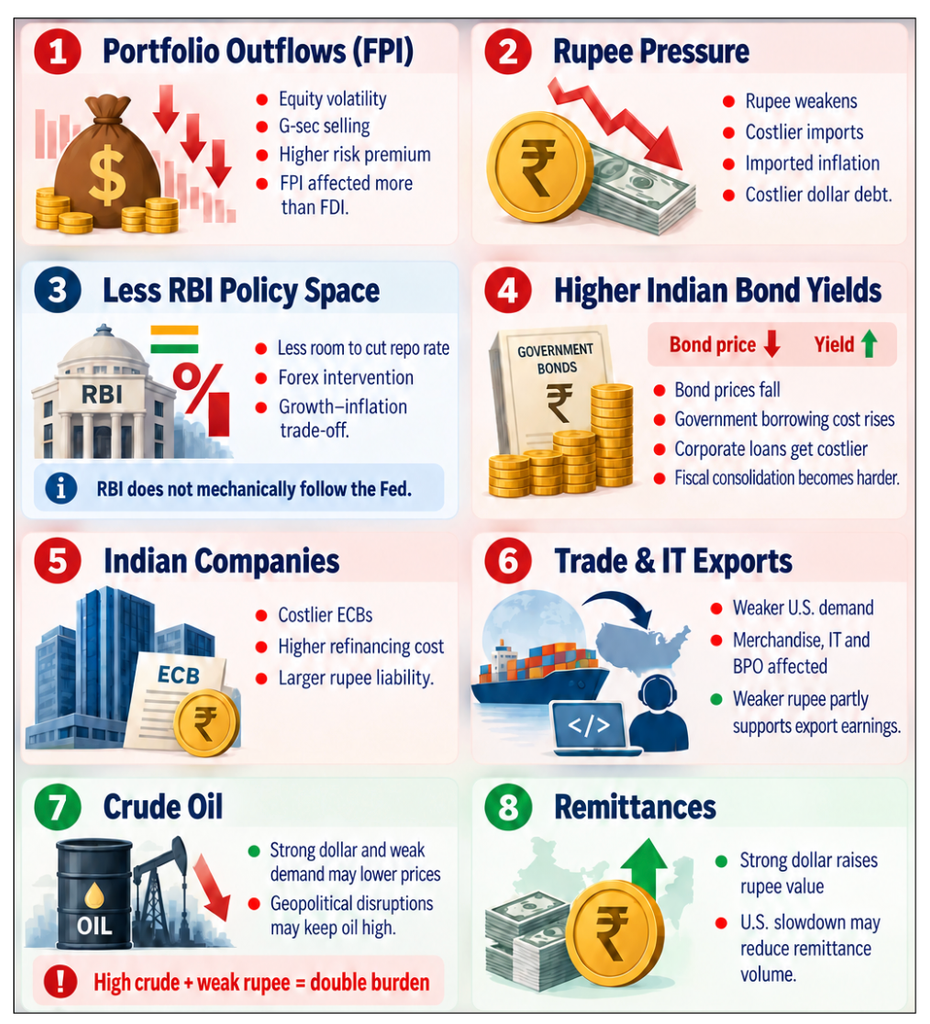
Impacts of the US Fed Rate Hike on India:
1. Foreign portfolio investment outflows:
- Higher U.S. yields reduce the relative attractiveness of Indian equities and bonds. Foreign portfolio investors may shift towards U.S. securities, causing:
- Equity-market volatility
- Selling pressure in Indian government bonds
- Higher risk premiums on Indian assets.
- The effect is generally stronger on FPI flows than on long-term FDI, which depends more on domestic growth, market size and investment conditions.
2. Depreciation pressure on the rupee:
- Capital outflows and greater demand for dollars can weaken the rupee. A weaker rupee:
- Raises the cost of crude oil, fertilisers, electronics and machinery
- Increases imported inflation
- Enlarges the subsidy or fiscal burden where prices are administered
- Makes foreign-currency debt servicing more expensive.
3. Reduced monetary-policy space for RBI:
- The RBI does not mechanically follow the Fed. Its mandate remains centred on Indian inflation and growth. However, a narrowing India-U.S. interest-rate differential can intensify capital outflows and currency pressure. This may:
- Reduce the RBI’s room to cut the repo rate
- Strengthen the case for holding or raising rates
- Require foreign-exchange intervention
- Produce a sharper growth-versus-inflation trade-off
4. Higher Indian bond yields:
- As US bond yields rise, it offers investors higher returns with relatively low risk. Foreign investors may therefore sell Indian government securities and move money to the U.S. This reduces demand for Indian government bonds. Bond prices and bond yields move in opposite directions.
- Higher Indian G-sec yields can:
- Raise government borrowing costs, as it must offer higher interest on new bonds.
- Increase corporate borrowing costs.
- Push up bank lending rates
- Reduce existing bond prices (Older bonds offering lower interest become less attractive)
This complicates fiscal consolidation: Higher interest payments consume more government revenue, leaving less money for development expenditure.
5. Impact on Indian companies:
- Companies with unhedged External Commercial Borrowings may face:
- Higher dollar interest rates
- Greater refinancing costs and
- Larger rupee liability if the domestic currency depreciates.
- Higher U.S. interest rates can slow American consumption and investment, potentially weakening demand for Indian merchandise exports, Information-technology services, Business-process outsourcing and Engineering and pharmaceutical products.
- However, rupee depreciation may partly raise the rupee earnings of exporters receiving revenue in dollars.
6. Crude oil:
- A stronger dollar and weaker global demand can put downward pressure on commodity prices, but geopolitical disruptions can keep oil prices elevated.
- For India, the combination of high crude prices + rupee depreciation is particularly adverse.
7. Remittances and household effects:
- A stronger dollar can increase the rupee value of dollar-denominated remittances. But tighter U.S. financial conditions may eventually weaken employment and income growth, reducing the volume of remittances.
UPSC PYQ 2021
Q. Indian Government Bond Yields are influenced by which of the following?
- Actions of the United States Federal Reserve
- Actions of the Reserve Bank of India
- Inflation and short-term interest rates
Select the correct answer using the code given below:
(a) 1 and 2 only
(b) 2 only
(c) 3 only
(d) 1, 2 and 3
Answer: (d) 1, 2 and 3
Satellite Smart Anti-Airfield Weapons
Why in News?
The Ministry of Defence (MoD) signed a ₹810.79-crore contract with Bharat Dynamics Limited (BDL) to procure 160 Satellite Smart Anti-Airfield Weapons (SAT-SAAW) and associated equipment for the Indian Air Force.
| UPSC Relevance: GS-3 Science and Technology: Defence Technology Prelims: Satellite Smart Anti-Airfield Weapons, Glide Bomb |
What is SAT-SAAW?
- SAT-SAAW stands for Satellite Smart Anti-Airfield Weapon. It is an air-to-ground precision-guided glide bomb designed to neutralise enemy airfields from stand-off distance/range.
- Indigenously developed by: Research Centre Imarat, a DRDO laboratory.
- Major targets: It can be employed against runways and taxi tracks, hardened aircraft shelters and hangars, bunkers, Radar installations, ammunition and fuel storage facilities and other reinforced ground targets.
Major Features of SAT-SAAW:
- Maximum range of approximately 100 km, depending on the aircraft’s release altitude, speed and other flight conditions.
- Precision guidance: SAT-SAAW uses an Inertial Navigation System and Satellite-based navigation updates. The satellite-navigation configuration has an accuracy of less than seven metres under stated conditions.
- Lightweight: weighs approximately 125 kg and is about 1.85 metres long. Its relatively light weight enables fighter aircraft to carry multiple weapons in a single mission.
- Multiple launch platforms: can be launched from aircraft such as Su-30MKI, Jaguar and Hawk.
- Delayed-action capability allows the weapon to penetrate a hardened surface, such as a runway or bunker, before detonating. This produces greater structural damage than an explosion occurring only on the surface.
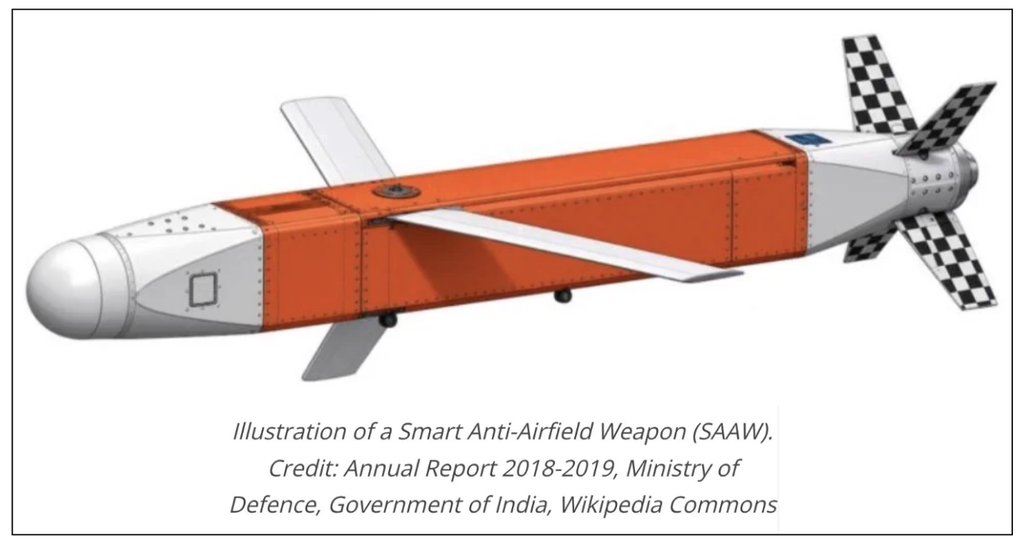
How does a Glide Bomb work?
A glide bomb differs from an ordinary gravity bomb.
- It is released from an aircraft at high altitude and speed.
- Deployable or fixed aerodynamic surfaces provide lift.
- The guidance system calculates and corrects its flight path.
- Satellite-navigation updates reduce accumulated navigation errors.
- The weapon glides towards the pre-designated target. Its fuze detonates the warhead at the required time or after penetration.
Glide Bomb versus Missile:
- A missile normally uses an onboard propulsion system during a substantial part of its flight.
- A glide bomb generally has no sustained propulsion after release; it uses the aircraft’s altitude and speed, along with aerodynamic lift, to reach the target.
Consequently, glide bombs can be lighter and cheaper than comparable powered missiles, but their range depends more heavily on the aircraft’s release conditions.
Significance:
- By damaging runways, radars and support infrastructure, the weapon can temporarily reduce an enemy air force’s ability to launch, recover and sustain combat aircraft.
- It would enable the IAF to neutralise critical enemy airfield infrastructure while reducing the exposure of its aircraft.
Practice Prelims MCQ:
Q. With reference to the Satellite Smart Anti-Airfield Weapon, consider the following statements:
- It is an air-to-ground precision-guided glide bomb.
- It has been designed and developed indigenously by DRDO.
- It requires continuous rocket propulsion throughout its flight.
- It can be launched from platforms such as the Su-30MKI, Jaguar and Hawk.
Which of the statements given above are correct?
(a) 1 and 2 only
(b) 1, 2 and 4 only
(c) 2, 3 and 4 only
(d) 1, 2, 3 and 4
Answer: (b): A glide bomb primarily uses aerodynamic lift and the launching aircraft’s altitude and speed; it does not require continuous rocket propulsion.
Source: https://anantamias.com/current-affairs/satellite-smart-anti-airfield-weapons/
Opposition calls for CEC’s exit over ‘illegal conduct’
Why in News?
An investigative report has claimed that Election Commissioners Sukhbir Singh Sandhu and Vivek Joshi recorded formal objections at least 14 times in ten months to decisions allegedly issued in the name of the Election Commission of India (ECI) without their knowledge or approval.
Opposition parties have demanded the removal of Chief Election Commissioner (CEC) Gyanesh Kumar and a Supreme Court-monitored investigation.
The ECI maintains that internal notes and technical suggestions are part of normal deliberation and that its final decisions, including SIR-related decisions, were taken unanimously.
| UPSC Relevance: GS-2 Polity and Governance: Constitutional Bodies, Election Commission, Transparency and accountability Prelims: Election Commission of India, Articles 324-329, Appointment and removal of Election Commissioners. Mains: Election Commission of India: Associated Challenges |
Current Controversy:
The Election Commissioners (ECs) had formally recorded objections at least 14 times over the last 10 months. The major decisions were being made in the name of the Election Commission of India (ECI) without their knowledge. The objections reportedly concerned:
- Changes to Form 6 for enrolling new voters
- Centralisation and custody of the electoral-roll database
- Restriction of access available to statutory electoral authorities
- Deletion and restoration of voters during the Special Intensive Revision (SIR)
- Appeals filed against orders restoring voters to electoral rolls; and
- Administrative changes affecting oversight of the ECI’s information-technology systems.
Election Commission of India:
The Election Commission of India is a permanent, independent body established by the Indian Constitution to ensure free and fair elections in the country.
- Article 324 (1): Vests the superintendence, direction and control of elections to Parliament and State Legislatures in the Election Commission of India.
- Art. 324(2): Appointments of CEC and ECs shall be made by the President, subject to any law made by Parliament.
- The Election Commission operated as a single-member body consisting only of the Chief Election Commissioner (CEC) till 1989. Presently, the ECI is a three-member body comprising 1 CEC and 2 ECs.
How must the Election Commission take decisions?
Although the CEC acts as the Chairperson, the office is not intended to exercise unilateral control over the Commission. The procedure is governed by the Chief Election Commissioner and Other Election Commissioners (Appointment, Conditions of Service and Term of Office) Act, 2023.
- The business of the ECI must be transacted in accordance with the provisions of the 2023 Act.
- The procedure for transacting and allocating the ECI’s business may be regulated only through a unanimous decision.
- However, if there is any difference of opinion, such a matter shall be decided according to the opinion of the majority.
| T.N. Seshan v. Union of India 1995: The Supreme Court upheld the multi-member character of the ECI and clarified that: Election Commissioners (ECs) are not subordinate to the Chief Election Commissioner (CEC). The CEC cannot render the other Commissioners merely ornamental. Decisions should preferably be unanimous; and where unanimity is impossible, the majority view must prevail. Thus, in substantive decision-making, the CEC is essentially first among equals but not a superior authority with a casting vote. |
Thus, if the two ECs formally opposed a final proposal, the CEC’s individual view would constitute a minority of one and could not become the Commission’s decision.
If an order was issued in the name of the full ECI without placing it before the other two Commissioners, it could be challenged as violating the provision under the Chief Election Commissioner and Other Election Commissioners Act, 2023.
However, no court or statutory inquiry has yet established that the CEC committed “illegal conduct”.
Major Issues Reportedly Flagged:
1. Centralisation of the Electoral-Roll Database & Restriction of Access available to Statutory Electoral Authorities:
- The Concern: The transition of voter data management from localised platforms (ERONet) to a highly centralised framework (ECINet) shifted data custody directly under the control of the ECI’s central IT division.
- Why does it matter?
- Software permissions within the centralised system restrict the operational and data-modification access of state-level election officials and Electoral Registration Officers (EROs). It strips their legal statutory autonomy under the Representation of the People Act, 1950.
- Under the Representation of the People Act, 1950, the ERO is the sole legal authority empowered to prepare and revise rolls.
- Centralisation exposes the entire national repository to a single point of failure. It heightens the risk of mass unauthorised alterations, systemic data breaches, and large-scale algorithmic errors operating without local oversight.
- Software permissions within the centralised system restrict the operational and data-modification access of state-level election officials and Electoral Registration Officers (EROs). It strips their legal statutory autonomy under the Representation of the People Act, 1950.
2. Changes to Form 6 for Enrolling New Voters:
- The Concern: The digital version of Form 6 introduced a mandatory field requiring applicants to declare whether their parents or grandparents were registered during the previous Special Intensive Revision (SIR).
- Why does it matter? This administrative change effectively created a new substantive eligibility criterion without amending the Registration of Electors Rules, 1960. As it has no basis in statutory law, it creates an illegal entry barrier that disproportionately disenfranchises young first-time voters, migrants, and marginalised groups who may lack ancestral documentation.
3. Deletion and Restoration of Voters during the SIR:
- The Concern: Massive alterations (affecting over 13 crore voter entries across 30 states) were executed via automated data-matching algorithms and top-down directives without the full Commission’s review.
- Why does it matter? Relying on automated software to delete or restore voters without rigorous local, human verification risks causing wrongful mass disenfranchisement. This directly violates Supreme Court mandates on voter roll integrity.
4. Appeals filed against Orders Restoring Voters:
- The Concern: Over 38 lakh appeals were generated within the system (including 16.10 lakh in West Bengal alone) to challenge decisions made by designated judicial officers who had already ordered wrongfully deleted voters to be restored.
- Why does it matter? The identity of who authorised or filed these mass appeals remained completely opaque. Allowing anonymous or automated mass appeals weaponises the legal process, trapping legitimate citizens in a loop of bureaucratic hurdles and delaying their constitutional right to vote.
5. Administrative Changes affecting IT Oversight:
- The Concern: Internal administrative restructuring stripped the full Commission (the CEC and the two ECs acting collectively) of direct oversight regarding how the ECI’s technical and information-technology systems operate.
- Why does it matter? By moving IT systems away from collective institutional control, it allowed the technical wing to deploy far-reaching database policies unilaterally. It violates the principle that decisions must be made by a three-member majority, insulating critical software infrastructure from constitutional checks and balances.
ECI’s Defence:
The Commission has advanced four broad arguments:
- Written observations and technical queries are normal features of decision-making in a multi-member institution.
- Internal notes may reflect preliminary concerns, not final dissent.
- Final decisions, including the SIR, were approved unanimously.
- ECINet and other platforms employ cybersecurity controls intended to prevent unauthorised tampering.
Can the Chief Election Commissioner be Removed?
- Under Article 324(5), the CEC can be removed only in the same manner and on the same grounds as a judge of the Supreme Court. Other Election Commissioners, however, can be removed by the President only on the recommendation of the CEC.
- The grounds are proved misbehaviour or incapacity.
- Removal requires an address by each House of Parliament supported by:
- A majority of the total membership of that House; and
- At least two-thirds of the members present in the House and voting.
Thereafter, the President issues the removal order.
Can the Opposition directly remove the CEC?
- No. A political demand, press conference or ordinary parliamentary resolution cannot remove the CEC. The constitutionally prescribed special-majority process must be completed.
Can the Supreme Court remove the CEC?
The Supreme Court cannot substitute itself for Parliament and remove the CEC through the procedure under Article 324(5). However, it may:
- Judicially review the legality of ECI decisions
- Require production of official records
- Quash decisions taken contrary to statute
- Protect voters against arbitrary exclusion
- Direct institutional or technical audits where legally justified; and
- Examine constitutional challenges through Articles 32 and 142.
Protection under Section 16 of the 2023 Act
- Section 16 protects present and former Commissioners from civil or criminal proceedings for acts, things or words done while acting or purporting to act in the discharge of official functions.
- However, such personal protection does not mean complete immunity of ECI decisions from constitutional judicial review.
What are the Wider Constitutional Concerns?
- Free and fair elections are part of the basic structure of the Constitution. Electoral-roll integrity is foundational because a citizen excluded from the roll is effectively denied political participation.
- Institutional independence versus internal accountability: Constitutional independence should strengthen collective institutional functioning rather than concentration of decision-making by unilateral executive command. The ECI must remain independent of executive pressure, partisan influence, internal unilateralism, and unaccountable technological systems.
- Digital constitutionalism in electoral governance: As electoral administration becomes increasingly digital, constitutional principles must extend to the design and operation of electoral technology. Digital architecture should reinforce, rather than displace, the legal architecture of electoral administration. This requires:
- Role-based access controls that correspond to statutory responsibilities
- Tamper-resistant audit trails recording who altered electoral data, when, and under whose authority
- Human verification before consequential automated decisions
- Independent technical audits of databases and algorithms
- Clear accountability for errors arising from data matching, software changes or unauthorised access.
- Public trust and institutional legitimacy: The ECI’s effectiveness depends not only on the legal validity of its decisions but also on public confidence in the fairness and transparency of the electoral process. Opaque changes to electoral procedures, unexplained alterations to digital systems or uncertainty regarding institutional authorisation can create doubts about the decision-making process even where the underlying objective is legitimate.
- Confidentiality versus transparency: Internal deliberations may legitimately require confidentiality to allow Commissioners and officials to examine competing legal and administrative options freely. However, confidentiality should be distinguished from institutional opacity. This requires greater transparency regarding final decisions, their statutory basis, the authority that approved them, material changes to electoral procedures, and formally recorded disagreements, while protecting genuinely confidential deliberative or security-sensitive material.
Thus, the controversy goes beyond an internal disagreement within the ECI. It highlights a larger transition in electoral governance from paper-based administration to technology-intensive electoral management.
The central question is how India can ensure that technology enhances the accuracy and efficiency of electoral administration without weakening statutory authority, due process, transparency and institutional accountability.
A robust electoral system, thus, requires three elements to operate together: Constitutional independence + statutory accountability + technological transparency.
UPSC Mains PYQs:
Q. Discuss the role of the Election Commission of India in the light of the evolution of the Model Code of Conduct. (2022)
Q. In the light of recent controversy regarding the use of Electronic Voting Machines (EVM), what are the challenges before the Election Commission of India to ensure the trustworthiness of elections in India? (2018)
Q. “To enhance the quality of democracy in India, the Election Commission of India has proposed electoral reforms in 2016. What are the suggested reforms and how far are they significant to make democracy successful? (2017)
Mains Practice Question:
Q. “The independence of the Election Commission requires not merely protection from executive interference, but also transparency and collegiality in its internal functioning.” Discuss in light of the statutory procedure governing decisions of the Commission.
UPSC PYQ 2017:
Q. Consider the following statements:
1. The Election Commission of India is a five-member body.
2. The Union Ministry of Home Affairs decides the election schedule for the conduct of both general elections and by-elections.
3. The Election Commission resolves the disputes relating to splits/mergers of recognised political parties.
Which of the statements given above is/are correct?
(a) 1 and 2 only
(b) 2 only
(c) 2 and 3 only
(d) 3 only
Answer: (d)
Practice Prelims MCQ:
Q. With reference to the Election Commission of India, consider the following statements:
- All decisions of the Election Commission must necessarily be unanimous.
- In case of disagreement, the matter is decided according to the majority opinion.
- The Chief Election Commissioner can be removed in the same manner and on the same grounds as a judge of the Supreme Court.
- Other Election Commissioners can be removed by the President only on the recommendation of the Chief Election Commissioner.
Which of the statements given above are correct?
(a) 1 and 2 only
(b) 2, 3 and 4 only
(c) 1, 3 and 4 only
(d) 1, 2, 3 and 4
Answer: (b)
Explanation: The Commission should transact business unanimously as far as possible, but unanimity is not compulsory in every matter. Where opinions differ, the majority view prevails. Statements 3 and 4 follow Article 324(5).
Source: https://anantamias.com/current-affairs/opposition-calls-for-cecs-exit-over-illegal-conduct/
12 years of Make in India
Why in News?
Make in India completed 12 years on September 25, 2026, marking more than a decade of policy efforts to strengthen India’s manufacturing base.
The period has seen significant production growth in electronics, automobiles, defence, steel, and other strategic sectors, alongside initiatives such as PLI, PM GatiShakti, and the National Single Window System.
However, the 12-year journey also raises a larger structural question: Has the expansion of selected manufacturing industries translated into a broad-based transformation of India’s manufacturing ecosystem?
| UPSC Relevance: GS-3 Economy: Industrial policy, economic growth, employment, investment and infrastructure Prelims: Make in India, PLI, FDI, GVA, IIP and gross fixed capital formation |
Key Features of Make in India Scheme:
- Launched on 25 September 2014, Make in India is an umbrella framework to transform India into a global design, manufacturing, and investment hub through targeted policy reforms, infrastructure development, and industrial incentives.
- Led by the Ministry of Commerce and Industry and implemented through the Department for Promotion of Industry and Internal Trade (DPIIT).
A. Four Foundational Pillars:
- New Processes: Streamlines regulatory compliance and approvals to improve the Ease of Doing Business (EoDB).
- New Infrastructure: Develops high-speed industrial corridors, logistics hubs, and modern facilities that foster innovation and cluster-based manufacturing.
- New Sectors: Opens and expands foreign investment limits across crucial defence, infrastructure, railway, and manufacturing segments.
- New Mindset: Shifts the government’s operational role from that of an industry regulator to an active enterprise partner and facilitator.
B. Expanded Sectoral Scope
- From 25 to 27 Sectors: Make in India originally identified 25 sectors. Under Make in India 2.0, it covers 27 sectors divided into 15 manufacturing sectors (coordinated by DPIIT) and 12 services sectors (coordinated by the Department of Commerce).
- Beyond Factory Floors: By integrating high-value service sectors (such as IT, legal, logistics, and medical tourism), the initiative supports the end-to-end industrial lifecycle from design and funding to digital integration and export.
C. Core Enabling Instruments:
- Investment Facilitation: Broad-based FDI liberalisation via automatic routes, streamlined clearances through the National Single Window System (NSWS), and mapped site acquisitions using the India Industrial Land Bank (IILB).
- Integrated Infrastructure: Multimodal connectivity powered by the PM GatiShakti National Master Plan alongside dedicated industrial corridor networks.
- Targeted Output Incentives: Dedicated Production Linked Incentive (PLI) schemes spanning 14 sectors to scale up domestic manufacturing, attract frontier technology, and boost export competitiveness.
- Enterprise & Innovation Ecosystem: Synergy with complementary national missions like Startup India, the National Logistics Policy, and sector-specific roadmaps for semiconductors, electronics, and capital goods.
Achievements during the 12 Years:
(i) Expansion of manufacturing output
The government’s anniversary assessment highlights several sectoral gains:
- Electronics: Production increased from approximately ₹1.9 lakh crore in 2014-15 to ₹13.11 lakh crore in 2025-26.
- Mobile phones: Production value increased from around ₹18,000 crore to ₹6.27 lakh crore over the same period.
- Defence: Indigenous production rose from ₹46,429 crore to ₹1.78 lakh crore over the same period.
- Steel: Crude steel production increased from 81.7 million tonnes to 170 million tonnes over this period.
- Automobiles: Vehicle production reached 31.03 million units in 2024-25, about 33% above 2014-15.
- Railways: Average annual coach production increased from fewer than 3300 during 2004-14 to 5481 during 2014-24.
(ii) Greater technological and industrial capability:
The report identifies progress beyond final-product assembly:
- Space electronics: Indigenous VIKRAM3201 and KALPANA3201 microprocessors demonstrate capabilities in specialised chip design and development.
- Strategic materials: The Nd-Fe-B rare-earth magnet pilot facility at ARCI, Hyderabad, supports indigenous process development.
- Capital goods: Production across the listed capital-goods and heavy-engineering segments nearly doubled between 2019-20 and 2024-25.
- Clean technology: Expansion in solar-cell and module manufacturing strengthens the domestic renewable-energy supply chain.
Such capabilities can reduce strategic vulnerabilities and generate domestic demand for components, engineering services and skilled labour.
(iii) Investment and production under PLI:
- By mid 2026, PLI schemes had attracted approximately ₹2.40 lakh crore in investment, generated over ₹22.66 lakh crore in production/sales, and supported more than 14 lakh jobs.
(iv) Improved access to industrial credit:
- The outstanding bank credit to micro and small industries increased from ₹3.5 lakh crore in 2013-14 to ₹10.6 lakh crore in 2025-26.
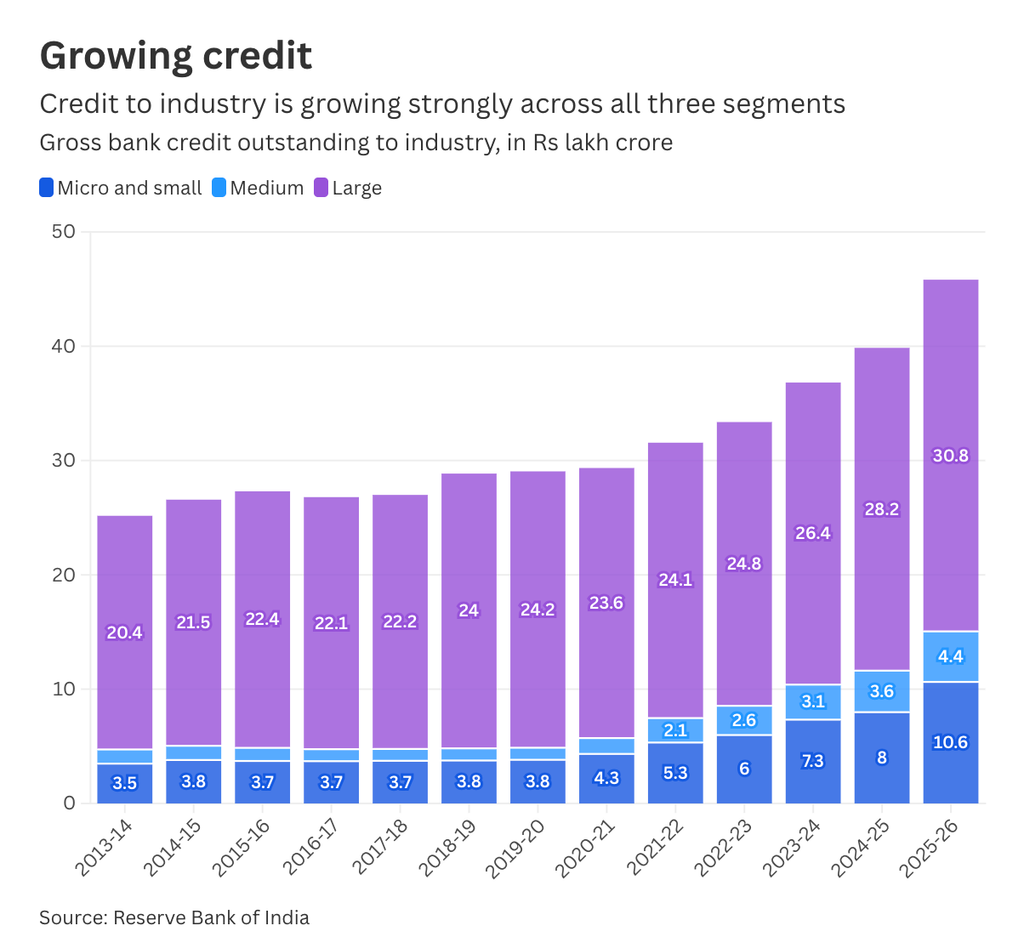
Existing Challenges to Make in India:
(i) Limited structural transformation:
- The manufacturing’s share in total GVA:
- Declined marginally from 17.3% in 2014-15 to 17.1% in 2025-26 under the old series.
- Increased from 14.6% in 2022-23 to 15.6% in 2025-26 under the revised series.
- Thus, increased production in successful industries has not yet translated into a decisive economy-wide shift towards manufacturing.
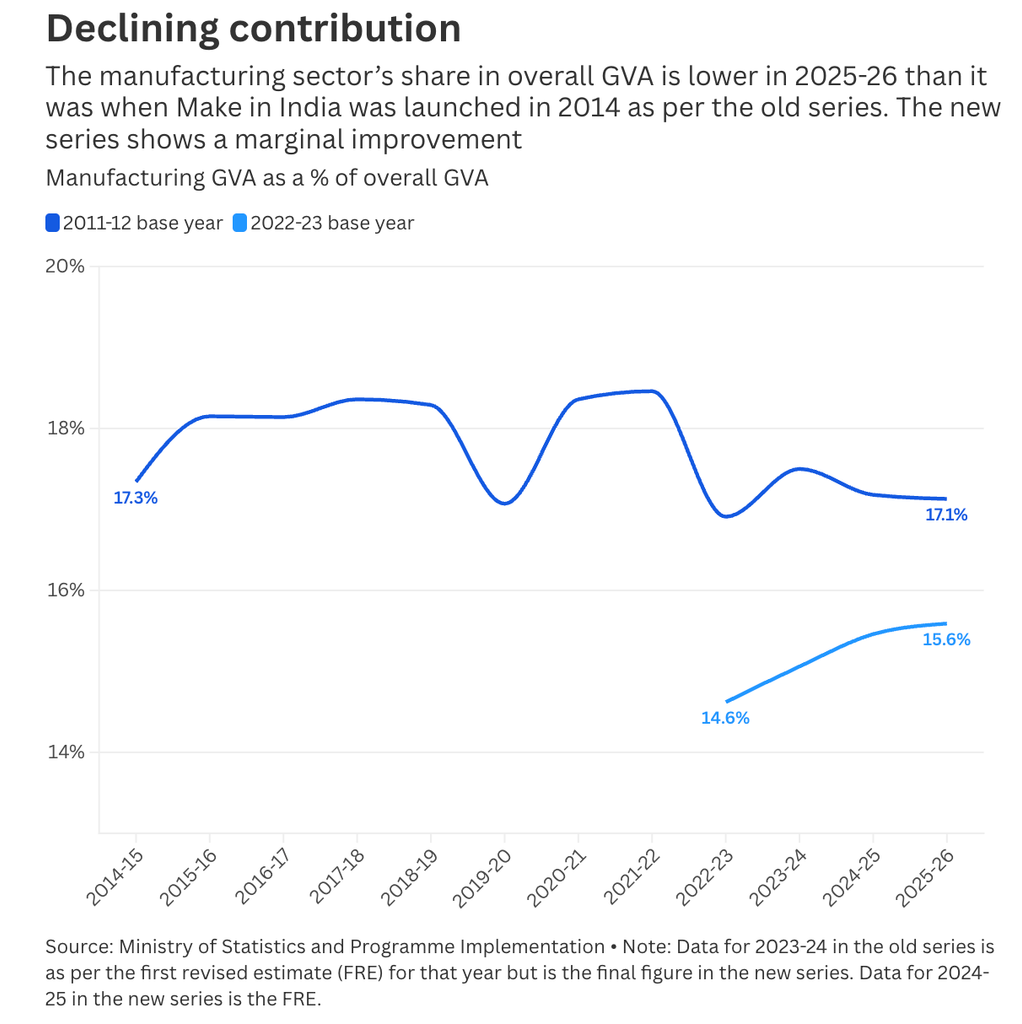
(ii) Insufficient employment transformation:
- Manufacturing employment increased only modestly, from 5.1 crore in 2016-17 to 5.3 crore in 2025-26, while its employment share remained below the initial level. This suggests limited large-scale absorption of workers into manufacturing.
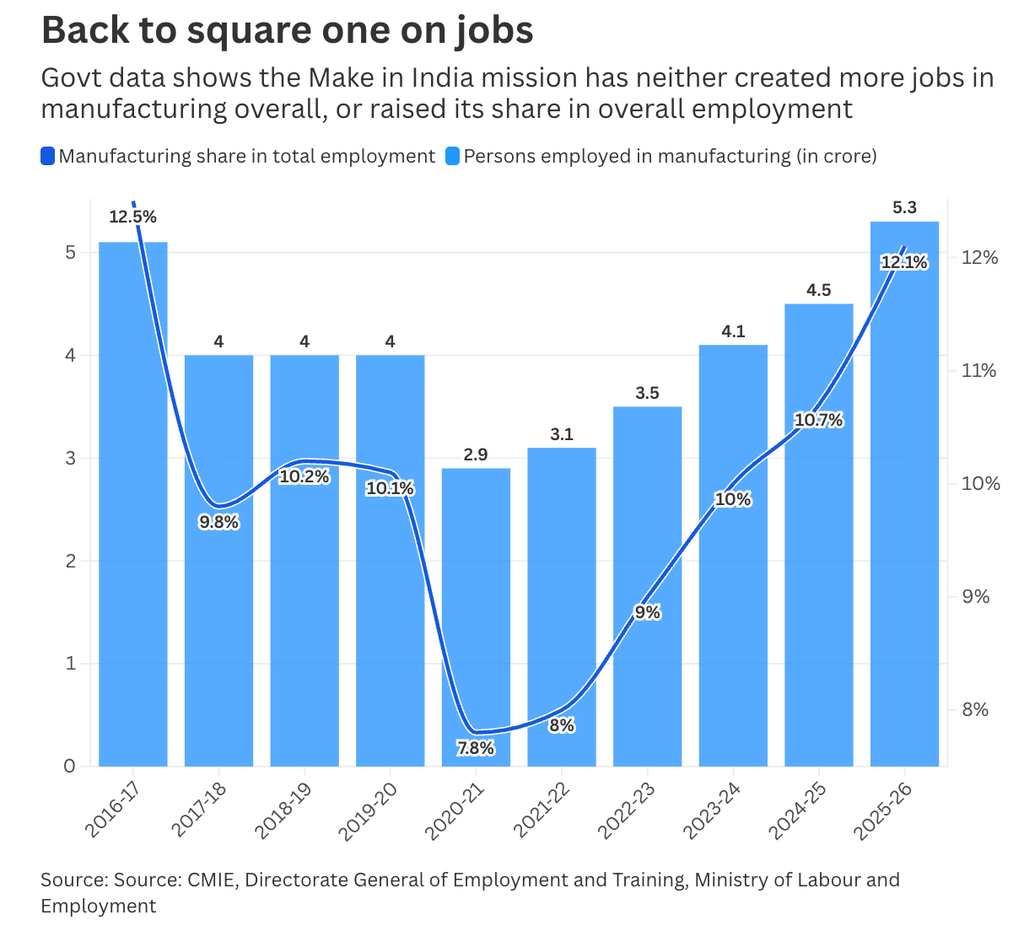
(iii) Rising exports without a larger global presence:
- Non-petroleum goods exports rose from $253.5 billion in 2014-15 to $388.3 billion in 2025-26, while India’s global merchandise-export share remained around 1.7%. Export expansion has not produced a sustained increase in global market share.
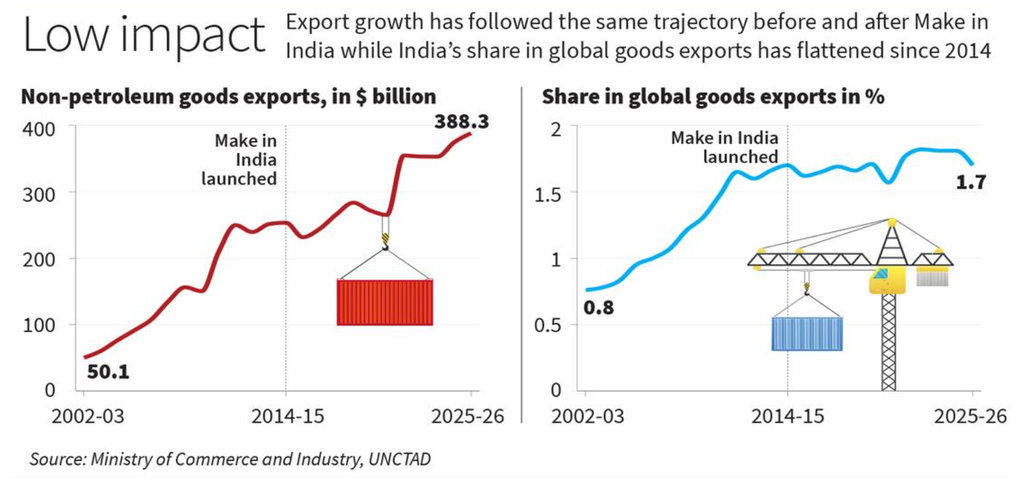
(iv) Uneven private-investment response:
- The revised-series chart shows private GFCF falling from 25.1% of GDP in 2022-23 to 23.9% in 2024-25. This suggests that infrastructure spending and incentives have not yet generated a sustained rise in private investment relative to GDP.
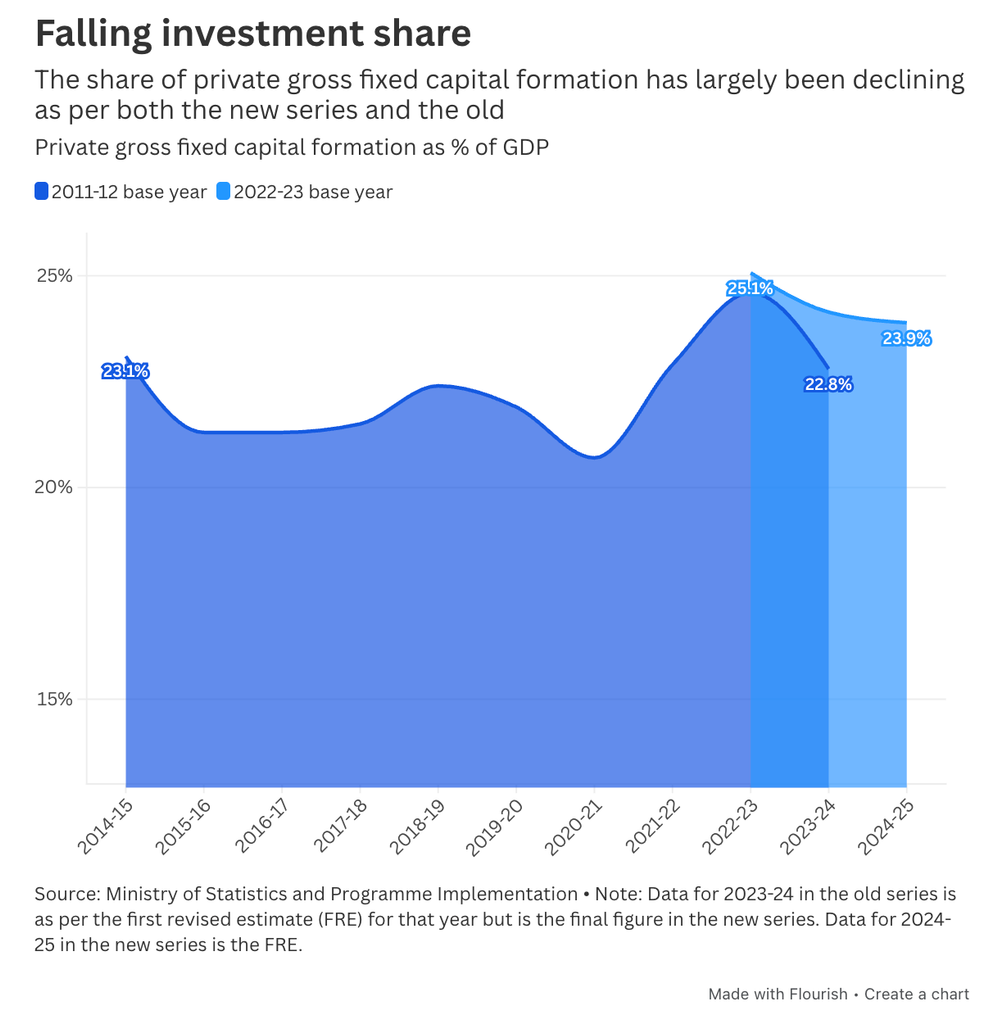
(v) Concentration of PLI gains:
- Five sectors- solar modules, pharmaceuticals, automobiles and components, speciality steel, and large-scale electronics accounted for nearly 83% of PLI investment. Sectoral success therefore needs to spread more widely, particularly to industries capable of generating substantial employment.
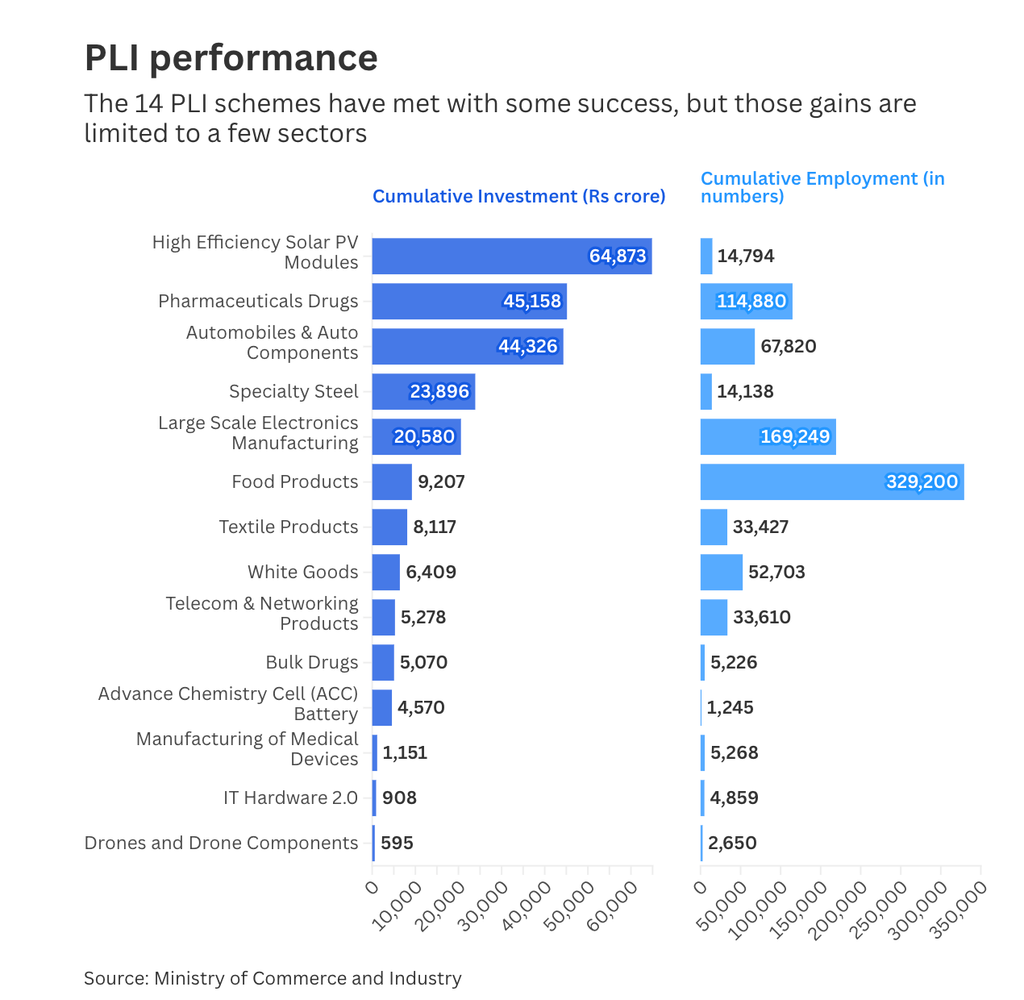
(vi) Gaps in domestic value addition
- High final-product output can coexist with dependence on imported components, machinery and technology. E.g., the supplied report’s much larger solar-module capacity than solar-cell capacity indicates uneven development across the production chain.
(vii) Constraints on firm competitiveness
- MSME limitations: Restricted finance, delayed payments and weak technology adoption constrain expansion.
- Infrastructure gaps: Unreliable utilities and weak last-mile connectivity raise production costs.
- Regulatory uncertainty: Complex approvals and unpredictable policy changes discourage long-term investment.
- Skills and innovation gaps: Firms need stronger links with training institutions, research laboratories and domestic suppliers.
Way Forward:
- Shift focus from assembly to value-chain depth: Prioritise the domestic production of components, materials, machinery, industrial electronics and critical intermediate goods, rather than measuring success primarily through final-product output.
- Build an MSME-to-global-firm manufacturing architecture: Large manufacturers should be linked systematically with domestic MSME suppliers through supplier-development programmes, common testing and certification facilities, technology-sharing arrangements and easier access to working capital. This would allow PLI-led investment to create wider industrial ecosystems rather than isolated large-scale production units.
- Focus on labour-intensive manufacturing: Electronics and capital-intensive sectors cannot absorb India’s large workforce. A dedicated manufacturing strategy for textiles, garments, footwear, furniture, toys, food processing and other labour-intensive sectors should combine plug-and-play industrial clusters, export infrastructure, skilling and predictable trade policy.
- Move from subsidy-led competitiveness to productivity-led competitiveness: PLI-type incentives should increasingly reward incremental domestic value addition, productivity, exports, R&D, supplier development and durable employment, with sunset and review mechanisms.
- Make States the next frontier of Make in India: States should be evaluated on measurable industrial outcomes such as time taken to operationalise projects, reliability of utilities, logistics costs, land availability and employment generation, rather than merely the number of MoUs signed.
- Use global integration strategically: India should combine selective strategic self-reliance in areas such as semiconductors, critical minerals and defence with competitive access to imported inputs and participation in global value chains. FTAs, customs procedures and standards policy should be aligned to make India a competitive production base.
- Make technology absorption a core manufacturing objective: Domestic manufacturing capability should extend to product design, process engineering, patents, industrial R&D and advanced machinery. Greater collaboration between firms, IITs, research institutions and technology centres.
- Create a single manufacturing performance dashboard: The success of Make in India should be assessed through a consistent set of indicators: manufacturing GVA, labour productivity, domestic value addition, manufacturing employment, private investment, export market share, MSME participation and R&D intensity.
The next challenge is more demanding: turning islands of manufacturing success into dense industrial ecosystems.
The focus must therefore shift to create more value in India, employ more workers productively, develop Indian technologies and embed Indian firms deeper in global supply chains. This would make manufacturing a broader engine of growth, employment and economic resilience.
Practice Prelims MCQ:
Q. Consider the following statements:
- Make in India 2.0 covers both manufacturing and services sectors.
- An increase in manufacturing output necessarily increases manufacturing’s share in total GVA.
- Higher exports of assembled products necessarily indicate proportionately higher domestic value addition.
Which of the statements given above is/are correct?
(a) 1 only
(b) 1 and 2 only
(c) 2 and 3 only
(d) 1, 2 and 3
Answer: (a) Manufacturing’s GVA share depends on its growth relative to other sectors. Export value may include substantial imported inputs.
Mains Practice Question:
Q. “Make in India has delivered significant sectoral achievements, but its contribution to broad-based industrial transformation remains uneven.” Critically examine and suggest measures to strengthen domestic value addition and employment generation.
Source: https://anantamias.com/current-affairs/12-years-of-make-in-india/
Should Permanent Membership and Veto Powers of the UNSC be Abolished?
Why in News?
At the ongoing UN General Assembly session, France renewed its call for permanent members of the UN Security Council to voluntarily refrain from using the veto in situations involving mass atrocities.
The French-Mexican initiative, presented in 2015, now has the support of 128 states. The United Kingdom has joined the declaration, becoming its second permanent-member supporter after France.
| UPSC Relevance: GS-2 International Relations: International Institutions Prelims: United Nations, United Nations Security Council Mains: United Nations Security Council: Relevance & Challenges |
What is the UNSC?
The United Nations Security Council (UNSC) is one of the UN’s six principal organs, entrusted with primary responsibility for maintaining international peace and security.
- Composition: Fifteen members: five permanent and ten elected members.
- Permanent Five (P5): China, France, Russia, the United Kingdom and the United States.
- Ten non-permanent members: Elected by the UNGA for two-year terms; retiring members cannot be immediately re-elected.
- Presidency: Rotates monthly in English alphabetical order.
- Principal functions: Peaceful settlement of disputes, sanctions, authorisation of military action and establishment of peacekeeping operations.
- Other responsibilities: Recommends admission of new UN members and appointment of the Secretary-General to the General Assembly.
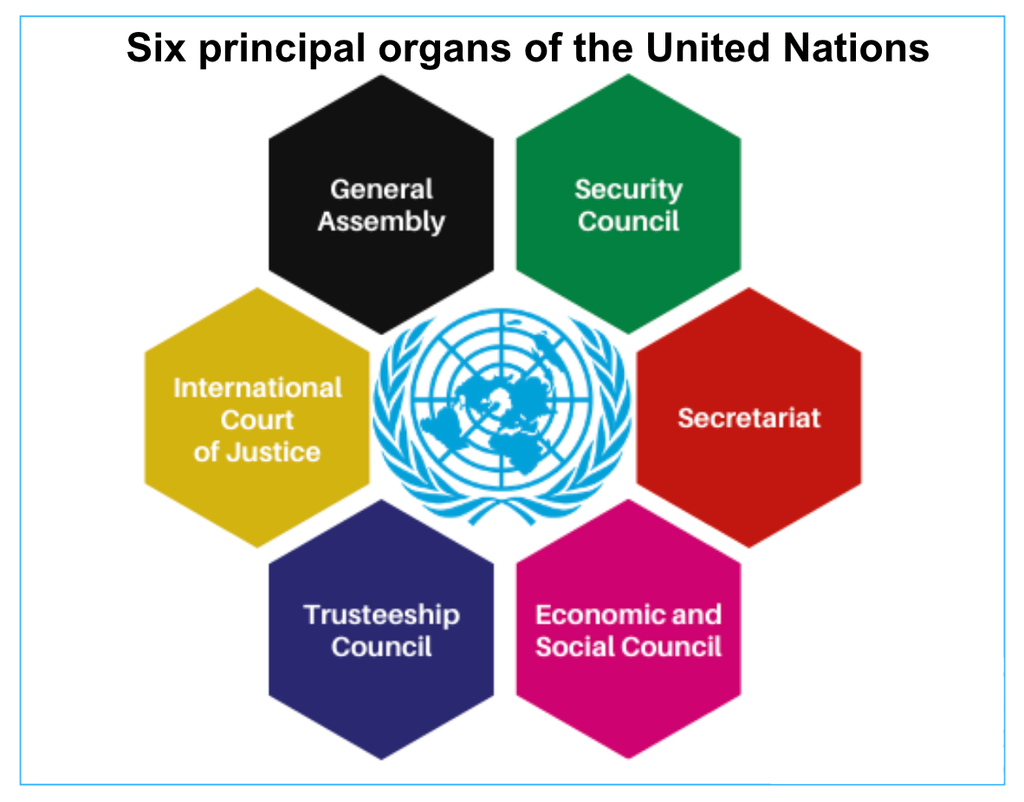
How does voting work?
- Procedural matters: Require at least nine affirmative votes; the veto does not apply.
- Substantive matters: Require at least nine affirmative votes and no negative vote by a permanent member.
- Abstention by a permanent member is not a veto, including on recommendations for admission of new members.
Veto power has its legal basis in Article 27 of the UN Charter. Veto power enables a permanent member to block substantive decisions. Reform may therefore address membership, voting privileges or both.
Arguments for abolishing UNSC Permanent Membership and Veto Powers:
- Democratic Deficit & Unequal Privileges: Permanent seats institutionalise a structural hierarchy that directly violates the UN Charter’s core tenet of sovereign equality. While elected members must routinely secure democratic mandates, the P5 operate with absolute, permanent immunity from electoral accountability.
- Outdated Anachronism (1945 vs. Present): The current composition freezes the global power architecture of 1945. It entirely excludes Africa and Latin America from permanent representation, while marginalising contemporary economic and demographic giants.
- Humanitarian Paralysis: A single veto can unilaterally obstruct critical global interventions. Strategic rivalries routinely weaponise this power, paralysing the Council during mass atrocities, war crimes, and humanitarian emergencies where consensus is urgently needed.
- Selective Accountability & Double Standards: The veto serves as a geopolitical shield, allowing permanent members to protect themselves or their allies from international sanctions. This creates a system of victor’s justice and severely weakens the credibility of international law.
- The Pocket Veto Effect: The mere threat of a veto exerts an invisible, chilling effect on global diplomacy. It stifles proposals, dilutes resolution text, and derails negotiations long before an official vote even occurs.
- Erosion of Collective Security: Chronic institutional deadlock forces states to bypass the UN entirely. This fuels unilateral military actions, minilateral coalitions, and regional alliances, fundamentally undermining the legitimacy of global collective security.
Existing approaches to Veto Reform:
(i) French-Mexican Initiative (Restraint Before a Veto)
- Calls on the P5 to voluntarily refrain from vetoing action concerning genocide, crimes against humanity and large-scale war crimes.
- Seeks behavioural change without Charter amendment.
- Its main limitation is its voluntary character: political commitments cannot ensure compliance when major interests are involved.
(ii) Liechtenstein Initiative (Accountability After a Veto)
UNGA Resolution 76/262, adopted in 2022, provides for:
- A General Assembly debate within ten working days of a veto, unless an emergency special session is already meeting on the same situation.
- Priority in the speakers’ list for the veto-casting permanent member.
- An invitation to the Security Council to submit a special report before the debate.
It increases public scrutiny, but neither reverses the veto nor legally compels a satisfactory explanation.
(iii) ACT Code of Conduct (Responsibility of All Council Members)
- The Accountability, Coherence and Transparency (ACT) Code of Conduct seeks commitments from current and prospective Council members to support credible action against genocide, crimes against humanity and war crimes.
- Unlike the French-Mexican initiative’s focus on the P5, it also addresses the voting conduct of elected members. Its force is political and moral.
(iv) Uniting for Peace (Wider UN Response)
- Under UNGA Resolution 377 A(V), 1950, the General Assembly can consider situations where permanent-member disagreement prevents the Council from discharging its responsibilities and recommend collective measures.
Way Forward:
- Expand Representative Membership: Democratise the Council by correcting the systemic underrepresentation of the Global South (particularly Africa, Latin America, and small island developing states) to align the body with modern demographic and economic realities.
- Institutionalise Voluntary Veto Restraint: Formalise initiatives (like the French-Mexican proposal) demanding that permanent members pledge to forfeit their veto power during verified mass atrocities, genocide, and war crimes, guided by independent UN fact-finding missions.
- Leverage General Assembly Accountability: Fully operationalise the UNGA “Veto Initiative” (Resolution 76/262) by using mandatory debates to aggressively scrutinise the legal, moral, and humanitarian consequences of any cast veto, shifting the political cost back to the obstructing state.
- Enforce Existing Charter Safeguards: Revitalise and strictly enforce Article 27(3) of the UN Charter, which legally requires any Council member to abstain from voting when they are a direct party to a dispute under Chapter VI, dismantling the conflict of interest.
- Democratise Internal Working Methods: Break the P5’s monopoly on Council mechanics by giving elected members (E10) leadership over drafting resolutions, chairing key committees, and setting the peace and security agenda.
- Pursue Dual-Track Reform: Employ a simultaneous strategy that uses immediate, incremental measures (like voluntary restraint) to mitigate ongoing humanitarian crises, while aggressively lobbying for long-term structural amendments to the UN Charter.
The structural paralysis of the UNSC is no longer just a diplomatic flaw; it is a systemic threat to global stability. Only by dismantling this outdated hierarchy and aligning the Council with the founding principle of sovereign equality can the United Nations restore its institutional legitimacy and fulfill its fundamental promise to maintain international peace and security.
Practice Prelims MCQ:
Q. Consider the following statements:
- A permanent member’s abstention necessarily prevents the adoption of a substantive UNSC resolution.
- Veto power has its legal basis in Article 27 of the UN Charter.
- UNGA Resolution 76/262 empowers the General Assembly to reverse a Security Council veto.
Which of the statements given above is/are correct?
(a) 2 only
(b) 1 and 2 only
(c) 2 and 3 only
(d) 1, 2 and 3
Answer: (a) Abstention is not a veto. Resolution 76/262 provides for debate and scrutiny, not reversal.
Mains Practice Question:
Q. “Reforming the UN Security Council requires addressing both unequal representation and the misuse of veto power.” Critically examine, with reference to recent veto-restraint and accountability initiatives.
US-Greenland-Denmark Security Agreement
Why in News?
On September 22, 2026, the U.S., Denmark and Greenland signed a security agreement expanding American military access to Greenland while retaining its existing territorial status. It follows President Donald Trump’s repeated demands to acquire the island, including threats of force.
- The agreement provides Trump a diplomatic exit from his acquisition demand while securing an expanded American strategic presence.
- For Denmark and Greenland, it reduces immediate pressure over sovereignty, although concerns about long-term autonomy remain.
| UPSC Relevance: GS-2 International Relations: International Agreements, Arctic Region Prelims: Greenland’s geography, Arctic region, GIUK Gap, NATO. |
About Greenland:
Geographical features:
- Location: Geographically part of North America, lying between the Arctic and North Atlantic Oceans.
- Size: The world’s largest island, excluding continental landmasses such as Australia.
- Population and capital: Approximately 57,000 people; Nuuk is the capital.
- Ice cover: Around 80% of its surface is covered by the ice sheet and glaciers.
- Map locations:
- Baffin Bay and Davis Strait lie towards Canada
- Greenland Sea lies to the east
- Denmark Strait separates Greenland from Iceland
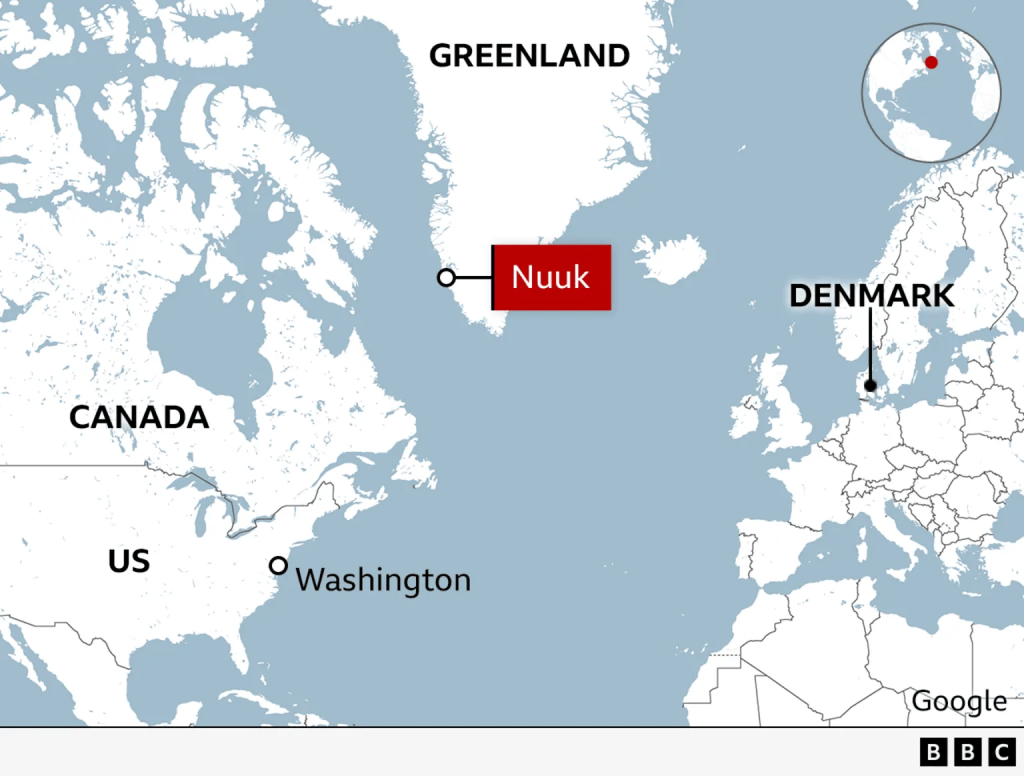
Political status:
- Greenland is a self-governing territory within the Kingdom of Denmark.
- It obtained Home Rule in 1979, followed by expanded autonomy under the 2009 Self-Government Act.
- Its elected Parliament and government administer transferred domestic responsibilities.
- Denmark retains responsibility for areas including defence, security, monetary policy and overarching foreign policy, while Greenland has specified external-affairs powers.
- Greenland assumed responsibility for mineral resources in 2010. The Self-Government Act recognises its people’s right to self-determination.
EU distinction: Greenland is outside the EU, but Greenlanders holding Danish nationality are EU citizens.
Key Provisions of the US-Greenland-Denmark Security Agreement:
The agreement supplements the 1951 U.S.-Denmark Defence Agreement and subsequent arrangements.
(i) Military Expansion:
- New and Expanded Bases: Allows the U.S. to expand the Pituffik Space Base and build two new military sites at Narsarsuaq (southern Greenland) and Mestersvig (eastern coast).
- Operational Rights: Grants U.S. aircraft and vessels broad flyover, landing, and undersea transit rights across Greenlandic territory and waters.
- Missile Defence: Includes frameworks for cooperation on advanced defence systems, such as the proposed “Golden Dome”.
(ii) Security & Third-Party Restrictions:
- Non-NATO Ban: Prohibits non-NATO or non-allied nations from maintaining an ongoing military presence or establishing bases on the island.
- Defence Continuity: Specifies that if Greenland ever achieves independence, both Denmark and Greenland must ensure the new nation remains inside NATO.
(iii) Investment & Economic Safeguards:
- Sensitive Sectors: Bars investors from outside NATO, NATO partners, or the European Union from gaining major influence or control over critical infrastructure and resource extraction/mining.
- Local Enforcement: Greenland retains the authority to screen and regulate these sensitive investments directly.
(iv) Governance & Status:
- Sovereignty: Reaffirms Greenland’s status as a self-governing territory within the Kingdom of Denmark and requires that U.S. actions respect local society and traditions.
- Ratification: The pact features no fixed end date, but it requires formal approval from the parliaments of both Denmark and Greenland to officially enter into force.
Significance of the Agreement:
- Diplomatic de-escalation: Provides a negotiated route away from territorial acquisition threat. Expands military access and strengthens the U.S.’s influence over Arctic security without acquiring the territory.
- Protection of territorial status: Enables Denmark and Greenland to preserve the existing constitutional arrangement.
- Reduced intra-NATO friction: Helps contain a dispute between the U.S. and Denmark, both founding NATO members.
- Greater Greenlandic participation: Greenland’s inclusion as a signatory acknowledges that its future cannot be negotiated solely between larger powers.
Why is Greenland Strategically Important?
- Defence of North America: Greenland’s Arctic position makes it valuable for detecting threats approaching North America across polar routes. The U.S. Pituffik Space Base, formerly Thule Air Base, supports missile warning, missile defence, space surveillance and satellite operations.
- Monitoring the North Atlantic: The Greenland-Iceland-United Kingdom (GIUK) Gap comprises maritime passages connecting Arctic and northern European waters with the North Atlantic. Monitoring these passages is important for tracking submarine movements and protecting transatlantic maritime communication routes.
- Growing Arctic competition: The US has concerns about Russian military activity and expanding Chinese engagement in the Arctic. Greenland offers the U.S. a platform for surveillance, logistics and deterrence as the region’s strategic importance increases.
- Critical mineral resources: The European Commission reported in 2023 that 25 of its 34 identified critical raw materials occur in Greenland. These resources could support clean-energy technologies, electronics and diversification of mineral supply chains.
- Emerging shipping opportunities: Declining Arctic sea ice could increase seasonal access to northern shipping routes, creating interest in ports, logistics and search-and-rescue infrastructure. However, difficult weather, variable ice conditions and limited infrastructure constrain commercial viability.
- Global climate significance: Greenland’s land-ice loss contributes to global sea-level rise, while freshwater entering the North Atlantic can influence ocean circulation.
Major Concerns and Necessary Legal Dimensions:
- Sovereignty and the threat of force: Article 2(4) of the UN Charter prohibits threats or use of force against a state’s territorial integrity or political independence. A proposal for a consensual territorial arrangement is legally different from coercive annexation.
- NATO solidarity: Article 1 of the North Atlantic Treaty requires peaceful settlement of disputes and restraint from threats or force inconsistent with the UN Charter. Acquisition threats against an ally (Denmark is the founding member of NATO) therefore undermine the alliance’s foundational commitments.
- Constraints on future independence: The agreement’s continuity provisions raise a political question: how much strategic choice would a future independent Greenland retain? Moreover, Greenland currently falls within NATO through Denmark.
- Militarisation of the Arctic: Expanded bases and missile-defence infrastructure could intensify competing military deployments, making environmental protection and scientific cooperation more difficult.
- Indigenous rights and environmental costs: Military construction and mining can affect Inuit communities, traditional livelihoods and fragile ecosystems. Local consultation, environmental assessment and equitable economic benefits are essential. Greenland has not imposed a blanket ban on mining: its mineral authority explicitly supports mining while restricting uranium activities under legislation introduced in 2021.
- Arctic waters are not entirely global common: Under UNCLOS, Arctic waters comprise different legal zones:
- Territorial seas: Subject to coastal-state sovereignty, with applicable passage rights.
- Exclusive Economic Zones: Coastal states possess specified resource rights; other states retain navigation and other lawful freedoms.
- High seas: Areas beyond national maritime jurisdiction where high-seas freedoms apply.
Therefore, neither Arctic coastal states nor an external military power can claim unrestricted ownership of the entire Arctic Ocean.
The Greenland agreement offers a diplomatic retreat from acquisition threats while expanding American strategic access. Its durability will depend on reconciling Arctic security with sovereignty, Greenlandic self-determination and environmental protection.
Practice Prelims MCQ:
Q. Consider the following statements:
- Greenland is geographically part of North America and politically part of the Kingdom of Denmark.
- Greenland is a member of the European Union.
- The GIUK Gap connects Arctic and northern European waters with the North Atlantic.
Which of the statements given above are correct?
(a) 1 and 2 only
(b) 1 and 3 only
(c) 2 and 3 only
(d) 1, 2 and 3
Answer: (b) Greenland is outside the EU, although Greenlanders holding Danish nationality are EU citizens.
Mains Practice Question:
Q. With reference to recent security arrangements, evaluate how Greenland reflects the friction between strategic competition, resource exploitation and ecological protection in the Arctic.
Source: https://anantamias.com/current-affairs/us-greenland-denmark-security-agreement/
Red Sanders
Why in News?
Andhra Pradesh Police arrested a Red Sanders smuggler facing 99 cases recently, highlighting the continuing illegal trade in this valuable timber.
| UPSC Relevance: GS-3 Environment and Biodiversity: Species in News, Biodiversity Prelims: Red Sanders |

Key facts about Red Sanders:
- Common name: Red sandalwood, Rakta Chandan and Lal Chandan.
- Distinctive wood: Prized for its deep-red, largely non-aromatic heartwood, unlike fragrant sandalwood.
- Pigment: Its heartwood yields santalin, a natural red dye.
- Growth: A slow-growing tree, taking approximately 25-40 years to attain maturity in natural forests.
Distribution and Habitat:
- Range: The Indian endemic species is found in the southern Eastern Ghats, with its principal natural populations in Andhra Pradesh, particularly the Seshachalam landscape. Smaller cultivation areas (non-native) include adjoining Tamil Nadu and Karnataka.
- Habitat: Tropical dry deciduous forests, typically with rocky, well-drained soils and a seasonally hot, dry climate.
- Adaptation: Drought-resistant
Economic Importance and Threats:
- Uses: Luxury furniture, carvings, musical instruments, dyes and traditional medicinal preparations.
- Principal threat: High timber demand, especially in East Asian markets, drives illegal logging and international smuggling.
- Additional pressures: Habitat degradation, agricultural expansion, grazing and forest fires; slow growth makes recovery difficult.
Conservation Status:
- IUCN Red List: Endangered
- CITES: Appendix II; international trade is regulated through permits and sustainability safeguards. This does not itself impose a blanket trade ban.
UPSC PYQ 2016
Q. With reference to ‘Red Sanders’, sometimes seen in the news, consider the following statements:
1. It is a tree species found in a part of South India.
2. It is one of the most important trees in the tropical rainforest areas of South India.
Which of the statements given above is /are correct?
(a) 1 only
(b) 2 only
(c) Both 1 and 2
(d) Neither 1 nor 2
Answer: (a)
